inflation pressure BMW 325Ci COUPE 2003 E46 Owner's Manual
[x] Cancel search | Manufacturer: BMW, Model Year: 2003, Model line: 325Ci COUPE, Model: BMW 325Ci COUPE 2003 E46Pages: 162, PDF Size: 4.23 MB
Page 8 of 162
Contents
Notes
About this Owner's Manual4
Symbols used4
Your individual vehicle4
Status at time of printing5
For your own safety5
Symbol on vehicle parts6
Service and warranty6
Reporting safety defects6
Overview
Cockpit14
Instrument cluster16
Indicator and warning lamps18
Steering wheel with multifunction
buttons*21
Hazard warning triangle*22
First-aid kit*22
Refueling23
Fuel specifications24
Tire inflation pressure24
Controls and features
Opening and closing:
Keys30
Central locking system30
Opening and closing – via the
remote control31
Opening and closing – via the
door lock33
Opening and closing – from the
inside34
Luggage compartment lid35
Luggage compartment37
Alarm system*38
Electric power windows40
Sliding/tilt sunroof*41
Adjustments:
Safe seating position43
Seats43
Manual seat adjustment44
Power seat adjustment*45
Lumbar support*45
Head restraints46
Entering the rear46
Safety belts47
Seat and mirror memory*48
Seat heating*49
Steering wheel50
Mirrors50
handbook.book Page 8 Tuesday, July 30, 2002 12:16 PM
Page 10 of 162
Contents
Operation, maintenance
Special operating instructions:
Break-in procedures108
Driving notes109
Antilock Brake System
(ABS)109
Brake system110
Wheels and tires:
Tire inflation pressure111
Tire condition111
Tire replacement112
Wheel and tire
combinations114
Winter tires114
In the engine compartment:
Hood116
Engine compartment
essentials118
Washer fluids120
Engine oil120
Coolant122
Brake fluid123
Maintenance:
The BMW Maintenance
System124
Laws and regulations:
California Proposition 65
warning126
OBD interface socket126
Owner service procedures
Replacement procedures:
Onboard tool kit130
Windshield wiper blades130
Lamps and bulbs131
Changing a wheel135
Run Flat tires*139
Battery140
Fuses140
Giving and receiving
assistance:
Jump-starting141
Towing the vehicle142
Technical data
Engine data146
Dimensions147
Weights148
Capacities149
handbook.book Page 10 Tuesday, July 30, 2002 12:16 PM
Page 19 of 162
19
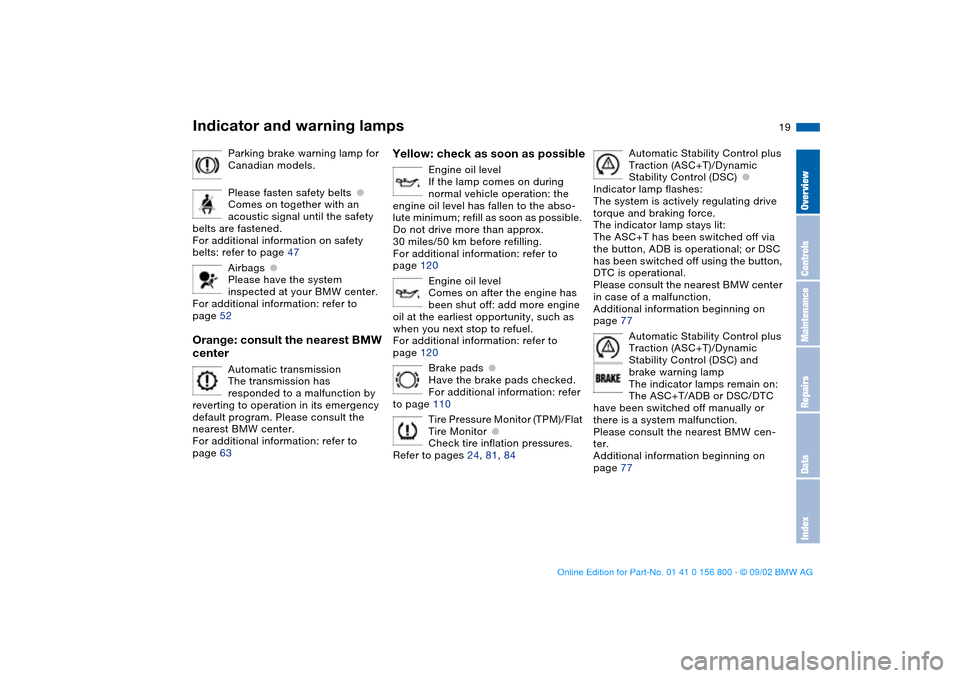
Parking brake warning lamp for
Canadian models.
Please fasten safety belts
●
Comes on together with an
acoustic signal until the safety
belts are fastened.
For additional information on safety
belts: refer to page 47
Airbags
●
Please have the system
inspected at your BMW center.
For additional information: refer to
page 52
Orange: consult the nearest BMW
center
Automatic transmission
The transmission has
responded to a malfunction by
reverting to operation in its emergency
default program. Please consult the
nearest BMW center.
For additional information: refer to
page 63
Yellow: check as soon as possible
Engine oil level
If the lamp comes on during
normal vehicle operation: the
engine oil level has fallen to the abso-
lute minimum; refill as soon as possible.
Do not drive more than approx.
30 miles/50 km before refilling.
For additional information: refer to
page 120
Engine oil level
Comes on after the engine has
been shut off: add more engine
oil at the earliest opportunity, such as
when you next stop to refuel.
For additional information: refer to
page 120
Brake pads
●
Have the brake pads checked.
For additional information: refer
to page 110
Tire Pressure Monitor (TPM)/Flat
Tire Monitor
●
Check tire inflation pressures.
Refer to pages 24, 81, 84
Automatic Stability Control plus
Traction (ASC+T)/Dynamic
Stability Control (DSC)
●
Indicator lamp flashes:
The system is actively regulating drive
torque and braking force.
The indicator lamp stays lit:
The ASC+T has been switched off via
the button, ADB is operational; or DSC
has been switched off using the button,
DTC is operational.
Please consult the nearest BMW center
in case of a malfunction.
Additional information beginning on
page 77
Automatic Stability Control plus
Traction (ASC+T)/Dynamic
Stability Control (DSC) and
brake warning lamp
The indicator lamps remain on:
The ASC+T/ADB or DSC/DTC
have been switched off manually or
there is a system malfunction.
Please consult the nearest BMW cen-
ter.
Additional information beginning on
page 77
Indicator and warning lamps
OverviewControlsMaintenanceRepairsDataIndex
handbook.book Page 19 Tuesday, July 30, 2002 12:16 PM
Page 24 of 162
24
Close the fuel filler cap carefully
after refueling until a click is
heard. While closing, be sure not to
squeeze the strap which is fastened to
the cap. A loose or missing cap will
activate the CHECK FILLER CAP
lamp.<
Fuel tank capacity>Approx. 16.6 gal./63 liters, of which
>approx. 2.1 gal./8 liters are reserve
capacity.
Do not drive to the last drop of
fuel. This can prevent the engine
from operating properly and result in
damage.<
Fuel specificationsThe engine uses lead-free gasoline
only.
Required fuel:
>Premium Unleaded Gasoline,
min. 91 AKI.
AKI = Anti Knock Index
Never use leaded fuel, as it would
cause permanent and irreversible
damage to the oxygen sensor and the
catalytic converter.<
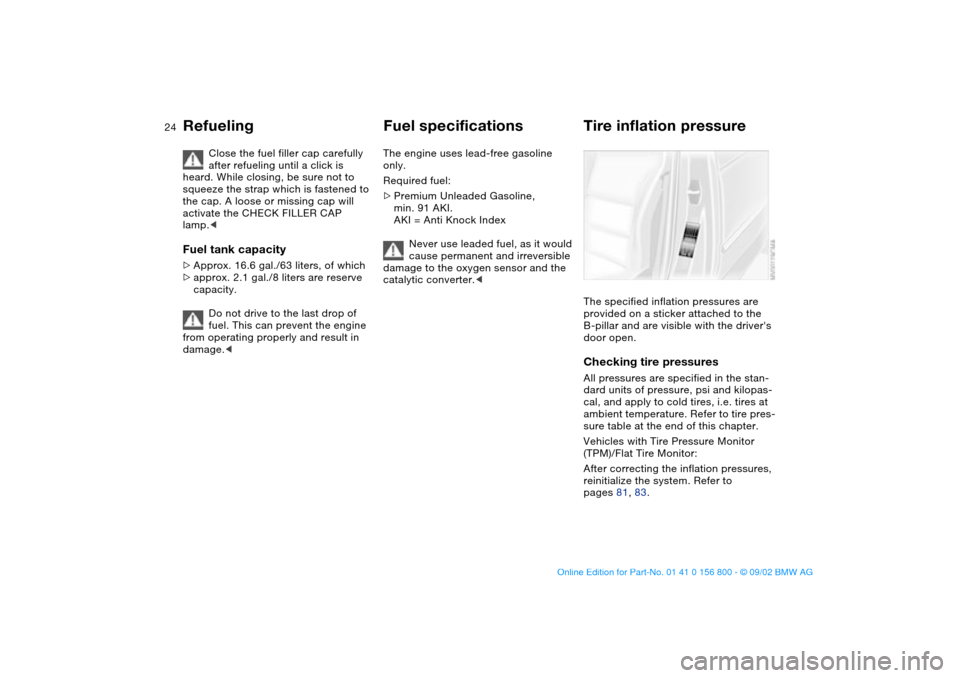
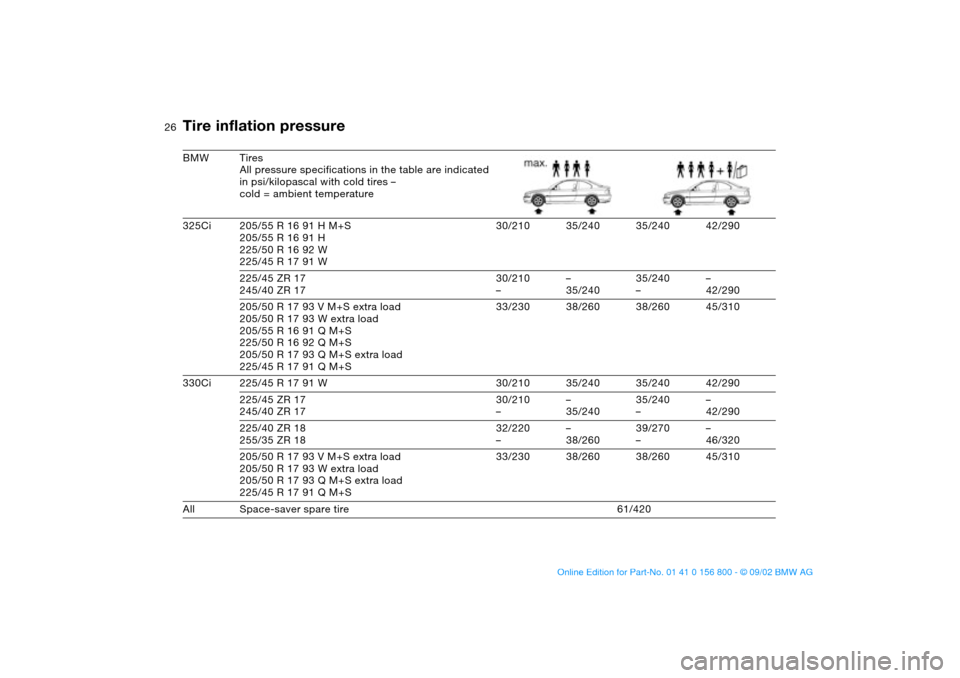
Tire inflation pressureThe specified inflation pressures are
provided on a sticker attached to the
B-pillar and are visible with the driver's
door open.Checking tire pressuresAll pressures are specified in the stan-
dard units of pressure, psi and kilopas-
cal, and apply to cold tires, i.e. tires at
ambient temperature. Refer to tire pres-
sure table at the end of this chapter.
Vehicles with Tire Pressure Monitor
(TPM)/Flat Tire Monitor:
After correcting the inflation pressures,
reinitialize the system. Refer to
pages 81, 83.
Refueling
handbook.book Page 24 Tuesday, July 30, 2002 12:16 PM
Page 25 of 162
25
Another instruction plate regarding
inflation pressures on the door pillar
indicates which system your vehicle is
equipped with.
Check the tire pressures on a reg-
ular basis – at least twice a month
– and before every extended journey. If
this is not done, incorrect tire pressures
can cause driving instability and tire
damage, ultimately resulting in acci-
dents.
Remember to check the inflation pres-
sure in the space-saver or standard
spare tire.
Inflate the spare tire to the highest infla-
tion pressure specified for your vehi-
cle.
apply to BMW approved tire sizes and
tire manufacturers. Your BMW center
can provide you with more information
about these. Higher pressures may be
required for tires made by other manu-
facturers.
Your vehicle is equipped with tires that
not only meet US standards, but also
European standards. We recommend
the exclusive use of BMW approved
tires.
Tire inflation pressure
OverviewControlsMaintenanceRepairsDataIndex
handbook.book Page 25 Tuesday, July 30, 2002 12:16 PM
Page 26 of 162
26
BMW Tires
All pressure specifications in the table are indicated
in psi/kilopascal with cold tires –
cold = ambient temperature
325Ci 205/55 R 16 91 H M+S
205/55 R 16 91 H
225/50 R 16 92 W
225/45 R 17 91 W30/210 35/240 35/240 42/290
225/45 ZR 17
245/40 ZR 1730/210
––
35/24035/240
––
42/290
205/50 R 17 93 V M+S extra load
205/50 R 17 93 W extra load
205/55 R 16 91 Q M+S
225/50 R 16 92 Q M+S
205/50 R 17 93 Q M+S extra load
225/45 R 17 91 Q M+S33/230 38/260 38/260 45/310
330Ci 225/45 R 17 91 W 30/210 35/240 35/240 42/290
225/45 ZR 17
245/40 ZR 1730/210
––
35/24035/240
––
42/290
225/40 ZR 18
255/35 ZR 1832/220
––
38/26039/270
––
46/320
205/50 R 17 93 V M+S extra load
205/50 R 17 93 W extra load
205/50 R 17 93 Q M+S extra load
225/45 R 17 91 Q M+S33/230 38/260 38/260 45/310
All Space-saver spare tire 61/420Tire inflation pressure
handbook.book Page 26 Tuesday, July 30, 2002 12:16 PM
Page 81 of 162
81
Tire Pressure Monitor (TPM)*The conceptTPM monitors the tire pressures at all
four tires even while the vehicle is mov-
ing. The system provides an alert when-
ever the inflation pressure drops signifi-
cantly below the specified pressure in
one or more tires.
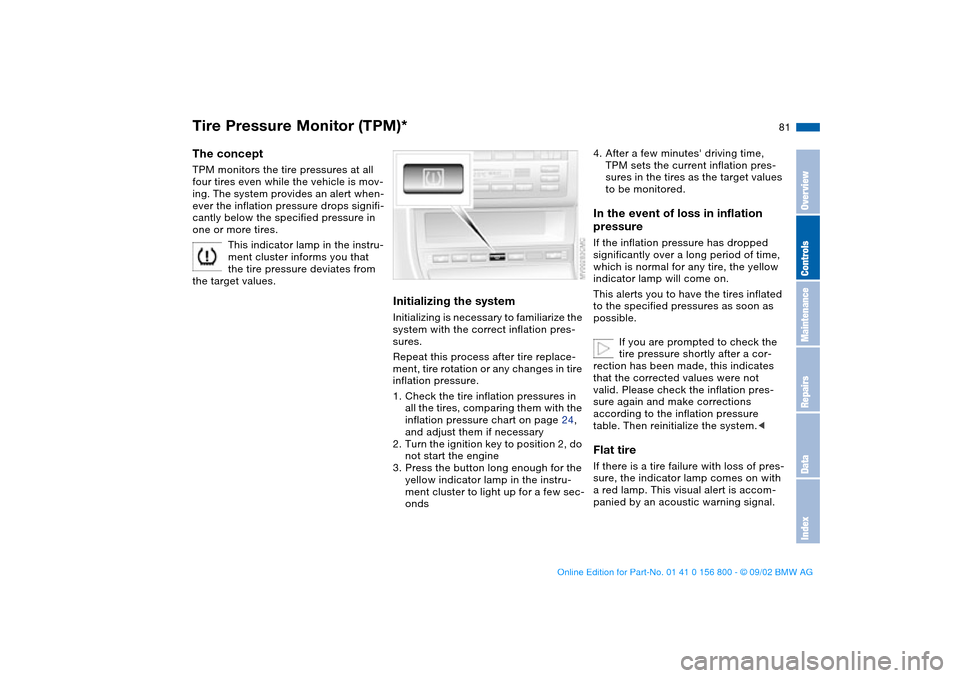
This indicator lamp in the instru-
ment cluster informs you that
the tire pressure deviates from
the target values.
Initializing the systemInitializing is necessary to familiarize the
system with the correct inflation pres-
sures.
Repeat this process after tire replace-
ment, tire rotation or any changes in tire
inflation pressure.
1. Check the tire inflation pressures in
all the tires, comparing them with the
inflation pressure chart on page 24,
and adjust them if necessary
2. Turn the ignition key to position 2, do
not start the engine
3. Press the button long enough for the
yellow indicator lamp in the instru-
ment cluster to light up for a few sec-
onds
4. After a few minutes' driving time,
TPM sets the current inflation pres-
sures in the tires as the target values
to be monitored.In the event of loss in inflation
pressureIf the inflation pressure has dropped
significantly over a long period of time,
which is normal for any tire, the yellow
indicator lamp will come on.
This alerts you to have the tires inflated
to the specified pressures as soon as
possible.
If you are prompted to check the
tire pressure shortly after a cor-
rection has been made, this indicates
that the corrected values were not
valid. Please check the inflation pres-
sure again and make corrections
according to the inflation pressure
table. Then reinitialize the system.
a red lamp. This visual alert is accom-
panied by an acoustic warning signal.
OverviewControlsMaintenanceRepairsDataIndex
handbook.book Page 81 Tuesday, July 30, 2002 12:16 PM
Page 83 of 162
83
Initializing the systemInitializing is necessary to familiarize the
system with the correct inflation pres-
sures.
Repeat this process after any changes
in tire inflation pressure, tire rotation or
replacement. Do not carry out further
system initialization after adjusting the
inflation pressure and letting the system
"learn" the correct pressures.
1. Check the tire inflation pressures in
all the tires, comparing them with the
inflation pressure chart on page 24
and adjusting their pressure if neces-
sary
2. Turn the ignition key to position 2
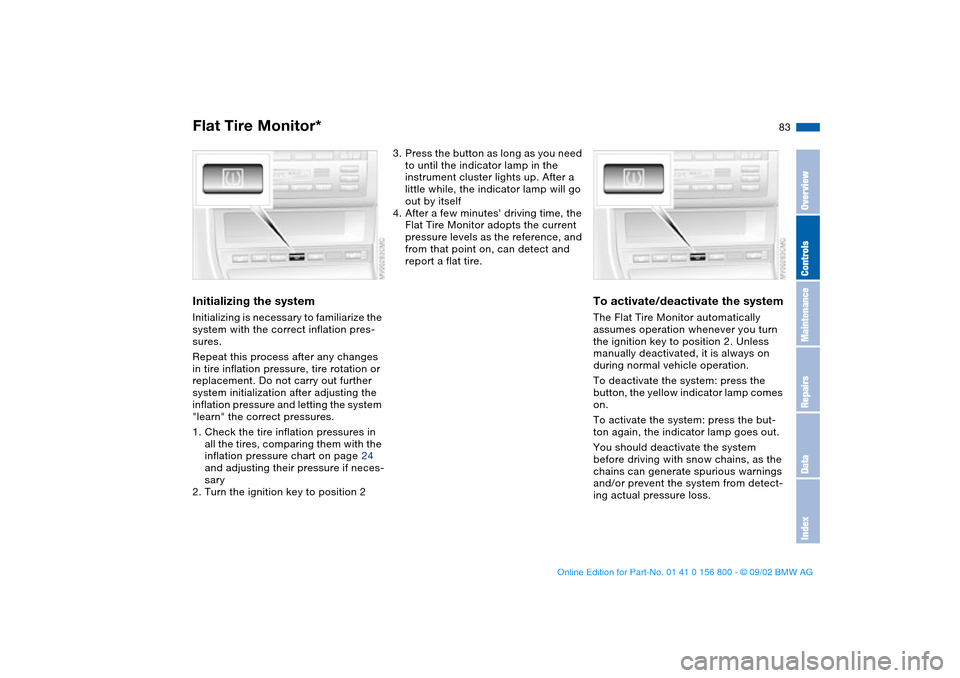
3. Press the button as long as you need
to until the indicator lamp in the
instrument cluster lights up. After a
little while, the indicator lamp will go
out by itself
4. After a few minutes' driving time, the
Flat Tire Monitor adopts the current
pressure levels as the reference, and
from that point on, can detect and
report a flat tire.
To activate/deactivate the systemThe Flat Tire Monitor automatically
assumes operation whenever you turn
the ignition key to position 2. Unless
manually deactivated, it is always on
during normal vehicle operation.
To deactivate the system: press the
button, the yellow indicator lamp comes
on.
To activate the system: press the but-
ton again, the indicator lamp goes out.
You should deactivate the system
before driving with snow chains, as the
chains can generate spurious warnings
and/or prevent the system from detect-
ing actual pressure loss.
Flat Tire Monitor*
OverviewControlsMaintenanceRepairsDataIndex
handbook.book Page 83 Tuesday, July 30, 2002 12:16 PM
Page 84 of 162
84
Flat tire
The red warning lamp in the
instrument cluster lights up to
warn of pressure loss and tire
failure. This visual alert is accompanied
by an acoustic warning signal. Reduce
your speed immediately, and steer and
brake gently as you bring the vehicle to
a stop.
To reset the warning lamp: after replac-
ing the damaged tire you will need to
reset the red warning lamp manually:
maintain pressure on the Flat Tire Moni-
tor button until the warning lamp goes
out. Then reinitialize the system.
The Flat Tire Monitor cannot pro-
vide you with advance warning of
sudden and severe tire damage caused
by external factors.
The system also does not detect the
gradual and minor loss of pressure that
all tires display over extended periods
of time.<
Check tire inflation pressures on a
regular basis, correcting them as
necessary, refer to page 24.
The system may respond to operation
on slippery or snow-covered road sur-
faces with false warnings or delays in
detecting actual pressure loss.
Performance-oriented driving – slip at
the drive wheels, high rates of lateral
acceleration – can also increase the
time that the Flat Tire Monitor requires
to detect a flat.<
System malfunctionsThe yellow indicator lamp in the instru-
ment cluster lights up and remains on
until the problem is corrected.
Please refer the problem to your BMW
center.
Flat Tire Monitor*
handbook.book Page 84 Tuesday, July 30, 2002 12:16 PM
Page 111 of 162
111 Wheels and tires
Tire inflation pressureInformation for your safetyThe factory-approved tires are matched
to your vehicle and have been selected
to provide optimum safety and driving
comfort when used properly.
It is not merely the tire's service life, but
also driving comfort and – above all else
– driving safety that depend on the con-
dition of the tires and the maintenance
of the specified tire inflation pressure.
Incorrect tire inflation pressure is a fre-
quent cause of tire damage. It also sig-
nificantly influences the roadholding
ability of your BMW.
Be sure to check the tire inflation
pressure, including the space-
saver spare tire or the spare tire, on a
regular basis, at least twice a month
and before every extended journey,
refer to page 24. If this is not done,
incorrect tire pressures can cause driv-
ing instability and tire damage, ulti-
mately resulting in accidents.<
Tire conditionTire tread – tire damageInspect your tires frequently for tread
wear, signs of damage and for foreign
objects lodged in the tread. Check the
tread depth.
Tread depth should not be allowed to
go below 1/8 in / 3 mm, even though
the legally specified minimum tread
depth is 1/16 in / 1.6 mm.
Below 1/8 in / 3 mm tread depth, there
is a great risk of hydroplaning, even at
relatively moderate speeds and with
only small amounts of water on the
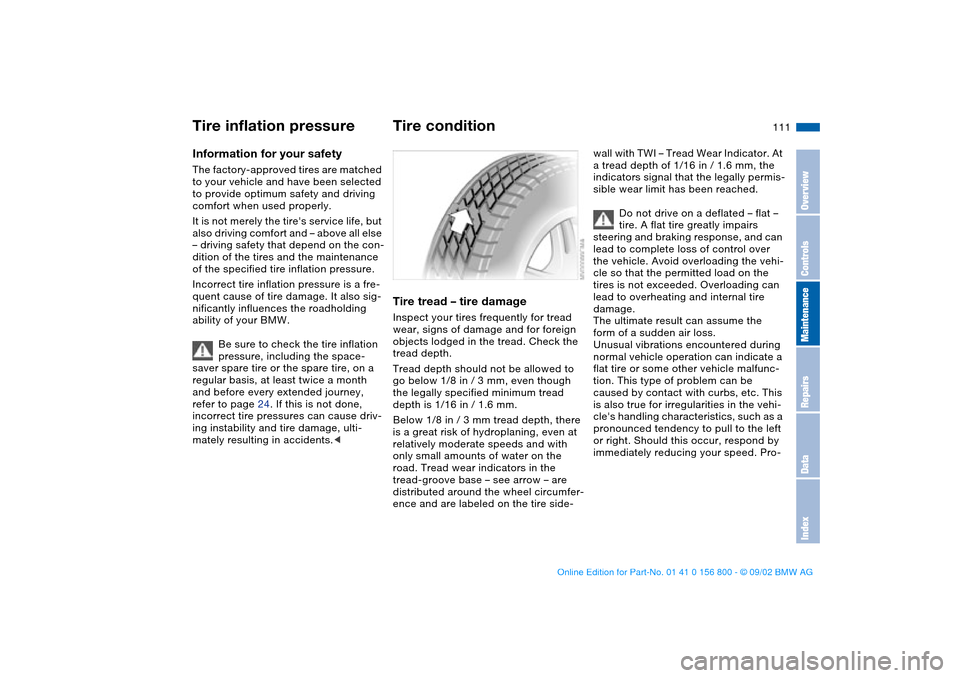
road. Tread wear indicators in the
tread-groove base – see arrow – are
distributed around the wheel circumfer-
ence and are labeled on the tire side-
wall with TWI – Tread Wear Indicator. At
a tread depth of 1/16 in / 1.6 mm, the
indicators signal that the legally permis-
sible wear limit has been reached.
Do not drive on a deflated – flat –
tire. A flat tire greatly impairs
steering and braking response, and can
lead to complete loss of control over
the vehicle. Avoid overloading the vehi-
cle so that the permitted load on the
tires is not exceeded. Overloading can
lead to overheating and internal tire
damage.
The ultimate result can assume the
form of a sudden air loss.
Unusual vibrations encountered during
normal vehicle operation can indicate a
flat tire or some other vehicle malfunc-
tion. This type of problem can be
caused by contact with curbs, etc. This
is also true for irregularities in the vehi-
cle's handling characteristics, such as a
pronounced tendency to pull to the left
or right. Should this occur, respond by
immediately reducing your speed. Pro-
OverviewControlsMaintenanceRepairsDataIndex
handbook.book Page 111 Tuesday, July 30, 2002 12:16 PM