fuel lines BMW 325i 1992 E36 User Guide
[x] Cancel search | Manufacturer: BMW, Model Year: 1992, Model line: 325i, Model: BMW 325i 1992 E36Pages: 759
Page 65 of 759
22
.
Move
A/C
compressor
out
of
the
way
without
distorting
26
.
Carefully
raise
engine
out
ofcar,
checking
for
any
wir-
or
damaging
any
lines
.
Support
compressor
by
hanging
ing,fuel
lines,
or
mechanical
parts
that
might
become
it
from
chassis
using
stiff
wire
.
snagged
as
engine
is
removed
.
23
.
Disconnect
wiring
from
starter
and
alternator
.
Move
27
.
Installation
is
reverse
of
removal,
noting
the
following
:
wiring
harness
out
of
the
way
.
See
121
Battery,
Start-
Replace
al¡
gaskets,
O-rings
and
seals
.
er,
Alternator
.
"
Change
engine
oil
and
filter
and
check
all
other
fluid
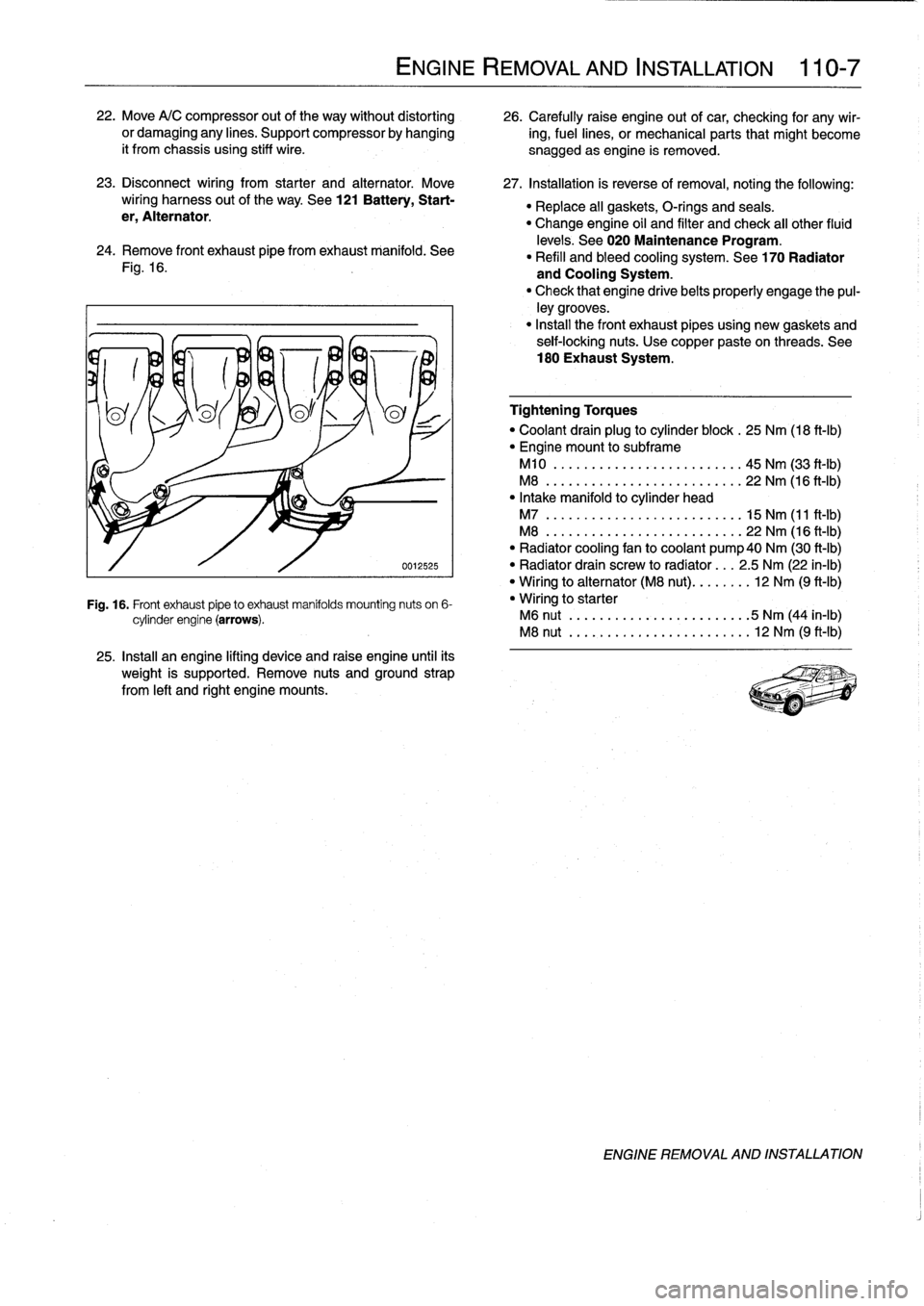
24
.
Remove
Fontexhaust
pipe
fromexhaust
manifold
.
See
levels
.
See
020
Maintenance
Program
.
"
Refill
and
bleed
cooling
system
.
See
170
Radiator
Fig
.
16
.
and
Cooling
System
.
"
Check
that
engine
drivebelts
properly
engage
the
pul-
ley
grooves
.
"
Install
the
Font
exhaust
pipesusing
new
gaskets
and
seif-locking
nuts
.
Use
copper
paste
on
threads
.
See
180
Exhaust
System
.
0012525
Fig
.
16
.
Front
exhaust
pipeto
exhaust
manifolds
mounting
nuts
on
6-
cylinder
engine
(arrows)
.
25
.
Install
an
engine
lifting
device
and
raise
engine
until
its
weight
is
supported
.
Remove
nuts
and
ground
strap
from
left
and
right
engine
mounts
.
ENGINE
REMOVAL
AND
INSTALLATION
110-
7
Tightening
Torques
"
Coolant
drain
plug
to
cylinder
block
.
25
Nm
(18
ft-Ib)
"
Engine
mount
to
subframe
M10
..
.
.
.
...
..............
..
.
45
Nm
(33
ft-Ib)
M8
..
..
.
..
................
...
22
Nm
(16
ft-Ib)
"
Intake
manifold
to
cylinder
head
M7
..
..
..
...
................
.
15
Nm
(11
ft-Ib)
M8
...
.
..
...
................
.
22
Nm
(16
ft-Ib)
"
Radiator
cooling
fan
to
coolant
pump40
Nm
(30
ft-Ib)
"
Radiator
drain
screw
to
radíator
...
2
.5
Nm
(22
in-lb)
"
Wiring
to
alternator
(M8
nut)
........
12
Nm
(9
ft-Ib)
"
Wiring
to
starter
M6
nut
.
..
...
..................
5
Nm
(44
in-lb)
M8
nut
.....
..
.
.
.
.
.............
12
Nm
(9
ft-Ib)
ENGINE
REMOVAL
AND
INSTALLATION
Page 69 of 759
11
.
Detach
wiring
harness
duct
at
rear
bulkhead
panel
and
pull
complete
duct
forward
and
up
to
allow
access
to
rear
of
cylinder
head
cover
.
12
.
Remove
spark
plugs
and
spark
plugwire
loom
.
"
Remove
plastic
cover
from
top
of
cylinder
head
.
"
Disconnect
spark
plug
wires
fromspark
plugs
and
re-
move
spark
plugs
.
"
Unbolt
spark
plug
cable
harness
and
heat
shield
from
right
side
of
cylinder
head
cover
and
set
aside
.
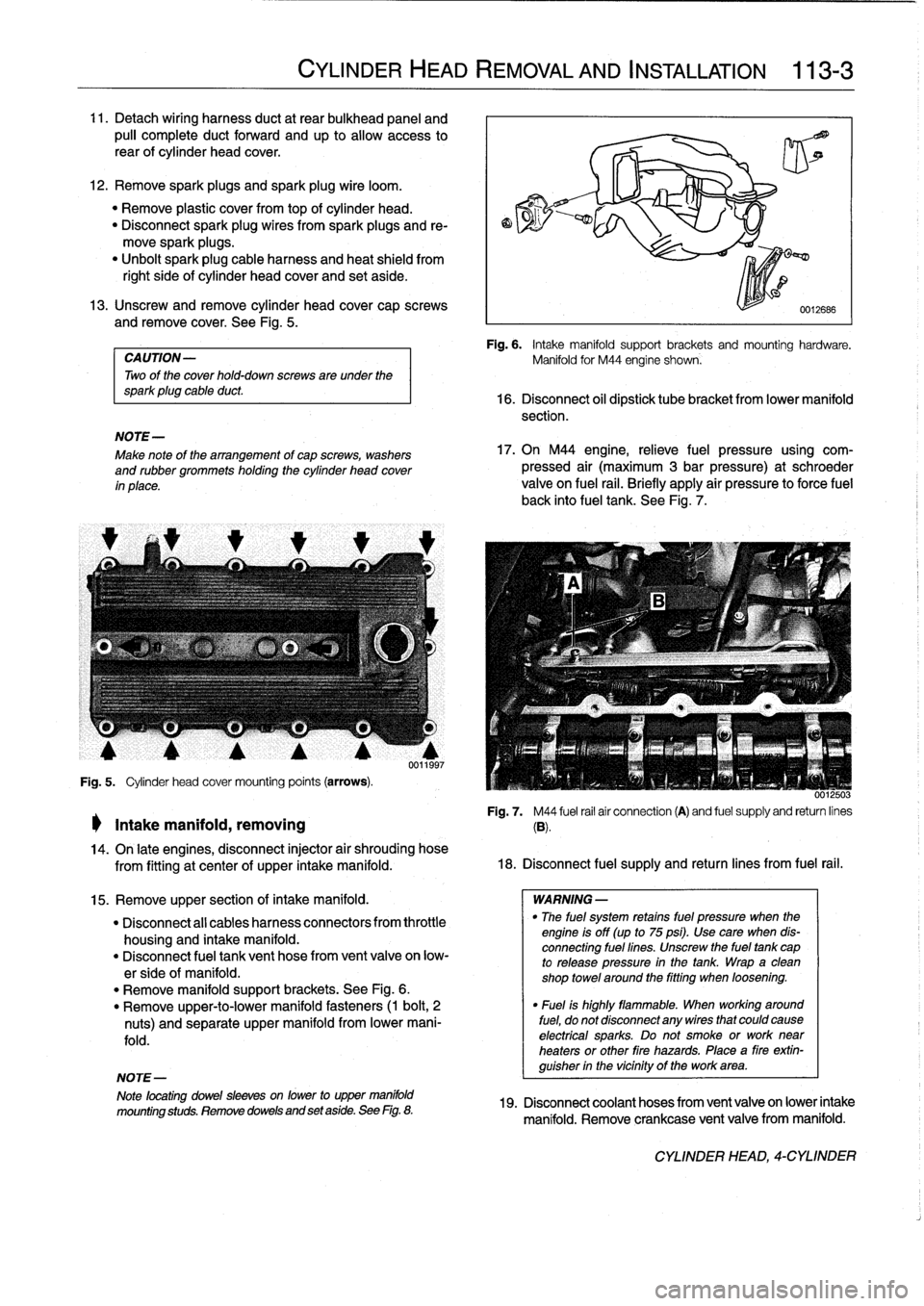
13
.
Unscrew
andremove
cylinder
head
cover
cap
screws
and
remove
cover
.
See
Fig
.
5
.
CAUTION-
Two
of
the
cover
hold-down
screws
are
under
the
spark
plug
cable
duct
.
NOTE-
Make
note
of
the
arrangement
of
cap
screws,
washers
and
rubber
grommets
holding
the
cylinder
head
cover
in
place
.
Fig
.
5
.
Cylinder
head
cover
mounting
points
(arrows)
.
Fig
.
7
.
M44
fuel
rail
air
connection
(A)
and
fuel
supply
and
return
lines
Intake
manifold,
removing
(B)
.
14
.
On
late
engines,
disconnect
injector
air
shrouding
hose
from
fitting
at
center
of
upper
intake
manifold
.
18
.
Disconnect
fuel
supply
and
return
lines
from
fuel
rail
.
15
.
Remove
upper
section
of
intake
manifold
.
"
Disconnect
ali
cables
harness
connectors
from
throttle
housing
and
intake
manifold
.
"
Disconnect
fuel
tank
vent
hose
fromvent
valve
on
low-
er
sitie
of
manifold
.
"
Remove
manifold
support
brackets
.
See
Fig
.
6
.
"
Remove
upper-to-lower
manifold
fasteners
(1
bolt,
2
nuts)
and
separate
upper
manifold
from
lowermani-
fold
.
Note
locating
dowei
sleeves
on
lower
to
upper
manifold
mounting
studs
.
Remove
dowels
and
set
aside
.
See
Fig
.
8
.
CYLINDER
HEAD
REMOVAL
AND
INSTALLATION
113-3
0012686
Fig
.
6
.
Intake
manifold
support
brackets
and
mountinghardware
.
Manifold
for
M44
engine
shows
.
16
.
Disconnect
oil
dipstick
tube
bracket
from
lower
manifold
section
.
17
.
On
M44
engine,
relieve
fuel
pressure
using
com-
pressed
air
(maximum
3
bar
pressure)
at
schroeder
valve
on
fuel
rail
.
Briefly
apply
air
pressure
to
force
fuel
back
intofuel
tank
.
See
Fig
.
7
.
WARNING
-
"
The
fuel
system
retains
fuel
pressure
when
the
engine
is
off
(up
to
75
psi)
.
Use
care
when
dis-
connecting
fuel
lines
.
Unscrew
the
fuel
tank
cap
to
retease
pressure
in
the
tank
.
Wrap
a
clean
shop
towel
around
the
fitting
when
loosening
.
"
Fuel
is
highly
flammable
.
When
working
around
fuel,
do
not
disconnect
any
wires
that
could
cause
electrical
sparks
.
Do
not
smoke
or
worknear
heaters
or
other
tire
hazards
.
Placea
tire
extin-
guisher
in
the
vicinity
of
the
work
area
.
19
.
Disconnect
coolant
hoses
from
vent
valve
on
lower
intake
manifold
.
Remove
crankcase
vent
valve
from
manifold
.
CYLINDER
HEAD,
4-CYLINDER
Page 78 of 759
113-12
CYLINDER
HEAD
REMOVAL
AND
INSTALLATION
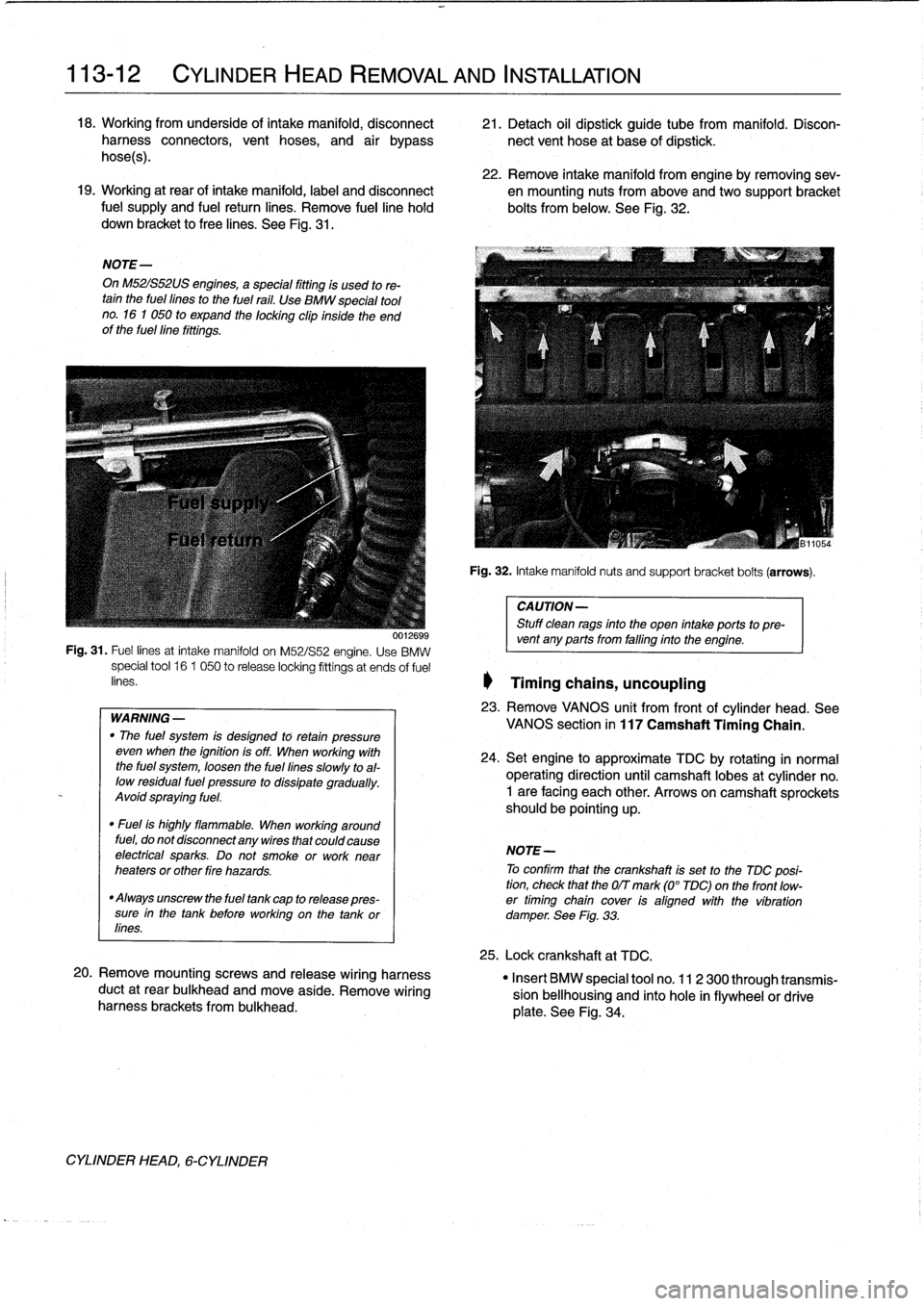
18
.
Working
from
underside
of
intake
manifold,
disconnect
21
.
Detach
oil
dipstick
guide
tube
from
manifold
.
Disconharness
connectors,
vent
hoses,
and
air
bypass
nectvent
hose
at
base
of
dipstick
.
hoses)
.
22
.
Remove
intake
manifold
from
engine
byremoving
sev-19
.
Working
at
rear
of
intake
manifold,
label
and
disconnect
en
mounting
nuts
from
above
andtwo
support
bracket
fuel
supply
and
fuel
return
lines
.
Remove
fuelline
hold
bolts
from
below
.
See
Fig
.
32
.
down
bracket
to
free
lines
.
See
Fig
.
31
.
NOTE-
On
M52IS52US
engines,
a
special
fitting
is
used
to
re-tain
the
fuel
fines
to
the
fuel
rail
.
Use
BMW
special
tool
no
.
16
1
050
to
expand
the
locking
clip
inside
the
end
of
the
fuellíne
fittings
.
WARNING
-
"
The
fuel
system
is
desígned
to
retan
pressure
even
wheh
the
ignition
is
off
.
When
working
with
the
fuel
system,
loosen
the
fuel
lines
slowly
toal-
low
residual
fuel
pressure
to
dissipate
gradually
.
Avoid
spraying
fuel
.
"
Fuel
is
highly
flammable
.
When
working
around
fuel,
do
not
disconnect
any
wires
that
could
cause
electrfcal
sparks
.
Do
not
smoke
orwork
near
heaters
or
other
fire
hazards
.
"
Always
unscrew
the
fuel
tank
cap
to
release
pres-
sure
in
the
tank
before
working
on
the
tank
or
lines
.
20
.
Remove
mountingscrews
and
release
wiring
harness
duct
at
rear
bulkhead
and
move
aside
.
Remove
wiring
harness
brackets
frombulkhead
.
CYLINDER
HEAD,
6-CYLINDER
Fig
.
32
.
Intake
manifoldnuts
and
support
bracket
bolts
(arrows)
.
CAUTION-
Stuff
clean
rags
into
the
open
intake
ports
topre-
001269s
vent
any
ports
from
falfing
into
the
engine
.
Fig
.
31
.
Fuel
lines
at
intake
manifold
on
M52/S52
engine
.
Use
BMW
special
tool
16
1
050
to
release
locking
fittings
at
ends
of
fuel
enes
.
1
Timing
chains,
uncoupling
23
.
Remove
VANOS
unit
from
frontof
cylinder
head
.
See
VANOS
section
in
117
Camshaft
Timing
Chain
.
24
.
Setengine
to
approximate
TDC
by
rotating
in
normal
operating
direction
until
camshaft
lobes
at
cylinder
no
.
1
are
facing
each
other
.
Arrows
on
camshaft
sprockets
should
be
pointing
up
.
NOTE-
To
confirm
that
the
crankshaft
is
set
to
the
TDC
posi-
tion,
check
that
the
OIT
mark
(0°
TDC)on
the
front
low-
er
timing
chain
cover
ís
aligned
with
the
víbration
damperSee
Fig
.
33
.
25
.
Lock
crankshaft
at
TDC
.
"
Insert
BMW
special
tool
no
.
11
2
300
through
transmis-
sion
bellhousing
and
finto
hole
in
flywheelor
drive
plate
.
See
Fig
.
34
.
Page 117 of 759
NOTE
-
The
guide
tube
is
sealed
in
the
pan
with
an
O-ring
.
Check
that
theO-ring
comes
out
with
the
tube
.
Use
a
new
O-ring
when
installing
the
tube
.
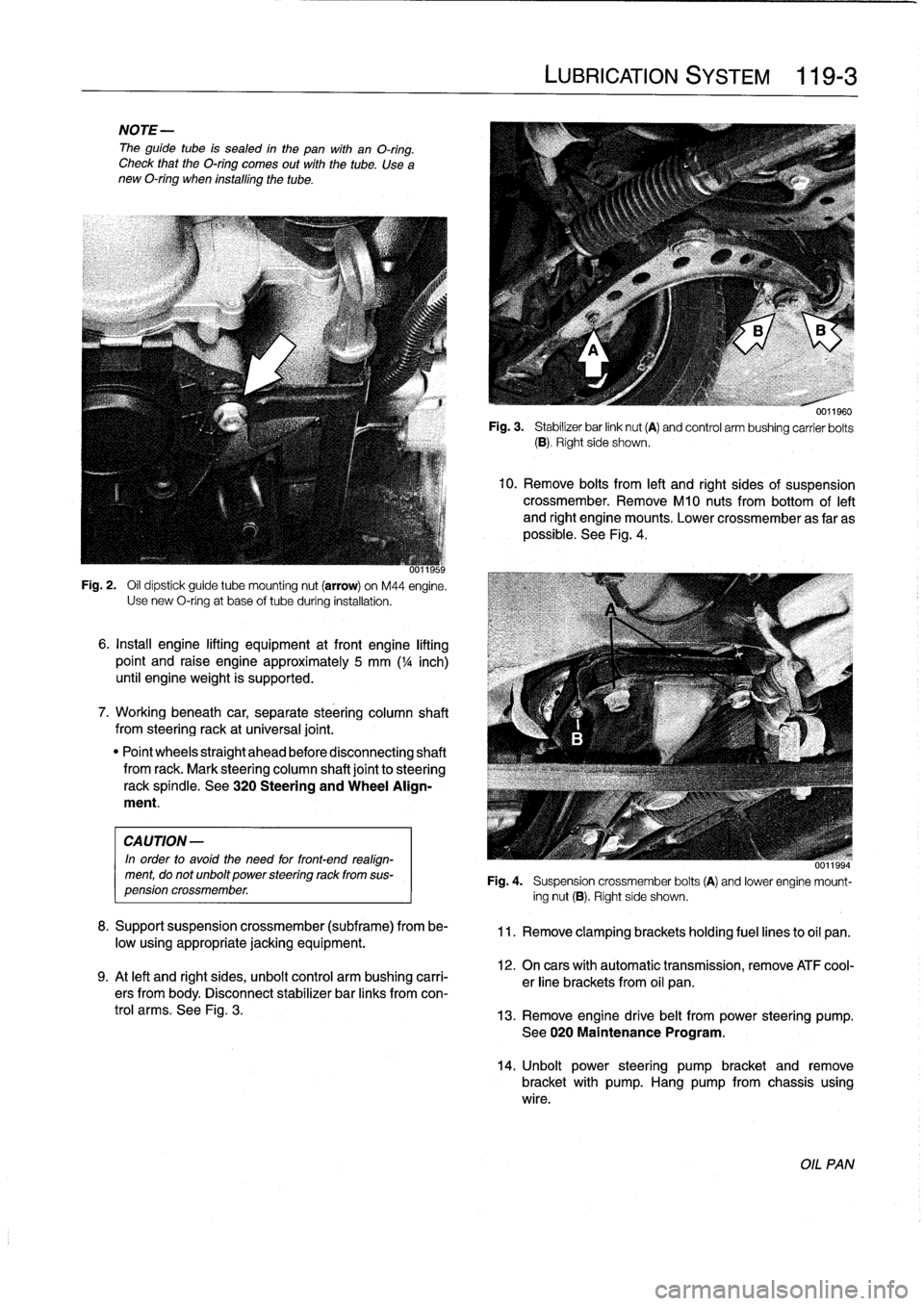
Fig
.
2
.
Oil
dipstick
guide
tube
mounting
nut
(arrow)
on
M44
engine
.
Use
new
O-ring
at
base
of
tube
during
installatidn
.
6
.
Install
engine
lifting
equipment
at
front
engine
lifting
point
and
raise
engine
approximately
5
mm
(
1
/4
inch)
until
engineweight
is
supported
.
7
.
Workingbeneath
car,
separate
steering
column
shaft
from
steeringrack
at
universal
joint
.
"
Point
wheels
straight
ahead
before
disconnecting
shaft
from
rack
.
Mark
steering
column
shaft
joint
to
steering
rackspíndle
.
See
320
Steering
and
Wheel
Align-
ment
.
CAUTION
-
In
order
to
avoíd
the
need
for
front-end
realign-
ment,
do
notunbolt
power
steering
rack
from
sus-
pension
crossmember
.
8
.
Supportsuspension
crossmember
(subframe)
from
be-
low
usingappropriate
jacking
equipment
.
9
.
At
left
and
right
sides,
unbolt
control
arm
bushing
carri-
ers
from
body
.
Disconnect
stabilizer
bar
links
fromcon-
trol
arms
.
See
Fig
.
3
.
LUBRICATION
SYSTEM
119-
3
0011960
Fig
.
3
.
Stabilizer
bar
link
nut
(A)
and
control
arm
bushing
carrier
bolts
(B)
.
Right
side
shows
.
10
.
Remove
bolts
from
left
and
right
sides
of
suspension
crossmember
.
RemoveM10
nuts
from
bottom
of
left
and
right
engine
mounts
.
Lower
crossmember
as
far
as
possible
.
See
Fig
.
4
.
uu1ibb4
Fig
.
4
.
Suspension
crossmember
bolts
(A)
and
lower
engine
mount-
ing
nut
(B)
.
Right
side
shows
.
11
.
Remove
clamping
brackets
holding
fuel
lines
to
oil
pan
.
12
.
On
cars
with
automatic
transmission,
remove
ATF
cool-
er
line
brackets
from
oil
pan
.
13
.
Remove
engine
drive
belt
from
power
steering
pump
.
See020
Maintenance
Program
.
14
.
Unbolt
power
steering
pumpbracket
andremove
bracket
with
pump
.
Hang
pump
from
chassis
using
wire
.
OIL
PAN
Page 121 of 759
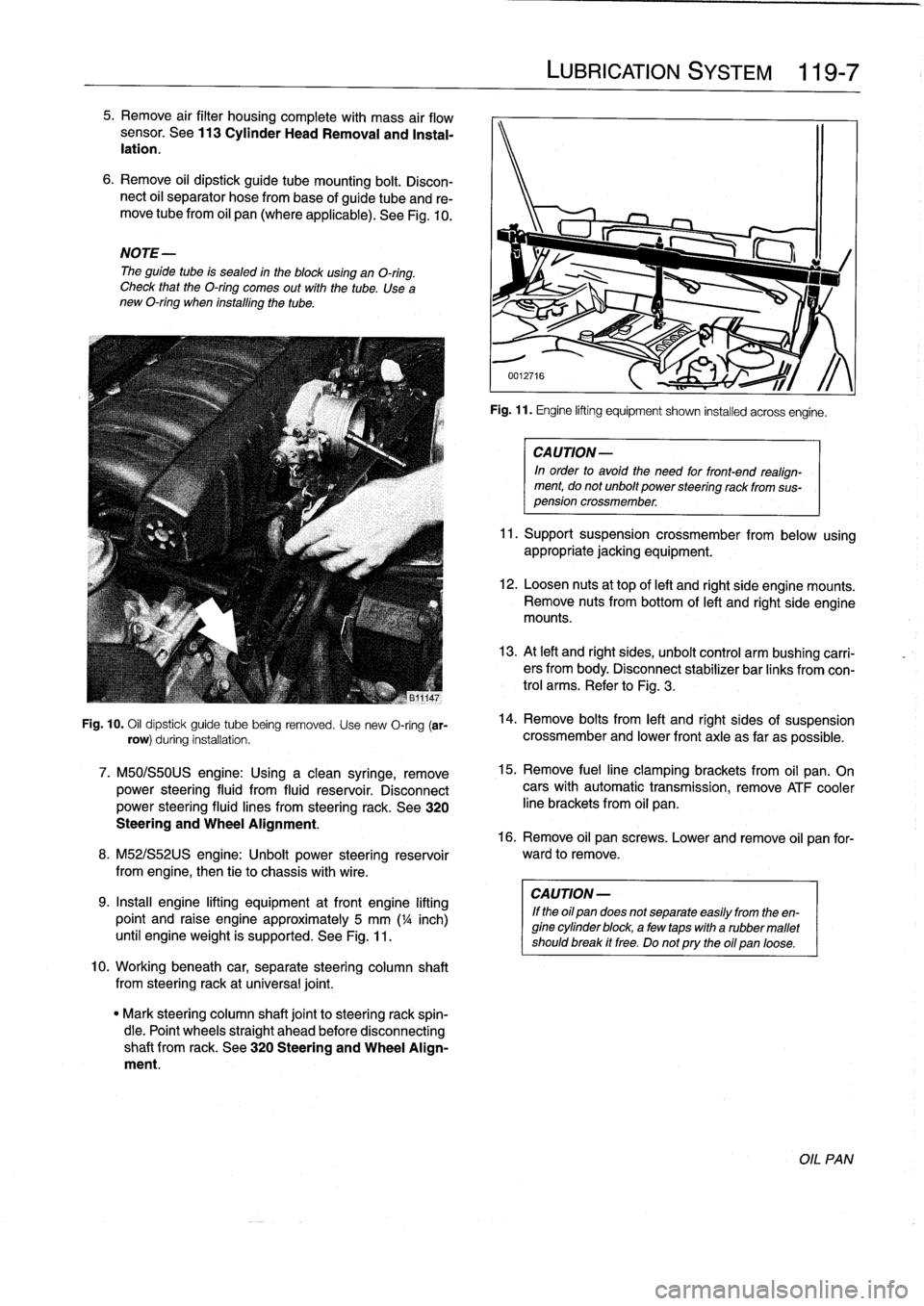
5
.
Remove
air
filter
housingcomplete
with
mass
air
flow
sensor
.
See113
Cylinder
HeadRemoval
and
Instal-
lation
.
6
.
Remove
oil
dipstick
guide
tube
mounting
bolt
.
Discon-
nect
oil
separator
hose
frombase
of
guide
tube
and
re-
move
tubefrom
oil
pan
(where
applicable)
.
See
Fig
.
10
.
NOTE-
The
guide
tube
is
sealed
in
the
blockusing
an
O-ring
.
Check
that
the
O-ring
comes
out
with
the
tube
.
Use
a
new
O-ring
when
installing
the
tube
.
Fig
.
10
.
Oil
dipstick
guide
tube
being
removed
.
Use
new
O-ring
(ar-
row)
during
installation
.
7
.
M50/S50US
engine
:
Using
a
clean
syringe,
remove
power
steering
fluid
from
fluid
reservoir
.
Disconnect
power
steering
fluid
lines
from
steering
rack
.
See
320
Steering
and
Wheel
Alignment
.
8
.
M52/S52US
engine
:
Unbolt
power
steering
reservoir
from
engíne,
then
tie
to
chassis
with
wire
.
9
.
Insta¡¡
engine
lifting
equipment
atfront
engine
lifting
point
and
raise
engine
approximately
5
mm
('/a
inch)
until
engineweight
is
supported
.
See
Fig
.
11
.
10
.
Workingbeneath
car,
separate
steering
column
shaft
from
steeringrack
at
universal
joint
.
"
Mark
steering
column
shaft
jointto
steering
rack
spin-
dle
.
Point
wheels
straight
ahead
before
disconnecting
shaft
from
rack
.
See
320
Steering
and
Wheel
Align-
ment
.
LUBRICATION
SYSTEM
119
Fig
.
11
.
Engine
lifting
equipment
shown
installed
acrossengíne
.
CA
UTION-
In
order
to
avoid
the
need
for
front-end
realign-
ment,
donot
unbolt
power
steering
rack
from
sus-
pension
crossmember
.
11
.
Support
suspension
crossmember
from
below
using
appropriate
jacking
equipment
.
12
.
Loosen
nuts
at
top
of
left
and
right
side
engine
mounts
.
Remove
nuts
from
bottom
of
left
and
right
side
engine
mounts
.
13
.
At
left
and
right
sides,
unbolt
control
arm
bushíng
carri-
ers
from
body
.
Disconnect
stabilizer
bar
links
fromcon-
trol
arms
.
Refer
to
Fig
.
3
.
14
.
Remove
bolts
from
left
and
right
sides
of
suspension
crossmember
and
lower
front
axle
as
far
as
possible
.
15
.
Remove
fuelline
clamping
brackets
from
oil
pan
.
On
cars
with
automatic
transmission,
remove
ATF
cooler
line
brackets
from
oil
pan
.
16
.
Remove
oil
pan
screws
.
Lower
and
remove
oil
pan
for-
ward
to
remove
.
CA
UTION-
If
the
oil
pan
does
not
separate
easily
from
the
en-
gine
cylinder
block,
a
few
taps
with
a
rubber
mallet
shouldbreak
it
free
.
Do
notpry
the
oil
pan
loose
.
OIL
PAN
Page 144 of 759
121-
8
BATTERY,
STARTER,
ALTERNATOR
1f
the
solenoid
audibly
cliicks
but
the
motor
does
not
turn,
Starter,
removing
and
installing
switch
on
the
lights
andtum
the
key
to
the
start
position
.
lf
the
(6-cylinder
engine
with
lights
go
out
while
attempting
to
start,
the
battery
cable
may
be
manual
transmission)
loose
or
the
starter
may
have
a
short
circuit
.
If
the
lights
stay
on,the
solenoid
is
most
likely
atfault
.
The
starter
on
a
6-cylinder
car
with
manual
transmission
is
Starter,
removing
and
installing
(4-cylinder
engine)
1
.
Disconnect
negative
(-)
battery
cable
.
1
.
Disconnect
negative
(-)
cable
from
battery
.
CAUTION-
Prior
to
disconnecting
the
battery,
read
the
battery
disconnection
cautions
given
at
the
front
of
this
manual
on
page
viii
.
2
.
Remove
guide
tube
for
oil
dipstick
.
3
.
Raise
vehicle
.
WARNING
-
Make
sure
the
car
ís
stable
and
wefl
supported
at
all
times
.
Use
a
professional
automotive
lift
or
jack
stands
designed
forthe
purpose
.
A
floor
jack
is
not
adequate
support
.
4
.
Disconnect
wiring
from
starter
.
5
.
Remove
top
and
bottom
starter
bolts
.
Bottom
bolt
must
be
removed
from
below
car
.
Remove
starter
support
bracket,
if
applicable
.
removed
from
below
.
2
.
Raise
vehicle
.
3
.
Remove
reinforcing
cross
bracefromunder
transmís-
sion,
if
applicable
.
4
.
Remove
cover
from
fuel
filter
and
fuel
lines
on
left
side
underneath
car,
if
applicable
.
Detach
fuel
lines
and
har-
ness
connectors
from
retainingbrackets,
as
necessary
5
.
Disconnect
wiring
from
starter
.
6
.
Loosen
andremove
bolts
and
nuts
fastening
starter
to
transmission
bell
housing
and/or
engine
block
.
Remove
starter
supportbracket
.
7
.
Remove
starter
from
below
.
8
.
Check
starter
pinion
gear
and
flywheel
teeth
for
dam-
age
.
9
.
Installation
is
reverse
of
removal
.
6
.
Pull
starter
downward
and
turn
until
solenoid
is
at
top,
Tightening
Torques
then
remove
from
car
.
"
Re¡
nforcing
cross
brace
to
chassis
(M10)
..
...............
42
Nm
(31
ft-Ib)
7
.
>Check
starter
pinion
gear
and
flywheel
teeth
for
dam-
"
Starter
to
engine
block
(M10
bolt)
...
50
Nm
(37
ft-Ib)
age
.
"
Support
bracket
to
starter
(M5
nut)
...
5
Nm
(44
in-lb)
"
Support
bracket
8
.
Installation
is
reverse
of
removal
.
to
engine
block
(M10
bolt)
.........
47
Nm
(35
ft-Ib)
"
Wire
to
terminal
50
(M6
nut)
.........
6
Nm
(53
ín-Ib)
"
Wire
to
terminal
30
(M8
nut)
.........
12
Nm
(9
ft-lb)
Tightening
Torques
"
Starter
to
engine
block
(M10
bolt)
...
50
Nm
(37
ft-lb)
Wire
to
terminal
50
(M6
nut)
........
6
Nm
(53
in-lb)
"
Wire
toterminal
30
(M8
nut)
...
,
..:.
12
Nm
(9
ft-Ib)
STARTER
SERVICE
Page 152 of 759
130-
6
FUEL
INJECTION
Warnings
and
Cautions
For
personal
safety,
as
well
as
the
protection
of
sensitive
electronic
components,
the
following
warnings
and
cautions
should
be
adhered
to
when
working
on
the
engine
manage-
ment
system
.
GENERAL
WARNING
-
"
The
ignition
system
produces
high
voltages
that
can
be
fatal
.
Avoid
contact
with
exposed
termi-
nals
.
Use
extreme
caution
when
working
onacar
with
the
ignition
switched
on
or
the
engine
run-
ning
.
"
Do
not
touch
or
disconnect
any
high
voltage
ca-
bles
from
the
coils
or
spark
plugs
while
the
engine
is
running
or
beingcranked
by
the
starter
.
"
Connect
and
disconnect
the
DME
system
wiring
and
test
equipment
leads
only
when
the
ignition
is
switched
off
.
"
Gasoline
is
highly
flammable
and
fts
vaporsare
explosive
.
Do
not
smoke
or
work
on
a
car
near
heaters
or
other
fire
hazards
when
diagnosing
and
repalring
fuel
system
problems
.
Have
a
tire
extinguisher
avaílable
in
case
of
an
emergency
.
"
When
working
onan
open
fuel
system,
wear
suit-
able
hand
protection,
asprolonged
contact
wfth
fuel
can
cause
illnesses
and
skin
disorders
.
"
Renew
fuel
system
hoses,
clamps
and
O-rings
any
timethey
are
removed
.
"
Before
makingany
electrical
tests
that
require
the
engine
to
be
cranked
using
the
starter,
disable
the
ignition
system
as
described
in
120
Ignition
System
.
CAUTION-
"
Prior
to
disconnecting
the
battery,
read
the
bat-
tery
disconnectinn
cautions
given
at
the
front
of
this
manual
onpage
vifi
.
"
Do
not
connect
any
test
equipment
that
delivers
a
12-volt
power
supply
to
terminal
15
(+)
of
the
ig-
nitioncoil
.
The
current
flow
may
damage
the
ECM
.
In
general,
connect
test
equipment
only
as
speclfied
by
BMW,
this
manual,
or
the
equipment
maker
.
"
Only
use
a
digital
multlmeter
for
electrical
test
.
"
Only
use
an
LED
test
light
for
quick
tests
.
"
Disconnecting
the
battery
may
erase
fault
code(s)
stored
in
memory
.
Check
for
fault
codes
prior
to
disconnecting
the
battery
cables
.
ff
the
Check
Engine
light
ís
illuminated,
see100En-
gine-General
for
DME
fault
code
information
.
ff
any
other
system
faults
have
been
detected
(indi-
catedbyan
illuminated
warning
light),
see
an
au-
thorized
BMW
dealer
.
Additional
systems
with
self-diagnostic
capabilities
include,
ABS
(Anti-
lock
brakes),
SRS
(Airbags),
EML
and
ASC+T
and
AST
(Traction
Control)
.
"
Do
not
run
the
engine
wfth
any
of
the
spark
plug
wires
dlsconnected
.
Catalytic
converter
damage
may
result
.
"
Always
waitat
least
40
seconds
afterturning
off
the
ignition
before
removing
the
engine
control
module
(ECM)
connector
.
ff
the
connector
isre-
moved
before
this
time,
residual
power
in
the
sys-
tem
relay
may
damage
the
control
module
.
"
Cleanliness
is
essential
when
working
onan
open
fuel
system
.
Thoroughly
clean
fuel
line
con-
nections
and
surroundlng
areas
before
loosen-
ing
.
Avoid
moving
the
car
.
Only
fnstall
cleanparts
.
"
Fuel
system
cleaners
and
other
chemical
addi-
tives
other
than
those
specifically
recommended
by
BMW
may
damage
the
catalytic
converter,
the
oxygensensor
or
other
fuel
supply
components
.
Page 156 of 759
130-
1
0
FUEL
INJECTION
Relleving
fuel
pressure
and
connecting
fuel
pressure
gauge
WARNING
-
"
Gasoline
is
highly
flammable
and
its
vaporsare
explosive
.
Do
not
smoke
orwork
on
acarnear
heaters
or
other
fire
hazards
when
diagnosing
and
repairing
fuel
system
problems
.
Have
a
fire
extinguisher
available
in
case
of
an
emergency
.
"
When
working
onanopen
fuel
system,
wear
suit-
able
hand
protection
.
Prolonged
contact
with
fuel
can
cause
illnesses
and
skin
disorders
.
To
prevent
fuel
from
spraying
on
a
hot
engine,
system
fuel
pressure
should
be
relieved
before
disconnecting
fuel
lines
.
One
method
is
to
tightly
wrap
a
shop
towel
around
a
fuelline
fit-
ting
and
loosenor
disconnect
the
fitting
.
Cleanliness
is
essential
when
working
with
fuelcircuit
com-
ponents
.
Thoroughly
clean
theunionsbefore
disconnecting
fuellines
.
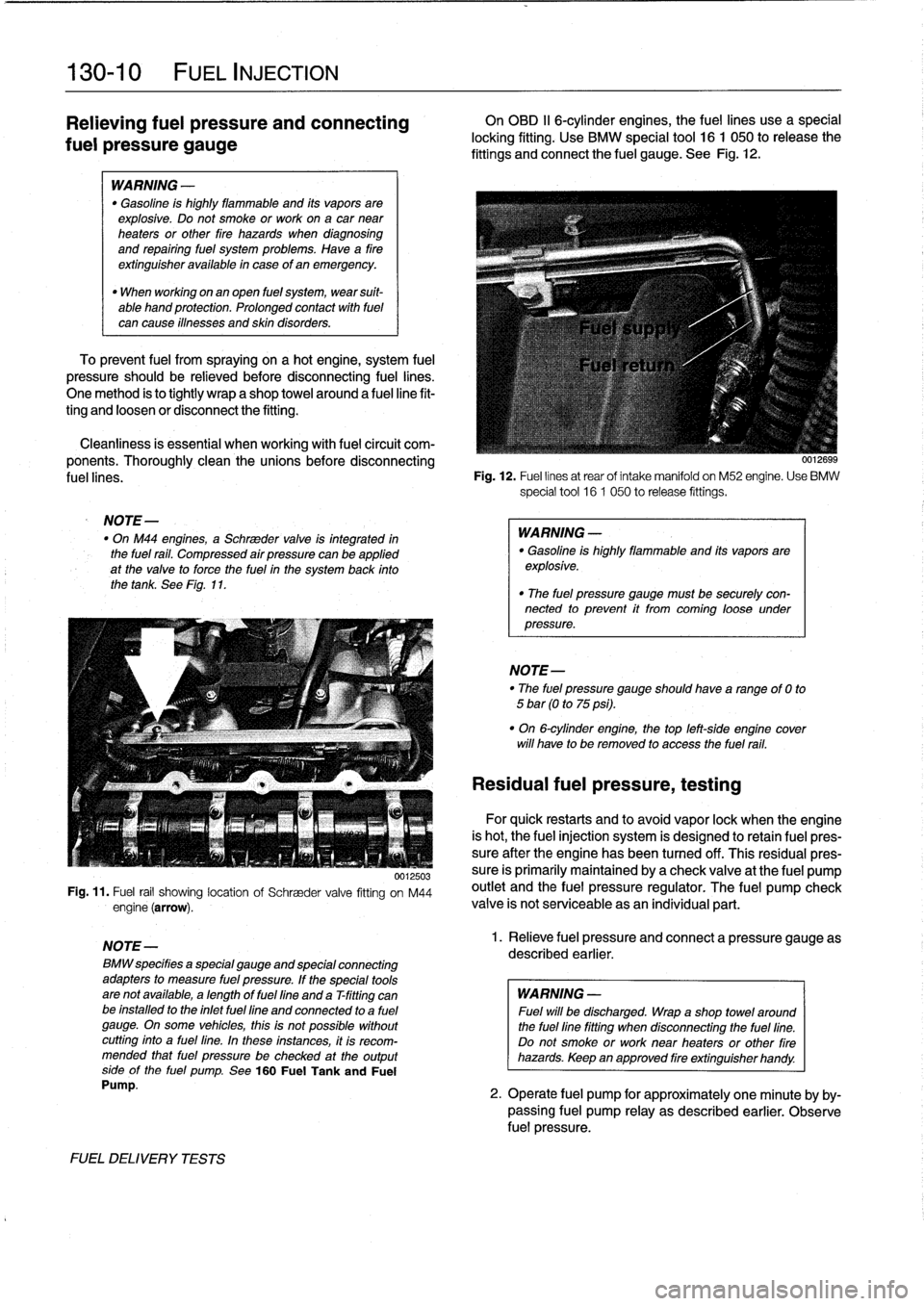
NOTE-
"
OnM44
engines,
a
Schrmder
valve
is
integrated
in
the
fuel
rail
.
Compressed
air
pressure
canbe
applied
at
the
valve
to
force
the
fuel
in
the
system
back
into
the
tank
.
See
Fig
.
11
.
0012503
Fig
.
11
.
Fuel
rail
showing
location
of
Schraeder
valve
fitting
on
M44
engine
(arrow)
.
NOTE-
B~
specifies
a
special
gauge
and
special
connecting
adapters
to
measure
fuel
pressure
.
If
the
special
tools
arenot
available,
a
length
of
fuel
fine
and
a
T-fitting
canbe
installed
to
the
inlet
fuel
fine
and
connected
to
a
fuel
gauge
.
On
some
vehicles,
thisis
not
possible
without
cutting
finto
a
fuel
lino
.
In
these
lnstances,
it
Is
recom-
mended
that
fuel
pressure
be
checked
at
theoutput
sidoof
the
fuel
pump
.
See
160
Fuel
Tankand
Fuel
Pump
.
FUELDELIVERY
TESTS
On
OBD
II
6-cylinder
engines,
the
fuel
lines
use
a
special
locking
fitting
.
Use
BMW
special
tool
16
1
050
to
release
the
fittings
and
connect
the
fuel
gauge
.
See
Fig
.
12
.
0012699
Fig
.
12
.
Fuel
linos
at
rear
of
intake
manifold
on
M52
engine
.
Use
BMW
special
tool
16
1
050
torelease
fittings
.
WARNING
-
"
Gasoline
is
highly
flammable
and
its
vapors
are
explosive
.
"
The
fuel
pressure
gauge
must
be
securely
con-nected
to
prevent
it
from
coming
loose
under
pressure
.
NOTE-
"
The
fuel
pressure
gauge
should
have
arangoof
0
to
5
bar
(0
to
75
psi)
.
"
On
6-cylinder
engine,
thetop
left-sido
engine
cover
will
have
to
be
removed
to
access
the
fuel
rail
.
Residual
fuel
pressure,
testing
For
quick
restarts
and
to
avoid
vapor
lock
when
the
engine
is
hot,
the
fuel
injection
system
is
designed
to
retain
fuel
pres-
sure
after
the
engine
has
been
turned
off
.
Thís
residualpres-
sure
is
primarily
maíntained
by
a
check
valve
at
the
fuel
pump
outiet
and
the
fuel
pressure
regulator
.
The
fuel
pump
check
valve
is
not
serviceable
asan
individual
part
.
1.
Relieve
fuel
pressure
and
connect
a
pressure
gauge
as
described
earlier
.
WARNING
-
Fuel
will
be
discharged
.
Wrap
a
shop
towel
around
the
fuellino
fitting
when
disconnecting
the
fuel
fine
.
Do
not
smoke
or
worknear
heaters
or
other
fire
hazards
.
Keep
an
approved
fire
extinguisher
handy
.
2
.
Operate
fuel
pump
for
approximately
one
minuto
by
by-
passing
fuel
pump
relay
as
described
earlier
.
Observe
fuel
pressure
.
Page 157 of 759
3
.
Observe
fuel
pressure
gauge
after
20
minutes
.
The
pressure
shouldnot
drop
off
more
than
0
.5
bar
from
system
pressure
listed
in
Tablec
.
4
.
When
finished
testing,
disconnect
pressure
gauge
and
reconnect
fuel
line
.
If
the
fuel
system
does
not
maintain
pressure,
check
visual-
¡y
for
leaks
in
fuel
lines
orat
unions
.
Leaks
can
also
be
due
to
a
leaking
injector
or
a
faulty
fuel
pump
check
valve
.
Check
the
pump
check
valve
by
repeating
the
test,
butbefore
turning
the
fuel
pump
off,
pinch
off
theretum
line
at
the
fuel
rail
.
If
the
pressure
is
now
maintained,
the
fault
is
most
likely
the
fuel
pump
check
valva
.
Tabla
c
.
Fuel
Pressure
Specifications
Engine
1
Fuel
pressure
4-cytinder
1
3
.0
t
0
.2
bar
(43
.5
t
2
.9psi)
6-cytinder
M50/S50US
engine
3
.0
t
0
.2
bar
(43
.5
±2
.9psi)
M52/S52US
engine
3
.5
f
0
.2
bar
(51
t
2.9psi)
Fuel
pressure
regulator
response
to
engine
load,
testing
1
.
With
fuel
pressure
gauge
connected,
reinstallfuel
pump
relay
.
Start
engine
and
allow
it
to
idle
.
NOTE-
The
fuel
pressure
should
be
lower
by0
.4-0.7
bar
from
the
specifications
listed
in
Table
c
.
Engine
vacuum
act-
ing
on
the
fuel
pressure
regulator
diaphragm
reduces
the
fuel
pressure
.
2
.
With
engine
idling,
remove
vacuum
hose
from
regula-
tor
.
Pressure
should
increase
.
3
.
Reconnecthose
and
check
that
pressure
decreases
.
4
.
When
finished
testing,
disconnect
pressure
gauge
and
reconnect
fuelline
.
Tighten
hose
clamp
.
0013190
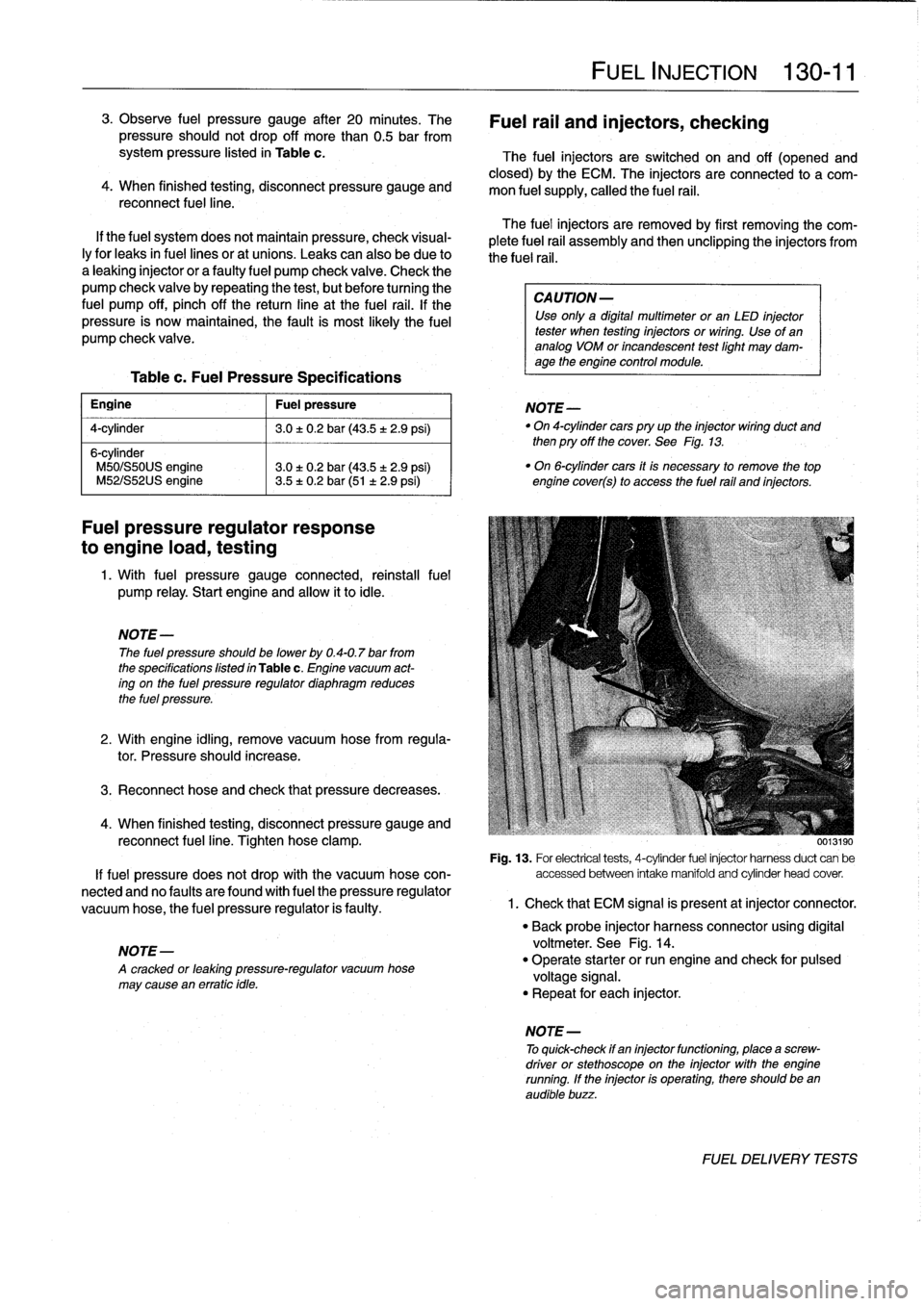
Fig
.
13
.
For
electrical
tests,
4-cytinder
fuel
injector
harnessduct
can
be
If
fuel
pressure
does
not
drop
with
the
vacuum
hose
con-
accessed
between
intake
manifold
and
cytinder
head
cover
.
nected
and
no
faulty
are
found
with
fuel
the
pressure
regulator
vacuum
hose,
the
fuel
pressure
regulator
is
faulty
.
1
.
Check
that
ECM
signal
is
present
atinjector
connector
.
NOTE-
A
cracked
or
leaktng
pressure-regulator
vacuum
hose
may
cause
en
erratic
tdle
.
FUEL
INJECTION
130-
11
Fuel
rail
and
injectors,
checking
The
fuel
injectors
are
switched
on
and
off
(opened
and
closed)
by
the
ECM
.
The
injectors
are
connected
to
a
com-
mon
fuel
supply,
callad
the
fuel
rail
.
The
fuel
injectors
are
removed
by
first
removing
the
com-
plete
fuel
rail
assembly
and
then
unclipping
the
injectors
from
the
fuel
rail
.
CA
UTION-
Use
only
a
digital
multimeter
or
an
LED
injector
tester
when
testing
injectors
or
wiring
.
Use
of
ananalog
VOM
or
incandescent
testlight
may
dam-
age
the
engine
control
module
.
NOTE-
"
On
4-cytindercars
pry
up
the
injector
wiring
duct
and
then
pry
off
the
cover
.
See
Fig
.
13
.
"
On
6-cytinder
cars
it
is
necessary
to
remove
the
top
engine
cover(s)
to
access
the
fuel
rail
and
injectors
.
"
Back
probe
injector
harness
connector
using
digital
voltmeter
.
See
Fig
.
14
.
"
Operate
starter
or
run
engine
and
check
for
pulsad
voltage
signal
.
"
Repeat
for
each
injector
.
NOTE
-
To
quick-check
if
en
injectorfunctioning,
place
a
screw-
driver
or
stethoscope
on
the
injector
with
the
engine
running
.
If
the
injector
is
operating,there
should
been
audible
buzz
.
FUEL
DELIVERYTESTS
Page 158 of 759
130-
1
2
FUEL
INJECTION
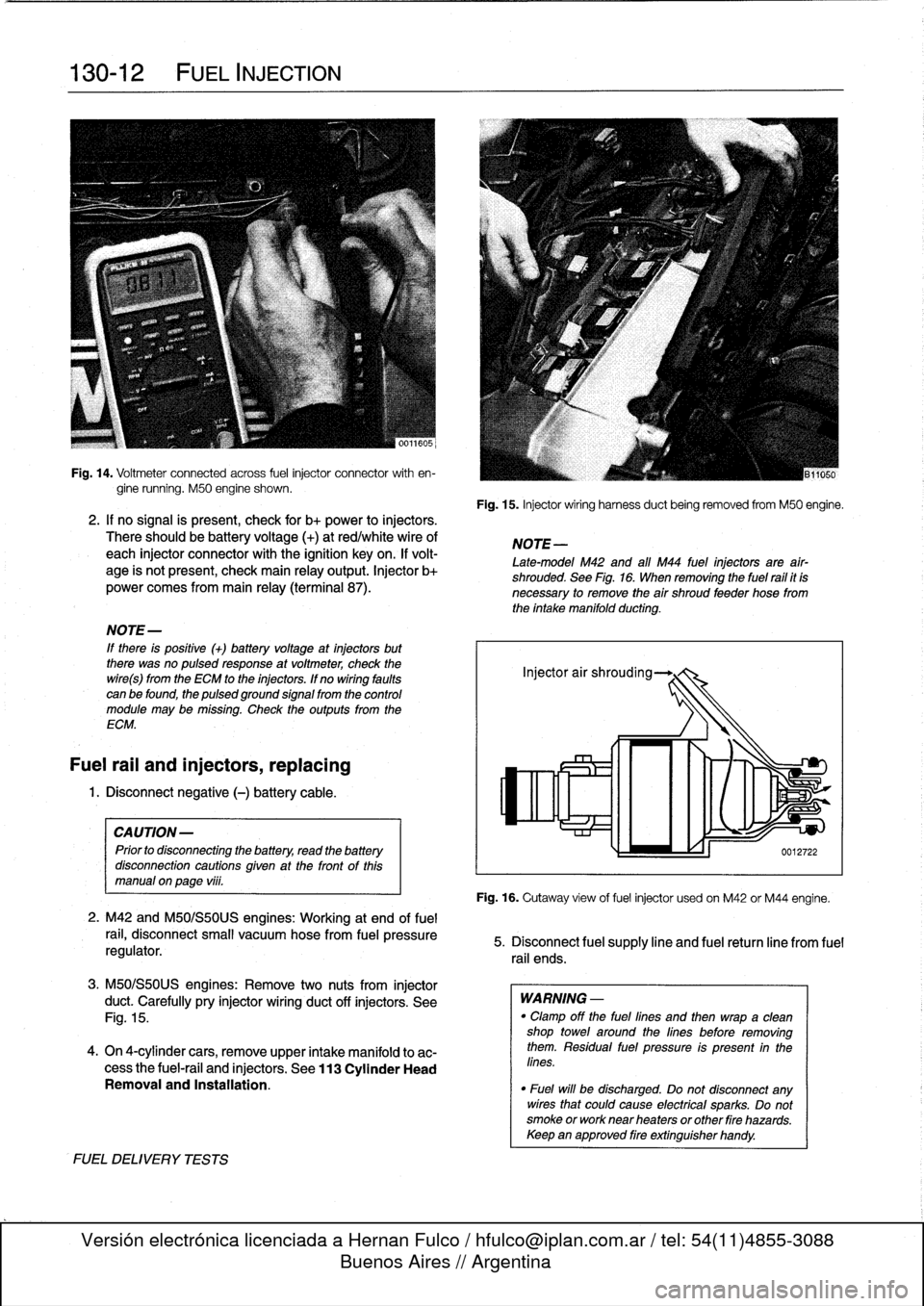
Fig
.
14
.
Voitmeter
connected
across
fuel
injector
connector
with
en-
gine
running
.
M50
engine
shown
.
2
.
If
no
signal
is
present,
check
for
b+
power
to
injectors
.
There
should
be
battery
voltage
(+)
at
red/whitewire
of
each
injector
connector
with
the
ignition
key
on
.
If
volt-
age
is
not
present,
check
main
relay
output
.
Injector
b+
power
comes
from
main
relay
(terminal
87)
.
NOTE-
If
there
is
positive
(+)
batteryvoltage
at
injectors
but
there
was
no
pulsedresponse
at
voltmeter,
check
the
wire(s)
from
the
ECM
to
the
injectors
.
If
no
wiring
faults
can
be
found,
the
pulsed
ground
signal
from
the
control
module
may
be
missing
.
Check
the
outputs
from
the
ECM
.
Fuel
rail
and
injectors,
replacing
1
.
Disconnect
negative
(-)
battery
cable
.
CAUTION-
Prior
to
disconnectiog
the
battery,
read
the
battery
disconnection
cautions
given
at
the
tront
of
this
manual
on
page
viii
.
2
.
M42
and
M50/S50US
engines
:
Working
at
end
offuel
rail,
disconnect
small
vacuum
hose
from
fuel
pressure
regulator
.
3
.
M50/S50US
engines
:
Remove
two
nuts
from
injector
duct
.
Carefully
pry
injector
wiring
duct
off
ínjectors
.
See
Fig
.
15
.
4
.
On
4-cylinder
cars,
remove
upper
intake
manifold
to
ac-
cess
the
fuel-rail
and
injectors
.
See
113
Cylinder
Head
Removal
and
Installation
.
FUELDELIVERYTESTS
Fig
.
15
.
Injector
wiring
harness
duct
being
removed
from
M50
engine
.
NOTE
-
Late-model
M42
and
all
M44
fuel
injectors
are
afr-
shrouded
.
See
Fig
.
16
.
When
removing
the
fuel
rail
it
is
necessary
to
remove
the
air
shroud
feeder
hose
from
the
intake
manifold
ducting
.
Fig
.
16
.
Cutaway
view
of
fuelinjector
usedon
M42
or
M44
engine
.
5
.
Disconnect
fuel
supply
line
and
fuel
retum
line
from
fuel
rail
ends
.
WARNING
-
"
Clamp
off
the
fuel
lines
and
then
wrapa
clean
shop
towei
around
the
lines
before
removing
them
.
Residual
fuel
pressure
is
present
in
the
lines
.
"
Fuel
will
be
discharged
.
Do
not
disconnect
any
wires
that
could
cause
electrical
sparks
.
Do
not
smoke
or
worknear
heaters
or
other
fire
hazards
.
Keepan
approved
fire
extinguisher
handy
.