Iat BMW 325i 1993 E36 Workshop Manual
[x] Cancel search | Manufacturer: BMW, Model Year: 1993, Model line: 325i, Model: BMW 325i 1993 E36Pages: 759
Page 2 of 759
B
-
1
ROBERT
BENTLEY,
INC
.
I
AUTOMOTIVE
PUBLISHERS
Information
that
makes
1734
Massachusetts
Avenue
the
difference
o
Cambridge,
MA
02138
USA
800-423-45951617-547-4170
www
.rb
.co
m
e-mail
:
sales@rb
.co
m
WARNING-Important
Safety
Notice
Technical
Contact
Information
We
value
your
feedback
.
Technical
comments
and
suggestions
are
helpful
to
us
.
Please
send
your
comments
and
thoughts
to
Bentley
Publishers
e-mail
:
tech
.bmw@rb
.co
m
From
timeto
time,
updates
may
be
made
tothis
manual
.
A
listing
of
updates
canbe
found
on
the
web
Iat
www
.rb
.com/update
s
Do
not
use
this
manual
unless
you
are
familiar
with
basic
automotive
repair
procedures
and
safe
workshop
practices
.
This
manual
illustrates
the
workshop
procedures
required
for
most
service
work
.
It
is
not
a
substitute
for
fui¡
and
up-to-dateinformation
from
the
vehicie
manufacturer
or
for
proper
training
asan
automotive
technician
.
Note
that
it
is
not
possible
for
us
to
anticipate
al¡
of
the
ways
or
conditions
under
which
vehicles
may
be
serviced
or
to
provide
cautions
as
to
all
of
the
possible
hazards
that
may
result
.
The
vehicie
manufacturer
will
continue
to
issue
service
information
updates
and
parts
retrofits
after
the
editorial
closing
of
this
manual
.
Some
of
those
updates
and
retrofits
will
apply
to
procedures
and
specifications
in
this
manual
.
We
regret
that
we
cannot
supply
updates
to
purchasers
of
this
manual
.
We
haveendeavored
to
ensure
the
accuracy
of
the
information
in
this
manual
.
Please
note,
however,
that
considering
thevast
quantity
and
the
complexity
of
the
service
information
involved,
we
cannot
warrant
the
accuracy
or
completeness
of
the
information
contained
in
this
manual
.
FORTHESE
REASONS,NEITHERTHEPUBLISHER
NORTHE
AUTHOR
MAKES
ANY
WARRANTIES,
EXPRESS
OR
IMPLIED,THATTHE
INFORMATION
IN
THIS
BOOK
IS
FREE
OF
ERRORS
OR
OMISSIONS,
AND
WE
EXPRESSLY
DISCLAIMTHE
IMPLIED
WARRANTIESOF
MERCHANTABILITY
AND
OF
FITNESS
FOR
A
PARTICULAR
PURPOSE,
EVEN
IF
THE
PUBLISHER
OR
AUTHOR
NAVEBEEN
ADVISED
OF
A
PARTICULAR
PURPOSE,
AND
EVEN
IF
A
PARTICULAR
PURPOSE
IS
INDICATED
IN
THE
MANUAL
.
THE
PUBLISHER
AND
AUTHOR
ALSO
DISCLAIM
ALL
LIABILITY
FOR
DIRECT,
INDIRECT,
INCIDENTAL
OR
CONSEQUENTIAL
DAMAGES
THAT
RESULT
FROM
ANYUSE
OF
THE
EXAMPLES,
INSTRUCTIONS
OR
OTHER
INFORMATION
IN
THIS
BOOK
.I
N
NO
EVENTSHALL
OUR
LIABILITY
WHETHER
INTORT,
CONTRACT
OR
OTHERWISE
EXCEEDTHECOST
OFTHIS
MANUAL
.
Your
common
sense
and
good
judgment
are
crucial
to
safe
and
successful
service
work
.
Read
procedures
through
before
starting
them
.
Thinkabout
whether
the
condition
of
your
car,
your
leve¡
of
mechanical
skill,
or
your
leve¡
of
reading
comprehension
might
result
in
or
contribute
in
some
way
to
an
occurrence
which
might
cause
you
injury,
damage
your
car,or
result
in
an
unsafe
repair
.
lf
you
have
doubts
for
these
or
other
reasons
about
your
ability
to
perform
safe
repair
workon
your
car,
have
the
work
done
at
an
authorized
BMW
dealeror
other
qualified
shop
.
Part
numbers
listed
inthis
manual
are
for
identification
purposes
only,
not
for
ordering
.
Always
check
with
your
authorized
BMW
dealer
toverifypart
numbers
and
availability
beforebeginning
service
work
that
may
requíre
new
parts
.
Before
attempting
any
work
on
your
BMW,
read
the
wamings
and
cautions
on
pages
vi¡
and
vi¡¡,
andany
waming
or
caution
that
accompanies
a
procedure
in
the
service
manual
.
Review
the
warnings
and
cautions
on
pages
vi¡
and
viü
each
time
you
prepare
to
workon
your
BMW
.
Special
tools
required
to
perform
certain
service
operations
are
identified
in
the
manual
and
are
recommended
for
use
.
Use
of
tools
other
than
those
recommended
inthis
service
manual
may
be
detrimental
to
the
car's
safe
operation
as
well
as
the
safety
of
the
person
servicing
thecar
.
Copies
of
this
manual
may
be
purchased
from
most
automotiveaccessories
and
parts
dealers
specializing
in
BMW
automobiles,
from
selected
booksellers,
or
directly
from
the
publisher
by
mail
.
The
publisher
encourages
comments
from
the
reader
of
this
manual
.
These
communications
havebeen
and
will
be
carefully
considered
in
the
preparation
of
this
and
other
manuals
.
Please
write
to
Robert
Bentley,
Inc
.,
Publishers
at
the
address
listed
on
the
top
of
this
page
.
This
manual
was
published
byRobert
Bentley,
Inc
.,
Publishers
.
BMW
has
not
reviewed
and
does
not
vouch
forthe
accuracy
of
thetechnical
specifications
and
procedures
described
in
this
manual
.
Libraryof
Congress
Cataloging-in-Publication
Data
BMW
3
SeriesService
ManualM3,
318i,
323i,3251,
328i,
Sedan,
Coupe
and
Convertible
:
1992,
1993,
1994,
1995,
1996,1997,
1998
.
p
.
c
m
.
Includes
index
.
ISBN
0-8376-0326-9
1
.
BMW
3
Series
automobile--Maintenance
and
repair--Handbooks,
manuals,
etc
.
I
.
Robert
Bentley,
inc
.
TL215
.13251356
1999
629
.28'
722--cic21
99-17179
CIP
Bentley
Stock
No
.
B398
Editorial
closing
01/99
0302010099
1098765432
The
paper
used
in
this
publication
is
acidfree
and
meets
the
requirements
of
the
National
Standard
for
Information
Sciences-
Permanence
of
Paper
for
PrintedLibrary
Materials
.
O
©Copyright
1999
Robert
Bentley,
Inc
.
All
rights
reserved
.
All
information
contained
in
this
manual
is
based
onthe
information
available
to
the
publisher
at
the
time
of
editorial
closing
.
The
right
is
reserved
to
make
changes
at
any
time
without
notice
.
No
partof
this
publication
may
be
reproduced,
stored
in
a
retrieval
system,
or
transmitted
in
any
form
orby
any
means,
electronic,
mechanical,
photocopying,
recording,
or
otherwise,
without
the
prior
written
consent
of
thepublisher
.
This
includes
text,
figures,
and
tables
.
All
rights
reserved
underBerne
andPan-American
Copyright
conventions
.
Manufactured
in
the
UnitedStates
of
America
Page 3 of 759
General
Data
and
010
FundamentalsfortheDo-lt-YourselfOwner
Maintenance
020
Maintenance
Program
Engine
Transmission
Suspension,
Steering
and
Brakes
4
Body
100
Engine-General
110
Engine
Removal
and
Installation
113
Cylinder
Head
Removal
and
Installation
116
Cylinder
Head
and
Valvetrain
117
Camshaft
Timing
Chain
119
Lubrication
System
200
Transmission-General
210
Clutch
230
Manual
Transmission
510
Exterior
Trim,
Bumpers
520
Seats
Bo
y
Equipment
512
DoorWTdws
540
nr
t
513
InteriorTrim
541
Convertible
Top
515
Central
Locking
and
Anti-Theft
600
Electrical
System-General
620
Instruments
Electrical
S
stem
610
Electrical
Component
Locations
630
Exterior
Lighting
611
Wipers
and
Washers
640
Heating
and
Air
Conditioning
6
612
Switches
and
Electrical
Accessories
650
Radio
Equipment
and
720
SeatBelts
Accessories
721
Airbag
System
(SRS)
Electrical
Wiring
Diagrams
Foreword
.
...
.
.
.
..................
.
.
.
.....
.
............
.
...
.
.
.
.
.
................
.
.
.
.....
.
......
.
................
.
.
.
.....
v
Warnings
and
Cautions
.....
.
...
.
.
.
.
.
..........
.
...
.
.
.
.
.
......
.
.........
.
.
.
...
.
.
.
......
.
.
.
.
.
............
.
.
.
.
.
.
.vii
Index
..............
.
.
.
.....
.
............
.
...
.
.
.
.
.
........
.
...
.
.
.
.
.
.......
.
......
.
...
.
.
.
.
.
.
.
........
.
.
.
..
back
of
book
300
Suspension,
Steering
and
330
RearSuspension
Brakes-General
331
Final
Drive
310
Front
Suspension
340
Brakes
320
Steering
and
Wheel
Alignment
400
Body-General
411
Doors
410
Fenders,
Engine
Hood
412
Trunk
Lid
120
Ignition
System
121
Battery,Starter,
Alternator
130
Fue¡
Injection
160
Fuel
Tank
and
Fuel
Pump
170
Radiator
and
Cooling
System180
Exhaust
System
240
Automatic
Transmission
250
Gearshift
Linkage
260
Driveshaft
Page 7 of 759
Please
read
these
warnings
and
cautions
before
proceeding
with
maintenance
and
repair
work
.
WARNING-
"
Friction
materials
(such
as
brake
pads
or
shorts
or
clutchdiscs)
contain
asbestos
fibers
or
other
friction
materials
.
Do
notcreate
"
See
also
Cautionson
page
viü
dustby
grinding,
sanding,
orby
cleaning
with
compressed
air
.
"
Some
repairs
may
be
beyond
your
capability
.
If
you
lack
the
Avoid
breathing
dust
.
Breathing
any
friction
material
dust
can
lead
skills,
tools
and
equipment,
or
a
suitable
workplace
for
any
proce-
to
serious
diseases
and
may
result
in
death
.
duredescribed
in
this
manual,
we
suggestyou
leave
such
repairs
"
Batteries
give
off
explosive
hydrogen
gas
during
charging
.
to
an
authorized
BMW
dealer
service
department
or
other
quali-
Keep
sparks,
lighted
matches
and
open
flame
away
from
the
top
fied
shop
.
of
the
battery
If
hydrogen
gas
escaping
from
the
cap
vents
is
"Do
not
re-use
any
fasteners
that
are
worn
or
deformed
in
normal
ignited,
it
will
ignite
gas
trapped
in
the
cells
and
cause
the
battery
use
.
Many
fasteners
are
designed
to
be
used
only
once
and
to
explode
.
become
unreliable
and
may
fail
when
used
a
second
time
.
This
"
Connect
and
disconnect
battery
cables,
jumper
cablesora
bat-
includes,
but
is
not
limited
to,
nuts,
bolts,
washers,
self-locking
nuts
or
bolts,
circlips
and
cotterpins
.
Always
replace
these
fasteners
with
new
parts
.
"Do
not
quick-charge
the
battery
(for
boost
starting)
for
longer
"
Never
work
under
a
lifted
car
unless
it
is
solidly
supportedon
than
one
minute
.
Wait
at
least
one
minute
before
boosting
the
bat-
stands
designed
for
the
purpose
.
Do
not
support
a
car
on
cinder
tery
a
second
time
.
blocks,
hollow
tiles
or
other
props
that
may
crumble
under
contin-
uous
load
.
Never
work
under
acar
that
is
supported
solely
by
a
"Do
not
allow
battery
charging
voltage
to
exceed
16
.5
volts
.
If
the
jack
.
Never
work
under
thecar
while
the
engine
is
running
.
battery
beginsproducing
gas
or
boiling
violently,
reduce
the
charg-
ing
rate
.
Boosting
a
sulfated
battery
at
a
high
charging
rate
can
"
If
you
are
going
to
work
under
acar
on
the
ground,
make
sure
cause
an
explosion
.
that
the
ground
is
level
.
Block
the
wheels
to
keep
the
carfrom
roll-
ing
.
Disconnect
the
battery
negative
(-)
terminal
(ground
strap)to
"
The
air-conditioning
system
is
filled
with
chemical
refrigerant,
prevent
others
from
starting
thecar
while
youare
under
it
.
which
is
hazardous
.
TheA/C
system
should
be
servicedonly
by
trained
technicians
using
approved
refrigerant
recovery/recycling
"
Never
run
the
engine
unless
the
work
area
is
well
ventilated
.
equipment,
trained
in
related
safetyprecautions,
and
familiar
with
Carbon
monoxide
kills
.
regulations
governing
the
discharging
and
disposal
of
automotive
"
Finger
rings,
bracelets
and
other
jewelry
shouldbe
removed
so
chemical
refrigerants
.
tery
charger
only
with
the
ignition
switched
off,
to
prevent
sparks
.
Do
not
disconnect
the
battery
while
the
engine
is
running
.
that
theycannot
cause
electrical
shorts,
get
caught
in
running
"
Do
not
expose
any
partof
the
A/Csystem
to
high
temperatures
machinery,
or
be
crushed
by
heavy
parts
.
suchas
open
flame
.
Excessiveheat
will
increase
system
pressure
"
Tie
long
hair
behind
your
head
.
Do
not
wear
a
necktie,
a
scarf,
and
may
cause
the
system
to
burst
.
loose
clothing,
or
a
necklace
when
you
work
near
machine
tools
or
"
Some
aerosol
tire
inflators
are
highly
flammable
.
Be
extremely
running
engines
.
If
your
hair,
clothing,
or
jewelry
were
to
get
caught
cautious
when
repairing
a
tire
that
may
havebeen
inflated
using
in
the
machinery,
severe
injury
could
result
.
an
aerosol
tire
inflator
.
Keep
sparks,
open
flame
or
other
sources
"
Do
not
attempt
to
work
onyourcar
if
you
do
not
feel
well
.
You
of
ignition
away
from
the
tire
repair
area
.
Inflate
and
deflate
the
tire
increase
the
danger
of
injury
toyourself
and
others
if
you
are
tired,
at
least
four
times
before
breaking
the
bead
from
therim
.
Com-
upset
or
have
takenmedication
or
any
other
substance
that
may
Pletely
remove
the
tire
from
the
rim
beforeattempting
any
repair
.
keep
you
from
being
fully
alert
.
"
Illuminate
your
work
areaadequately
but
safety
.
Use
a
portable
safety
light
for
working
inside
or
under
thecar
.
Make
surethe
bulb
is
enclosedbya
wire
cage
.
The
hot
filament
of
an
accidentally
bro-
ken
bulb
can
ignite
spilled
fuel
or
oil
.
"
Catch
draining
fuel,
oil,
orbrake
fluid
in
suitable
containers
.
Do
not
use
food
or
beverage
containers
that
mightmislead
someone
into
drínking
from
them
.
Store
flammable
fluids
away
from
fire
haz-
ards
.
Wipe
up
spills
at
once,
but
do
not
store
the
oily
rags,
which
can
ignite
and
burn
spontaneously
.
"
Always
observe
good
workshop
practices
.
Wear
goggles
when
youoperate
machine
tools
or
work
with
battery
acid
.
Gloves
or
other
protectioeclothing
should
be
worn
whenever
thejob
requires
working
with
harmful
substances
.
"
Greases,
lubricants
and
other
automotive
chemicals
contain
toxic
substances,
many
of
which
are
absorbed
directly
through
the
skin
.
Read
the
manufacturer's
instructions
and
warnings
carefully
.
Use
hand
andeye
protection
.
Avoid
direct
skin
contact
"
Cars
covered
by
this
manual
are
equipped
with
a
supplemental
restraint
system
(SRS),
that
automatically
deploys
an
airbag(s)
in
theevent
of
a
frontal
ímpact
.
The
airbag(s)
is
inflated
byan
explo-
sive
device
.
Handled
improperly
or
without
adequate
safeguards,
can
be
accidently
activated
and
cause
serious
injury
.
"
The
ignition
system
produces
high
voltages
that
can
be
fatal
.
Avoid
contact
with
exposed
terminals
and
use
extreme
care
when
working
ona
car
with
the
engine
running
or
the
ígnition
switched
on
.
"
Place
jack
stands
only
at
locations
specified
bymanufacturer
.
The
vehicle
lifting
jacksupplied
with
the
vehicle
is
intended
for
tire
changes
only
.
A
heavy
duty
floor
jack
shouldbe
used
to
lift
vehicle
before
installing
jack
stands
.
See
010
Fundamentals
for
theDo-
.
it-Yourself
Owner
.
"
Battery
acid
(electrolyte)
can
cause
severeburns
.
Flush
contact
area
with
water,
seek
medical
attention
.
"
Aerosolcleaners
and
solvents
may
contain
hazardous
ordeadly
vapors
and
are
highly
flammable
.
Use
only
in
a
wellventilated
area
.
Do
not
use
on
hot
surfaces
(engines,
brakes,
etc
.)
.
"
Disconnect
the
battery
negative
(-)
terminal
(Ground
strap)
"
Do
not
remove
coolant
reservoir
or
radiator
cap
with
theengine
whenever
you
work
on
the
fuel
system
orthe
electrical
system
.
Do
hot
.
Danger
of
bums
and
engine
damage
.
not
smoke
or
work
near
heaters
or
other
fire
hazards
.
Keep
an
approved
fire
extinguisher
handy
.
continued
on
next
page
vii
Page 8 of 759
Please
read
these
warnings
and
cautions
before
proceeding
with
maintenance
and
repair
work
.
CAUTION-
"
See
also
Warnings
onpage
vi¡
"
Beforedoing
any
electrical
welding
on
cars
equipped
with
ABS,
disconnect
the
battery
negative
(-)
terminal
(ground
strap)
and
the
"
If
you
lack
the
skills,
tools
and
equipment,
ora
suitable
work-
ABS
control
unit
connector
.
shop
for
any
procedure
described
in
this
manual,
we
suggest
you
leave
such
repairs
to
an
authorized
BMW
dealer
or
other
qualified
"
On
cars
equipped
with
anti-theft
radios,
make
sureyou
know
the
shop
.
correct
radio
activation
code
before
disconnecting
the
battery
or
removing
the
radio
.
lf
the
wrong
code
is
entered
into
the
radio
"
BMW
is
constantly
improving
its
cars
and
sometimes
these
when
power
is
restored,
that
radio
may
lock
up
and
be
renderedchanges,
both
in
parts
and
specifications,
are
made
applicable
to
inoperable,
even
if
the
correct
code
is
thenentered
.
earlier
models
.
Therefore,
part
numbers
listed
in
this
manual
are
for
reference
only
.
Always
check
with
your
authorized
BMW
dealer
"
Always
make
sure
ignition
is
off
before
disconnecting
battery
.
parts
department
for
the
latest
information
.
"
Label
battery
cablesbefore
disconnecting
.
Onsome
models,
"
Before
starting
a
job,
make
certain
that
you
have
all
the
neces-
battery
cablesarenot
color
coded
.
sary
tools
and
parts
on
hand
.
Read
al¡
the
instructions
thoroughly,
do
not
attempt
shortcuts
.
Use
tools
appropriate
to
the
work
and
"
Disconnecting
the
battery
may
erase
fault
code(s)
stored
in
con-
use
only
replacement
parts
meeting
BMW
specifications
.
Make-
trol
module
memory
Using
special
BMW
diagnostíc
equipment,
shift
tools,
parts
and
procedures
will
not
make
good
repairs
.
check
forfault
codes
prior
to
disconnecting
the
battery
cables
.If
the
Check
Engine
light
is
illuminated,
see100
Engine-General
for
"
Use
pneumatic
and
electric
tools
only
to
loosenthreaded
parts
On-Board
Diagnostics
(OBD)
fault
code
information
.
lf
any
other
and
fasteners
.
Never
use
these
tools
to
tighten
fasteners,
espe-
system
faults
have
been
detected
(indicated
by
an
ílluminated
cially
on
light
alloy
parts
.
Always
use
a
torque
wrench
to
tighten
warning
light),
see
an
authorized
BMW
dealer
.
fasteners
to
the
tightening
torque
specification
listed
.
"
If
a
normal
or
rapid
charger
is
used
to
charge
battery,
the
battery
"Be
mindful
of
the
environment
and
ecology
.
Before
you
drain
the
mustbe
disconnected
and
removed
fromthe
vehicle
in
order
to
crankcase,
find
outthe
proper
way
to
dispose
of
the
oil
.
Do
not
avoid
damaging
paint
and
upholstery
pour
oil
onto
the
ground,
down
a
drain,
or
into
a
stream,
pond
orlake
.
Dispose
of
in
accordance
withFederal,
State
and
Local
laws
.
"Do
not
quick-chargethe
battery
(for
boost
starting)
for
longer
than
one
minute
.
Wait
at
least
one
minute
before
boosting
the
bat-
e
If
battery
power
is
lost
or
the
battery
has
been
disconnected,
the
tery
a
second
time
.
powerwindows
must
be
re-initialized
.
Both
one
touch
up/down
and
pinch-protection
will
be
inactive
until
windows
are
re-initial-
"
Connect
and
disconnect
a
battery
charger
only
with
the
battery
ized
.
See
512
Door
Windows
.
charger
switched
off
.
"
The
control
module
for
the
anti-lock
brake
system
(ABS)
cannot
withstand
temperatures
from
a
paint-drying
booth
or
aheat
lamp
in
excess
of
203°F
(95°C)
and
should
not
be
subjected
to
temper-
atures
in
excess
of
185°F
(85°C)
for
more
than
twohours
.
"
Sealed
or
"maintenance
free"
batteries
shouldbeslow-charged
only,
at
anamperage
ratethat
is
approximately
10%
of
the
bat-
tery's
ampere-hour
(Ah)
rating
.
"
Do
not
allow
battery
chargingvoltage
to
exceed
16
.5
volts
.
If
the
battery
begins
producing
gas
or
boiling
violently,
reduce
the
charg-
ing
rate
.
Boosting
a
sulfated
battery
at
a
high
charging
rate
can
cause
an
explosion
.
Page 16 of 759
010-
8
FUNDAMENTALSFORTHE
DO-ITYOURSELF
OWNER
TOOLS
Mostmaintenance
can
be
accomplished
with
a
small
selec-
tion
of
the
right
tools
.
Toolsrange
in
quality
from
inexpensive
junk,
which
may
brakk
at
first
use,
tovery
expensive
and
well-
made
tools
for
the
professional
.
The
best
tools
for
most
do-it
yourself
BMW
owners
He
somewhere
in
between
.
O
Many
reputable
tool
manufacturers
offer
good
quality,
mod-
erately
priced
tools
with
a
lifetime
guarantee
.
These
are
your
best
buy
.
They
cost
a
little
more,
but
they
are
good
quality
tools
that
will
dowhat
is
expected
of
them
.
Sears'
Craftsman®
line
is
one
such
source
of
good
quality
tools
.
Some
of
the
repairs
covered
in
this
manual
require
the
use
of
special
tools,
suchas
a
custom
puller
or
specialized
electrical
test
equipment
.
These
special
tools
are
called
out
in
the
text
andcan
be
purchased
through
an
authorized
BMW
dealer
.
As
an
alternative,
some
special
tools
mentioned
may
be
pur-
chased
from
the
following
tool
manufacturers
andlor
distribu-
tors
:
"
Assenmacher
Specialty
Tools
6440
Odell
Place,Boulder,
CO
80301
(303)
530-2424
"
Baum
Tools
Unlimited
.
Inc
.
PO
.
Box
87,
Longboat
Key,
FL
34228
(800)
848-6657
"
Schley
Products
Inc
.
5350
E
.
Hunter
Ave
.,
Anaheim
Hills,
CA
92807
(714)
693-7666
"
Zelenda
Machine
and
Tool
Corp
.
66-02
Austin
Street,
Forest
Hills,
NY
11375
(718)
896-2288
Basic
Tool
Requirements
The
basic
hand
tools
described
below
canbe
used
to
accom-
plish
most
of
thesimple
maintenance
and
repair
tasks
.
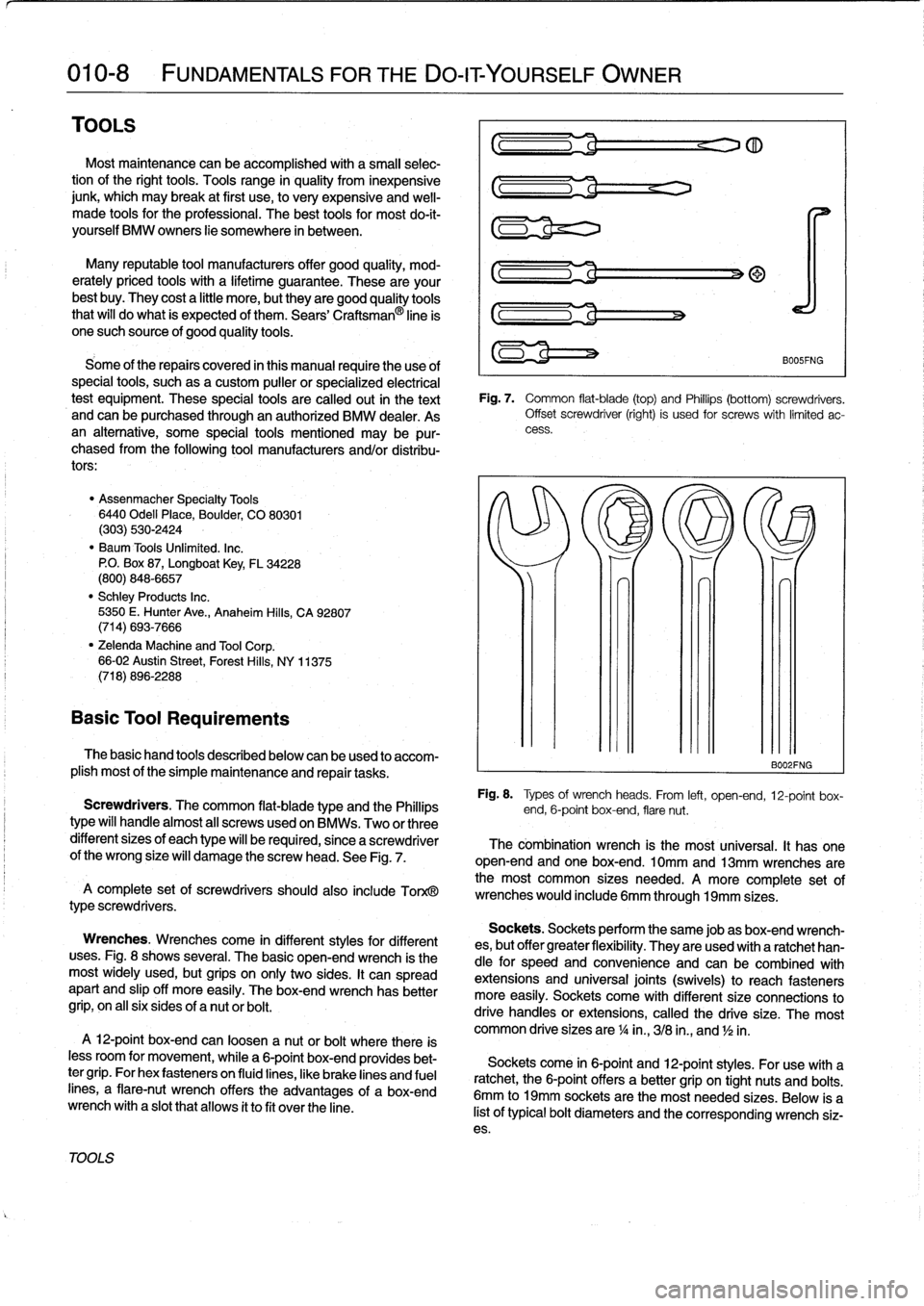
Fig
.
8
.
Types
of
wrench
heads
.
From
left,
open-end,
12-point
box-
Screwdrivers
.
The
common
fíat-blade
type
and
the
Phillips
end,6-point
box-end,
fiare
nut
.
type
will
handlealmost
all
screws
used
on
BMWs
.
Two
orthree
different
sizes
of
each
type
will
be
required,
since
a
screwdriver
The
cómbination
wrench
is
the
most
universal
.
It
hasone
of
the
wrong
size
will
damage
the
screw
head
.
See
Fig
.
7
.
open-end
andone
box-end
.
10mm
and
13mm
wrenches
arethe
most
common
sizes
needed
.
A
more
complete
set
of
A
complete
set
of
screwdrivers
should
also
include
Torx@
wrenches
would
inciude
6mm
through
19mm
sizes
.
typescrewdrivers
.
Wrenches
.
Wrenches
come
in
different
styles
for
different
uses
.
Fig
.
8
shows
several
.
The
basic
open-end
wrench
is
the
most
widely
used,
but
grips
on
only
two
sides
.
It
can
spread
apart
and
slip
off
more
easily
.
The
box-end
wrench
has
better
grip,
on
al¡
six
sides
of
a
nut
or
bolt
.
A
12-point
box-end
can
loosen
a
nut
or
bolt
where
there
is
less
room
for
movement,
while
a
6-point
box-end
provides
bet-
ter
grip
.
Forhex
fasteners
on
fluid
lines,
like
brake
lines
and
fuel
lines,
a
fiare-nut
wrench
offers
the
acivantages
of
a
box-end
wrench
with
a
slot
that
ailows
it
to
fit
over
the
line
.
TOOLS
B005FNG
Fig
.
7
.
Common
flat-blade
(top)
and
Phillips
(bottom)
screwdrivers
.
Offset
screwdríver
(right)
is
used
for
screws
with
limited
ac-
cess
.
B002FNG
Sockets
.
Socketsperform
the
same
job
asbox-end
wrench-
es,
but
offer
greater
flexibility
.
They
are
used
with
a
ratchet
han-
dle
for
speed
and
conveniente
and
can
be
combined
with
extensions
and
universal
joints
(swivels)
to
reach
fasteners
more
easily
.
Sockets
come
with
different
size
connections
to
drive
handies
or
extensions,
called
the
drive
size
.
The
most
common
drive
sizes
are
1
/4
in
.,
318
in
.,
and
1
/2
in
.
Sockets
come
in
6-point
and
12-point
styles
.
For
use
with
a
ratchet,
the
6-point
offers
a
better
grip
on
tight
nuts
and
bolts
.
6mm
to
19mm
sockets
arethe
most
needed
sizes
.
Below
is
a
list
oftypical
bolt
diameters
and
the
corresponding
wrench
siz-
es
.
Page 19 of 759
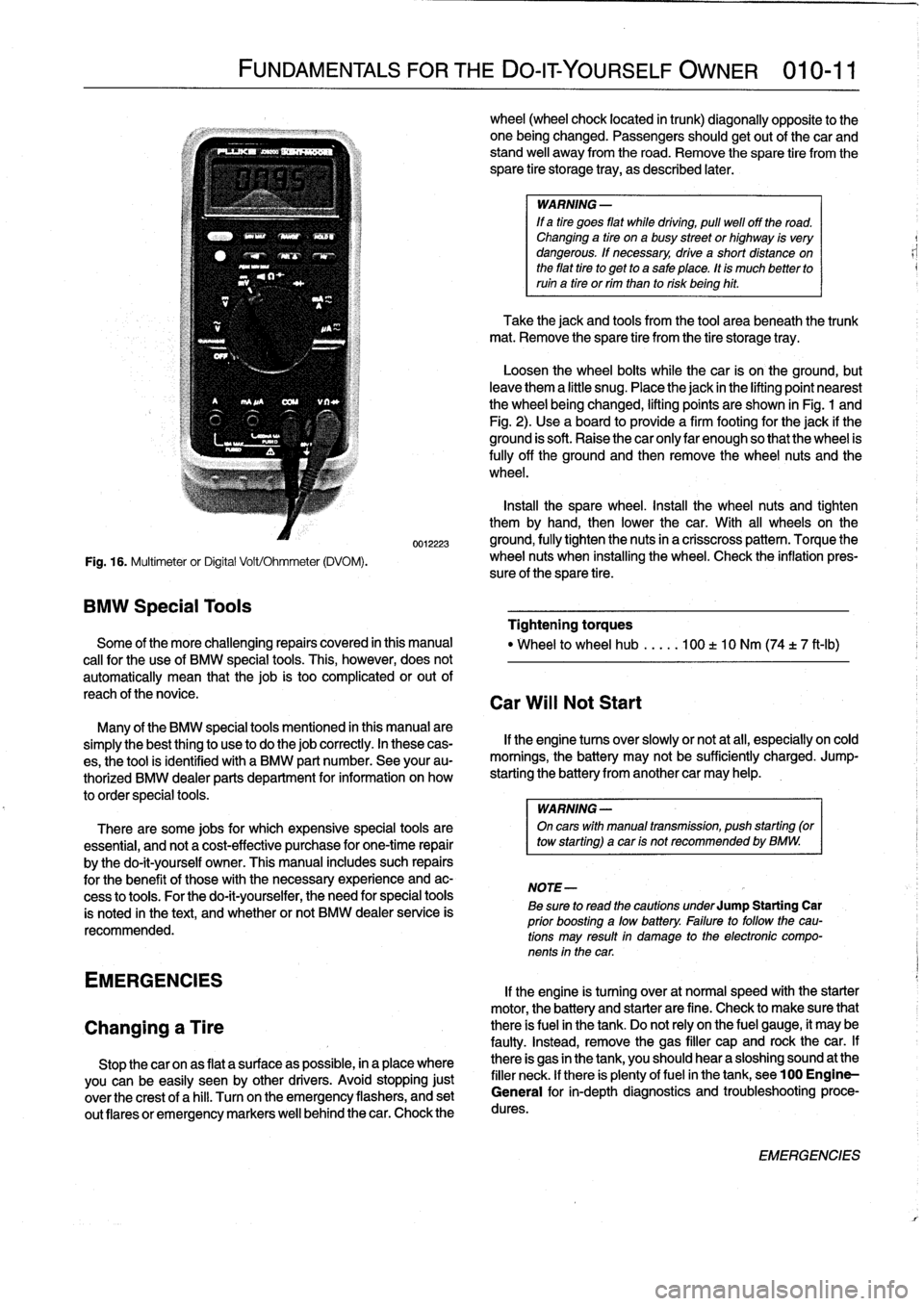
Fig
.
16
.
Multimeter
or
Digital
Volt/Ohmmeter
(DVOM)
.
BMW
Special
Tools
FUNDAMENTALS
FOR
THE
DO-ITYOURSELF
OWNER
010-11
0012223
Some
of
the
more
challenging
repairs
covered
in
this
manual
cal¡
for
the
use
of
BMW
special
tools
.
This,
however,
does
not
automatically
mean
that
thejob
is
too
complicated
or
out
of
reach
of
thenovice
.
Many
of
the
BMW
special
tools
mentioned
in
this
manual
are
simplythe
best
thing
to
use
to
do
thejob
correctly
.
In
these
cas-
es,
the
tool
is
identified
with
a
BMW
part
number
.
See
your
au-
thorized
BMW
dealer
parts
department
for
information
on
how
to
order
special
tools
.
There
are
some
jobs
for
which
expensive
special
tools
are
essential,
and
not
a
cost-effective
purchase
for
one-time
repair
by
the
do-it-yourself
owner
.
This
manual
includes
such
repairs
for
the
benefit
of
these
with
the
necessary
experience
and
ac-
cess
to
tools
.
For
the
do-it-yourselfer,
the
need
for
special
tools
is
noted
in
the
text,
and
whether
or
not
BMW
dealer
service
is
recommended
.
EMERGENCIES
Changing
a
Tire
Stop
thecar
onas
flat
a
surface
as
possible,
in
a
place
where
you
canbe
easily
seen
by
other
drivers
.
Avoid
stopping
just
over
the
crest
of
a
hill
.
Turnon
the
emergency
flashers,
and
set
out
(lares
or
emergency
markers
well
behindthecar
.
Chock
the
wheel
(wheel
chock
located
in
trunk)
diagonally
opposite
to
the
one
being
changed
.
Passengers
shouldgetout
of
thecar
and
stand
well
away
from
the
road
.
Remove
the
spare
tire
from
the
spare
tire
storage
tray,
as
described
later
.
WARNING
-
If
a
tire
goes
fíat
while
drtving,
pull
well
off
the
road
.
Changing
a
tire
ona
busy
street
or
highway
is
very
dangerous
.
If
necessary,
drive
a
short
distance
on
the
fíat
tire
to
get
to
a
sale
place
.
tt
is
much
better
to
ruin
a
tire
or
rim
than
to
risk
being
hit
.
Take
the
jack
and
tools
from
the
tool
area
beneath
the
trunk
mat
.
Remove
the
spare
tire
from
the
tire
storage
tray
.
Loosen
the
wheel
bolts
while
the
car
is
on
the
ground,
but
leave
them
a
little
snug
.
Placethe
jack
in
the
lifting
point
nearest
the
wheel
beingchanged,
lifting
points
are
shown
in
Fig
.
1
and
Fig
.
2)
.
Use
a
board
to
provide
a
firm
footing
for
the
jack
if
the
ground
is
soft
.
Raise
the
car
only
lar
enough
so
that
the
wheel
is
fully
off
the
ground
and
then
remove
the
wheel
nuts
and
the
wheel
.
Insta¡¡
the
spare
wheel
.
Install
the
wheel
nuts
and
tighten
them
by
hand,
then
lower
the
car
.
With
all
wheelson
the
ground,
fully
tighten
the
nuts
in
a
crisscross
pattern
.
Torque
the
wheel
nuts
when
installing
the
wheel
.
Check
the
inflation
pres-
sure
of
the
spare
tire
.
Tightening
torques
"
Wheel
to
wheel
hub
.....
100
t
10
Nm
(74
t
7
ft-Ib)
Car
Will
Not
Start
If
the
engine
tucos
over
slowly
or
not
at
all,
especially
on
cold
mornings,
the
battery
may
not
be
sufficiently
charged
.
Jump-
starting
the
battery
from
another
car
may
help
.
WARNING
-
On
carswith
manual
transmisston,
push
starting
(or
tow
starting)
acar
ts
not
recommended
by
BMW
.
NOTE-
Be
sure
to
read
the
cautions
underJump
Starting
Car
prior
boosting
a
low
battery
.
Fatlure
to
followthe
cau-
tions
may
result
in
damage
to
the
electronic
compo-
nents
in
the
car
.
If
the
engine
is
turning
over
at
normal
speed
with
the
starter
motor,
the
battery
and
starter
are
fine
.
Check
to
make
sure
that
there
is
fuel
in
the
tank
.
Do
not
rely
on
the
fuel
gauge,
it
may
be
faulty
.
Instead,
remove
the
gas
filler
cap
and
rock
thecar
.
If
there
is
gas
in
the
tank,
you
should
hear
a
sloshing
sound
at
the
filler
neck
.
lf
there
is
plenty
offuel
in
the
tank,
see100
Engine-
General
for
in-depth
diagnostics
and
troubleshootingproce-
dures
.
EMERGENCIES
Page 20 of 759
010-12
FUNDAMENTALSFOR
THE
DO-IT
YOURSELF
OWNER
Jump
Starting
Car
Cars
with
discharged
or
dead
batteries
can
be
jump-started
using
the
good
battery
from
another
car
.
When
jump-starting
the
engine,
always
note
the
following
warnings
.
WARNING
-
"
Battery
acid
(electrolyte)
can
cause
severe
burns,
and
will
damage
the
car
and
clothing
.
lf
electrolyte
is
spilled,
wash
the
surface
with
large
quantities
of
water
.
lfit
gets
finto
eyes,
flush
them
with
water
for
severa¡
minutes
and
cal¡
a
doctor
.
"
Batteries
produce
explosive
and
noxious
gas-
ses
.
Keep
sparks
and
flames
away
.
Do
not
smoke
near
batteries
.
"
Do
not
jump-start
the
engine
if
you
suspect
that
the
battery
is
frozen
.
Trapped
gas
may
explode
.
Allow
the
battery
to
thaw
first
.
"
Do
not
quick-charge
the
battery
(for
boost
start-
ing)for
longer
than
one
minute,
and
donot
ex-
ceed
15
volts
at
the
battery
with
the
boosting
cables
attached
.
Wait
at
least
one
minutebefore
boosting
the
battery
a
second
time
.
"
Some
electrical
system
'comfort"
features
may
not
function
correctly
once
battery
power
is
restored
.
For
example,
the
front
window
one-touch-up
func-
tion
may
be
disabled
.
Some
electrical
systems
will
need
to
be
reinitialized
Consult
the
appropriate
re-
pairgroup
formore
specific
information
.
1
.
Place
cars
close
together,
but
do
not
allow
them
to'touch
each
other
.
Turn
off
the
engine
of
thecar
with
the
good
battery
.
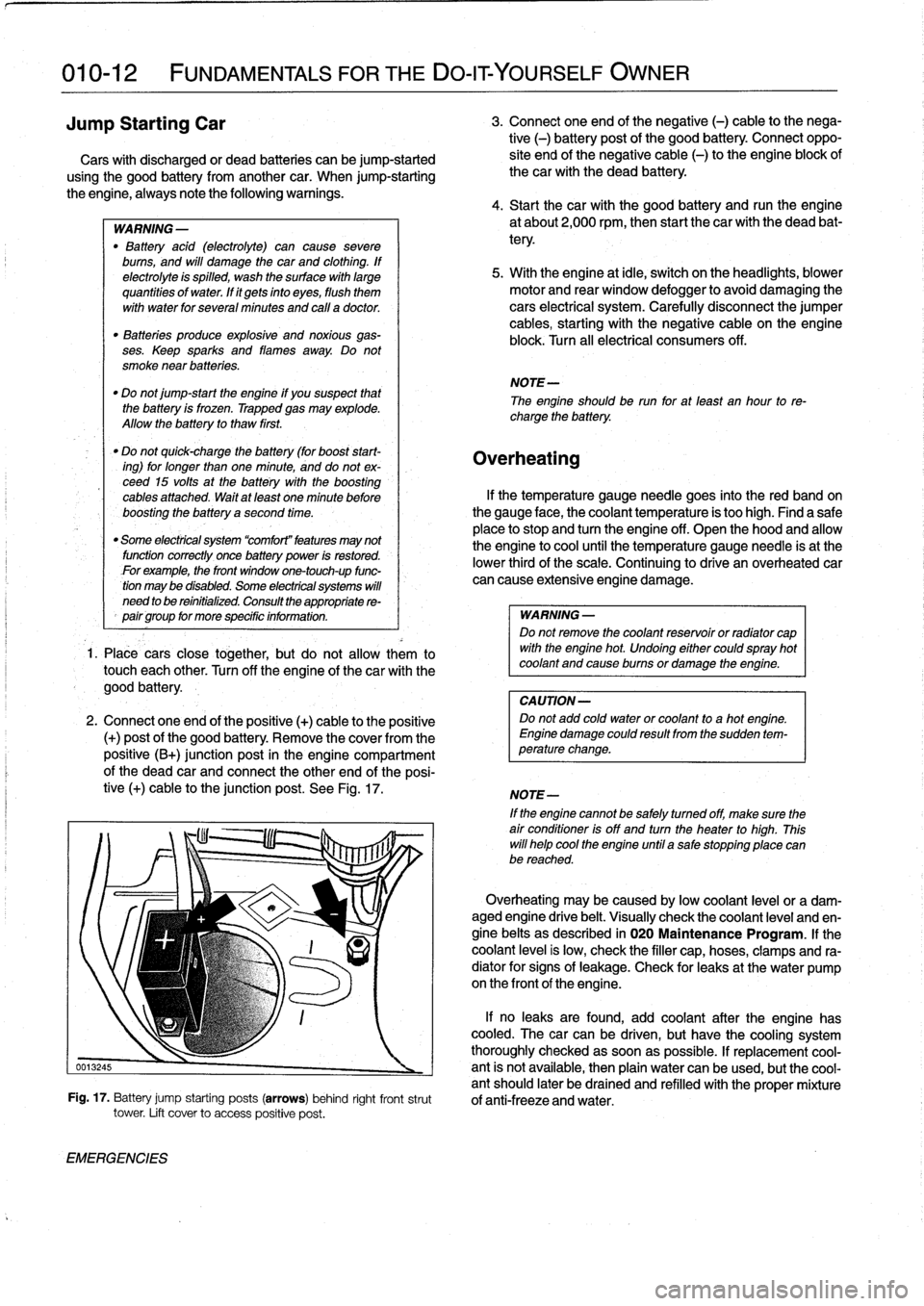
2
.
Connect
oneend
of
the
positive
(+)
cable
to
the
positive
(+)
post
of
the
good
battery
.
Remove
the
coverfromthe
positive
(B+)
junction
post
in
the
engine
compartment
of
the
dead
car
and
connect
the
other
end
of
the
posi-
tive
(+)
cable
to
the
junction
post
.
See
Fig
.
17
.
EMERGENCIES
3
.
Connect
one
end
of
the
negative
(-)
cable
to
the
nega-
tive
(-)
battery
post
of
the
good
battery
.
Connect
oppo-
site
end
of
the
negative
cable
(-)
to
the
engine
block
of
thecar
with
the
dead
battery
.
4
.
Start
thecar
with
the
good
battery
and
runthe
engine
at
about2,000
rpm,
then
start
the
car
with
the
dead
bat-
tery
.
5
.
With
the
engine
at
¡dle,
switch
on
the
headlights,
blower
motor
and
rear
window
defogger
to
avoid
damaging
the
cars
electrical
system
.
Carefully
disconnect
the
jumper
cables,
starting
with
the
negative
cable
on
the
engine
block
.
Turn
all
electrical
consumers
off
.
NOTE-
The
engineshould
be
run
for
at
least
an
hour
to
re-
charge
the
battery
.
Overheating
lf
the
temperature
gauge
needle
goes
into
the
red
band
on
the
gauge
face,
the
coolant
temperature
is
too
high
.
Find
a
safe
place
to
stop
and
turn
the
engine
off
.
Open
the
hood
and
allow
the
engine
to
cool
until
the
temperature
gauge
needle
is
at
the
lower
thirdof
the
scale
.
Continuing
to
drive
an
overheated
car
can
cause
extensive
engine
damage
.
WARNING
-
Do
not
remove
the
coolant
reservoir
or
radíator
cap
with
the
engine
hot
.
Undoing
either
couldspray
hot
coolant
and
cause
burns
or
damage
the
engine
.
CAUTION-
Do
not
add
cold
water
or
coolant
to
a
hot
engine
.
Engine
damage
could
result
from
the
sudden
tem-
perature
change
.
NOTE-
If
the
enginecannot
be
safely
tumed
off,
make
sure
the
air
condifioner
isoff
and
turn
the
heater
to
high
.
This
will
helo
cool
the
engine
until
a
salestopping
place
canbe
reached
.
Overheating
may
be
caused
bylow
coolant
leve¡
or
a
dam-aged
engine
drive
belt
.
Visually
check
the
coolant
leve¡
and
en-
gine
belts
as
described
in
020
Maintenance
Program
.
lf
the
coolant
leve¡
is
low,
check
the
filler
cap,hoses,
clamps
and
ra-
diator
for
signs
of
leakage
.
Check
for
leaks
at
the
water
pump
on
the
frontof
theengine
.
lf
no
leaks
are
found,
add
coolant
after
the
engine
has
cooled
.
The
carcan
be
driven,
but
have
the
cooling
system
thoroughly
checked
assoonas
possible
.
lf
replacement
cool
0013245
-
ant
is
not
available,
then
plain
water
canbe
used,
butthe
cool-
antshould
later
be
drained
and
refilled
with
theproper
mixture
Fig
.
17
.
Battery
jump
starting
posts
(arrows)
behind
right
frontstrut
of
anti-freeze
and
water
.
tower
.
Lift
cover
to
access
positive
post
.
Page 21 of 759
If
steam
is
coming
from
the
engine
compartment
thenthere
is
With
the
engine
and
ignition
off,
check
for
loose
or
corroded
most
likely
a
burst
coolant
hose
or
a
large
leak
in
the
cooling
battery
cables
or
wires
at
the
battery
or
thealtemator
.
Discon-
system
.
To
find
the
leak,
look
for
signs
of
coolant
leakage
on
necting,
cleaning,
and
reinstalling
corroded
wires
and
connec-
hoses,
at
hose
connections,
or
on
the
radiator
.
Let
theengine
tors
may
solve
the
problem
.
Also
check
drive
belt
tension
as
cool
thoroughly,
then
add
coolant
or
water
to
fill
the
system
and
described
in
020
Maintenance
Program
.
start
the
engine
.
If
a
great
deal
of
water
or
coolant
flows
out
of
the
hole,
then
thecarshouldnot
be
driven
until
repairs
are
made
.
lf
there
is
slight
seepage,
then
it
may
be
possible
to
drive
TOWi
ng
a
short
distance,
adding
coolant
as
needed
.
The
cars
covered
by
this
manual
should
be
towed
witha
tow
truck
using
wheel
lift
or
flat
bed
equipment
.
Do
not
tow
thecar
on
all
four
wheels
except
for
very
short
distances
to
move
it
to
a
safe
place
.
If
thered
engine
oil
pressure
warning
light
illuminates,
imme-
diately
stop
thecar
and
turn
off
the
engine
.
Have
the
vehicle
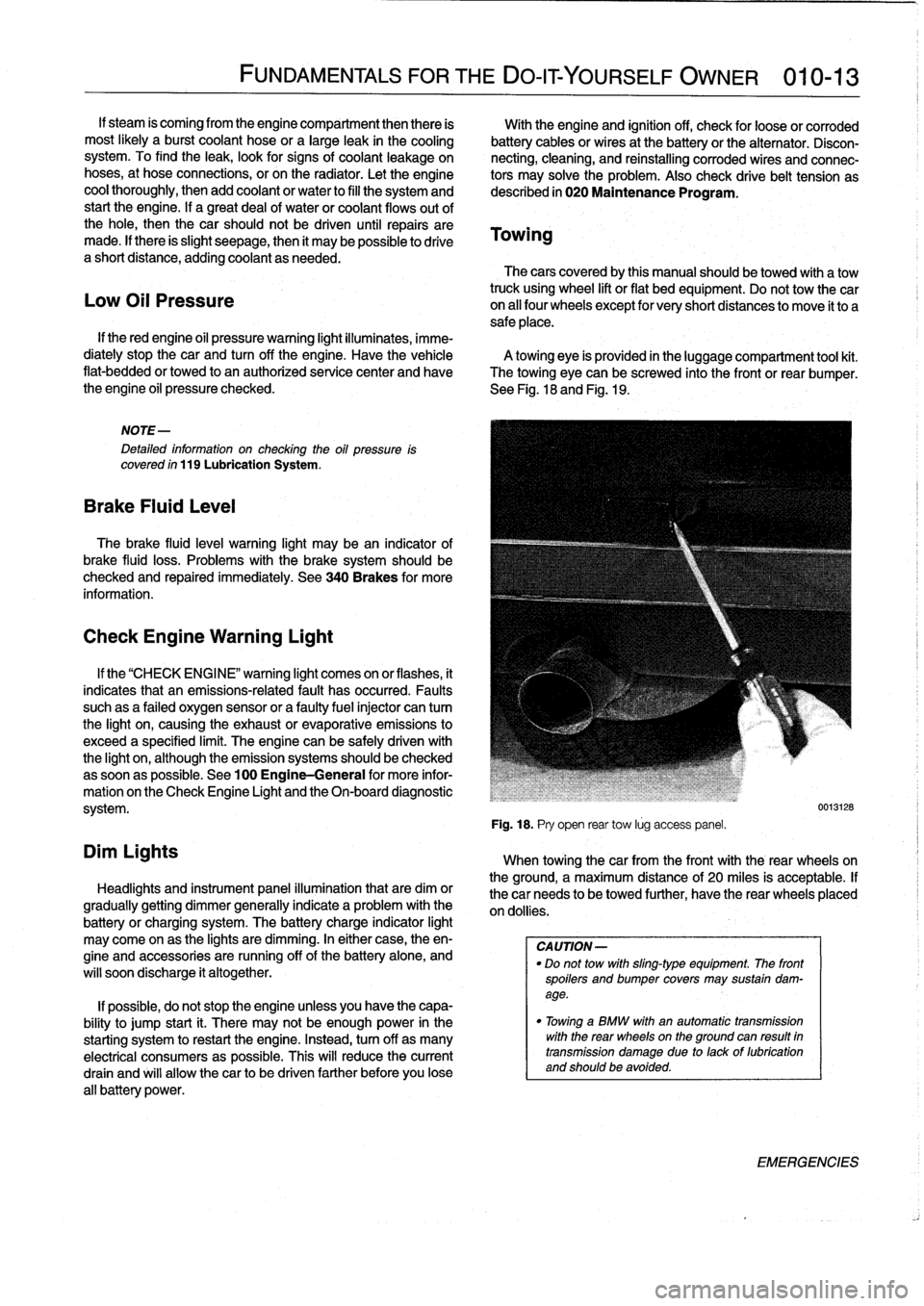
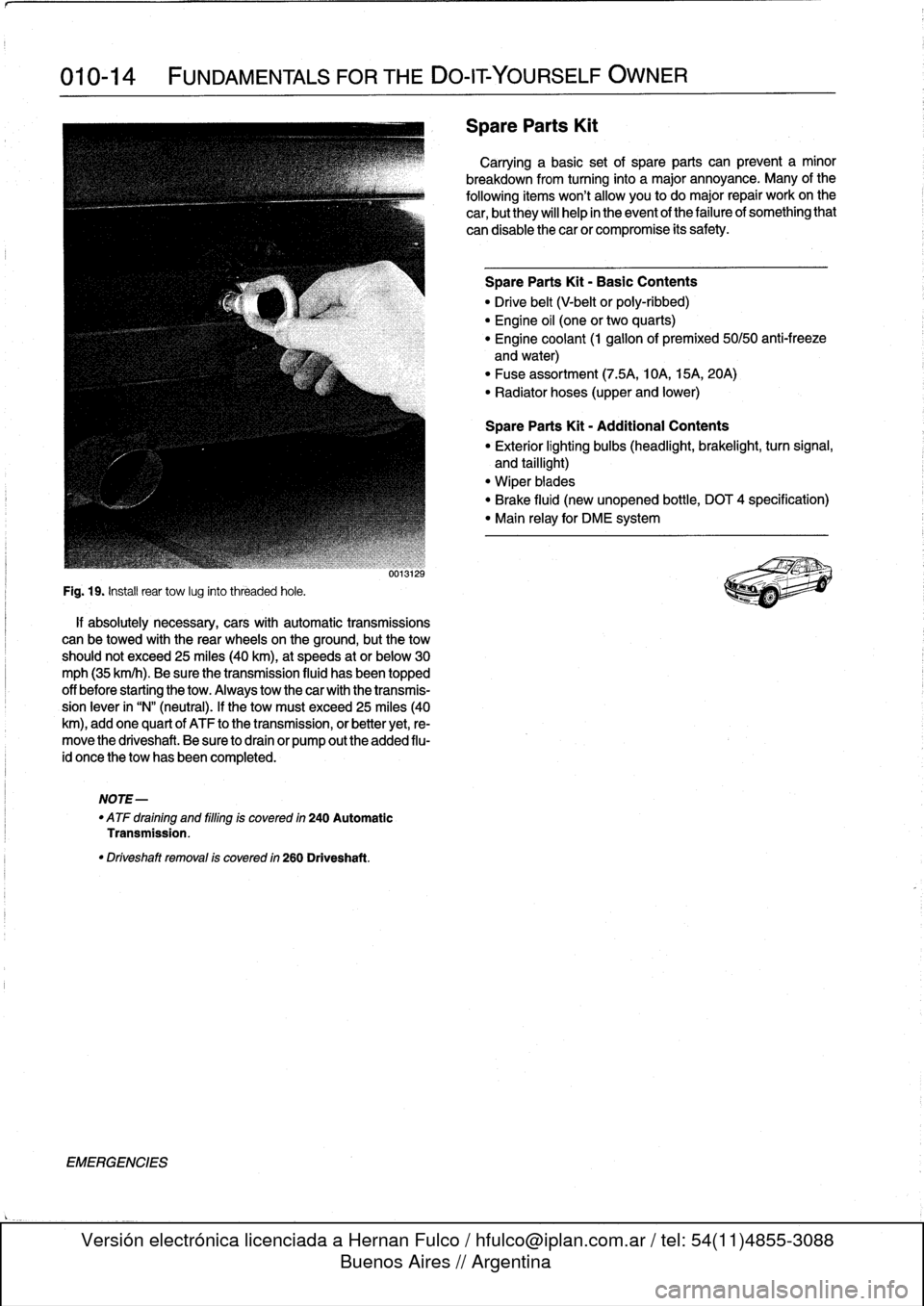
A
towing
eye
is
provided
in
the
luggage
compartment
tool
kit
.
flat-bedded
or
towed
to
an
authorized
service
center
and
have
The
towing
eye
can
be
screwed
into
the
front
or
rear
bumper
.
the
engine
oil
pressure
checked
.
See
Fig
.
18
and
Fig
.
19
.
Low
Oil
Pressure
NOTE-
Detafed
information
on
checking
the
oil
pressure
is
covered
ín
119
Lubrication
System
.
Brake
Fluid
Leve¡
The
brake
fluid
leve¡
warning
light
may
bean
indicator
of
brake
fluid
loss
.
Problems
with
the
brakesystem
should
be
checked
and
repaired
immediately
.
See
340Brakes
for
more
information
.
Check
Engine
Warning
Light
Dim
Lights
FUNDAMENTALS
FOR
THE
DO-IT
YOURSELF
OWNER
010-13
If
the
"CHECK
ENGI
NE"
warning
light
comes
on
or
flashes,
it
indicates
that
an
emissions-related
fault
has
occurred
.
Faults
suchas
a
failed
oxygen
sensor
or
a
faultyfuelinjector
can
tum
the
light
on,
causing
the
exhaust
or
evaporative
emissions
to
exceed
a
specified
limit
.
The
engine
can
be
safely
driven
with
the
light
on,
although
the
emission
systems
should
be
checked
assoonas
possible
.
See
100
Engine-General
for
more
infor-
mation
on
the
Check
Engine
Light
and
the
On-board
diagnostic
system
.
Headlights
and
instrument
panel
illuminationthat
are
dim
or
gradually
getting
dimmer
generally
indicate
a
problem
with
the
battery
or
charging
system
.
The
battery
charge
indicator
light
may
come
on
as
the
lights
are
dimming
.
In
either
case,
theen-
gine
and
accessories
are
running
off
of
the
battery
alone,
and
will
soon
discharge
it
altogether
.
If
possible,
do
not
stop
the
engine
unless
you
have
the
capa-
bility
to
jump
start
¡t
.
There
may
not
be
enough
power
in
the
starting
system
torestart
the
engine
.
Instead,turn
off
as
many
electrical
consumers
as
possible
.
This
will
reduce
the
current
drain
and
will
allow
thecar
to
be
driven
farther
before
you
lose
all
battery
power
.
Fig
.
18
.
Pry
open
rear
tow
lúg
access
panel
.
When
towingthecar
from
the
front
with
the
rear
wheelson
the
ground,
a
maximum
distance
of
20
miles
is
acceptable
.
If
thecar
needs
to
be
towed
further,
have
the
rear
wheels
placed
on
dollies
.
CA
UTION-
"
Do
not
tow
with
sling-type
equipment
The
front
spoilers
andbumper
covers
may
sustain
dam-
age
.
"
Towínga
BMW
with
an
automatic
transmission
with
the
rear
wheelson
the
ground
can
resuft
in
transmission
damage
due
to
lackof
lubrication
and
should
be
avoided
.
0013128
EMERGENCIES
Page 22 of 759
010-14
FUNDAMENTALS
FOR
THE
DO-ITYOURSELF
OWNER
Fig
.
19
.
Instaf
rear
tow
lug
into
threaded
hole
.
if
absolutely
necessary,
cars
with
automatic
transmissions
can
be
towed
with
the
rear
wheels
on
the
ground,
butthe
tow
should
not
exceed
25
miles
(40
km),at
speeds
at
or
below30
mph
(35
km/h)
.
Be
sure
the
transmission
fluid
hasbeen
topped
off
before
starting
the
tow
.
Always
tow
thecar
with
the
transmis-
sion
lever
in
"N"
(neutral)
.
If
the
tow
must
exceed25
miles
(40
km),
add
one
quart
of
ATF
to
the
transmission,
or
better
yet,
re-
move
the
driveshaft
.
Be
sure
to
drain
or
pump
outthe
added
flu-
id
once
the
tow
has
been
completed
.
NOTE-
"
ATF
draining
and
filling
is
covered
in
240
Automatic
Transmission
.
"
Driveshaft
removal
is
covered
in
260
Driveshaft
.
EMERGENCIES
úo1W¿b
Spare
Parts
Kit
Carrying
a
basic
set
of
spare
parts
can
prevent
a
minor
breakdown
from
turning
into
a
major
annoyance
.
Many
of
the
following
itemswon't
allow
you
todo
major
repair
workon
the
car,
but
they
will
help
in
the
event
of
the
failure
of
something
that
can
disable
thecar
or
compromise
its
safety
.
Spare
Parts
Kit
-
Basic
Contents
"
Drive
belt
(V-belt
or
poly-ribbed)
"
Engine
oil
(one
or
two
quarts)
"
Engine
coolant
(1
gallonof
premixed
50/50
anti-freeze
and
water)
"
Fuse
assortment
(7
.5A,
10A,
15A,
20A)
"
Radiator
hoses
(upper
and
lower)
Spare
Parts
Kit
-
Additional
Contents
"
Exterior
lighting
bulbs
(headlight,
brakelight,
turn
signal,
and
taillight)
"
Wiper
biades
"
Brake
fluid
(new
unopened
bottle,
DOT
4
specification)
"
Main
relay
for
DME
system
Page 24 of 759
020-2
MAINTENANCE
PROGRAM
GENERAL
The
information
given
in
this
repair
group
includes
the
routine
checks
and
maintenance
steps
that
are
both
required
by
BMW
under
the
terms
of
the
vehicle
warranty
protection
and
recom-
mended
by
BMW
to
ensure
long
and
reliable
vehicle
operation
.
GENERAL
NOTE-
Aside
from
keeping
yourcar
in
the
bestpossible
condi-
tion,
proper
maintenance
plays
a
role
in
maintaining
full
protection
under
BMWs
new-car
warranty
coverage
.
If
in
doubtabout
the
terms
and
conditions
of
yourcark
warranty,
an
authorized
BMW
dealer
should
be
able
to
explain
them
.
NOTE-
BMW
is
constantly
updating
their
recommended
main-
tenance
procedures
and
requirements
.
The
informa-
tion
contained
here
is
as
accurate
as
possible
at
the
time
of
publication
.
If
hhere
is
any
doubt
aboutwhat
pro-
cedures
apply
to
a
specific
model
or
model
year,
or
what
intervals
should
be
followed,
remember
that
an
authorized
BMW
dealer
has
the
latest
information
on
factory-recommended
maintenance
.
BMW
Service
Indicator
The
BMW
Service
Indicator
notifies
the
driver
when
mainte-
nance
is
required
.
The
service
indicator
consístsof
multiple
light
emitting
diodes
(lEDs)-typically
five
green,
one
yellow,
andone
red-as
well
as
OIL
SERVICE
and
INSPECTION
indi-
cators
.
When
the
ignition
is
tumed
on,the
green
LEDs
come
on
.
They
go
out
when
the
engine
is
started
.
After
the
Service
Indi-
cator
is
reset,
al¡
green
LEDs
will
be
illuminatedwith
the
keyon
.
As
thecar
is
driven
in
normal
use,
fewer
and
fewer
green
LEDs
will
be
illuminated
before
start-up,indicating
that
the
next
main-
tenance
interval
is
approaching
.
When
thecar
has
accumulated
sufficient
use
to
require
the
next
maintenance
interval,
the
yellow
LED
will
come
on
along
with
either
the
OIL
SERVICE
indicator
or
the
INSPECTION
in-
dicator
.
These
LEDs
will
stay
on
after
the
engine
is
started
.
If
maintenance
service
is
delayed,
thered
LED
will
also
illuminate
as
a
reminder
that
maintenance
service
is
overdue
.
An
OIL
SERVICE
interval
will
alwaysbe
followed
by
an
IN-
SPECTION
interval,
which
will
then
be
followed
byan
OIL
SER-VICE
interval,
andsoon
.
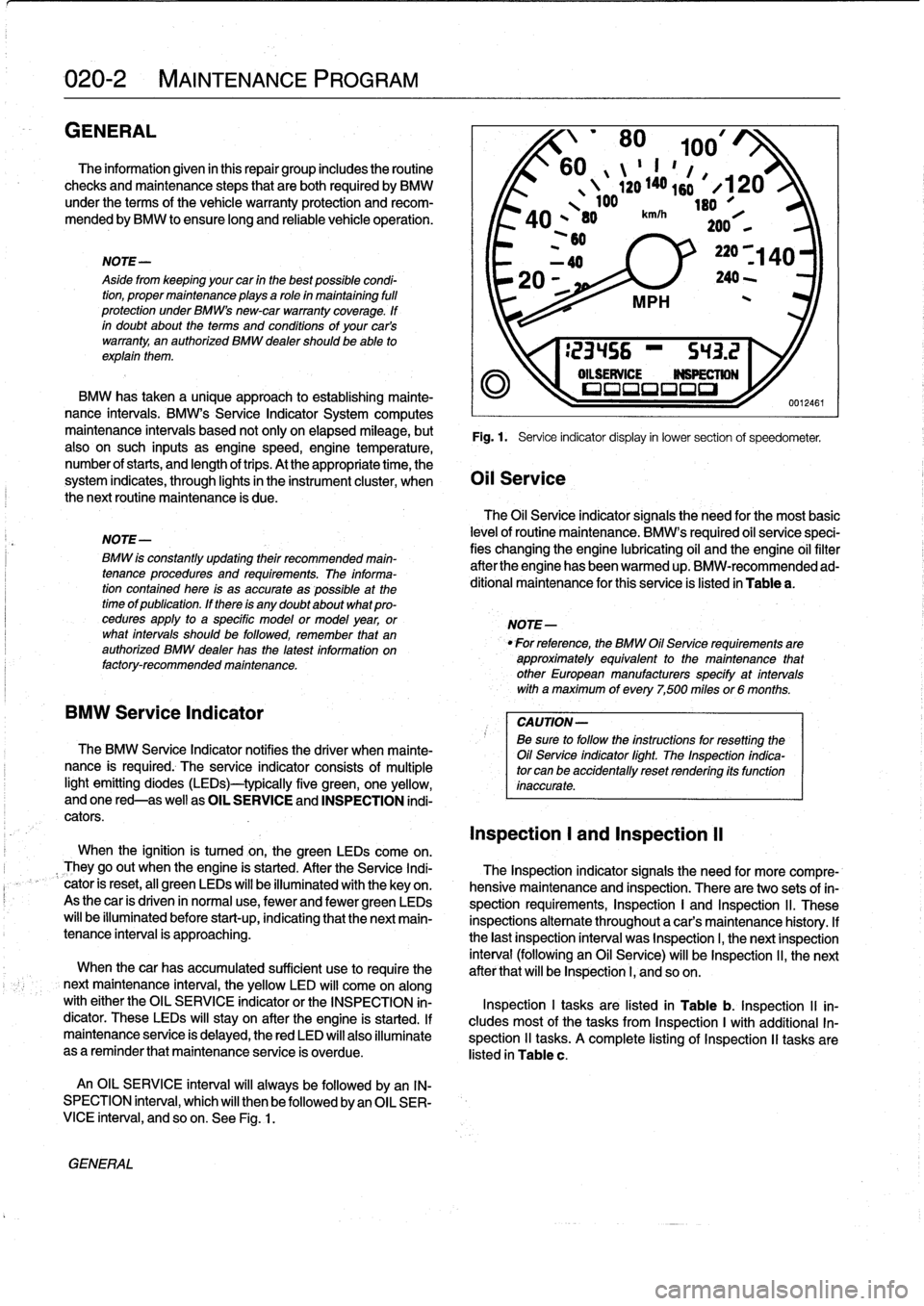
See
Fig
.
1
.
'
80
100/
60
II
"
1
,
ló
1
,
4
`20
140s
#
X120
100
leo
A
O
,
80
km/h`F
*101
200
,
,
~60
BMW
has
taken
a
unique
approach
to
establishing
mainte-
nance
intervals
.
BMW's
Service
Indicator
System
computes
maintenance
intervais
based
not
only
on
elapsed
mileage,
but
Fig
.
1
.
Service
indicator
display
in
lower
section
of
speedometer
.
also
on
such
inputs
as
enginespeed,engine
temperature,
number
of
starts,
and
length
oftrips
.
At
the
appropriate
time,
the
system
indicates,
through
lights
in
the
instrument
cluster,
when
Oil
Service
the
next
routine
maintenance
is
due
.
The
Oil
Service
indicator
signals
the
need
for
the
most
basic
levelof
routine
maintenance
.
BMW's
required
oil
service
speci-
fies
changing
the
engine
lubricating
oil
and
the
engine
oil
filter
after
the
engine
has
been
warmed
up
.
BMW-recommended
ad-
ditional
maintenance
for
this
service
is
listed
in
Table
a
.
NOTE-
For
reference,
the
BMW
Oil
Service
requirements
are
approximately
equivalent
to
the
maintenance
that
other
European
manufacturers
specify
at
intervals
with
a
maximum
of
every
7,500
miles
or6
months
.
CAUTION-
Be
sure
to
follow
the
ínstructions
forresetting
the
Oil
Service
indicator
fight
.
The
Inspection
indica-
tor
can
be
accidentally
reset
rendering
its
function
inaccurate
.
Inspection
l
and
Inspection
II
The
Inspection
indicator
signals
the
need
for
more
compre-
hensive
maintenance
and
Inspection
.
There
are
two
sets
of
in-
spection
requirements,
Inspection
I
and
Inspection
ll
.
These
inspections
alternate
throughout
a
car's
maintenance
history
.
If
the
last
Inspection
interval
was
Inspection
I,
the
next
Inspection
interval
(following
an
Oil
Service)
will
be
Inspection
ll,
the
next
after
that
will
be
Inspection
I,
and
so
on
.
Inspection
I
tasks
are
listed
in
Table
b
.
Inspection
II
in-
cludes
most
of
the
tasks
from
Inspection
I
with
additional
In-
spection
11
tasks
.
A
complete
listing
of
Inspection
II
tasks
are
listed
in
Table
c
.