central BMW 325i 1994 E36 User Guide
[x] Cancel search | Manufacturer: BMW, Model Year: 1994, Model line: 325i, Model: BMW 325i 1994 E36Pages: 759
Page 352 of 759
515-4
CENTRAL
LOCKING
AND
ANTI-THEFT
11
.
Installation
is
reverse
of
removal
.
Keep
in
mind
the
fol-
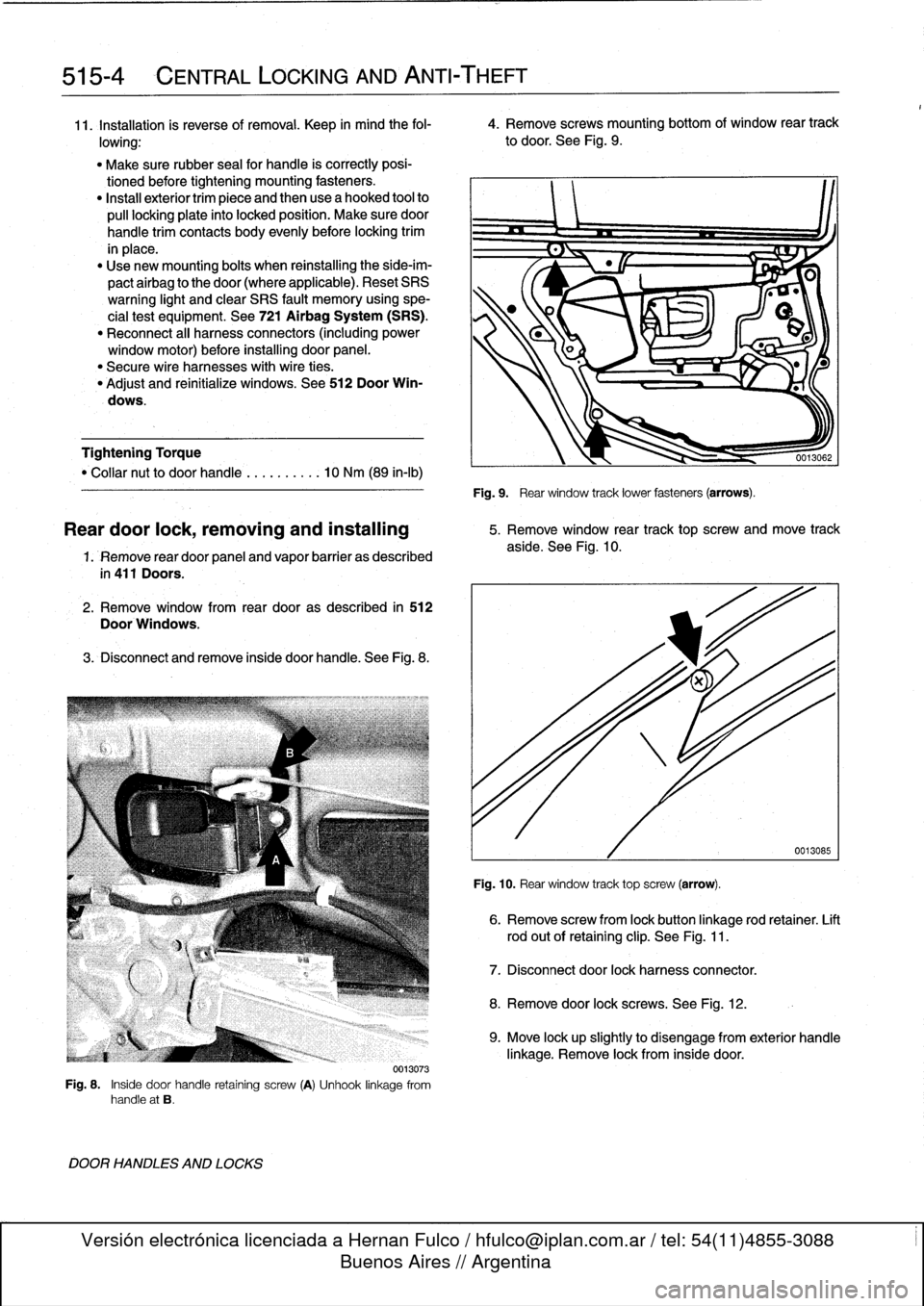
4
.
Remove
screws
mounting
bottom
of
window
rear
track
lowing
:
to
door
.
See
Fig
.
9
.
"
Make
sure
rubber
seal
for
handle
is
correctly
posi-
tionedbefore
tightening
mounting
fasteners
.
"
Install
exteriortrim
piece
and
then
use
a
hooked
tool
to
pull
locking
plate
into
locked
position
.
Make
sure
door
handle
trim
contacts
body
evenly
before
locking
trim
in
place
.
"
Use
new
mounting
bolts
when
reinstalling
the
side-im-
pactairbag
to
the
door(where
applicable)
.
Reset
SRS
warning
light
and
clear
SRS
fault
memory
using
spe-
cial
test
equipment
.
See
721
Airbag
System
(SRS)
.
"
Reconnect
al¡
harness
connectors
(including
power
window
motor)before
installing
door
panel
.
"
Secure
wire
harnesses
withwire
ties
.
"
Adjust
and
reinitialize
windows
.
See
512
Door
Win-
dows
.
Tightening
Torque
"
Collar
nut
to
doorhandle
..........
10
Nm
(89
in-lb)
1.
Remove
rear
door
panel
and
vapor
barrier
as
described
in
411
Doors
.
2
.
Remove
window
from
rear
dooras
described
in
512
Door
Windows
.
3
.
Disconnect
andremove
inside
door
handle
.
See
Fig
.
8
.
0013073
Fig
.
8
.
Inside
door
handle
retaining
screw
(A)
Unhook
linkage
from
handle
at
B
.
DOOR
HANDLES
AND
LOCKS
Fig
.
9
.
Rear
window
track
lower
fasteners
(arrows)
.
Reardoor
lock,
removing
and
installing
5
.
Remove
window
rear
track
top
screw
and
move
track
aside
.
See
Fig
.
10
.
Fig
.
10
.
Rear
window
track
top
screw
(arrow)
.
6
.
Remove
screw
from
lock
button
linkage
rod
retainer
.
Lift
rod
out
of
retaining
clip
.
See
Fig
.
11
.
7
.
Disconnect
door
lock
harnessconnector
.
8
.
Remove
door
lock
screws
.
See
Fig
.
12
.
0013085
9
.
Move
lock
upslightly
to
disengage
from
exterior
handle
linkage
.
Remove
lock
from
inside
door
.
Page 353 of 759
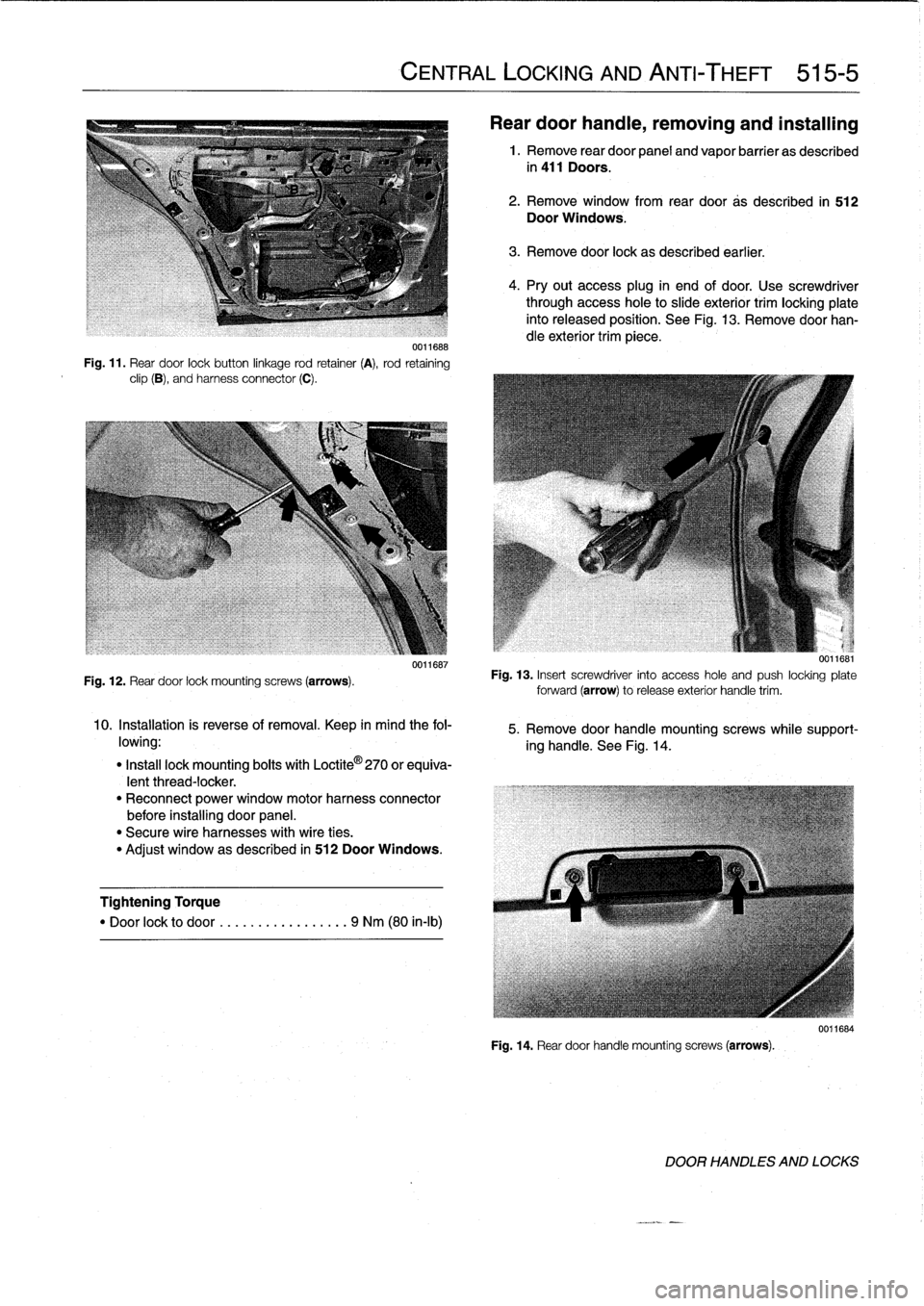
0011688
Fig
.
11
.
Rear
door
lockbutton
linkage
rod
retainer
(A),
rod
retaining
clip
(B),
and
harness
connector
(C)
.
Fig
.
12
.
Rear
door
lock
mounting
screws
(arrows)
.
0011687
10
.
Installation
is
reverse
of
removal
.
Keep
in
mind
the
fol-
lowing
:
"
Insta¡¡
lock
mounting
boits
with
Loctite
©
270
or
equiva-
lentthread-locker
.
"
Reconnect
power
window
motorharness
connector
before
installing
door
panel
.
"
Secure
wire
harnesses
with
wire
ties
.
"
Adjust
window
as
described
in
512
Door
Windows
.
Tightening
Torque
"
Door
lock
to
door
.
...
.
..
..........
9
Nm
(80
in-lb)
CENTRAL
LOCKING
AND
ANTI-THEFT
515-5
Rear
door
handie,
removing
and
installing
1
.
Remove
rear
door
panel
and
vapor
barrier
as
described
in
411
Doors
.
2
.
Remove
window
from
rear
door
as
described
in
512
Door
Windows
.
3
.
Remove
door
lock
as
described
earlier
.
4
.
Pry
out
access
plug
in
end
of
door
.
Use
screwdriver
through
access
hole
to
slide
exterior
trim
locking
plate
into
released
position
.
See
Fig
.
13
.
Remove
doorhan-
dle
exterior
trim
piece
.
u
.]lbbl
Fig
.
13
.
Insert
screwdriver
into
access
hole
and
push
locking
plate
forward
(arrow)torelease
exterior
handle
trim
.
5
.
Remove
door
handle
mountingscrews
while
support-
ing
handle
.
See
Fig
.
14
.
Fig
.
14
.
Reardoor
handle
mounting
screws
(arrows)
.
0011684
DOOR
HANDLES
AND
LOCKS
Page 354 of 759
515-6
CENTRAL
LOCKING
AND
ANTI-THEFT
6
.
Remove
door
handle
assembly
from
inside
door
.
7
.
Installation
is
reverse
of
removal
.
Keep
in
mindthe
fol-
lowing
:
"
Make
sure
rubber
seal
for
handle
is
correctly
posi-
tionedbefore
tightening
mounting
fasteners
.
"
Install
exterior
trim
piece
and
then
use
a
hooked
toolto
pull
locking
plate
into
locked
position
.
Make
sure
door
handle
trim
contacts
body
evenly
before
lockingtrim
in
place
.
"
Reconnect
all
harness
connectors
(including
power
window
motor)before
installing
door
panel
.
"
Secure
wire
harnesses
withwire
ties
.
"
Adjust
windowas
described
in
512
Door
Windows
.
Tightening
Torque
"
Rear
door
handle
mounting
screws
..
10
Nm
(89
in-lb)
NOTE
If
the
striker
backup
plate
fafls
into
the
body
cavlty,
it
can
be
retrieved
after
removing
the
inside
trim
from
the
B-pillar
(door-post
pillar)
.
Tightening
Torque
"
Striker
plate
to
body
pillar
..........
28
Nm
(20
ft-lb)
LOCKING
ACTUATORS
Door
Locking
Actuator
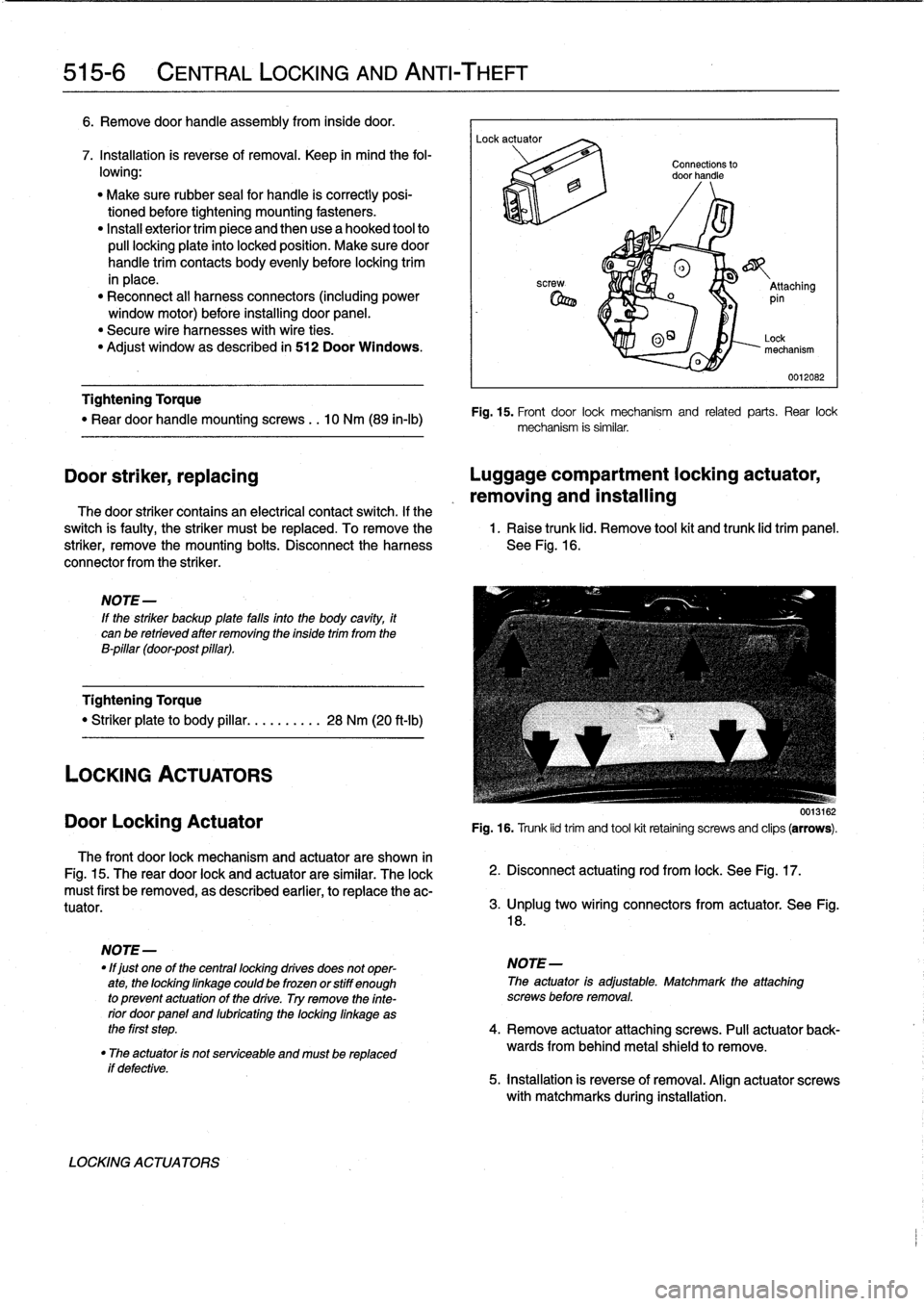
The
front
door
lock
mechanism
and
actuator
are
shown
in
Fig
.
15
.
The
rear
door
lock
and
actuator
are
similar
.
The
lock
must
first
be
removed,
as
described
earlier,
to
replace
the
ac-
tuator
.
if
defective
.
LOCKING
ACTUATORS
Connections
to
door
handle
®
o
_
Attaching
pin
0
O~
Lock
mechanism
0012082
Fig
.
15
.
Front
door
lock
mechanism
and
related
parts
.
Rear
lock
mechanism
is
similar
.
Door
striker,
replacing
Luggage
compartment
locking
actuator,
removing
and
installing
The
door
striker
contains
an
electrical
contact
switch
.
If
the
switch
is
faulty,
the
striker
must
be
replaced
.
To
remove
the
1
.
Raise
trunk
lid
.
Remove
tool
kit
and
trunk
lid
trim
panel
.
striker,
remove
the
mounting
bolts
.
Disconnect
the
harness
See
Fig
.
16
.
connector
from
the
striker
.
0013162
Fig
.
16
.
Trunk
lid
trim
and
tool
kit
retainíng
screws
and
clips
(arrows)
.
2
.
Disconnect
actuating
rod
from
lock
.
See
Fig
.
17
.
3
.
lJnplug
two
wíring
connectors
from
actuator
.
See
Fig
.
18
.
NOTE
-
"
lf
just
one
of
the
centrallocking
drives
does
not
oper-
NOTE-
ate,
the
lockinglinkage
could
be
frozen
orstiff
enough
The
actuator
is
adjustable
.
Matchmark
the
attaching
to
prevent
actuatonof
the
drive
.
Try
remove
the
finte-
screws
before
removal
.
rior
doorpanel
and
lubricating
the
locking
linkage
as
the
first
step
.
4
.
Remove
actuator
attaching
screws
.
Pull
actuator
back-
"
The
actuator
is
not
serviceable
and
mustbe
replaced
wards
from
behind
metal
shield
to
remove
.
5
.
installation
is
reverse
of
removal
.
Align
actuator
screws
with
matchmarks
during
installation
.
Page 355 of 759
002262
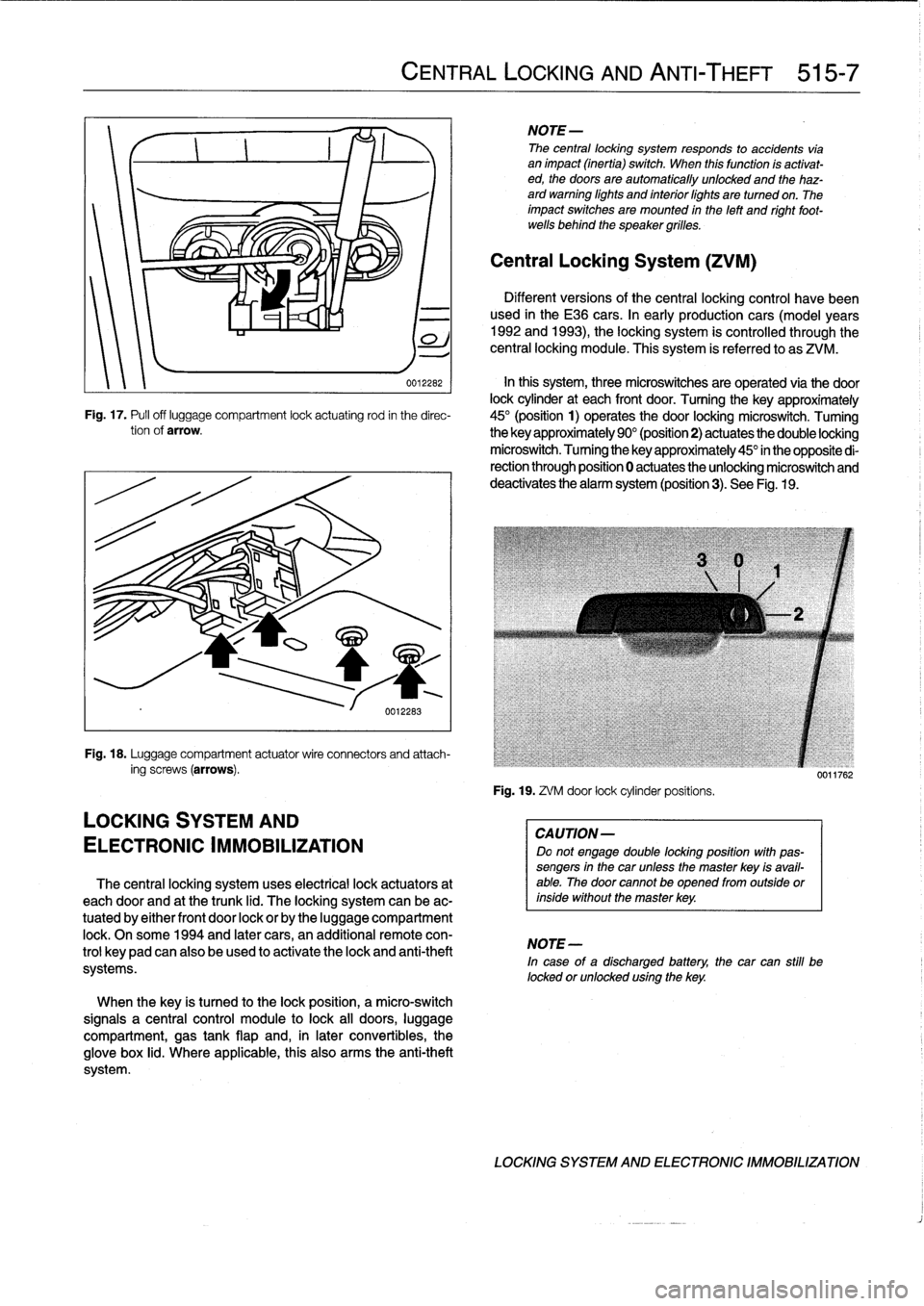
In
this
system,
three
microswitches
are
operated
via
the
door
lock
cylinder
at
each
front
door
.
Turning
the
key
approximately
Fig
.
17
.
Pufl
off
luggage
compartment
lock
actuating
rod
in
the
direc-
45°
(position
1)
operates
the
door
locking
microswitch
.
Tuming
tionof
arrow
.
the
key
approximately
90°
(position2)
actuates
the
double
locking
microswitch
.
Tuming
the
key
approximately
45°
in
the
opposite
di-
rection
through
position
0
actuates
the
unlocking
microswitch
and
deactivates
the
alarm
system
(position3)
.
See
Fig
.
19
.
Fig
.
18
.
Luggage
compartment
actuatorwire
connectors
and
attach-
ing
screws
(arrows)
.
LOCKING
SYSTEM
AND
ELECTRONIC
IMMOBILIZATION
The
central
locking
system
uses
electrical
lock
actuators
at
each
door
and
at
the
trunk
lid
.
The
locking
system
can
be
ac-
tuated
by
either
front
door
lock
or
by
the
luggage
compartment
lock
.
Onsome
1994
and
later
cars,
an
additional
remote
con-
trol
keypadcan
also
be
used
to
activate
the
lock
and
anti-theft
systems
.
When
the
key
is
tuned
to
the
lock
position,
a
micro-switch
signals
a
central
control
module
to
lock
all
doors,
luggage
compartment,
gas
tank
flap
and,
in
later
convertibles,
the
glove
box
lid
.
Where
applicable,
this
also
arms
the
anti-theft
system
.
CENTRAL
LOCKING
AND
ANTI-THEFT
515-7
NOTE-
The
central
locking
system
responds
to
accidents
vía
animpact
(inertia)
switch
.
When
this
function
ís
activat-
ed,
the
doors
are
automatically
unlocked
and
the
haz-
ard
warning
lights
and
interiorlights
are
turned
on
.
The
impact
switches
are
mounted
in
the
left
and
right
foot-
wells
behind
the
speaker
grilles
.
Central
Locking
System
(ZVM)
Different
versions
of
the
central
locking
control
havebeen
used
in
the
E36
cars
.
In
early
production
cars
(model
years
1992
and
1993),
the
locking
system
is
controlled
through
the
central
locking
module
.
This
system
is
referred
to
as
ZVM
.
Fig
.
19
.
ZVM
door
lock
cylinderpositíons
.
CAUTION-
Do
not
engage
double
locking
position
with
pas-
sengers
in
the
car
unless
the
master
key
isavail-
able
.
The
door
cannotbe
opened
from
outside
orinside
without
the
master
key
.
NOTE-
In
case
of
a
discharged
battery,
the
car
can
still
be
locked
orunlocked
using
the
key
.
0011762
LOCKING
SYSTEM
AND
ELECTRONIC
IMMOBILIZATION
Page 356 of 759
515-8
CENTRAL
LOCKING
AND
ANTI-THEFT
Central
Body
Electronics
(ZKE
IV)
Electronic
Immobilization
System
(EWS)
Beginning
withvehicles
produced
9193
(model
year
1994),
The
electronic
anti-theft
system
known
as
EWS
was
first
in-
the
centrallocking
system
was
integrated
with
sunroof
and
troduced
in
January
1994
.
The
early
version
of
the
system
window
closure
into
the
Central
Body
Electronics
(ZKE
IV)
uses
a
starting
inhibition
module
to
interrupt
the
ignition,
the
(generation
four)
system
.
The
control
module
for
this
system
fuel
injection
and
the
starter
motor
.
This
system
is
activated
ís
mounted
in
front
of
the
glove
compartment
.
and
deactivated
by
the
centrallockíng
system
.
The
control
module
for
the
system
is
installed
under
the
left
side
of
the
Inthis
system
two
microswítches
are
operated
viathe
door
dashboard
.
lock
cylinder
at
both
front
doors
.
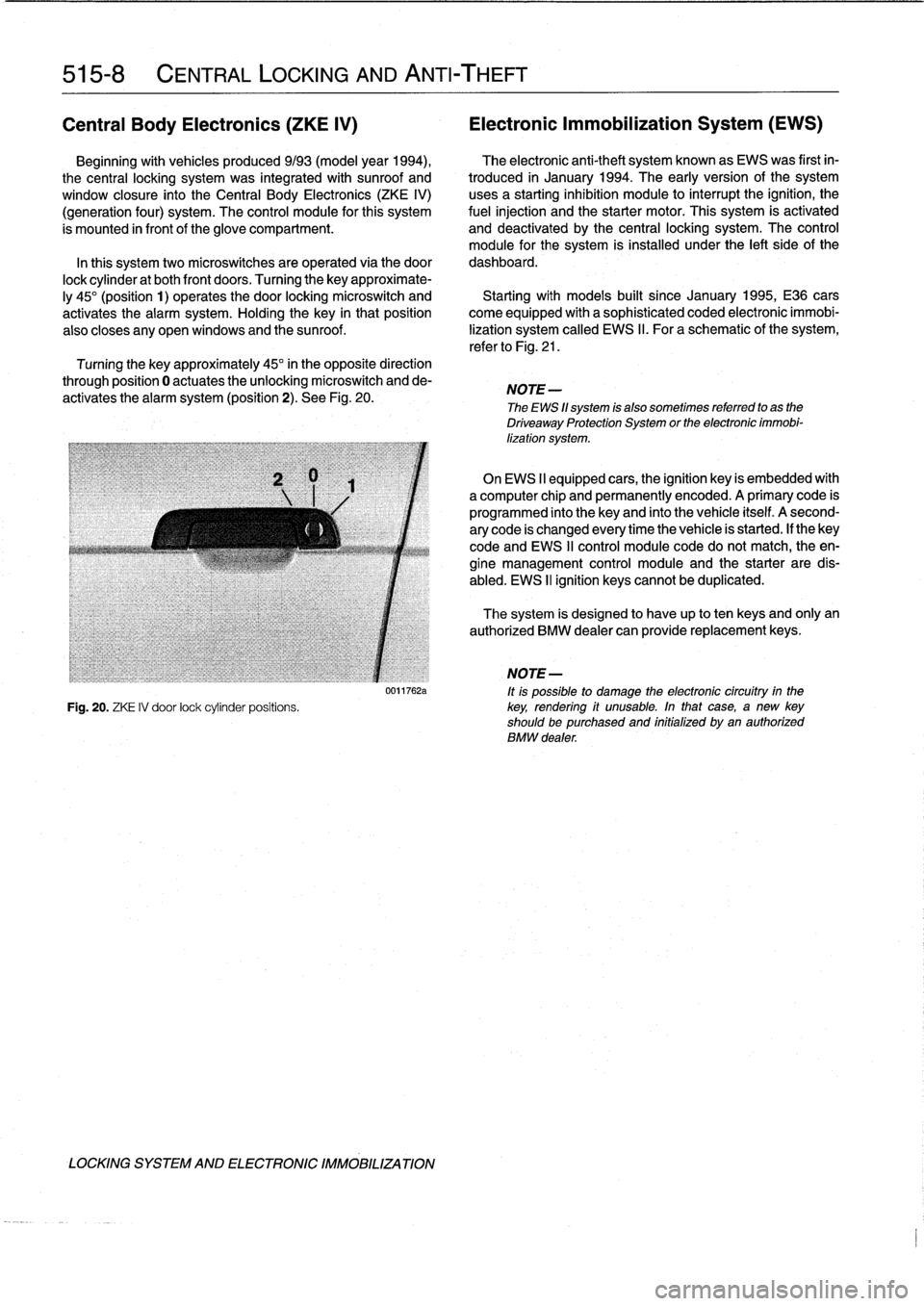
Turning
the
key
approximate-
ly
45°
(position
1)
operates
the
door
locking
microswitch
and
Startingwith
modeis
built
since
January
1995,
E36
cars
activates
the
alarm
system
.
Holding
the
key
in
thatposition
come
equipped
with
a
sophisticated
coded
electronic
immobi
also
closes
any
open
windows
and
the
sunroof
.
lization
system
called
EWS
II
.
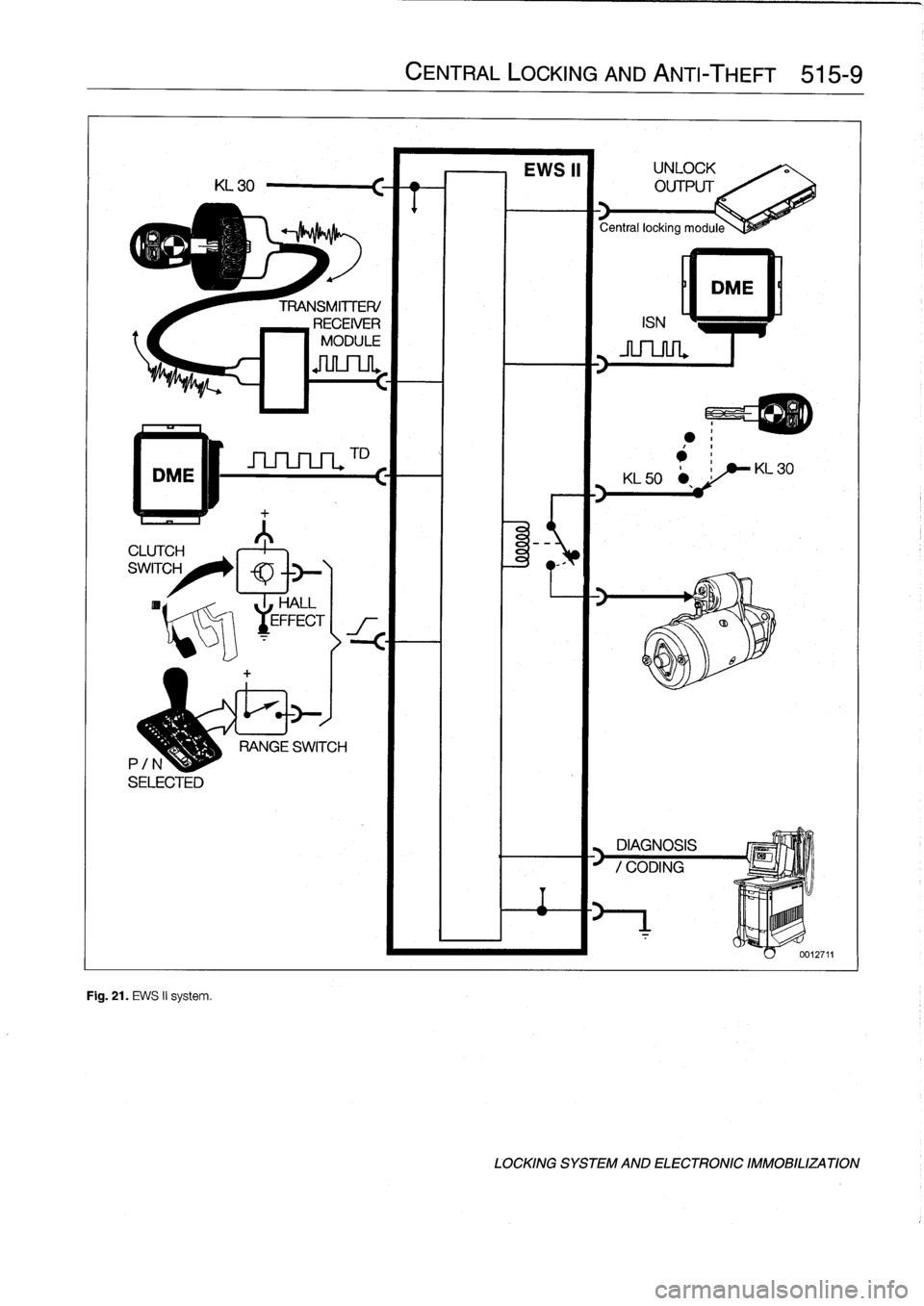
Foraschematic
of
the
system,
refer
to
Fig
.
21
.
Turning
the
key
approximately
45°
in
the
opposite
direction
through
position
0
actuates
theunlocking
microswitch
and
de-
activates
the
alarm
system
(position
2)
.
See
Fig
.
20
.
NOTE
-
The
EWS
11
system
is
also
sometimes
referred
to
as
the
Driveaway
Protection
System
or
the
electronic
immobi-
lization
system
.
On
EWS
II
equipped
cars,
the
ignition
key
is
embedded
with
a
computer
chip
and
permanently
encoded
.
A
primary
code
is
programmed
into
the
keyand
finto
the
vehicle
itself
.
A
second-
ary
code
is
changed
every
time
the
vehicle
is
started
.
If
thekey
code
and
EWS
II
control
module
code
do
notmatch,
the
en-
gine
management
control
module
and
the
starter
are
dis-
abled
.
EWS
II
ignition
keyscannot
be
duplicated
.
The
system
is
designed
to
have
up
to
ten
keys
and
only
an
authorized
BMW
dealer
can
provide
replacement
keys
.
j
NOTE-
0011762a
ft
is
possible
to
damage
the
electronic
circuítry
in
the
Fig
.
20
.
ZKE
IV
door
lock
cylinder
positions
.
key,
rendering
if
unusable
.
In
that
case,
a
new
key
shouldbe
purchased
and
initialized
byan
authorized
BMW
dealer
.
LOCKING
SYSTEM
AND
ELECTRONIC
IMM081LIZATION
Page 357 of 759
CLUTCH
SWITCH
Fig
.
21
.
EWS
II
system
.
TRANSMITTER/
RECEIVER
`I
MODULE
HALL
y
EFFECT
TD
CENTRAL
LOCKING
AND
ANTI-THEFT
515-9
DME
DIAGNOSIS
"
D
`
mol
111
IIIIIIIII
.r
LOCKING
SYSTEM
AND
ELECTRONIC
IMMOBILIZATION
Page 358 of 759
515-10
CENTRAL
LOCKING
AND
ANTI-THEFT
EWS
II
control
module,
replacing
1
.
Disconnect
negative
(-)
cable
from
battery
.
CAUTION-
Prior
to
disconnecting
the
battery,
read
the
battery
disconnection
cautions
given
at
the
front
of
this
manual
onpage
vüf
.
2
.
Remove
glove
compartment
as
described
in
513
Inte-
rior
Trim
.
3
.
Remove
EWS
II
control
module
harness
connector
.
Pull
module
out
of
bracket
.
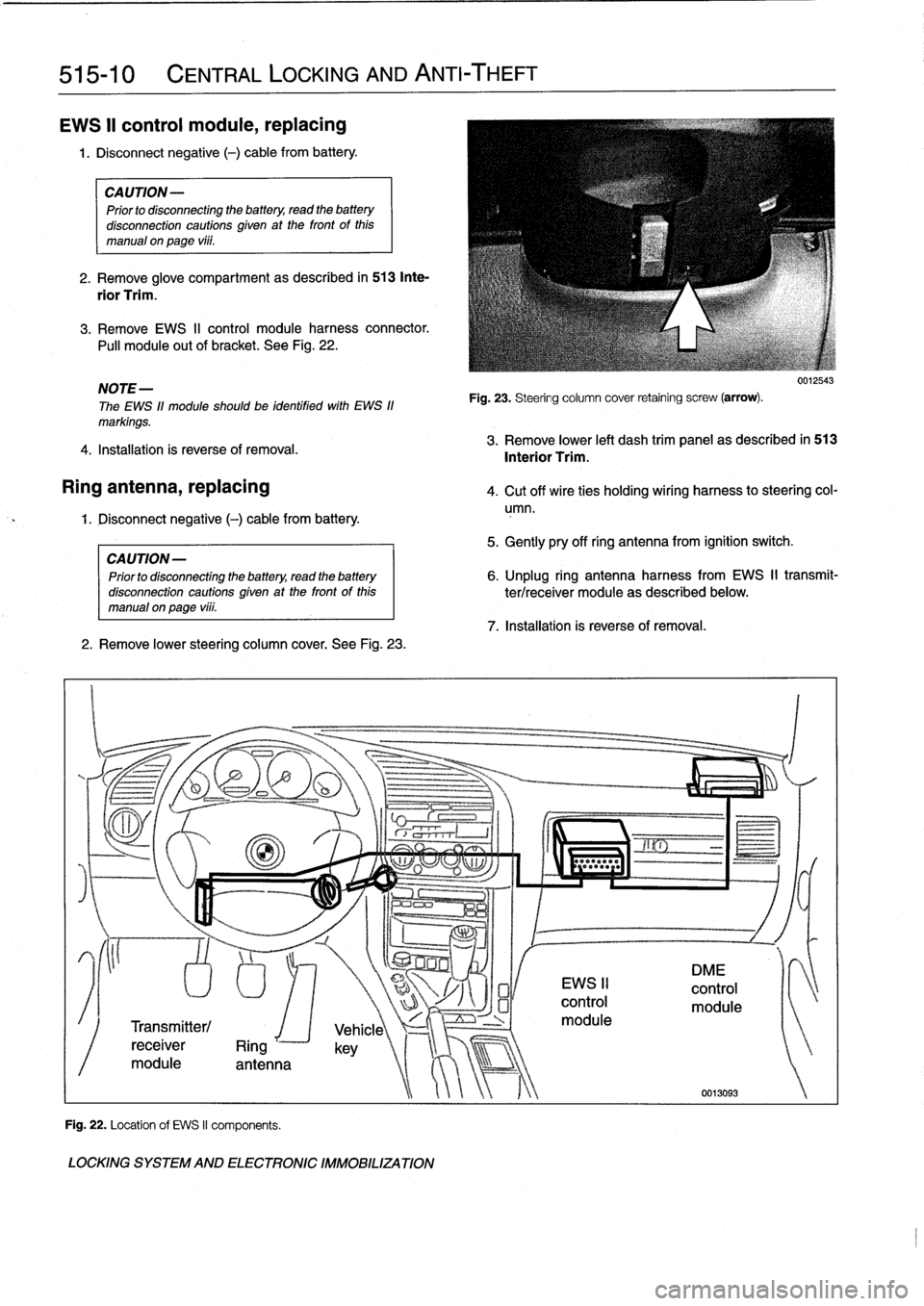
See
Fig
.
22
.
NOTE-
The
EWS
11
module
should
be
identified
with
EWS
11
markings
.
4
.
Installation
is
reverse
of
removal
.
Ring
antenna,
replacing
4
.
Cut
off
wire
ties
holding
wiring
harness
to
steering
col-
umn
.
1
.
Disconnect
negative
(-)
cable
from
battery
.
CAUTION
-
Prior
to
disconnecting
the
battery,
read
the
battery
disconnectioncautionsgiven
at
the
front
of
this
manualonpage
viii
.
2
.
Remove
lower
steering
column
cover
.
See
Fig
.
23
.
Transmitter/
receiver
Ring
r
module
antenna
Fig
.
22
.
Location
of
EWS
II
components
.
LOCKING
SYSTEM
AND
ELECTRONIC
IMMOBILIZATION
Fig
.
23
.
Steering
column
cover
retaining
screw
(arrow)
.
5
.
Gently
pry
off
ring
antenna
from
ignition
switch
.
7
.
Installation
is
reverse
of
removal
.
0012543
3
.
Remove
lower
left
dash
trim
panel
as
described
in
513
Interior
Trim
.
6
.
Unplug
ring
antennaharness
from
EWS
II
transmit-
ter/receiver
module
as
described
below
.
Page 359 of 759
EWS
II
transmitterlreceiver
module,
replacing
1
.
Disconnect
negative
(-)
cable
from
battery
.
CAUTION-
Prior
to
disconnectiog
the
battery,
read
the
battery
disconnection
cautions
given
at
the
front
of
this
manual
onpage
viii
.
2
.
Remove
lower
left
dash
trim
panel
and
knee
bolster
as
described
in
513
Interior
Trim
.
3
.
Unclip
auxiliary
relay
panel
under
steering
column
and
lower
it
to
access
relays
and
harness
connectors
.
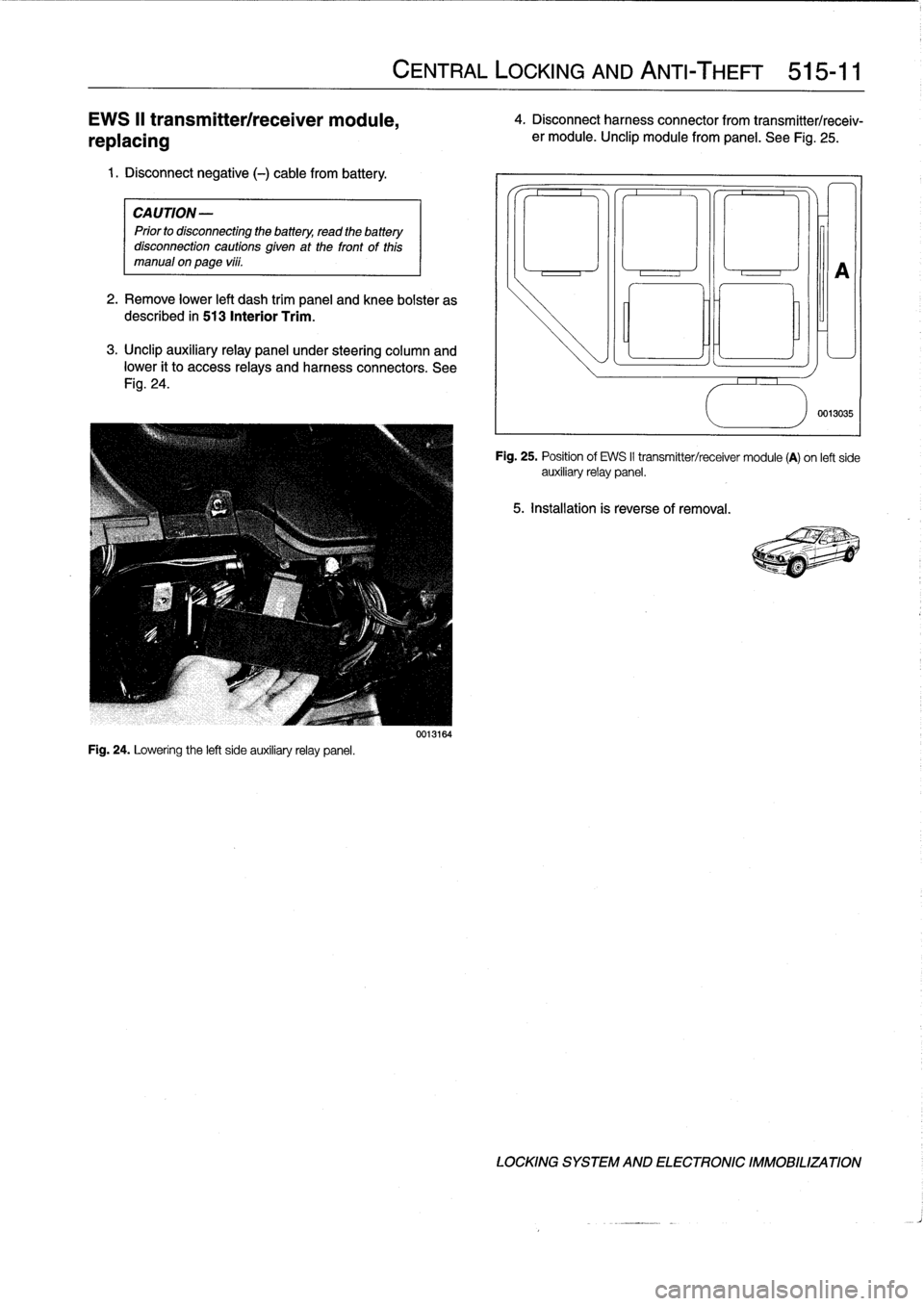
See
Fig
.
24
.
Fig
.
24
.
Lowering
the
left
side
auxiliaryrelay
panel
.
CENTRAL
LOCKING
AND
ANTI-THEFT
515-11
0013164
4
.
Disconnect
harness
connector
from
transmitter/receiv-
er
module
.
Unclip
module
from
panel
.
See
Fig
.
25
.
5
.
Installation
is
reverse
of
removal
.
0
A
0013035
Fig
.
25
.
Position
of
EWS
II
transmitter/receiver
module
(A)
on
left
side
auxiliaryrelay
panel
.
LOCKING
SYSTEM
AND
ELECTRONIC
IMMOBILIZATION
Page 383 of 759
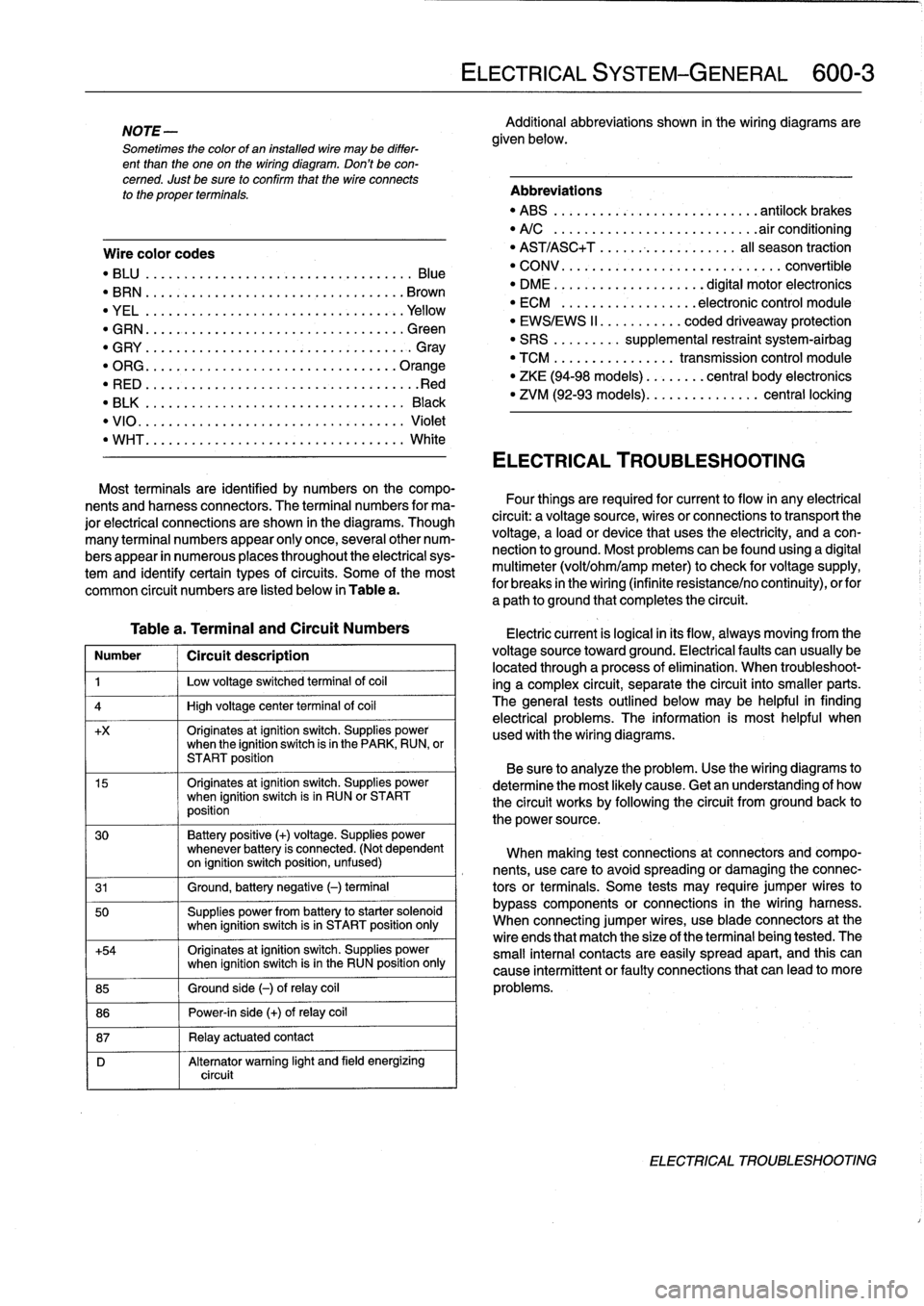
NOTE
-
Sometimes
the
color
of
en
installed
wire
may
be
differ-
ent
than
the
one
on
the
wiring
diagram
.
Don't
be
con-
cerned
.
Just
be
sure
lo
confirm
that
the
wire
connects
lo
the
proper
terminals
.
Wire
color
codes
"
BLU
.........
.
..
..
...
.
.................
Blue
"
BRN
....:....
.
..
..
...
..
...............
Brown
"
YEL
.........
.
..
..
...................
.Yellow
"
GRN
.........
.
..
..
...
.
................
creen
"
G
RY
.......
.
.
.
..
..
.....................
G
ray
"
ORG
.........
.
..
..
...
.
..............
.Orange
"
RED
......
...
.
.
..
.....................
.Red
"
BLK
.........
.
..
..
...
.
................
Black
"
VIO
..........
.
..
...
..
..
.......
.
.......
Violet
"
WHT
.........
.
.
....
.
...
:..............
White
Table
a
.
Terminal
and
Circuit
Numbers
Number
1
Circuít
description
1
j
Low
voltage
switched
terminal
of
coi¡
4
1
High
voltage
center
termina¡
of
coi¡
+x
Originates
atignition
switch
.
Supplies
powerwhen
the
ignition
switch
is
in
the
PARK,
RUN,
or
START
position
15
Originates
atignition
switch
.
Supplies
powerwhen
ignition
switch
is
in
RUN
or
START
position
30
Battery
positive
(+)
voltage
.
Supplies
power
whenever
battery
is
connected
.
(Not
dependent
on
ignition
switch
position,
unfused)
31
1
Ground,
battery
negative
(-)
terminal
50
Supplies
power
from
battery
to
starter
solenoid
when
ignition
switch
isin
START
position
only
+54
Originates
atignition
switch
.
Supplies
power
when
ignition
switch
isin
the
RUN
position
only
85
1
Ground
side
(-)
ofrelay
coil
86
1
Power-in
side
(+)
ofrelay
coil
87
1
Relay
actuatedcontact
D
Alternator
warning
light
and
field
energizing
circuit
ELECTRICAL
SYSTEM-GENERAL
600-
3
Additional
abbreviations
shown
in
the
wiring
diagrams
are
given
below
.
Abbreviations
"
ABS
........
.
...
.
...
.
..........
antilock
brakes
"
A/C
........
.
...
..
..
.
.........
.airconditioning
"
AST/ASC+T
.......
...
.
.
.......
al¡
season
traction
"
CONV
.......
.
.
...
.................
convertible
"
DME
........
.
.
...
.......
digital
motor
electronics
"
ECM
.......
.
...
..
..
.
..
electronic
control
module
"
EWS/EWS
II
......
...
.
.
coded
driveaway
protection
"
SRS
........
.
supplemental
restraint
system-airbag
"
TCM
........
.
..
....
.
transmission
control
module
"
ZKE
(94-98
models)
..
..
.
...
central
body
electronics
"
ZVM
(92-93
models)
...
.
.
..
.
.......
central
locking
ELECTRICAL
TROUBLESHOOTING
Most
terminals
are
identified
by
numbers
on
the
compo-
nents
and
harness
connectors
.
The
terminal
numbers
for
ma-
Four
things
are
required
for
current
toflow
in
any
electrical
jor
electrical
connections
are
shown
in
the
diagrams
.
Though
circuit
:
a
voltagesource,
wires
or
connections
to
transport
the
many
terminal
numbers
appear
only
once,
severa¡other
num-
voltage,
a
load
or
device
that
uses
the
electricity,
and
a
con-
bers
appear
in
numerous
places
throughout
the
electrical
sys-
nection
to
ground
.
Most
problemscanbefound
using
a
digital
tem
and
identify
certain
types
ofcircuits
.
Some
of
the
most
multimeter
(volt/ohm/amp
meter)to
check
for
voltage
supply,
common
circuit
numbers
are
listed
below
in
Table
a
.
for
breaks
in
the
wiring
(infinite
resistance/no
continuity),
orfor
a
path
to
ground
that
completesthe
circuit
.
Electric
current
is
logical
in
its
flow,
always
moving
from
the
voltage
sourcetoward
ground
.
Electricalfaults
can
usually
be
located
through
a
process
of
elimination
.
When
troubleshoot-
ing
a
complex
circuit,
separate
the
circuit
into
smaller
parts
.
The
general
testsoutlined
below
may
be
helpful
in
finding
electrical
problems
.
The
information
is
most
helpful
when
used
with
the
wiring
diagrams
.
Be
sure
to
analyze
the
problem
.
Use
the
wiring
diagrams
to
determine
the
most
likely
cause
.
Getan
understanding
of
how
the
circuit
works
by
following
the
circuit
from
groundback
to
the
power
source
.
When
making
test
connections
at
connectors
andcompo-
nents,
use
care
to
avoidspreading
or
damaging
the
connec-
tors
or
terminals
.
Some
tests
may
require
jumper
wires
to
bypass
components
or
connections
in
the
wiring
harness
.
When
connecting
jumper
wires,
use
bladeconnectors
at
the
wire
ends
that
match
the
size
of
the
terminal
being
tested
.
The
small
interna¡
contacts
are
easily
spread
apart,
and
this
can
cause
intermittent
or
faultyconnections
that
can
leadto
more
problems
.
ELECTRICAL
TROUBLESHOOTING
Page 390 of 759
610-4
ELECTRICAL
COMPONENT
LOCATIONS
--J
L
Windshield
washertank
&
pump
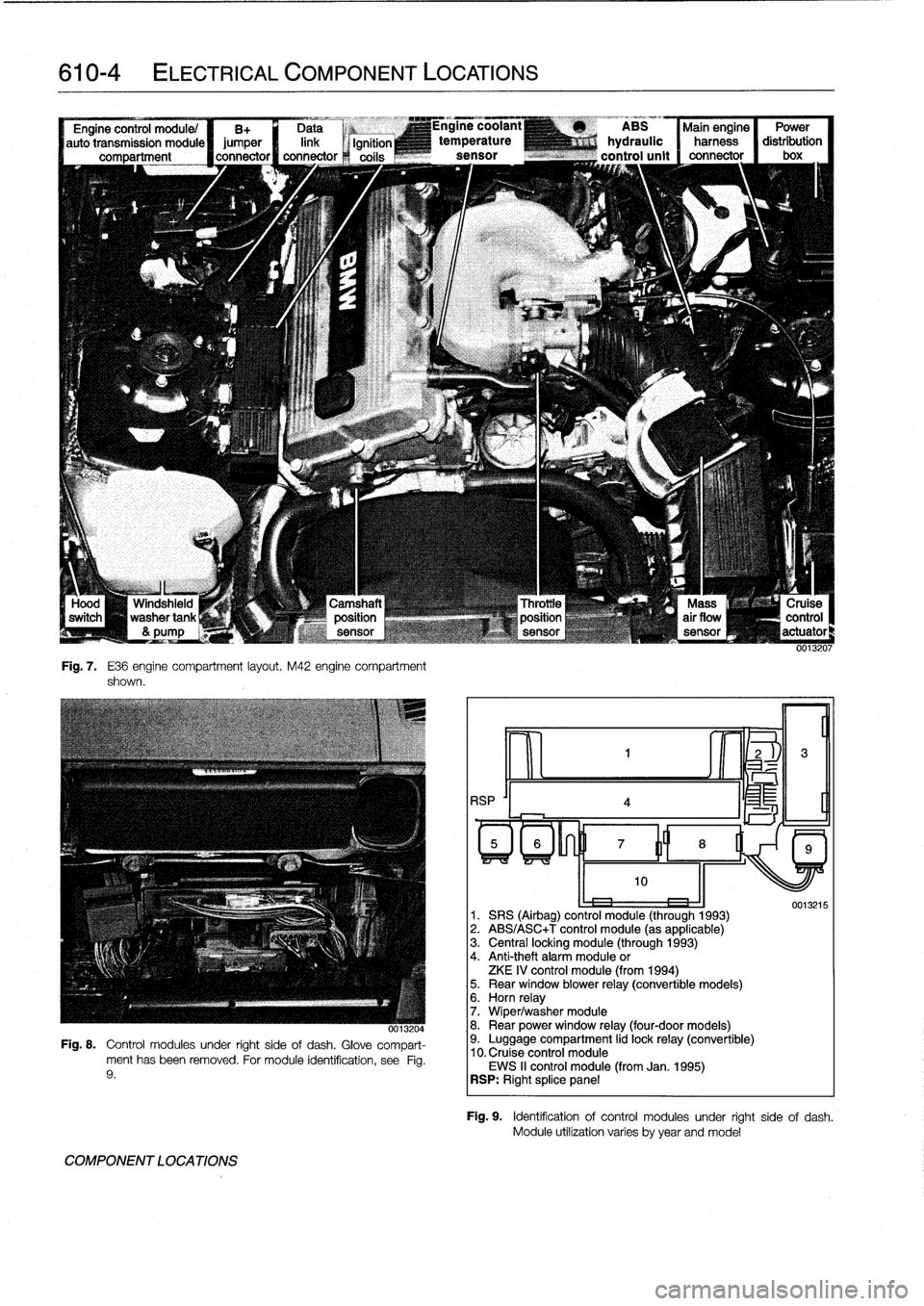
Fig
.
7
.
E36
engine
compartment
layout
.
M42
engine
compartment
shown
.
-,x
0013204
Fig
.
8
.
Control
modules
under
right
sideof
dash
.
Glove
compart-
ment
has
been
removed
.
For
module
identification,
see
Fig
.
9
.
COMPONENT
LOCATIONS
RSP
'I
4
ABS
Main
engine
Power
hydraulic
harness
distribution
control
unit
connector
I
box
oe
1
.
SRS
(Airbag)
control
module
(through
1993)
2
.
ABS/ASC+T
control
module
(as
applicable)
3
.
Central
locking
module
(through
1993)
4
.
Anti-theft
alarm
module
or
ZKE
IV
control
module
(from
1994)5
.
Rear
window
blower
relay
(convertible
models)6
.
Horn
relay
7
.
Wiper/washer
module
8
.
Rear
power
window
relay
(four-door
models)9
.
Luggage
compartment
lid
lock
relay
(convertible)
10
.
Cruise
control
module
EWS
II
control
module
(from
Jan
.
1995)
RSP
:
Right
splice
panel
0013215
Fig
.
9
.
Identificationof
control
modules
under
right
side
of
dash
.
Module
utilízation
varies
byyear
andmodel