airbag system BMW 325i 1994 E36 Owner's Manual
[x] Cancel search | Manufacturer: BMW, Model Year: 1994, Model line: 325i, Model: BMW 325i 1994 E36Pages: 759
Page 342 of 759
512-
1
2
DOOR
WINDOWS
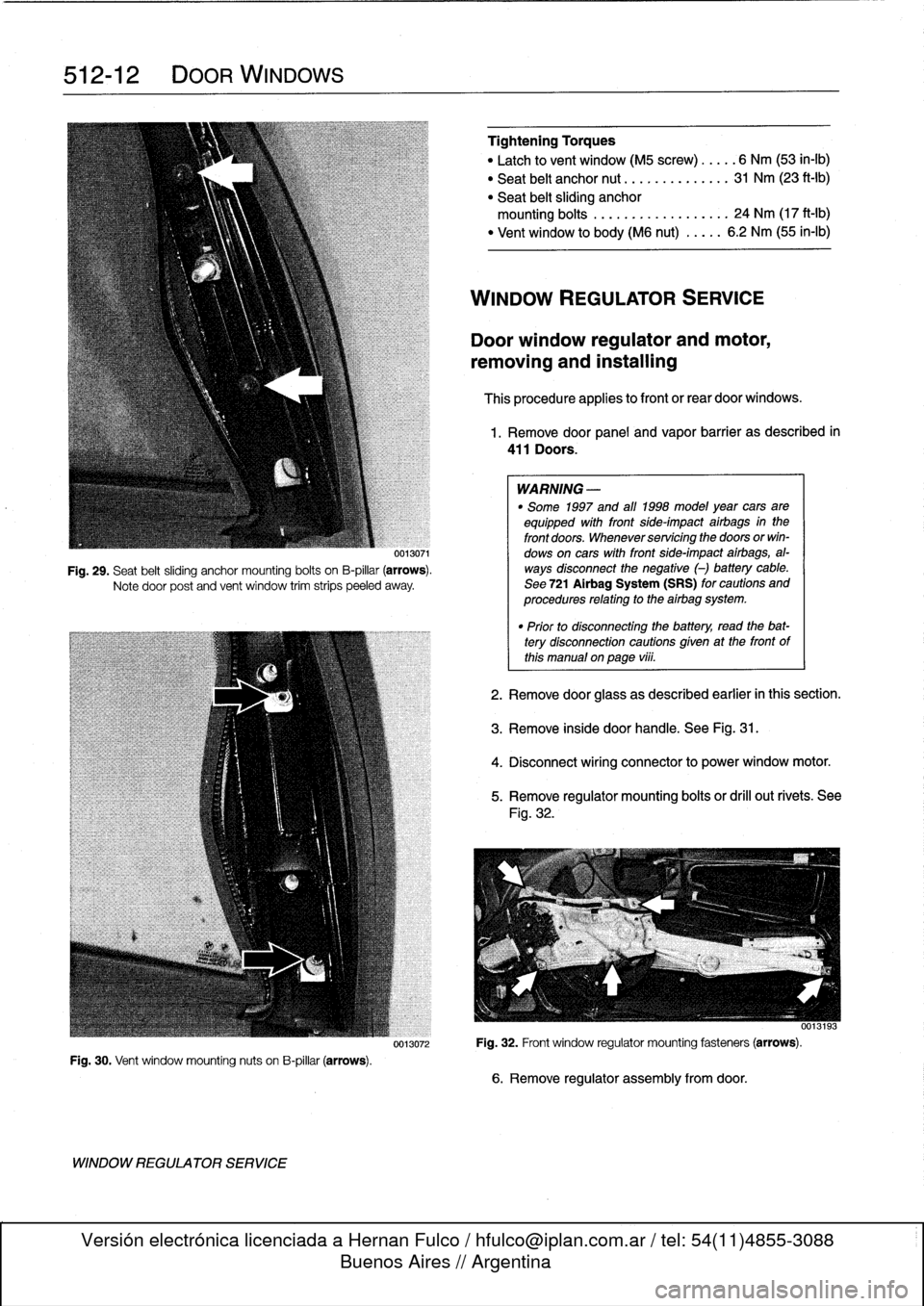
Fig
.
30
.
Vent
window
mounting
nuts
on
B-pillar
(arrows)
.
WINDOW
REGULATOR
SERVICE
0013071
Fig
.
29
.
Seat
belt
sliding
anchor
mounting
bolts
on
B-pillar
(arrows)
.
Notedoor
post
and
vent
window
trim
strips
peeled
away
.
Tightening
Torques
"
Latch
to
vent
window
(M5
screw)
.....
6
Nm
(53
in-lb)
"
Seat
belt
anchor
nut
..............
31
Nm
(23
ft-Ib)
"
Seat
belt
sliding
anchor
mounting
bolts
.
..
...
.
...........
24
Nm
(17
ft-Ib)
"
Vent
window
to
body(M6
nut)
.....
6
.2
Nm
(55
in-lb)
WINDOW
REGULATOR
SERVICE
Door
window
regulator
and
motor,
removing
and
installing
This
procedure
applies
to
front
or
rear
door
windows
.
1
.
Remove
door
panel
and
vapor
barrier
as
described
in
411
Doors
.
WARNING
-
"
Some
1997
and
all
1998
model
year
cars
are
equipped
with
front
side-impact
airbags
in
the
front
doors
.
Whenever
servicing
the
doors
orwin-
dows
on
cars
with
front
side-impact
airbags,
al-
ways
disconnect
the
negative
(-)
battery
cable
.
See
721
Airbag
System
(SRS)
for
cautions
and
procedures
relating
to
the
airbag
system
.
"
Prior
to
disconnectiog
the
battery,
read
the
bat-tery
disconnection
cautions
gíven
at
the
front
of
this
manual
onpage
vi¡¡
.
2
.
Remove
door
glass
as
described
earlier
in
this
section
.
3
.
Remove
inside
door
handle
.
See
Fig
.
31
.
4
.
Disconnect
wiring
connector
to
power
window
motor
.
5
.
Remove
regulator
mounting
bolts
or
drill
out
rivets
.
See
Fig
.
32
.
0013193
0013072
Fig
.
32
.
Front
window
regulator
mounting
fasteners
(arrows)
.
6
.
Remove
regulator
assembly
fromdoor
.
Page 346 of 759
513-2
INTERIOR
TRim
DASHBOARD
Dashboard
removal
is
a
complex
operation,
involving
dis-
connection
and
dismantling
of
a
number
of
electrical
and
dash
structural
components
.
The
BMW
E36
is
equipped
with
SRS
airbags
mounted
in
the
steering
wheel,
in
the
dashboard
(1994
and
later)
on
the
passenger
side,
and
in
the
front
doors(1997
and
later)
.
Air-
bags
units
are
pyrotechnic
devices
and
should
be
treated
with
extreme
caution
.
Improper
handling
of
the
airbags
could
cause
serious
injury
.
WARNING
-
"
The
BMW
Supplemental
Restraint
System
(SRS)
is
complex
and
special
precautions
must
be
ob-
served
when
servicing
.
Serious
injury
may
result
if
system
service
is
attempted
by
persons
unfa-
miliar
with
the
BMW
SRS
and
its
approved
ser-vice
procedures
.
BMW
specifies
that
all
inspection
and
service
shouldbe
performed
byan
authorized
BMW
dealer
.
"
Beforeperforming
any
work
involving
the
steering
wheel
or
interior
trim
in
the
vicinity
of
the
airbags,
disconnect
the
negative
()
battery
cable
.
See
721
Airbag
System
(SRS)
.
"
SRS
contains
aback-up
power
supply
within
the
SRS
control
module
.
A
10
minute
díscharge
peri-
od
should
be
allowed
after
the
battery
cable
has
been
disconnected
.
Glove
compartment,
removing
and
installing
1.
Open
glove
compartment
door
.
2
.
Remove
glove
compartment
mounting
screws
.
See
Fig
.
2
.
3
.
Pull
glove
compartment
out,
disconnecting
electrical
harness
connectors
as
necessary
.
4
.
Installation
is
reverse
of
removal
.
DASH80ARD
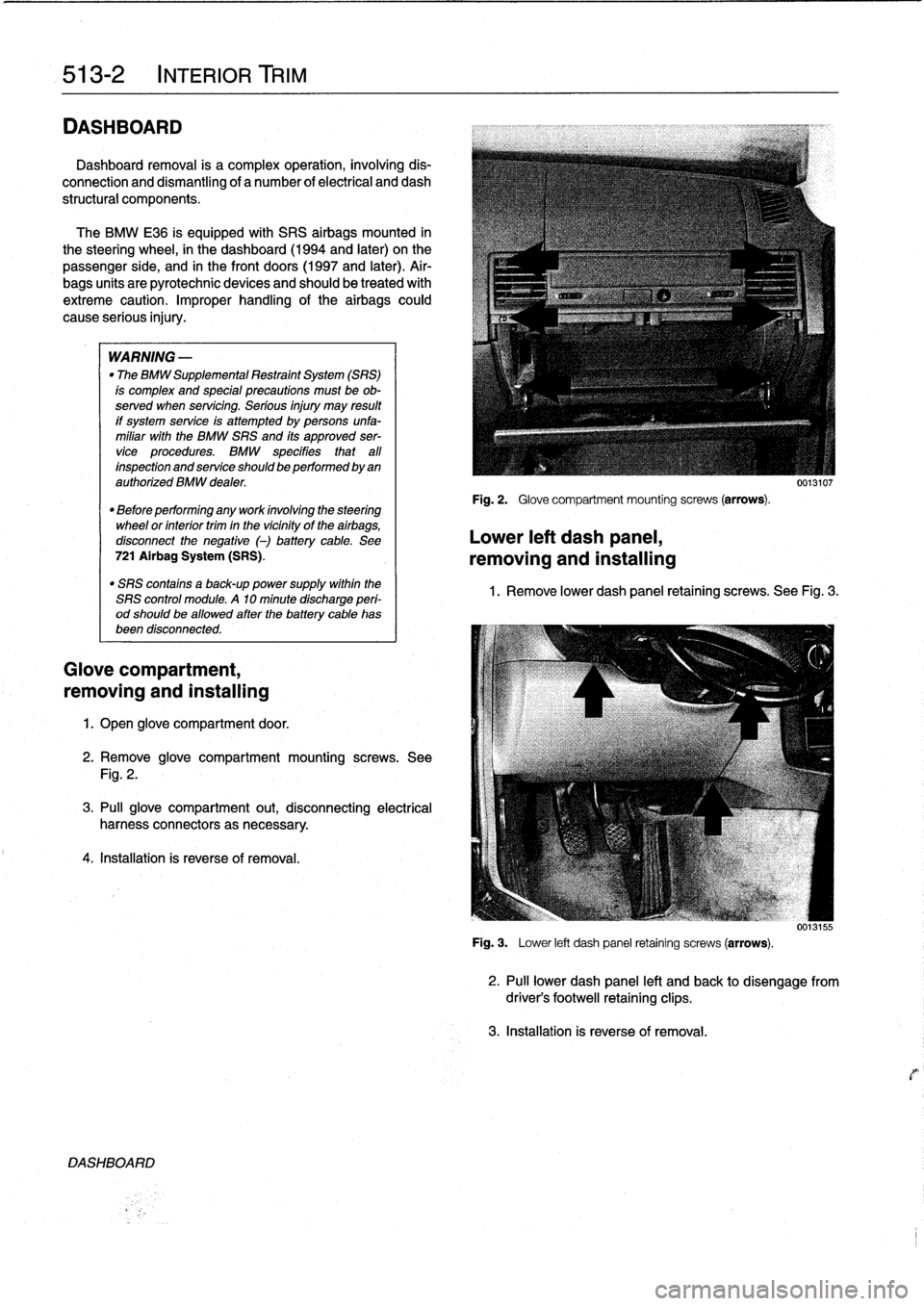
Fig
.
2
.
Glove
compartment
mounting
screws
(arrows)
.
Lower
left
dash
panel,
removing
and
installing
0013107
1
.
Remove
lower
dash
panel
retaining
screws
.
See
Fig
.
3
.
0013155
Fig
.
3
.
Lower
left
dash
panel
retaining
screws
(arrows)
.
2
.
Pull
lower
dash
panel
left
and
back
to
disengagefrom
driver's
footwell
retaining
clips
.
3
.
Installation
is
reverse
of
removal
.
Page 347 of 759
Dashboard,
removing
and
installing
1
.
Disconnect
negative
(-)
cable
from
battery
and
cover
terminal
with
insulating
material
.
CAUTION-
Prior
to
disconnectiog
the
battery,
read
the
battery
disconnection
cautionsgiven
at
the
front
of
this
manual
onpage
vi¡¡
.
2
.
Remove
center
console
as
described
earlier
.
3
.
Remove
glove
compartment
as
described
earlier
.
4
.
Remove
lower
left
dash
trim
piece
as
described
above
.
Remove
lower
right
dash
trim
panel
.
See
Fig
.
4
.
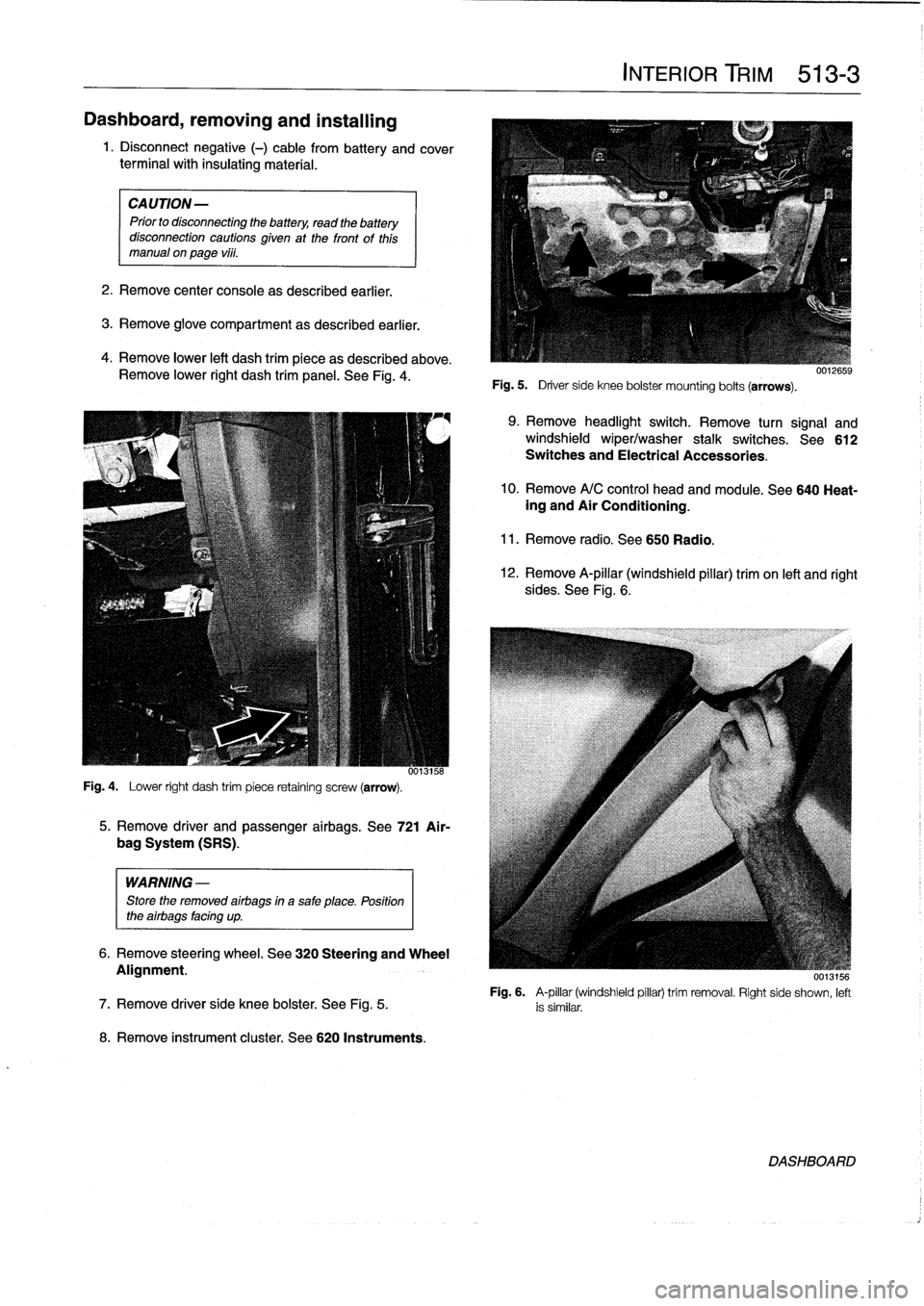
Fig
.
4
.
Lower
right
dash
trim
piece
retaining
screw
(arrow)
.
WARNING
-
Store
the
removed
airbags
in
a
safe
place
.
Position
the
airbags
facing
up
.
8
.
Remove
instrument
cluster
.
See
620
Instruments
.
5
.
Remove
driver
and
passenger
airbags
.
See
721
Air-
bag
System
(SRS)
.
6
.
Remove
steering
wheel
.
See
320
Steering
and
Wheel
Alignment
.
INTERIOR
TRIM
513-
3
Fig
.
5
.
Driver
side
knee
bolster
mounting
bolts
(arrows)
.
9
.
Remove
headlight
switch
.
Remove
turn
signal
and
windshield
wiper/washer
stalk
switches
.
See612
Switches
and
Electrical
Accessories
.
10
.
Remove
A/C
control
head
and
module
.
See
640
Heat-ing
and
Air
Conditioning
.
11
.
Remove
radio
.
See650
Radio
.
12
.
Remove
A-pillar
(windshield
pillar)
trim
on
left
and
right
sides
.
See
Fig
.
6
.
UU13156
Fig
.
6
.
A-pillar
(windshield
pillar)
trim
removal
.
Right
side
shown,
left
7
.
Remove
driver
side
knee
bolster
.
See
Fig
.
5
.
is
similar
.
DASHBOARD
Page 349 of 759
515
Central
Locking
and
Anti-Theft
GENERAL
.....
.
.
.
.
.
.
.
..:
.
.
.
......
.
.
.
.
515-1
Luggage
compartment
locking
actuator,
removing
and
installing
.
.
.
.
.
...........
.
515-6
DOOR
HANDLES
AND
LOCKS
.........
515-1
LOCKING
SYSTEM
AND
Front
door
lock,
removing
and
installing
....
.515-1
ELECTRONIC
IMMOBILIZATION
......
.515-7
Front
door
handle,
removing
and
installing
...
515-3
Rear
door
lock,
removing
and
installing
.....
515-4
Central
Locking
System(ZVM)
.
.
.
.
.......
.
515-7
Rear
door
handle,
removing
and
installing
...
515-5
Central
Body
Electronics
(ZKE
IV)
.
.
.......
.515-8
Electronic
Immobilization
System
(EWS)
.
.
.
.
.515-8
Door
striker,
rep
lacing
.
.
.
.
.
.
.
.
.
..........
515-6
EWS
II
control
module,
re
lacin
515-10
LOCKING
ACTUATORS
.
.
.
.
.
.
..........
515-6
Ring
antenna,
replacing
.
.
.
.
.
.
.
.
.
.
...
.
.
.
.
515-10
Door
Locking
Actuator
.
.
.
.
.
.
.
.
..........
515-6
EWS
II
transmitter/receiver
module,
replacing
...........
.
.
.
.
.
.
.
.
.
.
.
.
.
.
.
.
515-11
GENERAL
This
section
covers
repair
information
for
the
central
locking
and
the
anti-theft
systems
.
Keep
in
mind
that
E36
cars
are
CA
UTION-
equipped
with
sophisticated
and
self-diagnostic
electrical
sys-
Prior
to
disconnecting
the
battery,
read
the
battery
tems
.
When
experiencing
malfunctions
relatinglo
the
central
disconnection
cautions
given
at
the
front
of
this
locking
or
the
anti-theft
system,
it
is
recommended
that
the
manual
onpage
vi¡¡
.
systembe
diagnosed
using
the
BMW
service
tester
(DIS)
.
This
advanced
diagnostic
tool
can
usually
pinpoint
electrical
NOTE-
faults
quickly
and
safely
.
Consult
an
authorized
BMW
dealer
.
In
some
models
covered
inthis
manual,
it
is
not
essen-
tial
to
remove
the
side-impact
airbag
to
access
intemal
NOTE-
door
components
.
However,
the
procedure
is
recom-
Additional
general
electrical
information
can
be
found
mended
for
safely
reasons
.
i
n
610
Electrical
Component
Locations
and
Electri-
cal
Wiring
Diagrams
.
4
.
Disconnect
harnessconnector
from
window
motor
to
DOOR
HANDLES
AND
LOCKS
Front
door
lock,
removing
and
installing
1
.
Remove
front
door
panel
and
vapor
barrier
asde-
scribed
in
411
Doors
.
WARNING
-
Some
1997
and
all
1998
cars
are
fitted
with
side-im-
pact
airbags
in
the
front
doors
.
When
servicing
the
door
locks
on
cars
with
front
side-impact
airbags,
al-
ways
disconnect
the
negative
(-)
battery
terminal
.
See721
Airbag
System
(SRS)
forcautions
andpro-
cedures
relating
to
the
airbag
system
.
2
.
Raise
door
window
completely
CENTRAL
LOCKING
AND
ANTI-THEFT
515-1
3
.
On
cars
with
side-impact
airbags,
disconnect
negative
(-)
cable
from
battery,
then
remove
airbag
module
.
prevent
accidental
operation
.
5
.
On
4-door
cars
:
Peel
back
rubber
window
guide
from
reas
guide
rail
:
Remove
guide
rail
mounting
boltat
bot-
tom
.
Unclip
any
wiring
from
guide
rail
and
pull
guide
rail
downward
and
remove
from
door
.
See
Fig
.
1
.
NOTE
-
The
top
of
the
guide
rail
is
"hooked"
to
the
doorsheet
metal
.
6
.
Remove
inside
door
handle
retaining
screw
.
Discon-
nect
inside
handle
from
linkage
and
remove
.
See
Fig
.
2
.
7
.
Cut
wire
ties
and
remove
door
lock
electrical
harness
con-
nector
.
Remove
door
lock
mounting
screws
.
See
Fig
.
3
.
8
.
Working
inside
door,
disconnect
outside
door
handle
and
lockcylinder
linkage
from
door
lock
.
Remove
lock
from
inside
door
.
See
Fig
.
4
.
DOOR
HANDLES
AND
LOCKS
Page 351 of 759
![BMW 325i 1994 E36 Owners Manual
Front
door
handle,
removing
and
installing
1
.
Closedoor
window
completely
.
2
.
Remove
front
door
panel
and
vapor
barrier
asde-
scribed
in
411
Doors
.
WARNING
-
Some
1997
and
al]
1998
cars
are
f](/img/1/2800/w960_2800-350.png "BMW 325i 1994 E36 Owners Manual
Front
door
handle,
removing
and
installing
1
.
Closedoor
window
completely
.
2
.
Remove
front
door
panel
and
vapor
barrier
asde-
scribed
in
411
Doors
.
WARNING
-
Some
1997
and
al]
1998
cars
are
f")
Front
door
handle,
removing
and
installing
1
.
Closedoor
window
completely
.
2
.
Remove
front
door
panel
and
vapor
barrier
asde-
scribed
in
411
Doors
.
WARNING
-
Some
1997
and
al]
1998
cars
are
fitted
with
side-im-
pact
airbags
in
the
front
doors
.
When
servicing
the
door
handles
on
cars
with
front
side-impact
airbags,
always
disconnect
the
negative
(-)
battery
terminal
.
See
721
Airbag
System
(SRS)
for
cautions
and
pro-
cedures
relatíng
to
the
airbag
system
.
3
.
On
carswíth
side-impact
airbags,
disconnect
negative
(-)
cable
from
battery,
then
remove
airbag
module
.
CAUTION-
Prior
to
disconnecting
the
battery,
read
the
battery
disconnection
cautions
given
at
the
front
of
thís
manual
onpage
vi¡¡
.
NOTE-
In
some
models
covered
inthis
manual,
it
is
not
essen-
tial
to
remove
the
side-impact
airbag
to
access
internal
door
components
.
However,
the
procedure
is
recom-
mended
for
safety
reasons
.
4
.
Remove
door
lock
as
described
earlier
.
5
.
Remove
window
as
described
in
512
Door
Windows
.
CA
UTION-
On
models
with
side-impact
airbags,
removinglin-
stalling
the
front
window
requires
that
the
battery
cable
bereconnected
wíth
the
side-impact
airbag
disconnected
.
This
will
seta
fault
code
in
the
SRS
control
module,
turn
on
the
SRS
warning
light,
and
disable
the
SRS
system
until
the
fault
memo-
ry
is
cleared
usíng
special
SRS
test
equipment
.
6
.
Pry
out
access
plug
in
end
of
door
.
Use
screwdriver
through
access
hole
to
slide
exteriortrim
locking
plate
into
released
position
.
See
Fig
.
5
.
Remove
doorhandle
exterior
trim
piece
.
7
.
Working
inside
door,
remove
locking
clip
for
doorhan-
dle
retaining
pin
and
push
pin
out
.
8
.
Working
inside
door,
disconnect
electrical
harness
con-
nector
at
door
handle
.
Twist
plastic
connector
bracket
to
remove
from
door
handle
.
CENTRAL
LOCKING
AND
ANTI-THEFT
515-
3
0011681
Fig
.
5
.
Insert
screwdriver
into
access
hole
and
push
lockingplate
forward
(arrow)
to
release
exterior
handle
trim
.
uu11682
Fig
.
6
.
Door
handle
retaining
pin(A)
and
lock
collar
nut
(B)
.
Door
handle
trim
shown
removed
.
10
.
Remove
door
handle
fromdoor
by
angling
out
of
door
cavity
.
Removed
door
handle
assembly
is
shown
in
Fig
.
7
.
0012684
Fig
.
7
.
Door
handle
harnessconnector
(A)
;
retaining
pin
Iocking
clip
9
.
Working
at
door
exterior,
remove
handle
collar
nut
(B)
;
exterior
trim
Iocking
plate
(C)
.
Handleassembly
shown
re-
while
supporting
handle
.
See
Fig
.
6
.
moved
from
door
.
DOOR
HANDLES
AND
LOCKS
Page 352 of 759
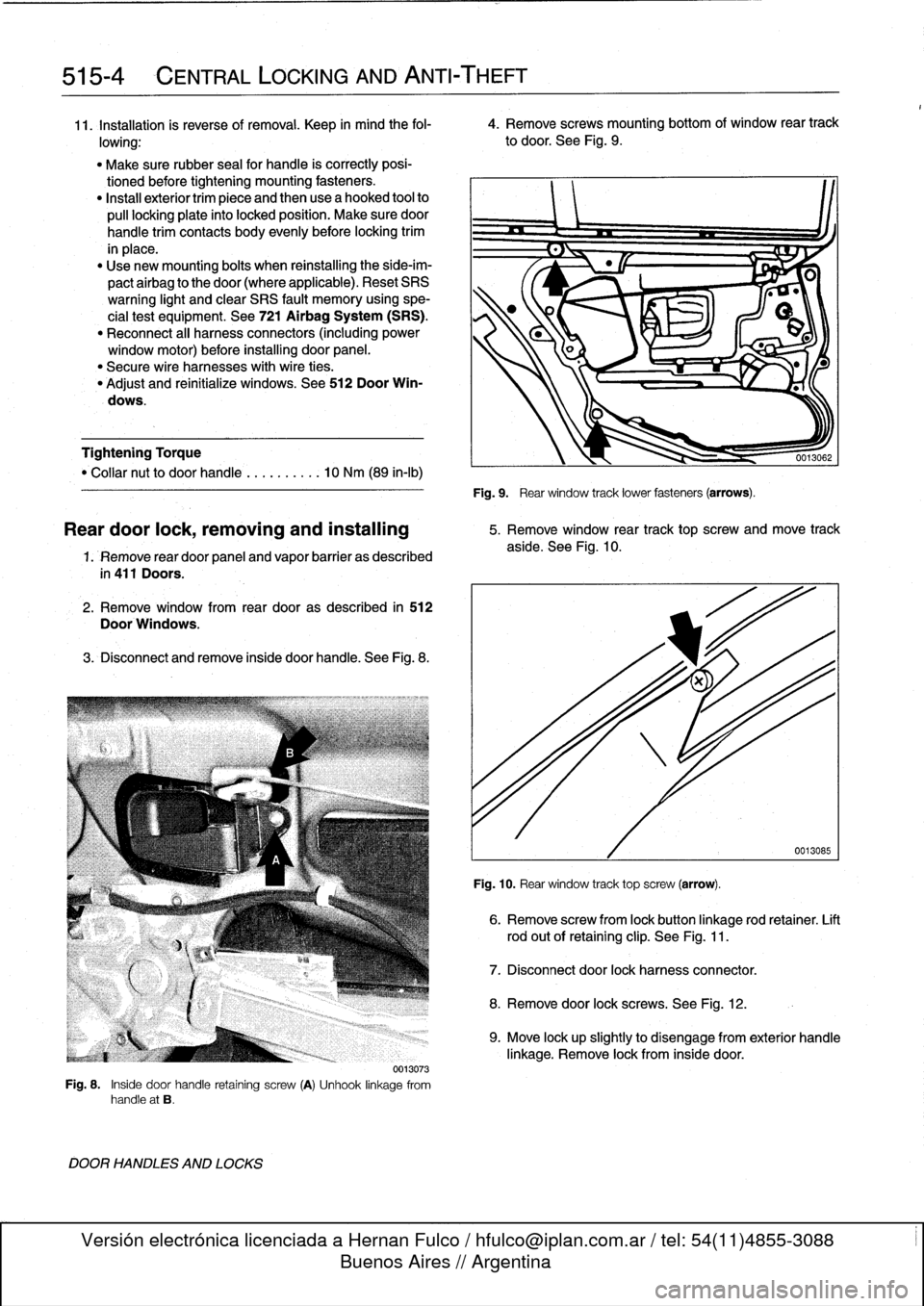
515-4
CENTRAL
LOCKING
AND
ANTI-THEFT
11
.
Installation
is
reverse
of
removal
.
Keep
in
mind
the
fol-
4
.
Remove
screws
mounting
bottom
of
window
rear
track
lowing
:
to
door
.
See
Fig
.
9
.
"
Make
sure
rubber
seal
for
handle
is
correctly
posi-
tionedbefore
tightening
mounting
fasteners
.
"
Install
exteriortrim
piece
and
then
use
a
hooked
tool
to
pull
locking
plate
into
locked
position
.
Make
sure
door
handle
trim
contacts
body
evenly
before
locking
trim
in
place
.
"
Use
new
mounting
bolts
when
reinstalling
the
side-im-
pactairbag
to
the
door(where
applicable)
.
Reset
SRS
warning
light
and
clear
SRS
fault
memory
using
spe-
cial
test
equipment
.
See
721
Airbag
System
(SRS)
.
"
Reconnect
al¡
harness
connectors
(including
power
window
motor)before
installing
door
panel
.
"
Secure
wire
harnesses
withwire
ties
.
"
Adjust
and
reinitialize
windows
.
See
512
Door
Win-
dows
.
Tightening
Torque
"
Collar
nut
to
doorhandle
..........
10
Nm
(89
in-lb)
1.
Remove
rear
door
panel
and
vapor
barrier
as
described
in
411
Doors
.
2
.
Remove
window
from
rear
dooras
described
in
512
Door
Windows
.
3
.
Disconnect
andremove
inside
door
handle
.
See
Fig
.
8
.
0013073
Fig
.
8
.
Inside
door
handle
retaining
screw
(A)
Unhook
linkage
from
handle
at
B
.
DOOR
HANDLES
AND
LOCKS
Fig
.
9
.
Rear
window
track
lower
fasteners
(arrows)
.
Reardoor
lock,
removing
and
installing
5
.
Remove
window
rear
track
top
screw
and
move
track
aside
.
See
Fig
.
10
.
Fig
.
10
.
Rear
window
track
top
screw
(arrow)
.
6
.
Remove
screw
from
lock
button
linkage
rod
retainer
.
Lift
rod
out
of
retaining
clip
.
See
Fig
.
11
.
7
.
Disconnect
door
lock
harnessconnector
.
8
.
Remove
door
lock
screws
.
See
Fig
.
12
.
0013085
9
.
Move
lock
upslightly
to
disengage
from
exterior
handle
linkage
.
Remove
lock
from
inside
door
.
Page 381 of 759
600
Electrical
System-General
GENERAL
.
...........
.
.
.
.
.
.
.
.
.
...
.
...
600-1
Voltage
and
Polarity
........
.
.
.
.
.
.
.
.....
600-1
Ming,
Fuses
and
Relays
............
.
.
.
.
600-1
Electrical
System
Safety
Precautions
...
.
.
.
.
600-1
Electrical
Test
Equipment
.....
.
.
.
....
.
.
.
.
600-2
WIRING
DIAGRAMS
..
.
.
.
.
.
.
.
.
.
........
600-2
Ming
Codes
and
Abbreviations
..
.
...
.
....
600-2
ELECTRICAL
TROUBLESHOOTING
..
.
..
600-3
Voltage
and
Voltage
Drops
..........
.
.
.
.
.
600-4
GENERAL
Electrical
System
Safety
Precautions
A
brief
description
of
the
principal
parts
of
the
electrical
sys-
tem
is
presented
here
.
Also
covered
here
are
basic
electrical
system
troubleshooting
tips
.
Voltage
and
Polarity
The
vehicle
electrical
system
is
a
12-volt
direct
current
(DC)
negative-ground
system
.
A
voltage
regulator
controls
system
voltage
at
approximately
the
12-volt
rating
of
the
battery
.
Al¡
circuits
are
grounded
by
direct
or
indirect
connection
to
the
negative
(-)
terminal
of
the
battery
.
A
number
of
ground
con-
nections
throughout
the
car
connect
the
wiring
harness
to
chassis
ground
.
These
circuits
are
completedby
the
battery
cable
or
ground
strap
between
the
body
and
the
battery
nega-
tive
(-)
terminal
.
Wiring,
Fuses
and
Relays
Nearly
all
parts
of
the
wiring
harnessconnect
to
compo-
nents
of
the
electrical
system
with
keyed,
push-on
connectors
that
lock
into
place
.
Notable
exceptions
arethe
heavy
battery
cables
and
the
starter
wiring
.
The
wiring
is
color-coded
for
cir-
cuitidentification
.
With
theexception
of
the
battery
charging
system,
most
electrical
power
is
routed
from
the
ignition
switch
or
the
bat-
tery
through
the
main
fuse/relay
panel,
located
in
¡he
left
rear
comer
of
the
engine
compartment
.
Fuses
are
color
coded
to
indicate
current
capacities
.
The
relays
and
control
units/modules
are
mounted
in
vari-
ous
places
throughout
the
vehicle
.
See610
Electrical
Com-
ponent
Locations
.
ELECTRICAL
SYSTEM-GENERAL
600-1
Voltage,
measuring
.
.
.
................
.
.
600-4
Voltage
drop,
testing
.
.
.....
.
.....
.
......
600-4
Continuity,
checking
..
.
...
.
.
.
.
.
.
.
.
.
.
.
.
.
.
.
600-5
Short
Circuits
.
.
.
.
.
.
.
.
.....
.
...
.
.
.
.
.
.
.
.
.
600-5
Short
circuit,
testing
with
ohmmete'r
.
.
.
.
.
.
.
.
.
600-6
Short
circuit,
testing
with
voitmeter
.
.
.
.
.
.
.
.
.
600-6
TABLES
a
.
Terminal
and
Circuit
Numbers
..............
..
.600-3
Please
read
the
following
warnings
and
cautions
before
do-
ing
any
work
on
your
electrical
system
.
WARNING
-
"
The
cars
covered
by
this
manual
are
equipped
with
aSupplemental
Restraint
System
(SRS)
that
automatically
deploys
one
or
more
airbags
.
Each
airbag
unit
houses
an
explosive
powerful
charge
.
Any
work
involving
the
SRS
system
should
only
be
performed
byan
authorized
BMW
dealer
.
Making
repairs
without
the
proper
knowledge
and
special
test
equipment
may
cause
serious
per-
sonal
injury
.
See
721
Airbag
System
(SRS)
.
"
The
ignition
system
of
the
car
operates
at
lethal
voltages
.
People
with
pacemakers
or
weak
hearts
should
not
expose
themselves
to
the
ignition
sys-
tem
.
Extra
caution
mustbe
taken
when
working
on
the
ignition
system
or
when
servicing
theen-
gine
while
it
is
runningor
the
key
is
on
.
See
120
Ignition
System
for
additional
ignition
system
warnings
and
cautions
.
"
Before
operating
the
starter
without
starting
the
engine
(as
when
making
a
compressfon
test),
dis-
able
the
ignition
system
as
described
in
120
Igni-
tion
System
.
"
Keep
hands,
clothing
and
other
objects
clear
of
the
electric
radiator
coollng
fan
when
working
on
a
warm
engine
.
The
fan
may
start
at
any
tíme,
even
when
the
ignition
is
switched
off
.
GENERAL
Page 383 of 759
NOTE
-
Sometimes
the
color
of
en
installed
wire
may
be
differ-
ent
than
the
one
on
the
wiring
diagram
.
Don't
be
con-
cerned
.
Just
be
sure
lo
confirm
that
the
wire
connects
lo
the
proper
terminals
.
Wire
color
codes
"
BLU
.........
.
..
..
...
.
.................
Blue
"
BRN
....:....
.
..
..
...
..
...............
Brown
"
YEL
.........
.
..
..
...................
.Yellow
"
GRN
.........
.
..
..
...
.
................
creen
"
G
RY
.......
.
.
.
..
..
.....................
G
ray
"
ORG
.........
.
..
..
...
.
..............
.Orange
"
RED
......
...
.
.
..
.....................
.Red
"
BLK
.........
.
..
..
...
.
................
Black
"
VIO
..........
.
..
...
..
..
.......
.
.......
Violet
"
WHT
.........
.
.
....
.
...
:..............
White
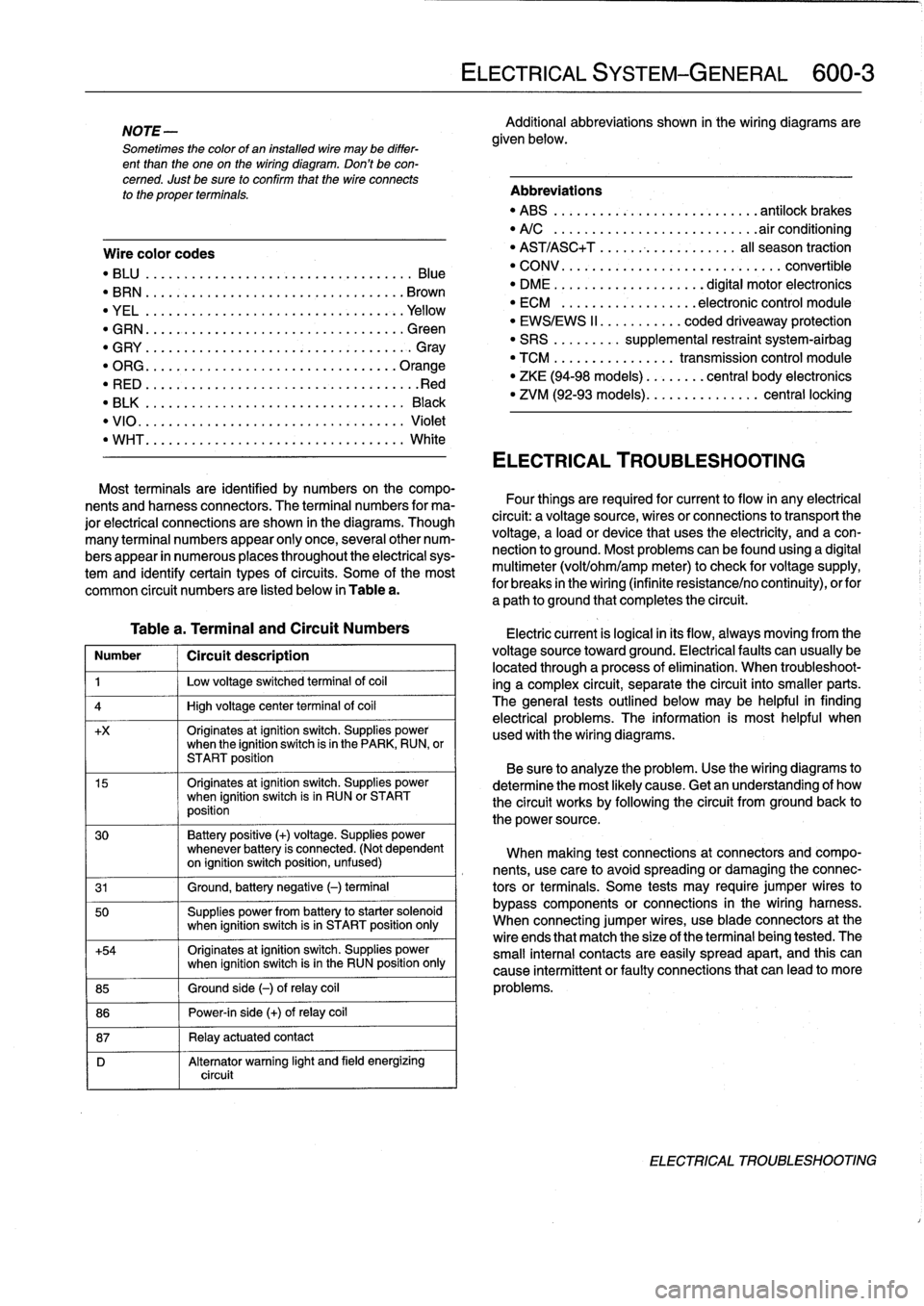
Table
a
.
Terminal
and
Circuit
Numbers
Number
1
Circuít
description
1
j
Low
voltage
switched
terminal
of
coi¡
4
1
High
voltage
center
termina¡
of
coi¡
+x
Originates
atignition
switch
.
Supplies
powerwhen
the
ignition
switch
is
in
the
PARK,
RUN,
or
START
position
15
Originates
atignition
switch
.
Supplies
powerwhen
ignition
switch
is
in
RUN
or
START
position
30
Battery
positive
(+)
voltage
.
Supplies
power
whenever
battery
is
connected
.
(Not
dependent
on
ignition
switch
position,
unfused)
31
1
Ground,
battery
negative
(-)
terminal
50
Supplies
power
from
battery
to
starter
solenoid
when
ignition
switch
isin
START
position
only
+54
Originates
atignition
switch
.
Supplies
power
when
ignition
switch
isin
the
RUN
position
only
85
1
Ground
side
(-)
ofrelay
coil
86
1
Power-in
side
(+)
ofrelay
coil
87
1
Relay
actuatedcontact
D
Alternator
warning
light
and
field
energizing
circuit
ELECTRICAL
SYSTEM-GENERAL
600-
3
Additional
abbreviations
shown
in
the
wiring
diagrams
are
given
below
.
Abbreviations
"
ABS
........
.
...
.
...
.
..........
antilock
brakes
"
A/C
........
.
...
..
..
.
.........
.airconditioning
"
AST/ASC+T
.......
...
.
.
.......
al¡
season
traction
"
CONV
.......
.
.
...
.................
convertible
"
DME
........
.
.
...
.......
digital
motor
electronics
"
ECM
.......
.
...
..
..
.
..
electronic
control
module
"
EWS/EWS
II
......
...
.
.
coded
driveaway
protection
"
SRS
........
.
supplemental
restraint
system-airbag
"
TCM
........
.
..
....
.
transmission
control
module
"
ZKE
(94-98
models)
..
..
.
...
central
body
electronics
"
ZVM
(92-93
models)
...
.
.
..
.
.......
central
locking
ELECTRICAL
TROUBLESHOOTING
Most
terminals
are
identified
by
numbers
on
the
compo-
nents
and
harness
connectors
.
The
terminal
numbers
for
ma-
Four
things
are
required
for
current
toflow
in
any
electrical
jor
electrical
connections
are
shown
in
the
diagrams
.
Though
circuit
:
a
voltagesource,
wires
or
connections
to
transport
the
many
terminal
numbers
appear
only
once,
severa¡other
num-
voltage,
a
load
or
device
that
uses
the
electricity,
and
a
con-
bers
appear
in
numerous
places
throughout
the
electrical
sys-
nection
to
ground
.
Most
problemscanbefound
using
a
digital
tem
and
identify
certain
types
ofcircuits
.
Some
of
the
most
multimeter
(volt/ohm/amp
meter)to
check
for
voltage
supply,
common
circuit
numbers
are
listed
below
in
Table
a
.
for
breaks
in
the
wiring
(infinite
resistance/no
continuity),
orfor
a
path
to
ground
that
completesthe
circuit
.
Electric
current
is
logical
in
its
flow,
always
moving
from
the
voltage
sourcetoward
ground
.
Electricalfaults
can
usually
be
located
through
a
process
of
elimination
.
When
troubleshoot-
ing
a
complex
circuit,
separate
the
circuit
into
smaller
parts
.
The
general
testsoutlined
below
may
be
helpful
in
finding
electrical
problems
.
The
information
is
most
helpful
when
used
with
the
wiring
diagrams
.
Be
sure
to
analyze
the
problem
.
Use
the
wiring
diagrams
to
determine
the
most
likely
cause
.
Getan
understanding
of
how
the
circuit
works
by
following
the
circuit
from
groundback
to
the
power
source
.
When
making
test
connections
at
connectors
andcompo-
nents,
use
care
to
avoidspreading
or
damaging
the
connec-
tors
or
terminals
.
Some
tests
may
require
jumper
wires
to
bypass
components
or
connections
in
the
wiring
harness
.
When
connecting
jumper
wires,
use
bladeconnectors
at
the
wire
ends
that
match
the
size
of
the
terminal
being
tested
.
The
small
interna¡
contacts
are
easily
spread
apart,
and
this
can
cause
intermittent
or
faultyconnections
that
can
leadto
more
problems
.
ELECTRICAL
TROUBLESHOOTING
Page 387 of 759
610
Electrical
Component
Locations
GENERAL
...........
.
.
.
.
.
.
.
.
.
........
610-1
FOSE
POSITION
TABLES
..
.
.
.
.
.
.....
.
610-19
FUSE
AND
RELAY
POSITIONS
.
...
.
.
.
.
.
610-1
Fuse
Positions
.
.
.
................
.
.
.
.
.
610-1
Relay
Positions
.
.
.
.....
.
.
.
........
.
.
.
.
.
610-2
Auxiliary
RelayPanel
.....
.
...
.
........
.
610-2
SplicePanel,
Left
.
.
.
...
.
.
.
...
.
........
.
610-2
SplicePanel,
Right
.
.
.
.
.
.
.
.
...
.
.........
610-3
COMPONENT
LOCATIONS
.
.
.
.
.......
.
.610-3
Component
Location
Table
.
.
.
.
.
.
.........
610-9
GENERAL
FUSE
AND
RELAY
POSITIONS
This
repair
group
covers
f
use,
relay,
and
control
module
lo-
The
front
power
distribution
box,
an
auxiliary
relay
panel,cation
information
.
Electrical
equipment
and
accessories
in-
and
two
auxiliary
splice
panels
contain
most
of
the
fuses
and
stalled
varies
depending
on
model
and
model
year
.
Always
relays
in
E36
vehicles
.
Refer
to
the
component
location
later
confirm
that
the
proper
electrical
component
has
been
identi-
in
this
section,
as
well
as
the
tables
at
the
end
of
this
repair
fied
by
using
the
electrical
wiring
diagrams
.
group
for
electrical
component
location
.
WARNING
-
On
cars
equipped
with
airbags,
special
precautionsapply
to
any
electrical
system
testing
orrepair
.
Air-
bag
units
areexplosive
devices
and
mustbe
han-
dled
with
extremecare
.
Before
starting
any
work
onan
airbag
equipped
car,
refer
to
the
wamings
and
cautions
in
721
Airbag
System
(SRS)
.
CAUTION
-
"
Prior
to
disconnectiog
the
battery,
read
the
bat-
tery
disconnection
cautions
given
at
the
front
of
this
manual
on
page
viii
.
"
Relay
and
fuse
positions
are
subject
to
changeand
may
varyfrom
car
to
car
.
If
questions
arise,
an
authorized
BMW
dealer
is
the
best
source
for
the
most
accurate
and
up-to-date
information
.
"
A
good
way
to
verify
a
relay
position
isto
com-
pare
the
wiring
colors
at
the
relay
socket
to
thecolors
indicated
on
the
wiring
diagrams
located
at
the
rear
of
this
manual
.
"
Always
switchthe
ignition
off
and
disconnect
the
negative
(-)
battery
cable
before
removing
any
electrical
components
.
"
Connect
and
disconnect
ignition
system
wires,
multiple
connectors,
and
ignition
test
equipment
leads
only
while
the
ignition
is
switched
off
.
"
Only
usea
digital
multimeter
for
electrical
tests
.
ELECTRICAL
COMPONENT
LOCATIONS
610-1
TABLES
a
.
E36Component
Locations
...........
.
.
..
...
610-10b
.
1992
E36
Fuse
Positions
..........
..
.
.
.....
610-20c
.
1993
E36
Fuse
Positions
..........
..
..
.
....
610-22d
.
1994
E36
Fuse
Positions
.........
...
.......
610-24e
.
1995
E36
Fuse
Positions
.........
...
.......
610-26
f
.
1996
E36
Fuse
Positions
.........
...
.......
610-28g
.
1997-1998
E36
Fuse
Positions
..
.
..
...
.......
610-30
Fuse
Positions
CAUTION
-
"
Replace
fuses
with
those
of
the
same
rating
.
In-
stalling
a
fuse
with
higher
rating
can
lead
to
cir-
cuit
failure
and
may
also
start
a
fire
.
"
Relay/fuse
positions
vary
by
model
and
equip-
ment
.
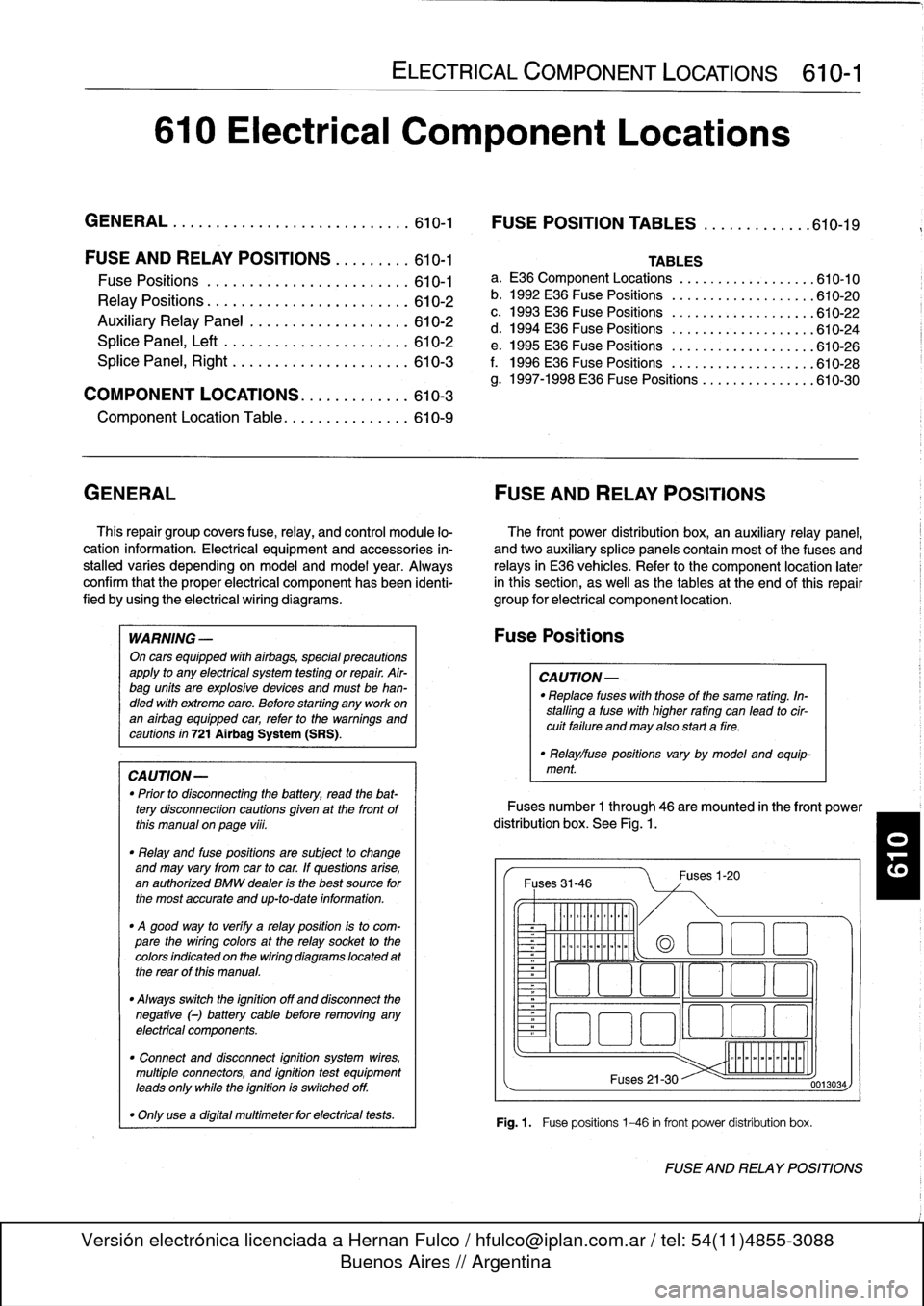
Fuses
number
1
through
46
are
mounted
in
the
front
power
distribution
box
.
See
Fig
.
1.
Fuses
31-46
~
Illlllllllll
°
-
Ilmmlmomlmoi
Fuses
1-20
(a
1
:1
E
El
~
~O!7
L~~n
4~
i
Fuses
21-30
Fig
.1.
Fuse
positions
1-46
in
front
power
distribution
box
.
0013034
FUSE
AND
RELAY
POSITIONS
Page 403 of 759
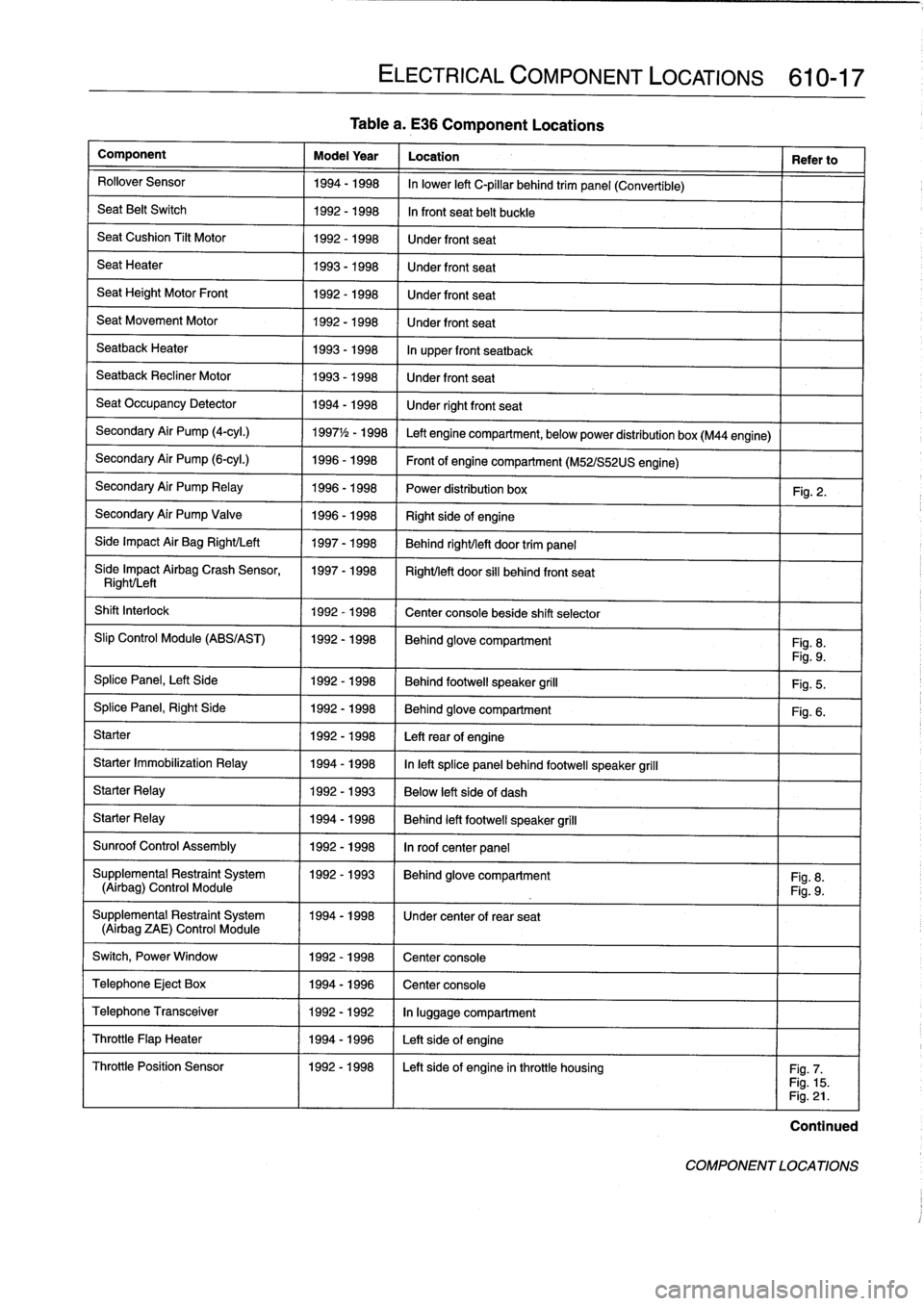
Tablea
.
E36
Component
Locations
Component
Model
Year
Location
Refer
to
Rollover
Sensor
1994-1998
In
lower
left
C-pillar
behind
trim
panel
(Convertible)
Seat
Belt
Switch
1992-1998
In
front
seat
belt
buckle
SeatCushion
Tilt
Motor
1992-1998
Under
front
seat
Seat
Heater
1993-1998
Under
front
seat
Seat
Height
Motor
Front
1992-1998
Under
front
seat
Seat
Movement
Motor
1992-1998
Under
front
seat
Seatback
Heater
1993-1998
In
upper
front
seatback
Seatback
Recliner
Motor
1993-1998
Under
front
seat
Seat
Occupancy
Detector
1994-1998
Under
rightfront
seat
Secondary
Air
Pump
(4-cyl
.)
1997
1
/2
-
1998
Left
engine
compartment,
belowpower
distribution
box
(M44
engine)
Secondary
Air
Pump
(6-cyl
.)
1996-1998
Front
of
engine
compartment
(M52/S52US
engine)
Secondary
Air
Pump
Relay
1996-1998
Power
distribution
box
Fig
.
2
.
Secondary
Air
Pump
Valve
1996-1998
Right
sideof
engine
Side
Impact
Air
Bag
Right/Left
1997-1998
Behind
right/left
door
trim
panel
Síde
Impact
Airbag
Crash
Sensor,
1997-1998
Right/left
door
si¡¡
behind
front
seat
Right/Left
Shift
Interlock
1992-1998
Center
console
beside
shift
selector
Slip
Control
Module
(ABS/AST)
1992-1998
Behind
glove
compartment
Fig
.
8
.
Fig
.
9
.
Splice
Panel,
Left
Side
1992-1998
Behind
footwell
speaker
grill
Fig
.
5
.
SplicePanel,
Right
Side
1992-1998
Behind
glove
compartment
Fig
.
6
.
Starter
1992-1998
Leftrear
of
engine
Starter
Immobilization
Relay
1994-1998
In
left
splice
panelbehind
footwell
speaker
grill
Starter
Relay
1992-1993
Below
left
side
of
dash
Starter
Relay
1994-1998
Behind
left
footwell
speaker
grill
Sunroof
Control
Assembly
1992-1998
In
roof
center
panel
Supplemental
Restraint
System
11992-1993
I
Behind
glove
compartment
I
Fig
.
8
.
(Airbag)
Control
Module
Fig
.
9
.
Supplemental
Restraint
System
1994-1998
1
Under
center
of
rear
seat
(Airbag
ZAE)
Control
Module
Switch,
Power
Window
1
1992-1998
1
Center
console
Telephone
Eject
Box
1
1994-1996
1
Center
console
ELECTRICAL
COMPONENT
LOCATIONS
610-17
Telephone
Transceiver
1992-1992
In
luggage
compartment
Throttle
Flap
Heater
1994-1996
Left
sideof
engine
Throttle
Position
Sensor
1992-1998
I
Left
sideof
engine
inthrottle
housing
I
Fig
.
7
.
Fig
.
15
.
Fig
.
21
.
Continued
COMPONENT
LOCATIONS