flat tire BMW 325I 2001 User Guide
[x] Cancel search | Manufacturer: BMW, Model Year: 2001, Model line: 325I, Model: BMW 325I 2001Pages: 203, PDF Size: 2.07 MB
Page 126 of 203

126n
Tire replacement Tire rotationTire ageThe date on which the tire was manu-
factured is indicated by the code on the
sidewall:
DOT ... 4100 indicates that the tire was
manufactured during week 41 of the
year 2000.
BMW recommends the replacement of
all tires when the tires are no more than
6 years old, even if a tire life of 10 years
is possible.
Spare tires over 6 years old should be
used only in case of emergency. A tire
of this age should be replaced by a new
tire immediately, and should not be
mounted together with new tires.
Between the axlesThe tread wear patterns at the front end
differ from those at the rear Ð the actual
patterns will vary according to indi-
vidual driving conditions. In the inter-
ests of safety and maintaining optimal
handling characteristics, tire rotation is
not recommended.
If a proposed interaxle rotation of tires
is based on economic considerations,
one should consider whether the costs
for the rotation are likely to be recap-
tured by any increase in the service life
of the tires that might be realized. In
principle, interaxle rotation must be
performed in short intervals, with a
maximum of 3,000 miles (5,000 km).
Consult your BMW center for more
information.
Should you decide to rotate the tires, it
is essential to comply with the following:
Rotate tires on the same side only, since
braking characteristics and road grip
could otherwise be adversely affected.
Following rotation, the tire inflation
pressure should always be corrected.If different tire sizes are mounted
on the front and rear axles (refer to
page 12 9), the wheels may not be
rotated from one axle to the other.<
Page 127 of 203

127n
IndexDataTechnologyRepairsCar careControlsOverview
Wheel and tire combinations The right choice Use only tires approved by BMW.
Refer to the information beginning on
page 129.
Due to the high speeds this vehicle can
reach, the use of specific brands, spec-
ifications and sizes is mandatory.
Consult any BMW center for details.
Comply with local/national regulations.
The correct wheel-tire combina-
tion affects different systems such
as ABS, ATC and ASC+T/DSC. The
function of these systems is impaired if
improper wheel-tire combinations are
used.
For this reason, use only tires of the
same brand and tread pattern. In the
event of a flat tire, for example, remount
the approved wheel-tire combination as
soon as possible.<
Codes on tires and wheels The tire codes will aid you in selecting
the correct tire.
Codes on radial tires:
The speed rating indicates the approved
maximum speed for the tire.
Summer tires:
S = up to 112 mph (180 km/h)
T = up to 118 mph (190 km/h)
H = up to 130 mph (210 km/h)
V = up to 150 mph (240 km/h)
W = up to 167 mph (270 km/h)
Y = up to 187 mph (300 km/h)
ZR = over 150 mph (240 km/h) For example:
Nominal width
in mm
Aspect ratio in %
Radial tire code
Rim diameter in inches
Load rating
(not on ZR tires)
Speed rating
(before R on ZR tires)
205/60 R 15 91 W
Winter tires:
Q M+S = up to 100 mph (160 km/h)
T M+S = up to 118 mph (190 km/h)
H M+S = up to 130 mph (210 km/h)
Codes stamped on light-alloy wheels:
Protect tire valves from dirt by using
screw-on valve stem caps. Dirt in the
valves frequently leads to slow leaks. For example:
Rim width
in inches
Code letter for
flange type
Symbol for full-drop
center rim
Rim diameter in inches
Hump on the 2 rim shoulders
7 x 15 H 2
J
Page 128 of 203

128n
Winter tiresChoosing the right tireBMW recommends winter tires (M+S
radial tires) for driving in adverse winter
road conditions. So-called all-season
tires with the M+S-identification mark
do indeed possess better winter trac-
tion than summer tires with the load
rating H, V, W, Y und ZR, but usually do
not achieve the same level of perfor-
mance as winter tires.
In the interests of safe tracking and
steering response, install radial tires
made by the same manufacturer and
with the same tread configuration on all
four wheels if you elect to mount winter
tires.
Mount only winter tires which have
been approved by BMW. Any BMW
center will be glad to provide you with
information on the best winter tires for
your particular driving conditions.
Do not exceed specified
maximum speeds
Never exceed the maximum speed
for which the tires are rated.
Unprofessional attempts by laymen to
service tires can lead to damage and
accidents.
Have this work performed by skilled
professionals only. Any BMW center
has the required technical knowledge
and the proper equipment and will be
happy to assist you.<
Tire condition, tire pressureOnce the tire wears to below 0.16 in
(4 mm), winter tires display a percep-
tible decrease in their ability to cope
with winter driving conditions, and
should be replaced in the interest of
safety.
Comply with the specified tire inflation
pressures Ð and be sure to have the
wheel and tire assemblies balanced
every time you change the tires.
StorageAlways store tires in a cool, dry place.
Store them away from light whenever
possible. Protect the tires against
contact with oil, grease and fuel.Snow chains
*
The use of narrow-link BMW snow
chains on summer or winter tires is
approved only in pairs and only on the
rear wheels. Comply with all manufac-
turer's safety precautions when
mounting the chains.
BMW 325xi: in a worst-case scenario,
i.e. if your vehicle is stuck on one side
or you cannot access one tire, then only
one chain may be attached to a rear
wheel for a short period of time.
Comply with all manufacturer's safety
precautions when mounting the chains.
Page 159 of 203
159n
IndexDataTechnologyRepairsCar careControlsOverview
Changing a wheel
Take these precautionary mea-
sures if you have either a flat tire or
are changing a wheel.
Stop the vehicle as far as possible from
passing traffic. Park on a firm, flat
surface. Switch on the hazard warning
flashers. Turn the steering wheel to the
straight-ahead position, remove the key
and engage the steering lock. Shift into
1st gear or reverse (selector lever in
"Park" with automatic transmission)
and engage the parking brake.
All passengers should be outside the
vehicle and well away from your imme-
diate working area (behind a guardrail,
for instance).
If a warning triangle or portable hazard
warning lamp is available, set it up on
the roadside at an appropriate distance
from the rear of the vehicle. Comply with
all safety guidelines and regulations.
Change the wheel only on a level, firm
surface that is not slippery. Avoid jack-
ing the vehicle on a soft or slippery
support surface (snow, ice, loose gravel,
etc.), as it could slide sideways.
Position the jack on a firm support
surface.
Do not place wooden blocks or similar
objects under the jack, otherwise, the
jack might not be able to reach its full
support capacity because of the limited
height.
Do not lie under the vehicle or start the
engine when the vehicle is supported by
the jack. Failure to comply with this
creates a risk of fatal injury.<
Your BMW has either a spare tire or
space-saver tire for temporary use to
ensure your mobility.
To remove the spare wheel, lift out
the floor panel in the luggage
compartment completely (refer to
page 109.<
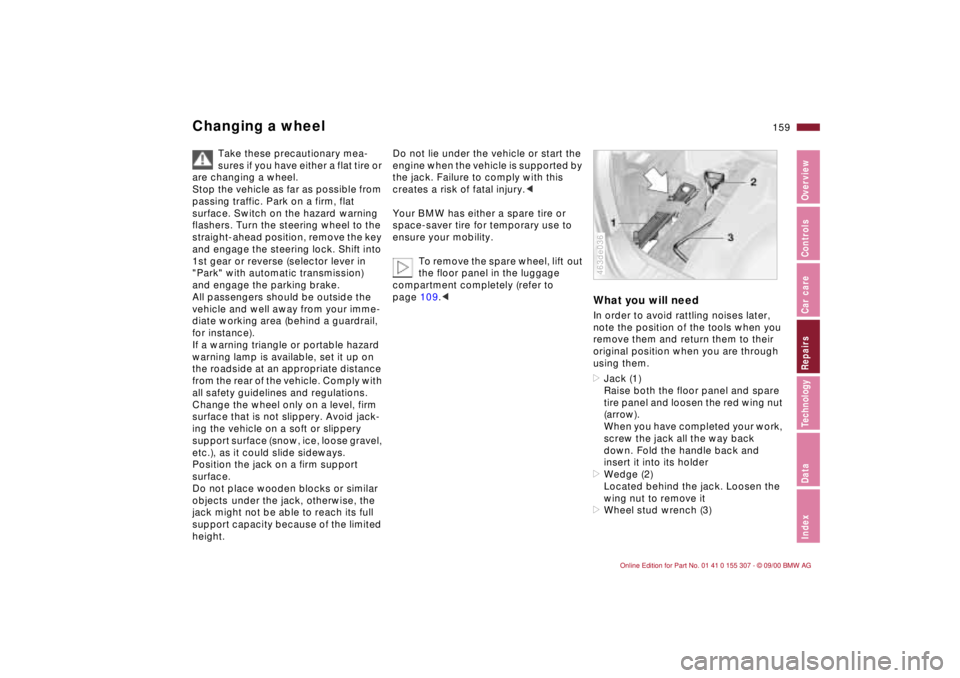
What you will needIn order to avoid rattling noises later,
note the position of the tools when you
remove them and return them to their
original position when you are through
using them.
>Jack (1)
Raise both the floor panel and spare
tire panel and loosen the red wing nut
(arrow).
When you have completed your work,
screw the jack all the way back
down. Fold the handle back and
insert it into its holder
>Wedge (2)
Located behind the jack. Loosen the
wing nut to remove it
>Wheel stud wrench (3) 463de036
Page 161 of 203
161n
IndexDataTechnologyRepairsCar careControlsOverview
Changing a wheel8 Remove mud or dirt accumulation
from the mounting surfaces of the
wheel and hub. Clean the lug bolts.
9 Position the new wheel or the
space-saver tire on the hub and
screw at least two lug bolts finger-
tight into opposite bolt holes.
10 Screw in the remaining lug bolts.
Tighten all the bolts snugly.
11 Lower the jack and remove it from
beneath the vehicle.
12 Tighten the lug bolts in a diagonal
pattern.
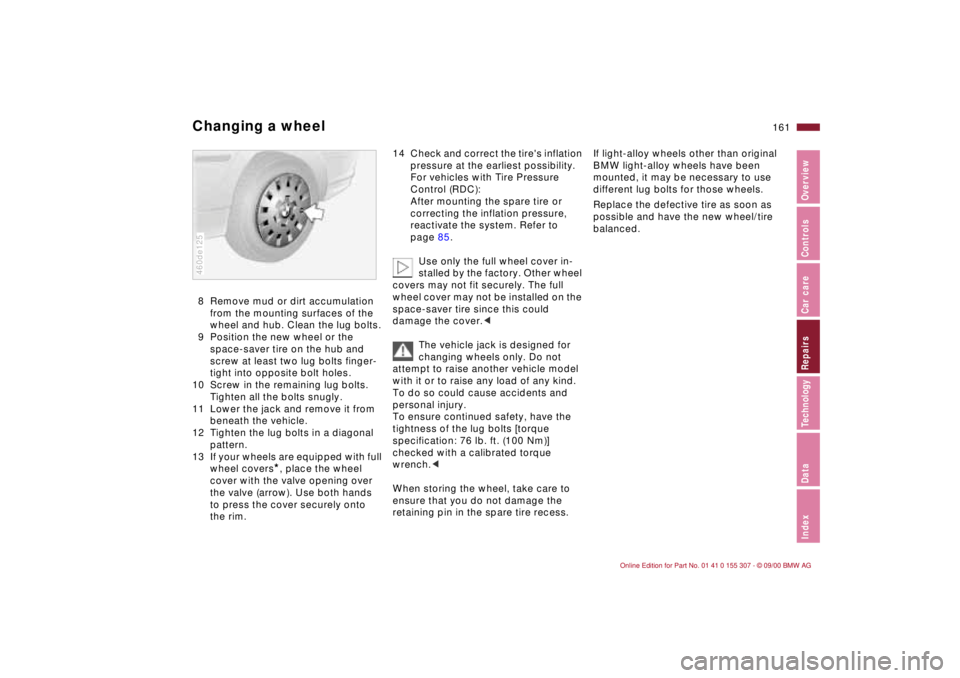
13 If your wheels are equipped with full
wheel covers
*, place the wheel
cover with the valve opening over
the valve (arrow). Use both hands
to press the cover securely onto
the rim.
460de125
14 Check and correct the tire's inflation
pressure at the earliest possibility.
For vehicles with Tire Pressure
Control (RDC):
After mounting the spare tire or
correcting the inflation pressure,
reactivate the system. Refer to
page 85.
Use only the full wheel cover in-
stalled by the factory. Other wheel
covers may not fit securely. The full
wheel cover may not be installed on the
space-saver tire since this could
damage the cover.<
The vehicle jack is designed for
changing wheels only. Do not
attempt to raise another vehicle model
with it or to raise any load of any kind.
To do so could cause accidents and
personal injury.
To ensure continued safety, have the
tightness of the lug bolts [torque
specification: 76 lb. ft. (100 Nm)]
checked with a calibrated torque
wrench.<
When storing the wheel, take care to
ensure that you do not damage the
retaining pin in the spare tire recess.
If light-alloy wheels other than original
BMW light-alloy wheels have been
mounted, it may be necessary to use
different lug bolts for those wheels.
Replace the defective tire as soon as
possible and have the new wheel/tire
balanced.
Page 172 of 203
172n
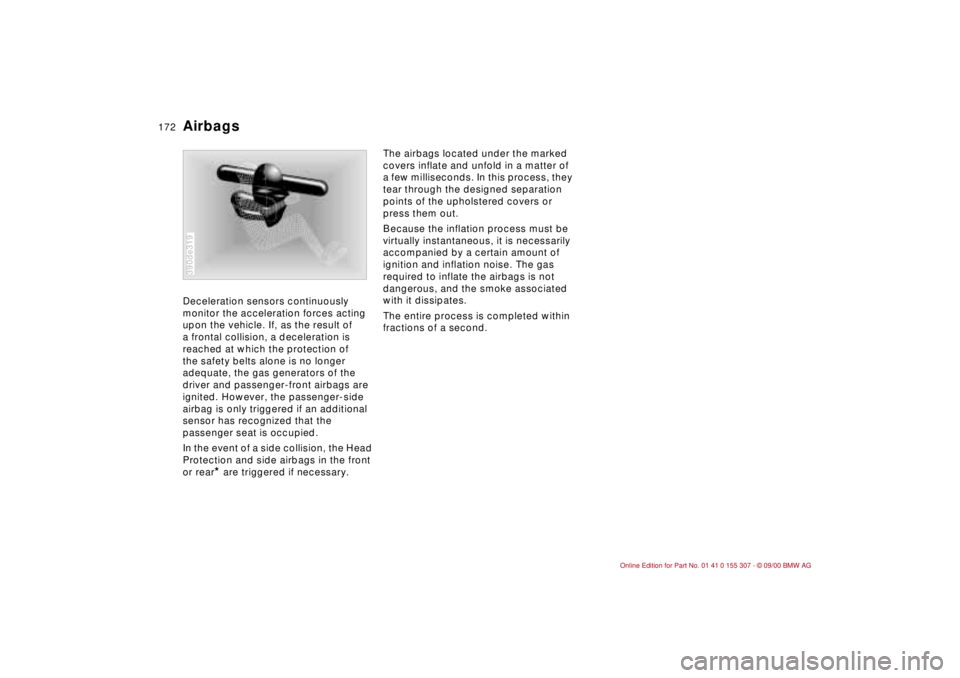
Deceleration sensors continuously
monitor the acceleration forces acting
upon the vehicle. If, as the result of
a frontal collision, a deceleration is
reached at which the protection of
the safety belts alone is no longer
adequate, the gas generators of the
driver and passenger-front airbags are
ignited. However, the passenger-side
airbag is only triggered if an additional
sensor has recognized that the
passenger seat is occupied.
In the event of a side collision, the Head
Protection and side airbags in the front
or rear
* are triggered if necessary.
390de319
The airbags located under the marked
covers inflate and unfold in a matter of
a few milliseconds. In this process, they
tear through the designed separation
points of the upholstered covers or
press them out.
Because the inflation process must be
virtually instantaneous, it is necessarily
accompanied by a certain amount of
ignition and inflation noise. The gas
required to inflate the airbags is not
dangerous, and the smoke associated
with it dissipates.
The entire process is completed within
fractions of a second.
Airbags
Page 193 of 203

Everything from A to Z
193n
IndexDataTechnologyRepairsCar careControlsOverview
Changing a wheel159
Charge indicator lamp20
Check air pressure28
Check Control75
Check engine oil level135
Child restraint
systems54,60
Child-safety locks58
Child's seat54
Cigarette lighter104
Cleaning windshield68
Clock75
refer also to the Radio or
Computer Owner's Manual
Cockpit16
Coin holder102
Combination switch68
Compression184
Computer76
Configure settings52
Consumption77
display74
Contents10
Control elements20
Coolant121,137,187
antifreeze121
Coolant temperature
gauge74
Cooling system187
Copyright4
Cornering Brake Control
(CBC)21,117 Cruise control71
Cruising range77
Cup holder, refer to
beverage holder102
Curb weight186
Current check indicator20
D
Dashboard16
Data
dimensions185
engine184
technical184
weights186
Daytime-driving lamp
switch87
DBC (Dynamic Brake
Control)118
Defrost position94,98
Defrostable rear window99
Defrosting
rear window92
windows94,98
Digital clock75
Dimensions185
Dipstick, engine oil135
Disc brakes118
Displacement184
Display lighting87
Displays18
Distance warning78 Diversity Antenna
system174
Door key32,35
Door locks, care121
Doors
child-safety locks58
emergency operation34
unlocking and locking34
DOT Quality Grades125
Draft-free ventilation93
Drive belts188
Driving hints115
Driving in winter121
Driving lamps87
DSC (Dynamic Stability
Control)81,173
Dynamic Brake Control
(DBC)118
Dynamic Stability Control
(DSC)22,81,173
E
Electric power seat48
Electric power windows43
Electrical accessories,
failure164
Electrical system188
Electronic vehicle
immobilizer33
Elements of operation16 Emergency operation,
doors34
Energy Control73
Engine
coolant137,187
data184
starting61
Engine oil
capacity187
consumption135
pressure20
quality136
specifications136
viscosity136
Engine speed184
Exterior mirrors51
F
Failure messages75
Fault displays75
Fault, ABS117
Filler cap cover27
Filling capacities187
Filling the washer
reservoir187
First-aid kit26
Fittings, tow starting and
towing168
Flashlight101
Flat tire124,159
Fog lamps88
Page 194 of 203

Everything from A to ZFolding rear backrest108
Footbrake118
Footwell lamps88
bulb replacement158
Four-wheel drive175
Front fog lamps, bulb
replacement155
Front seat adjustment46
Frost protection,
radiator137
Fuel28
consumption77
consumption display74
gauge74
preparation184
quality28
Fuel filler door
releasing following an
electrical malfunction166
Fuel reserve indicator
lamp74
Fuel tank capacity187
Fuel tank gauge74
Functional status179
Fuses164 G
Gasoline28
Gasoline gauge74
Gasoline quality28
Glove compartment101 Glove compartment lamp,
bulb replacement158
Gross vehicle weight186
H
Handbrake63
Hands-free system103
Hazard warning flashers26
Hazard warning triangle26
Head restraint47
Headlamp covers,
care141,153
Headlamp flasher88
Headlamp washer
system70,134,187
Heated seats100
Heating, rapid94
Heavy loads110
Height185
HiFi system101
High beams23,68,88
bulb replacement153
High Performance Synthetic
Oils136
High-mount brake lamp157
Hood release130
Horn17
Hubcap160
Hydraulic Brake assistant,
refer to DBC118
I
Ice warning76
Icy roads76,121
Identification, tires127
Ignition key32,35
Ignition lock61
Imprint4
Indicator lamps20
Inflation pressure28,124
monitoring85,178
INSPECTION74
Installation child restraint
systems60
Instrument cluster18
Instrument lighting87
Interaxle tire rotation126
Interface socket for Onboard
Diagnostics149
Interference, cellular
phone123
Interior lamps36,88
bulb replacement158
remote control36
Interior motion sensor41
Interior rearview mirror51
automatic dimming
feature52,176
Interlock61
Intermittent wipe68
J
Jack159
Jump-starting167 K
Key32,35
Key Memory52 L
Lamps and bulbs153
Lashing eyes110
LATCH attachment of the
child seat58
Leather care145
Length185
License plate lamp
bulb replacement157
Light switch87
Light-alloy wheels129
Lighter104
Load-securing devices110
Louvers90,96
Low beam headlamps87
bulb replacement153
Lug bolts160
Lug wrench159
Page 197 of 203

Everything from A to Z
197n
IndexDataTechnologyRepairsCar careControlsOverview
Tire codes127
Tire damages124
Tire inflation
pressure28,124
Tire Pressure Control
(RDC)85,178
Tire pressure
monitoring85,178
Tire Quality Grading125
Tire replacement125,126
Tire specifications129
Tire tread124
Tools152
Torque184
Tow fittings168
Tow starting168
Towing168
Track185
Traction Control System,
refer to DSC79
Transmission64
Transporting children
safely58
Tread depth, tires124
Trip odometer73
Trunk38
Turn signal
indicator23,68,154
bulb replacement154
Turning radius185
Two-way radios123
U
Uniform Tire Quality
Grading125
Used batteries164 V
Vacuum cleaner,
connecting104
Vanity mirror51
bulb replacement158
Vehicle battery162,188
Vehicle care
exterior142
interior144
Vehicle Identification
Number (VIN)139
Vehicle immobilizer33
Vehicle painting142
Vehicle removal from
service147
Vehicle storage147
Vehicle weight186
Ventilation90,93,96
draft-free93,100
Vinyl upholstery, care144
Voice recognition24,25 W
Warning lamps20
Warning messages75
Warranty and Service Guide
(Canadian models)140 Washer fluids134
Washer nozzles134
Washer reservoir, filling134
Washing your car141
Water on roadways
deep water115
Waxing, paintwork143
Weights186
Wheel changing159
Wheel lug wrench159
Wheel rims127
Wheel stud wrench159
Wheelbase185
Wheels and tires127,129
Width185
Windows, convenience
operation34
Windshield washer nozzle
adjustment134
Windshield washer reservoir,
filling134,187
Windshield wiper68
blade replacement152
Winter operation121
Winter tires127,128
Wiper blade
replacement152
Wiper system68
Work in the engine
compartment130
X
Xenon lamp154,180
Page 198 of 203
Owner service proceduresA
Activated-charcoal filter,
changing165
Adding brake fluid138
Adding engine coolant138
Adding engine oil135
Adjust washer nozzles134
Air pressure, checking28
Antifreeze138 B
Backup lamps
bulb replacement156
Battery
care163
charging164
removal and
installation163
Brake fluid, adding138
Brake lamps
bulb replacement156
Brakes, brake faults120 C
Changing a tire159
Changing a wheel159
Changing the
microfilter165
Charging the battery164 Check air pressure28
Check Control75
Checking air pressure28
Checking engine oil
level135
D
Defrost setting94
Defrosting the windows94
Difficult steering123
Disposal
batteries164
engine oil136
Doors, emergency
actuation34 E
Electrical accessories,
failure164
Electrical defect
fuel filler door166
sliding/tilt sunroof166
Emergency operation
doors34
fuel filler door166
luggage
compartment166
sliding/tilt sunroof166 Engine oil
add135
quality136
specifications136
viscosity136
Engine oil level,
checking135
F
Failure messages75
Filling washer reservoir134
First-aid kit26
Fittings, tow starting and
towing168
Flat tire159
Footwell lamps, bulb
replacement158
Front fog lamps
bulb replacement155
Fuses, replacing164 G
Glove compartment lamp,
bulb replacement158
H
Hatch lamps
bulb replacement156
Hatch, emergency lock
operation166
Hazard warning flashers26
Hazard warning triangle26
Headlamp cover, care153
High beams, bulb
replacement153 I
Indicator lamps20
Inflated pressure28
Interior lamps, bulb
replacement158
Interior motion sensor,
switching off42 J
Jack159 L
License plate lamp
bulb replacement157
Low beams, bulb
replacement153
Lug wrench159