oil BMW 325I 2001 User Guide
[x] Cancel search | Manufacturer: BMW, Model Year: 2001, Model line: 325I, Model: BMW 325I 2001Pages: 203, PDF Size: 2.07 MB
Page 137 of 203
137n
IndexDataTechnologyRepairsCar careControlsOverview
Engine oil Coolant
Comply with the applicable envi-
ronmental laws regulating the
disposal of used oil.<
Recommendation: have the oil changed
by your BMW center only.
Continuous exposure to used oil
has caused cancer in laboratory
testing.
For this reason, thoroughly wash any
areas of skin that come into contact
with oil using soap and water.
Always store oils, grease and similar
materials so that they are inaccessible
to children. Comply with warning labels
and information on containers.<
Do not add coolant to the cooling
system when the engine is hot.
If you do, escaping coolant can cause
burns.
To avoid the possibility of damage later
on, never use anything other than
factory-approved, nitrite- and amino-
free extended-duty antifreeze with
corrosion inhibitor. Your BMW center is
familiar with the approved specifica-
tions.
Antifreeze and anticorrosion agents are
hazardous to health. You should always
store it in its original container and in a
location that is inaccessible to children.
Extended-duty antifreeze with corro-
sion inhibitor contains the flammable
substance ethylene glycol. Therefore,
do not spill antifreeze with corrosion
inhibitor on hot engine parts. It could
ignite and cause burns.<
Comply with the applicable envi-
ronmental laws regulating the
disposal of extended-duty antifreeze
with corrosion inhibitor.<
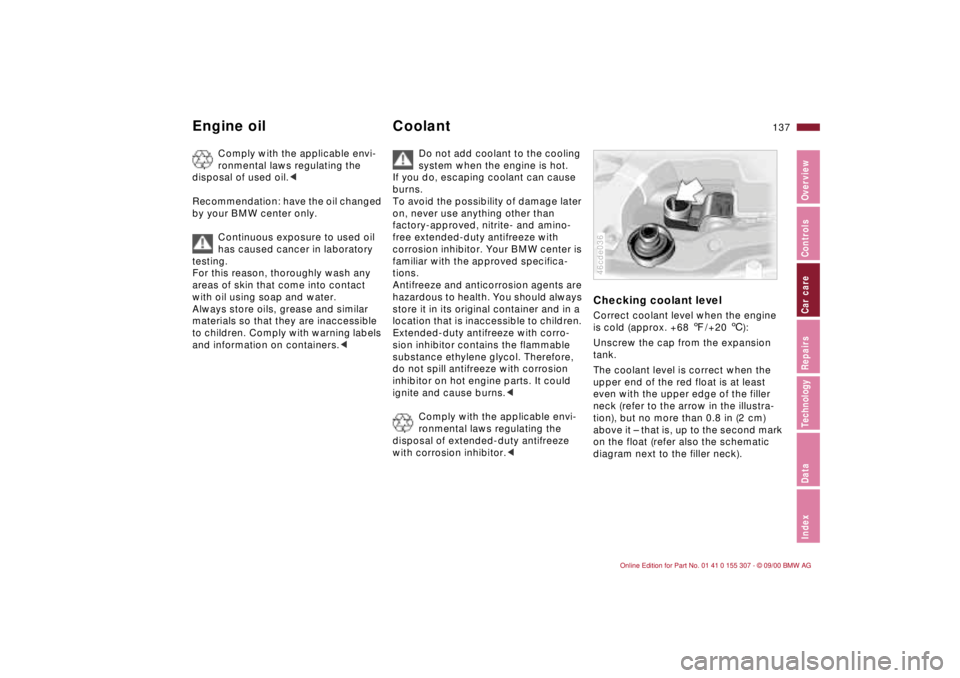
Checking coolant levelCorrect coolant level when the engine
is cold (approx. +68 7/+20 6):
Unscrew the cap from the expansion
tank.
The coolant level is correct when the
upper end of the red float is at least
even with the upper edge of the filler
neck (refer to the arrow in the illustra-
tion), but no more than 0.8 in (2 cm)
above it Ð that is, up to the second mark
on the float (refer also the schematic
diagram next to the filler neck).46cde036
Page 140 of 203
140n
The BMW Maintenance System has
been designed as a reliable means for
providing maximum driving and operat-
ing safety Ð and as cost effectively as
possible for you.
Please keep in mind that regular main-
tenance is not only necessary for the
safety of your vehicle, but also plays a
significant role in maintaining the resale
value of the vehicle.
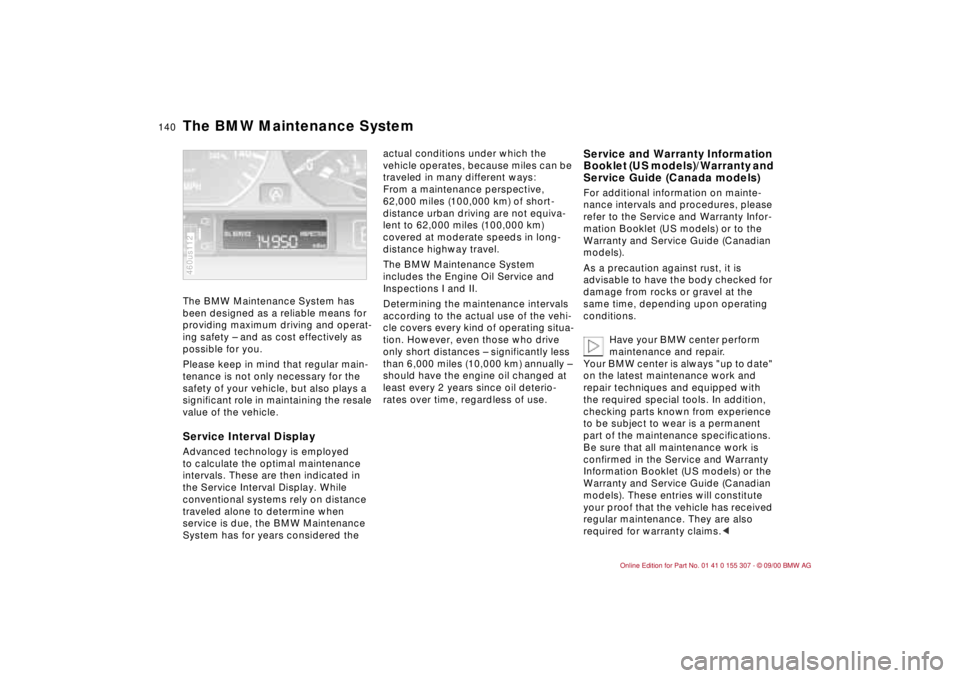
Service Interval DisplayAdvanced technology is employed
to calculate the optimal maintenance
intervals. These are then indicated in
the Service Interval Display. While
conventional systems rely on distance
traveled alone to determine when
service is due, the BMW Maintenance
System has for years considered the 460us112
actual conditions under which the
vehicle operates, because miles can be
traveled in many different ways:
From a maintenance perspective,
62,000 miles (100,000 km) of short-
distance urban driving are not equiva-
lent to 62,000 miles (100,000 km)
covered at moderate speeds in long-
distance highway travel.
The BMW Maintenance System
includes the Engine Oil Service and
Inspections I and II.
Determining the maintenance intervals
according to the actual use of the vehi-
cle covers every kind of operating situa-
tion. However, even those who drive
only short distances Ð significantly less
than 6,000 miles (10,000 km) annually Ð
should have the engine oil changed at
least every 2 years since oil deterio-
rates over time, regardless of use.
Service and Warranty Information
Booklet (US models)/Warranty and
Service Guide (Canada models)For additional information on mainte-
nance intervals and procedures, please
refer to the Service and Warranty Infor-
mation Booklet (US models) or to the
Warranty and Service Guide (Canadian
models).
As a precaution against rust, it is
advisable to have the body checked for
damage from rocks or gravel at the
same time, depending upon operating
conditions.
Have your BMW center perform
maintenance and repair.
Your BMW center is always "up to date"
on the latest maintenance work and
repair techniques and equipped with
the required special tools. In addition,
checking parts known from experience
to be subject to wear is a permanent
part of the maintenance specifications.
Be sure that all maintenance work is
confirmed in the Service and Warranty
Information Booklet (US models) or the
Warranty and Service Guide (Canadian
models). These entries will constitute
your proof that the vehicle has received
regular maintenance. They are also
required for warranty claims.<
The BMW Maintenance System
Page 141 of 203

141n
IndexDataTechnologyRepairsCar careControlsOverview
Washing your vehicle You can wash your BMW at an auto-
matic car wash, even when it is new.
Brushless systems are preferable.
Wipe away tough dirt and loosen and
remove dead insects before washing
the vehicle.
In order to avoid spots, do not wash
the vehicle when the hood is warm, or
during or immediately after exposure to
strong sunlight.
When using an automatic car wash, be
sure that:
>The car wash system is suited for the
dimensions of your vehicle.
>No damage will occur to vehicles
with attached body accessories (such
as spoilers or antennas). Consult the
car wash operator if necessary.
>The wheels and tires of your vehicle
cannot be damaged by the convey-
ance devices of the car wash system.
>The vehicle is cleaned with minimum
brush pressure, and that ample water
is available for washing and rinsing.
Vehicles with rain sensor:
Clean the windshield regularly. Wax
from automatic car washes or insects
can cause malfunctions in the function
of the rain sensor.Turn the rain sensor off (refer to
page 69) when passing through an
automatic car wash. Failure to do so
could result in damage caused by unin-
tended wiper activation.<
Parts of the vehicle which are
inaccessible to the automatic washer Ð
such as door sills, door and hood
edges, etc. Ð should be cleaned by
hand.
In the winter months, it is especially
important to ensure that the vehicle is
washed on a regular basis. Large quan-
tities of dirt and road salt are difficult to
remove, and they also damage the
vehicle.
If spray wands or high-pressure
washers are used, be sure to
maintain an adequate distance between
the spray source and the vehicle's
surface. Inadequate distance and
excessive pressure can damage or
weaken the finish, making it more
susceptible to subsequent attack. In
addition, moisture could penetrate to
vehicle components, leading to long-
term damage.<
When cleaning the headlamps,
please observe the following:
do not clean by wiping with a dry cloth
(scratches). Never use abrasives or
strong solvents to clean the covers.
Remove dirt and contamination (such
as insects) by soaking with BMW Car
Shampoo and then rinsing with plenty
of water. Always use a deicer spray to
remove accumulated ice and snow Ð
never use a scraper.<
After washing the vehicle, apply
the brakes briefly to dry them.
Braking efficiency might otherwise be
reduced by the moisture and the brake
rotors could be corrode.<
Caring for your vehicle
Page 142 of 203

142n
Caring for your vehicleExterior finish To provide effective corrosion protec-
tion, multilayer paintwork is applied at
the factory. Cataphoretic immersion
priming techniques are supplemented
with special body-cavity protectants,
by applying specially-developed and
extensively tested materials.
A layer of flexible PVC is first applied
to the undercarriage. Following this,
a comprehensive undercoating treat-
ment with a wax-based protectant is
applied. Regular maintenance makes
an important contribution to maintaining
the safety and value of your vehicle.
Increasing awareness of the effects of
harmful environmental factors on vehi-
cle finishes have led paint and vehicle
manufacturers to initiate programs
designed to further improve the durabil-
ity of their finishes. Despite this, envi-
ronmental factors that occur locally or
regionally can have negative effects on
the finish of your vehicle. Use the
factors to determine the frequency and
extent of your efforts to maintain the
vehicle finish.Depending upon material and type of
impact (perforation of paint layer),
physical stresses from sand, road salt,
gravel, etc., can cause corrosion to start
extending beneath the finish, starting at
the point of impact.
Road dirt, tar spots, dead insects,
animal droppings (strong alkali effect)
and tree excretions (resins and pollen)
all contain substances capable of
causing damage when allowed to
remain on the finish of your vehicle for
any extended period of time (spots,
etching, flaking, separation in the top
coat).
In industrial areas, flue dust deposits,
lime, oily soot, precipitation containing
sulfur-dioxide (acid rain) and other envi-
ronmental pollutants will damage the
vehicle's finish unless adequate care is
provided Ð even though this is generally
limited to the outside horizontal sur-
faces.In coastal regions, high levels of
atmospheric salt and humidity promote
corrosion.
In tropical zones, temperatures of over
+105 7 (+40 6) in the shade prevail,
in addition to heavy ultraviolet radiation
and high humidity. Under those condi-
tions, light paints can reach tempera-
tures up to +175 7 (+80 6) and dark
paints up to +250 7 (+120 6).
Page 143 of 203

143n
IndexDataTechnologyRepairsCar careControlsOverview
Caring for your vehicleCaring for the vehicle finish Regular washing is a preventive
measure against long-term effects from
substances that are harmful to the
vehicle's finish, especially if you drive
your vehicle in areas with high levels of
air pollution or aggressive natural
substances (tree resins, pollen).
Nevertheless, you should immediately
remove especially aggressive
substances. Failure to do so can lead to
changes in the paint's chemical
structure or to discoloration. Gasoline
spilled during refueling, oil, grease and
brake fluid should always be cleaned
away immediately, as should bird
droppings.
Any contamination remaining on the
surface of the vehicle will be especially
conspicuous after washing. Use
cleaning fluid or alcohol with a clean
cloth or cotton pad to remove. Remove
tar spots with tar remover. After clean-
ing, the affected areas should be waxed
to ensure continued protection.
Use the cleaning and car-care
products available at your BMW
center.<
Waxing your vehicle Protect the finish using only carnauba
or synthetic-based waxes.
The best way to determine when the
finish needs to be waxed is by noting
when water stops beading on the
surface.
You can use a glass cleaner to remove
any wax or silicone that may have been
left on the windows during waxing.
Use the cleaning and car-care
products available at your BMW
center.<
Paint damageYou can touch up small areas of paint
damage with a BMW spray paint or a
BMW touchup stick.
The paint color code for your car is
provided on a sticker located on the
righthand side under the hood and on
the first page of your Service and
Warranty Information Booklet
(US models) or Warranty and Service
Guide (Canadian models).
Damage caused by flying stones,
scratches, etc., must be touched up
without delay to prevent rust from
forming.
If corrosion has started to form in an
area with paint damage, remove all rust
and clean the area. Then prime the
area with a BMW Primer Stick. Finally,
apply the finish coat. Wait a few days,
then polish the repaired area. Finish by
applying a wax preservative.
More extensive paint damage should
be repaired professionally in accor-
dance with the manufacturer's instruc-
tions. Your BMW center uses original
BMW finish materials in accordance
with approved repair procedures.
Page 144 of 203

144n
Caring for your vehicleCaring for the windowsYou can use window and glass cleaner
to clean inside window surfaces and
mirrors without smearing and streaking.
Never use polishing pastes or abrasive
(quartz) cleansers on mirror lenses.
Clean the wiper blades with soapy
water. The wiper blades should be
replaced twice a year Ð before and after
winter. This is especially important for
vehicles with a rain sensor.
Use only wiper blades approved
by BMW.<
Caring for other vehicle
components and materials Light-alloy wheels should be treated
with alloy wheel cleaner, especially
during the winter months. However, do
not use aggressive products contain-
ing acids, strong alkalis or abrasives.
Do not use steam cleaners operating at
temperatures above +140 7 (+60 6).
Follow the manufacturer's instructions.
If your vehicle has chrome parts
*, such
as the window frames and door
handles, be especially careful about
cleaning them with plenty of water and
possibly a shampoo supplement as well
after the roads have been salted.
Use a chrome polish for an additional
treatment.
Plastic components, vinyl upholstery,
headliners, lamp lenses, the clear cover
of the instrument cluster and compo-
nents with a sprayed dull black surface
can be cleaned with water and a
synthetic cleaner (if necessary). Do not
allow moisture to soak through the
seats or headliner. Never use solvents
such as lacquer thinner, heavy-duty
grease remover, fuels, or similar
substances. Rubber components should be cleaned
with water only; a rubber treatment or
silicone spray may also be applied.
Safety belts should be cleaned with a
mild soap and water solution without
being removed from the car. Never
attempt chemical or dry cleaning, as
damage to the belt fabric could result.
After cleaning, never allow the inertia
reel to retract the belts until they are
completely dry. Dirty safety belts pre-
vent the inertia reel mechanism from
retracting the strap properly, and thus
constitute a safety hazard.
Heavily soiled floor carpets and mats
*
can be cleaned with an interior cleaner.
The floor mats can be removed from
the vehicle for cleaning.
Use only a damp cloth to clean trim
panels made of real wood
* and other
parts constructed of real wood
*. Follow
up by drying with a soft cloth.
Use the cleaning and car-care
products available at your BMW
center.<
Page 146 of 203

146n
Caring for your vehicleWe recommend that you perform this
procedure twice a year on leather
exposed to normal use.
Spills should be wiped up immediately.
Remove grease and oil stains by
dabbing with with spot remover. Avoid
rubbing.
If the upholstery is to be exposed to
intense sunlight or if the vehicle is to be
stored for an extended period, cover
all leather surfaces (or, better yet, the
windows) to prevent fading.
Use the cleaning and car-care
products available at your BMW
center.<
Cleaning agents can contain
substances that are dangerous or
pose health risks. Therefore, always
comply with the warnings and danger
labels on the package.
Open the doors or windows on your
vehicle when cleaning the interior.
Never clean your vehicle with solvents
or other materials not specifically
intended for this purpose.<
Page 187 of 203

187n
IndexDataTechnologyRepairsCar careControlsOverview
Capacities
Notes
Fuel tank
reserve gal. (liters)
gal. (liters)approx. 16.6 (approx. 63)
approx. 2.1 (approx. 8)Fuel specification: page 28
Windshield washer system/
Headlamp washer system (front)
Rear window washer system (rear)quarts (liters)
quarts (liters)approx. 5.6 (approx. 5.3)
approx. 2.4 (approx. 2.3)For details: page 134
Cooling system including heater circuit quarts (liters) approx. 8.9 (approx. 8.4) For details: page 137
Engine oil filter change quarts (liters) 325i approx. 6.9
(approx. 6.5)
325xi: approx. 7.9
(approx. 7.5)BMW High Performance
synthetic oil
Specifications: page 136
Manual and automatic transmission and
differentialÐ Lifetime fluid, no fluid change
required
Page 192 of 203

Everything from A to ZA
ABS (Antilock Brake
System)22,116
Accessories6
Activated-charcoal
filter100,165
Adaptive Transmission
Control (ATC)65,173
Adding engine oil135
Adding washer
fluid134,187
Adjust
backrest47
steering wheel50
temperature92
thigh support area48
Air conditioner90
Air distribution92,98
Air nozzles90
Air outlets96
ventilation90,96
Air pressure124
Air supply92,99
Airbags21,58,147,172
Alarm system41
Antenna123
Antenna Diversity174
Antifreeze137
radiator121
Antilock Brake System
(ABS)22,116
Anti-theft alarm system41
Aquaplaning115,124 Armrest102
ASC+T (Automatic Stability
Control plus
Traction)22,173
Ashtray104
ATC (Adaptive Transmission
Control)65,173
Attaching vacuum
cleaner104
AUC (Automatic climate
control)96
Automatic car washes141
Automatic climate
control96
remove condensation from
the windows98
Automatic cruise control71
Automatic dimming, interior
rearview mirror52
Automatic Stability Control
plus Traction
(ASC+T)22,173
Automatic transmission21
Automatic transmission with
Steptronic65
Automatic washer
rear window69
windshield69
Average consumption77
Average speed77
Axle loads186
B
Backrest, adjusting47
Backup lamps64
bulb replacement156
Battery162,188
capacity188
charging164
discharged167
removal and
installation163
Battery charge current20
Battery safety terminal163
Belts53
Beverage holder102
Blower92,99
BMW High Performance
Synthetic Oils136
BMW sports seat48
Bore184
Brake
fluid138
hydraulic system20
pads22
Brake lamps
bulb replacement156
Brake system118
faults120
Break-in procedure114
Bulb replacement153
Bulbs and lamps153
C
California Proposition
65 Warning148
Capacities187
Car Memory52
Car radio123
reception174
refer also to the separate
Owner's Manual
Car telephone103
Car vacuum cleaner,
connecting104
Car wash141
Care
upholstery145
vehicle exterior142
vehicle finish143
vehicle interior144
wool velour145
Cargo loading110
Catalytic converter115
CBC (Cornering Brake
Control)21,117
Cellular phone123
refer to the separate
Owner's Manual
Center armrest102
Center (high-mount) brake
lamp157
Central locking system34
button38
Changing a tire159
Page 193 of 203

Everything from A to Z
193n
IndexDataTechnologyRepairsCar careControlsOverview
Changing a wheel159
Charge indicator lamp20
Check air pressure28
Check Control75
Check engine oil level135
Child restraint
systems54,60
Child-safety locks58
Child's seat54
Cigarette lighter104
Cleaning windshield68
Clock75
refer also to the Radio or
Computer Owner's Manual
Cockpit16
Coin holder102
Combination switch68
Compression184
Computer76
Configure settings52
Consumption77
display74
Contents10
Control elements20
Coolant121,137,187
antifreeze121
Coolant temperature
gauge74
Cooling system187
Copyright4
Cornering Brake Control
(CBC)21,117 Cruise control71
Cruising range77
Cup holder, refer to
beverage holder102
Curb weight186
Current check indicator20
D
Dashboard16
Data
dimensions185
engine184
technical184
weights186
Daytime-driving lamp
switch87
DBC (Dynamic Brake
Control)118
Defrost position94,98
Defrostable rear window99
Defrosting
rear window92
windows94,98
Digital clock75
Dimensions185
Dipstick, engine oil135
Disc brakes118
Displacement184
Display lighting87
Displays18
Distance warning78 Diversity Antenna
system174
Door key32,35
Door locks, care121
Doors
child-safety locks58
emergency operation34
unlocking and locking34
DOT Quality Grades125
Draft-free ventilation93
Drive belts188
Driving hints115
Driving in winter121
Driving lamps87
DSC (Dynamic Stability
Control)81,173
Dynamic Brake Control
(DBC)118
Dynamic Stability Control
(DSC)22,81,173
E
Electric power seat48
Electric power windows43
Electrical accessories,
failure164
Electrical system188
Electronic vehicle
immobilizer33
Elements of operation16 Emergency operation,
doors34
Energy Control73
Engine
coolant137,187
data184
starting61
Engine oil
capacity187
consumption135
pressure20
quality136
specifications136
viscosity136
Engine speed184
Exterior mirrors51
F
Failure messages75
Fault displays75
Fault, ABS117
Filler cap cover27
Filling capacities187
Filling the washer
reservoir187
First-aid kit26
Fittings, tow starting and
towing168
Flashlight101
Flat tire124,159
Fog lamps88