engine BMW 325I 2001 Owner's Manual
[x] Cancel search | Manufacturer: BMW, Model Year: 2001, Model line: 325I, Model: BMW 325I 2001Pages: 203, PDF Size: 2.07 MB
Page 77 of 203
77n
IndexDataTechnologyRepairsCar careControlsOverview
Computer
*
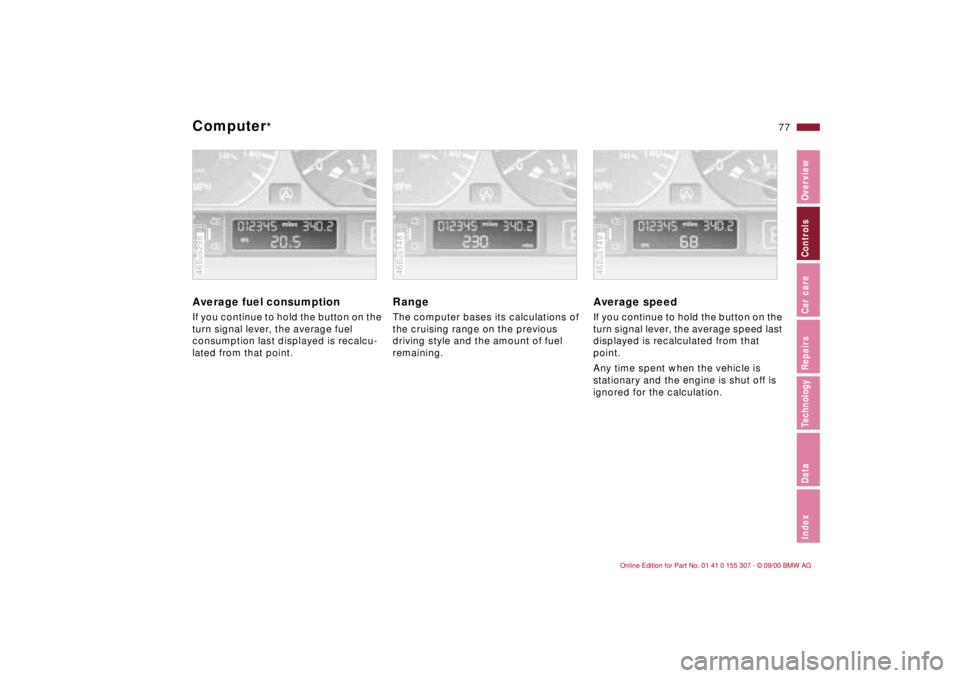
Average fuel consumption If you continue to hold the button on the
turn signal lever, the average fuel
consumption last displayed is recalcu-
lated from that point.460us296
Range The computer bases its calculations of
the cruising range on the previous
driving style and the amount of fuel
remaining.460us148
Average speed If you continue to hold the button on the
turn signal lever, the average speed last
displayed is recalculated from that
point.
Any time spent when the vehicle is
stationary and the engine is shut off is
ignored for the calculation.460us149
Page 79 of 203
79n
IndexDataTechnologyRepairsCar careControlsOverview
ASC+TThe conceptThis systems enhances driving stability
and traction, especially when you are
just starting off, accelerating or in
curves.
ASC+T recognizes the danger present
in traction loss and will increase driving
stability and traction by reducing the
engine's output, and if necessary, by
applying the brakes to the rear wheels.
ASC+T is available as soon as the
engine starts up.
Indicator lamp
The indicator lamp in the instru-
ment cluster goes out shortly
after you switch on the ignition.
Refer to pages 21 and 22.
Indicator lamp flashes:
ASC+T controls the drive and braking
forces.
If the indicator lamp fails to go out after
the engine is started, or if it comes on
during normal driving and stays on:
There is a system malfunction or the
system was deactivated with the
button. Consequently, interventions to
increase driving stability (as described
in the preceding column) are not avail-
able. You can still drive the vehicle
perfectly well without ASC+T.
Please consult your BMW center in the
event of a fault, refer to pages 21
and 22.
Deactivate the ASC+T Press the button; the indicator lamp
comes on and stays on.
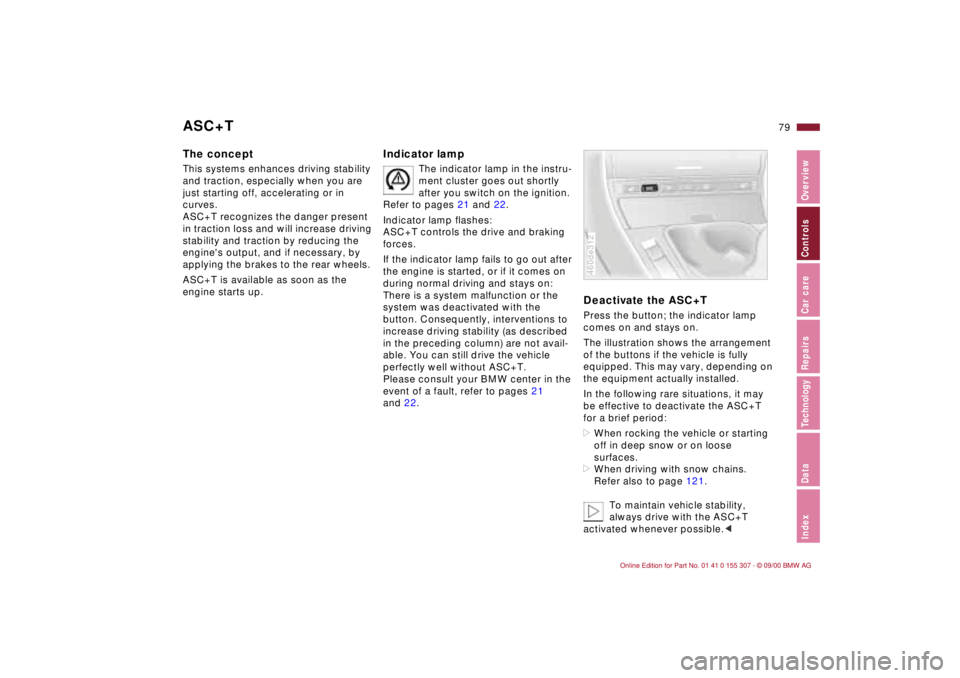
The illustration shows the arrangement
of the buttons if the vehicle is fully
equipped. This may vary, depending on
the equipment actually installed.
In the following rare situations, it may
be effective to deactivate the ASC+T
for a brief period:
>When rocking the vehicle or starting
off in deep snow or on loose
surfaces.
>When driving with snow chains.
Refer also to page 121.
To maintain vehicle stability,
always drive with the ASC+T
activated whenever possible.<460de312
Page 81 of 203
81n
IndexDataTechnologyRepairsCar careControlsOverview
DSC
* Ð BMW 325i
The concept DSC helps maintain vehicle stability,
even in critical driving situations.
The system optimizes vehicle stability
during acceleration and when starting
from a full stop, as well as optimizing
traction. In addition, the system recog-
nizes unstable vehicle conditions
(understeering or oversteering, for
example) and helps hold the vehicle on
a sure course by intervening via the
engine and by braking intervention at
the individual wheels.
The DSC is operational every time you
start the engine. DSC contains the
functions of ADB and CBC, refer to
page 117.
The ADB (Automatic Differential
Braking) copies the function of conven-
tional differential and transverse lock
through brake intervention, and
increases traction whenever conditions
merit, e. g. when driving on snow-
covered roads.
If the DSC is switched off the ADB will
still be in ready mode.
Indicator lamp
The indicator lamp in the instru-
ment cluster goes out shortly
after you switch on the ignition.
Refer to pages 21 and 22.
Indicator lamp flashes:
DSC is active and governs the drive
force and braking force.
The indicator lamp lights up continu-
ously:
The DSC has been turned off via the
switch; ADB is ready to use.
ADB intervention is not indicated.
The indicator lamp and the
brake warning lamp lights up
continuously:
The DSC, ADB and DBC have
been switched off via the button
or are defective.
Indicator and warning lamps for
Canadian models.
You can continue to drive the vehicle
normally, but without DSC. Please
consult your BMW center in the event
of a malfunction, refer to pages 21
and 22.
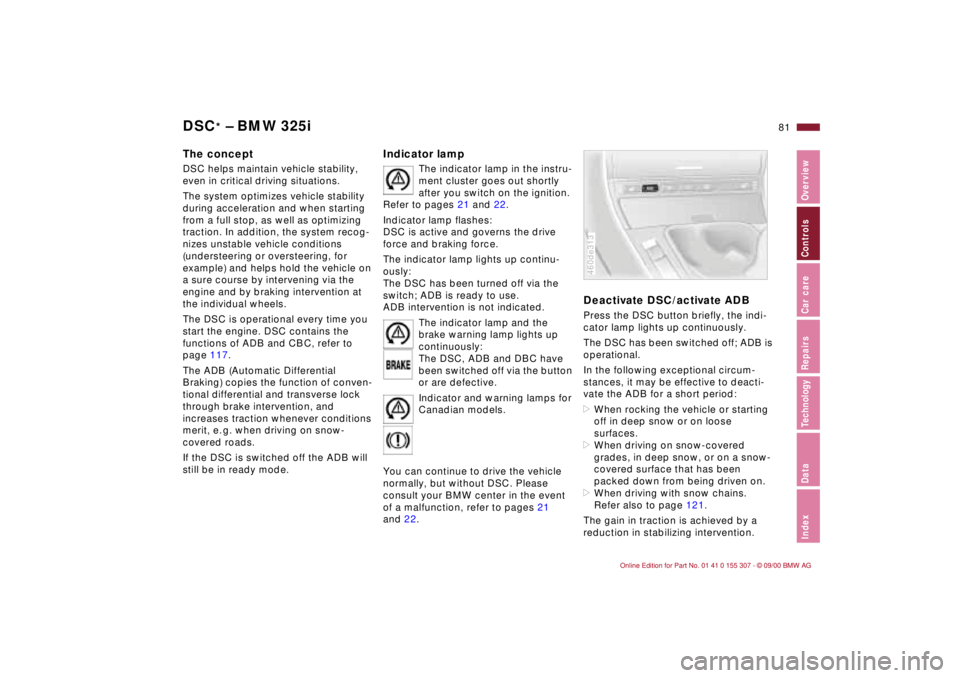
Deactivate DSC/activate ADBPress the DSC button briefly, the indi-
cator lamp lights up continuously.
The DSC has been switched off; ADB is
operational.
In the following exceptional circum-
stances, it may be effective to deacti-
vate the ADB for a short period:
>When rocking the vehicle or starting
off in deep snow or on loose
surfaces.
>When driving on snow-covered
grades, in deep snow, or on a snow-
covered surface that has been
packed down from being driven on.
>When driving with snow chains.
Refer also to page 121.
The gain in traction is achieved by a
reduction in stabilizing intervention.460de313
Page 82 of 203

82n
DSC
* Ð BMW 325i
Deactivate DSC and ADBHold the DSC switch down for at least
3 seconds. The indicator and the yellow
brake warning lamps will remain on the
entire time.
In this case, no interventions to
increase stability and traction for engine
and brakes are carried out.
To maintain vehicle stability,
always drive with the DSC on
whenever possible.<
Reactivate DSC and ADBPress the button again; the indicator
lamp or the indicator lamps will go out.
The laws of physics cannot be
repealed, even with DSC. It will
always be the driver's responsibility to
drive in a manner that matches road
conditions. We therefore urge you to
avoid using the additional safety margin
of the system as an excuse for taking
risks.
Whenever the ADB is activated, the
DSC is switched off and will not
perform any stabilizing intervention.
Do not make any modifications to the
DSC system. Allow only authorized
technicians to perform service proce-
dures on the DSC.<
For additional information concerning
DSC, please refer to the chapter
"Advanced technology" on page 173.
Page 83 of 203
83n
IndexDataTechnologyRepairsCar careControlsOverview
DSC Ð BMW 325xiThe conceptDSC maintains vehicle stability, even in
critical driving situations.
The system enhances vehicle stability
during acceleration and when starting
up from a full stop, and optimizes trac-
tion as well. In addition, it recognizes
unstable vehicle conditions, such as
understeering or oversteering, and, as
far as is possible within the laws of
physics, helps keep the vehicle on a
steady course by reducing the engine
output and brake applications to the
individual wheels.
The DSC is operational every time you
start the engine. DSC contains ADB-X
und DBC, refer to page 118.
The ADB-X (Automatic Differential
Braking) replaces the function of
conventional differential and transverse
lock through brake intervention, and
increases traction whenever conditions
merit, e. g. when driving on snow-
covered streets.Indicator lamp
The indicator lamp on the instru-
ment cluster will go out shortly
after the ignition has been
started. Refer to pages 21, 22.
If the indicator lamp flashes:
DSC controls the drive and braking
forces.
The indicator lamp stays lit:
DSC is switched off via the switch;
ADB-X is operational.
ADB-X intervention not indicated.
If the indicator lamp does not go
out after repeatedly pressing the
DSC switch, then the DSC and the
ADB-X are defective, and the interven-
tion described to the right is then no
longer available.<
The vehicle will remain completely
operational, however, without DSC. In
the event of a fault, please see your
BMW center. Refer to pages 21, 22.
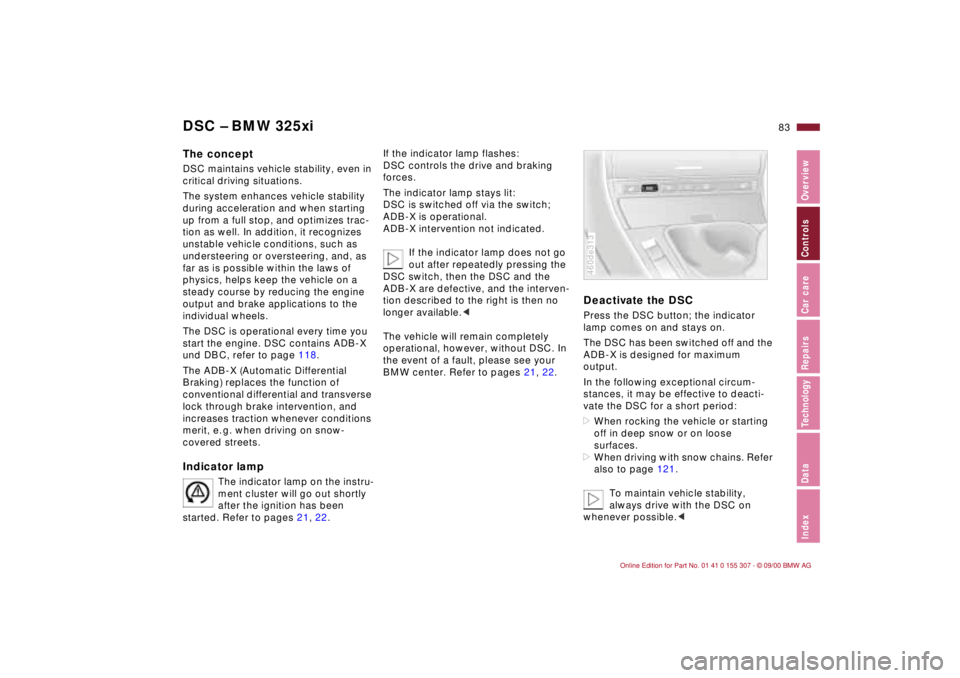
Deactivate the DSCPress the DSC button; the indicator
lamp comes on and stays on.
The DSC has been switched off and the
ADB-X is designed for maximum
output.
In the following exceptional circum-
stances, it may be effective to deacti-
vate the DSC for a short period:
>When rocking the vehicle or starting
off in deep snow or on loose
surfaces.
>When driving with snow chains. Refer
also to page 121.
To maintain vehicle stability,
always drive with the DSC on
whenever possible.<460de313
Page 85 of 203
85n
IndexDataTechnologyRepairsCar careControlsOverview
Tire Pressure Control (RDC)
*
The conceptThe RDC monitors the tire pressures at
all four wheels, even when the vehicle
is moving. The system provides an alert
whenever the inflation pressure drops
significantly below the specified pres-
sure in one or more tires.
In order for the RDC system to "learn"
the correct tire inflation pressure, first
check the tire inflation pressure in all
tires. Then compare these pressures
with the tire inflation pressure chart
(page 29) and adjust if necessary. Then
activate the system.
This indicator lamp in the instru-
ment cluster informs you when-
ever the tire pressure is not
normal.
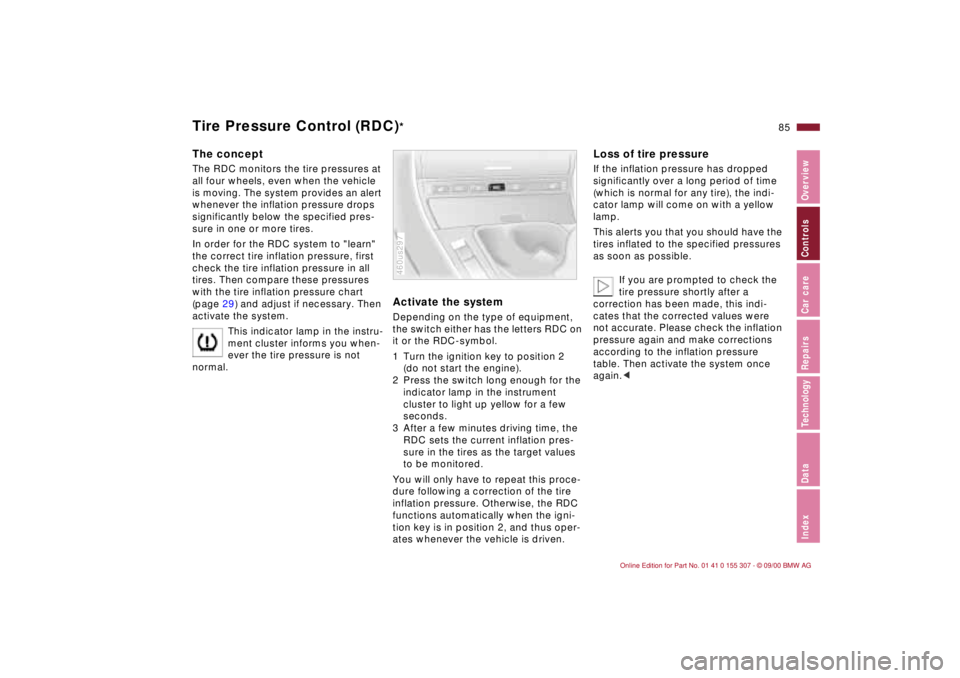
Activate the system Depending on the type of equipment,
the switch either has the letters RDC on
it or the RDC-symbol.
1 Turn the ignition key to position 2
(do not start the engine).
2 Press the switch long enough for the
indicator lamp in the instrument
cluster to light up yellow for a few
seconds.
3 After a few minutes driving time, the
RDC sets the current inflation pres-
sure in the tires as the target values
to be monitored.
You will only have to repeat this proce-
dure following a correction of the tire
inflation pressure. Otherwise, the RDC
functions automatically when the igni-
tion key is in position 2, and thus oper-
ates whenever the vehicle is driven.460us297
Loss of tire pressureIf the inflation pressure has dropped
significantly over a long period of time
(which is normal for any tire), the indi-
cator lamp will come on with a yellow
lamp.
This alerts you that you should have the
tires inflated to the specified pressures
as soon as possible.
If you are prompted to check the
tire pressure shortly after a
correction has been made, this indi-
cates that the corrected values were
not accurate. Please check the inflation
pressure again and make corrections
according to the inflation pressure
table. Then activate the system once
again.<
Page 92 of 203

92n
Air conditionerAir supply
You can select fan speeds
from 1 to 4. The greater the air
supply, the more effective the
heating and ventilation are. In
position 0, the fan and the heater are
switched off. By using position 0, you
can totally block the interior ventilation
outlets by pressing the button for the
recirculated-air mode.
Temperature
In order to increase the
temperature of the passenger
compartment, turn it to the
right (red). Temperature regu-
lation will keep the interior temperature
you have selected constant.
Air distribution
You can direct air to flow onto
the windows , toward the
upper body and into the
footwell . You can also
make all intermediate settings. In the
setting, there is a low flow of air onto
the windows to keep them free of
condensation. The "6 o'clock" setting is
recommended as a normal setting (refer
also to the illustration and overview on
page 90).
Rear window defroster
When the rear window defroster
is activated, the indicator lamp
comes on. The rear window defroster
switches off automatically. Refer to
page 70.
Air conditioner
The air is cooled and dehumidi-
fied and Ð depending on the
temperature setting Ð rewarmed when
the air conditioner system is switched
on.
Depending on the weather, the wind-
shield may fog over briefly when the
engine is started.
Use the button to switch the air condi-
tioner off at outside temperatures
below approx. 41 7(+5 6). This will
help to prevent the windows from
fogging up.
If the windows fog over after switching
the air conditioner off, switch it back
on.
Condensation forms in the air
conditioner system during opera-
tion, which then exits under the vehicle.
Traces of condensed water of this kind
are thus normal.<
Recirculated-air mode
You can respond to unpleasant
external odors by temporarily
blocking the outside air. The system
then recirculates the air already within
the vehicle.
If the windows fog over in the
recirculated air mode, switch the
recirculated air off and increase the air
supply as required.<
Page 99 of 203

99n
IndexDataTechnologyRepairsCar careControlsOverview
Automatic climate control
*
Air supply
By pressing the left or right half
of the button, you can vary the
air supply. By doing this, you switch off
the automatic control for the air supply.
Nevertheless, the automatic air distri-
bution remains unchanged.
When you set the lowest blower speed
by pressing the left half of the button,
all of the displays are canceled: the
blower, heating and air conditioner are
switched off, and the air supply stops.
You can reactivate the system by
pressing any button of the automatic
climate control.
Defrost windows and remove
condensation
This program quickly removes
ice and condensation from the
windshield and side windows.
Air conditioner
The air is cooled and dehumidi-
fied and Ð depending on the
temperature setting Ð rewarmed when
the air conditioner system is switched
on.
Depending on the weather, the wind-
shield may fog over briefly when the
engine is started.
Use the button to switch the air condi-
tioner off when outside air temperatures
are below approx. +41 7 (+5 6). This
will help to prevent the windows from
fogging up.
If the windows fog over after switching
the air conditioner off, switch it back on.
Condensation forms in the air
conditioner system during opera-
tion, that then exits under the vehicle.
Traces of condensed water of this kind
are thus normal.<
Automatic recirculated air control
(AUC)
You can respond to unpleasant
external odors by temporarily
blocking the outside air. The system
then recirculates the air already within
the vehicle. By repeated actuation of
the button, you can select one of three
different operation modes.
>Indicator lamps off: fresh air flows
into the vehicle.
>Left-hand indicator lamp on Ð AUC
mode: the system detects pollutants
in the outside air and responds by
deactivating the outside air flow as
required. The system then recircu-
lates the air already within the vehicle.
Depending on air quality require-
ments, the system automatically
switches between outside air supply
and recirculation of the air already
within the vehicle.
>Right-hand indicator lamp on: the
flow of outside air is permanently
blocked. The system recirculates the
air already within the vehicle.
If the windows fog over in the
recirculated air mode, switch this
mode off and increase the air supply as
required.
is turned on, the indicator lamp
comes on; refer to page 70.
Page 113 of 203
Overview
Controls and features
Operation, care
and maintenance
Owner service procedures
Technical data
Index Advanced technology
113n
Index DataTechnologyRepairs Car care Controls Overview
Special operating instructions:
Break-in procedures114
Driving notes115
Catalytic converter115
Antilock Brake System
(ABS)116
Disc brakes118
Brake system120
Winter operation121
Power steering123
Cellular phone123
Radio reception123
Wheels and tires:
Tire inflation pressure124
Tire condition124
Tire replacement125
Tire rotation126
Wheel and tire
combinations127
Winter tires128
Snow chains128
Approved wheel and tire
specifications129Under the hood:
Hood130
Engine compartment132
Washer fluids134
Washer nozzles134
Engine oil135
Coolant137
Brake fluid138
Vehicle Identification
Number139
Care and maintenance:
The BMW Maintenance
System140
Caring for your vehicle141
Airbags147
Vehicle storage147
Laws and regulations:
Technical modifications148
California Proposition
65 Warning148
OBD interface socket149
Car care
Page 114 of 203

114n
To ensure maximum economy and a
long service life, we request that you
observe the following suggestions.
Engine and differentialUp to 1,200 miles (2,000 km):
Drive at varying engine speeds and road
speeds, but do not exceed the following
engine or road speeds during this time:
4,500 rpm or 100 mph (160 km/h).
Obey your local and state maximum
speed limits.
Refrain from using full throttle and avoid
pressing the accelerator beyond the
"kickdown" point.
After you have driven 1,200 miles
(2,000 km), you can gradually increase
the engine and road speeds.
You should also comply with these
break-in procedures if the engine or
differential is replaced at a later point.
TiresDue to technical factors associated
with their manufacture, tires do not
achieve their full traction potential until
an initial break-in period has elapsed.
Thus drive with extra care during the
initial 200 miles (300 km).
Obey your local and state maximum
speed limits.
When the vehicle is operated on
wet or slushy roads, a wedge of
water may form between the tire and
the road surface. This phenomenon is
referred to as aquaplaning, or hydropla-
ning, and can lead to partial or
complete loss of traction, vehicle
control and braking effectiveness.
Reduce your speed on wet roads.<
Brake systemAfter approximately 300 miles (500 km),
the brake pads and discs achieve the
optimal pad surface and wear patterns
required for trouble-free operation and
long service life.
To break in the separate parking brake
drums, apply the parking brake lightly
when coasting to a standstill (at a traffic
signal, for instance), provided that
traffic conditions allow you to do so.
To avoid corrosion, repeat this proce-
dure from time to time.
The brake lamps do not come on
when the parking brake is applied.
Vacuum for the brake system servo unit
on your BMW is available only when the
engine is running. When you move the
vehicle with the engine off Ð when
towing, for example Ð substantially
higher levels of pedal force will be
required to brake the vehicle.
(500 km). Engage the gears carefully
during the break-in period.
Break-in procedures