manual transmission BMW 325I 2001 Owners Manual
[x] Cancel search | Manufacturer: BMW, Model Year: 2001, Model line: 325I, Model: BMW 325I 2001Pages: 203, PDF Size: 2.07 MB
Page 10 of 203
Contents
Overview
Controls and features
Cockpit16
Instrument cluster18
Indicator and warning lamps20
Multifunction steering wheel
(MFL)24
Sports steering wheel25
Hazard warning flashers26
Warning triangle26
First-aid kit26
Refueling27
Fuel specifications28
Tire inflation pressure28
Opening and closing:
Keys32
Electronic vehicle
immobilizer33
Central locking system34
Opening and closing Ð
from the outside34
Opening and closing Ð
from the inside38
Tailgate38
Cargo area40
Alarm system41
Electric power windows43
Sliding/tilt sunroof44
Adjustments:
Seats46
Seat and mirror memory49
Steering wheel50
Mirrors51
Car Memory, Key Memory52
Passenger safety systems:
Safety belts53
Airbags55
Transporting children safely58
Driving:
Steering/Ignition lock61
Starting the engine61
Switching off the engine62
Parking brake63
Manual transmission64
Automatic transmission with
Steptronic65
Turn signal indicator/
Headlamp flasher68
Washer/Wiper system68
Rear window defroster70
Cruise control71
Everything under control:
Odometer73
Tachometer73
Energy Control73
Fuel gauge74
Coolant temperature gauge74
Service Interval Display74
Check Control75
Clock75
Computer76
Technology for safety and
driving convenience:
Park Distance Control (PDC)78
Automatic Stability Control plus
Traction (ASC+T)79
Dynamic Stability Control
(DSC)80
Tire Pressure Control (RDC)85
Page 17 of 203
17n
IndexDataTechnologyRepairsCar careControlsOverview
Cockpit
1 Parking lamps/Low beams87
2
d
Turn signal indicator68
>
Parking lamps88
>
High beams88
>
Headlamp flasher68
>
Computer
*
76
3 Washer/Wiper system68
4 Shift lever/Selector lever
*
64
For vehicles equipped with manual
transmission:
To engage reverse gear, press the
lever to the left and overcome the
slight resistance you will encounter
5 Hazard warning flashers26
6 Central locking system34
7 Rear window defroster70
8 Horn sports steering wheel
*
: the
entire surface
9 Adjusting steering wheel50
10 Fog lamps
*
88
Page 31 of 203
Overview
Controls and features
Operation, care
and maintenance
Owner service procedures
Technical data
Index Advanced technology
31n
IndexDataTechnologyRepairsCar careControlsOverview
Driving:
Steering/Ignition lock61
Starting the engine61
Switching off the engine62
Parking brake63
Manual transmission64
Automatic transmission
with Steptronic65
Turn signal indicator/Headlamp
flasher68
Washer/Wiper system68
Rear window defroster70
Cruise control71
Everything under control:
Odometer73
Tachometer73
Energy Control73
Fuel gauge74
Coolant temperature gauge74
Service Interval Display74
Check Control75
Clock75
Computer76
Technology for safety and
driving convenience:
Park Distance Control (PDC)78
Automatic Stability Control plus
Traction (ASC+T)79
Dynamic Stability Control
(DSC)80
Tire Pressure Control (RDC)85Lamps:
Side lamps/Low beams87
Instrument lighting87
High beams/Parking lamps88
Fog lamps88
Interior lamps88
Controlling the climate
for pleasant driving:
Air conditioner90
Automatic climate control96
Seat heating100
Cabin convenience:
HiFi system101
Glove compartment101
Storage compartments102
Cellular phone103
Ashtray, front104
Cigarette lighter104
Ashtray, rear105
Power outlet105
Loading and transporting:
Ski bag106
Cargo area107
Cargo loading110
Roof-mounted luggage rack111
Page 61 of 203
61n
IndexDataTechnologyRepairsCar careControlsOverview
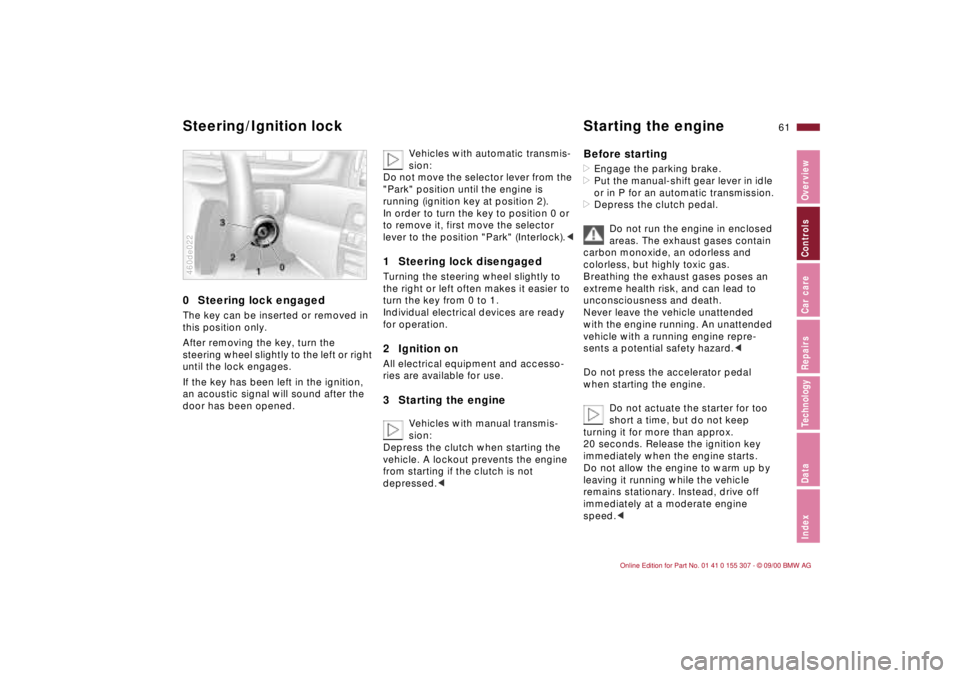
0 Steering lock engaged The key can be inserted or removed in
this position only.
After removing the key, turn the
steering wheel slightly to the left or right
until the lock engages.
If the key has been left in the ignition,
an acoustic signal will sound after the
door has been opened.460de022
Vehicles with automatic transmis-
sion:
Do not move the selector lever from the
"Park" position until the engine is
running (ignition key at position 2).
In order to turn the key to position 0 or
to remove it, first move the selector
lever to the position "Park" (Interlock).<
1 Steering lock disengaged Turning the steering wheel slightly to
the right or left often makes it easier to
turn the key from 0 to 1.
Individual electrical devices are ready
for operation.2 Ignition onAll electrical equipment and accesso-
ries are available for use.3 Starting the engine
Vehicles with manual transmis-
sion:
Depress the clutch when starting the
vehicle. A lockout prevents the engine
from starting if the clutch is not
depressed.<
Before starting>Engage the parking brake.
>Put the manual-shift gear lever in idle
or in P for an automatic transmission.
>Depress the clutch pedal.
Do not run the engine in enclosed
areas. The exhaust gases contain
carbon monoxide, an odorless and
colorless, but highly toxic gas.
Breathing the exhaust gases poses an
extreme health risk, and can lead to
unconsciousness and death.
Never leave the vehicle unattended
with the engine running. An unattended
vehicle with a running engine repre-
sents a potential safety hazard.<
Do not press the accelerator pedal
when starting the engine.
Do not actuate the starter for too
short a time, but do not keep
turning it for more than approx.
20 seconds. Release the ignition key
immediately when the engine starts.
Do not allow the engine to warm up by
leaving it running while the vehicle
remains stationary. Instead, drive off
immediately at a moderate engine
speed.<
Steering/Ignition lock Starting the engine
Page 62 of 203

62n
Starting the engine Switching off the engine If the engine does not start on the first
attempt (if it is very hot or cold, for
instance):
>Press the accelerator pedal halfway
down while engaging the starter.
Cold start at very low temperatures
approx. +5 7 (Ð15 6) at high altitude
over 3,300 ft (1000 m):
>On the first start attempt, engage
the starter for a longer period
(approx. 10 seconds).
>Press the accelerator pedal halfway
down while engaging the starter.
Engine idle speed is controlled by the
engine computer system. Increased
speeds at start-up are normal and
should decrease as the engine warms
up. If engine speed does not decrease,
service is required.
To prevent the battery from dischar-
ging, always switch off electrical
devices which are not in use and the
ignition when the vehicle is not being
driven.Turn the ignition key to position 1 or 0.
Never remove the ignition key
while the vehicle is still moving.
If you did so, the steering lock would
engage when the steering wheel is
turned.
When you leave the vehicle, always
remove the ignition key and engage the
steering lock.
Vehicles with manual transmission:
Always engage the parking brake when
parking on slopes and inclined
surfaces, since placing the lever in
1st gear or reverse may not provide
adequate resistance to rolling.
Vehicles with automatic transmission:
Place the selector lever in "Park."<
Page 63 of 203
63n
IndexDataTechnologyRepairsCar careControlsOverview
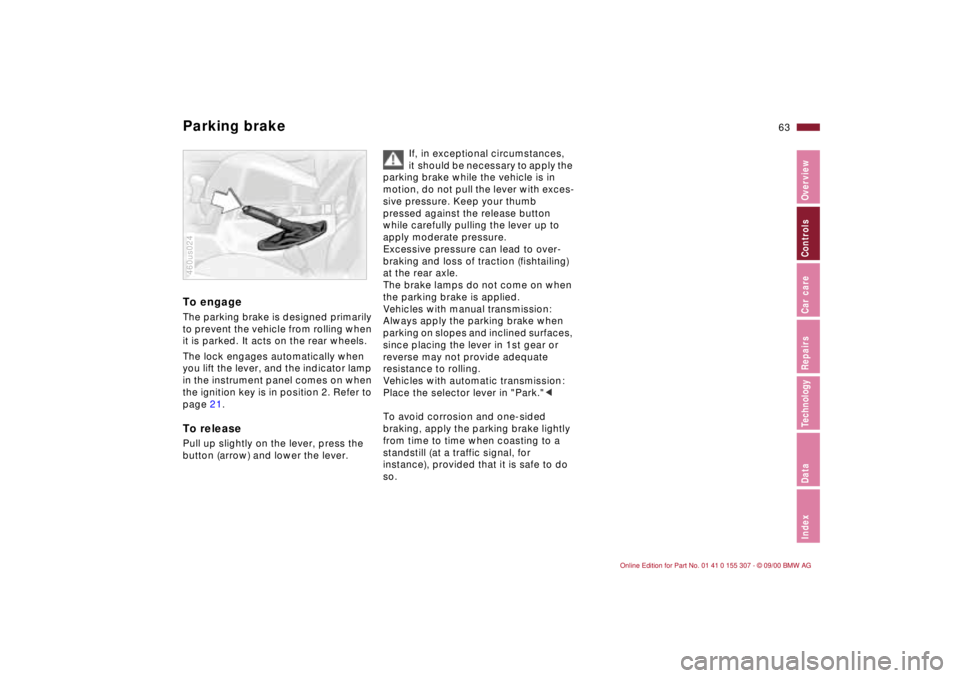
Parking brake To engageThe parking brake is designed primarily
to prevent the vehicle from rolling when
it is parked. It acts on the rear wheels.
The lock engages automatically when
you lift the lever, and the indicator lamp
in the instrument panel comes on when
the ignition key is in position 2. Refer to
page 21.To releasePull up slightly on the lever, press the
button (arrow) and lower the lever.460us024
If, in exceptional circumstances,
it should be necessary to apply the
parking brake while the vehicle is in
motion, do not pull the lever with exces-
sive pressure. Keep your thumb
pressed against the release button
while carefully pulling the lever up to
apply moderate pressure.
Excessive pressure can lead to over-
braking and loss of traction (fishtailing)
at the rear axle.
The brake lamps do not come on when
the parking brake is applied.
Vehicles with manual transmission:
Always apply the parking brake when
parking on slopes and inclined surfaces,
since placing the lever in 1st gear or
reverse may not provide adequate
resistance to rolling.
Vehicles with automatic transmission:
Place the selector lever in "Park."<
To avoid corrosion and one-sided
braking, apply the parking brake lightly
from time to time when coasting to a
standstill (at a traffic signal, for
instance), provided that it is safe to do
so.
Page 64 of 203
64n
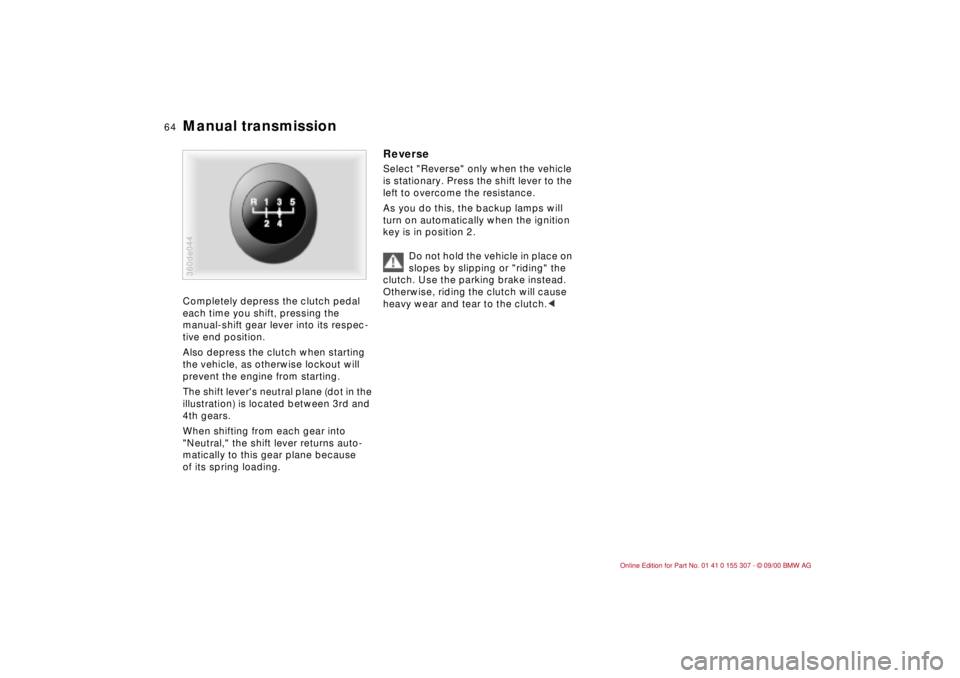
Manual transmission Completely depress the clutch pedal
each time you shift, pressing the
manual-shift gear lever into its respec-
tive end position.
Also depress the clutch when starting
the vehicle, as otherwise lockout will
prevent the engine from starting.
The shift lever's neutral plane (dot in the
illustration) is located between 3rd and
4th gears.
When shifting from each gear into
"Neutral," the shift lever returns auto-
matically to this gear plane because
of its spring loading.360de044
Reverse Select "Reverse" only when the vehicle
is stationary. Press the shift lever to the
left to overcome the resistance.
As you do this, the backup lamps will
turn on automatically when the ignition
key is in position 2.
Do not hold the vehicle in place on
slopes by slipping or "riding" the
clutch. Use the parking brake instead.
Otherwise, riding the clutch will cause
heavy wear and tear to the clutch.<
Page 65 of 203
65n
IndexDataTechnologyRepairsCar careControlsOverview
Automatic transmission with Steptronic
*
You have the option of driving with a
normal automatic transmission or
switching to manual.
When you move the selector lever from
the "D" position to the left into the M/S
range, the performance-oriented shift
programs of the automatic transmission
are engaged. As soon as you tap the
selector lever in the "+" or "Ð" direction,
Steptronic changes the gear. The
manual mode is engaged. Whenever
you want to use the automatic mode
again, move the selector lever to the
right into position "D."
The automatic transmission with Step-
tronic is equipped with Adaptive Trans-
mission Control (ATC). ATC reacts with
precision to your individual driving style
and the current driving conditions. It is
for this reason that various shift
programs are used.
For additional information concerning
the ATC, please refer to the chapter
describing "Advanced technology" on
page 173.
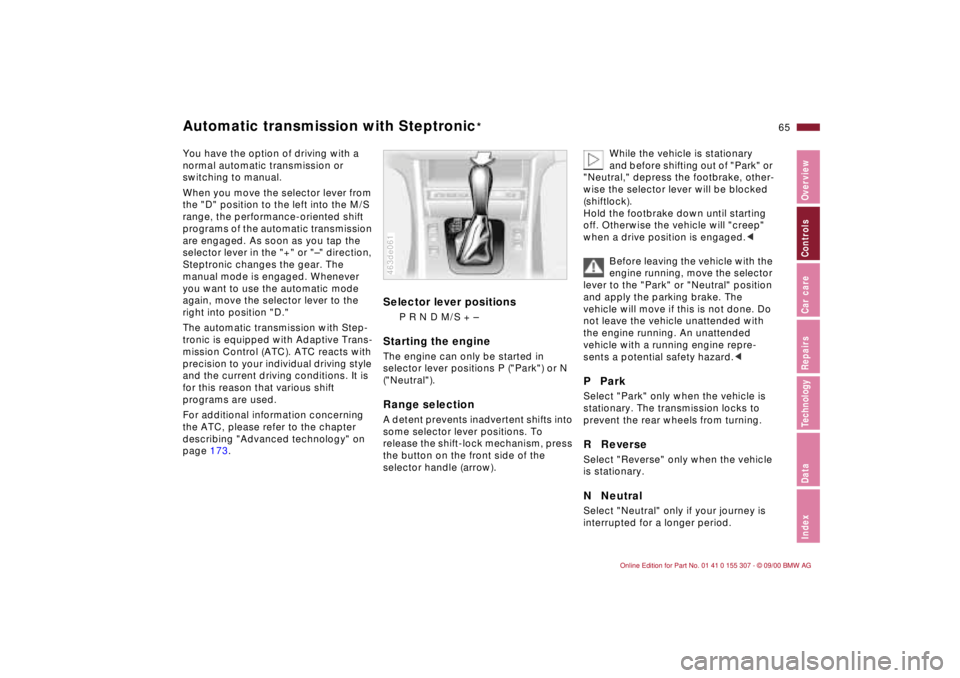
Selector lever positions
P R N D M/S + Ð
Starting the engineThe engine can only be started in
selector lever positions P ("Park") or N
("Neutral").Range selectionA detent prevents inadvertent shifts into
some selector lever positions. To
release the shift-lock mechanism, press
the button on the front side of the
selector handle (arrow).463de061
While the vehicle is stationary
and before shifting out of "Park" or
"Neutral," depress the footbrake, other-
wise the selector lever will be blocked
(shiftlock).
Hold the footbrake down until starting
off. Otherwise the vehicle will "creep"
when a drive position is engaged.<
Before leaving the vehicle with the
engine running, move the selector
lever to the "Park" or "Neutral" position
and apply the parking brake. The
vehicle will move if this is not done. Do
not leave the vehicle unattended with
the engine running. An unattended
vehicle with a running engine repre-
sents a potential safety hazard.<
P ParkSelect "Park" only when the vehicle is
stationary. The transmission locks to
prevent the rear wheels from turning.R ReverseSelect "Reverse" only when the vehicle
is stationary.N Neutral Select "Neutral" only if your journey is
interrupted for a longer period.
Page 66 of 203
66n
Automatic transmission with Steptronic
*
D Drive (automatic shift program)This position is designed for driving
under all normal operating conditions.
All forward gears are available and the
ATC is fully operational."Kickdown"You will get maximum vehicle perfor-
mance in the "kickdown" mode.
To activate this mode, depress the
accelerator pedal beyond the full-
throttle position, at which a resistance
point must be overcome.
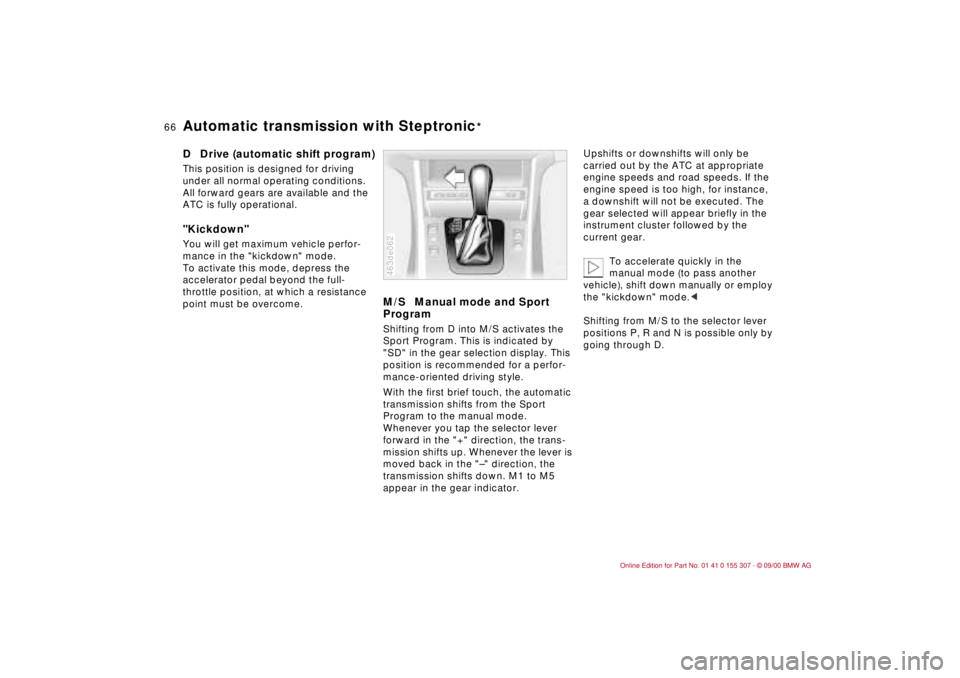
M/S Manual mode and Sport
ProgramShifting from D into M/S activates the
Sport Program. This is indicated by
"SD" in the gear selection display. This
position is recommended for a perfor-
mance-oriented driving style.
With the first brief touch, the automatic
transmission shifts from the Sport
Program to the manual mode.
Whenever you tap the selector lever
forward in the "+" direction, the trans-
mission shifts up. Whenever the lever is
moved back in the "Ð" direction, the
transmission shifts down. M1 to M5
appear in the gear indicator.463de062
Upshifts or downshifts will only be
carried out by the ATC at appropriate
engine speeds and road speeds. If the
engine speed is too high, for instance,
a downshift will not be executed. The
gear selected will appear briefly in the
instrument cluster followed by the
current gear.
To accelerate quickly in the
manual mode (to pass another
vehicle), shift down manually or employ
the "kickdown" mode.<
Shifting from M/S to the selector lever
positions P, R and N is possible only by
going through D.
Page 67 of 203
67n
IndexDataTechnologyRepairsCar careControlsOverview
Automatic transmission with Steptronic
*
In the following situations, the Step-
tronic "thinks" for you in the manual
mode:
>In order to prevent engine over-
speeding, the transmission shifts
automatically to the next higher gear
shortly before the engine speed
cutoff point.
>At low speeds, the transmission
shifts down automatically Ð you do
not have to act.
>In the "kickdown" mode, the trans-
mission shifts down to the lowest
gear possible, depending
on the engine speed.
>Depending on the situation Ð when
driving in adverse winter conditions,
for example Ð you may also start out
in 2nd or 3rd gear.
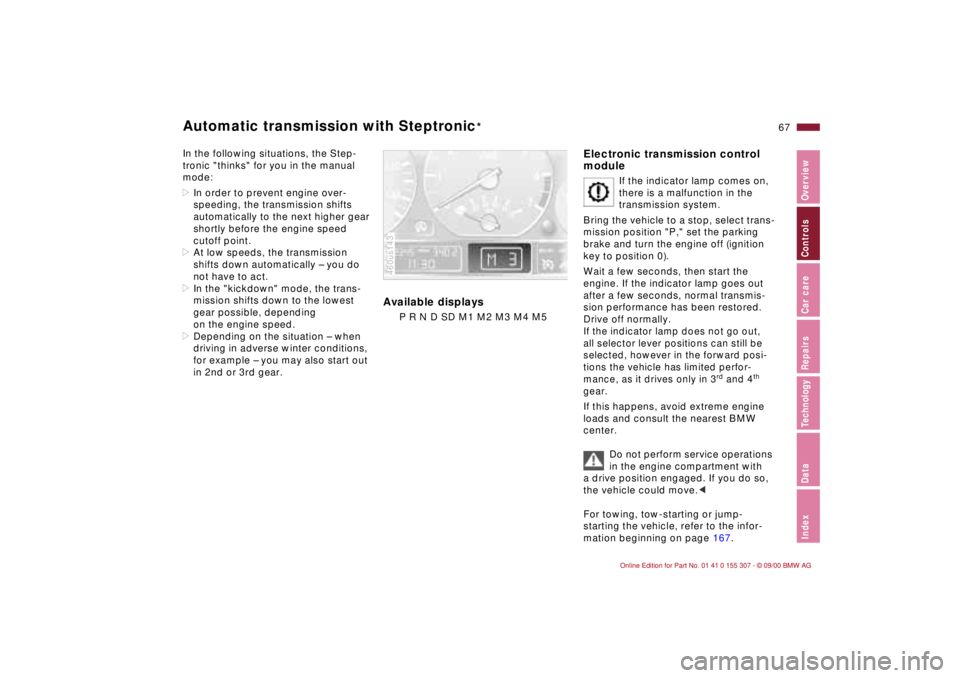
Available displays
P R N D SD M1 M2 M3 M4 M5460us143
Electronic transmission control
module
If the indicator lamp comes on,
there is a malfunction in the
transmission system.
Bring the vehicle to a stop, select trans-
mission position "P," set the parking
brake and turn the engine off (ignition
key to position 0).
Wait a few seconds, then start the
engine. If the indicator lamp goes out
after a few seconds, normal transmis-
sion performance has been restored.
Drive off normally.
If the indicator lamp does not go out,
all selector lever positions can still be
selected, however in the forward posi-
tions the vehicle has limited perfor-
mance, as it drives only in 3
rd and 4
th
gear.
If this happens, avoid extreme engine
loads and consult the nearest BMW
center.
Do not perform service operations
in the engine compartment with
a drive position engaged. If you do so,
the vehicle could move.<
For towing, tow-starting or jump-
starting the vehicle, refer to the infor-
mation beginning on page 167.