spare tire BMW 325I 2001 Owners Manual
[x] Cancel search | Manufacturer: BMW, Model Year: 2001, Model line: 325I, Model: BMW 325I 2001Pages: 203, PDF Size: 2.07 MB
Page 28 of 203
28n
Fuel specifications Tire inflation pressure The engine uses lead-free gasoline
only.
Required fuel:
Premium Unleaded Gasoline,
min. 91 AKI
AKI = Anti Knock Index
Do not use leaded fuels. The use
of leaded fuels will cause perma-
nent damage to the system's oxygen
sensor and the catalytic converter.<
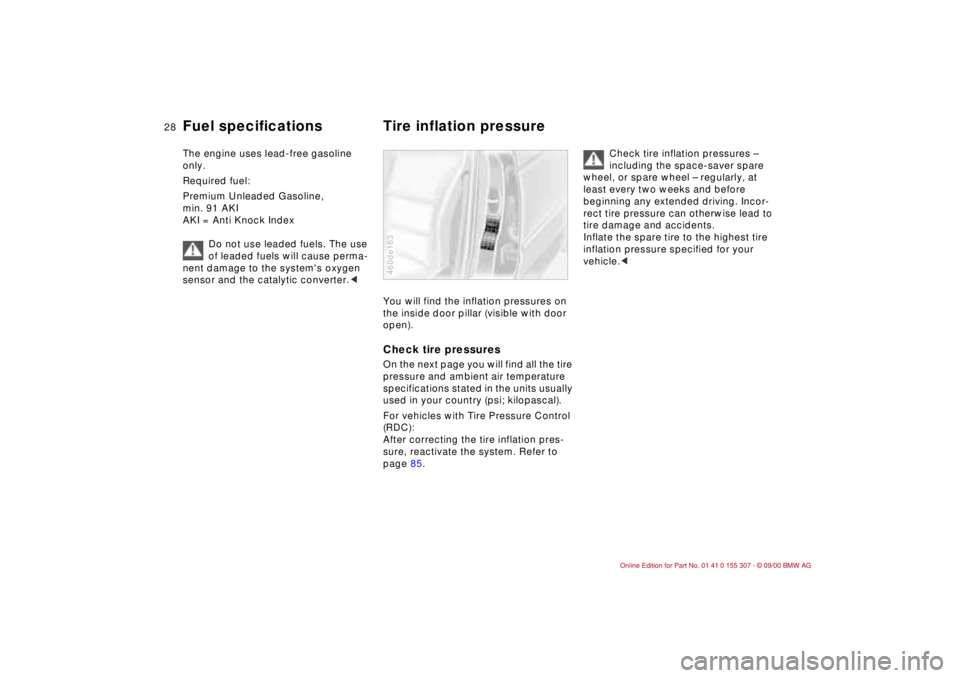
You will find the inflation pressures on
the inside door pillar (visible with door
open).Check tire pressures On the next page you will find all the tire
pressure and ambient air temperature
specifications stated in the units usually
used in your country (psi; kilopascal).
For vehicles with Tire Pressure Control
(RDC):
After correcting the tire inflation pres-
sure, reactivate the system. Refer to
page 85.460de163
Check tire inflation pressures Ð
including the space-saver spare
wheel, or spare wheel Ð regularly, at
least every two weeks and before
beginning any extended driving. Incor-
rect tire pressure can otherwise lead to
tire damage and accidents.
Inflate the spare tire to the highest tire
inflation pressure specified for your
vehicle.<
Page 86 of 203

86n
Tire Pressure Control (RDC)
*
Flat tireIf there is a tire failure with loss of pres-
sure, the indicator lamp comes on with
a red lamp. In addition, an acoustic
signal goes off.
If this occurs, reduce vehicle speed
immediately and stop the vehicle in a
safe location. Avoid hard brake applica-
tions. Do not oversteer. Replace the
wheel and flat tire.
The space-saver spare tire is
provided for temporary use only
in the event of a tire failure. It does not
have RDC electronics and is not moni-
tored. A full-size spare tire
that has the
same dimensions as the tires already
mounted on the vehicle is equipped
with the necessary RDC electronics,
and will also be monitored once the
tires have been mounted and the
system activated.<
The RDC cannot alert you to
severe and sudden tire damage
caused by external factors.<
Have the tires changed by your
BMW center.
Your BMW center has been trained to
work with the RDC system and is
equipped with the necessary special
tools.<
System interferenceThe RDC may encounter interference
from outside equipment or devices
which use the same radio frequency.
The indicator lamp will come on with
a yellow lamp during the malfunction.
The indicator lamp also comes on
>in the event of a system fault
>if a wheel is mounted without the
RDC electronics
>if, in addition to the spare tire, addi-
tional wheels with RDC electronics
are on board.
Please contact your BMW center for
additional information.
Page 103 of 203
103n
IndexDataTechnologyRepairsCar careControlsOverview
Storage compartments Cellular phone
*
Storage package
*
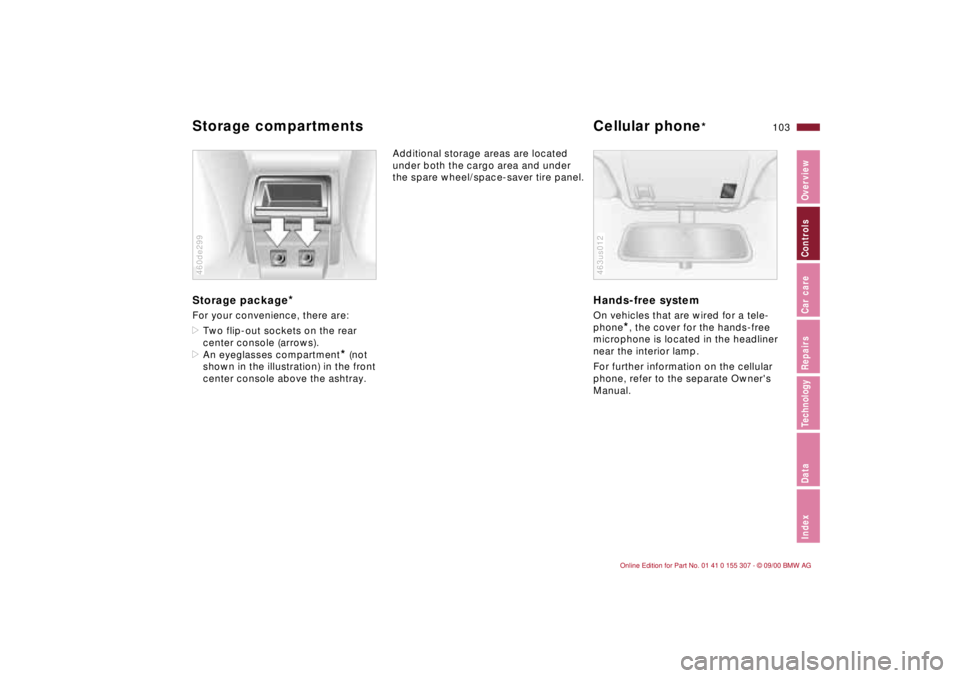
For your convenience, there are:
>Two flip-out sockets on the rear
center console (arrows).
>An eyeglasses compartment
* (not
shown in the illustration) in the front
center console above the ashtray.
460de299
Additional storage areas are located
under both the cargo area and under
the spare wheel/space-saver tire panel.
Hands-free systemOn vehicles that are wired for a tele-
phone
*, the cover for the hands-free
microphone is located in the headliner
near the interior lamp.
For further information on the cellular
phone, refer to the separate Owner's
Manual.
463us012
Page 124 of 203
124n
Information for your safetyThe factory-approved radial tires are
matched to the vehicle and have been
selected to provide optimum safety and
driving comfort on your vehicle.
It is not merely the tire's service life, but
also driving comfort and Ð above all
else Ð driving safety that depend on the
condition of the tires and the mainte-
nance of the specified tire pressure.
Incorrect inflation pressure is a frequent
cause of tire damage. It also signifi-
cantly influences the roadholding ability
of your BMW.
Check the tire inflation pressure Ð
for the space-saver spare tire or
spare tire Ð on a regular basis (refer to
page 28), at least twice a month, and
before starting out on any extended
trip. If this is not done, incorrect tire
pressures can cause driving instability
and tire damage, ultimately resulting in
an accident.<
Tire tread Ð tire damageInspect your tires frequently for tread
wear, signs of damage and for foreign
objects lodged in the tread. Check the
tread depth.
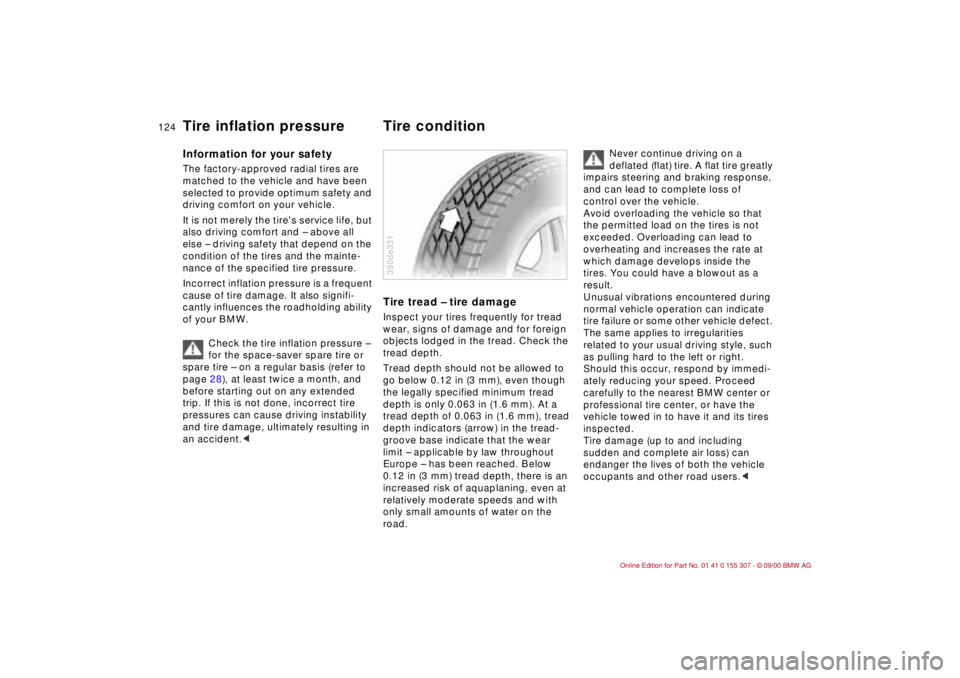
Tread depth should not be allowed to
go below 0.12 in (3 mm), even though
the legally specified minimum tread
depth is only 0.063 in (1.6 mm). At a
tread depth of 0.063 in (1.6 mm), tread
depth indicators (arrow) in the tread-
groove base indicate that the wear
limit Ð applicable by law throughout
Europe Ð has been reached. Below
0.12 in (3 mm) tread depth, there is an
increased risk of aquaplaning, even at
relatively moderate speeds and with
only small amounts of water on the
road.390de331
Never continue driving on a
deflated (flat) tire. A flat tire greatly
impairs steering and braking response,
and can lead to complete loss of
control over the vehicle.
Avoid overloading the vehicle so that
the permitted load on the tires is not
exceeded. Overloading can lead to
overheating and increases the rate at
which damage develops inside the
tires. You could have a blowout as a
result.
Unusual vibrations encountered during
normal vehicle operation can indicate
tire failure or some other vehicle defect.
The same applies to irregularities
related to your usual driving style, such
as pulling hard to the left or right.
Should this occur, respond by immedi-
ately reducing your speed. Proceed
carefully to the nearest BMW center or
professional tire center, or have the
vehicle towed in to have it and its tires
inspected.
Tire damage (up to and including
sudden and complete air loss) can
endanger the lives of both the vehicle
occupants and other road users.<
Tire inflation pressure Tire condition
Page 126 of 203

126n
Tire replacement Tire rotationTire ageThe date on which the tire was manu-
factured is indicated by the code on the
sidewall:
DOT ... 4100 indicates that the tire was
manufactured during week 41 of the
year 2000.
BMW recommends the replacement of
all tires when the tires are no more than
6 years old, even if a tire life of 10 years
is possible.
Spare tires over 6 years old should be
used only in case of emergency. A tire
of this age should be replaced by a new
tire immediately, and should not be
mounted together with new tires.
Between the axlesThe tread wear patterns at the front end
differ from those at the rear Ð the actual
patterns will vary according to indi-
vidual driving conditions. In the inter-
ests of safety and maintaining optimal
handling characteristics, tire rotation is
not recommended.
If a proposed interaxle rotation of tires
is based on economic considerations,
one should consider whether the costs
for the rotation are likely to be recap-
tured by any increase in the service life
of the tires that might be realized. In
principle, interaxle rotation must be
performed in short intervals, with a
maximum of 3,000 miles (5,000 km).
Consult your BMW center for more
information.
Should you decide to rotate the tires, it
is essential to comply with the following:
Rotate tires on the same side only, since
braking characteristics and road grip
could otherwise be adversely affected.
Following rotation, the tire inflation
pressure should always be corrected.If different tire sizes are mounted
on the front and rear axles (refer to
page 12 9), the wheels may not be
rotated from one axle to the other.<
Page 129 of 203

129n
IndexDataTechnologyRepairsCar careControlsOverview
Approved wheel and tire specifications Tire specifications Steel rim
(wheel rim)Light-alloy wheel
All season tires
205/55 R 16 91 H M+S 7Jx16 7Jx16
205/50 R 17 93 V M+S extra load 7Jx17 7Jx17
Summer tires
205/55 R 16 91 V
225/50 R 16 92 W
225/50 ZR 16Ð 7Jx16
205/50 R 17 93 W extra load Ð 7Jx17
225/45 R 17 91 W Ð 8Jx17
Front: 225/45 ZR 17
Rear: 245/40 ZR 17Ð
Ð7.5Jx17
8.5Jx17
Winter tires
205/55 R 16 91 Q M+S
225/50 R 16 92 Q M+S (not 325xi)7Jx16 7Jx16
205/50 R 17 93 Q M+S extra load 7Jx17 7Jx17
225/45 R 17 91 Q M+S Ð 8Jx17
Spare wheel
T 115/90 R 16 92 M 3.0Bx16
T 125/90 R 16 98 M 3.5Bx16 Ð
T 125/80 R 17 99 M 3.5Bx17 Ð
Comply with the specifications for tires and wheels in the vehicle documents.
If you install tire sizes not approved by the manufacturer, this information must
be entered in the vehicle documents.
BMW 325xiFor all tires, only light-alloy wheels must
be used.Snow chains
*
You cannot mount snow chains on the
following tires:
225/50 R 16 92 W
225/50 R 16 92 Q M+S
225/50 ZR 16
225/45 R 17 91 W
225/45 R 17 91 Q M+S
225/45 ZR 17Mixed tiresFor details concerning tire manufac-
turers for mixed tires, refer to the
vehicle documents.
Page 159 of 203
159n
IndexDataTechnologyRepairsCar careControlsOverview
Changing a wheel
Take these precautionary mea-
sures if you have either a flat tire or
are changing a wheel.
Stop the vehicle as far as possible from
passing traffic. Park on a firm, flat
surface. Switch on the hazard warning
flashers. Turn the steering wheel to the
straight-ahead position, remove the key
and engage the steering lock. Shift into
1st gear or reverse (selector lever in
"Park" with automatic transmission)
and engage the parking brake.
All passengers should be outside the
vehicle and well away from your imme-
diate working area (behind a guardrail,
for instance).
If a warning triangle or portable hazard
warning lamp is available, set it up on
the roadside at an appropriate distance
from the rear of the vehicle. Comply with
all safety guidelines and regulations.
Change the wheel only on a level, firm
surface that is not slippery. Avoid jack-
ing the vehicle on a soft or slippery
support surface (snow, ice, loose gravel,
etc.), as it could slide sideways.
Position the jack on a firm support
surface.
Do not place wooden blocks or similar
objects under the jack, otherwise, the
jack might not be able to reach its full
support capacity because of the limited
height.
Do not lie under the vehicle or start the
engine when the vehicle is supported by
the jack. Failure to comply with this
creates a risk of fatal injury.<
Your BMW has either a spare tire or
space-saver tire for temporary use to
ensure your mobility.
To remove the spare wheel, lift out
the floor panel in the luggage
compartment completely (refer to
page 109.<
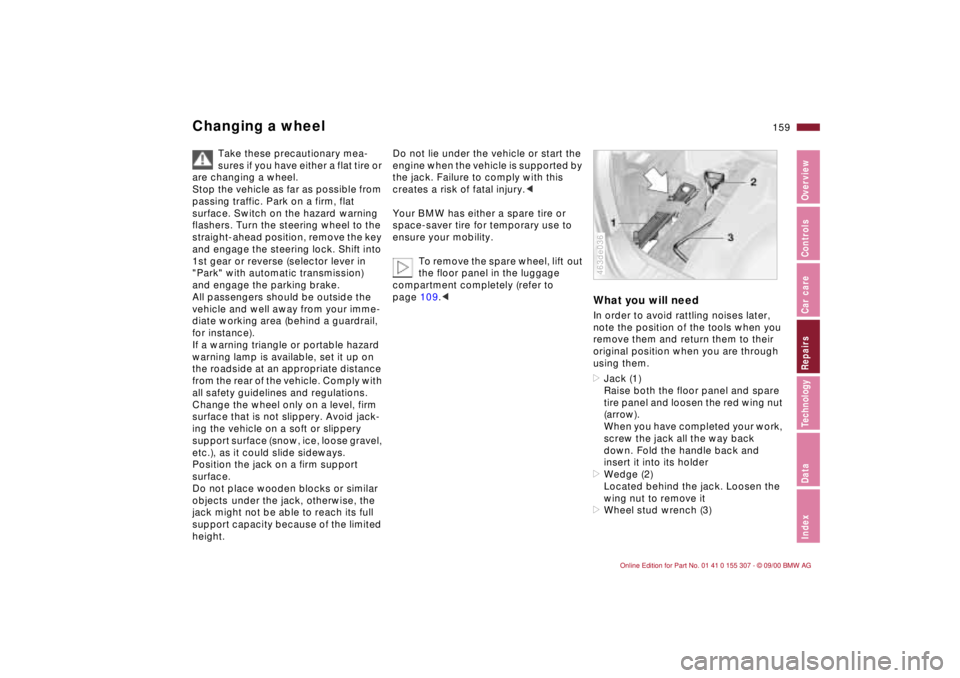
What you will needIn order to avoid rattling noises later,
note the position of the tools when you
remove them and return them to their
original position when you are through
using them.
>Jack (1)
Raise both the floor panel and spare
tire panel and loosen the red wing nut
(arrow).
When you have completed your work,
screw the jack all the way back
down. Fold the handle back and
insert it into its holder
>Wedge (2)
Located behind the jack. Loosen the
wing nut to remove it
>Wheel stud wrench (3) 463de036
Page 160 of 203
160n
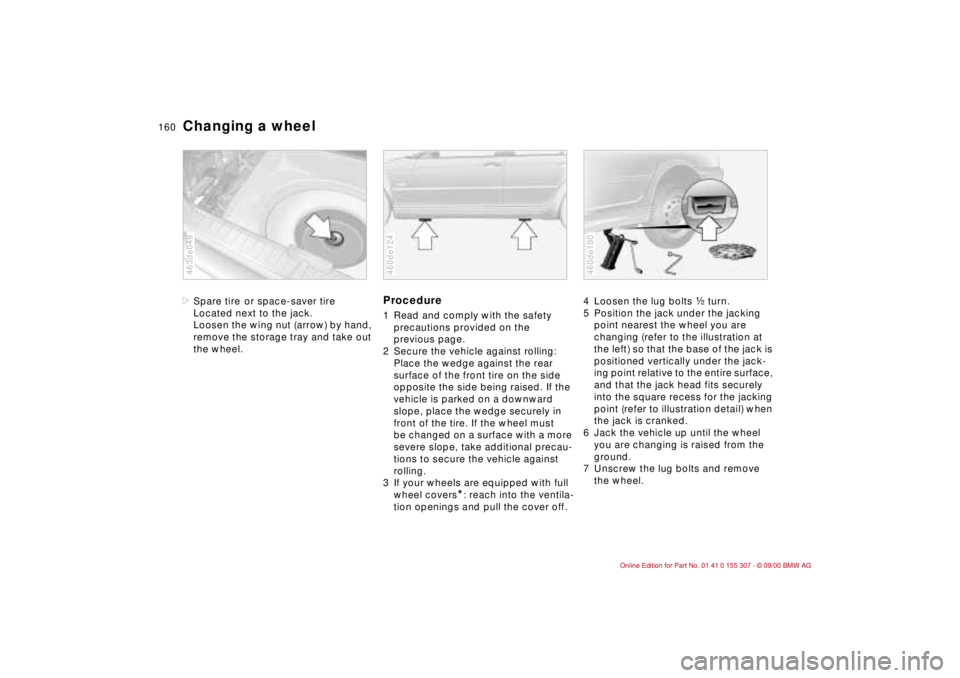
Changing a wheel>Spare tire
or space-saver tire
Located next to the jack.
Loosen the wing nut (arrow) by hand,
remove the storage tray and take out
the wheel.
463de049
Procedure1 Read and comply with the safety
precautions provided on the
previous page.
2 Secure the vehicle against rolling:
Place the wedge against the rear
surface of the front tire on the side
opposite the side being raised. If the
vehicle is parked on a downward
slope, place the wedge securely in
front of the tire. If the wheel must
be changed on a surface with a more
severe slope, take additional precau-
tions to secure the vehicle against
rolling.
3 If your wheels are equipped with full
wheel covers
*: reach into the ventila-
tion openings and pull the cover off.
460de124
4 Loosen the lug bolts g turn.
5 Position the jack under the jacking
point nearest the wheel you are
changing (refer to the illustration at
the left) so that the base of the jack is
positioned vertically under the jack-
ing point relative to the entire surface,
and that the jack head fits securely
into the square recess for the jacking
point (refer to illustration detail) when
the jack is cranked.
6 Jack the vehicle up until the wheel
you are changing is raised from the
ground.
7 Unscrew the lug bolts and remove
the wheel. 460de190
Page 161 of 203
161n
IndexDataTechnologyRepairsCar careControlsOverview
Changing a wheel8 Remove mud or dirt accumulation
from the mounting surfaces of the
wheel and hub. Clean the lug bolts.
9 Position the new wheel or the
space-saver tire on the hub and
screw at least two lug bolts finger-
tight into opposite bolt holes.
10 Screw in the remaining lug bolts.
Tighten all the bolts snugly.
11 Lower the jack and remove it from
beneath the vehicle.
12 Tighten the lug bolts in a diagonal
pattern.
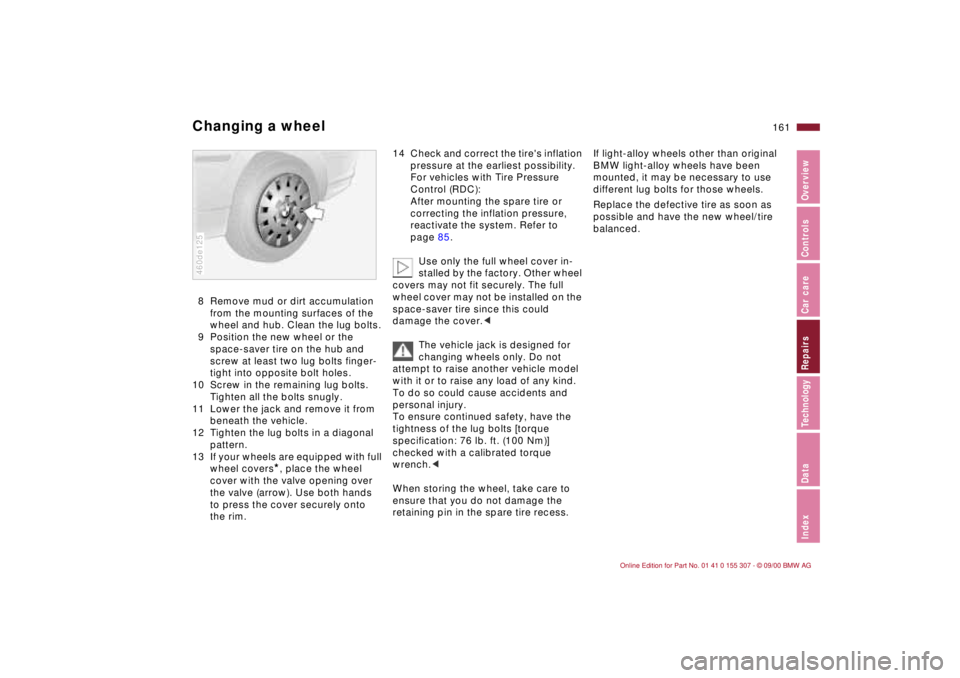
13 If your wheels are equipped with full
wheel covers
*, place the wheel
cover with the valve opening over
the valve (arrow). Use both hands
to press the cover securely onto
the rim.
460de125
14 Check and correct the tire's inflation
pressure at the earliest possibility.
For vehicles with Tire Pressure
Control (RDC):
After mounting the spare tire or
correcting the inflation pressure,
reactivate the system. Refer to
page 85.
Use only the full wheel cover in-
stalled by the factory. Other wheel
covers may not fit securely. The full
wheel cover may not be installed on the
space-saver tire since this could
damage the cover.<
The vehicle jack is designed for
changing wheels only. Do not
attempt to raise another vehicle model
with it or to raise any load of any kind.
To do so could cause accidents and
personal injury.
To ensure continued safety, have the
tightness of the lug bolts [torque
specification: 76 lb. ft. (100 Nm)]
checked with a calibrated torque
wrench.<
When storing the wheel, take care to
ensure that you do not damage the
retaining pin in the spare tire recess.
If light-alloy wheels other than original
BMW light-alloy wheels have been
mounted, it may be necessary to use
different lug bolts for those wheels.
Replace the defective tire as soon as
possible and have the new wheel/tire
balanced.
Page 196 of 203

Everything from A to ZRemote control35
Removal from service of the
vehicle147
Removing condensation
from the windows94
Reporting safety defects7
Restraint system54
Retaining straps40
Reverse17,64
Roll-up cover107
Roof load capacity186
Roof luggage rack111
Rubber parts121 S
Safety belt height
adjustment53
Safety belt tensioners175
Safety belts53
height adjustment53
Safety defects, reporting7
Safety feature43
Safety lock buttons38
Seat
electric power48
mechanical46
Seat adjustment46
Seat heating100
Seat memory49
Securing cargo110
Securing loads110 Selector lever, automatic
transmission65
Self-defrosting mirrors51
Self-diagnostics179
Service and Warranty
Information Booklet
(US models)140
Service Interval Display74
Setting the temperature98
Shiftlock65
Side airbags58
Side impact Head Protection
System58
Side lamps87
bulb replacement154
Ski bag106
Skid control122
Sliding/tilt sunroof44
close in the event of an
electrical short166
convenience operation34
Slippery roads122
Snow chains121
Socket104
for electrical
appliances104
for flashlights104
for vacuum cleaner104
refer also to power
outlet105
Space-saver spare tire159 Spare key32,35
with radio remote
control32,35
Spare tire159
Spark plugs188
Speaker103
Speed control71
Speedometer18
Sports seat48
Sports steering wheel25
Starting assistance167
Starting
problems115,167
Starting the engine61
Steel wheels129
Steering123
Steering wheel lock61
Steering wheel,
adjusting50
Steptronic65
Stereo system Ð harman
kardon101
Stopping the vehicle62
Storage compartments102
Storing the vehicle147
Stroke184
Summer tires127
Sun visors51
Sunroof44
Switching off the engine62
Symbols4,163 Synthetic oils136
T
Tachometer73
Tail lamps156
bulb replacement156
Tailgate
emergency release166
Tailgate lamp, bulb
replacement157
Tank capacity187
Technical data184
Technical
modifications6,148
Telephone
refer to the separate
Owner's Manual
Telephone hookup103
Temperature adjustment98
Temperature display,
outside temperature76
Temperature gauge, engine
coolant74
Temperature
layering93,100
Thigh support area,
adjusting48
Third brake lamp157
Tilt alarm42
Tilt sensor alarm system36
remote control36
Tire changing159