display BMW 325I 2002 User Guide
[x] Cancel search | Manufacturer: BMW, Model Year: 2002, Model line: 325I, Model: BMW 325I 2002Pages: 155, PDF Size: 2.17 MB
Page 69 of 155
69n
OverviewControlsMaintenanceRepairsDataIndex
Computer
*
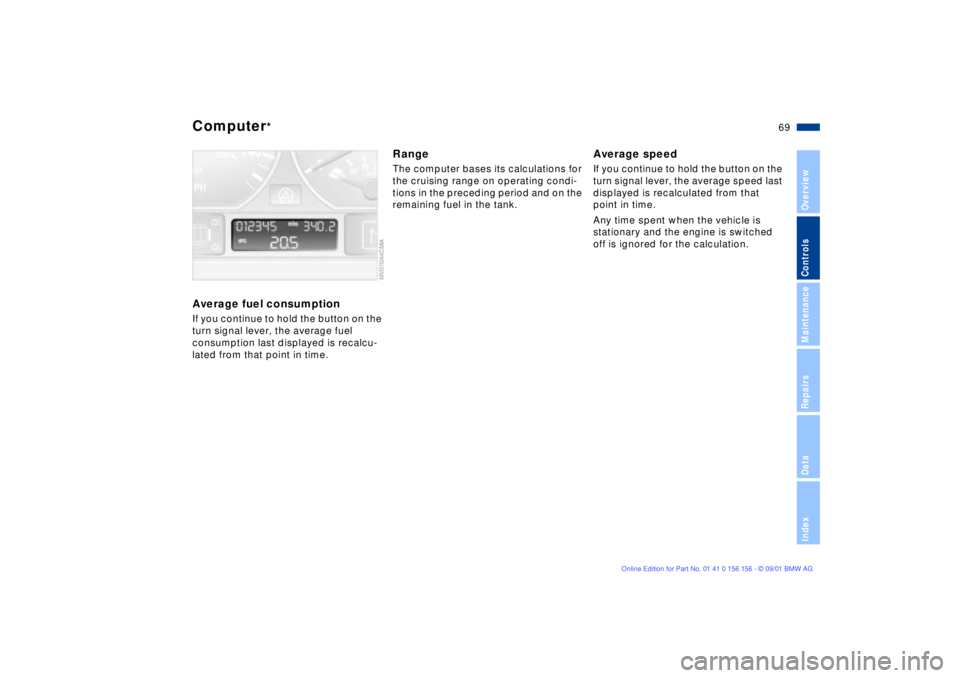
Average fuel consumptionIf you continue to hold the button on the
turn signal lever, the average fuel
consumption last displayed is recalcu-
lated from that point in time.
RangeThe computer bases its calculations for
the cruising range on operating condi-
tions in the preceding period and on the
remaining fuel in the tank.
Average speedIf you continue to hold the button on the
turn signal lever, the average speed last
displayed is recalculated from that
point in time.
Any time spent when the vehicle is
stationary and the engine is switched
off is ignored for the calculation.
Page 81 of 155
81n
OverviewControlsMaintenanceRepairsDataIndex
Flat Tire Monitor
*
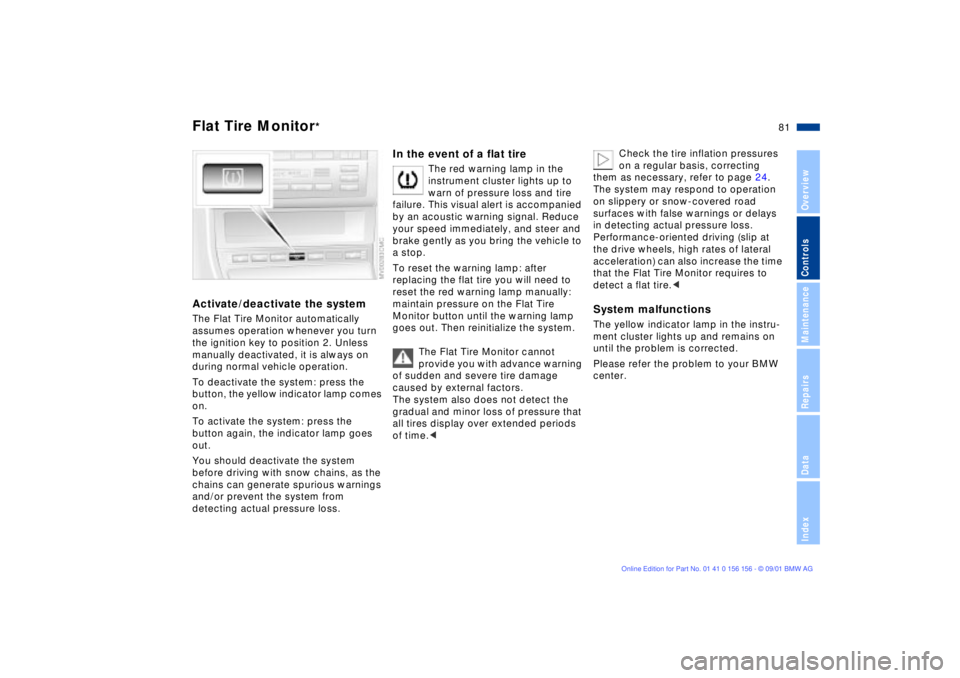
Activate/deactivate the systemThe Flat Tire Monitor automatically
assumes operation whenever you turn
the ignition key to position 2. Unless
manually deactivated, it is always on
during normal vehicle operation.
To deactivate the system: press the
button, the yellow indicator lamp comes
on.
To activate the system: press the
button again, the indicator lamp goes
out.
You should deactivate the system
before driving with snow chains, as the
chains can generate spurious warnings
and/or prevent the system from
detecting actual pressure loss.
In the event of a flat tire
The red warning lamp in the
instrument cluster lights up to
warn of pressure loss and tire
failure. This visual alert is accompanied
by an acoustic warning signal. Reduce
your speed immediately, and steer and
brake gently as you bring the vehicle to
a stop.
To reset the warning lamp: after
replacing the flat tire you will need to
reset the red warning lamp manually:
maintain pressure on the Flat Tire
Monitor button until the warning lamp
goes out. Then reinitialize the system.
The Flat Tire Monitor cannot
provide you with advance warning
of sudden and severe tire damage
caused by external factors.
The system also does not detect the
gradual and minor loss of pressure that
all tires display over extended periods
of time.<
Check the tire inflation pressures
on a regular basis, correcting
them as necessary, refer to page 24.
The system may respond to operation
on slippery or snow-covered road
surfaces with false warnings or delays
in detecting actual pressure loss.
Performance-oriented driving (slip at
the drive wheels, high rates of lateral
acceleration) can also increase the time
that the Flat Tire Monitor requires to
detect a flat tire.<
System malfunctionsThe yellow indicator lamp in the instru-
ment cluster lights up and remains on
until the problem is corrected.
Please refer the problem to your BMW
center.
Page 88 of 155
88n
Automatic climate control
*
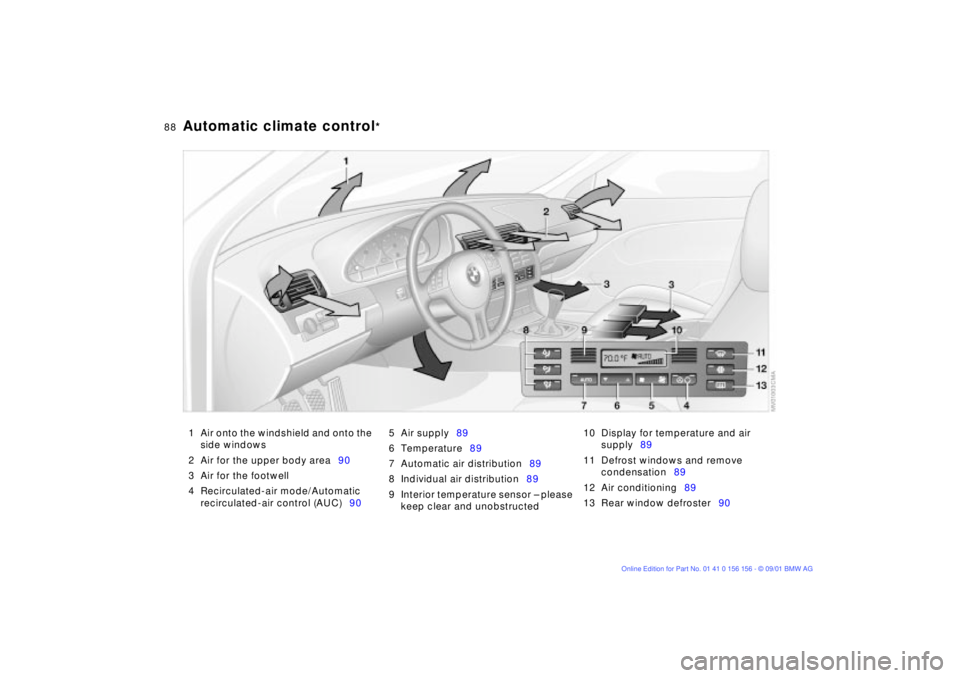
1 Air onto the windshield and onto the
side windows
2 Air for the upper body area90
3 Air for the footwell
4 Recirculated-air mode/Automatic
recirculated-air control (AUC)905 Air supply89
6 Temperature89
7 Automatic air distribution89
8 Individual air distribution89
9 Interior temperature sensor Ð please
keep clear and unobstructed10 Display for temperature and air
supply89
11 Defrost windows and remove
condensation89
12 Air conditioning89
13 Rear window defroster90
Page 89 of 155
89n
OverviewControlsMaintenanceRepairsDataIndex
Automatic climate control
*
Tips for pleasant drivingUse the automatic system Ð switch on
with AUTO button 7. Select the desired
interior temperature.
Detailed setting options are described
for you in the following section.Automatic air distribution
The AUTO program adjusts the
air distribution and the air
supply for you and in addition adapts
the temperature to external influences
(summer, winter) to meet preferences
you can specify.
Individual air distribution
You can cancel the AUTO
program by selecting specific
distribution patterns to suit your
own individual requirements.
While the AUTO program is then deacti-
vated, the automatic airflow control
remains in operation. The system
directs air to the windows , the upper
body and into the footwells . You
can reactivate the automatic air distri-
bution mode by selecting the AUTO
button.
Temperature
The interior temperature that
appears in the display panel is a
general figure intended for reference
purposes. We recommend 72 7
(+22 6) as a comfortable setting, even
if the air conditioning is on. When you
start the vehicle, the system ensures
that the selected temperature is
achieved as quickly as possible regard-
less of the season. It then maintains this
temperature.
Air supply
By pressing the left or right half
of the button, you can vary the
air supply. This deactivates the auto-
matic control of the air supply, AUTO
disappears from the display panel.
Nevertheless, the automatic air distri-
bution remains unchanged. You can
reactivate the automatic air distribution
mode by selecting the AUTO button.
When you select the lowest blower
speed by pressing the left half of the
button, all of the displays are canceled:
the blower, heating and air conditioning
are switched off. The outside air supply
is blocked. You can reactivate the
system by pressing any button for the
automatic climate control.
To defrost windows and remove
condensation
This program quickly removes
ice and condensation from the
windshield and the side windows.
Air conditioning
The air is cooled and dehumidi-
fied and Ð depending on the
temperature setting Ð rewarmed.
Depending on the weather, the wind-
shield may fog over briefly when the
engine is started. Switching on the air
conditioning will reduce condensation
forming on the windows.
As the air-conditioning system
operates, condensation forms
within the system.This moisture is
conducted to an outlet beneath the
vehicle; it is thus not unusual for a small
puddle to form under the car while the
system is running.<
Page 111 of 155

111n
OverviewControlsMaintenanceRepairsDataIndex
Winter tiresChoosing the right tireBMW recommends winter tires (M+S
radial tires) for operation under
inclement winter driving conditions.
While all-season tires (M+S designa-
tion) provide better winter traction than
summer tires with the load ratings H, V,
W, Y and ZR, they generally do not
achieve the performance of winter tires.
In the interest of safe tracking and
steering response, install winter tires
made by the same manufacturer having
the same tread configuration on all four
wheels.Never exceed the maximum
speed for which the winter tires
are rated.
Unprofessional attempts by laymen to
service tires can lead to damage and
accidents.
Have this work performed by trained
professionals only. Any BMW center
has the required technical knowledge
and the proper equipment and will be
happy to assist you.<
Tire condition, tire pressureOnce the tire wears to below 0.16 in
(4 mm), winter tires display a percep-
tible decrease in their ability to cope
with winter driving conditions, and
should be replaced in the interest of
safety.
Comply with the specified tire inflation
pressures Ñ and be sure to have the
wheel and tire assemblies balanced
every time you change the tires.
StorageAlways store tires in a cool, dry place.
Store them away from light whenever
possible. Protect the tires against
contact with oil, grease and fuel.Snow chains
*
Use BMW narrow-link snow chains on
summer or winter tires in pairs only and
only on the rear wheels.
BMW 325xi: in an extreme emergency Ð
for instance, with the vehicle stuck on
one side, or when obstructions make it
impossible to reach one tire Ð a chain
may also be mounted on just one tire
for the limited period needed to resolve
the problem.
Comply with all manufacturer's safety
precautions when mounting the chains.
You cannot mount snow chains on the
following tires:
225/50 R 16 92
225/45 R 17 91
245/40 ZR 17
Page 119 of 155
119n
OverviewControlsMaintenanceRepairsDataIndex
The BMW Maintenance System has
been designed as a reliable means of
providing maximum driving and oper-
ating safety Ð and as cost-effectively as
possible for you.
Please keep in mind that regular main-
tenance is not only necessary for the
safety of your vehicle, but also plays a
significant role in maintaining the resale
value of the vehicle.
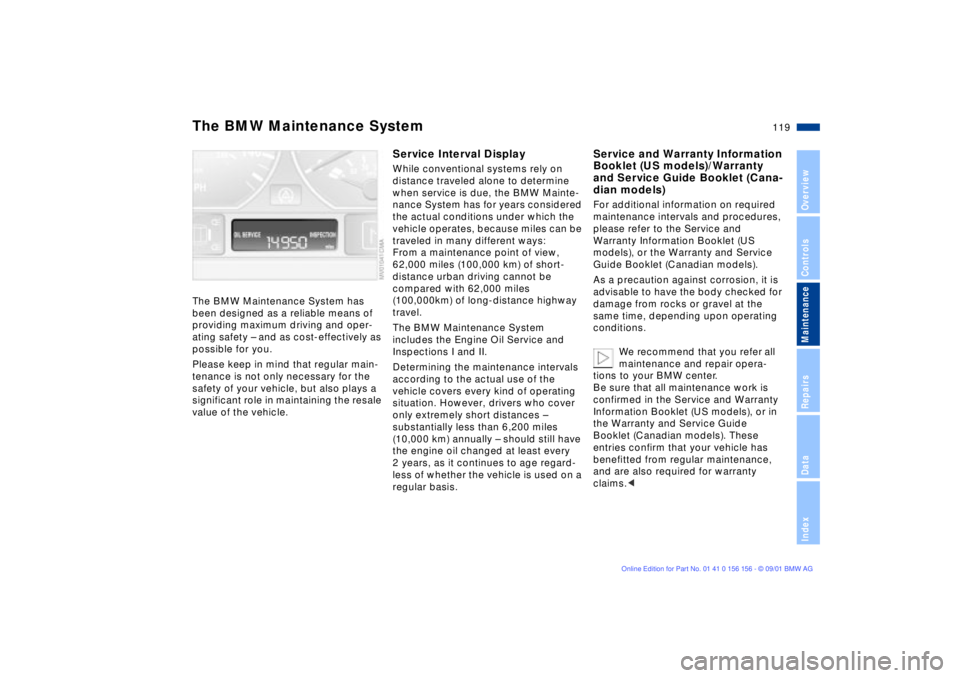
Service Interval DisplayWhile conventional systems rely on
distance traveled alone to determine
when service is due, the BMW Mainte-
nance System has for years considered
the actual conditions under which the
vehicle operates, because miles can be
traveled in many different ways:
From a maintenance point of view,
62,000 miles (100,000 km) of short-
distance urban driving cannot be
compared with 62,000 miles
(100,000km) of long-distance highway
travel.
The BMW Maintenance System
includes the Engine Oil Service and
Inspections I and II.
Determining the maintenance intervals
according to the actual use of the
vehicle covers every kind of operating
situation. However, drivers who cover
only extremely short distances Ð
substantially less than 6,200 miles
(10,000 km) annually Ð should still have
the engine oil changed at least every
2 years, as it continues to age regard-
less of whether the vehicle is used on a
regular basis.
Service and Warranty Information
Booklet (US models)/Warranty
and Service Guide Booklet (Cana-
dian models)For additional information on required
maintenance intervals and procedures,
please refer to the Service and
Warranty Information Booklet (US
models), or the Warranty and Service
Guide Booklet (Canadian models).
As a precaution against corrosion, it is
advisable to have the body checked for
damage from rocks or gravel at the
same time, depending upon operating
conditions.
We recommend that you refer all
maintenance and repair opera-
tions to your BMW center.
Be sure that all maintenance work is
confirmed in the Service and Warranty
Information Booklet (US models), or in
the Warranty and Service Guide
Booklet (Canadian models). These
entries confirm that your vehicle has
benefitted from regular maintenance,
and are also required for warranty
claims.<
The BMW Maintenance System
Page 120 of 155

120n
Light-emitting diodes (LEDs)Light-emitting diodes installed behind
translucent lenses serve as the light
source for many of the controls and
displays in your vehicle. These LEDs
use a concept related to that of conven-
tional lasers.
Do not remove the protective lens
and avoid staring directly at the
unfiltered beam for extended periods
(several hours), as inflammation of the
iris could result.<
California laws require us to state the
following warning:
Engine exhaust, some of its
constituents, and certain vehicle
components contain or emit chemicals
known to the State of California to
cause cancer and birth defects or other
reproductive harm.<
Technical modifications California Proposition 65 Warning
Page 147 of 155
Everything from A to Z
147n
OverviewControlsMaintenanceRepairsDataIndex
Break-in procedures104
Bulbs and lamps
replacement125 C
California Proposition
65 Warning120
Can holder, refer to
beverage holder93
Capacities143
Car care, refer to the "Caring
for your vehicle" manual
Car phone94
Car wash systems, refer to
the "Caring for your
vehicle" manual
Care of upholstery materials,
refer to the "Caring for your
vehicle" manual
Cargo area35, 97
capacity142
Cargo area cover97
Cargo area lighting33
Cargo loading99 CBC (Cornering Brake
Control)18, 73
Cellular phone94
refer also to the separate
"Owner's Manual"94
Center (high-mount) brake
lamp128
Center armrest92
Central locking system28
control button32
Changing a wheel129
Check Control67
Checking engine oil
level115
Checking tire pressures24
Child-restraint systems51
Cigarette lighter94
Cigarette lighter socket94
Clean rear window62
Clean the headlamps62
Cleaning windshield62
Clock67
refer also to the "Radio
Owner's Manual" Clothes hooks105
Clutch104
Cockpit14
Coin box93
Compartments92
Compression ratio140
Computer68
refer also to the "Owner's
Manual Onboard
Computer"
Configuring individual
settings via Vehicle and
Key Memory54
Convenience operation via
the door lock
power windows31
sliding/tilt sunroof31
Coolant117, 143
Coolant temperature
gauge66
Cooling system including
heating circuit,
capacity143
Copyright4
Cornering Brake Control
(CBC)18, 73 Correct sitting posture40
Cruise control63
Cruising range69
Curb weight142
D
Data
dimensions141
technical140
weights142
Daytime driving lamps82
DBC (Dynamic Brake
Control)74
Deep water105
Defrost windows87, 89
Defroster, rear
window86, 90
Digital clock67
Dimming rearview mirror48
Dipstick, engine oil115
Displacement140
Display lighting83
Displays15
Disposal
antifreeze and anti-
corrosion agents117
battery133
brake fluid118
engine oil116
Page 148 of 155

Everything from A to ZDistance warning70
Door keys28
Doors
electrical malfunction31
locking and unlocking29
manual operatiom31
DOT Quality Grades,
tires108
Draft-free ventilation87, 90
Drawbar weight142
Drink holder, refer to
beverage holder93
Drive belts17
Driving notes105
DSC (Dynamic Stability
Control)19, 73
Dynamic Brake Control
(DBC)74
Dynamic Stability Control
(DSC)19, 73 E
Electric power windows37
Electrical malfunction
doors31
fuel filler door22
sliding/tilt sunroof39
tailgate33 Electrical power socket95
Elements of operation14
Energy Control65
Engine compartment
essentials113
Engine coolant143
Engine data140
Engine oil
capacity143
consumption115
disposal116
quality116
specifications116
viscosity116
Engine oil level115
checking115
indicator lamp19
Engine specifications140
Engine speed140
F
Fault displays67
Filling capacities143
Fittings, tow starting and
towing135
Flashlight92
Flat Tire
Monitor80, 109, 132 Flat tires107, 129, 132
Fog lamps83
Follow me home lamps82
Front fog lamps83
Front seat adjustment40
Fuel consumption69
display66
Fuel filler door22
electrical malfunction22
manual operation22
Fuel gauge66
Fuel injection system140
Fuel reserve indicator
lamp66
Fuel tank capacity143
Fuel tank gauge66
Fuses133
G
Gasoline gauge66
Glove compartment92
Gross vehicle weight142 H
Handbrake57
Hands-free system94
microphone94 Harman Kardon premium
sound system91
Hazard warning triangle22
HDC (Hill Descent
Control)77
Head restraints43
Headlamp cover, care125
Headlamp flasher83
Headlamp washer
system114
capacity143
Headlight control82
Heated seats46
High beams20, 60, 83
bulb replacement125
High Performance Synthetic
Oil116
Hill Descent Control
(HDC)77
Holder for beverage
cans93
Hood release112
Horn14
Page 149 of 155
Everything from A to Z
149n
OverviewControlsMaintenanceRepairsDataIndex
I
Ice warning68
Icy roads68
Ignition keys28
Ignition lock55
Imprint4
Indicator lamps17
Inflation pressures24, 107
INSPECTION66
Instrument cluster15
Instrument lighting83
Instrument panel15
Interface socket
for onboard diagnostics
(OBD)121
Interior lamps30, 84
remote control30
Interior motion sensor35
operation via remote
control30
switching off36
Interior rearview mirror47
automatic dimming
feature48
Interlock55
J
Jack129
Jump-starting134 K
Key Memory54
Key set28
Keys28 L
Lamps and bulbs,
replacement125
Lashing eyes100
License plate lamps, bulb
replacement128, 129
LIGHTS ON warning82
Litter bag holder93
Loading and driving
notes100
Load-securing devices100
Lock buttons32
Low beams82
bulb replacement125
Lug wrench129
Luggage cover, refer to
cargo area cover
Luggage rack100
M
M+S tires111
Maintenance66, 119
Malfunction displays67
Manual operation
doors31
fuel filler door22
sliding/tilt sunroof39
tailgate33
Manual seat adjustment41
Manual transmission57
Manually controlled recircu-
lated-air90
Master keys28
Memory settings45
MFL (Multifunction steering
wheel)21
Microfilter87, 91
Mirror defrosting47
Mirror memory45
Mirrors47
Mobile phone94
Modifications,
technical10, 120
Motion sensor, refer to
interior motion sensor35
Multifunction steering wheel
(MFL)21
O
OBD interface socket121
Odometer65
Oil
additives115
capacity143
consumption115
quality116
specifications116
viscosity116
Oil change intervals, see the
Service and Warranty
Information Booklet
Oil dipstick115
Oil filter change143
OILSERVICE66
Onboard computer68
refer also to the "Owner's
Manual Onboard
Computer"
Onboard tool kit124
Opening and closing
from the inside32
via the door lock31
via the remote control29
Outside temperature
display68