roof BMW 325I 2002 Owners Manual
[x] Cancel search | Manufacturer: BMW, Model Year: 2002, Model line: 325I, Model: BMW 325I 2002Pages: 155, PDF Size: 2.17 MB
Page 4 of 155

Contents
© 2001 Bayerische Motoren Werke
Aktiengesellschaft
Munich, Germany
Reprinting, including excerpts, only with the
written consent of BMW AG, Munich.
Order No. 01 41 0 156 156
US English VIII/01
Printed in Germany
Printed on environmentally friendly paper
(bleached without chlorine, suitable for recycling).
Overview
Controls and features
Cockpit14
Instrument cluster15
Indicator and warning lamps17
Multifunction steering wheel
(MFL)21
Hazard warning triangle22
Refueling22
Fuel specifications23
Tire inflation pressures24
Opening and closing:
Keys28
Central locking system28
Opening and closing Ð via the
remote control29
Opening and closing Ð via the
door lock31
Opening and closing Ð from the
inside32
Tailgate33
Rear window34
Cargo area35
Alarm system35
Electric power windows37
Sliding/tilt sunroof38
Adjustments:
Correct sitting posture40
Seats40
Manual seat adjustment41
Power seat adjustment42
Lumbar support42
Head restraints43
Safety belts44
Seat and mirror memory45
Seat heating46
Steering wheel46
Mirrors47
Passenger safety systems:
Airbags48
Transporting children safely51Vehicle Memory, Key
Memory54
Driving:
Ignition lock55
Starting the engine55
Switching off the engine56
Parking brake57
Manual transmission57
Automatic transmission with
Steptronic58
Indicator/Headlamp flasher60
Washer/Wiper system/Rain
sensor61
Cruise control63
Everything under control:
Odometer65
Tachometer65
Energy control65
Fuel gauge66
Coolant temperature gauge66
Service Interval Display66
Check Control67
Clock67
Computer68
Technology for safety and
driving convenience:
Park Distance Control (PDC)70
Automatic Stability Control plus
Traction (ASC+T)71
Dynamic Stability Control
(DSC)73
Contents
Page 5 of 155

5n
OverviewControlsMaintenanceRepairsDataIndex
Controls and features
Operation, maintenance
Hill Descent Control (HDC) 77
Tire Pressure Monitor (RDC)78
Flat Tire Monitor80
Lamps:
Parking lamps/Low beams82
Instrument lighting83
High beams/Standing lamps83
Fog lamps83
Interior lamps84
Controlling the climate for
pleasant driving:
Air conditioning85
Automatic climate control88
Interior conveniences:
Sound system91
Glove compartment92
Storage compartments92
Cellular phone94
Ashtray, front94
Ashtray, rear95
Electrical power socket95
Loading and transporting:
Ski bag96
Cargo area97
Cargo loading99
Roof-mounted luggage rack100
Special operating instructions:
Break-in procedure104
Driving notes105
Antilock Brake System
(ABS)105
Brake system106
Wheels and tires:
Tire inflation pressure107
Tire condition107
Tire replacement108
Wheel and tire
combinations110
Winter tires111
In the engine compartment:
Hood112
Engine compartment
essentials113
Washer fluids114
Engine oil115
Coolant117
Brake fluid118
Maintenance:
The BMW Maintenance
System119
Laws and regulations:
Technical modifications120
California Proposition
65 Warning120
OBD interface socket121
Page 30 of 155
30n
Opening and closing Ð via the remote controlConvenience opening modePress and hold button: the power
windows and sliding/tilt sunroof are
opened.To lock and securePress button.
Do not lock the vehicle if anyone
will be remaining inside, as it
would then be impossible for the occu-
pant(s) to disengage the locks from the
inside.< To switch on the interior lampsAfter locking the vehicle, press button
again.To switch off tilt alarm sensor
*
and interior motion sensor
*
Press button a second time immedi-
ately after locking. For additional infor-
mation refer to page 36.
To open the rear windowPress button.
The rear window opens slightly. It can
now be tilted up.
Before and after a trip, be sure
that the rear window has not been
opened unintentionally.<
If you prefer, the tailgate will open
instead of the rear window.
gered in the event of danger, if it is
armed.
Press the button to cancel the alarm.External systemsThe remote control system's operation
may be affected by other units or
equipment operating in the immediate
vicinity of your vehicle.
If this should occur, you can still open
and close the vehicle using the master
key in the door lock.For US owners onlyThe transmitter and receiver units
comply with part 15 of the FCC (Federal
Communication Commission) regula-
tions. Operation is governed by the
following:
FCC ID: LX8EWS
LX8FZVS
LX8FZVE
Compliance statement:
This device complies with part 15 of the
FCC Rules. Operation is subject to the
following two conditions:
>This device may not cause harmful
interference, and
>this device must accept any interfer-
ence received, including interference
that may cause undesired operation.
Any unauthorized modifications to
these devices could void the
user's authority to operate the equip-
ment.<
Page 31 of 155

31n
OverviewControlsMaintenanceRepairsDataIndex
Opening and closing Ð via the door lockOne turn of the key in the driver's door
lock unlocks the driver's door only.
Turning the key a second time unlocks
all of the remaining doors, the tailgate
and the fuel filler door.
Do not lock the vehicle if anyone
will be remaining inside, as it
would then be impossible for the occu-
pant(s) to disengage the locks from the
inside.<
You can have a signal set to
confirm that the vehicle's locks
have engaged securely.<
Convenience operationYou can also operate the power
windows and the sliding/tilt sunroof via
the door lock.
>To open: with the door closed, hold
the key in the "Unlock" position
>To close: with the door closed, hold
the key in the "Lock" position.
Watch the closing process care-
fully and be sure that no one is
trapped by the closing motion.
Releasing the key stops the opera-
tion.<
Manual operation (in the event of electrical malfunction)
Turn the key all the way to the left or
right to unlock/lock the driver's door.
Page 34 of 155
34n
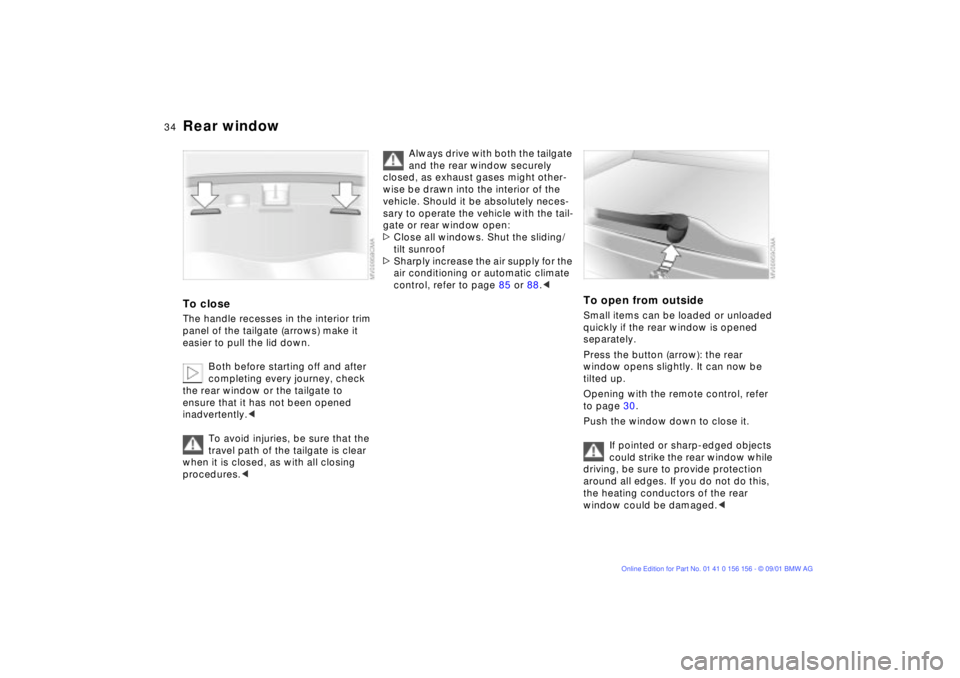
Rear windowTo closeThe handle recesses in the interior trim
panel of the tailgate (arrows) make it
easier to pull the lid down.
Both before starting off and after
completing every journey, check
the rear window or the tailgate to
ensure that it has not been opened
inadvertently.<
To avoid injuries, be sure that the
travel path of the tailgate is clear
when it is closed, as with all closing
procedures.<
Always drive with both the tailgate
and the rear window securely
closed, as exhaust gases might other-
wise be drawn into the interior of the
vehicle. Should it be absolutely neces-
sary to operate the vehicle with the tail-
gate or rear window open:
>Close all windows. Shut the sliding/
tilt sunroof
>Sharply increase the air supply for the
air conditioning or automatic climate
control, refer to page 85 or 88.<
To open from outsideSmall items can be loaded or unloaded
quickly if the rear window is opened
separately.
Press the button (arrow): the rear
window opens slightly. It can now be
tilted up.
Opening with the remote control, refer
to page 30.
Push the window down to close it.
If pointed or sharp-edged objects
could strike the rear window while
driving, be sure to provide protection
around all edges. If you do not do this,
the heating conductors of the rear
window could be damaged.<
Page 36 of 155
36n
Alarm system
*
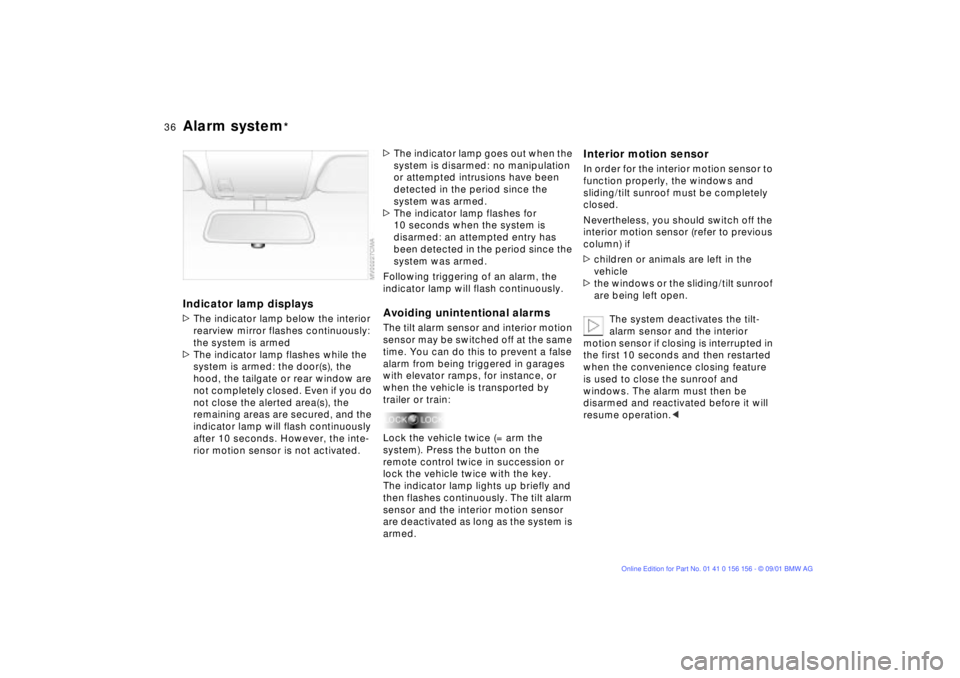
Indicator lamp displays>The indicator lamp below the interior
rearview mirror flashes continuously:
the system is armed
>The indicator lamp flashes while the
system is armed: the door(s), the
hood, the tailgate or rear window are
not completely closed. Even if you do
not close the alerted area(s), the
remaining areas are secured, and the
indicator lamp will flash continuously
after 10 seconds. However, the inte-
rior motion sensor is not activated.
>The indicator lamp goes out when the
system is disarmed: no manipulation
or attempted intrusions have been
detected in the period since the
system was armed.
>The indicator lamp flashes for
10 seconds when the system is
disarmed: an attempted entry has
been detected in the period since the
system was armed.
Following triggering of an alarm, the
indicator lamp will flash continuously.Avoiding unintentional alarmsThe tilt alarm sensor and interior motion
sensor may be switched off at the same
time. You can do this to prevent a false
alarm from being triggered in garages
with elevator ramps, for instance, or
when the vehicle is transported by
trailer or train:
Lock the vehicle twice (= arm the
system). Press the button on the
remote control twice in succession or
lock the vehicle twice with the key.
The indicator lamp lights up briefly and
then flashes continuously. The tilt alarm
sensor and the interior motion sensor
are deactivated as long as the system is
armed.
Interior motion sensorIn order for the interior motion sensor to
function properly, the windows and
sliding/tilt sunroof must be completely
closed.
Nevertheless, you should switch off the
interior motion sensor (refer to previous
column) if
>children or animals are left in the
vehicle
>the windows or the sliding/tilt sunroof
are being left open.
The system deactivates the tilt-
alarm sensor and the interior
motion sensor if closing is interrupted in
the first 10 seconds and then restarted
when the convenience closing feature
is used to close the sunroof and
windows. The alarm must then be
disarmed and reactivated before it will
resume operation.<
Page 38 of 155
38n
Electric power windows Sliding/tilt sunroof
*
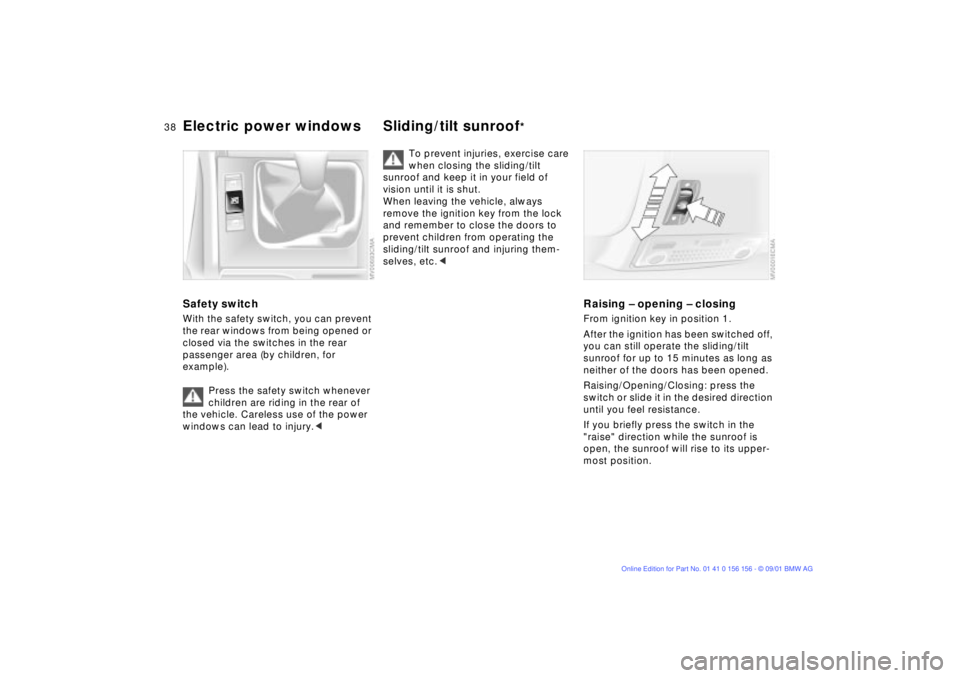
Safety switch With the safety switch, you can prevent
the rear windows from being opened or
closed via the switches in the rear
passenger area (by children, for
example).
Press the safety switch whenever
children are riding in the rear of
the vehicle. Careless use of the power
windows can lead to injury.<
To prevent injuries, exercise care
when closing the sliding/tilt
sunroof and keep it in your field of
vision until it is shut.
When leaving the vehicle, always
remove the ignition key from the lock
and remember to close the doors to
prevent children from operating the
sliding/tilt sunroof and injuring them-
selves, etc.<
Raising Ð opening Ð closingFrom ignition key in position 1.
After the ignition has been switched off,
you can still operate the sliding/tilt
sunroof for up to 15 minutes as long as
neither of the doors has been opened.
Raising/Opening/Closing: press the
switch or slide it in the desired direction
until you feel resistance.
If you briefly press the switch in the
"raise" direction while the sunroof is
open, the sunroof will rise to its upper-
most position.
Page 39 of 155
39n
OverviewControlsMaintenanceRepairsDataIndex
Sliding/tilt sunroof
*
The headliner insert slides back some-
what when you raise the sunroof. When
the sunroof is opened, the headliner
retracts with it.
Do not use force to close the
headliner insert with the sunroof in
its raised position, as damage to the
mechanism could result.<
For the convenience mode via the door
lock, refer to page 31.Automatic opening and closingPress the switch briefly past the pres-
sure point: the sunroof travels to either
the fully-closed or fully-open position.
Pressing the switch again stops the
motion immediately.
Safety featureIf the sliding/tilt sunroof encounters
resistance
>when it is closing from the raised
position
>when it is closing from a point
roughly past the middle of its travel,
the closing cycle is interrupted and the
sliding/tilt sunroof will open again
slightly.
Despite this safety feature, be
extremely careful that the travel
path of the sunroof is not obstructed
whenever it is closed. Remember that
the safety mechanism may not be able
to detect obstructions under all circum-
stances (with very thin objects, for
instance).
You can disable this safety feature by
pressing the switch beyond the pres-
sure point and holding it.<
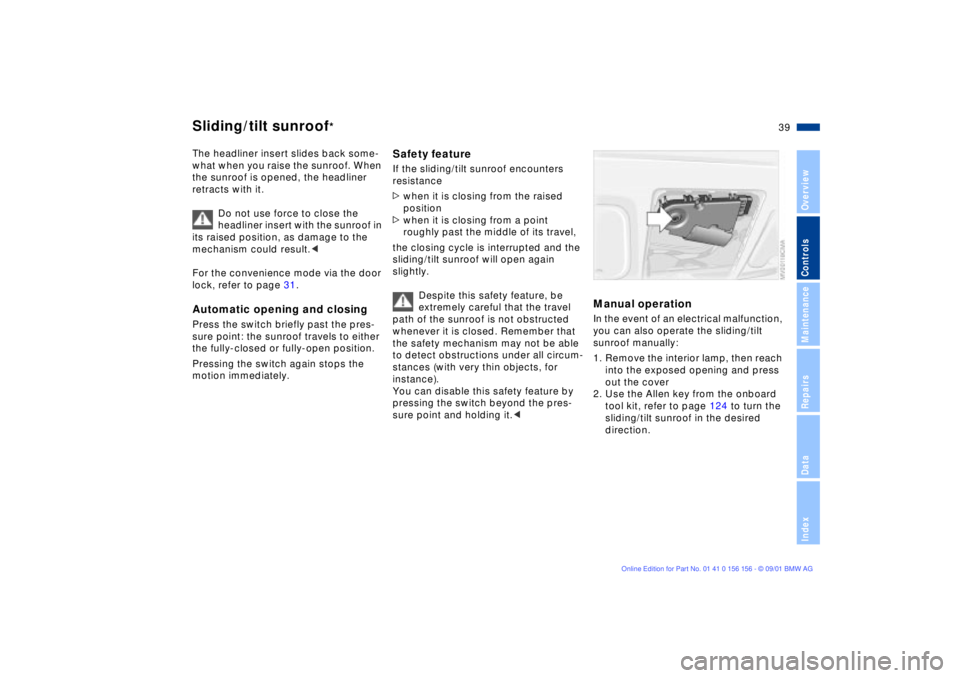
Manual operation In the event of an electrical malfunction,
you can also operate the sliding/tilt
sunroof manually:
1. Remove the interior lamp, then reach
into the exposed opening and press
out the cover
2. Use the Allen key from the onboard
tool kit, refer to page 124 to turn the
sliding/tilt sunroof in the desired
direction.
Page 49 of 155

49n
OverviewControlsMaintenanceRepairsDataIndex
Airbags
The airbags do not respond to
minor collisions, rear impacts, or
to some kinds of vehicle rollovers.<
For your safety, comply with the
following instructions for the
airbags. If you do not, the airbags may
not be able to provide their maximum
protection. All passengers in the vehicle
should be aware of and comply with
this information:
The airbags are supplemental restraint
devices designed to provide extra
protection; they are not a substitute for
safety belts. Wear your safety belt at all
times. The airbags will not be triggered
in the event of a minor accident, a
vehicle rollover, or collisions from the
rear. In these instances, the safety belt
provides optimal protection.
Airbags are located under cover panels
in the steering wheel, in the instrument
panel, in the side trim panels in the
front and rear
*, in the roof panels, and
in the sides of the inside roof lining.
Adjust your seat to a position that
provides maximum distance between
you and the steering wheel, the instru-
ment panel and the door while still
allowing comfortable and safe access
to all vehicle controls.
To avoid sustaining hand and arm inju-
ries, always grasp the steering wheel
on the rim with the hands at the 9 and
3 o'clock positions. Do not place your
hands on the center pad.
Never allow any objects to obstruct the
area between the airbag and an occu-
pant.
Do not use the cover panel above the
passenger-side airbag as a storage
area.
Do not apply adhesive materials to the
cover panels of the airbags, cover them
or modify them in any other way.
Do not install a rear-facing child-
restraint system in the front passenger
seat of this vehicle.
Children under 13 years of age and less
than 5 ft (150 cm) tall should ride only in
the rear seat.
Infants or small children should never
be held on the lap of a passenger.
If your vehicle is equipped with side
airbags in the rear passenger area
*, be
sure that child restraints are mounted
correctly with the greatest-possible
distance between them and the airbags
in the side trim panels. Do not allow
children to lean out of the child's seat in
the direction of the side trim panels. If
they do so, serious injuries can occur if
the airbag is triggered.
(infants and small children in appro-
priate child-restraint systems; larger
children and adults using the safety
belts). Never let an occupant's head
rest near or on a side airbag because
the inflating airbag could cause a
serious or fatal injury. Please note that
the word Airbag imprinted on the door
trim panel indicates the airbag's loca-
tion.
Accident research shows that the
safest place for children in an
automobile is in the rear seat. However,
a child sitting in the rear seat and not
properly restrained may place his or her
head on or near the airbag, if so
equipped. For example, a child Ñ even
though belted Ñ may fall asleep with his
or her head against the side airbag. It
may be difficult for a driver to ensure
that children in the rear seat will remain
properly positioned at all times and not
place their heads on or near the side
airbag.
Therefore, we recommend that the
rear-seat side airbags, if installed in the
vehicle, be deactivated if children will
travel in the rear seat.
The rear side airbags may already have
been deactivated, either at the time of
Page 98 of 155

98n
Cargo areaTo remove cargo cover and
partition net1. Press the buttons on the sides
(arrow 1)
2. Extract the case by pulling to the rear
(arrow 2).InstallationSimply slide the case forward in the two
side holders until it engages.
Storing with backrests folded
forwardSupports for the case are also provided
on the rear sides of the backrests
(arrow 1).
Slide the case into the supports as
shown in the illustration, continuing
until the detent engages (arrow 2).
Ensure that the cargo cover is toward
the front of the vehicle, with the parti-
tion net's loop on the top.
You can pull the partition net out and
insert it in the holders above it in the
upper roof area.
To ensure that the case centers
correctly, remember to insert it
from the right side, always continuing
until the detents snap into place. Failure
to observe the prescribed insertion
procedure could also result in damage
to the door's upholstery.<