maintenance BMW 325I 2003 User Guide
[x] Cancel search | Manufacturer: BMW, Model Year: 2003, Model line: 325I, Model: BMW 325I 2003Pages: 166, PDF Size: 4.29 MB
Page 25 of 166
25
Close the fuel filler cap carefully
after refueling until a click is
heard. While closing, be sure not to
squeeze the strap which is fastened to
the cap. A loose or missing cap will
activate the CHECK FILLER CAP
lamp.<
Fuel tank capacity>Approx. 16.6 gal./63 liters, of which
>approx. 2.1 gal./8 liters are reserve
capacity.
Do not drive to the last drop of
fuel. This can prevent the engine
from operating properly and result in
damage.<
Fuel specificationsThe engine uses lead-free gasoline
only.
Required fuel:
>Premium Unleaded Gasoline,
min. 91 AKI.
AKI = Anti Knock Index
Never use leaded fuel, as it would
cause permanent and irreversible
damage to the oxygen sensor and the
catalytic converter.<
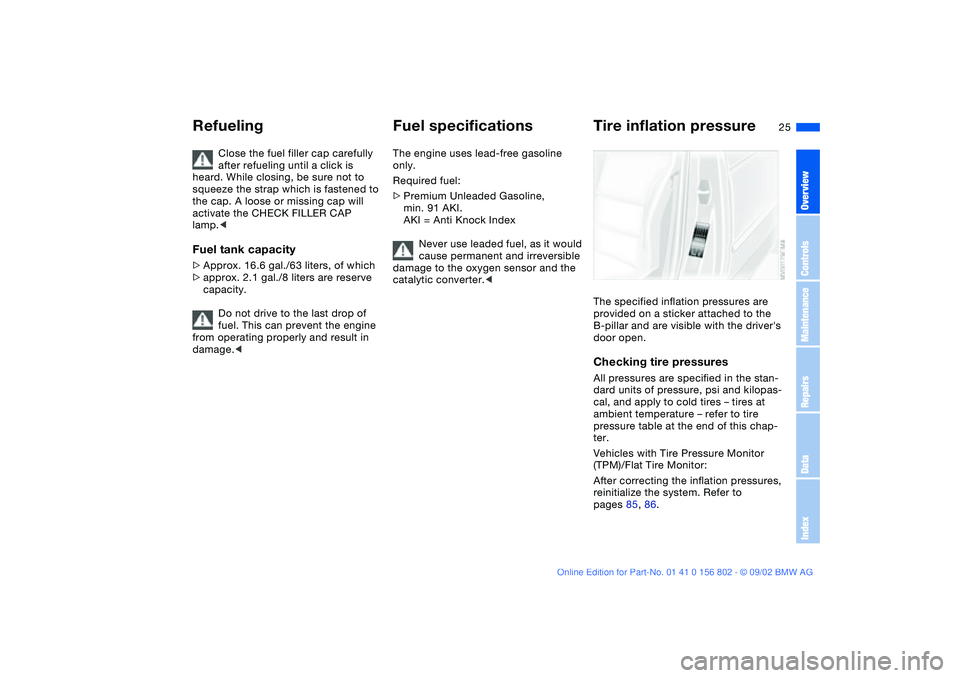
Tire inflation pressureThe specified inflation pressures are
provided on a sticker attached to the
B-pillar and are visible with the driver's
door open.Checking tire pressuresAll pressures are specified in the stan-
dard units of pressure, psi and kilopas-
cal, and apply to cold tires – tires at
ambient temperature – refer to tire
pressure table at the end of this chap-
ter.
Vehicles with Tire Pressure Monitor
(TPM)/Flat Tire Monitor:
After correcting the inflation pressures,
reinitialize the system. Refer to
pages 85, 86.
Refueling
OverviewControlsMaintenanceRepairsDataIndex
handbook.book Page 25 Saturday, July 27, 2002 1:36 PM
Page 27 of 166
27
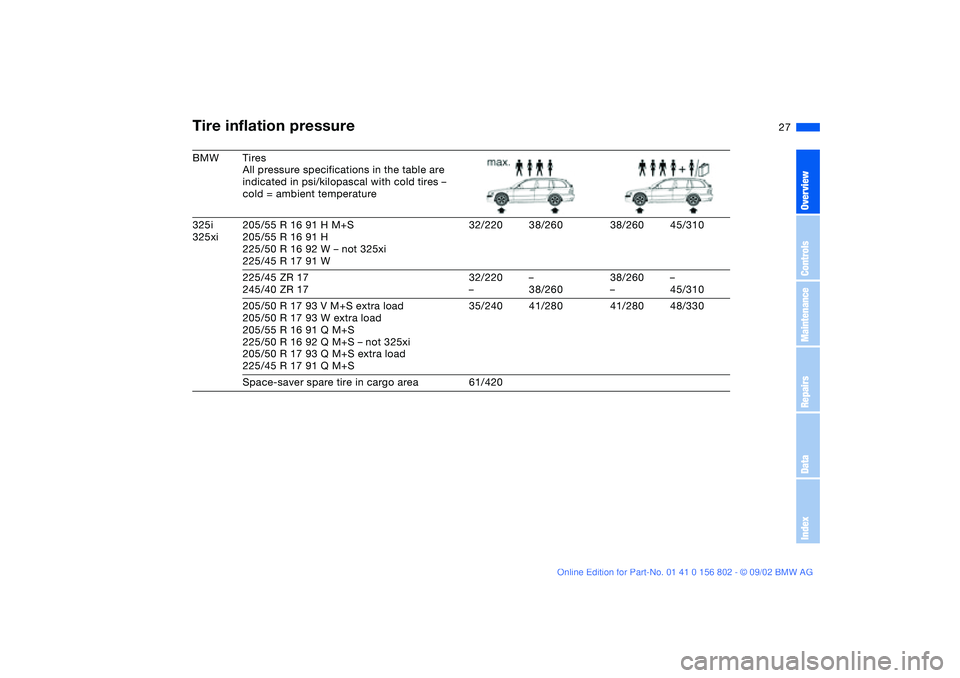
BMW Tires
All pressure specifications in the table are
indicated in psi/kilopascal with cold tires –
cold = ambient temperature
325i
325xi205/55 R 16 91 H M+S
205/55 R 16 91 H
225/50 R 16 92 W – not 325xi
225/45 R 17 91 W32/220 38/260 38/260 45/310
225/45 ZR 17
245/40 ZR 1732/220
––
38/26038/260
––
45/310
205/50 R 17 93 V M+S extra load
205/50 R 17 93 W extra load
205/55 R 16 91 Q M+S
225/50 R 16 92 Q M+S – not 325xi
205/50 R 17 93 Q M+S extra load
225/45 R 17 91 Q M+S35/240 41/280 41/280 48/330
Space-saver spare tire in cargo area 61/420Tire inflation pressure
OverviewControlsMaintenanceRepairsDataIndex
handbook.book Page 27 Saturday, July 27, 2002 1:36 PM
Page 29 of 166
29
Overview
Controls and features
Operation, maintenance
Owner service procedures
Technical data
Index
OverviewControlsMaintenanceRepairsDataIndex
handbook.book Page 29 Saturday, July 27, 2002 1:36 PM
Page 31 of 166
31
Opening and closing – via the remote controlThe conceptThe remote control gives you an excep-
tionally convenient method for unlock-
ing and locking your vehicle. Further-
more, it provides two additional
functions:
>To switch on interior lamps, refer to
page 32.
With this function you can also
search for the vehicle when parked in
an underground garage, for instance
>Opening the rear window, refer to
page 32.
The rear window will open slightly,
regardless of whether it was previ-
ously locked or unlocked.
Whenever you unlock or lock the vehi-
cle, you simultaneously deactivate/acti-
vate the anti-theft system, disarm/arm
the alarm system and switch the interior
lamps on/off.
You can have a signal set to con-
firm that the vehicle's locks have
engaged securely.<
Master keys with remote control
Persons or animals inside the
vehicle may be able to lock the
doors from the inside. For this reason,
always take the vehicle keys with you
so that the vehicle can be opened again
from the outside at any time.<
If it is no longer possible to lock
the vehicle via the remote control,
the battery is discharged. Use this key
while driving for an extended period in
order to recharge the battery. To pre-
vent unauthorized use of the remote
control, surrender only the door and
ignition key or the spare key when leav-
ing the vehicle for valet parking, for
example.
In the event of a system malfunction,
please contact your BMW center. You
can also obtain replacement keys
there.<
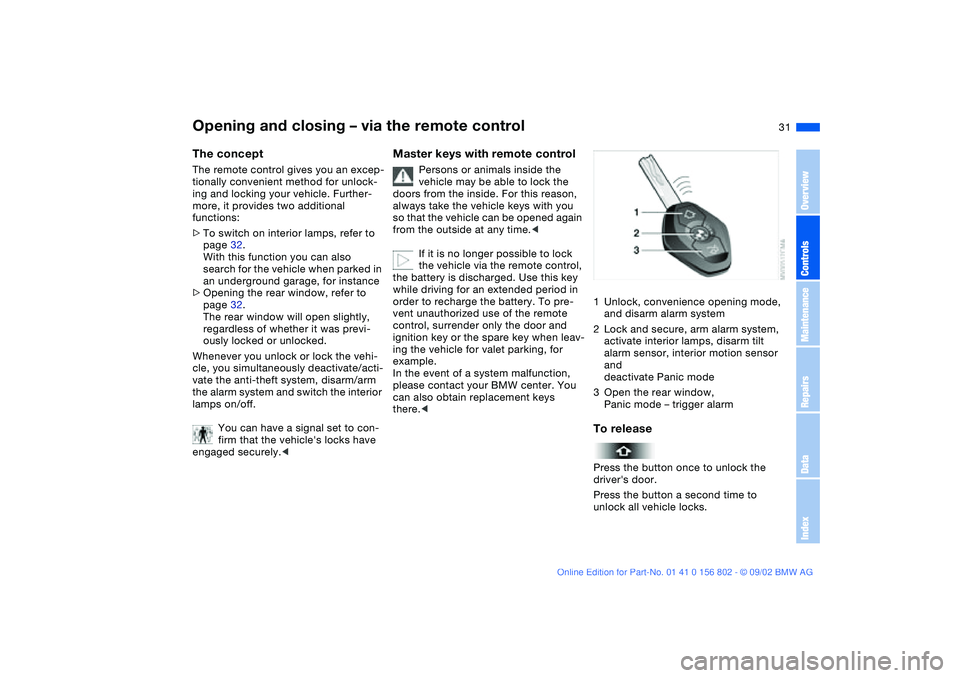
1Unlock, convenience opening mode,
and disarm alarm system
2Lock and secure, arm alarm system,
activate interior lamps, disarm tilt
alarm sensor, interior motion sensor
and
deactivate Panic mode
3Open the rear window,
Panic mode – trigger alarmTo releasePress the button once to unlock the
driver's door.
Press the button a second time to
unlock all vehicle locks.
OverviewControlsMaintenanceRepairsDataIndex
handbook.book Page 31 Saturday, July 27, 2002 1:36 PM
Page 33 of 166
33
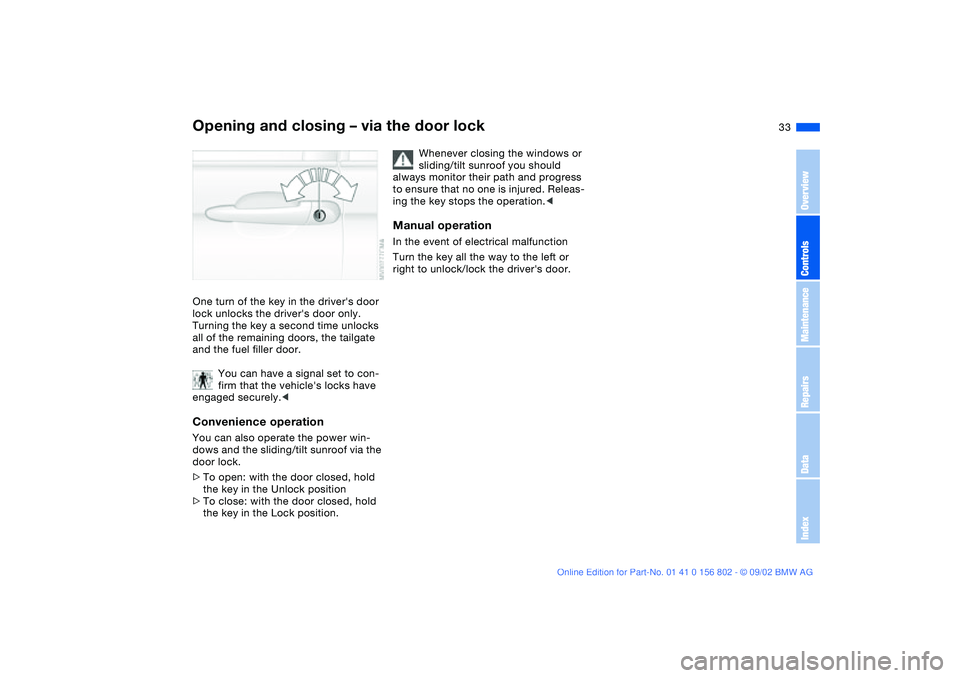
Opening and closing – via the door lockOne turn of the key in the driver's door
lock unlocks the driver's door only.
Turning the key a second time unlocks
all of the remaining doors, the tailgate
and the fuel filler door.
You can have a signal set to con-
firm that the vehicle's locks have
engaged securely.
door lock.
>To open: with the door closed, hold
the key in the Unlock position
>To close: with the door closed, hold
the key in the Lock position.
Whenever closing the windows or
sliding/tilt sunroof you should
always monitor their path and progress
to ensure that no one is injured. Releas-
ing the key stops the operation.<
Manual operationIn the event of electrical malfunction
Turn the key all the way to the left or
right to unlock/lock the driver's door.
OverviewControlsMaintenanceRepairsDataIndex
handbook.book Page 33 Saturday, July 27, 2002 1:36 PM
Page 35 of 166
35
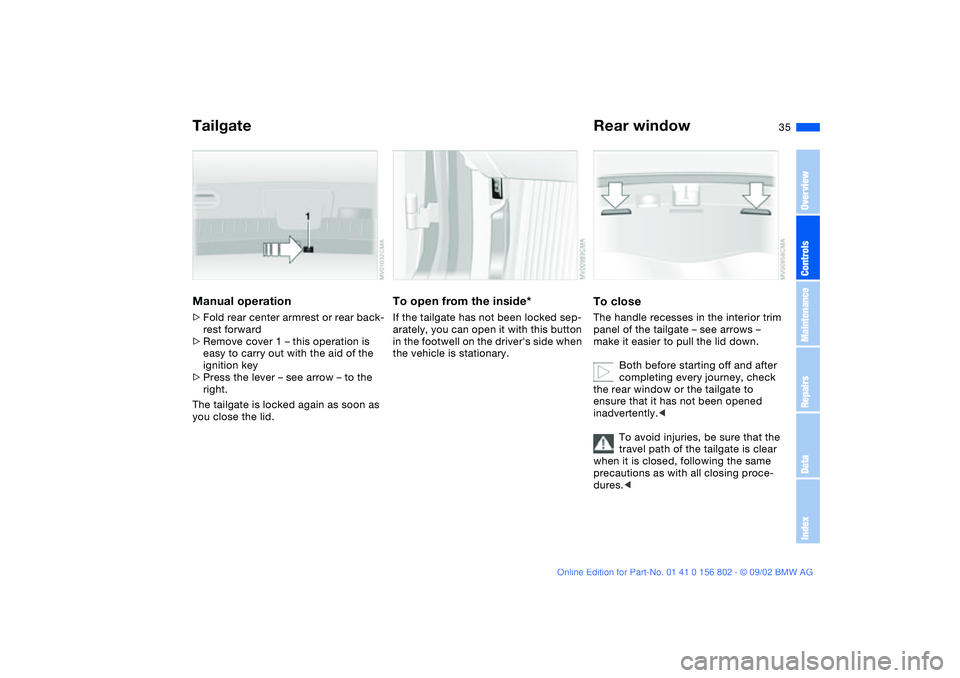
Manual operation>Fold rear center armrest or rear back-
rest forward
>Remove cover 1 – this operation is
easy to carry out with the aid of the
ignition key
>Press the lever – see arrow – to the
right.
The tailgate is locked again as soon as
you close the lid.
To open from the inside*If the tailgate has not been locked sep-
arately, you can open it with this button
in the footwell on the driver's side when
the vehicle is stationary.
Rear windowTo closeThe handle recesses in the interior trim
panel of the tailgate – see arrows –
make it easier to pull the lid down.
Both before starting off and after
completing every journey, check
the rear window or the tailgate to
ensure that it has not been opened
inadvertently.<
To avoid injuries, be sure that the
travel path of the tailgate is clear
when it is closed, following the same
precautions as with all closing proce-
dures.<
Tailgate
OverviewControlsMaintenanceRepairsDataIndex
handbook.book Page 35 Saturday, July 27, 2002 1:36 PM
Page 37 of 166
37
Alarm system*The conceptThe vehicle alarm system responds:
>When a door, the hood, the tailgate
or the rear window is opened
>To movement inside the vehicle –
interior motion sensor
>To variations in the vehicle's tilt angle
such as those occurring during
attempts to steal the wheels or tow
the vehicle
>To interruption of battery voltage.
The system responds to unauthorized
vehicle entry and attempted theft by
simultaneously activating the following:
>Sounding an acoustic alarm for
30 seconds
>The hazard warning flashers are acti-
vated for approx. five minutes
>Flashing the high beams on and off in
rhythm with the hazard warning flash-
ers.To arm and disarm the alarm
systemWhen the vehicle is locked or unlocked
via the driver's door lock or with the
remote control, the alarm system is also
simultaneously armed or disarmed.You can have different acknowl-
edgment signals set to confirm
arming and disarming.<
You can also open the rear window
when the system is armed by pressing
the remote control button, refer to
page 32. The window is once again
secured when it is closed.
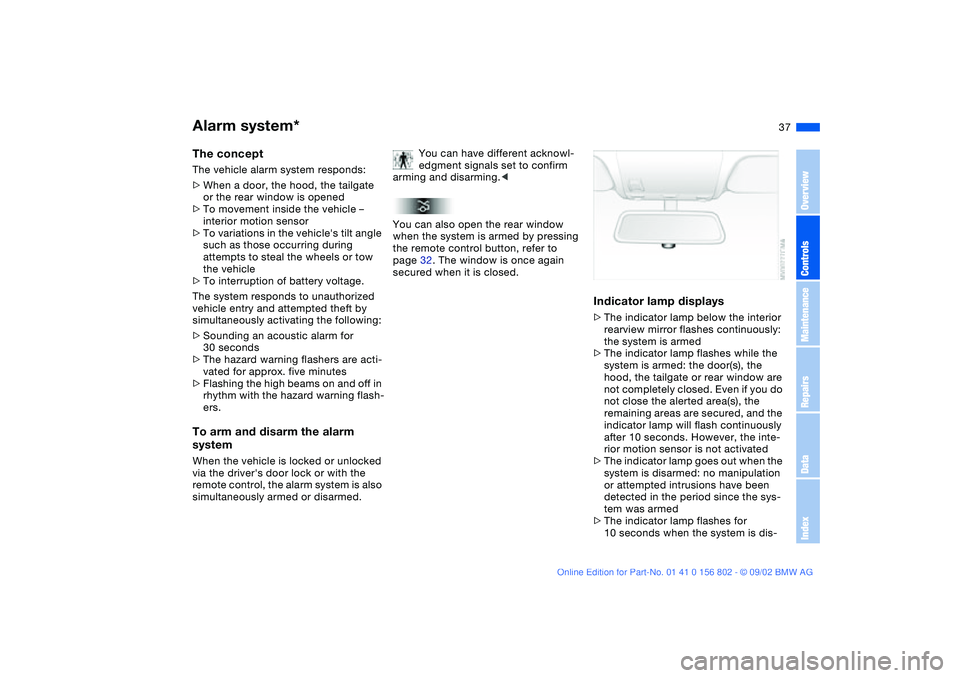
Indicator lamp displays>The indicator lamp below the interior
rearview mirror flashes continuously:
the system is armed
>The indicator lamp flashes while the
system is armed: the door(s), the
hood, the tailgate or rear window are
not completely closed. Even if you do
not close the alerted area(s), the
remaining areas are secured, and the
indicator lamp will flash continuously
after 10 seconds. However, the inte-
rior motion sensor is not activated
>The indicator lamp goes out when the
system is disarmed: no manipulation
or attempted intrusions have been
detected in the period since the sys-
tem was armed
>The indicator lamp flashes for
10 seconds when the system is dis-
OverviewControlsMaintenanceRepairsDataIndex
handbook.book Page 37 Saturday, July 27, 2002 1:36 PM
Page 39 of 166
39
Electric power windowsTo open and close windows
When leaving the vehicle, always
remove the ignition key from the
lock and remember to close the doors
to prevent persons or animals from
operating the power windows and injur-
ing themselves, etc.<
After the ignition has been switched off:
You can still operate the electric power
windows for up to 15 minutes, as long
as no one opens either of the front
doors.
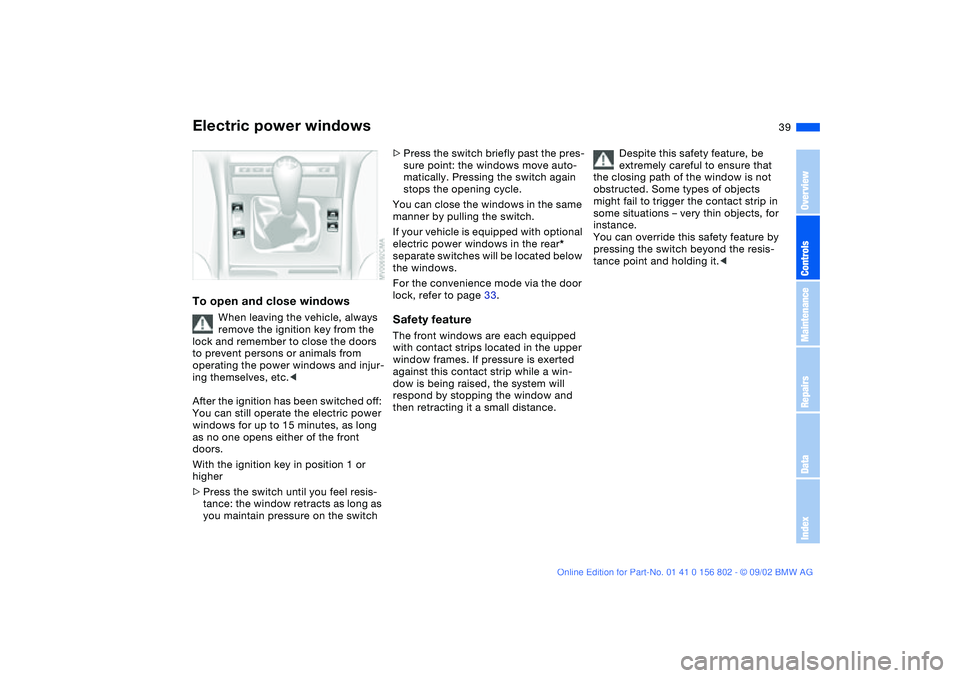
With the ignition key in position 1 or
higher
>Press the switch until you feel resis-
tance: the window retracts as long as
you maintain pressure on the switch
>Press the switch briefly past the pres-
sure point: the windows move auto-
matically. Pressing the switch again
stops the opening cycle.
You can close the windows in the same
manner by pulling the switch.
If your vehicle is equipped with optional
electric power windows in the rear*
separate switches will be located below
the windows.
For the convenience mode via the door
lock, refer to page 33.Safety featureThe front windows are each equipped
with contact strips located in the upper
window frames. If pressure is exerted
against this contact strip while a win-
dow is being raised, the system will
respond by stopping the window and
then retracting it a small distance.Despite this safety feature, be
extremely careful to ensure that
the closing path of the window is not
obstructed. Some types of objects
might fail to trigger the contact strip in
some situations – very thin objects, for
instance.
You can override this safety feature by
pressing the switch beyond the resis-
tance point and holding it.<
OverviewControlsMaintenanceRepairsDataIndex
handbook.book Page 39 Saturday, July 27, 2002 1:36 PM
Page 41 of 166
41
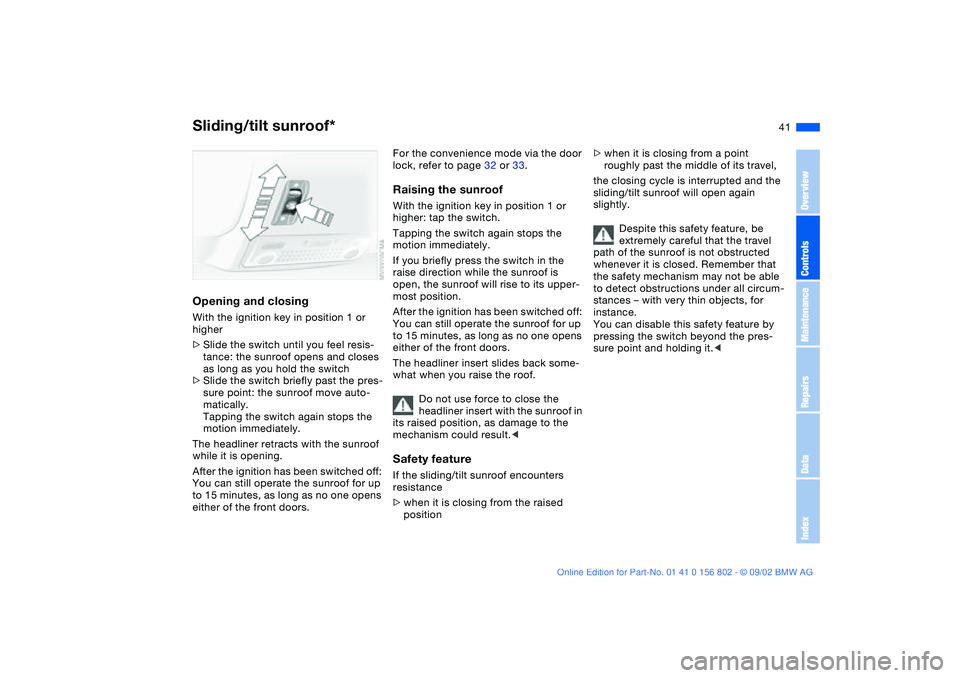
Opening and closingWith the ignition key in position 1 or
higher
>Slide the switch until you feel resis-
tance: the sunroof opens and closes
as long as you hold the switch
>Slide the switch briefly past the pres-
sure point: the sunroof move auto-
matically.
Tapping the switch again stops the
motion immediately.
The headliner retracts with the sunroof
while it is opening.
After the ignition has been switched off:
You can still operate the sunroof for up
to 15 minutes, as long as no one opens
either of the front doors.
For the convenience mode via the door
lock, refer to page 32 or 33.Raising the sunroofWith the ignition key in position 1 or
higher: tap the switch.
Tapping the switch again stops the
motion immediately.
If you briefly press the switch in the
raise direction while the sunroof is
open, the sunroof will rise to its upper-
most position.
After the ignition has been switched off:
You can still operate the sunroof for up
to 15 minutes, as long as no one opens
either of the front doors.
The headliner insert slides back some-
what when you raise the roof.
Do not use force to close the
headliner insert with the sunroof in
its raised position, as damage to the
mechanism could result.
>when it is closing from the raised
position
>when it is closing from a point
roughly past the middle of its travel,
the closing cycle is interrupted and the
sliding/tilt sunroof will open again
slightly.
Despite this safety feature, be
extremely careful that the travel
path of the sunroof is not obstructed
whenever it is closed. Remember that
the safety mechanism may not be able
to detect obstructions under all circum-
stances – with very thin objects, for
instance.
You can disable this safety feature by
pressing the switch beyond the pres-
sure point and holding it.<
Sliding/tilt sunroof*
OverviewControlsMaintenanceRepairsDataIndex
handbook.book Page 41 Saturday, July 27, 2002 1:36 PM
Page 43 of 166
43 To adjust
Safe seating positionFor relaxed and fatigue-free driving you
should select a sitting position that
reflects your personal requirements. In
combination with the safety belts and
airbags, the correct seating position
plays an important role in enhancing
occupant safety in the event of an acci-
dent. To ensure that the vehicle's safety
systems provide you with optimal pro-
tection, we request that you direct your
careful attention to the following sec-
tion.
For additional information on transport-
ing children refer to page 54.Sitting safely with airbags
Always maintain an adequate dis-
tance between yourself and the
airbags. Always hold the steering wheel
by the rim to keep any chance of injury
to hands or arms to an absolute mini-
mum should the airbag be deployed.
Never allow any objects, individuals or
animals to obstruct the areas between
passengers and airbags. Never use the
front airbag's cover as a storage tray or
support for objects of any kind. Never
allow front passengers to rest their feet
or legs on the airbag cover.<
For airbag locations and additional
information on airbags, refer to
page 52.Sitting safely with safety belts
Never allow more than one person
to wear a single safety belt. Never
allow infants or small children to ride in
a passenger's lap. Avoid twisting the
belt while routing it firmly across the
hips and shoulder, wear it as snugly
against your body as possible. Do not
allow the belt to rest against hard or
fragile objects. Do not route the belt
across your neck, or run it across sharp
edges. Be sure that the belt does not
become caught or jammed. Avoid
wearing loose or bulky clothing. You
should remember to retension the lap
belt periodically by pulling the shoulder
strap to take up any slack in the mecha-
nism. In the event of a frontal impact, a
loose lap belt could slide over your
hips, leading to abdominal injury. In
addition, the safety belt's restraint
effectiveness is reduced if the belt is
worn loosely. Expectant mothers
should always wear their safety belts,
taking care to position the lap belt
against the lower hips, where it will not
exert pressure against the abdominal
area.<
For information on using the safety
belts, refer to page 47.
OverviewControlsMaintenanceRepairsDataIndex
handbook.book Page 43 Saturday, July 27, 2002 1:36 PM