service engine BMW 325I SEDAN 2004 E46 Owner's Manual
[x] Cancel search | Manufacturer: BMW, Model Year: 2004, Model line: 325I SEDAN, Model: BMW 325I SEDAN 2004 E46Pages: 182, PDF Size: 2.76 MB
Page 9 of 182
Contents
9
Driving:
Ignition lock65
Starting the engine65
Switching off the engine67
Parking brake67
Manual transmission68
Sequential manual gearbox
SMG*69
Automatic transmission with
Steptronic*73
Turn signal indicator/Headlamp
flasher76
Washer/wiper system/Rain
sensor*77
Cruise control*78
Everything under control:
Odometer80
Tachometer80
Energy control80
Fuel gauge81
Engine coolant temperature
gauge81
Service interval display82
Check Control82
Clock83
Computer*84
Technology for safety and
driving convenience:
Park Distance Control (PDC)*86
Dynamic Stability Control
(DSC)87
Dynamic Stability Control (DSC) –
325xi, 330xi89
Hill Descent Control (HDC)*91
Flat Tire Monitor*92
Brake force display93
Lamps:
Parking lamps/Low beams94
Instrument lighting95
High beams/Standing lamps95
Fog lamps*96
Interior lamps96
Controlling the climate for
pleasant driving:
Air conditioning98
Automatic climate control*102
Roller sun blind*106
Interior conveniences:
Premium sound system*107
Glove compartment107
Storage compartments108
Cellular phone*110
Ashtray, front*110
Ashtray, rear*111
Loading and transporting:
Through-loading system*112
Ski bag*113
Cargo loading114
Roof-mounted luggage
rack*117
Controls and features
Page 10 of 182
Contents
Operation, maintenance
Special operating instructions:
Break-in procedures120
General driving notes121
Antilock Brake System
(ABS)121
Brake system122
Wheels and tires:
Tire inflation pressure124
Tire condition124
Tire replacement125
Wheel and tire
combinations127
Winter tires127
In the engine compartment:
Hood129
Engine compartment
essentials130
Washer fluids132
Engine oil132
Coolant134
Brake fluid134
Maintenance:
The BMW Maintenance
System136
Laws and regulations:
California Proposition 65
warning138
OBD interface socket138
Owner service procedures
Replacement procedures:
Onboard tool kit142
Windshield wiper blades142
Lamps and bulbs143
Changing a wheel147
Run Flat tires*150
Battery151
Fuses151
Giving and receiving
assistance: Receiving assistance152
Jump-starting153
Towing the vehicle154
Technical data
Engine data160
Dimensions161
Weights162
Capacities163
Page 17 of 182
17
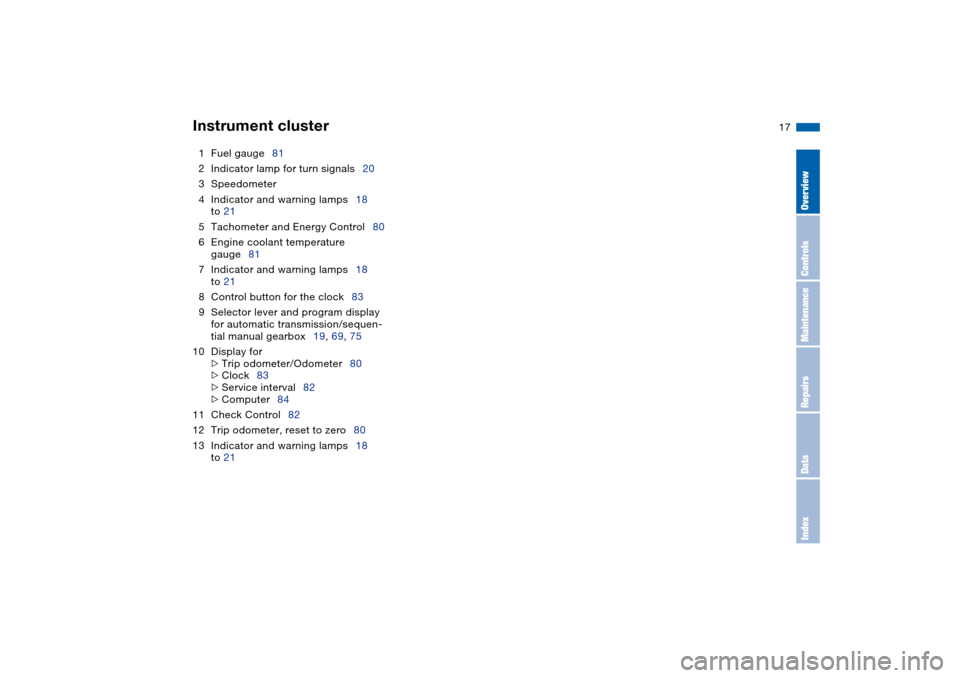
1Fuel gauge81
2Indicator lamp for turn signals20
3Speedometer
4Indicator and warning lamps18
to 21
5Tachometer and Energy Control80
6Engine coolant temperature
gauge81
7Indicator and warning lamps18
to 21
8Control button for the clock83
9Selector lever and program display
for automatic transmission/sequen-
tial manual gearbox19, 69, 75
10 Display for
>
Trip odometer/Odometer80
>
Clock83
>
Service interval82
>
Computer84
11 Check Control82
12 Trip odometer, reset to zero80
13 Indicator and warning lamps18
to 21
Instrument cluster
OverviewControlsMaintenanceRepairsDataIndex
Page 20 of 182
20
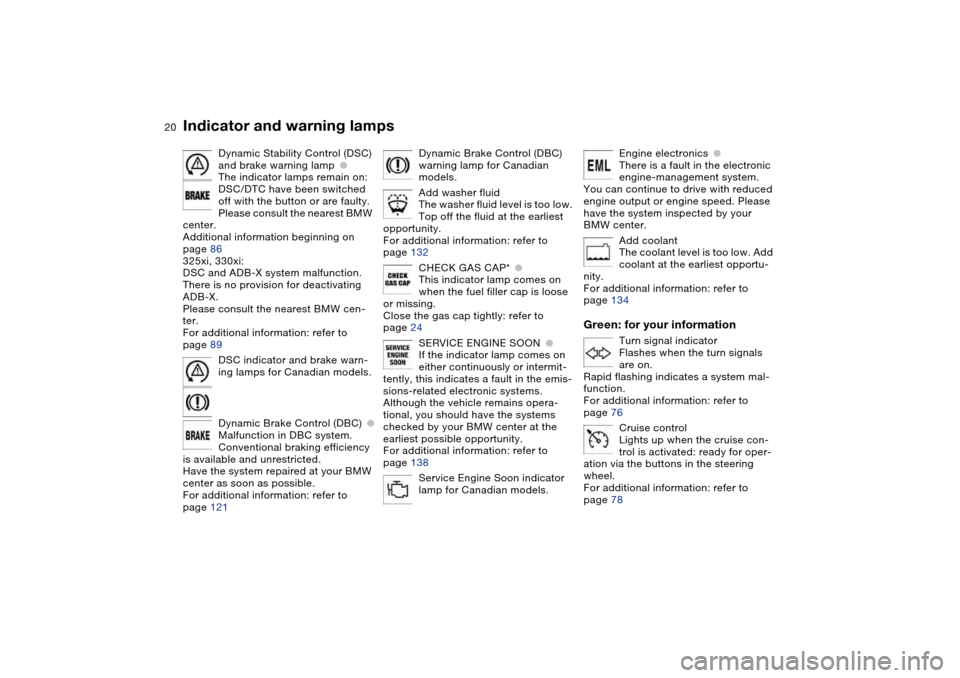
Dynamic Stability Control (DSC)
and brake warning lamp
●
The indicator lamps remain on:
DSC/DTC have been switched
off with the button or are faulty.
Please consult the nearest BMW
center.
Additional information beginning on
page 86
325xi, 330xi:
DSC and ADB-X system malfunction.
There is no provision for deactivating
ADB-X.
Please consult the nearest BMW cen-
ter.
For additional information: refer to
page 89
DSC indicator and brake warn-
ing lamps for Canadian models.
Dynamic Brake Control (DBC)
●
Malfunction in DBC system.
Conventional braking efficiency
is available and unrestricted.
Have the system repaired at your BMW
center as soon as possible.
For additional information: refer to
page 121
Dynamic Brake Control (DBC)
warning lamp for Canadian
models.
Add washer fluid
The washer fluid level is too low.
Top off the fluid at the earliest
opportunity.
For additional information: refer to
page 132
CHECK GAS CAP*
●
This indicator lamp comes on
when the fuel filler cap is loose
or missing.
Close the gas cap tightly: refer to
page 24
SERVICE ENGINE SOON
●
If the indicator lamp comes on
either continuously or intermit-
tently, this indicates a fault in the emis-
sions-related electronic systems.
Although the vehicle remains opera-
tional, you should have the systems
checked by your BMW center at the
earliest possible opportunity.
For additional information: refer to
page 138
Service Engine Soon indicator
lamp for Canadian models.
Engine electronics
●
There is a fault in the electronic
engine-management system.
You can continue to drive with reduced
engine output or engine speed. Please
have the system inspected by your
BMW center.
Add coolant
The coolant level is too low. Add
coolant at the earliest opportu-
nity.
For additional information: refer to
page 134
Green: for your information
Turn signal indicator
Flashes when the turn signals
are on.
Rapid flashing indicates a system mal-
function.
For additional information: refer to
page 76
Cruise control
Lights up when the cruise con-
trol is activated: ready for oper-
ation via the buttons in the steering
wheel.
For additional information: refer to
page 78
Indicator and warning lamps
Page 24 of 182
24
RefuelingFuel filler door
Always switch off the engine
before refueling, as it is not possi-
ble to add fuel with the engine running,
and attempts may also trigger the
SERVICE ENGINE SOON lamp.<
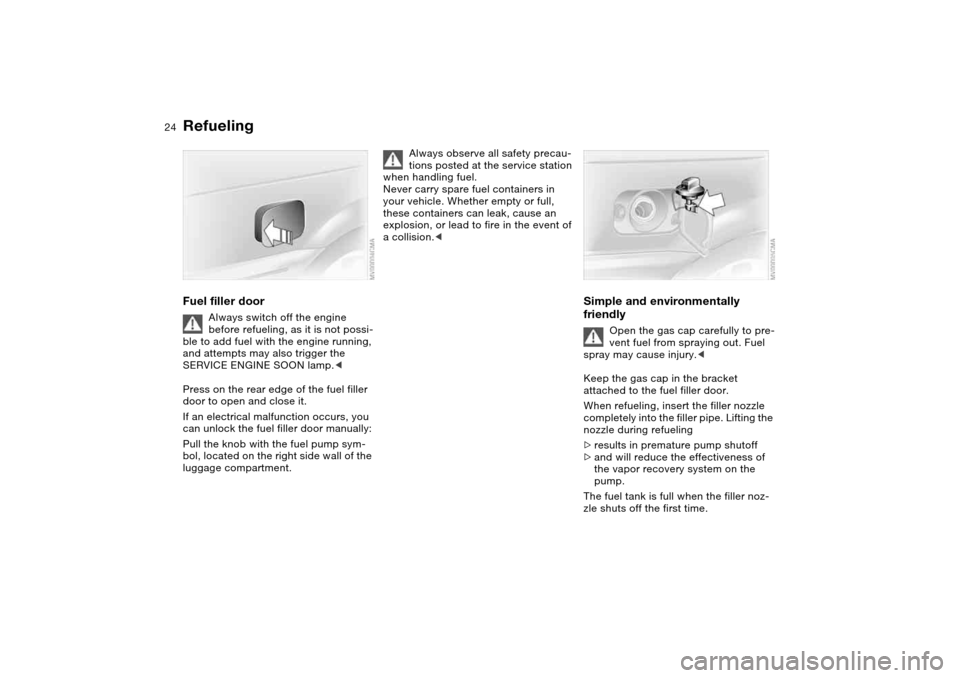
Press on the rear edge of the fuel filler
door to open and close it.
If an electrical malfunction occurs, you
can unlock the fuel filler door manually:
Pull the knob with the fuel pump sym-
bol, located on the right side wall of the
luggage compartment.
Always observe all safety precau-
tions posted at the service station
when handling fuel.
Never carry spare fuel containers in
your vehicle. Whether empty or full,
these containers can leak, cause an
explosion, or lead to fire in the event of
a collision.<
Simple and environmentally
friendly
Open the gas cap carefully to pre-
vent fuel from spraying out. Fuel
spray may cause injury.<
Keep the gas cap in the bracket
attached to the fuel filler door.
When refueling, insert the filler nozzle
completely into the filler pipe. Lifting the
nozzle during refueling
>results in premature pump shutoff
>and will reduce the effectiveness of
the vapor recovery system on the
pump.
The fuel tank is full when the filler noz-
zle shuts off the first time.
Page 66 of 182
66
If the engine does not start on the first
attempt – if it is very hot or cold, for
instance:
>Press the accelerator pedal halfway
down while engaging the starter.
Cold starts at extremely low tempera-
tures below approx. +57/–156 and at
altitudes over 3,300 ft/1,000 m:
>On the first start attempt, it may be
necessary to engage the starter for a
longer period, but no longer than
20 seconds
>Press the accelerator pedal halfway
down while engaging the starter.
Extended starting attempts, char-
acterized by excessively frequent
or long periods with the starter
engaged, can damage the catalytic
converter.<
Engine idle speed is controlled by the
engine computer system. Increased
speeds at start-up are normal and
should decrease as the engine warms
up. If engine speed does not decrease,
service is required.
To prevent the battery from discharg-
ing, always deactivate electrical
devices that are not in use. Switch the
ignition off when the vehicle is not
being driven.Manual transmission1. Engage the parking brake
2. Gearshift lever in idling position
3. Start the engine.Automatic transmission1. Depress footbrake
2. Place the selector lever in position P
or N
3. Start the engine.
To prevent the vehicle from start-
ing off on its own, always move
the selector lever to position P and
engage the parking brake before leav-
ing your vehicle with the engine run-
ning.
Do not leave the vehicle unattended
with the engine running. An unattended
vehicle with a running engine repre-
sents a safety hazard.
position N
3. Start the engine.
If the engine does not start, reen-
gage the gear last selected, refer
to the gear indicator in the display, and
move the selector lever into neutral
position N again.
The gearbox is automatically taken out
of gear if the driver's door is opened
while the engine is running and the
driver does not actuate the pedals, the
shift paddles or the selector lever. This
is accompanied by a warning tone and
the flashing gear indicator. The gear
display N appears in the instrument-
cluster.<
Before exiting the vehicle with the
engine running, move the selector
lever into position N and apply the park-
ing brake.
Do not leave the vehicle unattended
with the engine running. An unattended
vehicle with a running engine repre-
sents a safety hazard.<
Starting the engine
Page 82 of 182
82
Service interval displayRemaining distance to next
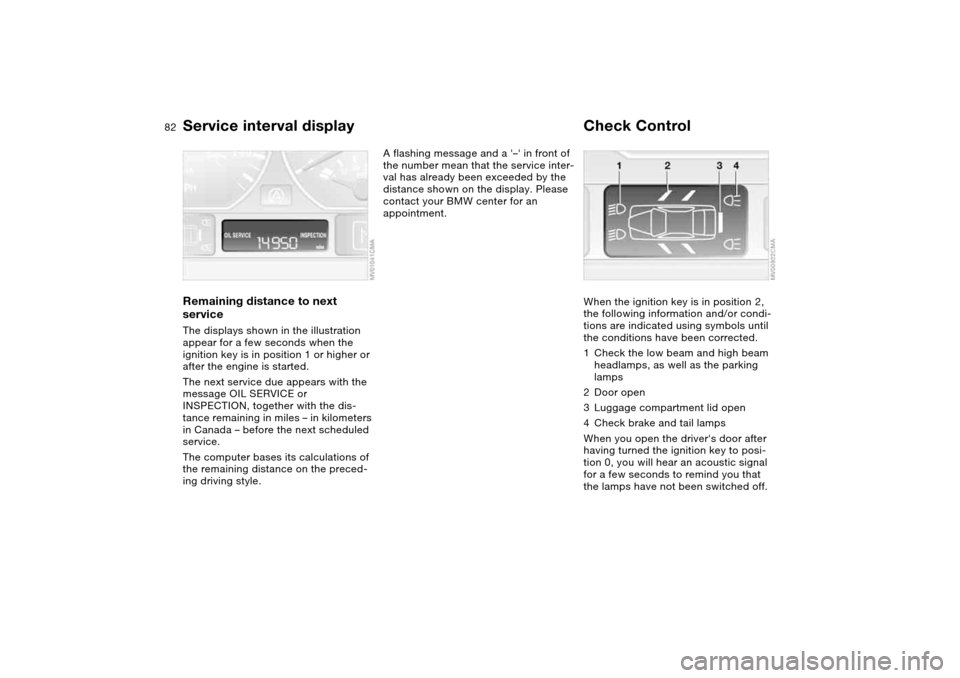
serviceThe displays shown in the illustration
appear for a few seconds when the
ignition key is in position 1 or higher or
after the engine is started.
The next service due appears with the
message OIL SERVICE or
INSPECTION, together with the dis-
tance remaining in miles – in kilometers
in Canada – before the next scheduled
service.
The computer bases its calculations of
the remaining distance on the preced-
ing driving style.
A flashing message and a '–' in front of
the number mean that the service inter-
val has already been exceeded by the
distance shown on the display. Please
contact your BMW center for an
appointment.
Check ControlWhen the ignition key is in position 2,
the following information and/or condi-
tions are indicated using symbols until
the conditions have been corrected.
1Check the low beam and high beam
headlamps, as well as the parking
lamps
2Door open
3Luggage compartment lid open
4Check brake and tail lamps
When you open the driver's door after
having turned the ignition key to posi-
tion 0, you will hear an acoustic signal
for a few seconds to remind you that
the lamps have not been switched off.
Page 120 of 182
120Special operating instructions
Break-in proceduresTo ensure that your vehicle provides
maximum economy throughout a long
service life, we request that you
observe the following suggestions.Engine and differentialUp to 1,250 miles/2,000 km:
Constantly vary both vehicle and engine
speeds, remembering not to exceed
4,500 rpm or vehicle speeds of over
100 mph / 160 km/h:
Obey your local and state maximum
speed limits.
Do not use full throttle, and avoid
pressing the accelerator beyond the
kickdown point during these initial
miles.
You can then proceed to increase
engine or vehicle speeds once the ini-
tial 1,250 miles/2,000 km have elapsed.
Please remember to observe these
same break-in procedures if either the
engine or the differential should have to
be replaced later in the course of the
vehicle's service life.
TiresDue to technical factors associated
with their manufacture, tires do not
achieve their full traction potential until
an initial break-in period has elapsed.
Thus drive with extra care during the
initial 200 miles/300 km.
Obey your local and state maximum
speed limits.
When the vehicle is operated on
wet or slushy roads, a wedge of
water may form between the tire and
the road surface. This phenomenon is
referred to as hydroplaning, and can
lead to partial or complete loss of trac-
tion, as well as loss of vehicle control
and braking effectiveness. Reduce your
speed on wet roads.
achieve the optimal pad-surface and
wear patterns required for trouble-free
operation and long service life later on.
To break in the separate parking brake
drums, apply the parking brake lightly
when coasting to a standstill – at a traf-
fic signal, for instance – use caution to
avoid posing a danger to other road
users.
To avoid corrosion, repeat this proce-
dure from time to time.
The brake lamps do not come on
when the parking brake is set.
Vacuum for the brake system servo unit
on your BMW is available only when the
engine is running. When you move the
vehicle with the engine off – when tow-
ing, for example – substantially higher
levels of pedal force will be required to
brake the vehicle.
optimum efficiency. Remember to
engage the clutch carefully during this
initial period.
Page 122 of 182
122
Brake systemBrake fluid levelLow brake fluid level in the reservoir
combined with longer than usual pedal
travel may indicate a defect in one of
the brake system's hydraulic circuits.
Proceed to the nearest BMW cen-
ter. It may be necessary to apply
higher levels of pressure to the pedal
when stopping and braking distances
may also be longer. Please remember
to adapt your driving style accord-
ingly.
the vehicle is not used at all, and in
operating conditions where brake appli-
cations are less frequent, there is an
increased tendency for corrosion of the
rotors and accumulation of contamina-
tion on the brake pads. This occurs
because the minimal pressure that must
be exerted by the pads to clean the
rotors by brake applications is not
reached.
Corrosion on brake rotors is signaled by
a running or pulsation during braking;
even extended subsequent braking will
not cure this phenomenon.
It is a good idea to periodically dry the
brakes with a gentle application when
driving in rain and on wet roads. Watch
traffic conditions to ensure that this
maneuver does not endanger other
road users. The heat generated in this
process helps dry the pads and rotors
to ensure that your brake system will
respond with undiminished efficiency
when you need it.
When descending steep hills and
extended grades, downshift to a gear
that will allow you to continue safely
with only a minimal amount of braking.
This helps avoid placing excessive
loads on the brake system. Use care to
avoid exceeding the approved engine-
speed range, refer to page 80.Do not coast with the clutch
depressed or with the transmis-
sion or selector lever in Neutral. Do not
coast with the engine shut off. The
engine provides no braking effect when
the clutch is depressed and there is no
power-assist for braking or steering
when the engine is not running.
325xi, 330xi: always refer all brake
inspection and service work to your
BMW center, as failure to observe the
special procedures could result in dam-
age to components of the all-wheel
drive.
Never allow floor mats, carpets or any
other objects to protrude into the area
around the accelerator, clutch and
brake pedals and obstruct their move-
ment.<
Brake pads
For your own safety: use only
brake pads which BMW has
approved for your specific vehicle
model. BMW cannot evaluate non-
approved brake pads to determine if
they are suitable for use, and therefore
cannot ensure the operating safety of
the vehicle if they are installed.<
Page 129 of 182
129 In the engine compartment
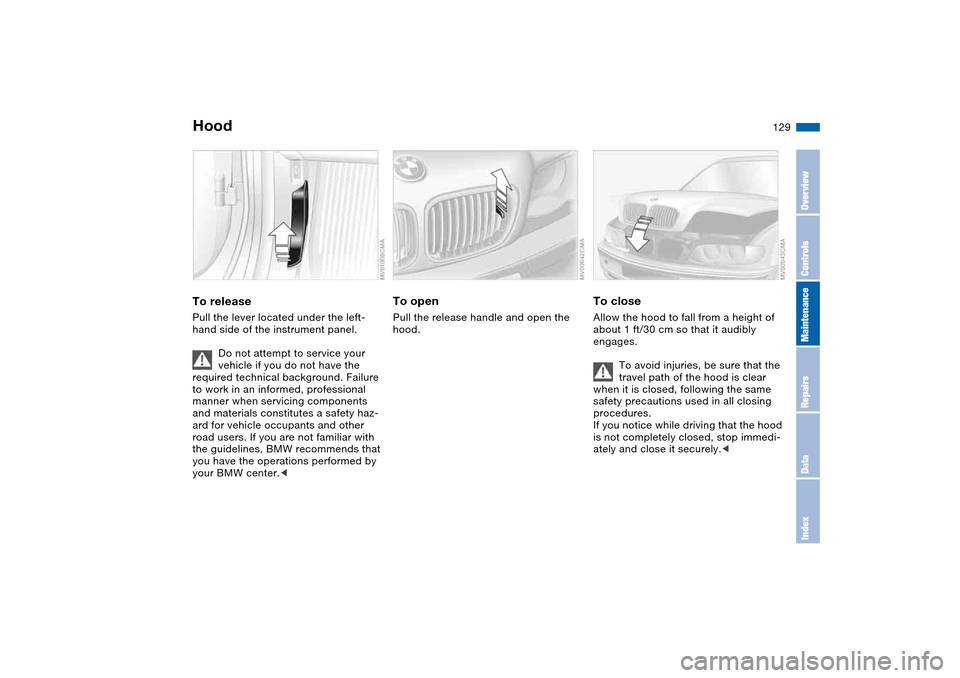
HoodTo releasePull the lever located under the left-
hand side of the instrument panel.
Do not attempt to service your
vehicle if you do not have the
required technical background. Failure
to work in an informed, professional
manner when servicing components
and materials constitutes a safety haz-
ard for vehicle occupants and other
road users. If you are not familiar with
the guidelines, BMW recommends that
you have the operations performed by
your BMW center.<
To openPull the release handle and open the
hood.
To closeAllow the hood to fall from a height of
about 1 ft/30 cm so that it audibly
engages.
To avoid injuries, be sure that the
travel path of the hood is clear
when it is closed, following the same
safety precautions used in all closing
procedures.
If you notice while driving that the hood
is not completely closed, stop immedi-
ately and close it securely.<
OverviewControlsMaintenanceRepairsDataIndex