ESP BMW 325i TOURING 2001 E46 Owner's Guide
[x] Cancel search | Manufacturer: BMW, Model Year: 2001, Model line: 325i TOURING, Model: BMW 325i TOURING 2001 E46Pages: 203, PDF Size: 2.07 MB
Page 91 of 203

91n
IndexDataTechnologyRepairsCar careControlsOverview
Air conditioner1 Air onto the windshield and onto the
side windows
2 Air flow for the upper body
The side rotary dials allow you to
open and close the air supply through
an infinitely-variable range, while the
levers change the airflow direction.
The center rotary dial controls the
temperature of the air as it flows out.
Refer to page 92
3 Ventilation for the front footwell
There are corresponding air vents in
the rear footwell as well
4 Air supply
Heating and ventilation are available
starting with position 1. Refer to
page 92
5 Temperature92
6 Air distribution toward
>the windows
>the upper body
>the footwell
All intermediate settings are possible.
Refer to page 92
7 Rear window defroster92
8 Air conditioner92
9 Recirculated-air mode92
Page 92 of 203
92n
Air conditionerAir supply
You can select fan speeds
from 1 to 4. The greater the air
supply, the more effective the
heating and ventilation are. In
position 0, the fan and the heater are
switched off. By using position 0, you
can totally block the interior ventilation
outlets by pressing the button for the
recirculated-air mode.
Temperature
In order to increase the
temperature of the passenger
compartment, turn it to the
right (red). Temperature regu-
lation will keep the interior temperature
you have selected constant.
Air distribution
You can direct air to flow onto
the windows , toward the
upper body and into the
footwell . You can also
make all intermediate settings. In the
setting, there is a low flow of air onto
the windows to keep them free of
condensation. The "6 o'clock" setting is
recommended as a normal setting (refer
also to the illustration and overview on
page 90).
Rear window defroster
When the rear window defroster
is activated, the indicator lamp
comes on. The rear window defroster
switches off automatically. Refer to
page 70.
Air conditioner
The air is cooled and dehumidi-
fied and Ð depending on the
temperature setting Ð rewarmed when
the air conditioner system is switched
on.
Depending on the weather, the wind-
shield may fog over briefly when the
engine is started.
Use the button to switch the air condi-
tioner off at outside temperatures
below approx. 41 7(+5 6). This will
help to prevent the windows from
fogging up.
If the windows fog over after switching
the air conditioner off, switch it back
on.
Condensation forms in the air
conditioner system during opera-
tion, which then exits under the vehicle.
Traces of condensed water of this kind
are thus normal.<
Recirculated-air mode
You can respond to unpleasant
external odors by temporarily
blocking the outside air. The system
then recirculates the air already within
the vehicle.
If the windows fog over in the
recirculated air mode, switch the
recirculated air off and increase the air
supply as required.<
Page 97 of 203

97n
IndexDataTechnologyRepairsCar careControlsOverview
Automatic climate control
*
1 Air onto the windshield and the side
windows
2 Air flow toward the upper body
The side rotary dials provide infi-
nitely-variable regulation of the air
supply, while the levers change the
air-flow direction. The center rotary
dial controls the temperature of the
air as it flows out. Refer to page 100
3 Front footwell ventilation
There are corresponding air vents in
the rear footwell as well
4 Recirculated air mode/Automatic
recirculated air control (AUC)99
5 Air supply99
6 Temperature98
7 Automatic air distribution98
8 Individual air distribution98
9 Air grill for interior temperature
sensor Ð please keep clear and
unobstructed
10 Display for temperature and air
supply98
11 Defrost windows and remove
condensation99
12 Air conditioner99
13 Rear window defroster70, 99
Page 99 of 203
99n
IndexDataTechnologyRepairsCar careControlsOverview
Automatic climate control
*
Air supply
By pressing the left or right half
of the button, you can vary the
air supply. By doing this, you switch off
the automatic control for the air supply.
Nevertheless, the automatic air distri-
bution remains unchanged.
When you set the lowest blower speed
by pressing the left half of the button,
all of the displays are canceled: the
blower, heating and air conditioner are
switched off, and the air supply stops.
You can reactivate the system by
pressing any button of the automatic
climate control.
Defrost windows and remove
condensation
This program quickly removes
ice and condensation from the
windshield and side windows.
Air conditioner
The air is cooled and dehumidi-
fied and Ð depending on the
temperature setting Ð rewarmed when
the air conditioner system is switched
on.
Depending on the weather, the wind-
shield may fog over briefly when the
engine is started.
Use the button to switch the air condi-
tioner off when outside air temperatures
are below approx. +41 7 (+5 6). This
will help to prevent the windows from
fogging up.
If the windows fog over after switching
the air conditioner off, switch it back on.
Condensation forms in the air
conditioner system during opera-
tion, that then exits under the vehicle.
Traces of condensed water of this kind
are thus normal.<
Automatic recirculated air control
(AUC)
You can respond to unpleasant
external odors by temporarily
blocking the outside air. The system
then recirculates the air already within
the vehicle. By repeated actuation of
the button, you can select one of three
different operation modes.
>Indicator lamps off: fresh air flows
into the vehicle.
>Left-hand indicator lamp on Ð AUC
mode: the system detects pollutants
in the outside air and responds by
deactivating the outside air flow as
required. The system then recircu-
lates the air already within the vehicle.
Depending on air quality require-
ments, the system automatically
switches between outside air supply
and recirculation of the air already
within the vehicle.
>Right-hand indicator lamp on: the
flow of outside air is permanently
blocked. The system recirculates the
air already within the vehicle.
If the windows fog over in the
recirculated air mode, switch this
mode off and increase the air supply as
required.
is turned on, the indicator lamp
comes on; refer to page 70.
Page 107 of 203
107n
IndexDataTechnologyRepairsCar careControlsOverview
Cargo areaRear backrest that can be folded
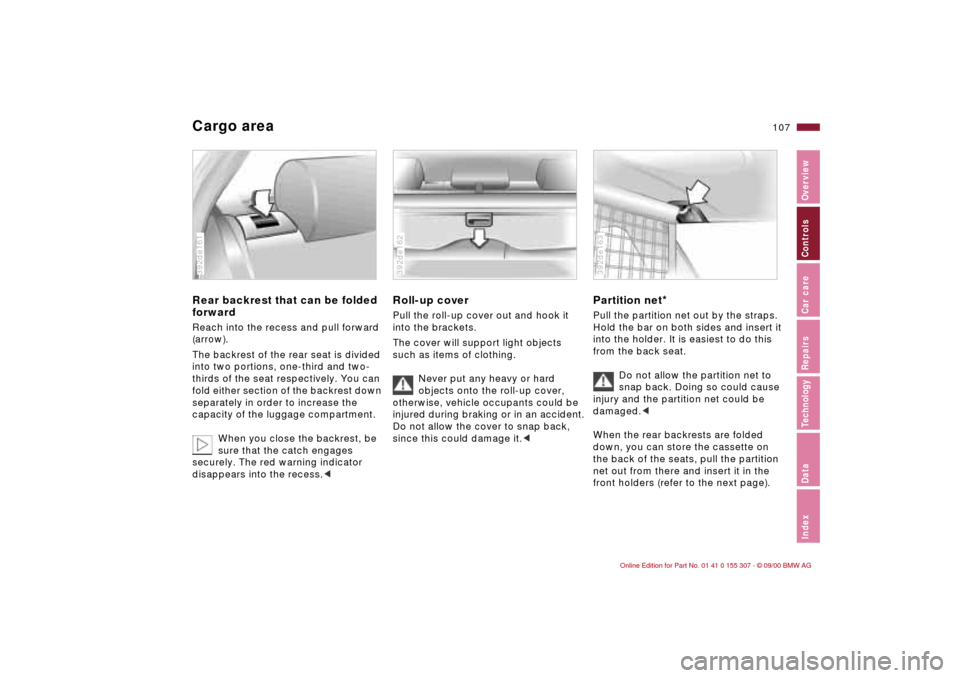
forwardReach into the recess and pull forward
(arrow).
The backrest of the rear seat is divided
into two portions, one-third and two-
thirds of the seat respectively. You can
fold either section of the backrest down
separately in order to increase the
capacity of the luggage compartment.
When you close the backrest, be
sure that the catch engages
securely. The red warning indicator
disappears into the recess.<392de161
Roll-up coverPull the roll-up cover out and hook it
into the brackets.
The cover will support light objects
such as items of clothing.
Never put any heavy or hard
objects onto the roll-up cover,
otherwise, vehicle occupants could be
injured during braking or in an accident.
Do not allow the cover to snap back,
since this could damage it.<392de162
Partition net
*
Pull the partition net out by the straps.
Hold the bar on both sides and insert it
into the holder. It is easiest to do this
from the back seat.
Do not allow the partition net to
snap back. Doing so could cause
injury and the partition net could be
damaged.<
When the rear backrests are folded
down, you can store the cassette on
the back of the seats, pull the partition
net out from there and insert it in the
front holders (refer to the next page).392de163
Page 111 of 203
111n
IndexDataTechnologyRepairsCar careControlsOverview
Roof-mounted luggage rack
*
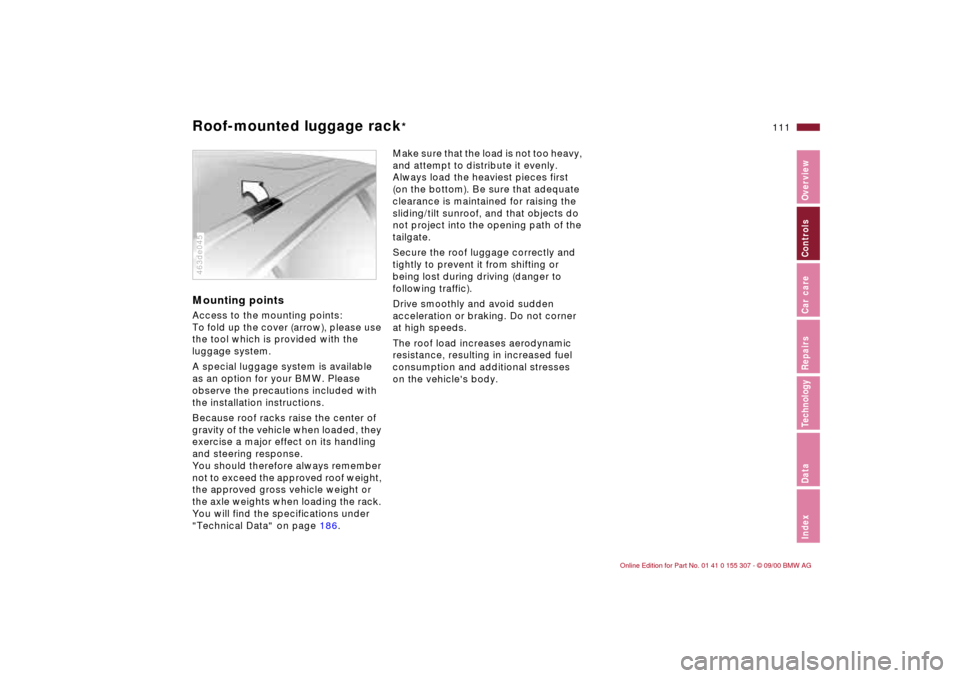
Mounting pointsAccess to the mounting points:
To fold up the cover (arrow), please use
the tool which is provided with the
luggage system.
A special luggage system is available
as an option for your BMW. Please
observe the precautions included with
the installation instructions.
Because roof racks raise the center of
gravity of the vehicle when loaded, they
exercise a major effect on its handling
and steering response.
You should therefore always remember
not to exceed the approved roof weight,
the approved gross vehicle weight or
the axle weights when loading the rack.
You will find the specifications under
"Technical Data" on page 186.463de045
Make sure that the load is not too heavy,
and attempt to distribute it evenly.
Always load the heaviest pieces first
(on the bottom). Be sure that adequate
clearance is maintained for raising the
sliding/tilt sunroof, and that objects do
not project into the opening path of the
tailgate.
Secure the roof luggage correctly and
tightly to prevent it from shifting or
being lost during driving (danger to
following traffic).
Drive smoothly and avoid sudden
acceleration or braking. Do not corner
at high speeds.
The roof load increases aerodynamic
resistance, resulting in increased fuel
consumption and additional stresses
on the vehicle's body.
Page 116 of 203

116n
Catalytic converter Antilock Brake System (ABS)
Be sure to observe the instruc-
tions above to prevent unburned
fuel from reaching the catalytic
converter, otherwise, the catalytic
converter could overheat and be
damaged.
High temperatures occur in any vehicle
equipped with a catalytic converter.
Heat shields are installed adjacent to
some sections of the exhaust system.
Never remove these shields; do not
apply undercoating to their surfaces.
When driving, standing at idle, and
parking the vehicle, take care to avoid
contact between the exhaust system
and flammable materials (grass, hay,
leaves etc.). Such contact could lead to
a fire, resulting in personal injury and
property damage.<
The concept ABS enhances active driving safety by
helping to prevent the wheels from
locking under braking. The reason:
locked wheels are dangerous. When the
front wheels slide, the driver loses
steering control over the vehicle. Trac-
tion loss at the rear wheels can cause
the rear end to break into an uncon-
trolled skid.
The system can achieve the shortest
braking distances possible under most
conditions (on straight-aways and in
curves, on asphalt, ice, wet road
surfaces, etc.).
ABS is designed to meet two essential
requirements during every brake appli-
cation:
>To help provide vehicle stability.
>Assured ability to steer and
maneuver Ð on the various road
surfaces (asphalt, concrete, dirt,
wet conditions, snow, ice).
The system can achieve the shortest
braking distances possible under most
conditions (on straight-away and in
curves, on asphalt, ice, wet road
surfaces, etc.).
Braking with ABSThe system is operative once the
vehicle exceeds a speed of approx.
6 mph (10 km/h). It is deactivated once
again below approx. 4 mph (6 km/h).
This means that the wheels can lock in
the final phase of a panic stop Ð a factor
of no significance in actual use.
If you are in a situation that requires full
braking, you will exploit the full benefits
of the ABS system if you apply
maximum brake pressure ("panic
stop"). Since the vehicle maintains
steering responsiveness, you can
nevertheless avoid possible obstacles
with a minimum of steering effort.
The ABS closed-loop control circuit
cycles in fractions of a second. A pulsa-
tion at the brake pedal, together with
the sounds associated with the
hydraulic controls, tells you that the
brake system is within its maximum
limit range, and reminds you that you
should adapt road speed to the road
conditions.
On road surfaces that have a loose
surface layer on a firm base with good
traction (on gravel or snow, for
example), or when snow chains are
mounted, braking distances may be
longer than with locked wheels.
Page 117 of 203
117n
IndexDataTechnologyRepairsCar careControlsOverview
Antilock Brake System (ABS)Nevertheless, ABS possesses the
advantage of vehicle stability and
steering response.Information for your safetyNot even ABS can suspend the laws
of physics. The consequences of brake
applications with inadequate clea-
rances for safety between vehicles,
excessive speed or if aquaplaning
occurs are always the responsibility of
the driver. You should never allow the
added safety of ABS to lull you into a
false sense of security, or mislead you
into taking risks that could affect your
own safety and that of others.
Do not make any modifications to
the ABS system.
Service procedures on ABS are to be
performed by authorized technicians
only.
opment of ABS. When braking while
cornering at high speed or braking
during high lateral acceleration, or
when braking during a lane change,
vehicle stability is improved and
steering response is enhanced.
In the event of a malfunction
If the ABS warning lamp in the
instrument cluster lights up,
refer to page 22. The brake
system then reverts to conventional
operation as on vehicles without ABS.
However, have the brake system
checked by your BMW center as soon
as possible. To prevent undetected
defects and cumulative faults from
adversely affecting the brake system,
refer any problems to your authorized
BMW center at the earliest opportunity.
ABS warning lamp for Canadian
model.
If the brake warning lamps light
up together with the indicator
lamps for ABS and ASC+T/DSC
Ð refer to page 19 Ð then the
entire regulating system, the
ABS, CBC and ASC+T/DSC
and
ADB/ ADB-X/DBC have failed.
Continue driving cautiously and
defensively. Avoid full brake applica-
tions. This could cause the vehicle to
lose stability and you might no longer
be able to control it.
Have the system checked by your BMW
center as soon as possible.
CBC, ABS und ASC+T/DSC
indicators and warning lamps
for Canadian models.
Page 118 of 203

118n
Antilock Brake System (ABS) Disc brakesDynamic Brake Control (DBC)*DBC is included in the DSC, refer to
information beginning on page 81.
If you step on the brake rapidly, this
system automatically produces
maximum braking force boost and thus
helps to achieve the shortest possible
braking distance during "panic stops."
All of the benefits of the ABS system
are exploited under these circum-
stances.
Do not reduce the pressure on the
brake pedal for the duration of the
brake application. When the brake
pedal is released, the DBC is deacti-
vated.
In the event of a malfunction,
the yellow warning lamp comes
on. Normal braking efficiency
and the anti-lock braking system are
still fully available.
Have the system checked and repaired
at your BMW center as soon as
possible.
Refer to the "Information for your
safety" covering the ABS system.
This information also generally applies
for DBC.<
Disc brakes furnish optimum decelera-
tion and braking control and greater
fade resistance under heavy use.
When the vehicle is driven only occa-
sionally, during extended periods when
the vehicle is not used at all, and in
operating conditions where brake appli-
cations are less frequent, there is an
increased tendency for corrosion of the
discs and accumulation of contamina-
tion on the brake pads. This occurs
because the minimal pressure that must
be exerted by the pads to clean the
discs by brake applications is not
reached.
If the brake discs are corroded, they will
tend to respond to braking with a
pulsating effect that even extended
brake applications will fail to cure.
For your own safety: use only
brake pads which BMW has
approved for your specific vehicle
model. BMW cannot evaluate
non-approved brake pads to determine
if they are suited for use, and therefore
cannot ensure the operating safety of
the vehicle if they are installed.<
Page 122 of 203

122n
Winter operationBrakingWinter road conditions substantially
reduce the amount of traction available
between the tires and the road surface.
Keep this in mind, because the braking
distance increases substantially.
ABS is intended to prevent the wheels
from locking during brake applications,
thus helping to maintain vehicle stability
and steering response.
If the ABS does not respond in a critical
braking situation and the wheels lock:
reduce the pressure on the brake pedal
until the wheels just start to roll again
while still maintaining enough force to
continue braking.
Then increase the pressure, reduce the
pressure when the wheels lock, reapply
pressure etc.
This staggered braking procedure will
reduce braking distances while helping
you maintain steering control.
You can then attempt to steer around
hazards after you have reduced pres-
sure on the brake pedal.Do not shift down on slick road
surfaces Ð if you want to decel-
erate. Doing so could cause the rear
wheels to lose traction and skid, which
could result in the loss of vehicle
control.<
Depress the clutch during hard
braking on road surfaces that
provide only poor or uneven traction.<
Skid control Depress the clutch and release the
accelerator pedal, or place the selector
lever of the automatic transmission into
the "Neutral" position. Countersteer
carefully and attempt to regain control
of the vehicle.
ParkingEngage 1st or reverse gear. If your
vehicle is equipped with an automatic
transmission, place the selector lever in
"Park." On vehicles with manual trans-
mission, also apply the parking brake
when parking on inclined surfaces. In
order to prevent the parking brake pads
from locking due to frost or corrosion,
dry them by gently applying the parking
brake as the vehicle is coming to a
stop. Make sure that following traffic
is not endangered.
The brake lamps do not come
on when the parking brake is
applied.<