TOWING BMW 325i TOURING 2001 E46 Owner's Manual
[x] Cancel search | Manufacturer: BMW, Model Year: 2001, Model line: 325i TOURING, Model: BMW 325i TOURING 2001 E46Pages: 203, PDF Size: 2.07 MB
Page 12 of 203

Contents
Owner service procedures
Advanced technology
Technical data
Replacement procedures:
Onboard tool kit152
Windshield wiper blades152
Lamps and bulbs153
Changing a wheel159
Battery162
Fuses164
Microfilter/Activated-charcoal
filter165
In case of electrical
malfunction:
Fuel filler door166
Sliding/Tilt sunroof166
Tailgate166
Assistance, giving and
receiving:
Jump-starting167
Towing the vehicle168Airbags172
Adaptive Transmission Control
(ATC)173
Automatic Stability Control plus
Traction (ASC+T)/Dynamic
Stability Control (DSC)173
Radio reception174
Four-wheel drive175
Safety belt tensioner175
Interior rearview mirror with
automatic dimmer176
Rain sensor177
Tire Pressure Control (RDC)178
Self-diagnostics179
Xenon lamps180Engine data184
Dimensions185
Weights186
Capacities187
Electrical system188
Drive belts188
Page 67 of 203
67n
IndexDataTechnologyRepairsCar careControlsOverview
Automatic transmission with Steptronic
*
In the following situations, the Step-
tronic "thinks" for you in the manual
mode:
>In order to prevent engine over-
speeding, the transmission shifts
automatically to the next higher gear
shortly before the engine speed
cutoff point.
>At low speeds, the transmission
shifts down automatically Ð you do
not have to act.
>In the "kickdown" mode, the trans-
mission shifts down to the lowest
gear possible, depending
on the engine speed.
>Depending on the situation Ð when
driving in adverse winter conditions,
for example Ð you may also start out
in 2nd or 3rd gear.
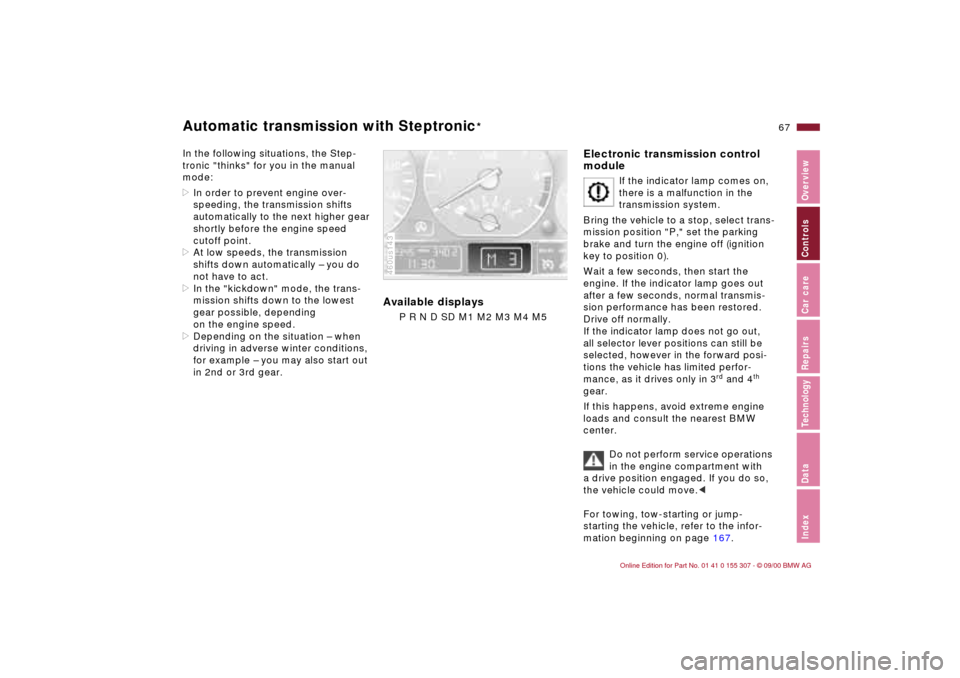
Available displays
P R N D SD M1 M2 M3 M4 M5460us143
Electronic transmission control
module
If the indicator lamp comes on,
there is a malfunction in the
transmission system.
Bring the vehicle to a stop, select trans-
mission position "P," set the parking
brake and turn the engine off (ignition
key to position 0).
Wait a few seconds, then start the
engine. If the indicator lamp goes out
after a few seconds, normal transmis-
sion performance has been restored.
Drive off normally.
If the indicator lamp does not go out,
all selector lever positions can still be
selected, however in the forward posi-
tions the vehicle has limited perfor-
mance, as it drives only in 3
rd and 4
th
gear.
If this happens, avoid extreme engine
loads and consult the nearest BMW
center.
Do not perform service operations
in the engine compartment with
a drive position engaged. If you do so,
the vehicle could move.<
For towing, tow-starting or jump-
starting the vehicle, refer to the infor-
mation beginning on page 167.
Page 110 of 203
110n
Cargo loadingStowing cargo If you are transporting a load in your
BMW:
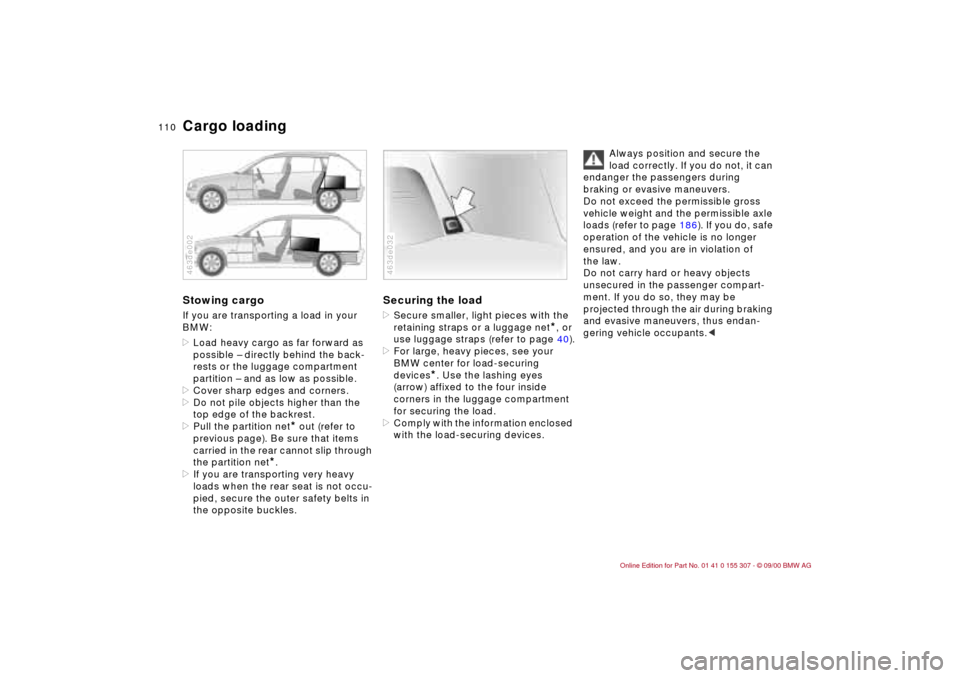
>Load heavy cargo as far forward as
possible Ð directly behind the back-
rests or the luggage compartment
partition Ð and as low as possible.
>Cover sharp edges and corners.
>Do not pile objects higher than the
top edge of the backrest.
>Pull the partition net
* out (refer to
previous page). Be sure that items
carried in the rear cannot slip through
the partition net
*.
>If you are transporting very heavy
loads when the rear seat is not occu-
pied, secure the outer safety belts in
the opposite buckles.
463de002
Securing the load >Secure smaller, light pieces with the
retaining straps or a luggage net
*, or
use luggage straps (refer to page 40).
>For large, heavy pieces, see your
BMW center for load-securing
devices
*. Use the lashing eyes
(arrow) affixed to the four inside
corners in the luggage compartment
for securing the load.
>Comply with the information enclosed
with the load-securing devices.
463de032
Always position and secure the
load correctly. If you do not, it can
endanger the passengers during
braking or evasive maneuvers.
Do not exceed the permissible gross
vehicle weight and the permissible axle
loads (refer to page 186). If you do, safe
operation of the vehicle is no longer
ensured, and you are in violation of
the law.
Do not carry hard or heavy objects
unsecured in the passenger compart-
ment. If you do so, they may be
projected through the air during braking
and evasive maneuvers, thus endan-
gering vehicle occupants.<
Page 114 of 203

114n
To ensure maximum economy and a
long service life, we request that you
observe the following suggestions.
Engine and differentialUp to 1,200 miles (2,000 km):
Drive at varying engine speeds and road
speeds, but do not exceed the following
engine or road speeds during this time:
4,500 rpm or 100 mph (160 km/h).
Obey your local and state maximum
speed limits.
Refrain from using full throttle and avoid
pressing the accelerator beyond the
"kickdown" point.
After you have driven 1,200 miles
(2,000 km), you can gradually increase
the engine and road speeds.
You should also comply with these
break-in procedures if the engine or
differential is replaced at a later point.
TiresDue to technical factors associated
with their manufacture, tires do not
achieve their full traction potential until
an initial break-in period has elapsed.
Thus drive with extra care during the
initial 200 miles (300 km).
Obey your local and state maximum
speed limits.
When the vehicle is operated on
wet or slushy roads, a wedge of
water may form between the tire and
the road surface. This phenomenon is
referred to as aquaplaning, or hydropla-
ning, and can lead to partial or
complete loss of traction, vehicle
control and braking effectiveness.
Reduce your speed on wet roads.<
Brake systemAfter approximately 300 miles (500 km),
the brake pads and discs achieve the
optimal pad surface and wear patterns
required for trouble-free operation and
long service life.
To break in the separate parking brake
drums, apply the parking brake lightly
when coasting to a standstill (at a traffic
signal, for instance), provided that
traffic conditions allow you to do so.
To avoid corrosion, repeat this proce-
dure from time to time.
The brake lamps do not come on
when the parking brake is applied.
Vacuum for the brake system servo unit
on your BMW is available only when the
engine is running. When you move the
vehicle with the engine off Ð when
towing, for example Ð substantially
higher levels of pedal force will be
required to brake the vehicle.
(500 km). Engage the gears carefully
during the break-in period.
Break-in procedures
Page 151 of 203
Overview
Controls and features
Operation, care
and maintenance
Owner service procedures
Technical data
Index Advanced technology
151n
IndexDataTechnologyRepairsCar careControlsOverview
Replacement procedures:
Onboard tool kit152
Windshield wiper blades152
Lamps and bulbs153
Changing a wheel159
Battery162
Fuses164
Microfilter/Activated-charcoal
filter165
In case of electrical
malfunction:
Fuel filler door166
Sliding/Tilt sunroof166
Tailgate166
Assistance, giving and
receiving:
Jump-starting167
Towing the vehicle168
Repairs
Page 168 of 203
168n
Towing the vehicleTow fittingThe screw-in tow fitting is stored in the
onboard tool kit; be sure that it remains
in the vehicle at all times. This fitting
is designed for installation in the tow
sockets located at the front and rear of
the vehicle. It is intended for towing on
paved road surfaces only. This fitting
should not be used to pull a vehicle out
of deep snow, mud, sand, etc.
Always observe all applicable towing
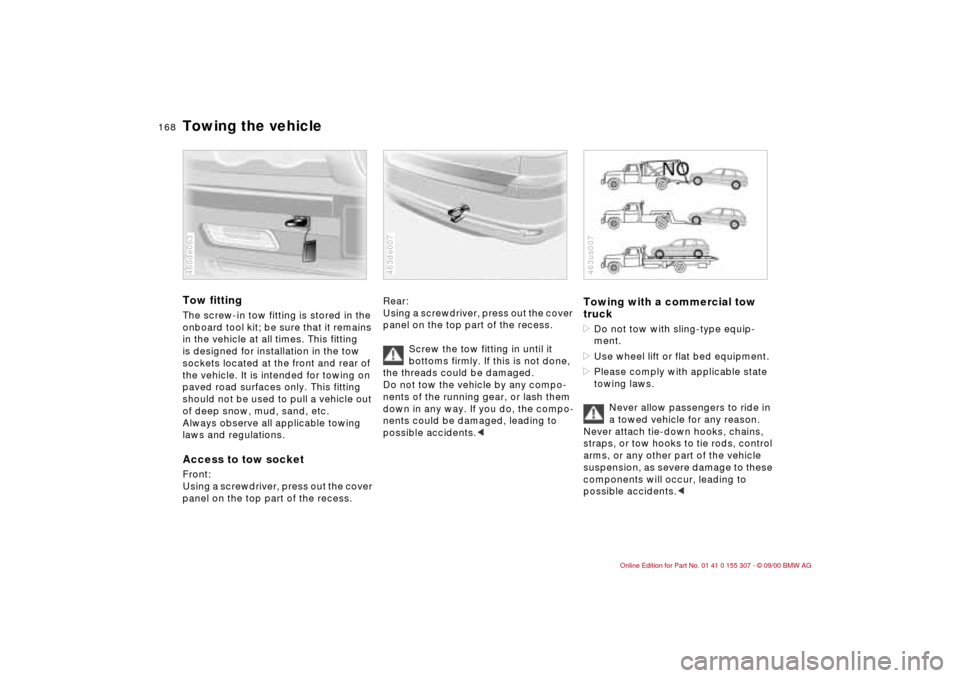
laws and regulations. Access to tow socketFront:
Using a screwdriver, press out the cover
panel on the top part of the recess.460de063
Rear:
Using a screwdriver, press out the cover
panel on the top part of the recess.
Screw the tow fitting in until it
bottoms firmly. If this is not done,
the threads could be damaged.
Do not tow the vehicle by any compo-
nents of the running gear, or lash them
down in any way. If you do, the compo-
nents could be damaged, leading to
possible accidents.<463de007
Towing with a commercial tow
truck>Do not tow with sling-type equip-
ment.
>Use wheel lift or flat bed equipment.
>Please comply with applicable state
towing laws.
Never allow passengers to ride in
a towed vehicle for any reason.
Never attach tie-down hooks, chains,
straps, or tow hooks to tie rods, control
arms, or any other part of the vehicle
suspension, as severe damage to these
components will occur, leading to
possible accidents.c463us007
Page 169 of 203

169n
IndexDataTechnologyRepairsCar careControlsOverview
Towing the vehicleBMW 325xi: tow the vehicle with
one raised axle1 Place the gearshift lever or selector
lever in "Neutral."
2 Switch off the engine.
3 Towing speed:
Maximum 30 mph (50 km/h).
4 Towing distance:
Maximum 95 miles (150 km).
Remove the rear driveshaft for
longer towing distances with the
front axle lifted; remove the front drive-
shaft for towing over longer distances
with the rear axle lifted. Failure to
comply with this will result in damage to
the transfer box.<
Page 193 of 203

Everything from A to Z
193n
IndexDataTechnologyRepairsCar careControlsOverview
Changing a wheel159
Charge indicator lamp20
Check air pressure28
Check Control75
Check engine oil level135
Child restraint
systems54,60
Child-safety locks58
Child's seat54
Cigarette lighter104
Cleaning windshield68
Clock75
refer also to the Radio or
Computer Owner's Manual
Cockpit16
Coin holder102
Combination switch68
Compression184
Computer76
Configure settings52
Consumption77
display74
Contents10
Control elements20
Coolant121,137,187
antifreeze121
Coolant temperature
gauge74
Cooling system187
Copyright4
Cornering Brake Control
(CBC)21,117 Cruise control71
Cruising range77
Cup holder, refer to
beverage holder102
Curb weight186
Current check indicator20
D
Dashboard16
Data
dimensions185
engine184
technical184
weights186
Daytime-driving lamp
switch87
DBC (Dynamic Brake
Control)118
Defrost position94,98
Defrostable rear window99
Defrosting
rear window92
windows94,98
Digital clock75
Dimensions185
Dipstick, engine oil135
Disc brakes118
Displacement184
Display lighting87
Displays18
Distance warning78 Diversity Antenna
system174
Door key32,35
Door locks, care121
Doors
child-safety locks58
emergency operation34
unlocking and locking34
DOT Quality Grades125
Draft-free ventilation93
Drive belts188
Driving hints115
Driving in winter121
Driving lamps87
DSC (Dynamic Stability
Control)81,173
Dynamic Brake Control
(DBC)118
Dynamic Stability Control
(DSC)22,81,173
E
Electric power seat48
Electric power windows43
Electrical accessories,
failure164
Electrical system188
Electronic vehicle
immobilizer33
Elements of operation16 Emergency operation,
doors34
Energy Control73
Engine
coolant137,187
data184
starting61
Engine oil
capacity187
consumption135
pressure20
quality136
specifications136
viscosity136
Engine speed184
Exterior mirrors51
F
Failure messages75
Fault displays75
Fault, ABS117
Filler cap cover27
Filling capacities187
Filling the washer
reservoir187
First-aid kit26
Fittings, tow starting and
towing168
Flashlight101
Flat tire124,159
Fog lamps88
Page 197 of 203

Everything from A to Z
197n
IndexDataTechnologyRepairsCar careControlsOverview
Tire codes127
Tire damages124
Tire inflation
pressure28,124
Tire Pressure Control
(RDC)85,178
Tire pressure
monitoring85,178
Tire Quality Grading125
Tire replacement125,126
Tire specifications129
Tire tread124
Tools152
Torque184
Tow fittings168
Tow starting168
Towing168
Track185
Traction Control System,
refer to DSC79
Transmission64
Transporting children
safely58
Tread depth, tires124
Trip odometer73
Trunk38
Turn signal
indicator23,68,154
bulb replacement154
Turning radius185
Two-way radios123
U
Uniform Tire Quality
Grading125
Used batteries164 V
Vacuum cleaner,
connecting104
Vanity mirror51
bulb replacement158
Vehicle battery162,188
Vehicle care
exterior142
interior144
Vehicle Identification
Number (VIN)139
Vehicle immobilizer33
Vehicle painting142
Vehicle removal from
service147
Vehicle storage147
Vehicle weight186
Ventilation90,93,96
draft-free93,100
Vinyl upholstery, care144
Voice recognition24,25 W
Warning lamps20
Warning messages75
Warranty and Service Guide
(Canadian models)140 Washer fluids134
Washer nozzles134
Washer reservoir, filling134
Washing your car141
Water on roadways
deep water115
Waxing, paintwork143
Weights186
Wheel changing159
Wheel lug wrench159
Wheel rims127
Wheel stud wrench159
Wheelbase185
Wheels and tires127,129
Width185
Windows, convenience
operation34
Windshield washer nozzle
adjustment134
Windshield washer reservoir,
filling134,187
Windshield wiper68
blade replacement152
Winter operation121
Winter tires127,128
Wiper blade
replacement152
Wiper system68
Work in the engine
compartment130
X
Xenon lamp154,180
Page 198 of 203
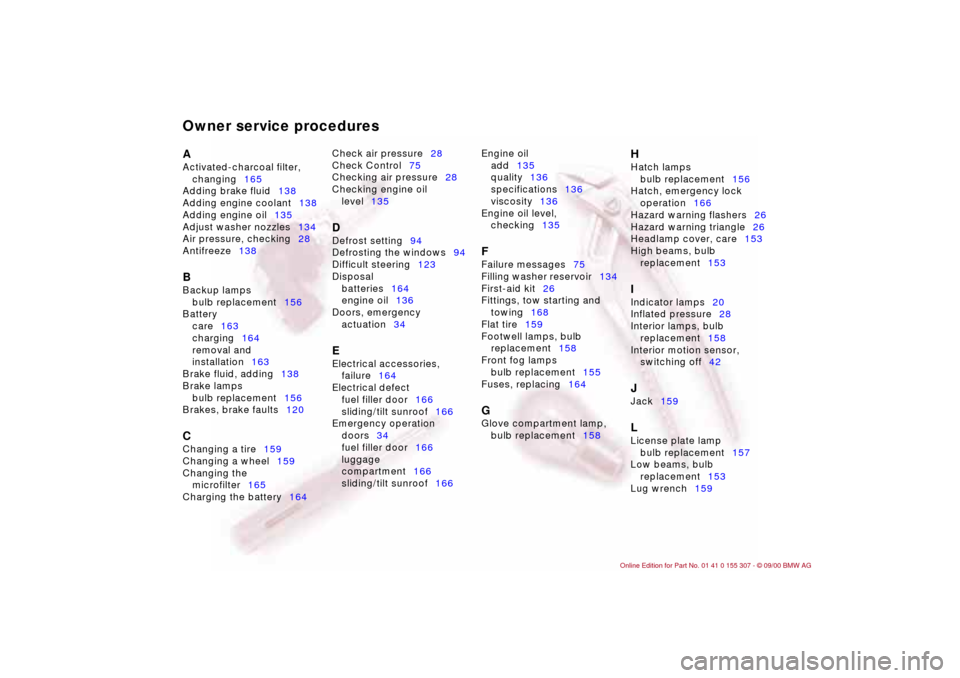
Owner service proceduresA
Activated-charcoal filter,
changing165
Adding brake fluid138
Adding engine coolant138
Adding engine oil135
Adjust washer nozzles134
Air pressure, checking28
Antifreeze138 B
Backup lamps
bulb replacement156
Battery
care163
charging164
removal and
installation163
Brake fluid, adding138
Brake lamps
bulb replacement156
Brakes, brake faults120 C
Changing a tire159
Changing a wheel159
Changing the
microfilter165
Charging the battery164 Check air pressure28
Check Control75
Checking air pressure28
Checking engine oil
level135
D
Defrost setting94
Defrosting the windows94
Difficult steering123
Disposal
batteries164
engine oil136
Doors, emergency
actuation34 E
Electrical accessories,
failure164
Electrical defect
fuel filler door166
sliding/tilt sunroof166
Emergency operation
doors34
fuel filler door166
luggage
compartment166
sliding/tilt sunroof166 Engine oil
add135
quality136
specifications136
viscosity136
Engine oil level,
checking135
F
Failure messages75
Filling washer reservoir134
First-aid kit26
Fittings, tow starting and
towing168
Flat tire159
Footwell lamps, bulb
replacement158
Front fog lamps
bulb replacement155
Fuses, replacing164 G
Glove compartment lamp,
bulb replacement158
H
Hatch lamps
bulb replacement156
Hatch, emergency lock
operation166
Hazard warning flashers26
Hazard warning triangle26
Headlamp cover, care153
High beams, bulb
replacement153 I
Indicator lamps20
Inflated pressure28
Interior lamps, bulb
replacement158
Interior motion sensor,
switching off42 J
Jack159 L
License plate lamp
bulb replacement157
Low beams, bulb
replacement153
Lug wrench159