belt BMW 325i TOURING 2001 E46 Owner's Manual
[x] Cancel search | Manufacturer: BMW, Model Year: 2001, Model line: 325i TOURING, Model: BMW 325i TOURING 2001 E46Pages: 203, PDF Size: 2.07 MB
Page 10 of 203

Contents
Overview
Controls and features
Cockpit16
Instrument cluster18
Indicator and warning lamps20
Multifunction steering wheel
(MFL)24
Sports steering wheel25
Hazard warning flashers26
Warning triangle26
First-aid kit26
Refueling27
Fuel specifications28
Tire inflation pressure28
Opening and closing:
Keys32
Electronic vehicle
immobilizer33
Central locking system34
Opening and closing Ð
from the outside34
Opening and closing Ð
from the inside38
Tailgate38
Cargo area40
Alarm system41
Electric power windows43
Sliding/tilt sunroof44
Adjustments:
Seats46
Seat and mirror memory49
Steering wheel50
Mirrors51
Car Memory, Key Memory52
Passenger safety systems:
Safety belts53
Airbags55
Transporting children safely58
Driving:
Steering/Ignition lock61
Starting the engine61
Switching off the engine62
Parking brake63
Manual transmission64
Automatic transmission with
Steptronic65
Turn signal indicator/
Headlamp flasher68
Washer/Wiper system68
Rear window defroster70
Cruise control71
Everything under control:
Odometer73
Tachometer73
Energy Control73
Fuel gauge74
Coolant temperature gauge74
Service Interval Display74
Check Control75
Clock75
Computer76
Technology for safety and
driving convenience:
Park Distance Control (PDC)78
Automatic Stability Control plus
Traction (ASC+T)79
Dynamic Stability Control
(DSC)80
Tire Pressure Control (RDC)85
Page 12 of 203

Contents
Owner service procedures
Advanced technology
Technical data
Replacement procedures:
Onboard tool kit152
Windshield wiper blades152
Lamps and bulbs153
Changing a wheel159
Battery162
Fuses164
Microfilter/Activated-charcoal
filter165
In case of electrical
malfunction:
Fuel filler door166
Sliding/Tilt sunroof166
Tailgate166
Assistance, giving and
receiving:
Jump-starting167
Towing the vehicle168Airbags172
Adaptive Transmission Control
(ATC)173
Automatic Stability Control plus
Traction (ASC+T)/Dynamic
Stability Control (DSC)173
Radio reception174
Four-wheel drive175
Safety belt tensioner175
Interior rearview mirror with
automatic dimmer176
Rain sensor177
Tire Pressure Control (RDC)178
Self-diagnostics179
Xenon lamps180Engine data184
Dimensions185
Weights186
Capacities187
Electrical system188
Drive belts188
Page 19 of 203

19n
IndexDataTechnologyRepairsCar careControlsOverview
Instrument cluster
1 Fuel gauge with indicator lamp for
fuel reserve74
2 Turn signal indicator23
3 Speedometer
4 Indicator lamp for:
>
Battery charge current20
>
High beams23
>
Engine oil pressure/Engine oil
level20, 22
5 Tachometer and Energy Control73
6 Engine coolant temperature gauge
with "Coolant temperature too high"
indicator74
7 Indicator and warning lamps
(clockwise) for:
> Parking brake/Brake hydraulic
system/Cornering Brake Control
(CBC)/(DBC)20, 21 >
Antilock Brake System (ABS)22
>
Brake pads22
>
Tire Pressure Control
(RDC)20, 22
>
Airbags21
>
Please fasten safety belts21
>
Cruise control
* 23
8 Adjusting knob for the clock759 Program display for automatic
transmission65, 67
Indicator lamp for automatic
transmission21, 65, 67
10 Indicator lamp for Automatic
Stability Control plus Traction
(ASC+T)/Dynamic Stability Control
(DSC) or DSC and
ADB/ADB-X22
11 Indicator for:
>
Odometer73
>
Trip odometer73
>
Clock75
>
Service Interval74
Display for computer, operation
via the turn signal lever, refer to
page 76:
>
Clock
>
Outside temperature
>
Average fuel consumption
> Cruising range >
Average speed
12 Indicator for Check Control75
13 Trip odometer, reset to zero7314 Indicator and warning lamps
(clockwise) for:
>
Fog lamps23
>
Add washer fluid22
>
Coolant level23
>
Electronic Throttle Control
(EML)
*
23
>
Service engine soon23
You can display the outside
temperature and distance driven
in different units of measurement.
<
Page 20 of 203
20n
Indicator and warning lamps
Technology that monitors itself
Many of the systems of your BMW
monitor themselves automatically, both
during engine starts and while you are
driving. Indicator and warning lamps
that are identified by "
l
" are tested for
proper functioning whenever the igni-
tion key is turned. They each light up
once for different periods of time.
If a fault should occur in one of these
systems, the corresponding lamp does
not go out after the engine is started or
it will light up while the vehicle is
moving. You will see how to react to
this below.
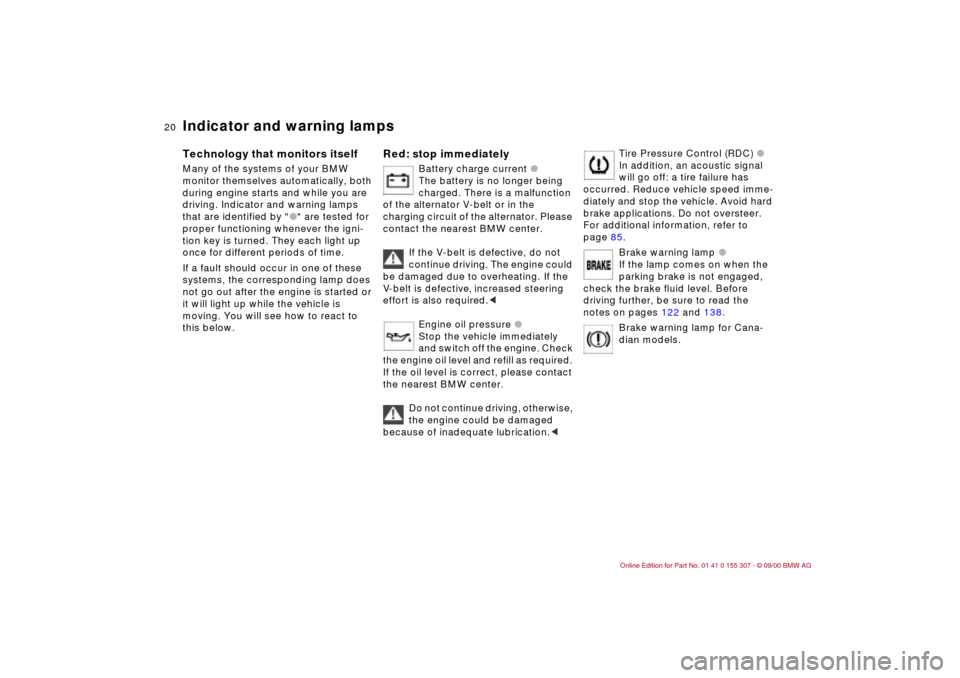
Red: stop immediately
Battery charge current
l
The battery is no longer being
charged. There is a malfunction
of the alternator V-belt or in the
charging circuit of the alternator. Please
contact the nearest BMW center.
If the V-belt is defective, do not
continue driving. The engine could
be damaged due to overheating. If the
V-belt is defective, increased steering
effort is also required.
<
Engine oil pressure
l
Stop the vehicle immediately
and switch off the engine. Check
the engine oil level and refill as required.
If the oil level is correct, please contact
the nearest BMW center.
Do not continue driving, otherwise,
the engine could be damaged
because of inadequate lubrication.
<
Tire Pressure Control (RDC) l
In addition, an acoustic signal
will go off: a tire failure has
occurred. Reduce vehicle speed imme-
diately and stop the vehicle. Avoid hard
brake applications. Do not oversteer.
For additional information, refer to
page 85.
Brake warning lamp l
If the lamp comes on when the
parking brake is not engaged,
check the brake fluid level. Before
driving further, be sure to read the
notes on pages 122 and 138.
Brake warning lamp for Cana-
dian models.
Page 21 of 203
21n
IndexDataTechnologyRepairsCar careControlsOverview
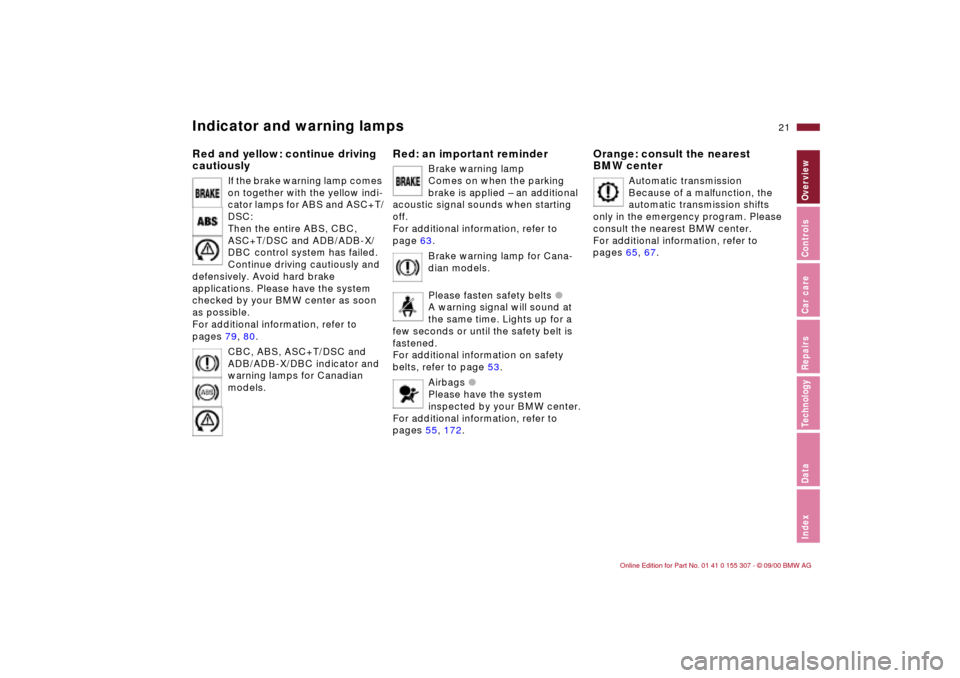
Indicator and warning lampsRed and yellow: continue driving
cautiously
If the brake warning lamp comes
on together with the yellow indi-
cator lamps for ABS and ASC+T/
DSC:
Then the entire ABS, CBC,
ASC+T/DSC and ADB/ADB-X/
DBC
control system has failed.
Continue driving cautiously and
defensively. Avoid hard brake
applications. Please have the system
checked by your BMW center as soon
as possible.
For additional information, refer to
pages 79, 80.
CBC, ABS, ASC+T/DSC and
ADB/ADB-X/DBC indicator and
warning lamps for Canadian
models.
Red: an important reminder
Brake warning lamp
Comes on when the parking
brake is applied Ð an additional
acoustic signal sounds when starting
off.
For additional information, refer to
page 63.
Brake warning lamp for Cana-
dian models.
Please fasten safety belts l
A warning signal will sound at
the same time. Lights up for a
few seconds or until the safety belt is
fastened.
For additional information on safety
belts, refer to page 53.
Airbags l
Please have the system
inspected by your BMW center.
For additional information, refer to
pages 55, 172.
Orange: consult the nearest
BMW center
Automatic transmission
Because of a malfunction, the
automatic transmission shifts
only in the emergency program. Please
consult the nearest BMW center.
For additional information, refer to
pages 65, 67.
Page 30 of 203
30n
Opening and closing:
Keys32
Electronic vehicle
immobilizer33
Central locking system34
Opening and closing Ð
from the outside34
Opening and closing Ð
from the inside38
Tailgate39
Cargo area40
Alarm system41
Electric power windows43
Sliding/tilt sunroof44
Adjustments:
Seats46
Seat and mirror memory49
Steering wheel50
Mirrors51
Car Memory, Key Memory52
Passenger safety systems:
Safety belts53
Airbags55
Transporting children safely58
Controls
Page 46 of 203
46n
For maximum safety when adjusting
the seat position, please observe the
following:
Never try to adjust your seat while
driving the vehicle. The seat could
respond with an unexpected move-
ment, and the ensuing loss of vehicle
control could lead to an accident.
Be sure that the safety belt remains
firmly against your body at all times. In
the event of a frontal impact, a loose lap
belt could slide over the hips, leading to
abdominal injury. In addition, the safety
belt's restraint effectiveness is reduced
if the belt is worn loosely.
While driving, do not recline the back-
rest too far (this applies to the
passenger side especially), because
otherwise there is the danger of sliding
underneath the safety belt during an
accident, thereby negating the safety
belt's protection.<
Correct sitting postureTo reduce strain on the spinal column,
sit all the way back in the seat and rest
your back fully against the backrest.
The ideal sitting posture is when your
head forms a straight line with your
spine.
For long-distance driving, you may wish
to increase the backrest angle slightly
to reduce muscular tension. You should
be able to grasp the steering wheel at
its highest point with your arms slightly
bent.
After a seat adjustment, adjust the
height of the safety belt also. Refer to
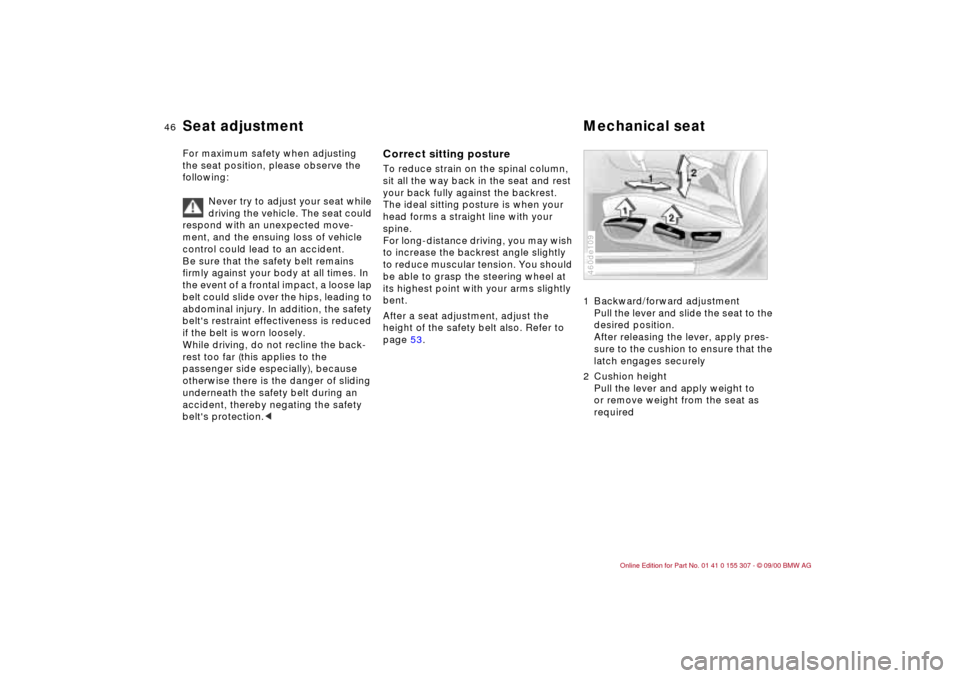
page 53.1 Backward/forward adjustment
Pull the lever and slide the seat to the
desired position.
After releasing the lever, apply pres-
sure to the cushion to ensure that the
latch engages securely
2 Cushion height
Pull the lever and apply weight to
or remove weight from the seat as
required
460de109
Seat adjustment Mechanical seat
Page 53 of 203
53n
IndexDataTechnologyRepairsCar careControlsOverview
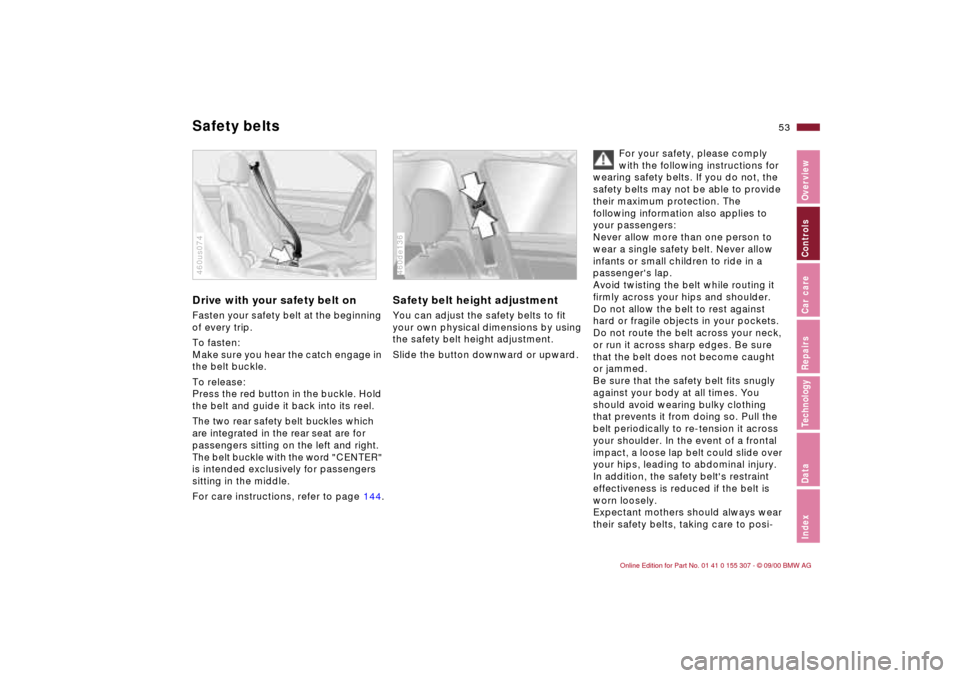
Drive with your safety belt onFasten your safety belt at the beginning
of every trip.
To fasten:
Make sure you hear the catch engage in
the belt buckle.
To release:
Press the red button in the buckle. Hold
the belt and guide it back into its reel.The two rear safety belt buckles which
are integrated in the rear seat are for
passengers sitting on the left and right.
The belt buckle with the word "CENTER"
is intended exclusively for passengers
sitting in the middle.
For care instructions, refer to page 144.
460us074
Safety belt height adjustmentYou can adjust the safety belts to fit
your own physical dimensions by using
the safety belt height adjustment.
Slide the button downward or upward.460de136
For your safety, please comply
with the following instructions for
wearing safety belts. If you do not, the
safety belts may not be able to provide
their maximum protection. The
following information also applies to
your passengers:
Never allow more than one person to
wear a single safety belt. Never allow
infants or small children to ride in a
passenger's lap.
Avoid twisting the belt while routing it
firmly across your hips and shoulder.
Do not allow the belt to rest against
hard or fragile objects in your pockets.
Do not route the belt across your neck,
or run it across sharp edges. Be sure
that the belt does not become caught
or jammed.
Be sure that the safety belt fits snugly
against your body at all times. You
should avoid wearing bulky clothing
that prevents it from doing so. Pull the
belt periodically to re-tension it across
your shoulder. In the event of a frontal
impact, a loose lap belt could slide over
your hips, leading to abdominal injury.
In addition, the safety belt's restraint
effectiveness is reduced if the belt is
worn loosely.
Expectant mothers should always wear
their safety belts, taking care to posi-
Safety belts
Page 54 of 203

54n
Safety beltstion the lap belt against the lower hips,
where it will not exert pressure against
the abdominal area.<
For child restraint system installation,
refer to page 59.
If the safety belt system has been
subjected to the stresses involved
in an accident or otherwise damaged,
have the entire safety belt mechanism
replaced by your BMW center,
including the safety belt tensioner. In
addition, have your BMW center
inspect the safety belt anchors. If a
child restraint system was in the vehicle
during an accident, consult the manu-
facturer's instructions regarding
replacement.<
Child restraint systems
*
Never install a rear-facing child
restraint system on the front
passenger seat. If you do so, the child
could be injured when the airbag is trig-
gered.
Children should always ride in the rear
and the restraint systems should be
secured with the outer belts.
The center seat belt should only be
used when it is necessary to secure
three child restraint systems.
Do not modify the child restraint system
in any way. If you do so, it will not
provide your child with maximum
protection.<
Page 55 of 203
55n
IndexDataTechnologyRepairsCar careControlsOverview
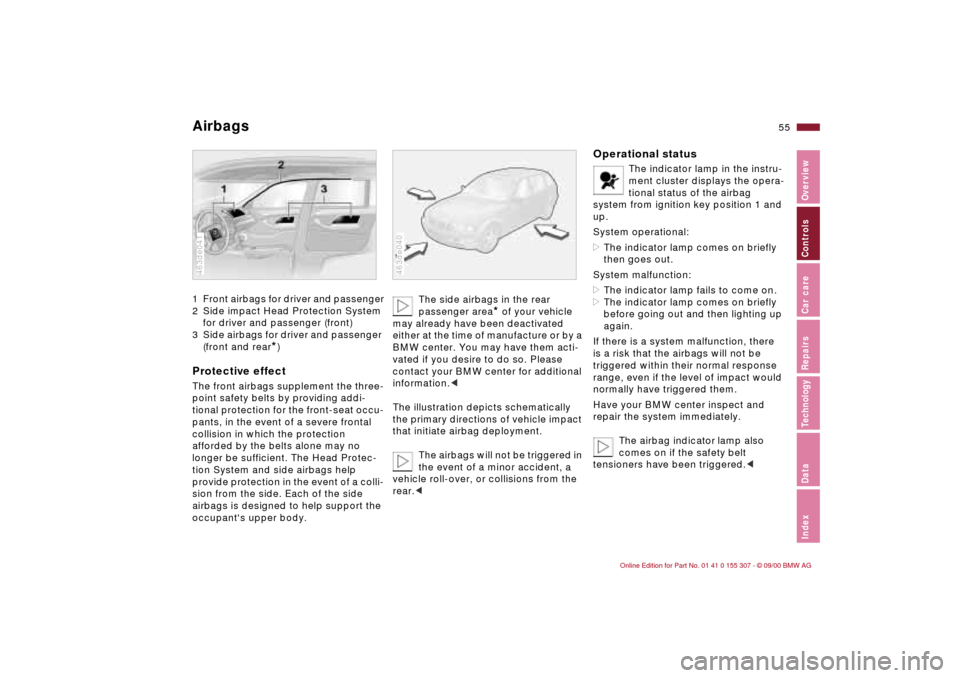
Airbags1 Front airbags for driver and passenger
2 Side impact Head Protection System
for driver and passenger (front)
3 Side airbags for driver and passenger
(front and rear
*)
Protective effectThe front airbags supplement the three-
point safety belts by providing addi-
tional protection for the front-seat occu-
pants, in the event of a severe frontal
collision in which the protection
afforded by the belts alone may no
longer be sufficient. The Head Protec-
tion System and side airbags help
provide protection in the event of a colli-
sion from the side. Each of the side
airbags is designed to help support the
occupant's upper body.463de041
The side airbags in the rear
passenger area
* of your vehicle
may already have been deactivated
either at the time of manufacture or by a
BMW center. You may have them acti-
vated if you desire to do so. Please
contact your BMW center for additional
information.<
The illustration depicts schematically
the primary directions of vehicle impact
that initiate airbag deployment.
The airbags will not be triggered in
the event of a minor accident, a
vehicle roll-over, or collisions from the
rear.c
463de040
Operational status
The indicator lamp in the instru-
ment cluster displays the opera-
tional status of the airbag
system from ignition key position 1 and
up.
System operational:
>The indicator lamp comes on briefly
then goes out.
System malfunction:
>The indicator lamp fails to come on.
>The indicator lamp comes on briefly
before going out and then lighting up
again.
If there is a system malfunction, there
is a risk that the airbags will not be
triggered within their normal response
range, even if the level of impact would
normally have triggered them.
Have your BMW center inspect and
repair the system immediately.
The airbag indicator lamp also
comes on if the safety belt
tensioners have been triggered.<