load BMW 325i TOURING 2003 E46 Owner's Manual
[x] Cancel search | Manufacturer: BMW, Model Year: 2003, Model line: 325i TOURING, Model: BMW 325i TOURING 2003 E46Pages: 166, PDF Size: 4.29 MB
Page 9 of 166
Contents
9
Passenger safety systems:
Airbags52
Transporting children safely54
Vehicle Memory, Key
Memory58
Driving:
Ignition lock59
Starting the engine59
Switching off the engine61
Parking brake61
Manual transmission62
Automatic transmission with
Steptronic*63
Turn signal indicator/Headlamp
flasher66
Washer/wiper system/Rain
sensor*67
Cruise control*69
Everything under control:
Odometer71
Tachometer71
Energy control71
Fuel gauge72
Engine coolant temperature
gauge72
Service interval display73
Check Control73
Clock74
Computer*75
Technology for safety and
driving convenience:
Park Distance Control (PDC)*77
Automatic Stability Control plus
Traction (ASC+T)*78
Dynamic Stability Control
(DSC)*80
Dynamic Stability Control (DSC) –
BMW 325xi82
Hill Descent Control (HDC)*84
Tire Pressure Monitor (TPM)*85
Flat Tire Monitor*86
Lamps:
Parking lamps/Low beams89
Instrument lighting90
High beams/Standing lamps90
Fog lamps*91
Interior lamps91
Controlling the climate for
pleasant driving:
Air conditioning92
Automatic climate control*96
Interior conveniences:
Premium sound system*101
Glove compartment101
Storage compartments102
Cellular phone*103
Ashtray, front*104
Ashtray, rear*104
Socket105
Loading and transporting:
Ski bag*106
Cargo area107
Cargo loading109
Roof-mounted luggage
rack*111
Controls and features
handbook.book Page 9 Saturday, July 27, 2002 1:36 PM
Page 27 of 166
27
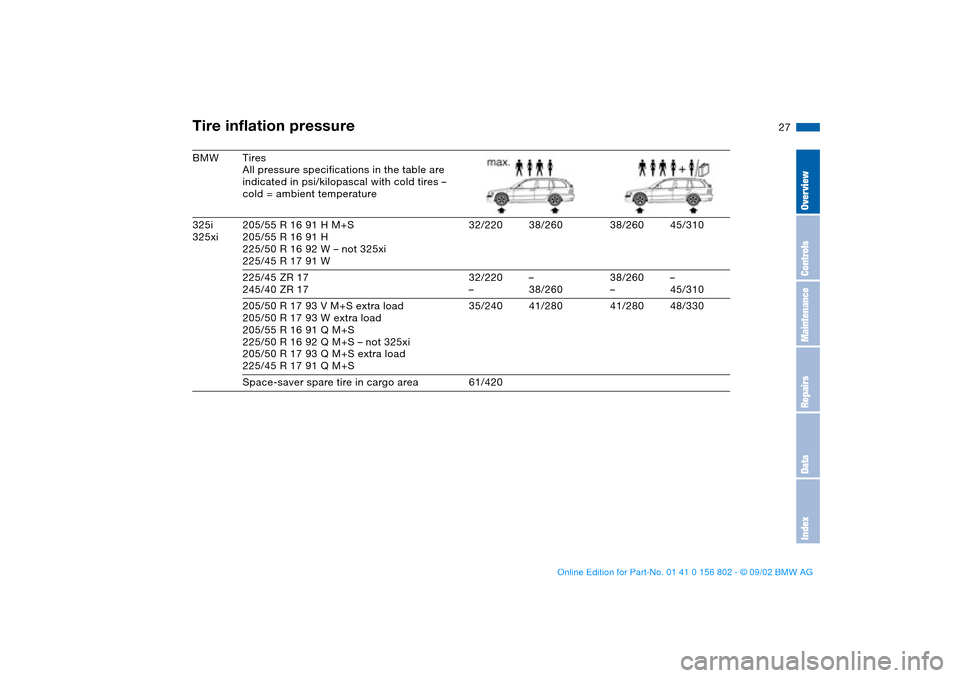
BMW Tires
All pressure specifications in the table are
indicated in psi/kilopascal with cold tires –
cold = ambient temperature
325i
325xi205/55 R 16 91 H M+S
205/55 R 16 91 H
225/50 R 16 92 W – not 325xi
225/45 R 17 91 W32/220 38/260 38/260 45/310
225/45 ZR 17
245/40 ZR 1732/220
––
38/26038/260
––
45/310
205/50 R 17 93 V M+S extra load
205/50 R 17 93 W extra load
205/55 R 16 91 Q M+S
225/50 R 16 92 Q M+S – not 325xi
205/50 R 17 93 Q M+S extra load
225/45 R 17 91 Q M+S35/240 41/280 41/280 48/330
Space-saver spare tire in cargo area 61/420Tire inflation pressure
OverviewControlsMaintenanceRepairsDataIndex
handbook.book Page 27 Saturday, July 27, 2002 1:36 PM
Page 36 of 166
36
Always drive with both the tailgate
and the rear window securely
closed, as exhaust gases might other-
wise be drawn into the interior of the
vehicle.
<
Should it be absolutely necessary to
operate the vehicle with the tailgate or
rear window open:
1. Close all windows. Shut the slid-
ing/tilt sunroof
2. To increase the quantity of air for the
air conditioner or automatic climate
control system, see page 92 or 96.
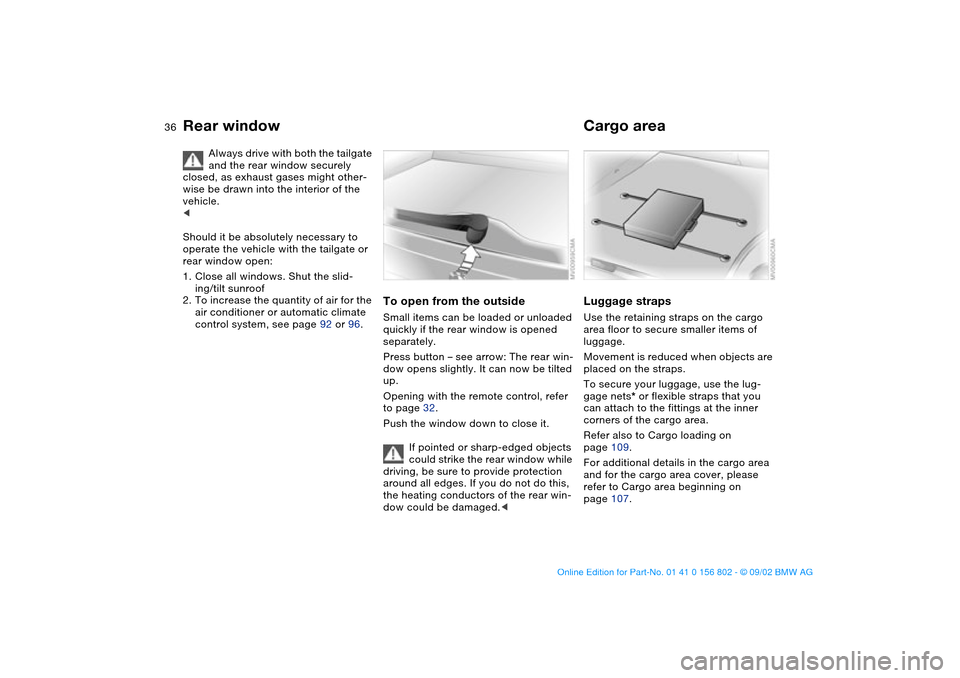
To open from the outsideSmall items can be loaded or unloaded
quickly if the rear window is opened
separately.
Press button – see arrow: The rear win-
dow opens slightly. It can now be tilted
up.
Opening with the remote control, refer
to page 32.
Push the window down to close it.
If pointed or sharp-edged objects
could strike the rear window while
driving, be sure to provide protection
around all edges. If you do not do this,
the heating conductors of the rear win-
dow could be damaged.<
Cargo areaLuggage strapsUse the retaining straps on the cargo
area floor to secure smaller items of
luggage.
Movement is reduced when objects are
placed on the straps.
To secure your luggage, use the lug-
gage nets* or flexible straps that you
can attach to the fittings at the inner
corners of the cargo area.
Refer also to Cargo loading on
page 109.
For additional details in the cargo area
and for the cargo area cover, please
refer to Cargo area beginning on
page 107.
Rear window
handbook.book Page 36 Saturday, July 27, 2002 1:36 PM
Page 65 of 166
65
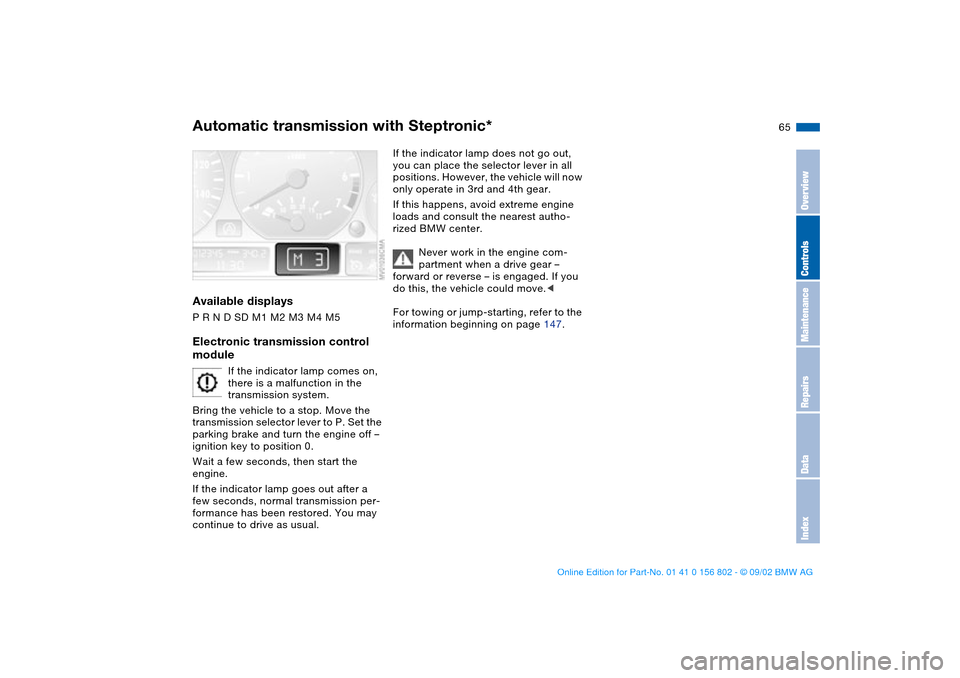
Available displaysP R N D SD M1 M2 M3 M4 M5Electronic transmission control
module
If the indicator lamp comes on,
there is a malfunction in the
transmission system.
Bring the vehicle to a stop. Move the
transmission selector lever to P. Set the
parking brake and turn the engine off –
ignition key to position 0.
Wait a few seconds, then start the
engine.
If the indicator lamp goes out after a
few seconds, normal transmission per-
formance has been restored. You may
continue to drive as usual.
If the indicator lamp does not go out,
you can place the selector lever in all
positions. However, the vehicle will now
only operate in 3rd and 4th gear.
If this happens, avoid extreme engine
loads and consult the nearest autho-
rized BMW center.
Never work in the engine com-
partment when a drive gear –
forward or reverse – is engaged. If you
do this, the vehicle could move.<
For towing or jump-starting, refer to the
information beginning on page 147.
Automatic transmission with Steptronic*
OverviewControlsMaintenanceRepairsDataIndex
handbook.book Page 65 Saturday, July 27, 2002 1:36 PM
Page 102 of 166
102
If – for example for valet parking –
you turn over only your door and
ignition key, refer to page 30, then
access to the glove compartment is not
possible.<
Rechargeable flashlightThe flashlight is located on the left side
of the glove compartment.
It features integral overload protection,
so it can be left in its holder continu-
ously.
To avoid completely discharging
and possibly damaging the lamp,
always ensure that it is switched off
before inserting it in the socket.<
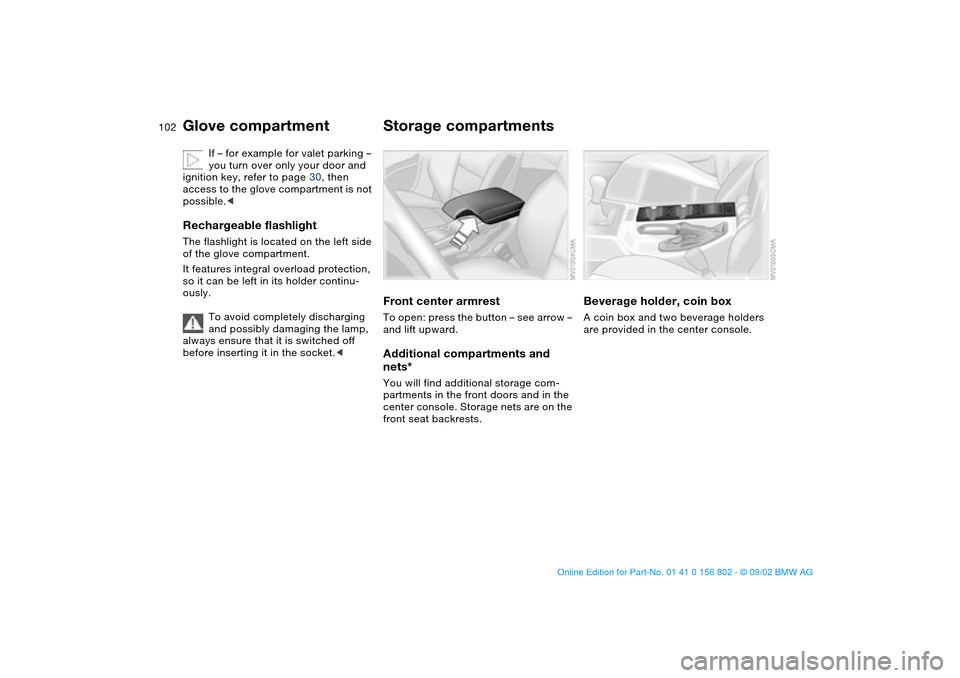
Storage compartmentsFront center armrestTo open: press the button – see arrow –
and lift upward.Additional compartments and
nets*You will find additional storage com-
partments in the front doors and in the
center console. Storage nets are on the
front seat backrests.
Beverage holder, coin boxA coin box and two beverage holders
are provided in the center console.
Glove compartment
handbook.book Page 102 Saturday, July 27, 2002 1:36 PM
Page 106 of 166
106Loading and transporting
Ski bag*The ski bag allows the safe and clean
transport of up to 4 pairs of standard
skis or up to two snowboards.
The length of the ski bag and the addi-
tional space provided in the cargo area
make it possible to carry skis up to
6 ft 10 in / 2.10 m long. Because of the
tapered shape of the bag, only two
pairs of skis longer than 6 ft 10 in /
2.10 m can be carried.
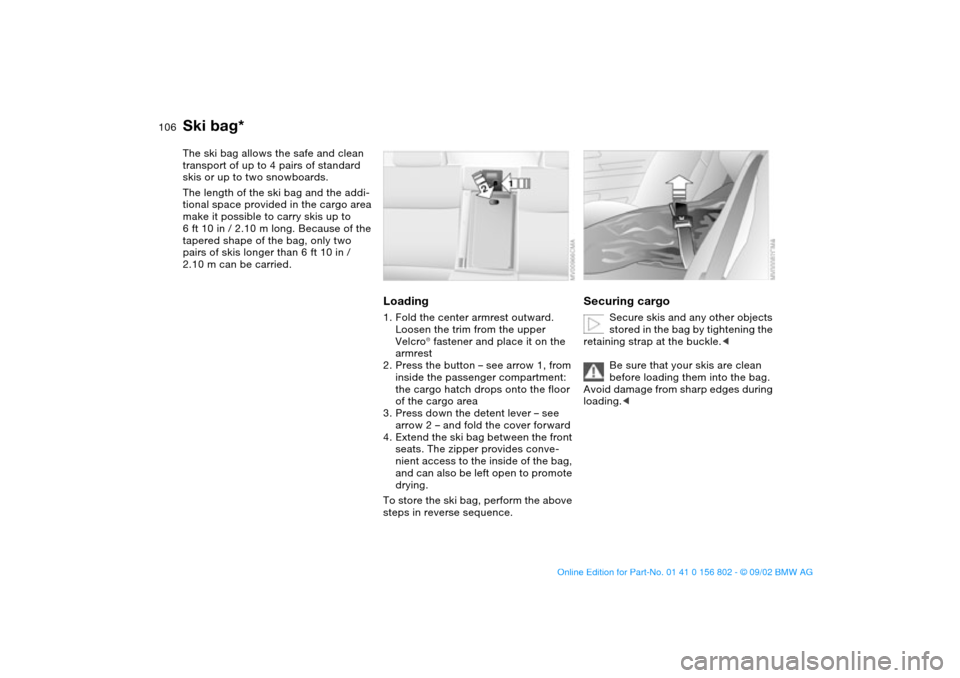
Loading1. Fold the center armrest outward.
Loosen the trim from the upper
Velcro® fastener and place it on the
armrest
2. Press the button – see arrow 1, from
inside the passenger compartment:
the cargo hatch drops onto the floor
of the cargo area
3. Press down the detent lever – see
arrow 2 – and fold the cover forward
4. Extend the ski bag between the front
seats. The zipper provides conve-
nient access to the inside of the bag,
and can also be left open to promote
drying.
To store the ski bag, perform the above
steps in reverse sequence.
Securing cargo
Secure skis and any other objects
stored in the bag by tightening the
retaining strap at the buckle.<
Be sure that your skis are clean
before loading them into the bag.
Avoid damage from sharp edges during
loading.<
handbook.book Page 106 Saturday, July 27, 2002 1:36 PM
Page 109 of 166
109
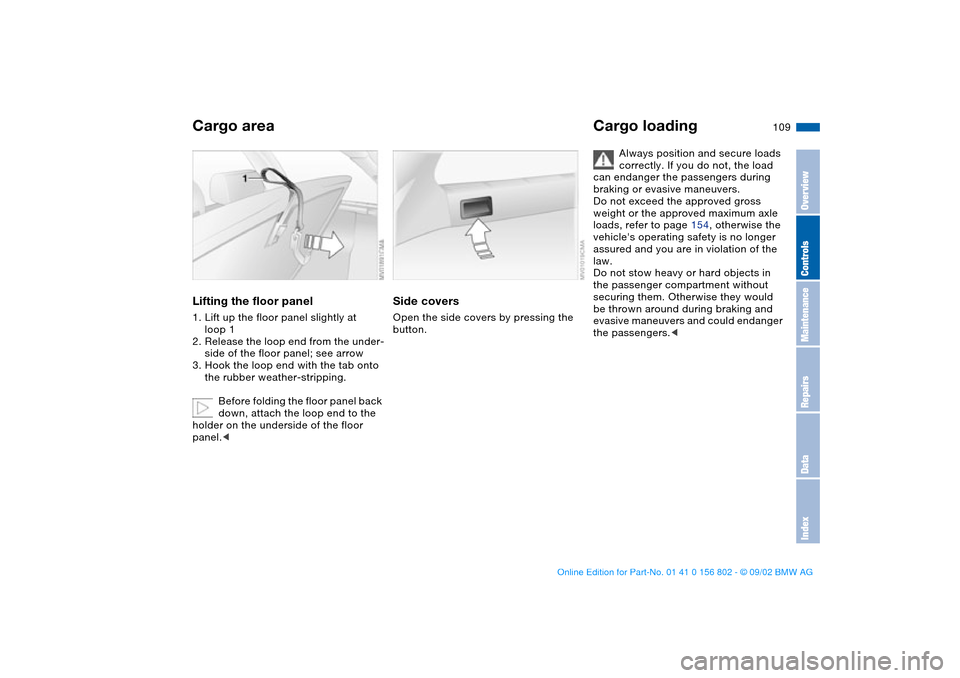
Lifting the floor panel1. Lift up the floor panel slightly at
loop 1
2. Release the loop end from the under-
side of the floor panel; see arrow
3. Hook the loop end with the tab onto
the rubber weather-stripping.
Before folding the floor panel back
down, attach the loop end to the
holder on the underside of the floor
panel.<
Side coversOpen the side covers by pressing the
button.
Cargo loading
Always position and secure loads
correctly. If you do not, the load
can endanger the passengers during
braking or evasive maneuvers.
Do not exceed the approved gross
weight or the approved maximum axle
loads, refer to page 154, otherwise the
vehicle's operating safety is no longer
assured and you are in violation of the
law.
Do not stow heavy or hard objects in
the passenger compartment without
securing them. Otherwise they would
be thrown around during braking and
evasive maneuvers and could endanger
the passengers.<
Cargo area
OverviewControlsMaintenanceRepairsDataIndex
handbook.book Page 109 Saturday, July 27, 2002 1:36 PM
Page 110 of 166
110
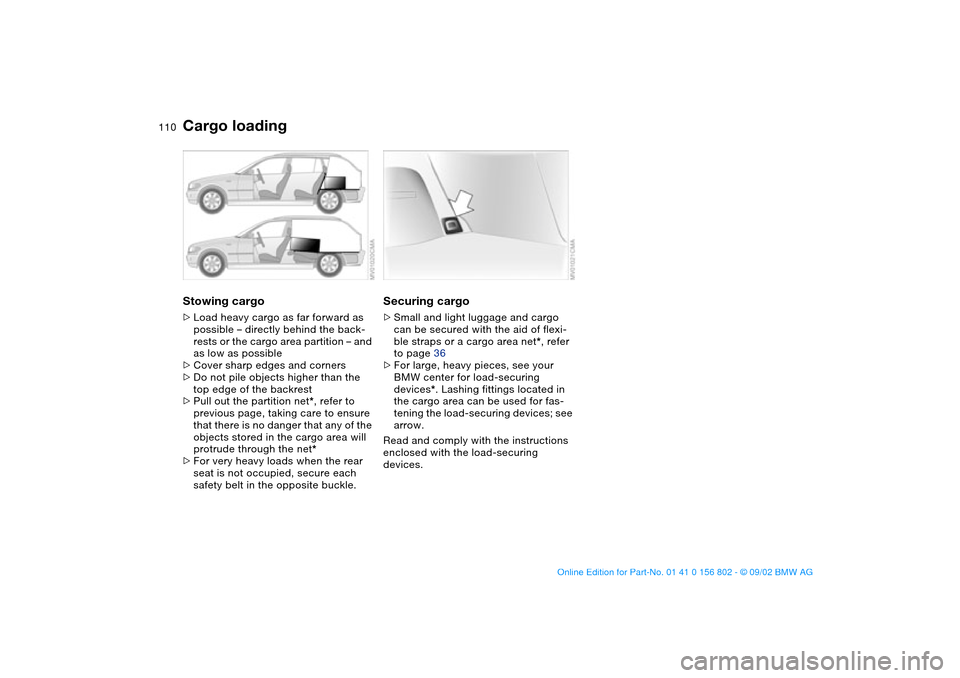
Stowing cargo>Load heavy cargo as far forward as
possible – directly behind the back-
rests or the cargo area partition – and
as low as possible
>Cover sharp edges and corners
>Do not pile objects higher than the
top edge of the backrest
>Pull out the partition net*, refer to
previous page, taking care to ensure
that there is no danger that any of the
objects stored in the cargo area will
protrude through the net*
>For very heavy loads when the rear
seat is not occupied, secure each
safety belt in the opposite buckle.
Securing cargo>Small and light luggage and cargo
can be secured with the aid of flexi-
ble straps or a cargo area net*, refer
to page 36
>For large, heavy pieces, see your
BMW center for load-securing
devices*. Lashing fittings located in
the cargo area can be used for fas-
tening the load-securing devices; see
arrow.
Read and comply with the instructions
enclosed with the load-securing
devices.
Cargo loading
handbook.book Page 110 Saturday, July 27, 2002 1:36 PM
Page 111 of 166
111
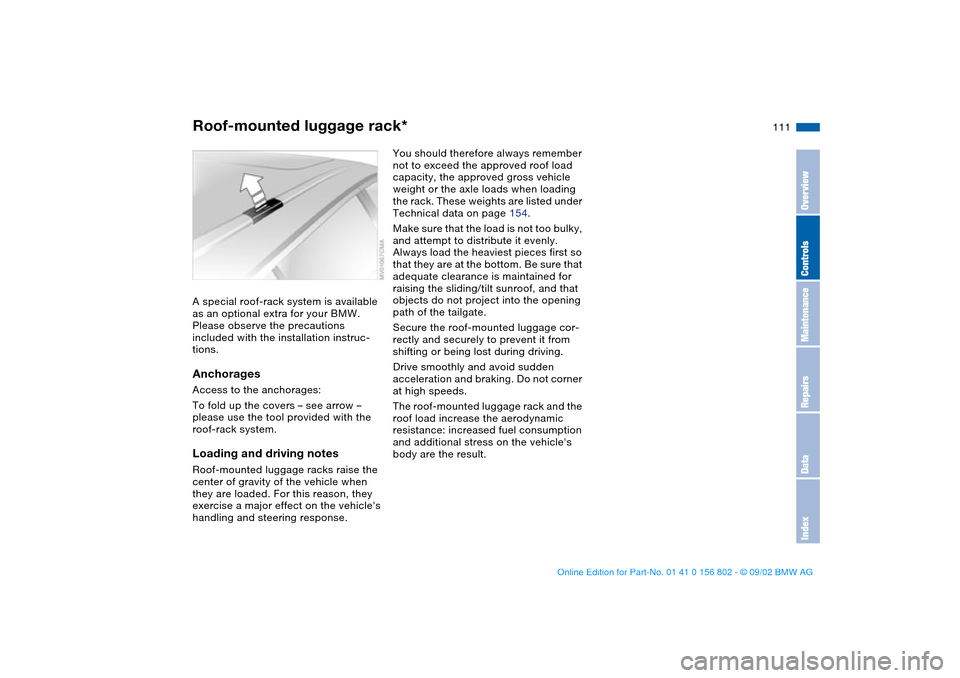
Roof-mounted luggage rack*A special roof-rack system is available
as an optional extra for your BMW.
Please observe the precautions
included with the installation instruc-
tions.AnchoragesAccess to the anchorages:
To fold up the covers – see arrow –
please use the tool provided with the
roof-rack system.Loading and driving notesRoof-mounted luggage racks raise the
center of gravity of the vehicle when
they are loaded. For this reason, they
exercise a major effect on the vehicle's
handling and steering response.
You should therefore always remember
not to exceed the approved roof load
capacity, the approved gross vehicle
weight or the axle loads when loading
the rack. These weights are listed under
Technical data on page 154.
Make sure that the load is not too bulky,
and attempt to distribute it evenly.
Always load the heaviest pieces first so
that they are at the bottom. Be sure that
adequate clearance is maintained for
raising the sliding/tilt sunroof, and that
objects do not project into the opening
path of the tailgate.
Secure the roof-mounted luggage cor-
rectly and securely to prevent it from
shifting or being lost during driving.
Drive smoothly and avoid sudden
acceleration and braking. Do not corner
at high speeds.
The roof-mounted luggage rack and the
roof load increase the aerodynamic
resistance: increased fuel consumption
and additional stress on the vehicle's
body are the result.
OverviewControlsMaintenanceRepairsDataIndex
handbook.book Page 111 Saturday, July 27, 2002 1:36 PM
Page 116 of 166
116
Brake systemBrake fluid levelIf the brake fluid level is too low and
brake pedal travel has become longer,
there may be a defect in one of the two
brake system's hydraulic circuits.
Proceed to the nearest BMW cen-
ter. It may be necessary to apply
higher levels of pressure to the pedal
when stopping and braking distances
may also be longer. Please remember
to adapt your driving style accord-
ingly.
and operating conditions in which brak-
ing is restricted to gentle, low-pressure
applications will all increase the ten-
dency for corrosion to form on the
rotors; this is often accompanied by a
simultaneous accumulation of contami-
nation on the brake pads. The pads
must exert a certain minimal level of
pressure against the rotors for the disc
brakes' inherent self-cleaning effect to
remain effective; the pressure available
under the above conditions may not
provide adequate cleansing.
If the brake rotors are corroded, they
will tend to respond to braking with a
pulsating effect that even extended
brake applications will fail to cure.
When driving in heavy rain and on wet
roads it is useful to apply light pressure
to the brake pedal every few miles.
Monitor traffic conditions to ensure that
this maneuver does not pose a hazard
to you or to other road users. The heat
generated in this process helps dry the
pads and rotors to ensure that your
brake system will respond with undi-
minished efficiency when you need it.
When descending steep hills and
extended grades, downshift to a gear
that will allow you to continue safely
with only a minimal amount of braking.
By minimizing the loads placed on the
brake system, this strategy helps
ensure that optimal brake system
response will remain available at all
times. Use care to avoid exceeding the
approved engine-speed range, refer to
page 71.
Do not coast with the clutch
depressed or with the transmis-
sion or selector lever in Neutral. Do not
coast with the engine shut off. The
engine provides no braking effect when
the clutch is depressed and there is no
power-assist for braking or steering
when the engine is not running.
BMW 325xi: always refer all brake
inspection and service work to your
BMW center, as failure to observe the
special procedures could result in dam-
age to components of the all-wheel
drive.
Never allow floor mats, carpets or any
other objects to protrude into the area
around the accelerator, clutch and
brake pedals and obstruct their move-
ment.
brake pads that BMW has
released for your particular vehicle
model. BMW cannot evaluate non-
approved brake pads to determine if
they are suitable for use, and therefore
cannot ensure the operating safety of
the vehicle if they are installed.<
handbook.book Page 116 Saturday, July 27, 2002 1:36 PM