air condition BMW 325IT WAGON 2003 User Guide
[x] Cancel search | Manufacturer: BMW, Model Year: 2003, Model line: 325IT WAGON, Model: BMW 325IT WAGON 2003Pages: 166, PDF Size: 4.29 MB
Page 95 of 166
95
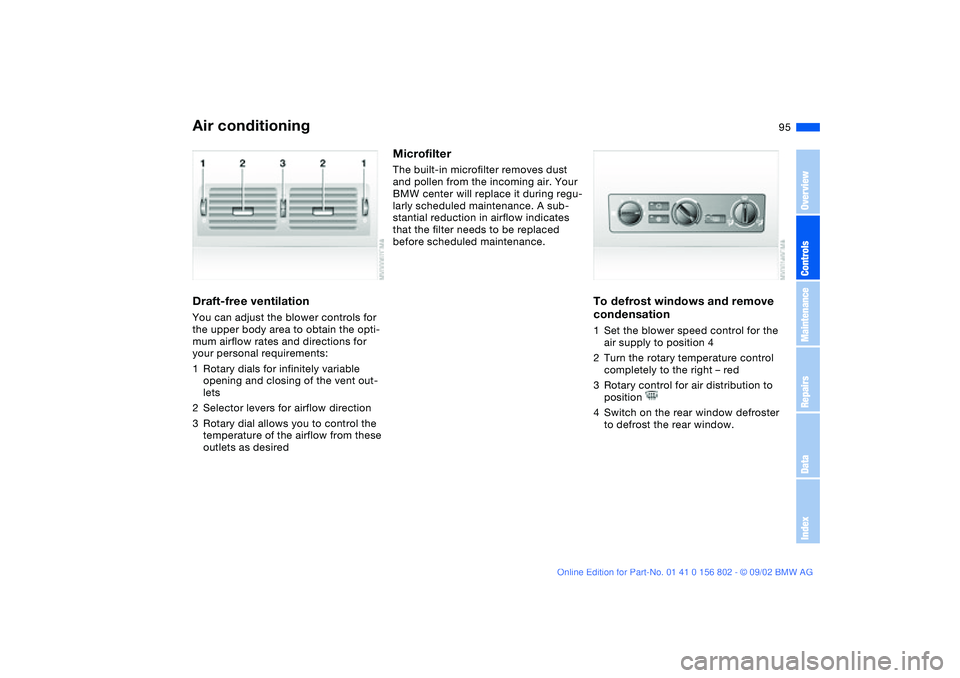
Draft-free ventilationYou can adjust the blower controls for
the upper body area to obtain the opti-
mum airflow rates and directions for
your personal requirements:
1Rotary dials for infinitely variable
opening and closing of the vent out-
lets
2Selector levers for airflow direction
3Rotary dial allows you to control the
temperature of the airflow from these
outlets as desired
MicrofilterThe built-in microfilter removes dust
and pollen from the incoming air. Your
BMW center will replace it during regu-
larly scheduled maintenance. A sub-
stantial reduction in airflow indicates
that the filter needs to be replaced
before scheduled maintenance.
To defrost windows and remove
condensation1Set the blower speed control for the
air supply to position 4
2Turn the rotary temperature control
completely to the right – red
3Rotary control for air distribution to
position
4Switch on the rear window defroster
to defrost the rear window.
Air conditioning
OverviewControlsMaintenanceRepairsDataIndex
handbook.book Page 95 Saturday, July 27, 2002 1:36 PM
Page 97 of 166
97
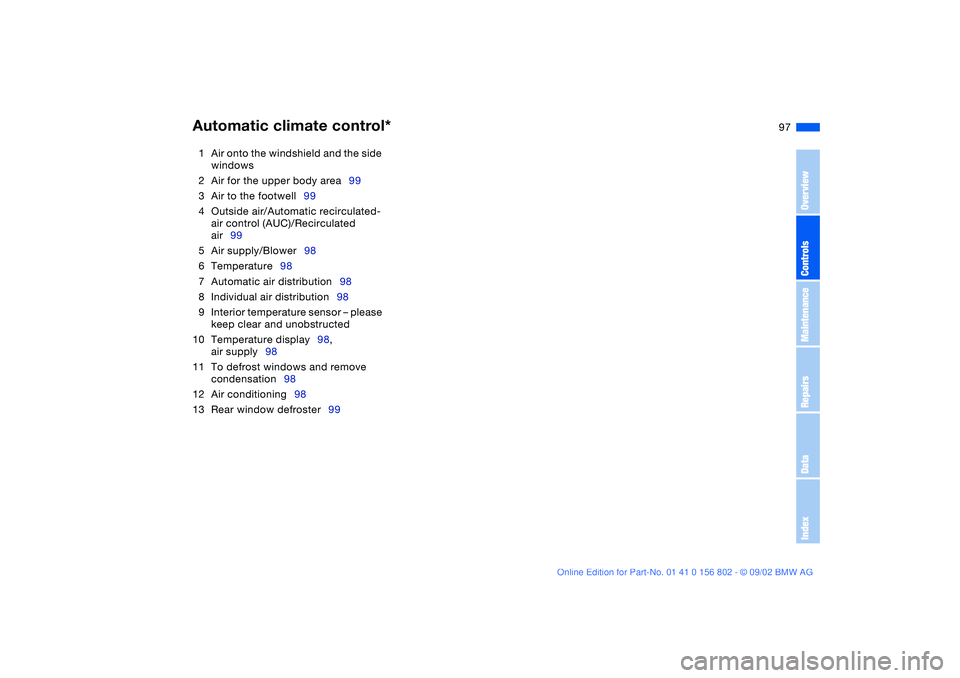
1Air onto the windshield and the side
windows
2Air for the upper body area99
3Air to the footwell99
4Outside air/Automatic recirculated-
air control (AUC)/Recirculated
air99
5Air supply/Blower98
6Temperature98
7Automatic air distribution98
8Individual air distribution98
9Interior temperature sensor – please
keep clear and unobstructed
10 Temperature display98,
air supply98
11 To defrost windows and remove
condensation98
12 Air conditioning98
13 Rear window defroster99Automatic climate control*
OverviewControlsMaintenanceRepairsDataIndex
handbook.book Page 97 Saturday, July 27, 2002 1:36 PM
Page 98 of 166
98
Tips for pleasant drivingUse the automatic mode by pressing
AUTO button 7. Select an interior tem-
perature that is comfortable for you.
Detailed setting options are described
for you in the following section.
You can make the settings of your
vehicle in such a manner that
when you unlock the vehicle with the
remote control of your personal key,
your own personalized setting for the
automatic climate control is initiated.
The AUTO program adjusts the
air distribution and the air sup-
ply for you and in addition adapts the
temperature to external influences –
summer, winter – to meet preferences
you can specify.
Individual air distribution
You can cancel the AUTO pro-
gram by selecting specific dis-
tribution patterns to suit your
own individual requirements.
While the AUTO program is then deacti-
vated, the automatic airflow control
remains in operation. Air flows onto
windows , toward the upper body
, and into the footwell . You can
switch the automatic distribution of air
back on by selecting the AUTO button.Temperature
The interior temperature that
appears in the display panel is a
general figure intended for reference
purposes. We recommend 727/+226
as a comfortable setting, even if the air
conditioning is on. When you start the
vehicle, the system ensures that the
selected temperature is achieved as
quickly as possible regardless of the
season. It then maintains this tempera-
ture.
To select the units of measure 6/7 of
the display, refer to 75.
Air supply/Blower
Press the left or right half of the
button to regulate the air supply.
This deactivates the automatic control
of the air supply, AUTO disappears
from the display panel. Nevertheless,
the automatic air distribution remains
unchanged. You can reactivate the
automatic air distribution mode by
selecting the AUTO button.
When the lowest blower speed is set
and you press the left half of the button,
all of the displays are canceled: the
blower, heating and air conditioning are
switched off. The outside air supply is
blocked. You can reactivate the system
by pressing any button for the auto-
matic climate control.To defrost windows and remove
condensation
This program quickly removes
ice and condensation from the
windshield and the side windows.
Air conditioning
The air is cooled and dehumidi-
fied and – depending on the
temperature setting – rewarmed.
Depending on the weather, the wind-
shield may fog over briefly when the
engine is started. Air conditioning helps
prevent the windows from fogging up.
Condensation forms during opera-
tion of the air conditioning system,
which then exits under the vehicle. It is
thus not unusual for a small puddle to
form under the car while the system is
running.<
Automatic climate control*
handbook.book Page 98 Saturday, July 27, 2002 1:36 PM
Page 101 of 166
101 Interior conveniences
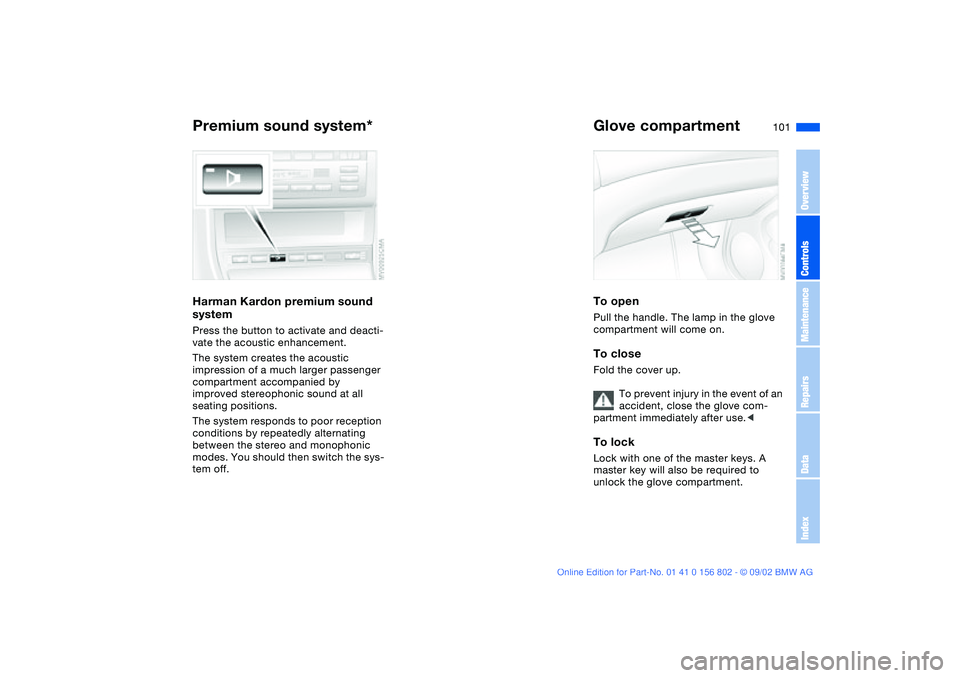
Premium sound system*Harman Kardon premium sound
systemPress the button to activate and deacti-
vate the acoustic enhancement.
The system creates the acoustic
impression of a much larger passenger
compartment accompanied by
improved stereophonic sound at all
seating positions.
The system responds to poor reception
conditions by repeatedly alternating
between the stereo and monophonic
modes. You should then switch the sys-
tem off.
Glove compartmentTo openPull the handle. The lamp in the glove
compartment will come on.To closeFold the cover up.
To prevent injury in the event of an
accident, close the glove com-
partment immediately after use.
unlock the glove compartment.
OverviewControlsMaintenanceRepairsDataIndex
handbook.book Page 101 Saturday, July 27, 2002 1:36 PM
Page 117 of 166
117 Wheels and tires
Tire inflation pressureInformation for your safetyThe factory-approved tires are matched
to your vehicle and have been selected
to provide optimum safety and driving
comfort when used properly.
It is not merely the tire's service life, but
also driving comfort and – above all else
– driving safety that depend on the con-
dition of the tires and the maintenance
of the specified tire inflation pressure.
Incorrect tire inflation pressure is a fre-
quent cause of tire damage. It also sig-
nificantly influences the roadholding
ability of your BMW.
Be sure to check the tire inflation
pressure, including the space-
saver spare tire or the spare tire, on a
regular basis, at least twice a month
and before every extended journey,
refer to page 25. If this is not done,
incorrect tire pressures can cause driv-
ing instability and tire damage, ulti-
mately resulting in an accident.<
Tire conditionTire tread – tire damageInspect your tires frequently for tread
wear, signs of damage and for foreign
objects lodged in the tread. Check the
tread depth.
Tread depth should not be allowed to
go below 1/8 in / 3 mm, even though
the legally specified minimum tread
depth is 1/16 in / 1.6 mm.
Below 1/8 in / 3 mm tread depth, there
is a great risk of hydroplaning, even at
relatively moderate speeds and with
only small amounts of water on the
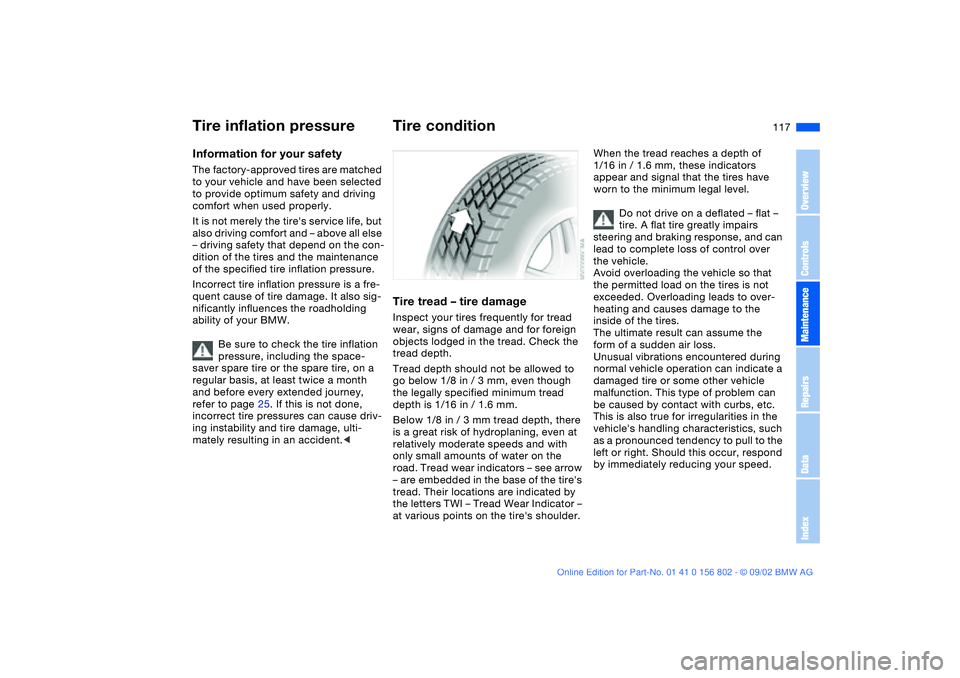
road. Tread wear indicators – see arrow
– are embedded in the base of the tire's
tread. Their locations are indicated by
the letters TWI – Tread Wear Indicator –
at various points on the tire's shoulder.
When the tread reaches a depth of
1/16 in / 1.6 mm, these indicators
appear and signal that the tires have
worn to the minimum legal level.
Do not drive on a deflated – flat –
tire. A flat tire greatly impairs
steering and braking response, and can
lead to complete loss of control over
the vehicle.
Avoid overloading the vehicle so that
the permitted load on the tires is not
exceeded. Overloading leads to over-
heating and causes damage to the
inside of the tires.
The ultimate result can assume the
form of a sudden air loss.
Unusual vibrations encountered during
normal vehicle operation can indicate a
damaged tire or some other vehicle
malfunction. This type of problem can
be caused by contact with curbs, etc.
This is also true for irregularities in the
vehicle's handling characteristics, such
as a pronounced tendency to pull to the
left or right. Should this occur, respond
by immediately reducing your speed.
OverviewControlsMaintenanceRepairsDataIndex
handbook.book Page 117 Saturday, July 27, 2002 1:36 PM
Page 118 of 166
118
Proceed carefully to the nearest BMW
center or professional tire center, or
have the vehicle towed in to have it, its
wheels or its tires inspected.
Tire damage, up to and including sud-
den and complete air loss, can endan-
ger the lives of both the vehicle occu-
pants and other road users.<
Tire replacementTo maintain good handling and vehicle
response, use only tires of a single
tread configuration from a single manu-
facturer.DOT quality gradesTread wear
Traction AA A B C
Temperature A B C
All passenger car tires must con-
form to Federal Safety Require-
ments in addition to these grades.
when tested under controlled condi-
tions on a specified government test
course.
For example, a tire graded 150 would
wear one and one-half – 1
1/2 – times as
well on the government course as a tire
graded 100. The relative performance
of tires depends upon the actual condi-
tions of their use, however, and may
depart significantly from the norm due
to variations in driving habits, service
practices and differences in road char-
acteristics and climate.
TractionThe traction grades, from highest to
lowest, are AA, A, B, and C.
Those grades represent the tire's ability
to stop on wet pavement as measured
under controlled conditions on speci-
fied government test surfaces of
asphalt and concrete. A tire marked C
may have poor traction performance.
The traction grade assigned to
this tire is based on straight-
ahead braking traction tests, and does
not include acceleration, cornering,
hydroplaning, or peak traction charac-
teristics.
tire's resistance to the generation of
heat and its ability to dissipate heat
when tested under controlled condi-
tions on a specified indoor laboratory
test wheel.
Sustained high temperature can cause
the material of the tire to degenerate
and reduce tire life, and excessive tem-
perature can lead to sudden tire failure.
The grade C corresponds to a level of
performance which all passenger car
Tire condition
handbook.book Page 118 Saturday, July 27, 2002 1:36 PM
Page 120 of 166
120
Wheel and tire combinationsThe right choice
BMW recommends using only
wheels and tires that have been
approved by BMW for your particular
vehicle model, as otherwise body con-
tact and serious accidents can result
despite the use of the same nominal
size, e.g. due to manufacturing toler-
ances. BMW cannot evaluate all tires
and wheels on the market, and is thus
unable to guarantee that the vehicle will
continue to perform safely if unap-
proved tires and/or wheels are
mounted.<
For each tire size, BMW has assessed
the safe performance of specific tire
brands and approved them for use.
Consult any BMW center for details.
Comply with any local/national regula-
tions, for example by recording the tire
type in the vehicle documents.
The correct wheel-tire combina-
tion affects different systems such
as ABS, ASC+T/DSC and ADB/
ADB-X/DBC. The function of these sys-
tems is impaired if improper wheel-tire
combinations are used. For this reason,
use only tires of the same manufacture
and tread configuration. In the event of
a flat tire, for example, remount the
approved wheel and tire combination
as soon as possible.
possible. Protect the tires against con-
tact with oil, grease and fuel.
Winter tiresChoosing the right tireBMW recommends winter tires – M+S
tires – for operation under inclement
winter driving conditions. While all-sea-
son tires – M+S designation – provide
better winter traction than the corre-
sponding summer tires, they generally
do not achieve the performance of win-
ter tires.
In the interest of safe tracking and
steering response, install winter tires
made by the same manufacturer and
having the same tread configuration on
all four wheels.
Never exceed the maximum
speed for which the winter tires
are rated.
Unprofessional attempts by laymen to
service tires can lead to damage and
accidents.
Have this work performed by trained
professionals only. Any BMW center
has the required technical knowledge
and the proper equipment and will be
happy to assist you.<
handbook.book Page 120 Saturday, July 27, 2002 1:36 PM
Page 121 of 166
121
Tire condition, tire pressureAt tread depths below approx. 3/16 in /
4 mm, winter tires display a perceptible
decrease in their ability to cope with
winter driving conditions, and should be
replaced in the interest of safety.
Comply with the specified tire inflation
pressures — and be sure to have the
wheel and tire assembly balanced
every time you change a tire or wheel.Snow chains*Only certain snow chains have been
tested by BMW and determined and
approved as roadworthy. Consult any
BMW center for details. BMW recom-
mends using only these approved fine-
link snow chains. Use them in pairs on
either summer or winter tires, but only
on both rear wheels.
BMW 325xi: in an extreme emergency –
for instance, with the vehicle stuck on
one side, or when obstructions make it
impossible to reach one tire – a chain
may also be mounted on just one tire
for the limited period needed to resolve
the problem.
Comply with all manufacturer's safety
precautions when mounting the chains.
Do not exceed a speed of 30 mph /
50 km/h when unsing snow chains.You cannot mount snow chains on the
following tires:
225/50 R 16
225/45 R 17
245/40 R 17
225/40 R 18
255/35 R 18Winter tires
OverviewControlsMaintenanceRepairsDataIndex
handbook.book Page 121 Saturday, July 27, 2002 1:36 PM
Page 130 of 166
130Maintenance
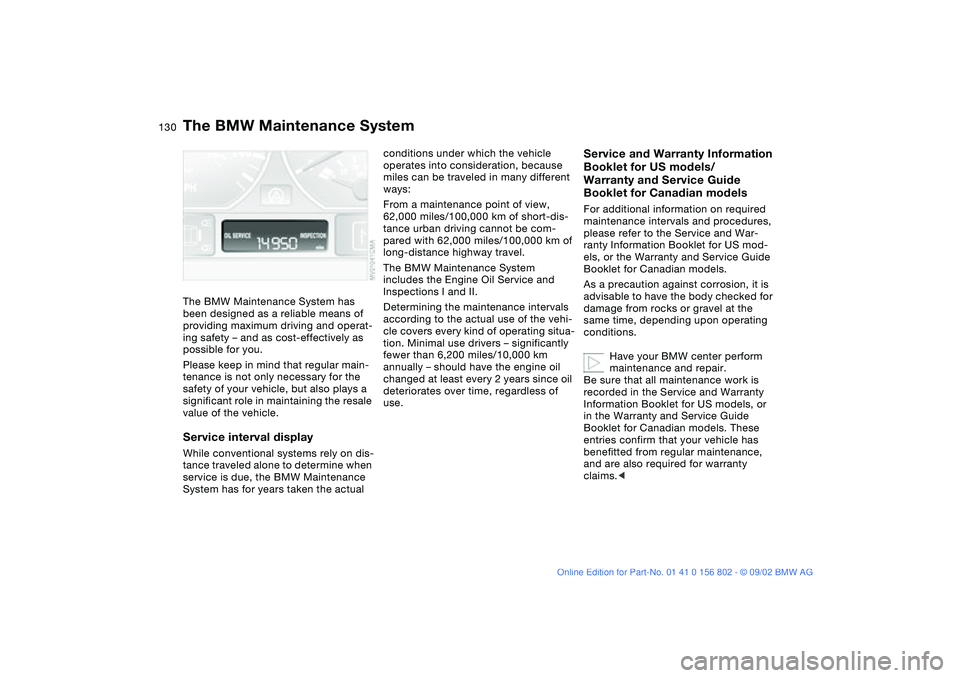
The BMW Maintenance SystemThe BMW Maintenance System has
been designed as a reliable means of
providing maximum driving and operat-
ing safety – and as cost-effectively as
possible for you.
Please keep in mind that regular main-
tenance is not only necessary for the
safety of your vehicle, but also plays a
significant role in maintaining the resale
value of the vehicle.Service interval displayWhile conventional systems rely on dis-
tance traveled alone to determine when
service is due, the BMW Maintenance
System has for years taken the actual
conditions under which the vehicle
operates into consideration, because
miles can be traveled in many different
ways:
From a maintenance point of view,
62,000 miles/100,000 km of short-dis-
tance urban driving cannot be com-
pared with 62,000 miles/100,000 km of
long-distance highway travel.
The BMW Maintenance System
includes the Engine Oil Service and
Inspections I and II.
Determining the maintenance intervals
according to the actual use of the vehi-
cle covers every kind of operating situa-
tion. Minimal use drivers – significantly
fewer than 6,200 miles/10,000 km
annually – should have the engine oil
changed at least every 2 years since oil
deteriorates over time, regardless of
use.
Service and Warranty Information
Booklet for US models/
Warranty and Service Guide
Booklet for Canadian modelsFor additional information on required
maintenance intervals and procedures,
please refer to the Service and War-
ranty Information Booklet for US mod-
els, or the Warranty and Service Guide
Booklet for Canadian models.
As a precaution against corrosion, it is
advisable to have the body checked for
damage from rocks or gravel at the
same time, depending upon operating
conditions.
Have your BMW center perform
maintenance and repair.
Be sure that all maintenance work is
recorded in the Service and Warranty
Information Booklet for US models, or
in the Warranty and Service Guide
Booklet for Canadian models. These
entries confirm that your vehicle has
benefitted from regular maintenance,
and are also required for warranty
claims.<
handbook.book Page 130 Saturday, July 27, 2002 1:36 PM
Page 158 of 166
Everything from A to ZA
ABS Antilock Brake System
18, 115
Accessories 4, 5
Activated-charcoal filter 100
ADB Automatic Differential
Brake 78
Adding brake fluid 129
Air conditioning 92
Air distribution 94, 98
Air nozzles 92, 96
Air outlets 92, 96
Air pressure 117
check 25
Air supply 94, 98
Airbags 18, 52
Alarm system 37
Antifreeze agent 128
Antilock Brake System (ABS)
18, 115
Anti-theft system 37
Armrest 102
ASC+T Automatic Stability
Control plus Traction 18,
19, 78
Ashtray
front 104
rear 104
AUC Automatic recircu-
lated-air control 99Automatic car wash, refer to
the Caring for your vehicle
brochure
Automatic climate control 96
Automatic cruise control 69
Automatic Differential Brake
(ADB) 78
Automatic dimming, interior
rearview mirror 51
Automatic headlamp
control 89
Automatic recirculated-air
control (AUC) 99
Automatic Stability Control
plus Traction (ASC+T) 18,
19, 78
Automatic transmission with
Steptronic 19, 63
Average fuel
consumption 76
Average speed 76
Avoiding unintentional
alarms 38
Axle loads 154
B
Backrest, adjusting 44, 45
Backup lamps 62
replacing bulb 139
Battery
charge 146
discharged 146Battery charge current 18
Belts 47
Beverage holder 103
Blower 94, 98
BMW High Performance
Synthetic Oils 127
BMW sports seat 45, 46
Bore 152
Bottle holder, see Beverage
holder 103
Brake hydraulic system 18
Brake lamps
replacing bulb 139
Brake pads 19
Brake, parking 61
Brakes, malfunctions 116
Break-in procedures 114
Bulb, replacing 137
C
California Proposition 65
warning 132
Can holder, see Beverage
holder 103
Capacities 155
Car care, refer to the Caring
for your vehicle brochure
Car radio
refer to the Owner's Man-
ual for RadioCar telephone
refer to the separate
Owner's Manual
Car vacuum cleaner, con-
necting 104
Car wash, refer to the Caring
for your vehicle brochure
Cargo area 36, 107
capacity 154
emergency operation 35
floor 36
floor panel 109
remote control 32
Cargo area cover 107
Cargo area lamps 34
Cargo loading 109
Cargo, securing 110
Cassette player operation,
refer to the Owner's Man-
ual for Radio
CBC Cornering Brake
Control 18, 115
CD player operation, refer to
the Owner's Manual for
Radio
Cellular phone 103
Center armrest 102
Center high-mount brake
lamp 140
Central locking system 30
button 34
Charge indicator lamp 18
handbook.book Page 158 Saturday, July 27, 2002 1:36 PM