maintenance BMW 325IT WAGON 2003 Workshop Manual
[x] Cancel search | Manufacturer: BMW, Model Year: 2003, Model line: 325IT WAGON, Model: BMW 325IT WAGON 2003Pages: 166, PDF Size: 4.29 MB
Page 103 of 166
103
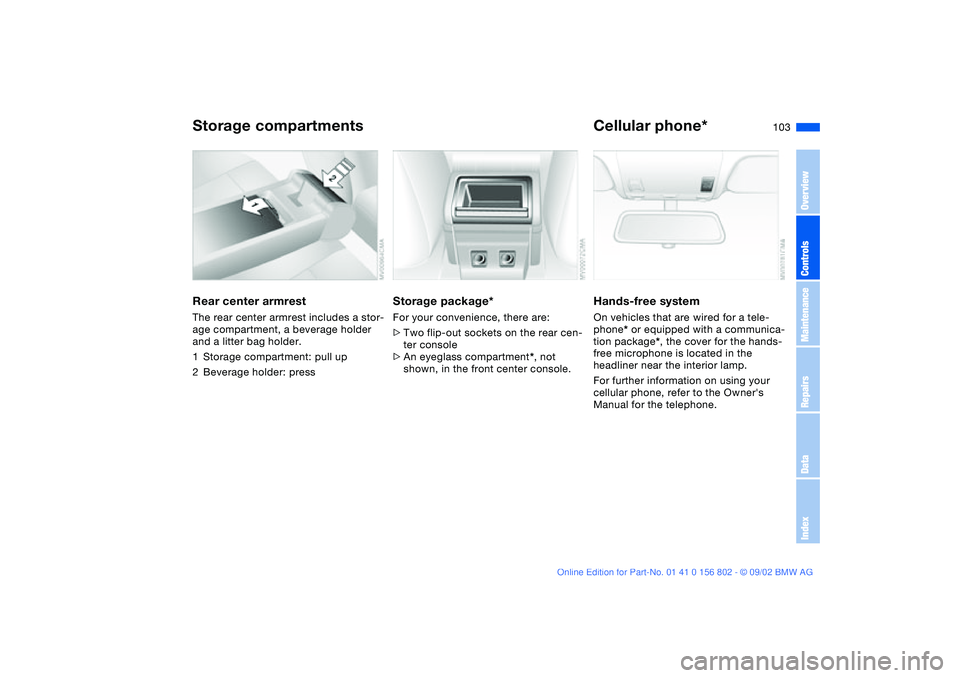
Rear center armrestThe rear center armrest includes a stor-
age compartment, a beverage holder
and a litter bag holder.
1Storage compartment: pull up
2Beverage holder: press
Storage package*For your convenience, there are:
>Two flip-out sockets on the rear cen-
ter console
>An eyeglass compartment*, not
shown, in the front center console.
Cellular phone*Hands-free systemOn vehicles that are wired for a tele-
phone* or equipped with a communica-
tion package*, the cover for the hands-
free microphone is located in the
headliner near the interior lamp.
For further information on using your
cellular phone, refer to the Owner's
Manual for the telephone.
Storage compartments
OverviewControlsMaintenanceRepairsDataIndex
handbook.book Page 103 Saturday, July 27, 2002 1:36 PM
Page 105 of 166
105
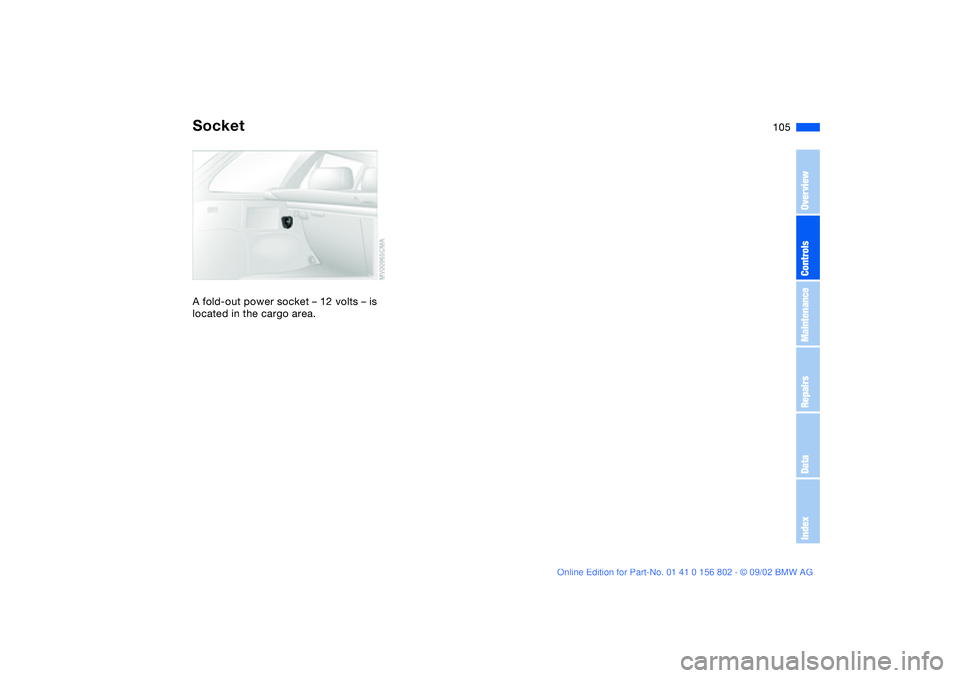
SocketA fold-out power socket – 12 volts – is
located in the cargo area.
OverviewControlsMaintenanceRepairsDataIndex
handbook.book Page 105 Saturday, July 27, 2002 1:36 PM
Page 107 of 166
107
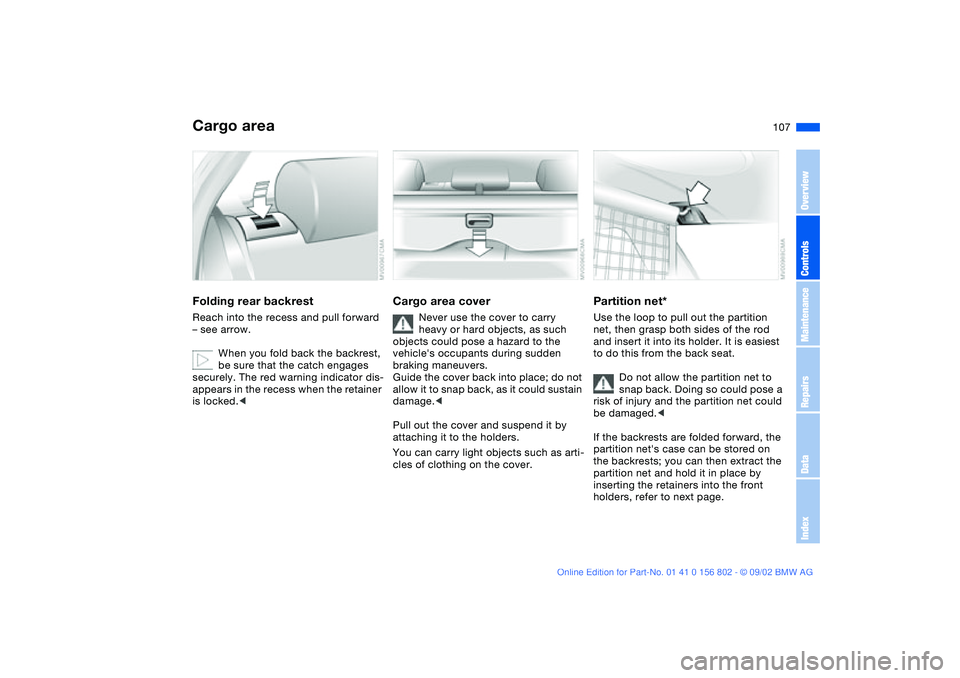
Cargo areaFolding rear backrestReach into the recess and pull forward
– see arrow.
When you fold back the backrest,
be sure that the catch engages
securely. The red warning indicator dis-
appears in the recess when the retainer
is locked.<
Cargo area cover
Never use the cover to carry
heavy or hard objects, as such
objects could pose a hazard to the
vehicle's occupants during sudden
braking maneuvers.
Guide the cover back into place; do not
allow it to snap back, as it could sustain
damage.<
Pull out the cover and suspend it by
attaching it to the holders.
You can carry light objects such as arti-
cles of clothing on the cover.
Partition net*Use the loop to pull out the partition
net, then grasp both sides of the rod
and insert it into its holder. It is easiest
to do this from the back seat.
Do not allow the partition net to
snap back. Doing so could pose a
risk of injury and the partition net could
be damaged.<
If the backrests are folded forward, the
partition net's case can be stored on
the backrests; you can then extract the
partition net and hold it in place by
inserting the retainers into the front
holders, refer to next page.
OverviewControlsMaintenanceRepairsDataIndex
handbook.book Page 107 Saturday, July 27, 2002 1:36 PM
Page 109 of 166
109
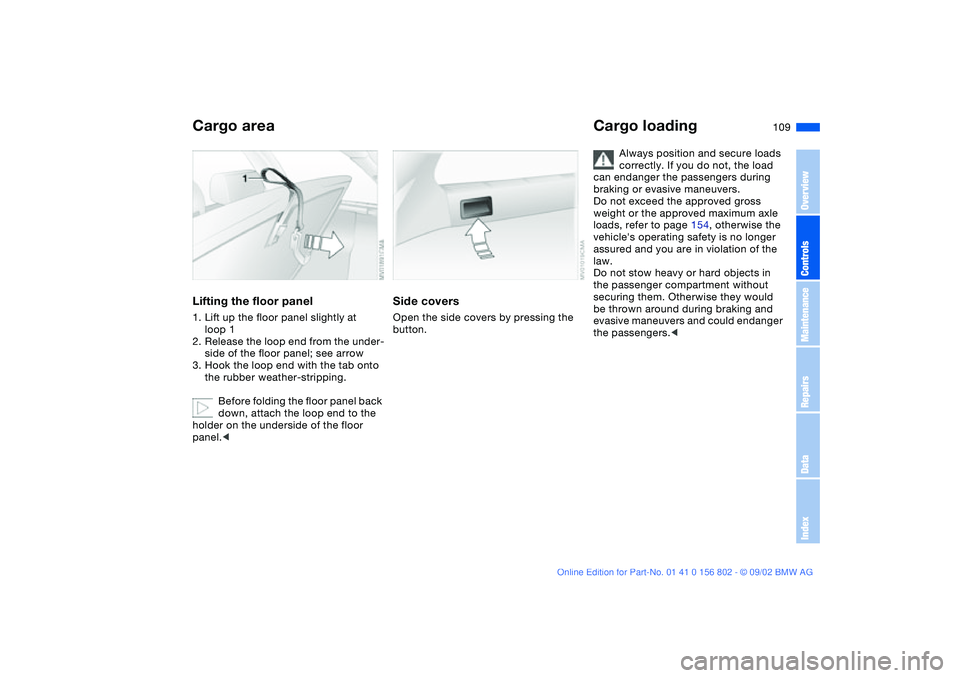
Lifting the floor panel1. Lift up the floor panel slightly at
loop 1
2. Release the loop end from the under-
side of the floor panel; see arrow
3. Hook the loop end with the tab onto
the rubber weather-stripping.
Before folding the floor panel back
down, attach the loop end to the
holder on the underside of the floor
panel.<
Side coversOpen the side covers by pressing the
button.
Cargo loading
Always position and secure loads
correctly. If you do not, the load
can endanger the passengers during
braking or evasive maneuvers.
Do not exceed the approved gross
weight or the approved maximum axle
loads, refer to page 154, otherwise the
vehicle's operating safety is no longer
assured and you are in violation of the
law.
Do not stow heavy or hard objects in
the passenger compartment without
securing them. Otherwise they would
be thrown around during braking and
evasive maneuvers and could endanger
the passengers.<
Cargo area
OverviewControlsMaintenanceRepairsDataIndex
handbook.book Page 109 Saturday, July 27, 2002 1:36 PM
Page 111 of 166
111
Roof-mounted luggage rack*A special roof-rack system is available
as an optional extra for your BMW.
Please observe the precautions
included with the installation instruc-
tions.AnchoragesAccess to the anchorages:
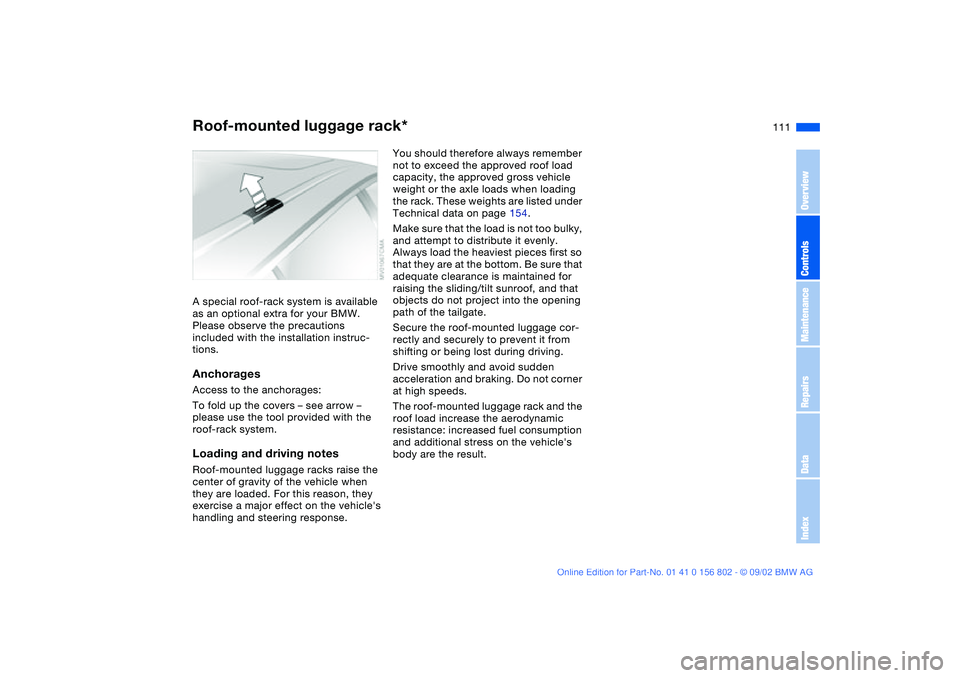
To fold up the covers – see arrow –
please use the tool provided with the
roof-rack system.Loading and driving notesRoof-mounted luggage racks raise the
center of gravity of the vehicle when
they are loaded. For this reason, they
exercise a major effect on the vehicle's
handling and steering response.
You should therefore always remember
not to exceed the approved roof load
capacity, the approved gross vehicle
weight or the axle loads when loading
the rack. These weights are listed under
Technical data on page 154.
Make sure that the load is not too bulky,
and attempt to distribute it evenly.
Always load the heaviest pieces first so
that they are at the bottom. Be sure that
adequate clearance is maintained for
raising the sliding/tilt sunroof, and that
objects do not project into the opening
path of the tailgate.
Secure the roof-mounted luggage cor-
rectly and securely to prevent it from
shifting or being lost during driving.
Drive smoothly and avoid sudden
acceleration and braking. Do not corner
at high speeds.
The roof-mounted luggage rack and the
roof load increase the aerodynamic
resistance: increased fuel consumption
and additional stress on the vehicle's
body are the result.
OverviewControlsMaintenanceRepairsDataIndex
handbook.book Page 111 Saturday, July 27, 2002 1:36 PM
Page 113 of 166
113
Overview
Controls and features
Operation, maintenance
Owner service procedures
Technical data
Index
OverviewControlsMaintenanceRepairsDataIndex
handbook.book Page 113 Saturday, July 27, 2002 1:36 PM
Page 115 of 166
115
Driving notes
Brakes: do not drive with your foot
resting on the brake pedal. Even
light but consistent pressure on the
brake pedal can lead to high tempera-
tures, accelerated brake wear and pos-
sibly even brake failure.
Hydroplaning: when driving on wet or
slushy roads, reduce your speed. If you
do not, a wedge of water may form
between tires and road surface. This
phenomenon can lead to partial or
complete loss of contact between the
tires and road surface, as well as loss of
vehicle control and braking ability.
Driving through water: do not drive
through water on the road if it is deeper
than 1 ft/30 cm, and then only at walk-
ing speed. Otherwise, the vehicle's
engine, the electrical systems and the
transmission may be damaged.
Cargo area cover: never use it to store
heavy or hard objects, as otherwise
occupants could be injured during
braking maneuvers.
Clothes hooks: when hanging clothing
from the hooks, be sure that they will
not obstruct the driver's vision. Do not
hang heavy objects on the hooks. If you
do so, they could cause personal injury
during braking or evasive maneuvers.<
Antilock Brake System (ABS)The conceptABS keeps the wheels from locking
during braking, thereby enhancing
active driving safety.Braking with ABSIf you are in a situation that requires full
braking, you will exploit the full benefits
of ABS system if you apply maximum
pedal pressure – panic stop. Since the
vehicle maintains steering responsive-
ness, you can avoid possible obstacles
with a minimum of steering effort,
despite the full brake application.
Pulsation at the brake pedal combined
with sounds from the hydraulic circuits
indicates to the driver that ABS is in its
active mode.Dynamic Brake Control (DBC)DBC is included in the DSC, refer to
page 80.
The system responds to sudden, high-
intensity applications of force to the
brake pedal by automatically braking
the vehicle with maximum boost to
achieve the shortest-possible braking
distances during "panic stops". This
system exploits all the benefits of ABS.Do not reduce the pressure exerted
against the brake pedal until the brak-
ing maneuver has been completed.
DBC is deactivated when you release
the brake pedal.
Cornering Brake Control (CBC)CBC is an advanced engineering devel-
opment of ABS. When braking during
cornering with high lateral accelera-
tion, or when braking during a lane
change, vehicle stability is improved
and the steering response is enhanced.
OverviewControlsMaintenanceRepairsDataIndex
handbook.book Page 115 Saturday, July 27, 2002 1:36 PM
Page 117 of 166
117 Wheels and tires
Tire inflation pressureInformation for your safetyThe factory-approved tires are matched
to your vehicle and have been selected
to provide optimum safety and driving
comfort when used properly.
It is not merely the tire's service life, but
also driving comfort and – above all else
– driving safety that depend on the con-
dition of the tires and the maintenance
of the specified tire inflation pressure.
Incorrect tire inflation pressure is a fre-
quent cause of tire damage. It also sig-
nificantly influences the roadholding
ability of your BMW.
Be sure to check the tire inflation
pressure, including the space-
saver spare tire or the spare tire, on a
regular basis, at least twice a month
and before every extended journey,
refer to page 25. If this is not done,
incorrect tire pressures can cause driv-
ing instability and tire damage, ulti-
mately resulting in an accident.<
Tire conditionTire tread – tire damageInspect your tires frequently for tread
wear, signs of damage and for foreign
objects lodged in the tread. Check the
tread depth.
Tread depth should not be allowed to
go below 1/8 in / 3 mm, even though
the legally specified minimum tread
depth is 1/16 in / 1.6 mm.
Below 1/8 in / 3 mm tread depth, there
is a great risk of hydroplaning, even at
relatively moderate speeds and with
only small amounts of water on the
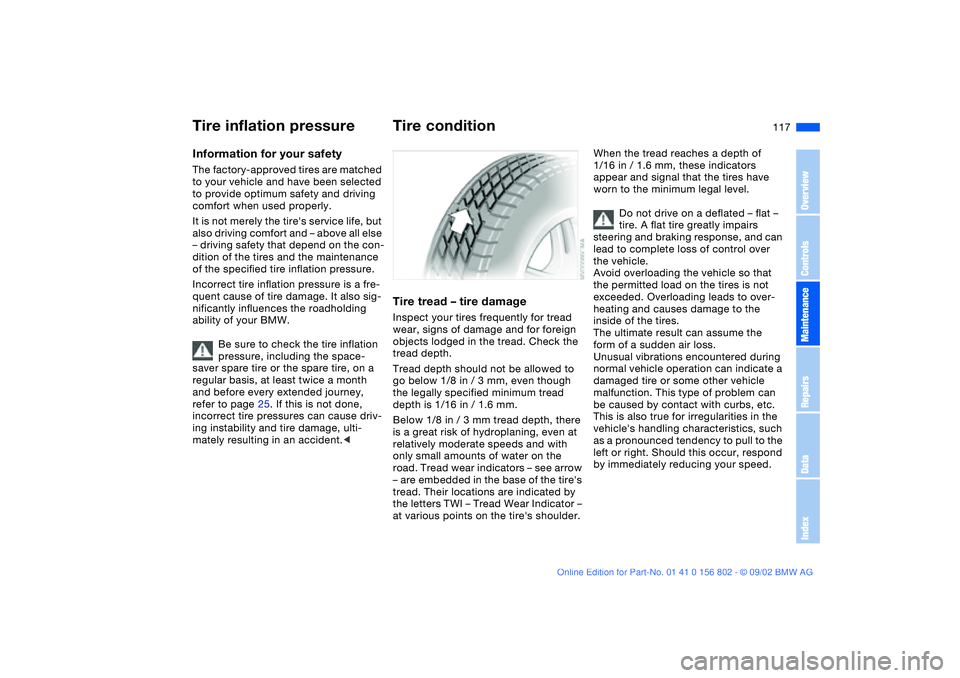
road. Tread wear indicators – see arrow
– are embedded in the base of the tire's
tread. Their locations are indicated by
the letters TWI – Tread Wear Indicator –
at various points on the tire's shoulder.
When the tread reaches a depth of
1/16 in / 1.6 mm, these indicators
appear and signal that the tires have
worn to the minimum legal level.
Do not drive on a deflated – flat –
tire. A flat tire greatly impairs
steering and braking response, and can
lead to complete loss of control over
the vehicle.
Avoid overloading the vehicle so that
the permitted load on the tires is not
exceeded. Overloading leads to over-
heating and causes damage to the
inside of the tires.
The ultimate result can assume the
form of a sudden air loss.
Unusual vibrations encountered during
normal vehicle operation can indicate a
damaged tire or some other vehicle
malfunction. This type of problem can
be caused by contact with curbs, etc.
This is also true for irregularities in the
vehicle's handling characteristics, such
as a pronounced tendency to pull to the
left or right. Should this occur, respond
by immediately reducing your speed.
OverviewControlsMaintenanceRepairsDataIndex
handbook.book Page 117 Saturday, July 27, 2002 1:36 PM
Page 119 of 166
119
tires must meet under the Federal
Motor Vehicle Safety Standard No. 109.
Grades B and A represent higher levels
of performance on the laboratory test
wheel than the minimum required by
law.
The temperature grade for this tire
is established for a tire that is
properly inflated and not overloaded.
Excessive speed, underinflation, or
excessive loading, either separately or
in combination, can cause heat buildup
and possible tire failure.
tread shoulder and maximum section
width. For example:
Tread wear 200
Traction AA
Temperature A
BMW advises against using
retreaded tires, since driving
safety may be impaired. This is due to
the possible variations in casing struc-
tures and, in some cases, to their
extreme age, which can lead to a
decrease in their durability.<
Tire ageThe date on which the tire was manu-
factured is indicated by the code on the
sidewall:
DOT... 3502 indicates that the tire was
manufactured in week 35 of the year
2002.
BMW recommends the replacement of
all tires – including the spare tire* –
when the tires are no more than 6 years
old, even if a tire life of 10 years is pos-
sible.Run Flat tires*Run Flat tires consist of self-supporting
tires and special rims. The tire rein-
forcement ensures that the tire retains
some residual safety in the event of
pressure drop and driving remains pos-
sible to a restricted degree. The vehicle
is equipped with a Tire Pressure Moni-
tor (TPM) or Flat Tire Monitor, which
indicate a flat tire. For additional infor-
mation on the Tire Pressure Monitor
(TPM) or Flat Tire Monitor, refer to
page 85 or 86.
Run Flat tires are only possible in
conjunction with the Tire Pres-
sure Monitor (TPM) or Flat Tire Moni-
tor.<
Tire replacement
OverviewControlsMaintenanceRepairsDataIndex
handbook.book Page 119 Saturday, July 27, 2002 1:36 PM
Page 121 of 166
121
Tire condition, tire pressureAt tread depths below approx. 3/16 in /
4 mm, winter tires display a perceptible
decrease in their ability to cope with
winter driving conditions, and should be
replaced in the interest of safety.
Comply with the specified tire inflation
pressures — and be sure to have the
wheel and tire assembly balanced
every time you change a tire or wheel.Snow chains*Only certain snow chains have been
tested by BMW and determined and
approved as roadworthy. Consult any
BMW center for details. BMW recom-
mends using only these approved fine-
link snow chains. Use them in pairs on
either summer or winter tires, but only
on both rear wheels.
BMW 325xi: in an extreme emergency –
for instance, with the vehicle stuck on
one side, or when obstructions make it
impossible to reach one tire – a chain
may also be mounted on just one tire
for the limited period needed to resolve
the problem.
Comply with all manufacturer's safety
precautions when mounting the chains.
Do not exceed a speed of 30 mph /
50 km/h when unsing snow chains.You cannot mount snow chains on the
following tires:
225/50 R 16
225/45 R 17
245/40 R 17
225/40 R 18
255/35 R 18Winter tires
OverviewControlsMaintenanceRepairsDataIndex
handbook.book Page 121 Saturday, July 27, 2002 1:36 PM