check engine BMW 325XI 2001 User Guide
[x] Cancel search | Manufacturer: BMW, Model Year: 2001, Model line: 325XI, Model: BMW 325XI 2001Pages: 211, PDF Size: 2.1 MB
Page 119 of 211
119n
IndexDataTechnologyRepairsCar careControlsOverview
Antilock Brake System (ABS)consequences of brake applications
with inadequate clearances for safety
between vehicles, when exceeding the
speed limit, or the risks involved when
aquaplaning occurs. Responsibility for
these types of situations remains in the
hands (and at the feet) of the driver. You
should never allow the added safety of
ABS to mislead you into taking
increased risks.
Do not make any modifications to
the ABS system. Service proce-
dures on ABS are to be performed by
authorized technicians only.
opment of ABS. When braking during
cornering with high lateral accelera-
tion, or when braking during a lane
change, vehicle stability is improved
and the steering response is enhanced.In the event of a fault
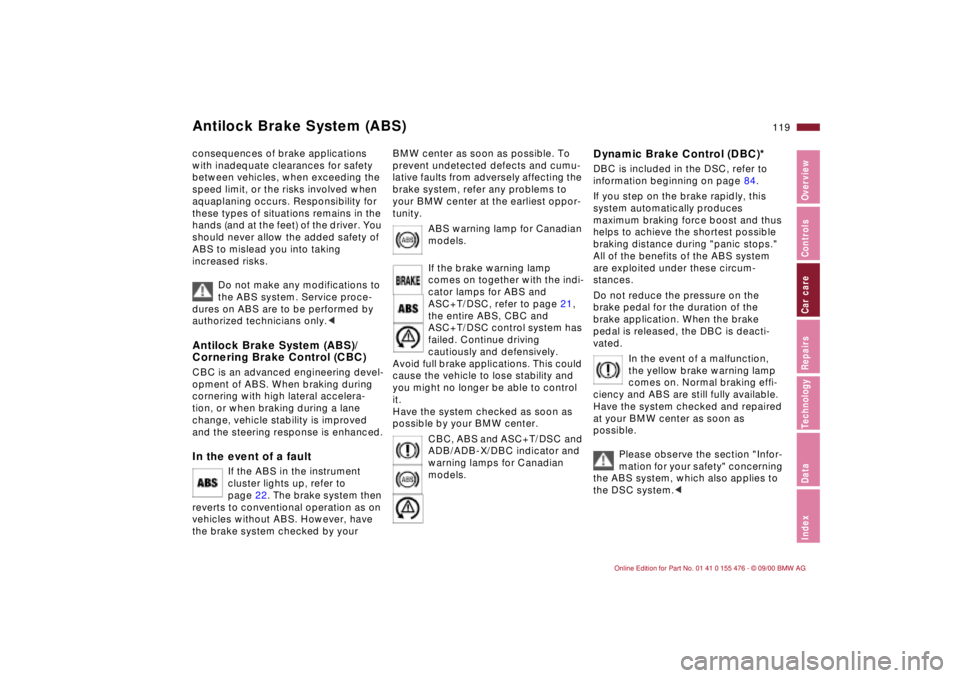
If the ABS in the instrument
cluster lights up, refer to
page 22. The brake system then
reverts to conventional operation as on
vehicles without ABS. However, have
the brake system checked by your
BMW center as soon as possible. To
prevent undetected defects and cumu-
lative faults from adversely affecting the
brake system, refer any problems to
your BMW center at the earliest oppor-
tunity.
ABS warning lamp for Canadian
models.
If the brake warning lamp
comes on together with the indi-
cator lamps for ABS and
ASC+T/DSC, refer to page 21,
the entire ABS, CBC and
ASC+T/DSC control system has
failed. Continue driving
cautiously and defensively.
Avoid full brake applications. This could
cause the vehicle to lose stability and
you might no longer be able to control
it.
Have the system checked as soon as
possible by your BMW center.
CBC, ABS and ASC+T/DSC
and
ADB/ADB-X/DBC indicator and
warning lamps for Canadian
models.
Dynamic Brake Control (DBC)*DBC is included in the DSC, refer to
information beginning on page 84.
If you step on the brake rapidly, this
system automatically produces
maximum braking force boost and thus
helps to achieve the shortest possible
braking distance during "panic stops."
All of the benefits of the ABS system
are exploited under these circum-
stances.
Do not reduce the pressure on the
brake pedal for the duration of the
brake application. When the brake
pedal is released, the DBC is deacti-
vated.
In the event of a malfunction,
the yellow brake warning lamp
comes on. Normal braking effi-
ciency and ABS are still fully available.
Have the system checked and repaired
at your BMW center as soon as
possible.
Please observe the section "Infor-
mation for your safety" concerning
the ABS system, which also applies to
the DSC system.<
Page 139 of 211
139n
IndexDataTechnologyRepairsCar careControlsOverview
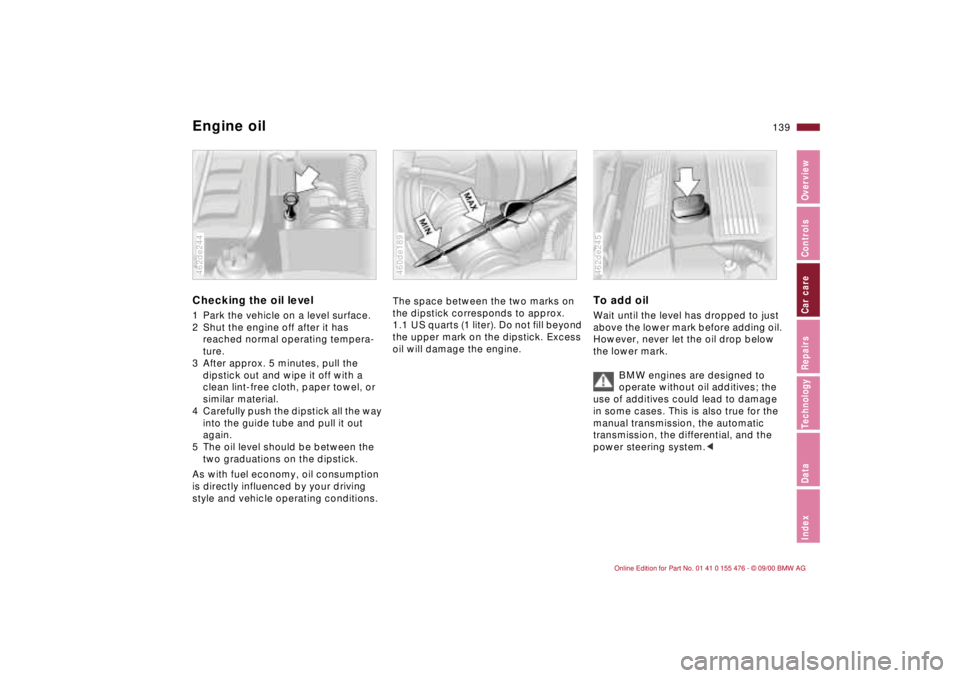
Engine oilChecking the oil level 1 Park the vehicle on a level surface.
2 Shut the engine off after it has
reached normal operating tempera-
ture.
3 After approx. 5 minutes, pull the
dipstick out and wipe it off with a
clean lint-free cloth, paper towel, or
similar material.
4 Carefully push the dipstick all the way
into the guide tube and pull it out
again.
5 The oil level should be between the
two graduations on the dipstick.
As with fuel economy, oil consumption
is directly influenced by your driving
style and vehicle operating conditions.462de244
The space between the two marks on
the dipstick corresponds to approx.
1.1 US quarts (1 liter). Do not fill beyond
the upper mark on the dipstick. Excess
oil will damage the engine.460de189
To add oil Wait until the level has dropped to just
above the lower mark before adding oil.
However, never let the oil drop below
the lower mark.
BMW engines are designed to
operate without oil additives; the
use of additives could lead to damage
in some cases. This is also true for the
manual transmission, the automatic
transmission, the differential, and the
power steering system.<462de245
Page 142 of 211
142n
Coolant
Do not add coolant to the cooling
system when the engine is hot. If
you attempt to do so, escaping coolant
can cause burns.
To avoid the possibility of damage later
on, never use anything other than
factory-approved, nitrite and amino-
free extended-duty antifreeze with
corrosion inhibitor. Your BMW center is
familiar with the official specifications.
Antifreeze and anticorrosion agents are
hazardous to health. You should always
store them in their original container
and in a location that is inaccessible to
children. Extended-duty antifreeze with
corrosion inhibitor contains ethylene
glycol, a flammable substance. For this
reason, do not spill antifreeze with
corrosion inhibitor on hot engine parts.
It could ignite and cause burns.<
Comply with the applicable envi-
ronmental laws regulating the
disposal of extended-duty antifreeze
with corrosion inhibitor.<
Checking coolant levelCorrect coolant level when the engine
is cold (approx. 68 7 or +20 6):
Unscrew the cap from the expansion
tank.
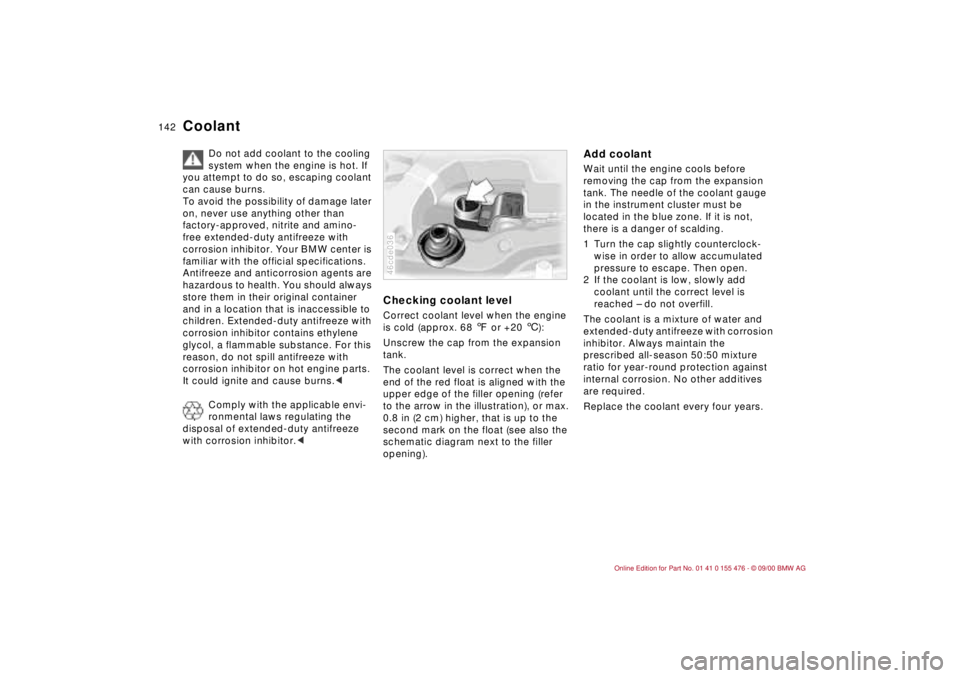
The coolant level is correct when the
end of the red float is aligned with the
upper edge of the filler opening (refer
to the arrow in the illustration), or max.
0.8 in (2 cm) higher, that is up to the
second mark on the float (see also the
schematic diagram next to the filler
opening).46cde036
Add coolant Wait until the engine cools before
removing the cap from the expansion
tank. The needle of the coolant gauge
in the instrument cluster must be
located in the blue zone. If it is not,
there is a danger of scalding.
1 Turn the cap slightly counterclock-
wise in order to allow accumulated
pressure to escape. Then open.
2 If the coolant is low, slowly add
coolant until the correct level is
reached Ð do not overfill.
The coolant is a mixture of water and
extended-duty antifreeze with corrosion
inhibitor. Always maintain the
prescribed all-season 50:50 mixture
ratio for year-round protection against
internal corrosion. No other additives
are required.
Replace the coolant every four years.
Page 143 of 211
143n
IndexDataTechnologyRepairsCar careControlsOverview
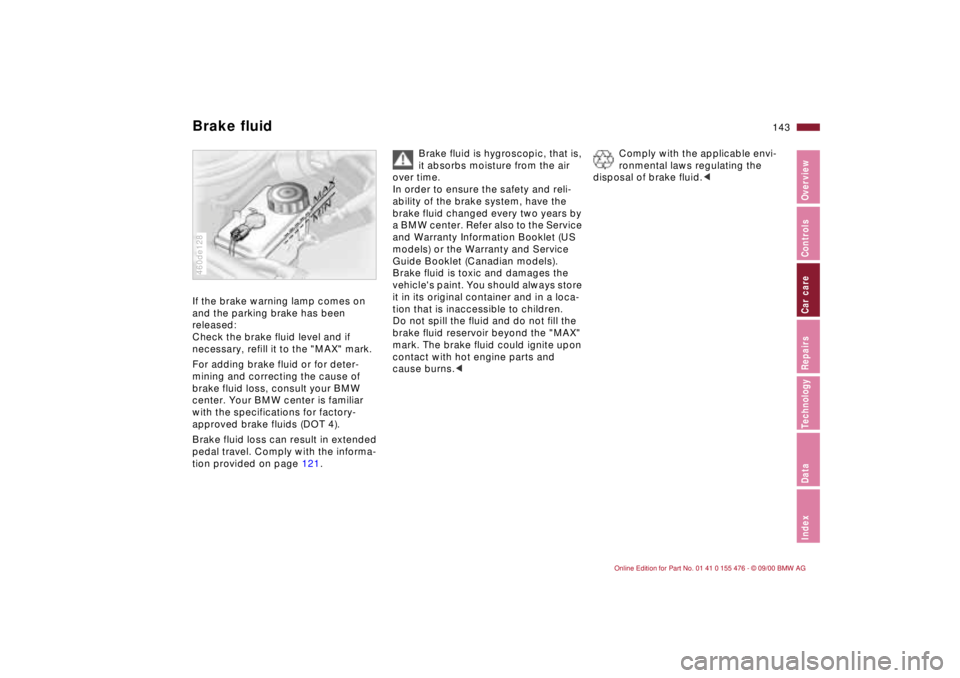
Brake fluidIf the brake warning lamp comes on
and the parking brake has been
released:
Check the brake fluid level and if
necessary, refill it to the "MAX" mark.
For adding brake fluid or for deter-
mining and correcting the cause of
brake fluid loss, consult your BMW
center. Your BMW center is familiar
with the specifications for factory-
approved brake fluids (DOT 4).
Brake fluid loss can result in extended
pedal travel. Comply with the informa-
tion provided on page 121.460de128
Brake fluid is hygroscopic, that is,
it absorbs moisture from the air
over time.
In order to ensure the safety and reli-
ability of the brake system, have the
brake fluid changed every two years by
a BMW center. Refer also to the Service
and Warranty Information Booklet (US
models) or the Warranty and Service
Guide Booklet (Canadian models).
Brake fluid is toxic and damages the
vehicle's paint. You should always store
it in its original container and in a loca-
tion that is inaccessible to children.
Do not spill the fluid and do not fill the
brake fluid reservoir beyond the "MAX"
mark. The brake fluid could ignite upon
contact with hot engine parts and
cause burns.<
Comply with the applicable envi-
ronmental laws regulating the
disposal of brake fluid.<
Page 145 of 211
145n
IndexDataTechnologyRepairsCar careControlsOverview
The BMW Maintenance System has
been designed as a reliable means of
providing maximum driving and operat-
ing safety Ð and as cost-effectively as
possible for you.
Please keep in mind that regular main-
tenance is not only necessary for the
safety of your vehicle, but also plays a
significant role in maintaining the resale
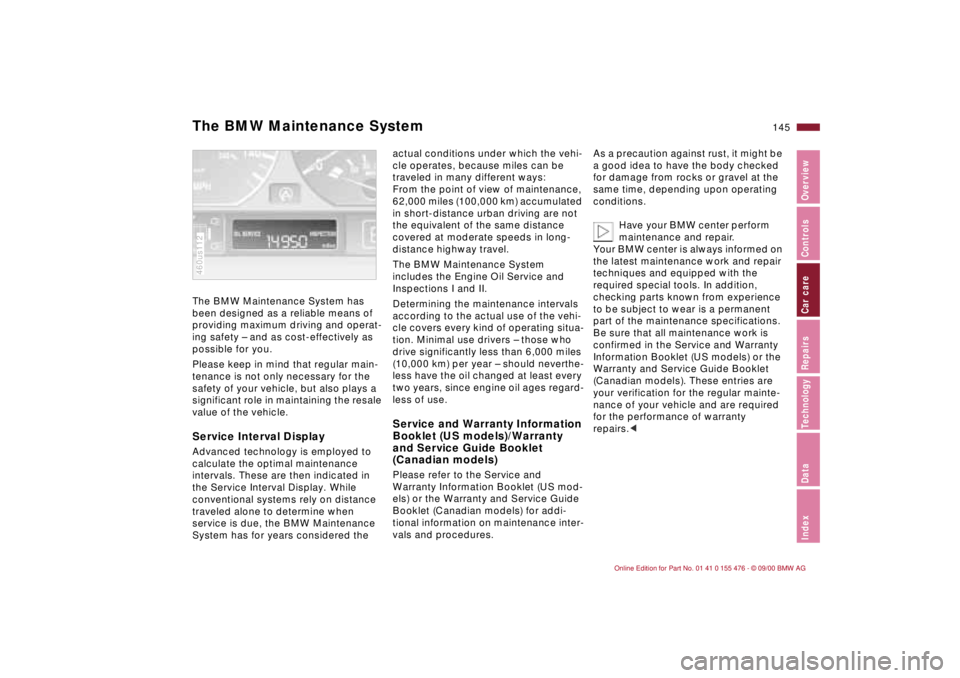
value of the vehicle. Service Interval DisplayAdvanced technology is employed to
calculate the optimal maintenance
intervals. These are then indicated in
the Service Interval Display. While
conventional systems rely on distance
traveled alone to determine when
service is due, the BMW Maintenance
System has for years considered the 460us112
actual conditions under which the vehi-
cle operates, because miles can be
traveled in many different ways:
From the point of view of maintenance,
62,000 miles (100,000 km) accumulated
in short-distance urban driving are not
the equivalent of the same distance
covered at moderate speeds in long-
distance highway travel.
The BMW Maintenance System
includes the Engine Oil Service and
Inspections I and II.
Determining the maintenance intervals
according to the actual use of the vehi-
cle covers every kind of operating situa-
tion. Minimal use drivers Ð those who
drive significantly less than 6,000 miles
(10,000 km) per year Ð should neverthe-
less have the oil changed at least every
two years, since engine oil ages regard-
less of use.Service and Warranty Information
Booklet (US models)/Warranty
and Service Guide Booklet
(Canadian models) Please refer to the Service and
Warranty Information Booklet (US mod-
els) or the Warranty and Service Guide
Booklet (Canadian models) for addi-
tional information on maintenance inter-
vals and procedures.As a precaution against rust, it might be
a good idea to have the body checked
for damage from rocks or gravel at the
same time, depending upon operating
conditions.
Have your BMW center perform
maintenance and repair.
Your BMW center is always informed on
the latest maintenance work and repair
techniques and equipped with the
required special tools. In addition,
checking parts known from experience
to be subject to wear is a permanent
part of the maintenance specifications.
Be sure that all maintenance work is
confirmed in the Service and Warranty
Information Booklet (US models) or the
Warranty and Service Guide Booklet
(Canadian models). These entries are
your verification for the regular mainte-
nance of your vehicle and are required
for the performance of warranty
repairs.<
The BMW Maintenance System
Page 154 of 211
154n
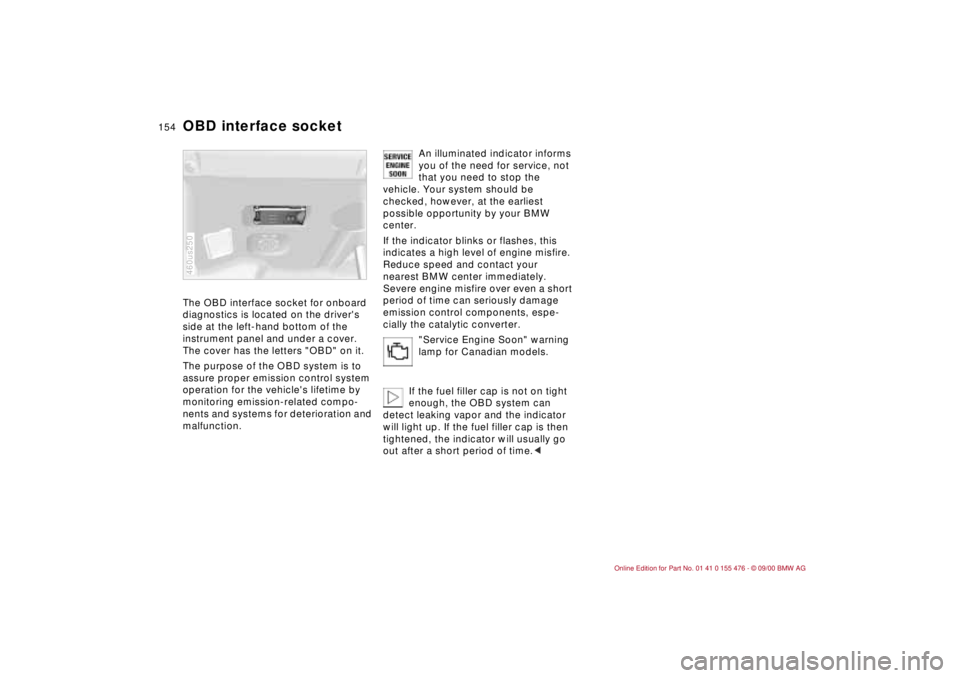
OBD interface socket The OBD interface socket for onboard
diagnostics is located on the driver's
side at the left-hand bottom of the
instrument panel and under a cover.
The cover has the letters "OBD" on it.
The purpose of the OBD system is to
assure proper emission control system
operation for the vehicle's lifetime by
monitoring emission-related compo-
nents and systems for deterioration and
malfunction.460us250
An illuminated indicator informs
you of the need for service, not
that you need to stop the
vehicle. Your system should be
checked, however, at the earliest
possible opportunity by your BMW
center.
If the indicator blinks or flashes, this
indicates a high level of engine misfire.
Reduce speed and contact your
nearest BMW center immediately.
Severe engine misfire over even a short
period of time can seriously damage
emission control components, espe-
cially the catalytic converter.
"Service Engine Soon" warning
lamp for Canadian models.
If the fuel filler cap is not on tight
enough, the OBD system can
detect leaking vapor and the indicator
will light up. If the fuel filler cap is then
tightened, the indicator will usually go
out after a short period of time.<
Page 170 of 211
170n
Battery FusesCharging the battery Charge the battery in the vehicle only
when the engine is not running.
Before doing any work on the elec-
trical system, be sure to unclamp
the cable from the battery's negative
terminal. Failure to do so can result in
short-circuits, a fire or personal injury.<
If the vehicle is to be parked longer than
four weeks, disconnect the battery from
the vehicle's electrical system by
disconnecting the negative terminal
cable and then recharge using a suit-
able charging device.
If you intend to store your vehicle for
longer than twelve weeks: remove the
battery, charge it and store it in a cool
(but frost-and dust-free) room. Every
three months and before reinstalling the
battery, have it recharged. If it is not
recharged, it will not be serviceable.
Every time the battery is discharged,
especially over extended periods, its
service life is reduced.
Return used batteries to a recy-
cling center or your BMW center.
Maintain the battery in an upright posi-
tion for transport and storage. Secure
the battery to prevent it from tilting
during transport.<
Storage periods during which the
battery is disconnected are not
taken into consideration by the Service
Interval Display for changing the brake
fluid.
For this reason, be sure that the brake
fluid is changed every two years,
regardless of the information displayed.
Read and comply with the information
on page 143 covering this subject.<
If an electrical accessory should fail,
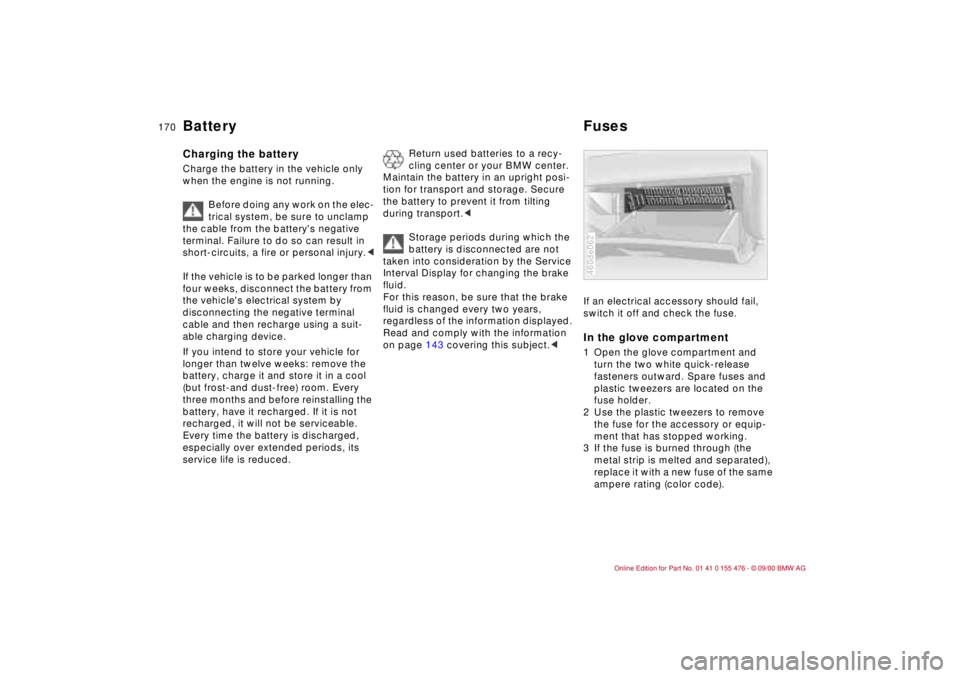
switch it off and check the fuse. In the glove compartment1 Open the glove compartment and
turn the two white quick-release
fasteners outward. Spare fuses and
plastic tweezers are located on the
fuse holder.
2 Use the plastic tweezers to remove
the fuse for the accessory or equip-
ment that has stopped working.
3 If the fuse is burned through (the
metal strip is melted and separated),
replace it with a new fuse of the same
ampere rating (color code).460de062
Page 187 of 211
187n
IndexDataTechnologyRepairsCar careControlsOverview
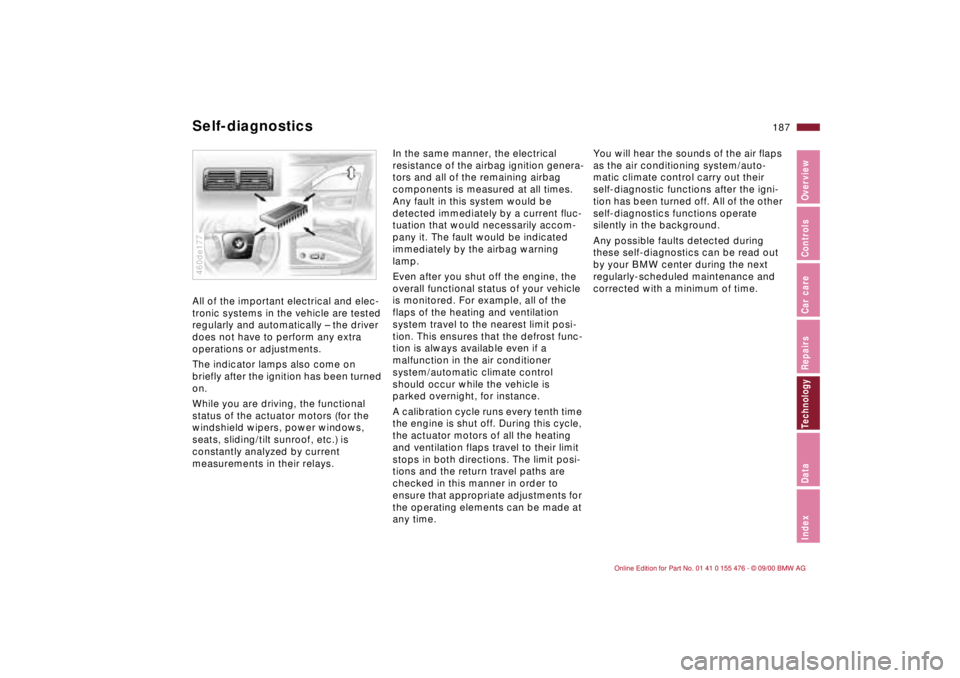
Self-diagnostics All of the important electrical and elec-
tronic systems in the vehicle are tested
regularly and automatically Ð the driver
does not have to perform any extra
operations or adjustments.
The indicator lamps also come on
briefly after the ignition has been turned
on.
While you are driving, the functional
status of the actuator motors (for the
windshield wipers, power windows,
seats, sliding/tilt sunroof, etc.) is
constantly analyzed by current
measurements in their relays.460de177
In the same manner, the electrical
resistance of the airbag ignition genera-
tors and all of the remaining airbag
components is measured at all times.
Any fault in this system would be
detected immediately by a current fluc-
tuation that would necessarily accom-
pany it. The fault would be indicated
immediately by the airbag warning
lamp.
Even after you shut off the engine, the
overall functional status of your vehicle
is monitored. For example, all of the
flaps of the heating and ventilation
system travel to the nearest limit posi-
tion. This ensures that the defrost func-
tion is always available even if a
malfunction in the air conditioner
system/automatic climate control
should occur while the vehicle is
parked overnight, for instance.
A calibration cycle runs every tenth time
the engine is shut off. During this cycle,
the actuator motors of all the heating
and ventilation flaps travel to their limit
stops in both directions. The limit posi-
tions and the return travel paths are
checked in this manner in order to
ensure that appropriate adjustments for
the operating elements can be made at
any time.You will hear the sounds of the air flaps
as the air conditioning system/auto-
matic climate control carry out their
self-diagnostic functions after the igni-
tion has been turned off. All of the other
self-diagnostics functions operate
silently in the background.
Any possible faults detected during
these self-diagnostics can be read out
by your BMW center during the next
regularly-scheduled maintenance and
corrected with a minimum of time.
Page 201 of 211

Everything from A to Z
201n
IndexDataTechnologyRepairsCar careControlsOverview
Center (high-mount) brake
lamp163
Center 3-point-safety belt in
the rear109
Center armrest105
Central locking system34
button38
Changing a tire165
Changing a wheel165
Charge indicator lamp20
Check Control76
Child restraint
systems55,59,61
Child seat59
Child seat security61
Child-safety locks55
Cigarette lighter108
Clock76
refer also to the Radio or
Onboard Monitor Owner's
Manual
Cockpit16
Coin holder105
Combination switch69
Compression192
Computer77
Configure settings53
Consumption78
Consumption display75
Contents10
Coolant122,142,195
antifreeze122 Coolant temperature
gauge75
Cooling system195
Copyright4
Cornering Brake Control
(CBC)21,119
Cruise control72
Cruising range78
Cup holder105
Curb weight194
D
Dashboard16
Data
dimensions193
engine192
weights194
Daytime-driving lamp
switch88
DBC (Dynamic Brake
Control)119
Defrost position96,101
Defroster, rear
window94,102
Defrosting the
windows96,101
Digital clock76
Dimensions193
Dipstick139
Disc brakes120
Displacement192
Displays18 Distance warning79
Diversity Antenna181
Divided rear backrest109
Door key32
Door locks, care122
Doors
child-safety locks55
emergency operation34
unlocking and locking34
Draft-free
ventilation95,102
Driving hints117
Driving in winter122
Driving lamps88
DSC (Dynamic Stability
Control)22,80,180
Dynamic Brake Control
(DBC)119
Dynamic Stability Control
(DSC)22,80,180
E
Electric power windows44
Electrical accessories,
failure170
Electrical system196
Electronic vehicle
immobilizer33
Elements of operation16
Emergency operation,
doors34
Energy Control74 Engine compartment136
Engine coolant142,195
Engine data192
Engine oil
capacity195
consumption139
pressure20
quality140
specifications140
viscosity140
Engine oil level22
check139
Engine speed192
Engine, starting62
Exterior mirrors52
F
Failure messages76
Fault displays76
Fault, ABS119
Filler cap cover27
Filling capacities195
Filling the washer
reservoir195
First-aid kit26
Fittings, towing and
tow-starting174
Flashlight104
Flat tire125,165
Fog lamps89
Folding rear backrest109
Footbrake120
Page 205 of 211

Everything from A to Z
205n
IndexDataTechnologyRepairsCar careControlsOverview
Tire inflation
pressure28,125
Tire pressure
checking28
Tire Pressure Control
(RDC)86,186
Tire pressure
monitoring86,186
Tire Quality Grading126
Tire replacement126,127
Tire rotation127
Tire specifications130
Tire tread125
To switch on the interior
lamps36
Tools158
Torque192
Tow fittings174
Tow starting174
Towing174
Track193
Traction Control System,
refer to DSC80
Transmission65
Transporting children
safely59
Tread depth, tires125
Trip odometer74
Trunk39
Trunk lid, refer to luggage
compartment lid39 Turn signal
indicator23,69,160
bulb replacement160
Turning radius193
Two-way radios124
U
Uniform Tire Quality
Grading126
Used batteries170 V
Vacuum cleaner108
Vacuum cleaner,
connecting108
Vanity mirror52
bulb replacement164
V-belts196
Vehicle battery168,196
Vehicle care
exterior147
interior150
Vehicle Identification
Number (VIN)144
Vehicle immobilizer33
Vehicle painting147
Vehicle storage152 Vehicle weight194
Ventilation92,95,98
draft-free95,102
Vinyl care149
Voice recognition24,25
W
Warning lamp "Please fasten
safety belts"21
Warning lamps20
Warning messages76
Warranty and Service Guide
Booklet145
Washer fluids138
Washer nozzles138
Washer reservoir, filling138
Washing your car146
Water on roadways
deep water117
Waxing, paintwork148
Weights194
Wheel changing165
Wheel rims128
Wheelbase193
Wheels and tires128,130
Width193
Windows, convenience
operation34
Windshield washer nozzle
adjustment138
Windshield washer reservoir,
filling138,195 Windshield washer,
automatic70
Windshield wiper69
Windshield wiper blade
replacement158
Winter operation122
Winter tires128,129
Wiper blade
replacement158
Wiper system69
Work in the engine
compartment134
X
Xenon lamps159,188