ECU BMW 325XI 2001 Owner's Manual
[x] Cancel search | Manufacturer: BMW, Model Year: 2001, Model line: 325XI, Model: BMW 325XI 2001Pages: 211, PDF Size: 2.1 MB
Page 113 of 211
113n
IndexDataTechnologyRepairsCar careControlsOverview
Cargo loading Roof-mounted luggage rack
*
Always position and secure the
load correctly. If you do not, it can
endanger the passengers during brak-
ing or evasive maneuvers.
Do not exceed the permissible gross
vehicle weight and the permissible axle
loads (refer to page 194). If you do, the
operating safety of the vehicle is no
longer ensured and you are in violation
of the law.
Do not carry hard or heavy objects
unsecured in the passenger compart-
ment. If you do so, they may be
projected through the air during braking
and evasive maneuvers, thus
endangering vehicle occupants.<
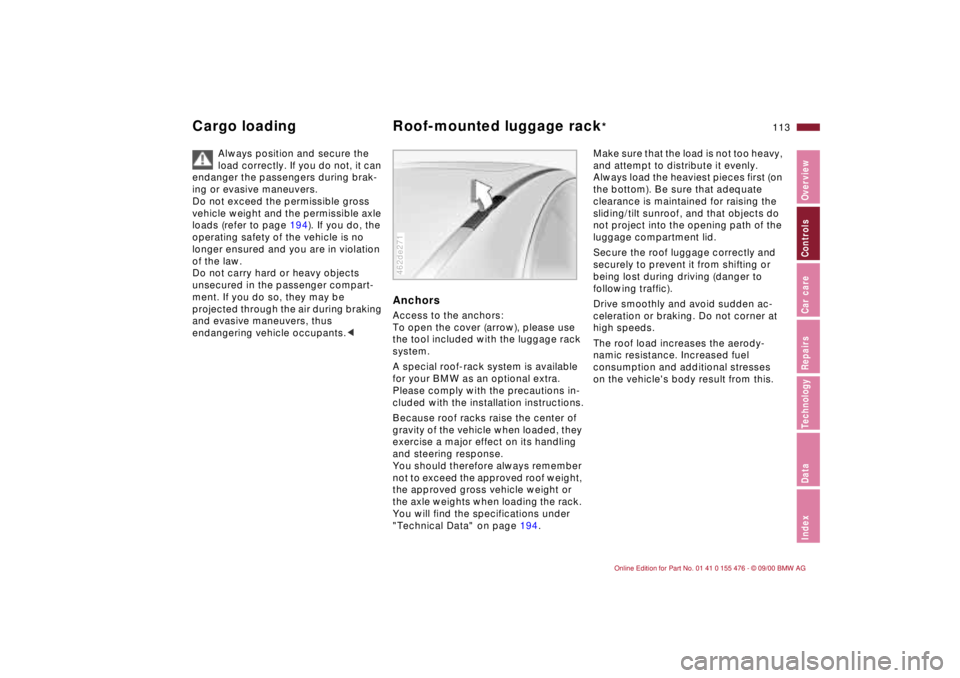
AnchorsAccess to the anchors:
To open the cover (arrow), please use
the tool included with the luggage rack
system.
A special roof-rack system is available
for your BMW as an optional extra.
Please comply with the precautions in-
cluded with the installation instructions.
Because roof racks raise the center of
gravity of the vehicle when loaded, they
exercise a major effect on its handling
and steering response.
You should therefore always remember
not to exceed the approved roof weight,
the approved gross vehicle weight or
the axle weights when loading the rack.
You will find the specifications under
"Technical Data" on page 194.462de271
Make sure that the load is not too heavy,
and attempt to distribute it evenly.
Always load the heaviest pieces first (on
the bottom). Be sure that adequate
clearance is maintained for raising the
sliding/tilt sunroof, and that objects do
not project into the opening path of the
luggage compartment lid.
Secure the roof luggage correctly and
securely to prevent it from shifting or
being lost during driving (danger to
following traffic).
Drive smoothly and avoid sudden ac-
celeration or braking. Do not corner at
high speeds.
The roof load increases the aerody-
namic resistance. Increased fuel
consumption and additional stresses
on the vehicle's body result from this.
Page 135 of 211
135n
IndexDataTechnologyRepairsCar careControlsOverview
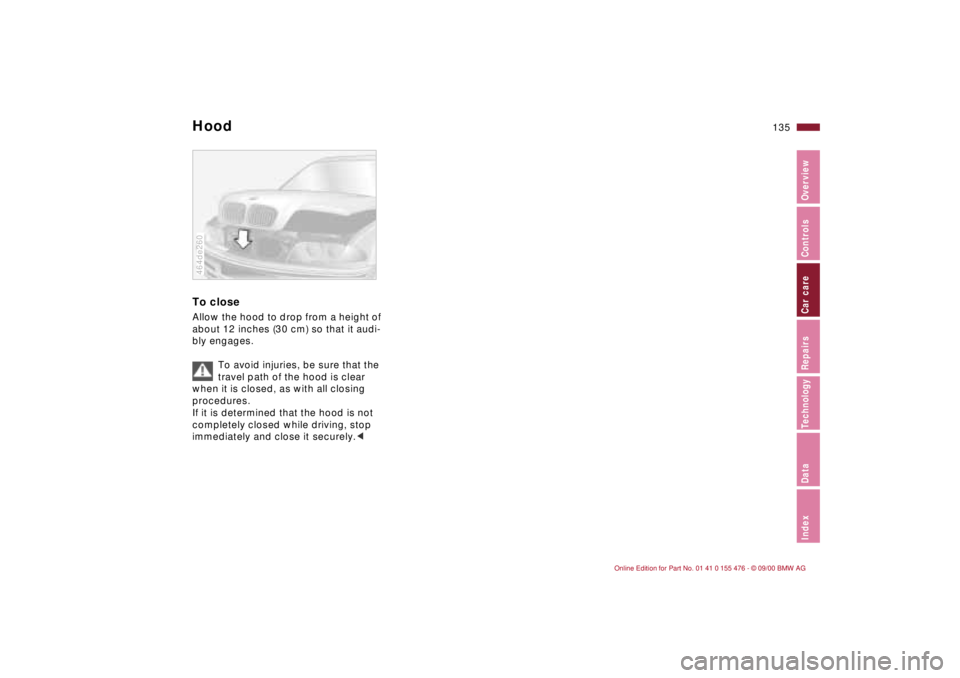
HoodTo closeAllow the hood to drop from a height of
about 12 inches (30 cm) so that it audi-
bly engages.
To avoid injuries, be sure that the
travel path of the hood is clear
when it is closed, as with all closing
procedures.
If it is determined that the hood is not
completely closed while driving, stop
immediately and close it securely.<464de260
Page 150 of 211

150n
Caring for your vehicleCare of upholstery materials Depressions in the upholstery that
result from everyday use can be
brushed smooth by brushing against
the nap with a lightly dampened brush.
The tendency of the pile to lie in a
particular direction on velour upholstery
is not a quality defect. Just as with
home textiles or clothing, this cannot be
avoided.
Lint on upholstery materials, rubbed-in
fabric or suede residues can be re-
moved with a lint brush or Velcro¨
brush. A cleaning glove is available for
especially "stubborn" lint. Stains and
fairly large areas of dirt should be
cleaned off without delay, using luke-
warm water and an interior cleaner,
stain remover or appropriate cleaning
fluid. Brush the fabric afterwards to
restore its appearance.
If the vehicle will be stored for an
extended period or if it is exposed to
intense sunlight, cover all the seats or
the windows to prevent fading.
Use cleaning and car-care
products that you can obtain at
your BMW center.<
The buildup of an electrostatic charge
on the seat covers, particularly if
atmospheric humidity is low, can give
the occupants an unpleasant electric
shock if they touch metal body parts
after leaving the vehicle. Although this is
not dangerous in any way, it can be
avoided by touching a bare or polished
metal part of the vehicle while getting
out.
Leather care The leather upholstery
* used by BMW
is a natural product of the highest
quality, processed using state-of-the-
art methods to ensure that it will main-
tain its high quality for years to come,
provided that it is properly cared for.
Because this product is manufactured
using natural materials, you must make
allowance for its special characteristics
and for the peculiarities of its use and
care.
Regular periodic cleaning and care are
essential, as dust and road dirt act as
abrasives in the pores and creases of
the material. This leads to wear spots
and premature brittleness on the
surface of the leather. We therefore
suggest that you clean the leather with
a vacuum cleaner or cloth at frequent
intervals.
For cleaning, use BMW leather cleaning
foam.
Since dirt and grease gradually attack
the protective layer of the leather, the
cleaned surfaces should be treated
with BMW leather care agent. This also
acts as an antistatic agent.
Page 166 of 211
166n
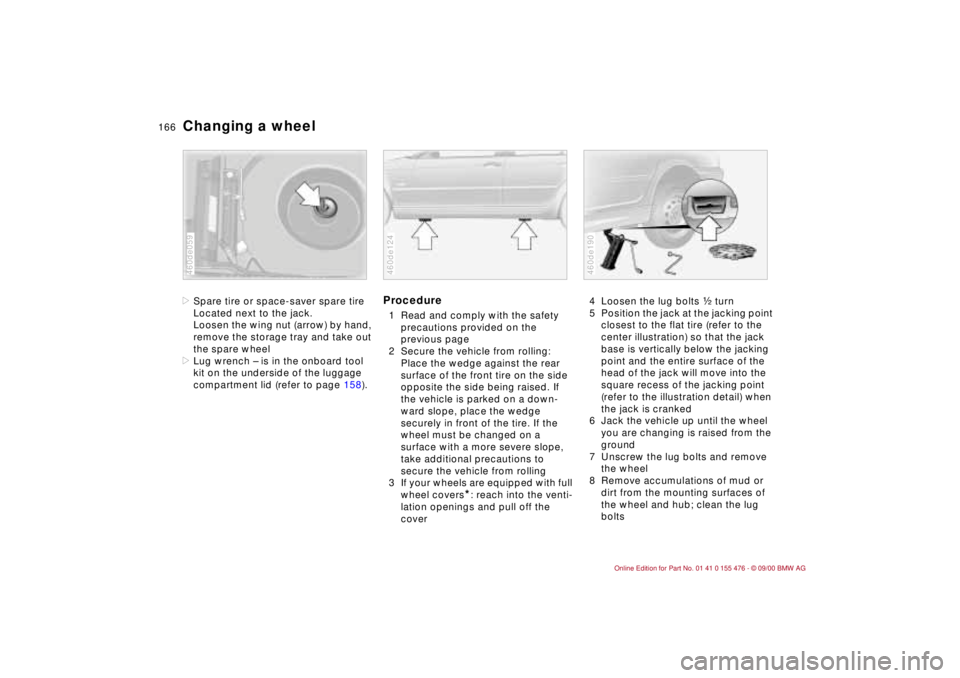
Changing a wheel>Spare tire or space-saver spare tire
Located next to the jack.
Loosen the wing nut (arrow) by hand,
remove the storage tray and take out
the spare wheel
>Lug wrench Ð is in the onboard tool
kit on the underside of the luggage
compartment lid (refer to page 158).460de059
Procedure1 Read and comply with the safety
precautions provided on the
previous page
2 Secure the vehicle from rolling:
Place the wedge against the rear
surface of the front tire on the side
opposite the side being raised. If
the vehicle is parked on a down-
ward slope, place the wedge
securely in front of the tire. If the
wheel must be changed on a
surface with a more severe slope,
take additional precautions to
secure the vehicle from rolling
3 If your wheels are equipped with full
wheel covers
*: reach into the venti-
lation openings and pull off the
cover
460de124
4 Loosen the lug bolts g turn
5 Position the jack at the jacking point
closest to the flat tire (refer to the
center illustration) so that the jack
base is vertically below the jacking
point and the entire surface of the
head of the jack will move into the
square recess of the jacking point
(refer to the illustration detail) when
the jack is cranked
6 Jack the vehicle up until the wheel
you are changing is raised from the
ground
7 Unscrew the lug bolts and remove
the wheel
8 Remove accumulations of mud or
dirt from the mounting surfaces of
the wheel and hub; clean the lug
bolts460de190
Page 167 of 211
167n
IndexDataTechnologyRepairsCar careControlsOverview
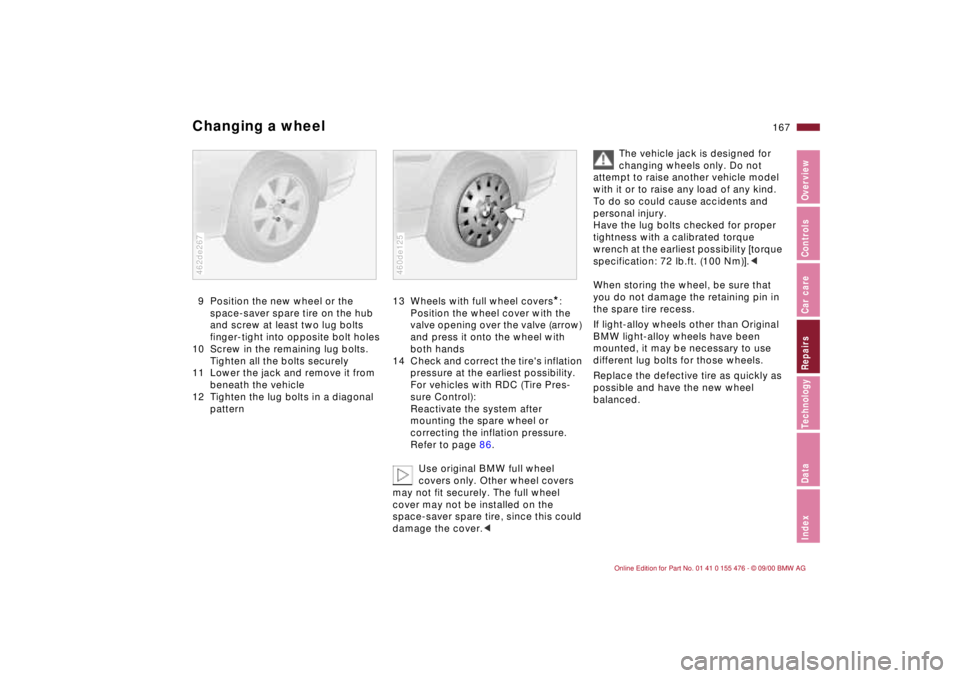
Changing a wheel9 Position the new wheel or the
space-saver spare tire on the hub
and screw at least two lug bolts
finger-tight into opposite bolt holes
10 Screw in the remaining lug bolts.
Tighten all the bolts securely
11 Lower the jack and remove it from
beneath the vehicle
12 Tighten the lug bolts in a diagonal
pattern462de267
13 Wheels with full wheel covers
*:
Position the wheel cover with the
valve opening over the valve (arrow)
and press it onto the wheel with
both hands
14 Check and correct the tire's inflation
pressure at the earliest possibility.
For vehicles with RDC (Tire Pres-
sure Control):
Reactivate the system after
mounting the spare wheel or
correcting the inflation pressure.
Refer to page 86.
Use original BMW full wheel
covers only. Other wheel covers
may not fit securely. The full wheel
cover may not be installed on the
space-saver spare tire, since this could
damage the cover.<
460de125
The vehicle jack is designed for
changing wheels only. Do not
attempt to raise another vehicle model
with it or to raise any load of any kind.
To do so could cause accidents and
personal injury.
Have the lug bolts checked for proper
tightness with a calibrated torque
wrench at the earliest possibility [torque
specification: 72 lb.ft. (100 Nm)].<
When storing the wheel, be sure that
you do not damage the retaining pin in
the spare tire recess.
If light-alloy wheels other than Original
BMW light-alloy wheels have been
mounted, it may be necessary to use
different lug bolts for those wheels.
Replace the defective tire as quickly as
possible and have the new wheel
balanced.
Page 169 of 211

169n
IndexDataTechnologyRepairsCar careControlsOverview
BatteryBattery careThe battery is absolutely maintenance-
free, that is, the original electrolyte will
normally last for the service life of the
battery under moderate climatic condi-
tions.
For all questions that regard the
battery, please consult your BMW
center. Since the battery is mainte-
nance-free, the following is for your
information only.
please comply with the corresponding
precautions whenever you work with or
near the battery.
Before handling the battery,
please read the following infor-
mation.
Wear eye protection. Do not
allow particles containing
battery acid or lead to come into
contact with your eyes, your skin, or
your clothing.
Battery acid is extremely corro-
sive. Wear eye protection and
protective gloves. Do not tip the
battery. Battery acid can leak from the
ventilation openings.
Do not allow children access to
batteries and battery acid.
Never allow sparks or open
flame in the vicinity of the
battery. Avoid sparks from elec-
trical cables or electrical equipment.
Turn the key to position 0 in the
steering lock when disconnecting or
connecting the battery. Do not short-
circuit the battery terminals. This
creates a risk of injury from high-energy
sparks.
A highly explosive gas is gener-
ated when the battery is charged.
If battery acid is splashed into
your eyes, immediately rinse
them with clear water for
15 minutes. Consult a physician imme-
diately. If your skin or clothing are
splashed by acid, rinse immediately
with ample clear water. If battery acid is
accidentally swallowed, consult a
physician immediately.
In order to protect the battery
case from ultraviolet radiation,
do not place it in direct sunlight.
A discharged battery can freeze. Store
the battery in areas where temperature
remains above freezing.
Removal and installation
Do not disconnect the battery
when the engine is running. If you
do so, the ensuing voltage surge will
damage the vehicle's onboard elec-
tronics.
Do not make any modifications in the
wires to the positive terminal. If you do
so, the protective function of the safety
battery terminal is no longer ensured.
Repair and disposal must be performed
by trained technicians only.<
When removing the battery, disconnect
the cable on the negative terminal first,
then the cable on the positive terminal.
Loosen the center adjusting screw on
the battery retaining strap (use the
screwdriver included with the onboard
tool kit) and disconnect the strap.
When installing a battery, connect the
positive terminal first, then connect the
negative terminal.
When installing a battery, be sure
that it is mounted properly and
that the retaining bracket is installed
with the center adjustment screw. If this
is not done, the battery will not be
adequately secured in case of an acci-
dent.<
Page 170 of 211
170n
Battery FusesCharging the battery Charge the battery in the vehicle only
when the engine is not running.
Before doing any work on the elec-
trical system, be sure to unclamp
the cable from the battery's negative
terminal. Failure to do so can result in
short-circuits, a fire or personal injury.<
If the vehicle is to be parked longer than
four weeks, disconnect the battery from
the vehicle's electrical system by
disconnecting the negative terminal
cable and then recharge using a suit-
able charging device.
If you intend to store your vehicle for
longer than twelve weeks: remove the
battery, charge it and store it in a cool
(but frost-and dust-free) room. Every
three months and before reinstalling the
battery, have it recharged. If it is not
recharged, it will not be serviceable.
Every time the battery is discharged,
especially over extended periods, its
service life is reduced.
Return used batteries to a recy-
cling center or your BMW center.
Maintain the battery in an upright posi-
tion for transport and storage. Secure
the battery to prevent it from tilting
during transport.<
Storage periods during which the
battery is disconnected are not
taken into consideration by the Service
Interval Display for changing the brake
fluid.
For this reason, be sure that the brake
fluid is changed every two years,
regardless of the information displayed.
Read and comply with the information
on page 143 covering this subject.<
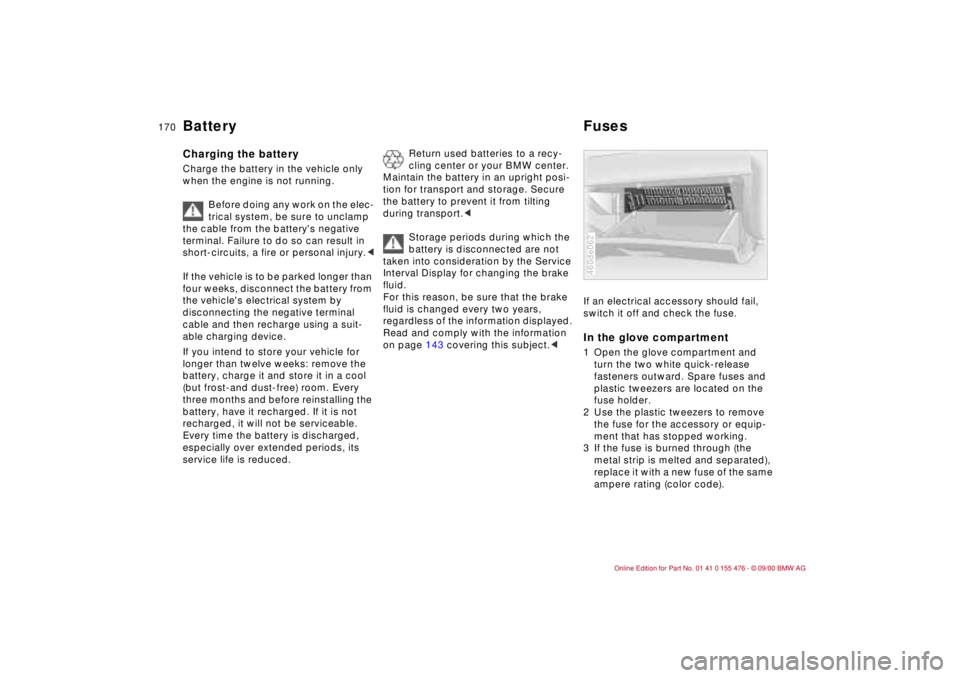
If an electrical accessory should fail,
switch it off and check the fuse. In the glove compartment1 Open the glove compartment and
turn the two white quick-release
fasteners outward. Spare fuses and
plastic tweezers are located on the
fuse holder.
2 Use the plastic tweezers to remove
the fuse for the accessory or equip-
ment that has stopped working.
3 If the fuse is burned through (the
metal strip is melted and separated),
replace it with a new fuse of the same
ampere rating (color code).460de062
Page 171 of 211
171n
IndexDataTechnologyRepairsCar careControlsOverview
Fuses Microfilter/Activated-charcoal filterThe fuses, their respective ampere
ratings and the equipment in their
circuits are all indicated below the fuse
holder.
To close the fuse holder, snap it into
position at the top and turn the two
fasteners inward.
Do not attempt to repair a burned
fuse or replace it with a fuse
having a different color or amperage
rating. To do this could cause a fire in
the vehicle resulting from a circuit over-
load.<
If a fuse blows repeatedly, refer the
problem to your BMW center for repair.
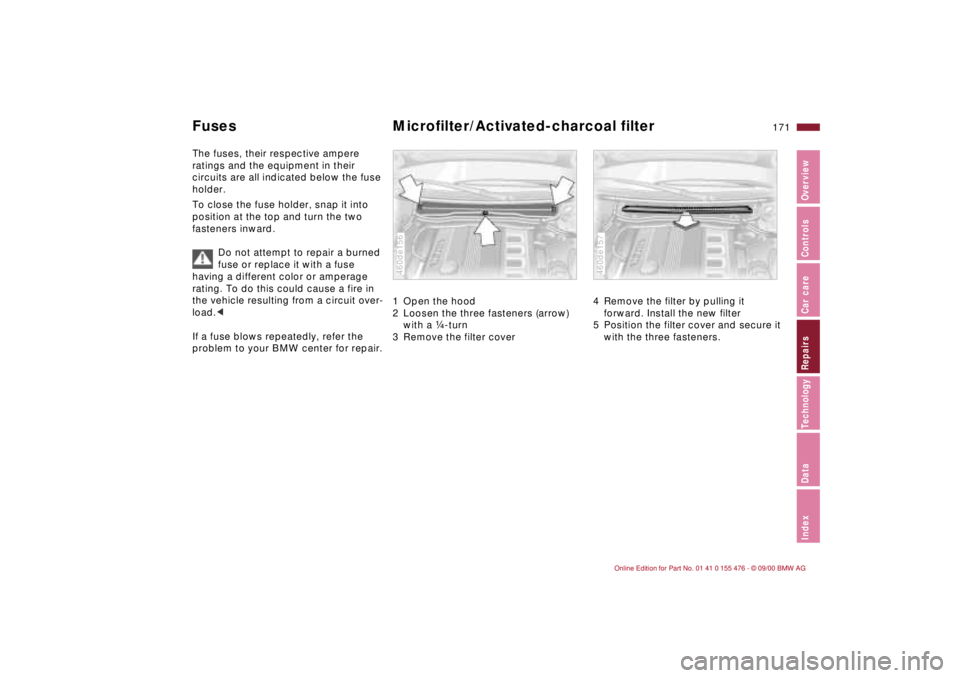
1 Open the hood
2 Loosen the three fasteners (arrow)
with a f-turn
3 Remove the filter cover 460de156
4 Remove the filter by pulling it
forward. Install the new filter
5 Position the filter cover and secure it
with the three fasteners. 460de157
Page 201 of 211

Everything from A to Z
201n
IndexDataTechnologyRepairsCar careControlsOverview
Center (high-mount) brake
lamp163
Center 3-point-safety belt in
the rear109
Center armrest105
Central locking system34
button38
Changing a tire165
Changing a wheel165
Charge indicator lamp20
Check Control76
Child restraint
systems55,59,61
Child seat59
Child seat security61
Child-safety locks55
Cigarette lighter108
Clock76
refer also to the Radio or
Onboard Monitor Owner's
Manual
Cockpit16
Coin holder105
Combination switch69
Compression192
Computer77
Configure settings53
Consumption78
Consumption display75
Contents10
Coolant122,142,195
antifreeze122 Coolant temperature
gauge75
Cooling system195
Copyright4
Cornering Brake Control
(CBC)21,119
Cruise control72
Cruising range78
Cup holder105
Curb weight194
D
Dashboard16
Data
dimensions193
engine192
weights194
Daytime-driving lamp
switch88
DBC (Dynamic Brake
Control)119
Defrost position96,101
Defroster, rear
window94,102
Defrosting the
windows96,101
Digital clock76
Dimensions193
Dipstick139
Disc brakes120
Displacement192
Displays18 Distance warning79
Diversity Antenna181
Divided rear backrest109
Door key32
Door locks, care122
Doors
child-safety locks55
emergency operation34
unlocking and locking34
Draft-free
ventilation95,102
Driving hints117
Driving in winter122
Driving lamps88
DSC (Dynamic Stability
Control)22,80,180
Dynamic Brake Control
(DBC)119
Dynamic Stability Control
(DSC)22,80,180
E
Electric power windows44
Electrical accessories,
failure170
Electrical system196
Electronic vehicle
immobilizer33
Elements of operation16
Emergency operation,
doors34
Energy Control74 Engine compartment136
Engine coolant142,195
Engine data192
Engine oil
capacity195
consumption139
pressure20
quality140
specifications140
viscosity140
Engine oil level22
check139
Engine speed192
Engine, starting62
Exterior mirrors52
F
Failure messages76
Fault displays76
Fault, ABS119
Filler cap cover27
Filling capacities195
Filling the washer
reservoir195
First-aid kit26
Fittings, towing and
tow-starting174
Flashlight104
Flat tire125,165
Fog lamps89
Folding rear backrest109
Footbrake120
Page 202 of 211

Everything from A to ZFootwell lamps89
bulb replacement164
Four-wheel drive182
Front fog lamps89
bulb replacement161
Frost protection,
radiator142
Fuel28
Fuel consumption78
Fuel consumption
display75
Fuel filler door
releasing following an
electrical malfunction172
Fuel gauge75
Fuel injection192
Fuel quality28
Fuel reserve indicator
lamp75
Fuel specifications28
Fuel tank capacity195
Fuel tank gauge75
Functional status187
Fuses170 G
Gasoline28
Gasoline gauge75
Glove compartment104 Glove compartment lamp,
bulb replacement164
Gross vehicle weight194
H
Handbrake64
Handsfree system107
Hazard warning flashers26
Hazard warning triangle26
Head restraints48
Headlamp covers,
care146,159
Headlamp flasher69,89
Headlamp washer
system138,195
Headlamp washers71
Headlamps88
Heated seats103
Heating, rapid96
Heavy loads112
Height193
HiFi system Ð harman
kardon104
High beams23,69,89
bulb replacement159
High Performance Synthetic
Oils140
High-mount brake lamp163
Hood release134 Horn17
Hubcap166
Hydraulic Brake assistant,
refer to DBC
I
Ice warning77
Icy roads77
Identification, tires128
Ignition key32
Ignition lock62
Imprint4
Indicator lamps20
Inflated pressure28,125
Inflation pressure
monitoring86,186
INSPECTION75
Instrument cluster18
Instrument panel18
Interaxle tire rotation127
Interface socket108
for Onboard
Diagnostics154
Interference
cellular phone124
Interior lamps36,89
bulb replacement163
remote control36
Interior motion sensor42 Interior rearview mirror52
automatic dimming
feature53,184
Interlock62
Intermittent wipe69
J
Jack165
Jump-starting173 K
Key Memory53
Keys32
with remote control32 L
Lamps and bulbs158
LAMPS ON warning88
Lashing eyes112
LATCH attachment of the
child seat59
Leather care150
Length193
License plate lamp, bulb
replacement163
Light switch88
Light-alloy wheels130
Lighter108
Load-securing devices112