engine BMW 325XI 2001 Workshop Manual
[x] Cancel search | Manufacturer: BMW, Model Year: 2001, Model line: 325XI, Model: BMW 325XI 2001Pages: 211, PDF Size: 2.1 MB
Page 169 of 211
169n
IndexDataTechnologyRepairsCar careControlsOverview
BatteryBattery careThe battery is absolutely maintenance-
free, that is, the original electrolyte will
normally last for the service life of the
battery under moderate climatic condi-
tions.
For all questions that regard the
battery, please consult your BMW
center. Since the battery is mainte-
nance-free, the following is for your
information only.
please comply with the corresponding
precautions whenever you work with or
near the battery.
Before handling the battery,
please read the following infor-
mation.
Wear eye protection. Do not
allow particles containing
battery acid or lead to come into
contact with your eyes, your skin, or
your clothing.
Battery acid is extremely corro-
sive. Wear eye protection and
protective gloves. Do not tip the
battery. Battery acid can leak from the
ventilation openings.
Do not allow children access to
batteries and battery acid.
Never allow sparks or open
flame in the vicinity of the
battery. Avoid sparks from elec-
trical cables or electrical equipment.
Turn the key to position 0 in the
steering lock when disconnecting or
connecting the battery. Do not short-
circuit the battery terminals. This
creates a risk of injury from high-energy
sparks.
A highly explosive gas is gener-
ated when the battery is charged.
If battery acid is splashed into
your eyes, immediately rinse
them with clear water for
15 minutes. Consult a physician imme-
diately. If your skin or clothing are
splashed by acid, rinse immediately
with ample clear water. If battery acid is
accidentally swallowed, consult a
physician immediately.
In order to protect the battery
case from ultraviolet radiation,
do not place it in direct sunlight.
A discharged battery can freeze. Store
the battery in areas where temperature
remains above freezing.
Removal and installation
Do not disconnect the battery
when the engine is running. If you
do so, the ensuing voltage surge will
damage the vehicle's onboard elec-
tronics.
Do not make any modifications in the
wires to the positive terminal. If you do
so, the protective function of the safety
battery terminal is no longer ensured.
Repair and disposal must be performed
by trained technicians only.<
When removing the battery, disconnect
the cable on the negative terminal first,
then the cable on the positive terminal.
Loosen the center adjusting screw on
the battery retaining strap (use the
screwdriver included with the onboard
tool kit) and disconnect the strap.
When installing a battery, connect the
positive terminal first, then connect the
negative terminal.
When installing a battery, be sure
that it is mounted properly and
that the retaining bracket is installed
with the center adjustment screw. If this
is not done, the battery will not be
adequately secured in case of an acci-
dent.<
Page 170 of 211
170n
Battery FusesCharging the battery Charge the battery in the vehicle only
when the engine is not running.
Before doing any work on the elec-
trical system, be sure to unclamp
the cable from the battery's negative
terminal. Failure to do so can result in
short-circuits, a fire or personal injury.<
If the vehicle is to be parked longer than
four weeks, disconnect the battery from
the vehicle's electrical system by
disconnecting the negative terminal
cable and then recharge using a suit-
able charging device.
If you intend to store your vehicle for
longer than twelve weeks: remove the
battery, charge it and store it in a cool
(but frost-and dust-free) room. Every
three months and before reinstalling the
battery, have it recharged. If it is not
recharged, it will not be serviceable.
Every time the battery is discharged,
especially over extended periods, its
service life is reduced.
Return used batteries to a recy-
cling center or your BMW center.
Maintain the battery in an upright posi-
tion for transport and storage. Secure
the battery to prevent it from tilting
during transport.<
Storage periods during which the
battery is disconnected are not
taken into consideration by the Service
Interval Display for changing the brake
fluid.
For this reason, be sure that the brake
fluid is changed every two years,
regardless of the information displayed.
Read and comply with the information
on page 143 covering this subject.<
If an electrical accessory should fail,
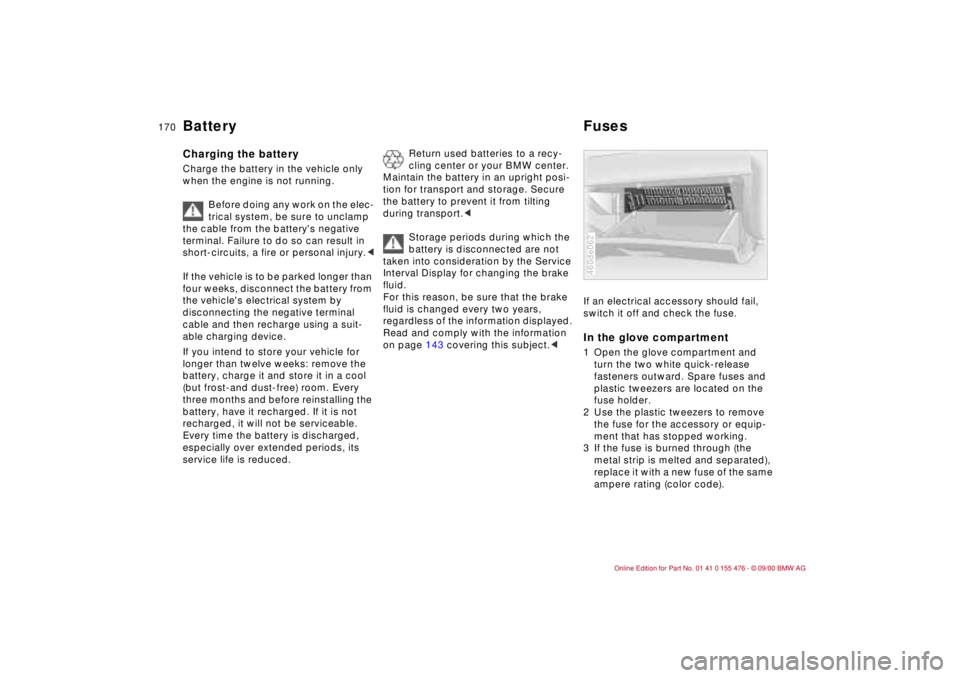
switch it off and check the fuse. In the glove compartment1 Open the glove compartment and
turn the two white quick-release
fasteners outward. Spare fuses and
plastic tweezers are located on the
fuse holder.
2 Use the plastic tweezers to remove
the fuse for the accessory or equip-
ment that has stopped working.
3 If the fuse is burned through (the
metal strip is melted and separated),
replace it with a new fuse of the same
ampere rating (color code).460de062
Page 173 of 211
173n
IndexDataTechnologyRepairsCar careControlsOverview
Do not use spray starter fluids.
If the battery is discharged, the engine
can be started with the use of two
jumper cables and the battery of
another vehicle. Use only jumper cables
with fully insulated grips on the terminal
clamps.
Do not touch the parts conducting
electrical current while the engine
is running. Failure to comply with this
creates a risk of fatal injury.<
Carefully comply with the following
instructions to avoid personal injury or
damage to one or both vehicles:
1 Be sure that the battery on the
support vehicle is also rated at
12 volts, and that the capacities of
the two batteries (Ah) are roughly
comparable (printed on casing)
2 Leave the discharged battery
connected to the vehicle's electrical
system
3 Make sure that there is no contact
between the bodywork of the two
vehicles Ð this creates a risk of short
circuits
4 Start by connecting the jumper cable
from the positive terminal of the
support vehicle to the positive
terminal connector located in your
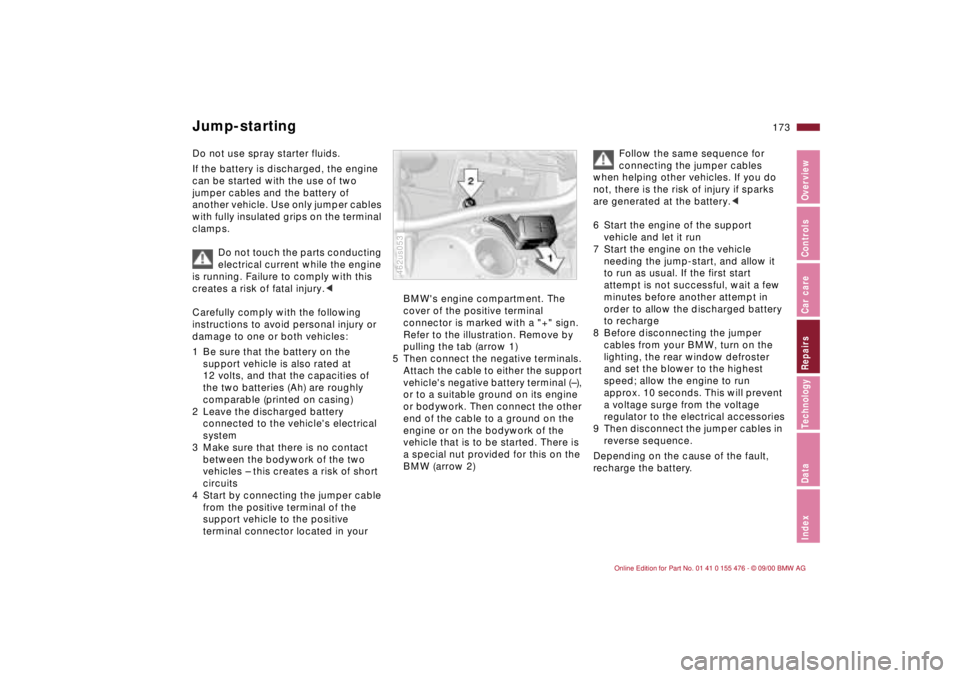
BMW's engine compartment. The
cover of the positive terminal
connector is marked with a "+" sign.
Refer to the illustration. Remove by
pulling the tab (arrow 1)
5 Then connect the negative terminals.
Attach the cable to either the support
vehicle's negative battery terminal (Ð),
or to a suitable ground on its engine
or bodywork. Then connect the other
end of the cable to a ground on the
engine or on the bodywork of the
vehicle that is to be started. There is
a special nut provided for this on the
BMW (arrow 2)462us053
Follow the same sequence for
connecting the jumper cables
when helping other vehicles. If you do
not, there is the risk of injury if sparks
are generated at the battery.<
6 Start the engine of the support
vehicle and let it run
7 Start the engine on the vehicle
needing the jump-start, and allow it
to run as usual. If the first start
attempt is not successful, wait a few
minutes before another attempt in
order to allow the discharged battery
to recharge
8 Before disconnecting the jumper
cables from your BMW, turn on the
lighting, the rear window defroster
and set the blower to the highest
speed; allow the engine to run
approx. 10 seconds. This will prevent
a voltage surge from the voltage
regulator to the electrical accessories
9 Then disconnect the jumper cables in
reverse sequence.
Depending on the cause of the fault,
recharge the battery.
Jump-starting
Page 175 of 211

175n
IndexDataTechnologyRepairsCar careControlsOverview
Towing the vehicleBMW 325xi, 330xi: towing the
vehicle with one raised axle only 1 Place the gearshift lever or selector
lever in "Neutral"
2 Switching off the engine
3 Towing speed:
Max. 30 mph (50 km/h)
4 Towing distance:
Max. 95 miles (150 km)
Remove the rear driveshaft for
towing over longer distances with
the front axle lifted; remove the front
driveshaft for towing over longer
distances with the rear axle lifted.
Failure to comply with this will result in
damage to the transfer box.<
Page 178 of 211
178n
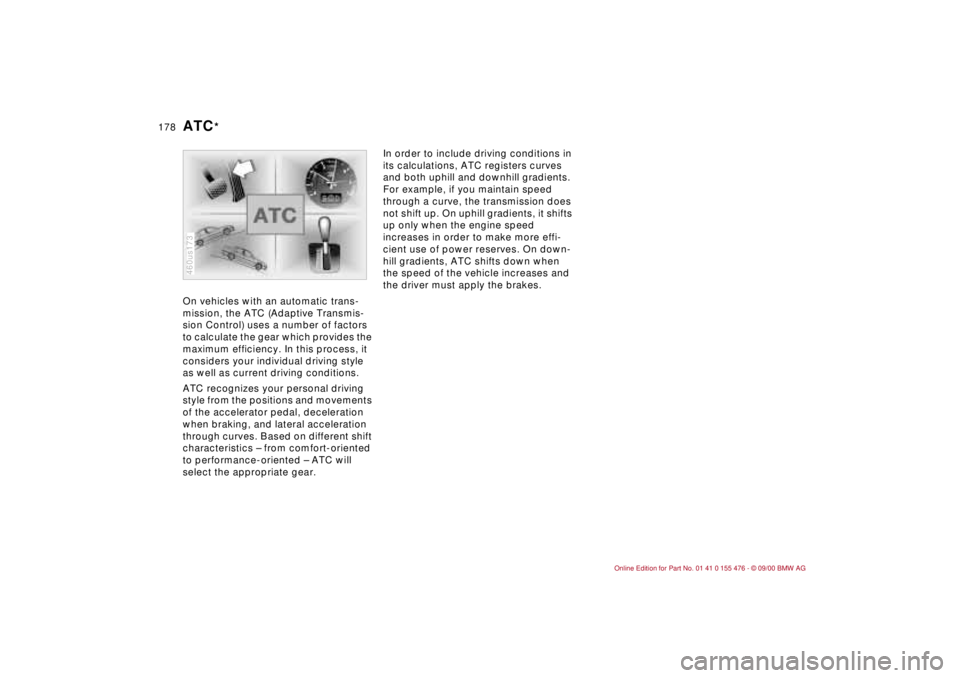
On vehicles with an automatic trans-
mission, the ATC (Adaptive Transmis-
sion Control) uses a number of factors
to calculate the gear which provides the
maximum efficiency. In this process, it
considers your individual driving style
as well as current driving conditions.
ATC recognizes your personal driving
style from the positions and movements
of the accelerator pedal, deceleration
when braking, and lateral acceleration
through curves. Based on different shift
characteristics Ð from comfort-oriented
to performance-oriented Ð ATC will
select the appropriate gear.
460us173
In order to include driving conditions in
its calculations, ATC registers curves
and both uphill and downhill gradients.
For example, if you maintain speed
through a curve, the transmission does
not shift up. On uphill gradients, it shifts
up only when the engine speed
increases in order to make more effi-
cient use of power reserves. On down-
hill gradients, ATC shifts down when
the speed of the vehicle increases and
the driver must apply the brakes.
ATC
*
Page 180 of 211

180n
ASC+T/DSC
*
Highly sensitive sensors monitor the
number of revolutions of the wheels.
When equipped with DSC, they also
monitor steering angle, lateral accelera-
tion, brake pressure and the movement
of the vehicle around its vertical axis.
If differences in the wheel speeds occur,
ASC+T counteracts the danger of
wheelspin by reducing engine torque; if
necessary, ASC will also respond by
applying the brakes to the rear wheels.
In addition, DSC permanently monitors
the vehicle's current operating condition
and compares it with an ideal condition
that is calculated from the sensor's
signals. If deviations from this occur
(understeering or oversteering, for
instance), DSC can stabilize the vehicle
in fractions of a second by reducing
engine output and with the assistance of
braking intervention at individual
wheels. As a result, dangerous skids can
be prevented even as they are just
beginning, but only within the laws of
physics.
You may need some time to become
accustomed to this system's interven-
tion. However, it provides optimum
drive force and driving stability.
The braking intervention may be
accompanied by sounds specific to the
system.
Page 182 of 211
182n
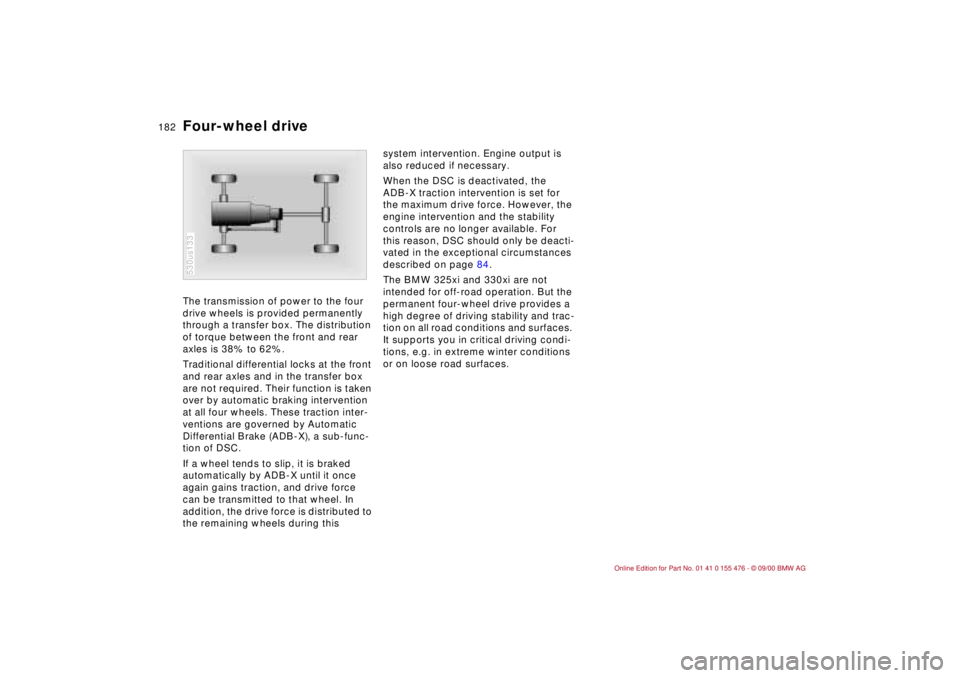
Four-wheel driveThe transmission of power to the four
drive wheels is provided permanently
through a transfer box. The distribution
of torque between the front and rear
axles is 38% to 62%.
Traditional differential locks at the front
and rear axles and in the transfer box
are not required. Their function is taken
over by automatic braking intervention
at all four wheels. These traction inter-
ventions are governed by Automatic
Differential Brake (ADB-X), a sub-func-
tion of DSC.
If a wheel tends to slip, it is braked
automatically by ADB-X until it once
again gains traction, and drive force
can be transmitted to that wheel. In
addition, the drive force is distributed to
the remaining wheels during this 530us133
system intervention. Engine output is
also reduced if necessary.
When the DSC is deactivated, the
ADB-X traction intervention is set for
the maximum drive force. However, the
engine intervention and the stability
controls are no longer available. For
this reason, DSC should only be deacti-
vated in the exceptional circumstances
described on page 84.
The BMW 325xi and 330xi are not
intended for off-road operation. But the
permanent four-wheel drive provides a
high degree of driving stability and trac-
tion on all road conditions and surfaces.
It supports you in critical driving condi-
tions, e.g. in extreme winter conditions
or on loose road surfaces.
Page 187 of 211
187n
IndexDataTechnologyRepairsCar careControlsOverview
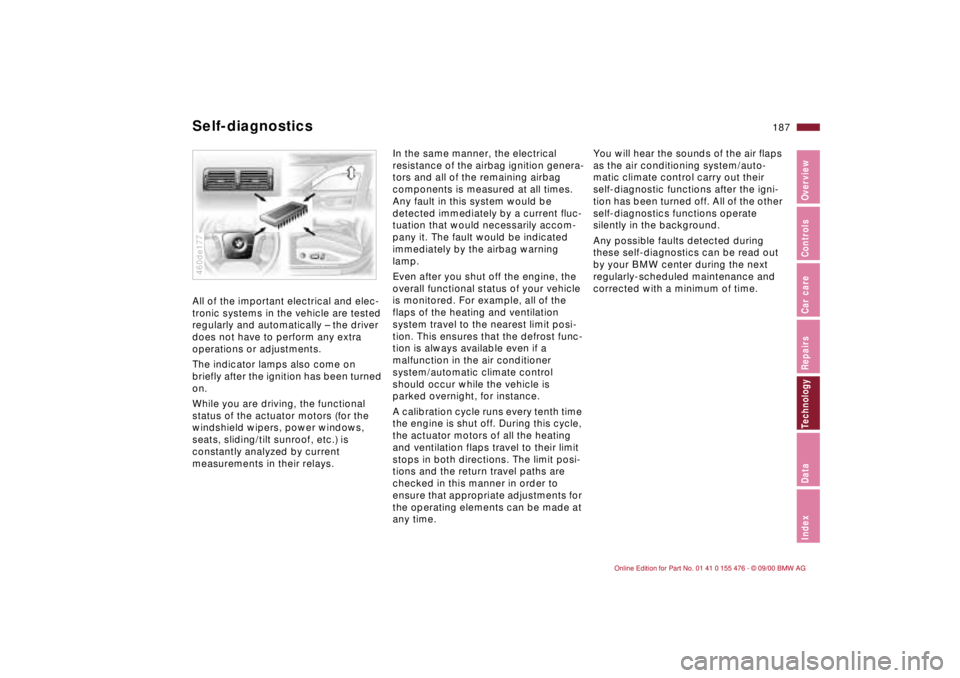
Self-diagnostics All of the important electrical and elec-
tronic systems in the vehicle are tested
regularly and automatically Ð the driver
does not have to perform any extra
operations or adjustments.
The indicator lamps also come on
briefly after the ignition has been turned
on.
While you are driving, the functional
status of the actuator motors (for the
windshield wipers, power windows,
seats, sliding/tilt sunroof, etc.) is
constantly analyzed by current
measurements in their relays.460de177
In the same manner, the electrical
resistance of the airbag ignition genera-
tors and all of the remaining airbag
components is measured at all times.
Any fault in this system would be
detected immediately by a current fluc-
tuation that would necessarily accom-
pany it. The fault would be indicated
immediately by the airbag warning
lamp.
Even after you shut off the engine, the
overall functional status of your vehicle
is monitored. For example, all of the
flaps of the heating and ventilation
system travel to the nearest limit posi-
tion. This ensures that the defrost func-
tion is always available even if a
malfunction in the air conditioner
system/automatic climate control
should occur while the vehicle is
parked overnight, for instance.
A calibration cycle runs every tenth time
the engine is shut off. During this cycle,
the actuator motors of all the heating
and ventilation flaps travel to their limit
stops in both directions. The limit posi-
tions and the return travel paths are
checked in this manner in order to
ensure that appropriate adjustments for
the operating elements can be made at
any time.You will hear the sounds of the air flaps
as the air conditioning system/auto-
matic climate control carry out their
self-diagnostic functions after the igni-
tion has been turned off. All of the other
self-diagnostics functions operate
silently in the background.
Any possible faults detected during
these self-diagnostics can be read out
by your BMW center during the next
regularly-scheduled maintenance and
corrected with a minimum of time.
Page 191 of 211
Overview
Controls and features
Operation, care
and maintenance
Technical data
Index Advanced technology
191n
IndexDataTechnologyRepairsCar careControlsOverview
Engine data192
Dimensions193
Weights194
Capacities195
Electrical system196
V-belts196
Data
Owner service procedures
Page 192 of 211

192n
BMW 320i BMW 325i/325xi BMW 330i/330xi
Displacement
Number of cylinders cu in (ccm) 132.5 (2,171)
6152.2 (2,494)
6181.8 (2,979)
6
Maximum output
at engine speed hp (kW)
rpm168 (124)
6,250184 (135)
6,000225 (165)
5,900
Maximum torque
at engine speedlb ft (Nm)
rpm155 (210)
3,500175 (237)
3,500214 (290)
3,500
Compression ratioe
10.8 10.5 10.2
Stroke
Borein (mm)
in (mm)2.83 (72)
3.15 (80)2.95 (75)
3.31 (84)3.53 (89.6)
3.31 (84)
Fuel-injection system Digital electronic Engine-Management System
BMW 325xi, 330xi: an engine performance test is authorized only on a suitable chassis dynamometer.
Engine data