parking brake BMW 325XI 2002 User Guide
[x] Cancel search | Manufacturer: BMW, Model Year: 2002, Model line: 325XI, Model: BMW 325XI 2002Pages: 155, PDF Size: 2.24 MB
Page 104 of 155

104n
To ensure that your vehicle continues to
provide maximum economy throughout
an extended service life, we request
that you devote careful attention to the
following instructions.
Engine and differentialThe first 1,200 miles (2,000 km):
Attempt to constantly vary both vehicle
and engine speed during these initial
miles while remembering to avoid
engine speeds in excess of 4,500 rpm
and/or vehicle speeds of over 100 mph
(160 km/h):
Always obey all official speed limits.
Refrain from using full throttle and avoid
pressing the accelerator beyond the
kickdown point.
After the initial 1,200 miles (2,000 km)
you can gradually increase both engine
and vehicle speeds.
Please remember to observe these
same break-in procedures if either the
engine or the differential is replaced
later in the course of the vehicle's
service life.
TiresOwing to technical factors associated
with their manufacture, tires do not
achieve their full traction potential until
an initial break-in period has elapsed.
We thus ask you to drive with extra care
during the first 200 miles (300 km).
Always obey all official speed limits.
When the vehicle is operated on
wet or slushy roads, a wedge of
water may form between the tire and
the road surface. This phenomenon is
referred to as aquaplaning, or hydro-
planing, and can lead to partial or
complete loss of traction, vehicle
control and braking effectiveness.
Reduce your speed on wet roads.
rotors achieve the optimal pad-surface
and wear patterns required for trouble-
free operation and an extended service
life later on.
To break in the separate parking brake
drums, apply the parking brake lightly
when coasting to a standstill (at a traffic
signal, for instance); use caution to
avoid posing a danger to other road
users. You can prevent corrosion in the
drums by periodically repeating this
procedure.
The rear brake lamps do not come
on when you apply the parking
brake.
Vacuum for the brake system servo unit
on your BMW is available only when the
engine is running. When you move the
vehicle with the engine off Ð when
towing, for example Ð substantially
higher levels of pedal force will be
required to brake the vehicle.
operate at optimum efficiency.
Remember to engage the clutch care-
fully during this initial period.
Break-in procedures
Page 118 of 155
118n
Brake fluidWarning lamp
The brake warning lamp comes
on when the parking brake is
not engaged: the brake fluid
level is too low, refer to page 17.
Brake warning lamp for Cana-
dian models.
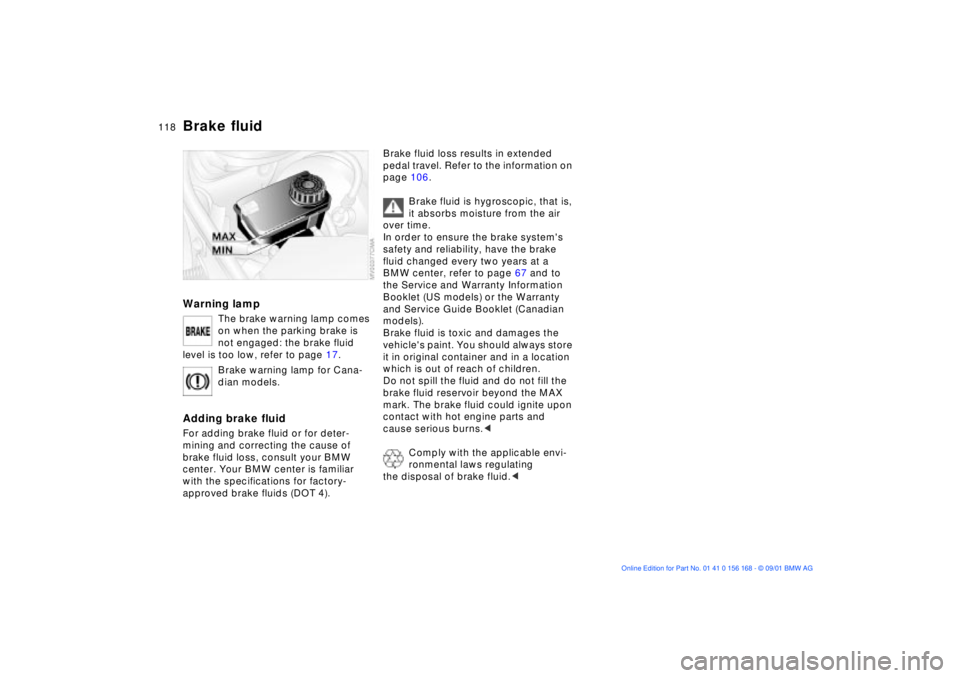
Adding brake fluidFor adding brake fluid or for deter-
mining and correcting the cause of
brake fluid loss, consult your BMW
center. Your BMW center is familiar
with the specifications for factory-
approved brake fluids (DOT 4).
Brake fluid loss results in extended
pedal travel. Refer to the information on
page 106.
Brake fluid is hygroscopic, that is,
it absorbs moisture from the air
over time.
In order to ensure the brake system's
safety and reliability, have the brake
fluid changed every two years at a
BMW center, refer to page 67 and to
the Service and Warranty Information
Booklet (US models) or the Warranty
and Service Guide Booklet (Canadian
models).
Brake fluid is toxic and damages the
vehicle's paint. You should always store
it in original container and in a location
which is out of reach of children.
Do not spill the fluid and do not fill the
brake fluid reservoir beyond the MAX
mark. The brake fluid could ignite upon
contact with hot engine parts and
cause serious burns.<
Comply with the applicable envi-
ronmental laws regulating
the disposal of brake fluid.<
Page 129 of 155
129n
OverviewControlsMaintenanceRepairsDataIndex
Changing a wheel
Safety precautions in the event of
a flat tire or wheel change:
Stop the vehicle as far as possible from
passing traffic. Park on a firm, flat,
surface. Switch on the hazard warning
flashers. Turn the steering wheel to the
straight-ahead position and engage the
steering lock. Shift into 1st or reverse
(selector lever in Park with automatic
transmission) and engage the parking
brake.
All passengers should be outside the
vehicle and well away from your imme-
diate working area (behind a guardrail,
for example).
If a warning triangle or portable hazard
warning lamp is available, set it up on
the roadside at an appropriate distance
from the rear of the vehicle. Comply
with all safety guidelines and regula-
tions.
Change the wheel only on a level, firm
surface which is not slippery. Avoid
jacking the vehicle on a soft or slippery
support surface (snow, ice, loose
gravel, etc.), as either the vehicle or the
jack could slip sideways.
Position the jack on a firm support
surface.
Do not place wooden blocks or similar
objects under the jack. They could
prevent the jack from extending to its
full height and reduce its support
capacity.
Do not lie under the vehicle or start the
engine when the vehicle is supported
by the jack Ð risk of fatal injury.<
Your BMW is equipped with a spare tire
or a space-saver spare tire designed for
temporary use in maintaining the
vehicle's mobility in an emergency.
To remove the spare tire, lift the
floor panel in the luggage
compartment completely out, refer to
page 35.<
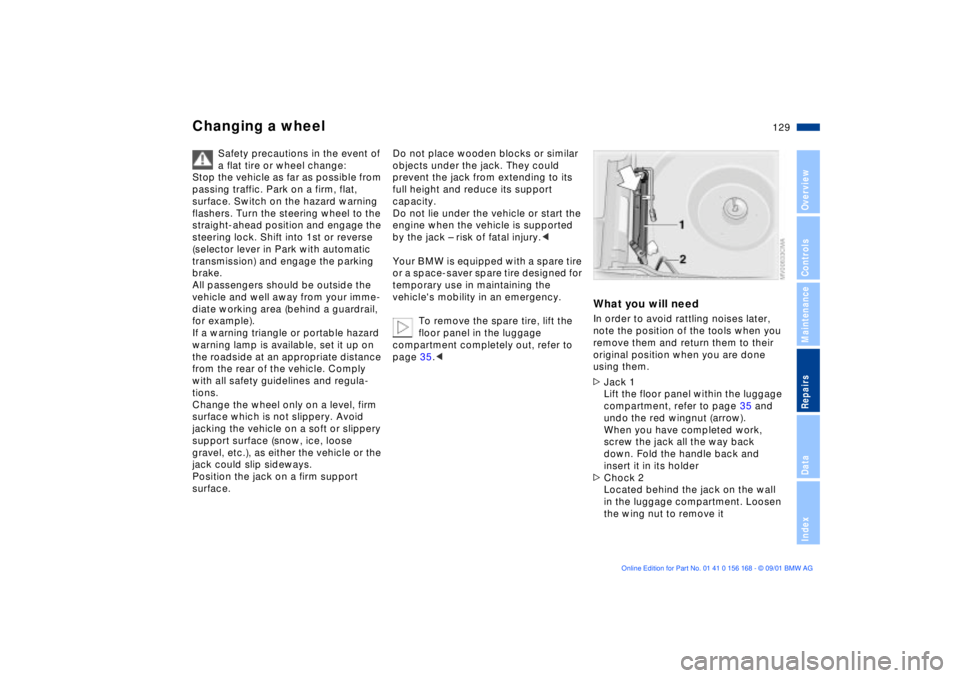
What you will needIn order to avoid rattling noises later,
note the position of the tools when you
remove them and return them to their
original position when you are done
using them.
>Jack 1
Lift the floor panel within the luggage
compartment, refer to page 35 and
undo the red wingnut (arrow).
When you have completed work,
screw the jack all the way back
down. Fold the handle back and
insert it in its holder
>Chock 2
Located behind the jack on the wall
in the luggage compartment. Loosen
the wing nut to remove it
Page 132 of 155

132n
Changing a wheelDriving with the space-saver
spare tireDrive cautiously. Do not exceed a
speed of 50 mph (80 km/h).
You can anticipate changes in vehicle
handling such as delayed braking
response, longer braking distances and
sacrifices in roadholding.
The changes in handling characteristics
will be even more pronounced if winter
tires are mounted.
Only one space-saver spare tire
may be mounted at one time.
Reinstall wheels and tires of the same
size and specification as soon as
possible. Maintain correct tire pres-
sures, refer to page 25.<
Safety tires
*
Safety tires consist of self-supporting
tires and special rims. The tire rein-
forcement ensures that the tire retains
some residual safety in the event of
pressure drop and driving remains
possible to a restricted degree. The
vehicle is equipped with Tire Pressure
Monitor (RDC) or Flat Tire Monitor,
which indicate a flat tire.Flat tireIf there is a tire failure, the red warning
lamp symbol lights up. A supplemen-
tary gong is also heard.
For additional information on Tire Pres-
sure Monitor (RDC) or Flat Tire Monitor
refer to pages 78 or 80.
Reduce vehicle speed carefully to
under 50 mph (80 km/h), avoiding hard
brake applications and steering maneu-
vers.
With the safety tires, you can drive
another approx. 155 miles (250 km) to
reach a safe parking location, a service
station or the nearest BMW center.
With a low vehicle load, this can also be
considerably more than 155 miles
(250 km).Safety tires are only possible in
conjunction with Tire Pressure
Monitor (RDC) or Flat Tire Monitor.<
If the defective wheel can not be seen
as such immediately from the outside,
check the tire inflation pressure at all
four wheels.
Have the tires changed by your
BMW center. For safety reasons,
do not have a safety tire repaired. Your
BMW center has the information
needed for working with safety tires
and is equipped with the necessary
special tools.<
If appropriate, please consult your
BMW center to reequip your
vehicle from summer to winter tires Ð or
vice versa.<
Page 150 of 155

Everything from A to ZN
Navigation system, refer to
the Radio or Onboard
Computer "Owner's
Manual" O
OBD interface socket121
Odometer66
Oil
additives115
capacity143
consumption115
level, checking115
Oil change intervals, refer to
the Service and Warranty
Information Booklet/
Warranty and Service
Guide Booklet
Oil dipstick115
Oil filter change143
OIL SERVICE67
Onboard Computer, refer to
the "Onboard Computer
Owner's Manual"
Onboard tool kit124 Opening and closing
from the inside32
via the door lock31
via the remote control29
Outlets, ventilation88
Outside temperature
display69
P
Paintwork, refer to the
"Caring for your vehicle"
manual
Park assistant71
Park Distance Control
(PDC)71
Parking aid71
Parking brake58
Parking lamps82
bulb replacement125
Passenger-side mirror tilt
function47
PDC (Park Distance
Control)71
Phone, refer to cellular
phone
Power140
Power windows37
safety switch38
Premium sound system91
Q
Quality Grades, tires108 R
Radiator143
Rain sensor62
RDC (Tire Pressure
Monitor)78
warning lamp17
Reading lamps
front84
rear84
Rear center 3-point belt96
Rear lamps127
Rear reading lamps84
Rear window
defroster86, 90
Rear-seat backrest,
removable96
Rearview mirror48
Recirculated-air mode86
Reclining seat41
Refueling22
Remote control29
Removable rear-seat
backrest96
Reporting safety defects11
Roller sun blind91
Roof weight142
Roof-mounted luggage
rack100
S
Safe with safety belts41
Safety belts45
height adjustment45
Safety defects, reporting11
Safety tires109, 132
Seat adjustment41
Seat heating47
Seat memory46
Seat, manually adjusted42
Seats41
Securing cargo99
Securing child-restraint
system54
Selector lever, automatic
transmission59
Service and Warranty Infor-
mation Booklet (US
models)119
Service Interval
Display67, 119
Setting temperature86
Shiftlock59
Side airbags49
Side Impact Head Protection
System49
Sitting correctly with
airbags41
Ski bag97