steering wheel BMW 325XI 2002 User Guide
[x] Cancel search | Manufacturer: BMW, Model Year: 2002, Model line: 325XI, Model: BMW 325XI 2002Pages: 155, PDF Size: 2.24 MB
Page 77 of 155
77n
OverviewControlsMaintenanceRepairsDataIndex
Hill Descent Control (HDC)* Ð BMW 325xi, 330xiThe conceptBy reducing the vehicle's speed on
steep downhill stretches, HDC main-
tains predictable vehicle handling
response to provide you with even
greater control of your BMW during
extreme descents.
The vehicle slows to a pace just slightly
faster than walking speed.
HDC is available for activation at
vehicle speeds below approx. 22 mph
(35 km/h). When driving down steep
hills, the vehicle reduces speed auto-
matically down to slightly more than
double walking speed (approx. 8 mph/
12 km/h) and then maintains this speed
at a constant.
You can use the accelerator or brakes
to vary this automatically controlled
speed within a range extending from
approx. 3 mph (5 km/h) to 15 mph
(25 km/h).
In conjunction with the multifunction
steering wheel, you can use the
+/Ð button to set the cruise control to a
target speed in the range from approx.
3 mph (5 km/h) to 15 mph (25 km/h).
HDC is automatically deactivated once
vehicle speed again exceeds approx.
35 mph (60 km/h).
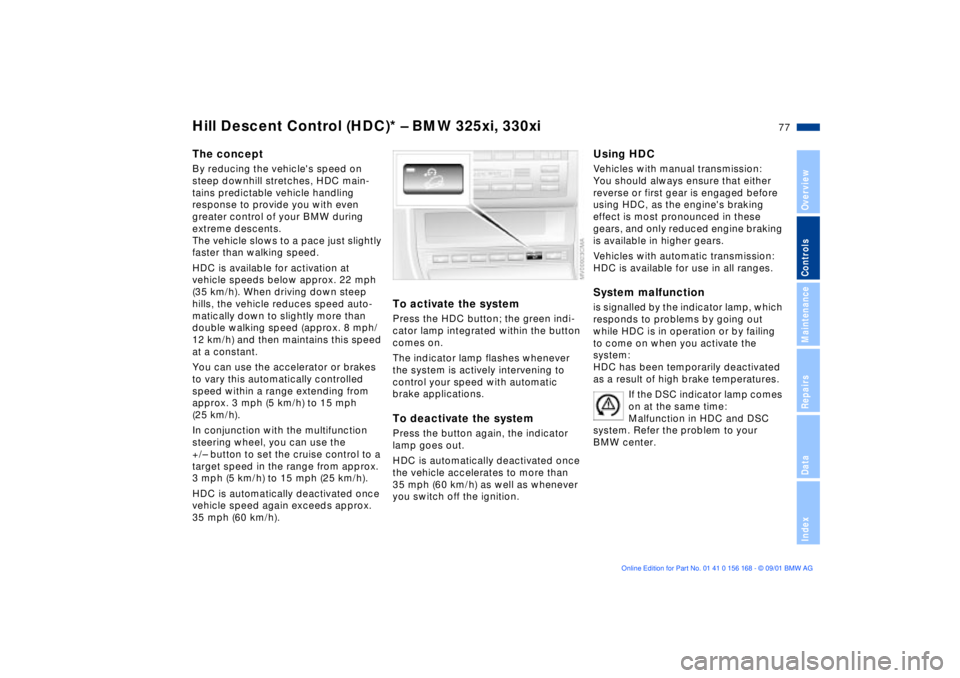
To activate the systemPress the HDC button; the green indi-
cator lamp integrated within the button
comes on.
The indicator lamp flashes whenever
the system is actively intervening to
control your speed with automatic
brake applications.To deactivate the systemPress the button again, the indicator
lamp goes out.
HDC is automatically deactivated once
the vehicle accelerates to more than
35 mph (60 km/h) as well as whenever
you switch off the ignition.
Using HDCVehicles with manual transmission:
You should always ensure that either
reverse or first gear is engaged before
using HDC, as the engine's braking
effect is most pronounced in these
gears, and only reduced engine braking
is available in higher gears.
Vehicles with automatic transmission:
HDC is available for use in all ranges.System malfunctionis signalled by the indicator lamp, which
responds to problems by going out
while HDC is in operation or by failing
to come on when you activate the
system:
HDC has been temporarily deactivated
as a result of high brake temperatures.
If the DSC indicator lamp comes
on at the same time:
Malfunction in HDC and DSC
system. Refer the problem to your
BMW center.
Page 105 of 155

105n
OverviewControlsMaintenanceRepairsDataIndex
Driving notes Antilock Brake System
Brakes: do not drive with your foot
resting on the brake pedal. Even
light but consistent pedal pressure can
lead to high temperatures, brake wear
and possibly even brake failure.
Aquaplaning: when driving on wet or
slushy roads, reduce vehicle speed. If
you do not, a wedge of water may form
between the tires and the road surface.
This phenomenon can lead to partial or
complete loss of contact between the
tires and road surface, vehicle control
and braking ability.
Driving through water: do not drive
through water on the road if it is deeper
than 1 ft (30 cm), and then only at
walking speed. Otherwise, the vehicle's
engine, the electrical systems and the
transmission may be damaged.
Rear tray: never use it to store heavy or
hard objects, as otherwise occupants
could be injured during braking maneu-
vers.
Clothes hooks: when hanging clothing
from the hooks, be sure that they will
not obstruct the driver's vision. Do not
hang heavy objects on the hooks. If you
do so, they could cause personal injury
during braking or evasive maneuvers.<
The conceptThe Antilock Brake System (ABS) keeps
the wheels from locking during braking,
thereby enhancing active driving safety.Braking with ABSIf you are in a situation that requires full
braking, you will exploit the full benefits
of the ABS system if you apply
maximum pedal pressure ("panic stop").
Since the vehicle maintains steering
responsiveness, you can avoid possible
obstacles with a minimum of steering
effort, despite the full brake application.
Pulsation at the brake pedal combined
with sounds from the hydraulic circuits
indicates to the driver that ABS is in its
active mode.
Page 107 of 155
107n
OverviewControlsMaintenanceRepairsDataIndex
Information for your safetyThe factory-approved radial tires are
matched to the vehicle and have been
selected to provide optimum safety and
driving comfort.
It is not merely the tire's service life, but
also driving comfort and Ð above all else
Ð driving safety that depend on the
condition of the tires and the mainte-
nance of the specified tire pressure.
Incorrect tire inflation pressure is
a frequent cause of tire damage.
Tire pressure also has a major effect on
your BMW's handling response. Be
sure to check the tire inflation pressure,
including the space-saver spare tire or
the spare tire, on a regular basis, at
least twice a month and before every
extended journey, refer to page 24.
Otherwise, incorrect tire pressure can
lead to poor handling, to tire damage
and accidents.<
Tire tread Ð tire damageInspect your tires frequently for tread
wear, signs of damage and for foreign
objects lodged in the tread. Check the
tread depth.
Tread depth should not be allowed to go
below 0.12 in (3 mm), even though the
legally specified minimum tread depth is
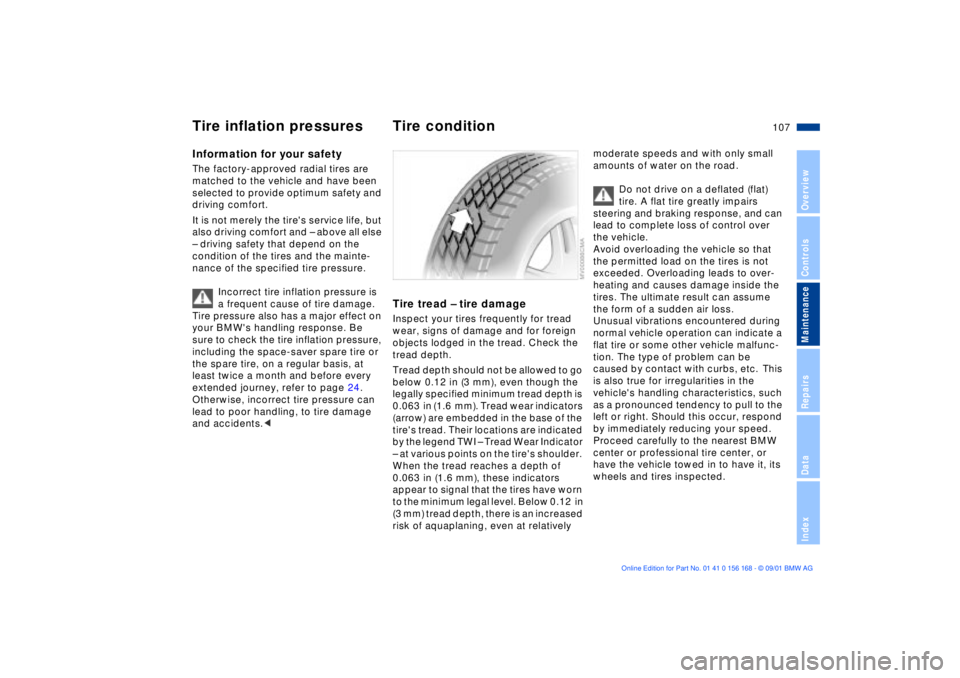
0.063 in (1.6 mm). Tread wear indicators
(arrow) are embedded in the base of the
tire's tread. Their locations are indicated
by the legend TWI Ð Tread Wear Indicator
Ð at various points on the tire's shoulder.
When the tread reaches a depth of
0.063 in (1.6 mm), these indicators
appear to signal that the tires have worn
to the minimum legal level. Below 0.12 in
(3 mm) tread depth, there is an increased
risk of aquaplaning, even at relatively
moderate speeds and with only small
amounts of water on the road.
Do not drive on a deflated (flat)
tire. A flat tire greatly impairs
steering and braking response, and can
lead to complete loss of control over
the vehicle.
Avoid overloading the vehicle so that
the permitted load on the tires is not
exceeded. Overloading leads to over-
heating and causes damage inside the
tires. The ultimate result can assume
the form of a sudden air loss.
Unusual vibrations encountered during
normal vehicle operation can indicate a
flat tire or some other vehicle malfunc-
tion. The type of problem can be
caused by contact with curbs, etc. This
is also true for irregularities in the
vehicle's handling characteristics, such
as a pronounced tendency to pull to the
left or right. Should this occur, respond
by immediately reducing your speed.
Proceed carefully to the nearest BMW
center or professional tire center, or
have the vehicle towed in to have it, its
wheels and tires inspected.
Tire inflation pressures
Tire condition
Page 111 of 155

111n
OverviewControlsMaintenanceRepairsDataIndex
Winter tiresChoosing the right tireBMW recommends winter tires (M+S
radial tires) for operation under
inclement winter driving conditions.
While all-season tires (M+S designa-
tion) provide better winter traction than
summer tires with the load ratings H, V,
W, Y and ZR, they generally do not
achieve the performance of winter tires.
In the interest of safe tracking and
steering response, install winter tires
made by the same manufacturer having
the same tread configuration on all four
wheels.
Never exceed the maximum
speed for which the winter tires
are rated.
Unprofessional attempts by laymen to
service tires can lead to damage and
accidents.
Have this work performed by trained
professionals only. Any BMW center
has the required technical knowledge
and the proper equipment and will be
happy to assist you.<
Tire condition, tire pressureOnce the tire wears to below 0.16 in
(4 mm), winter tires display a percep-
tible decrease in their ability to cope
with winter driving conditions, and
should be replaced in the interest of
safety.
Comply with the specified tire inflation
pressures Ñ and be sure to have the
wheel and tire assemblies balanced
every time you change the tires.StorageStore tires in a cool, dry place,
protecting them against light whenever
possible. Protect the tires against
contact with oil, grease and fuel.
Snow chains
*
BMW narrow-link snow chains are
intended for mounting on summer or
winter tires in pairs at the rear wheels
only.
BMW 325xi, 330xi: in an extreme emer-
gency Ð for instance, with the vehicle
stuck on one side, or when obstruc-
tions make it impossible to reach one
tire Ð a chain may also be mounted on
just one tire for the limited period
needed to resolve the problem.
Comply with all manufacturer's safety
precautions when mounting the chains.
You cannot mount snow chains on the
following tires:
225/50 R 16 92
225/45 R 17 91
245/40 ZR 17
Page 129 of 155
129n
OverviewControlsMaintenanceRepairsDataIndex
Changing a wheel
Safety precautions in the event of
a flat tire or wheel change:
Stop the vehicle as far as possible from
passing traffic. Park on a firm, flat,
surface. Switch on the hazard warning
flashers. Turn the steering wheel to the
straight-ahead position and engage the
steering lock. Shift into 1st or reverse
(selector lever in Park with automatic
transmission) and engage the parking
brake.
All passengers should be outside the
vehicle and well away from your imme-
diate working area (behind a guardrail,
for example).
If a warning triangle or portable hazard
warning lamp is available, set it up on
the roadside at an appropriate distance
from the rear of the vehicle. Comply
with all safety guidelines and regula-
tions.
Change the wheel only on a level, firm
surface which is not slippery. Avoid
jacking the vehicle on a soft or slippery
support surface (snow, ice, loose
gravel, etc.), as either the vehicle or the
jack could slip sideways.
Position the jack on a firm support
surface.
Do not place wooden blocks or similar
objects under the jack. They could
prevent the jack from extending to its
full height and reduce its support
capacity.
Do not lie under the vehicle or start the
engine when the vehicle is supported
by the jack Ð risk of fatal injury.<
Your BMW is equipped with a spare tire
or a space-saver spare tire designed for
temporary use in maintaining the
vehicle's mobility in an emergency.
To remove the spare tire, lift the
floor panel in the luggage
compartment completely out, refer to
page 35.<
What you will needIn order to avoid rattling noises later,
note the position of the tools when you
remove them and return them to their
original position when you are done
using them.
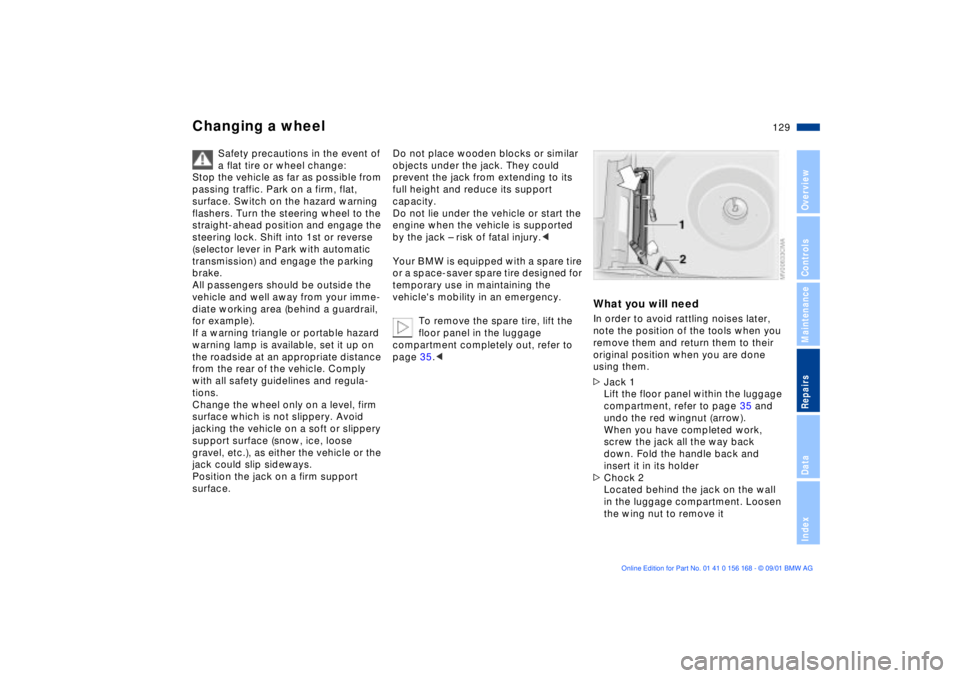
>Jack 1
Lift the floor panel within the luggage
compartment, refer to page 35 and
undo the red wingnut (arrow).
When you have completed work,
screw the jack all the way back
down. Fold the handle back and
insert it in its holder
>Chock 2
Located behind the jack on the wall
in the luggage compartment. Loosen
the wing nut to remove it
Page 132 of 155

132n
Changing a wheelDriving with the space-saver
spare tireDrive cautiously. Do not exceed a
speed of 50 mph (80 km/h).
You can anticipate changes in vehicle
handling such as delayed braking
response, longer braking distances and
sacrifices in roadholding.
The changes in handling characteristics
will be even more pronounced if winter
tires are mounted.
Only one space-saver spare tire
may be mounted at one time.
Reinstall wheels and tires of the same
size and specification as soon as
possible. Maintain correct tire pres-
sures, refer to page 25.<
Safety tires
*
Safety tires consist of self-supporting
tires and special rims. The tire rein-
forcement ensures that the tire retains
some residual safety in the event of
pressure drop and driving remains
possible to a restricted degree. The
vehicle is equipped with Tire Pressure
Monitor (RDC) or Flat Tire Monitor,
which indicate a flat tire.Flat tireIf there is a tire failure, the red warning
lamp symbol lights up. A supplemen-
tary gong is also heard.
For additional information on Tire Pres-
sure Monitor (RDC) or Flat Tire Monitor
refer to pages 78 or 80.
Reduce vehicle speed carefully to
under 50 mph (80 km/h), avoiding hard
brake applications and steering maneu-
vers.
With the safety tires, you can drive
another approx. 155 miles (250 km) to
reach a safe parking location, a service
station or the nearest BMW center.
With a low vehicle load, this can also be
considerably more than 155 miles
(250 km).Safety tires are only possible in
conjunction with Tire Pressure
Monitor (RDC) or Flat Tire Monitor.<
If the defective wheel can not be seen
as such immediately from the outside,
check the tire inflation pressure at all
four wheels.
Have the tires changed by your
BMW center. For safety reasons,
do not have a safety tire repaired. Your
BMW center has the information
needed for working with safety tires
and is equipped with the necessary
special tools.<
If appropriate, please consult your
BMW center to reequip your
vehicle from summer to winter tires Ð or
vice versa.<
Page 146 of 155

Everything from A to ZA
ABS (Antilock Brake
System)19, 105
Accessories10
Activated-charcoal filter91
Adaptive Transmission
Control (ATC)60
ADB (Automatic Differential
Brake)73
Adding
brake fluid118
coolant117
engine oil115
washer fluid114
Adjusting
head restraints44
lumbar support43
manual seats42
mirrors48
power seat43
steering wheel47
thigh support42
Air conditioning85
temperature settings86
Air distribution86, 89
Air nozzles85 Air outlets,
ventilation85, 88
Air supply86, 89
Airbags18, 49
sitting correctly41
Alarm system36
Antifreeze117
Antilock Brake System
(ABS)19, 105
Anti-theft system36
Aquaplaning104, 105
Armrest92
ASC+T (Automatic Stability
Control plus Traction)72
Ashtray
front95
rear95
ATC (Adaptive Transmission
Control)60
Attach vehicle vacuum
cleaner95
AUC (Automatic recircu-
lated-air control)90
Automatic climate
control88
temperature settings89
Automatic cruise control64
Automatic curb monitor47 Automatic Differential Brake
(ADB)73
Automatic headlight
control82
Automatic recirculated-air
control (AUC)90
Automatic Stability Control
plus Traction (ASC+T)72
Automatic transmission59
Automatic transmission with
Steptronic18, 59
Automatic-dimming feature,
mirrors49
Average consumption70
Average speed70
Axle loads142
B
Backrest, adjusting42
Backup lamps58
bulb replacement127
Battery133
care133
charge current
indicator17
charging133
Belts, safety45
Beverage holder93 Blower86, 89
BMW High Performance
Synthetic Oil116
BMW Maintenance
System119
BMW sports seat
electrical adjustment43
manual adjustment42
Bore140
Bottle holder, refer to
beverage holder93
Brake fluid118
add118
warning lamp17
Brake lamps
bulb replacement127
Brake system104, 106
brake fluid118
brake fluid level106
brake pads106
brake pads, indicator
lamp19
disc brakes106
Break-in procedure104
Bulbs and lamps,
replacement124
A-Z
Page 149 of 155

Everything from A to Z
149n
OverviewControlsMaintenanceRepairsDataIndex
I
Ice warning69
Icy roads69
Ignition key28
Ignition lock56
Imprint4
Indicator lamps17
Inflation pressures,
tires24, 107
Inside rearview mirror
automatic dimming
feature49
INSPECTION67
Instrument cluster15
Instrument lighting83
Instruments15
Interface socket for onboard
diagnostics (OBD)121
Interior lamps30, 84
remote control30
Interior motion sensor37
avoiding unintentional
alarms37
deactivate by remote
control30
Interior rearview mirror48
Interlock56
J
Jack129
Jump-starting134 K
Key Memory55
Keys28
with remote control28 L
Lamps and bulbs,
replacement124
Lashing eyes99
LATCH child-restraint
mounting system52
Length141
License plate lamp
bulb replacement128
LIGHTS ON warning82
Litter bag holder93
Load-securing devices99
Lock buttons32
Louvers85
Low beams82
bulb replacement125
Lug wrench129 Luggage compartment35
bulb replacement127
capacity142
floor mat35
floor panel35
Luggage compartment
lid33
bulb replacement127
disconnect from central
locking system33
electrical malfunction33
manual operation33
operate via remote
control30
secure separately33
Luggage compartment
lighting33
Luggage compartment's
interior, emergency
release35
Luggage rack100
Lumbar support43
M
M+S tires111
Maintenance67, 119
Malfunction displays68
Manual operation
doors31
fuel filler door22
luggage compartment
lid33
sliding/tilt sunroof40
Manual seat adjustment42
Manual transmission58
Manually controlled recircu-
lated-air90
MFL (Multifunction steering
wheel)21
Microfilter87, 91
Microphone94
Mirror defrosting48
Mirror memory46
Mirrors48
Modifications,
technical10, 120
Motion sensor, refer to
interior motion sensor
Multifunction steering wheel
(MFL)21
Page 151 of 155

Everything from A to Z
151n
OverviewControlsMaintenanceRepairsDataIndex
Sliding/tilt sunroof39
electrical malfunction40
manual operation40
Socket95
Sound system91
Space-saver spare
tire25, 132
Spare tire129
Speedometer15
Sports seat
electrical adjustment43
manual adjustment42
Standing lamps83
Starting the engine56
Steering wheel47
Steering wheel lock56
Stopping the vehicle57
Storage compartments92
Storing heavy loads99
Stroke140
Sun blind cover91
Switching off the engine57
Symbols used in this
manual8
Synthetic oils116
T
Tachometer66
Tail lamps
bulb replacement127
Tank capacity143
Technical data140
Technical
modifications10, 120
Telephone preparation94
Temperature display
outside temperature69
Temperature gauge
engine coolant67
Temperature
layering87, 90
Temperature settings
air conditioning86
automatic climate
control89
Thigh support
adjustment42
Third brake light128
Through-loading system96
Tilt alarm sensor30
avoiding unintentional
alarms37
deactivate by remote
control30 Tilt function, passenger-side
mirror47
Tire change129
Tire condition107
Tire inflation
pressures24, 107
monitoring78
table25
Tire Pressure Monitor
(RDC)78, 109, 132
warning lamp17
Tire Quality Grading109
Tire replacement108
Tire tread107
Tool kit124
Torque140
Tow fittings135
Towing the vehicle135
Track141
Transmission58
Transmitter keys28
Transporting children
safely52
Tread depth, tires107
Tread wear, tires107
Trip odometer66
Trunk lid, refer to luggage
compartment lid33 Trunk, refer to luggage
compartment35
Turn signal
indicators20, 61
bulb replacement126
Turning radius141
U
Uniform Tire Quality
Grading109 V
Vehicle Memory55
Vehicle weight142
Vehicle, starting56
Ventilation85, 88
draft-free87, 90 W
Warning lamp "Fasten safety
belts"18
Warning lamps17
Warning messages68
Warning triangle22
Warranty and Service Guide
Booklet (Canadian
models)119