rear BMW 325XI 2003 Service Manual
[x] Cancel search | Manufacturer: BMW, Model Year: 2003, Model line: 325XI, Model: BMW 325XI 2003Pages: 166, PDF Size: 4.29 MB
Page 110 of 166
110
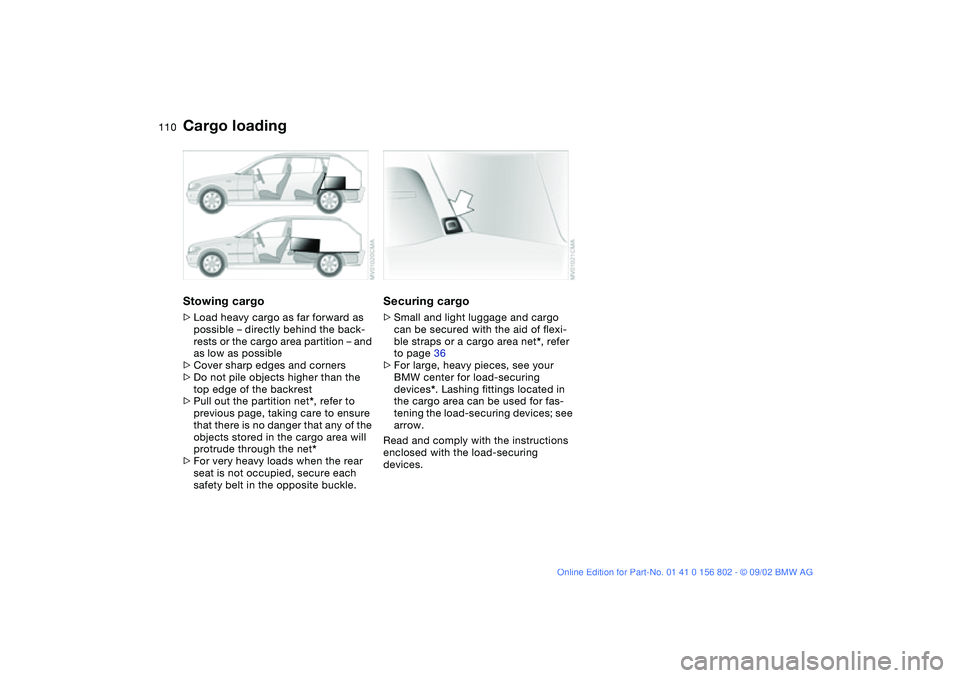
Stowing cargo>Load heavy cargo as far forward as
possible – directly behind the back-
rests or the cargo area partition – and
as low as possible
>Cover sharp edges and corners
>Do not pile objects higher than the
top edge of the backrest
>Pull out the partition net*, refer to
previous page, taking care to ensure
that there is no danger that any of the
objects stored in the cargo area will
protrude through the net*
>For very heavy loads when the rear
seat is not occupied, secure each
safety belt in the opposite buckle.
Securing cargo>Small and light luggage and cargo
can be secured with the aid of flexi-
ble straps or a cargo area net*, refer
to page 36
>For large, heavy pieces, see your
BMW center for load-securing
devices*. Lashing fittings located in
the cargo area can be used for fas-
tening the load-securing devices; see
arrow.
Read and comply with the instructions
enclosed with the load-securing
devices.
Cargo loading
handbook.book Page 110 Saturday, July 27, 2002 1:36 PM
Page 121 of 166
121
Tire condition, tire pressureAt tread depths below approx. 3/16 in /
4 mm, winter tires display a perceptible
decrease in their ability to cope with
winter driving conditions, and should be
replaced in the interest of safety.
Comply with the specified tire inflation
pressures — and be sure to have the
wheel and tire assembly balanced
every time you change a tire or wheel.Snow chains*Only certain snow chains have been
tested by BMW and determined and
approved as roadworthy. Consult any
BMW center for details. BMW recom-
mends using only these approved fine-
link snow chains. Use them in pairs on
either summer or winter tires, but only
on both rear wheels.
BMW 325xi: in an extreme emergency –
for instance, with the vehicle stuck on
one side, or when obstructions make it
impossible to reach one tire – a chain
may also be mounted on just one tire
for the limited period needed to resolve
the problem.
Comply with all manufacturer's safety
precautions when mounting the chains.
Do not exceed a speed of 30 mph /
50 km/h when unsing snow chains.You cannot mount snow chains on the
following tires:
225/50 R 16
225/45 R 17
245/40 R 17
225/40 R 18
255/35 R 18Winter tires
OverviewControlsMaintenanceRepairsDataIndex
handbook.book Page 121 Saturday, July 27, 2002 1:36 PM
Page 126 of 166
126
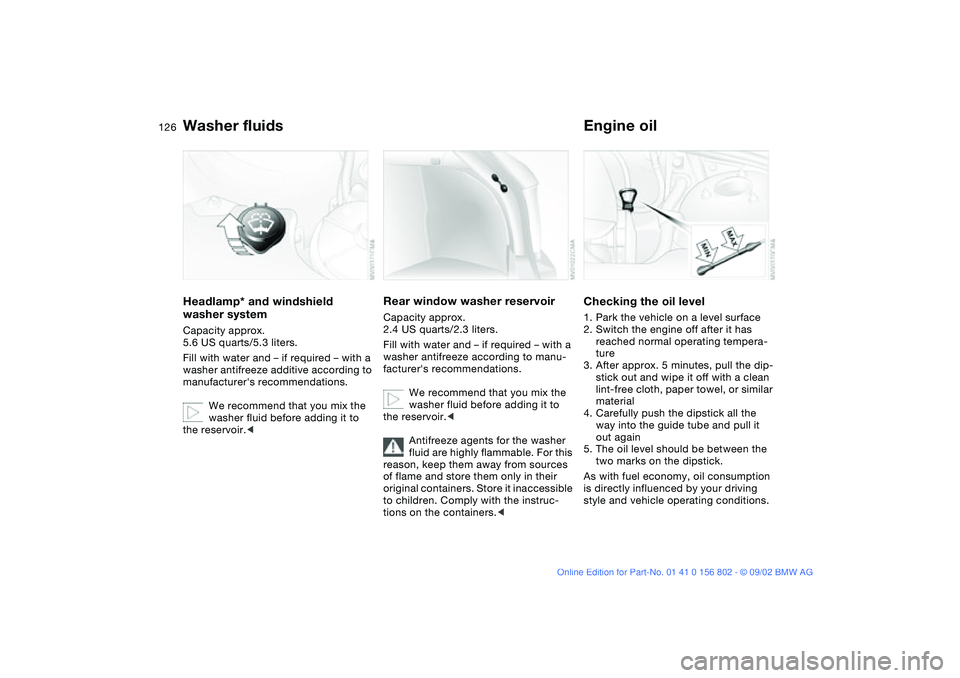
Washer fluidsHeadlamp* and windshield
washer systemCapacity approx.
5.6 US quarts/5.3 liters.
Fill with water and – if required – with a
washer antifreeze additive according to
manufacturer's recommendations.
We recommend that you mix the
washer fluid before adding it to
the reservoir.<
Rear window washer reservoirCapacity approx.
2.4 US quarts/2.3 liters.
Fill with water and – if required – with a
washer antifreeze according to manu-
facturer's recommendations.
We recommend that you mix the
washer fluid before adding it to
the reservoir.<
Antifreeze agents for the washer
fluid are highly flammable. For this
reason, keep them away from sources
of flame and store them only in their
original containers. Store it inaccessible
to children. Comply with the instruc-
tions on the containers.<
Engine oilChecking the oil level1. Park the vehicle on a level surface
2. Switch the engine off after it has
reached normal operating tempera-
ture
3. After approx. 5 minutes, pull the dip-
stick out and wipe it off with a clean
lint-free cloth, paper towel, or similar
material
4. Carefully push the dipstick all the
way into the guide tube and pull it
out again
5. The oil level should be between the
two marks on the dipstick.
As with fuel economy, oil consumption
is directly influenced by your driving
style and vehicle operating conditions.
handbook.book Page 126 Saturday, July 27, 2002 1:36 PM
Page 136 of 166
136Replacement procedures
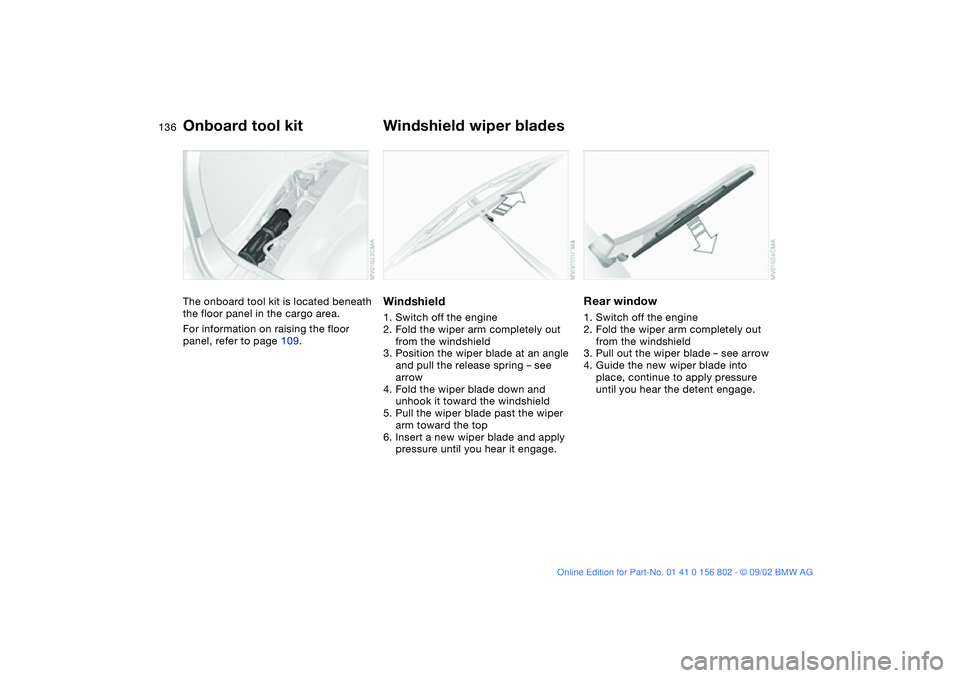
Onboard tool kitThe onboard tool kit is located beneath
the floor panel in the cargo area.
For information on raising the floor
panel, refer to page 109.
Windshield wiper bladesWindshield1. Switch off the engine
2. Fold the wiper arm completely out
from the windshield
3. Position the wiper blade at an angle
and pull the release spring – see
arrow
4. Fold the wiper blade down and
unhook it toward the windshield
5. Pull the wiper blade past the wiper
arm toward the top
6. Insert a new wiper blade and apply
pressure until you hear it engage.
Rear window1. Switch off the engine
2. Fold the wiper arm completely out
from the windshield
3. Pull out the wiper blade – see arrow
4. Guide the new wiper blade into
place, continue to apply pressure
until you hear the detent engage.
handbook.book Page 136 Saturday, July 27, 2002 1:36 PM
Page 139 of 166
139
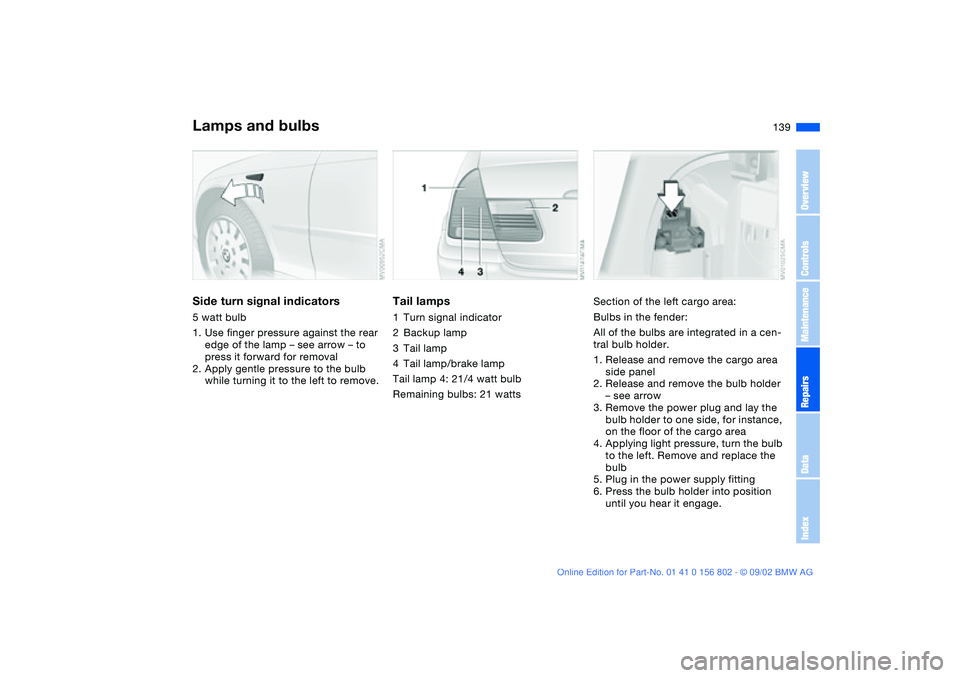
Side turn signal indicators5 watt bulb
1. Use finger pressure against the rear
edge of the lamp – see arrow – to
press it forward for removal
2. Apply gentle pressure to the bulb
while turning it to the left to remove.
Tail lamps1Turn signal indicator
2Backup lamp
3Tail lamp
4Tail lamp/brake lamp
Tail lamp 4: 21/4 watt bulb
Remaining bulbs: 21 watts
Section of the left cargo area:
Bulbs in the fender:
All of the bulbs are integrated in a cen-
tral bulb holder.
1. Release and remove the cargo area
side panel
2. Release and remove the bulb holder
– see arrow
3. Remove the power plug and lay the
bulb holder to one side, for instance,
on the floor of the cargo area
4. Applying light pressure, turn the bulb
to the left. Remove and replace the
bulb
5. Plug in the power supply fitting
6. Press the bulb holder into position
until you hear it engage.
Lamps and bulbs
OverviewControlsMaintenanceRepairsDataIndex
handbook.book Page 139 Saturday, July 27, 2002 1:36 PM
Page 140 of 166
140
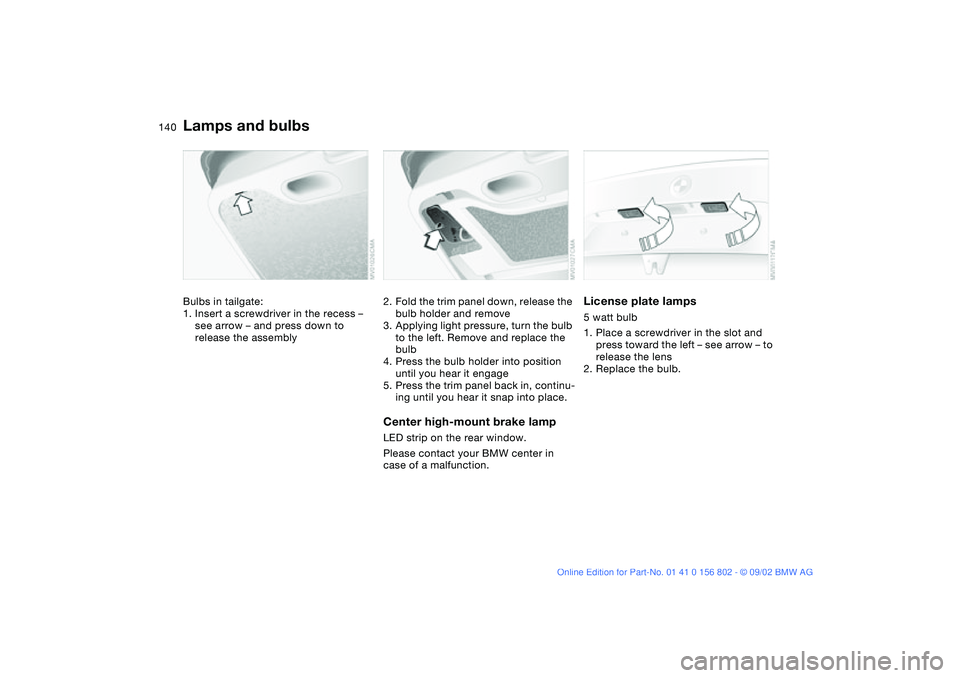
Bulbs in tailgate:
1. Insert a screwdriver in the recess –
see arrow – and press down to
release the assembly
2. Fold the trim panel down, release the
bulb holder and remove
3. Applying light pressure, turn the bulb
to the left. Remove and replace the
bulb
4. Press the bulb holder into position
until you hear it engage
5. Press the trim panel back in, continu-
ing until you hear it snap into place.Center high-mount brake lampLED strip on the rear window.
Please contact your BMW center in
case of a malfunction.
License plate lamps5 watt bulb
1. Place a screwdriver in the slot and
press toward the left – see arrow – to
release the lens
2. Replace the bulb.
Lamps and bulbs
handbook.book Page 140 Saturday, July 27, 2002 1:36 PM
Page 141 of 166
141
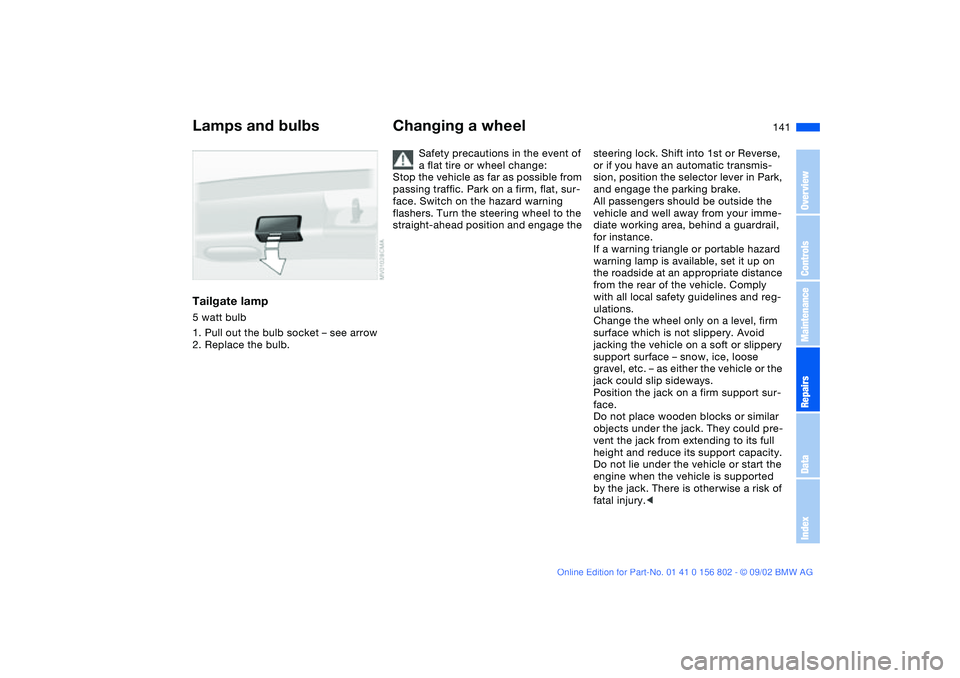
Tailgate lamp5 watt bulb
1. Pull out the bulb socket – see arrow
2. Replace the bulb.
Changing a wheel
Safety precautions in the event of
a flat tire or wheel change:
Stop the vehicle as far as possible from
passing traffic. Park on a firm, flat, sur-
face. Switch on the hazard warning
flashers. Turn the steering wheel to the
straight-ahead position and engage the
steering lock. Shift into 1st or Reverse,
or if you have an automatic transmis-
sion, position the selector lever in Park,
and engage the parking brake.
All passengers should be outside the
vehicle and well away from your imme-
diate working area, behind a guardrail,
for instance.
If a warning triangle or portable hazard
warning lamp is available, set it up on
the roadside at an appropriate distance
from the rear of the vehicle. Comply
with all local safety guidelines and reg-
ulations.
Change the wheel only on a level, firm
surface which is not slippery. Avoid
jacking the vehicle on a soft or slippery
support surface – snow, ice, loose
gravel, etc. – as either the vehicle or the
jack could slip sideways.
Position the jack on a firm support sur-
face.
Do not place wooden blocks or similar
objects under the jack. They could pre-
vent the jack from extending to its full
height and reduce its support capacity.
Do not lie under the vehicle or start the
engine when the vehicle is supported
by the jack. There is otherwise a risk of
fatal injury.<
Lamps and bulbs
OverviewControlsMaintenanceRepairsDataIndex
handbook.book Page 141 Saturday, July 27, 2002 1:36 PM
Page 142 of 166
142
Your BMW is equipped with a spare tire
or a space-saver spare tire designed for
temporary use in maintaining the vehi-
cle's mobility in an emergency.
To remove the spare tire, lift the
floor panel in the cargo area com-
pletely out, refer to page 109.<
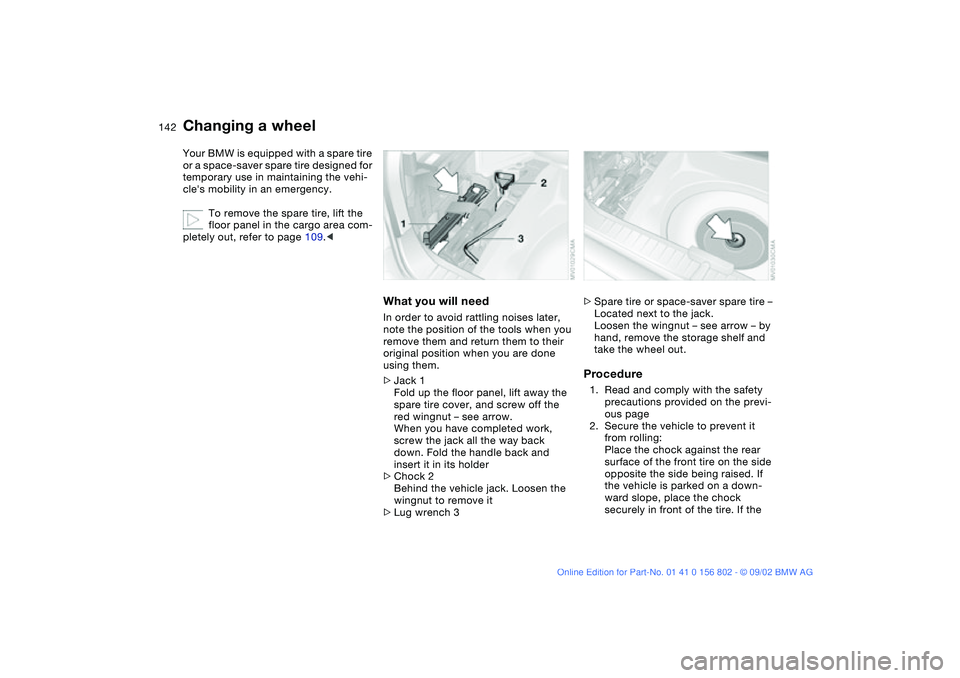
What you will needIn order to avoid rattling noises later,
note the position of the tools when you
remove them and return them to their
original position when you are done
using them.
>Jack 1
Fold up the floor panel, lift away the
spare tire cover, and screw off the
red wingnut – see arrow.
When you have completed work,
screw the jack all the way back
down. Fold the handle back and
insert it in its holder
>Chock 2
Behind the vehicle jack. Loosen the
wingnut to remove it
>Lug wrench 3
>Spare tire or space-saver spare tire –
Located next to the jack.
Loosen the wingnut – see arrow – by
hand, remove the storage shelf and
take the wheel out.Procedure1. Read and comply with the safety
precautions provided on the previ-
ous page
2. Secure the vehicle to prevent it
from rolling:
Place the chock against the rear
surface of the front tire on the side
opposite the side being raised. If
the vehicle is parked on a down-
ward slope, place the chock
securely in front of the tire. If the
Changing a wheel
handbook.book Page 142 Saturday, July 27, 2002 1:36 PM
Page 148 of 166
148
Do not use spray starter fluids to
start the engine.<
Towing the vehicleTowing eyeletThe screw-in towing eyelet is stored in
the onboard tool kit; be sure that it
remains in the vehicle at all times. It is
designed for installation in the tow
sockets located at the front and rear of
the vehicle, and is intended for towing
on paved road surfaces only. The tow-
ing eyelet should not be used to pull a
vehicle out of deep snow, mud, sand,
etc. Always observe all applicable tow-
ing laws and regulations.
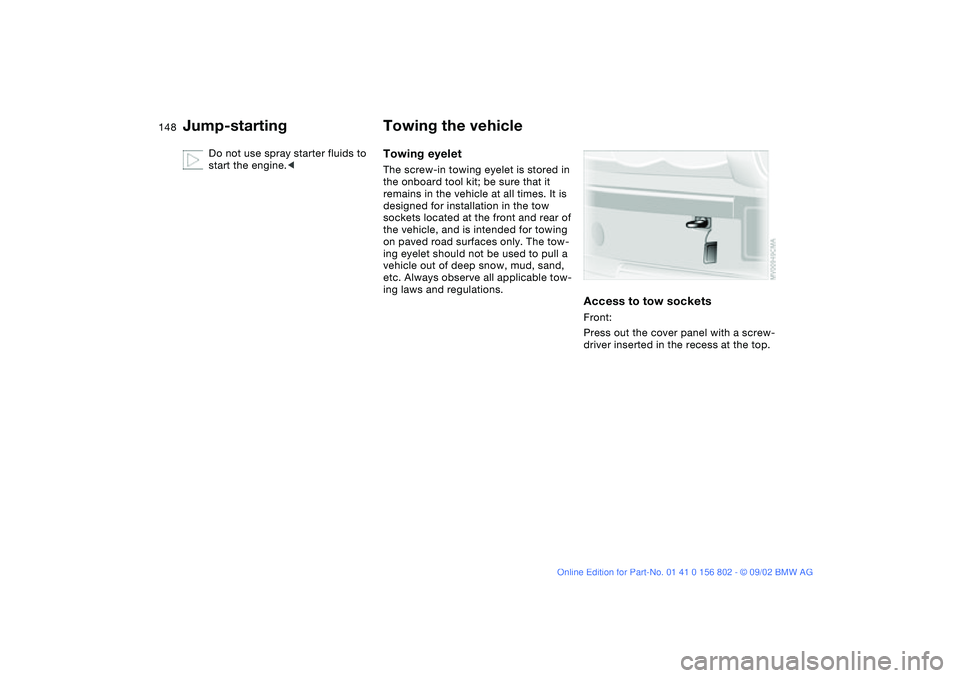
Access to tow socketsFront:
Press out the cover panel with a screw-
driver inserted in the recess at the top.
Jump-starting
handbook.book Page 148 Saturday, July 27, 2002 1:36 PM
Page 149 of 166
149
Rear:
Press out the cover panel with a screw-
driver inserted in the recess at the top.
Make sure the towing eyelet is
firmly screwed all the way in, oth-
erwise the thread could be damaged.
Never attach tie-down hooks, chains,
straps, or tow hooks to tie rods, control
arms, or any other part of the vehicle
suspension, as severe damage to these
components will occur, possibly lead-
ing to accidents.<
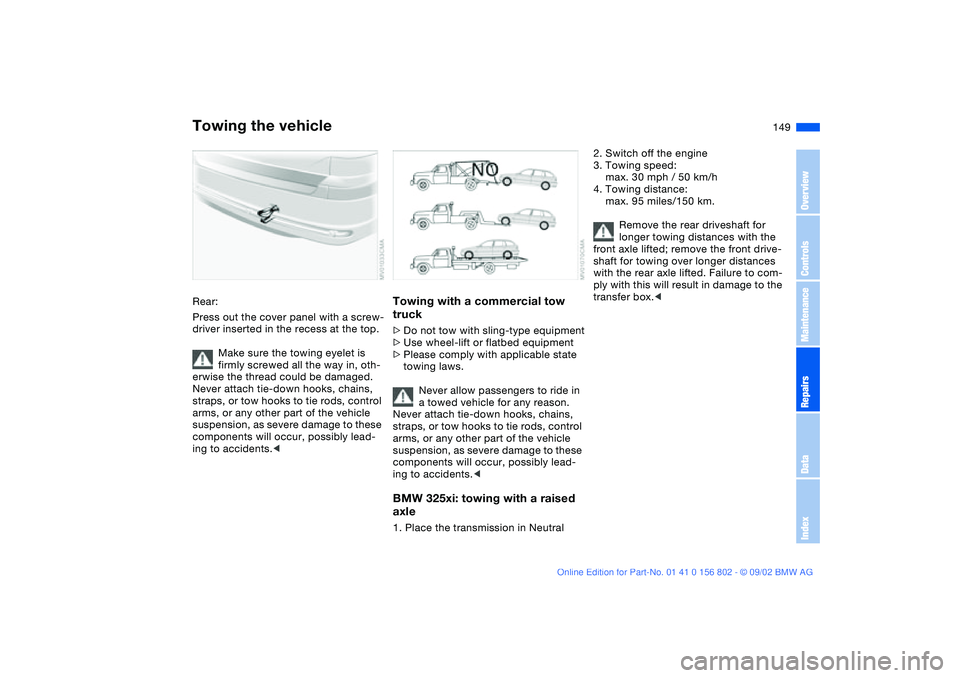
Towing with a commercial tow
truck>Do not tow with sling-type equipment
>Use wheel-lift or flatbed equipment
>Please comply with applicable state
towing laws.
Never allow passengers to ride in
a towed vehicle for any reason.
Never attach tie-down hooks, chains,
straps, or tow hooks to tie rods, control
arms, or any other part of the vehicle
suspension, as severe damage to these
components will occur, possibly lead-
ing to accidents.
2. Switch off the engine
3. Towing speed:
max. 30 mph / 50 km/h
4. Towing distance:
max. 95 miles/150 km.
Remove the rear driveshaft for
longer towing distances with the
front axle lifted; remove the front drive-
shaft for towing over longer distances
with the rear axle lifted. Failure to com-
ply with this will result in damage to the
transfer box.<
Towing the vehicle
OverviewControlsMaintenanceRepairsDataIndex
handbook.book Page 149 Saturday, July 27, 2002 1:36 PM