display BMW 328Ci CONVERTIBLE 2000 E46 User Guide
[x] Cancel search | Manufacturer: BMW, Model Year: 2000, Model line: 328Ci CONVERTIBLE, Model: BMW 328Ci CONVERTIBLE 2000 E46Pages: 199, PDF Size: 1.77 MB
Page 85 of 199
85n
IndexDataTechnologyRepairsCar careControlsOverview
Onboard computer
*
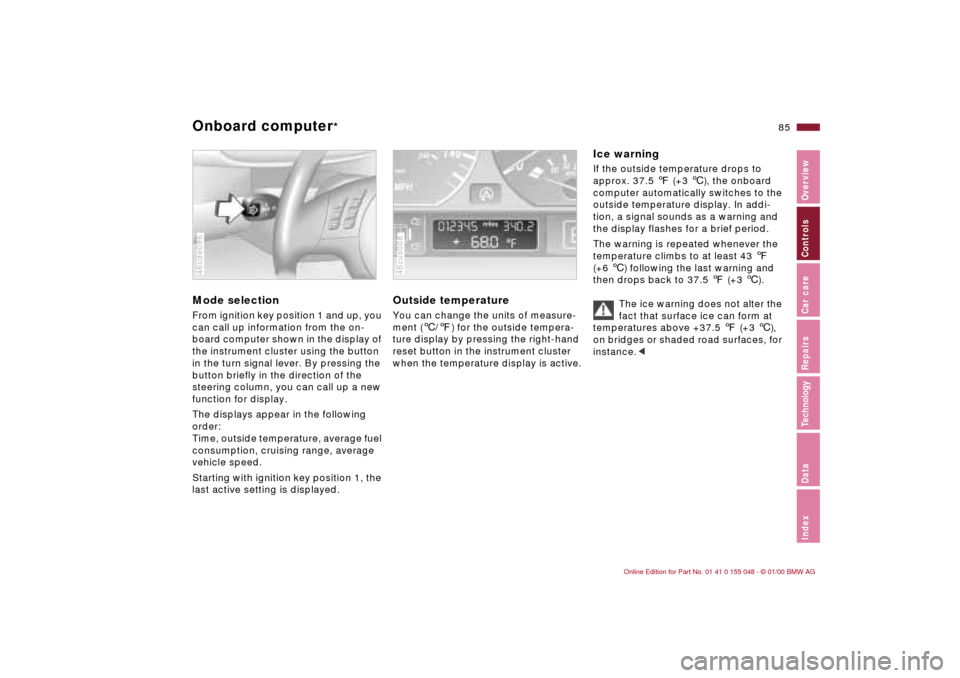
Mode selectionFrom ignition key position 1 and up, you
can call up information from the on-
board computer shown in the display of
the instrument cluster using the button
in the turn signal lever. By pressing the
button briefly in the direction of the
steering column, you can call up a new
function for display.
The displays appear in the following
order:
Time, outside temperature, average fuel
consumption, cruising range, average
vehicle speed.
Starting with ignition key position 1, the
last active setting is displayed.46cde096
Outside temperature You can change the units of measure-
ment (6/7) for the outside tempera-
ture display by pressing the right-hand
reset button in the instrument cluster
when the temperature display is active. 46cus008
Ice warning If the outside temperature drops to
approx. 37.5 7 (+3 6), the onboard
computer automatically switches to the
outside temperature display. In addi-
tion, a signal sounds as a warning and
the display flashes for a brief period.
The warning is repeated whenever the
temperature climbs to at least 43 7
(+6 6) following the last warning and
then drops back to 37.5 7 (+3 6).
The ice warning does not alter the
fact that surface ice can form at
temperatures above +37.5 7 (+3 6),
on bridges or shaded road surfaces, for
instance.<
Page 86 of 199
86n
Onboard computer
*
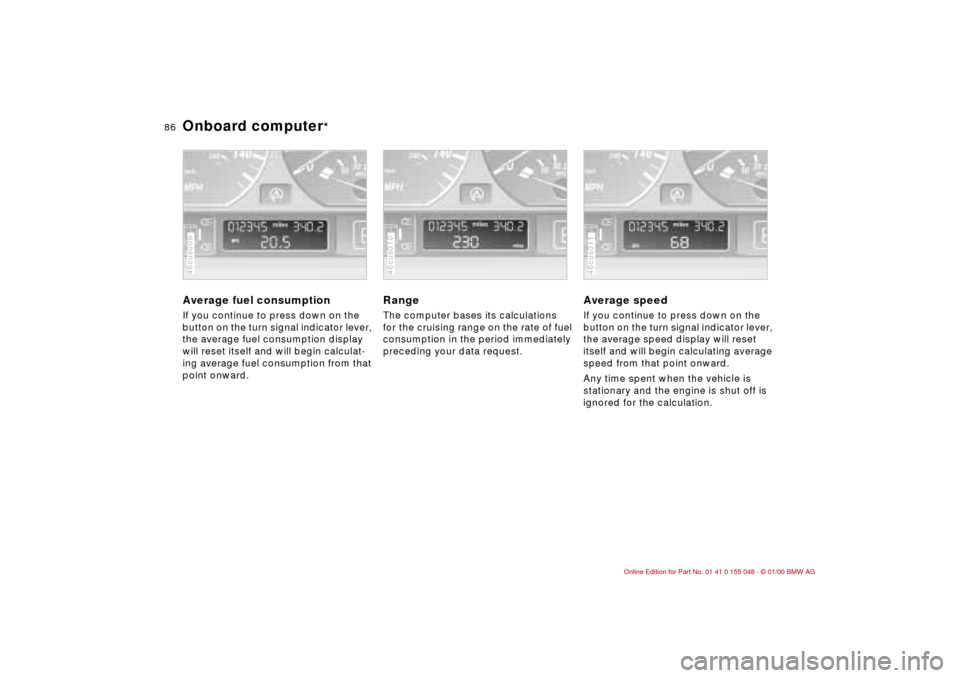
Average fuel consumption If you continue to press down on the
button on the turn signal indicator lever,
the average fuel consumption display
will reset itself and will begin calculat-
ing average fuel consumption from that
point onward.46cus009
Range The computer bases its calculations
for the cruising range on the rate of fuel
consumption in the period immediately
preceding your data request.46cus010
Average speed If you continue to press down on the
button on the turn signal indicator lever,
the average speed display will reset
itself and will begin calculating average
speed from that point onward.
Any time spent when the vehicle is
stationary and the engine is shut off is
ignored for the calculation.46cus011
Page 95 of 199

95n
IndexDataTechnologyRepairsCar careControlsOverview
Automatic climate control 1 Air onto the windshield and the side
windows
2 Air flow toward the upper body
The side rotary dials provide infi-
nitely variable regulation of the air
supply, while the levers change the
air flow direction. The center rotary
dial controls the temperature of the
air as it flows out, refer to page 98
3 Front footwell ventilation
There are corresponding air vents in
the rear footwell as well
4 Recirculated air mode/Automatic
recirculated air control (AUC)97
5 Air supply97
6 Temperature96
7 Automatic air distribution96
8 Individual air distribution96
9 Air grill for interior temperature
sensor – please keep clear and
unobstructed
10 Display for temperature and air
supply96
11 Defrost the windshield and side
windows97
12 Air conditioner97
13 Rear window defroster79, 98
Page 96 of 199
96n
Automatic climate controlTips for pleasant drivingUse the automatic system (switch on
AUTO button 7). Select an interior tem-
perature that is comfortable for you –
we recommend 72 7 (+22 6). When
the outside temperature is above 41 7
(+5 6), you can also use the air condi-
tioner 12. This will dry the air as well as
preventing condensation on the win-
dow surfaces – if there are passengers
with damp clothing, for example. Set
the outlets 2 so that the air flows past
you and is not directed straight at you.
Set the rotary dial between the air out-
lets 2 for the upper body to a medium
position, since air that is somewhat
cooler promotes driving without fatigue.
Detailed setting options are described
for you in the following section.
When you unlock the vehicle
using your personalized remote
control key, your vehicle is set up so
that it will retrieve and initiate your
customized setting for the automatic
climate control.<
Automatic air distribution
The AUTO program assumes
the adjustment of the air distri-
bution and the air supply for you and
adapts the temperature to external influ-
ences (summer, winter) to meet prefer-
ences you can specify. This program
maintains a comfortable in-car climate
regardless of the season. Select an inte-
rior temperature that is comfortable for
you – we recommend 72 7 (+22 6).
The temperature selected and AUTO
for the air flow appear in the display 10
(refer to the overview on page 94). Open
the air outlets for the upper body area.
Switch on the air conditioner in warm
weather. The maximum cooling capac-
ity is achieved when you set rotary dial 3
(refer to page 98) to cold.
Individual air distribution
You can cancel the AUTO pro-
gram by selecting specific dis-
tribution patterns to suit your
own individual requirements.
You can direct air to flow onto the win-
dows toward the upper body , and
into the footwell .
Temperature
The figures in the display pro-
vide a general indication of inte-
rior temperature. We recommend 72 7
(+22 6) as a comfortable setting,
whether the air conditioner is operating
or not. When you start the vehicle, the
system ensures that the selected tem-
perature is reached as quickly as possi-
ble. The system then maintains this
temperature, regardless of the season.
Set rotary dial 3 (refer to "Draft-free
ventilation" on page 98) to a medium
setting, since air that is somewhat
cooler promotes driving without fatigue.
You can use this setting for mixing air to
make minor comfort modifications.
You can set uncontrolled heater
output up to 90 7 (+32 6).
At 60 7 (+16 6), full cooling output
is available from an activated air
conditioner.<
Page 97 of 199
97n
IndexDataTechnologyRepairsCar careControlsOverview
Automatic climate controlAir supply
By pressing the left or right half
of the button, you can vary the
air supply. By doing this, you switch off
the automatic control for the air supply.
Nevertheless, the automatic air distri-
bution remains unchanged.
When you set the lowest blower speed
by pressing the left half of the button,
all of the displays are canceled: the
blower, heater and air conditioner are
switched off, and the air supply stops.
You can reactivate the system by
pressing any button of the automatic
climate control.
Defrost the windshield and side
windows
This program quickly removes
ice and condensation from the
windshield and side windows.
Air conditioner
The air is cooled and dehumidi-
fied and – depending on the tem-
perature setting – rewarmed when the
air conditioner system is switched on.
Depending on the weather, the wind-
shield may fog over briefly when the
engine is started.
Use the button to switch the air condi-
tioner off when outside air temperatures
are below approx. 41 7 (+5 6). This
will help to prevent the windows from
fogging over.
If the windows fog over after switching
the air conditioner off, switch it back on.
Condensation forms in the air
conditioner system during opera-
tion, which then exits under the vehicle.
Traces of condensed water of this kind
are thus normal.<
Automatic recirculated air
control (AUC)
If there are unpleasant odors or
pollutants in the outside air, you
can temporarily block the air flow from
the outside. The system then recircu-
lates the air already within the vehicle.
By repeated actuation of the button,
you can select three different operating
modes.
>Indicator lamps off: fresh air flows
into the vehicle
>Left-hand indicator lamp on – AUC
mode: the system detects pollutants
in the outside air and responds by
deactivating the outside air flow as
required. The system then recircu-
lates the air already within the vehicle.
Depending on air quality require-
ments, the system automatically
switches between outside air supply
and recirculation of the air already
within the vehicle
>Right-hand indicator lamp on: the
flow of outside air is permanently
blocked. The system recirculates the
air already within the vehicle.
If the windows fog over in the
recirculated air mode, switch this
mode off and increase the air supply
as required.<
Page 138 of 199
138n
The BMW Maintenance System has
been designed as a reliable means for
providing maximum driving and operat-
ing safety – and as cost effectively as
possible for you. Once again, with re-
spect to the previous version, mainte-
nance costs were able to be reduced
due to technical innovations.
Please keep in mind that regular main-
tenance is not only necessary for the
safety of your vehicle, but also plays
a significant role in maintaining its
resale value.
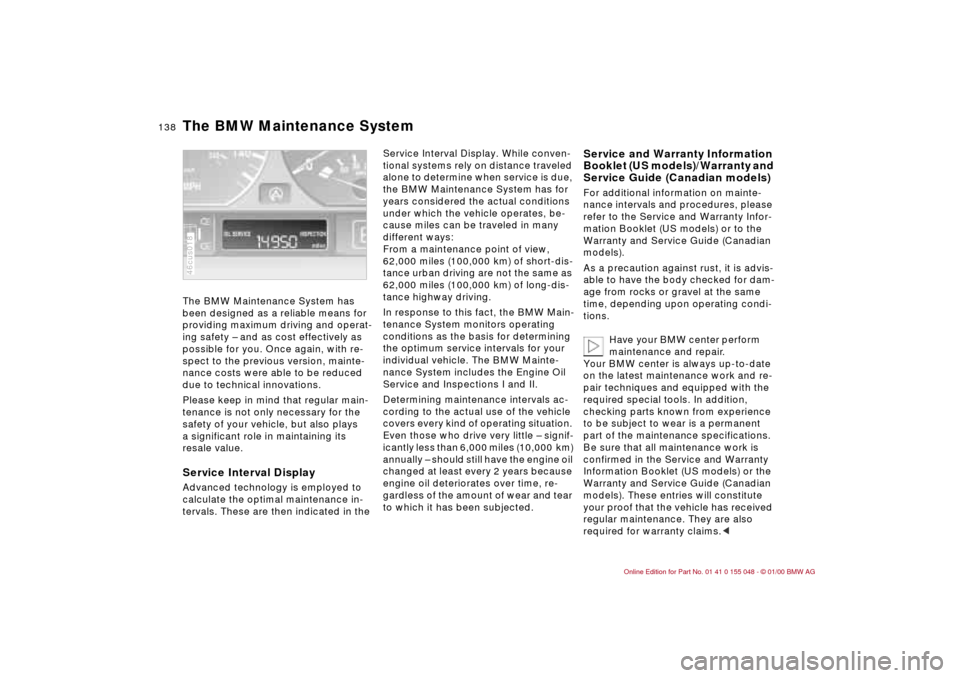
Service Interval DisplayAdvanced technology is employed to
calculate the optimal maintenance in-
tervals. These are then indicated in the 46cus018
Service Interval Display. While conven-
tional systems rely on distance traveled
alone to determine when service is due,
the BMW Maintenance System has for
years considered the actual conditions
under which the vehicle operates, be-
cause miles can be traveled in many
different ways:
From a maintenance point of view,
62,000 miles (100,000 km) of short-dis-
tance urban driving are not the same as
62,000 miles (100,000 km) of long-dis-
tance highway driving.
In response to this fact, the BMW Main-
tenance System monitors operating
conditions as the basis for determining
the optimum service intervals for your
individual vehicle. The BMW Mainte-
nance System includes the Engine Oil
Service and Inspections I and II.
Determining maintenance intervals ac-
cording to the actual use of the vehicle
covers every kind of operating situation.
Even those who drive very little – signif-
icantly less than 6,000 miles (10,000 km)
annually – should still have the engine oil
changed at least every 2 years because
engine oil deteriorates over time, re-
gardless of the amount of wear and tear
to which it has been subjected.
Service and Warranty Information
Booklet (US models)/Warranty and
Service Guide (Canadian models)For additional information on mainte-
nance intervals and procedures, please
refer to the Service and Warranty Infor-
mation Booklet (US models) or to the
Warranty and Service Guide (Canadian
models).
As a precaution against rust, it is advis-
able to have the body checked for dam-
age from rocks or gravel at the same
time, depending upon operating condi-
tions.
Have your BMW center perform
maintenance and repair.
Your BMW center is always up-to-date
on the latest maintenance work and re-
pair techniques and equipped with the
required special tools. In addition,
checking parts known from experience
to be subject to wear is a permanent
part of the maintenance specifications.
Be sure that all maintenance work is
confirmed in the Service and Warranty
Information Booklet (US models) or the
Warranty and Service Guide (Canadian
models). These entries will constitute
your proof that the vehicle has received
regular maintenance. They are also
required for warranty claims.<
The BMW Maintenance System
Page 164 of 199

164n
BatteryRemoval and installation
Do not disconnect the battery when
the engine is running. If you do so,
the ensuing voltage surge will damage
the vehicle's onboard electronics.
Do not make any modifications in the
wires to the positive terminal. If you do
so, the protective function of the safety
battery terminal is no longer ensured.
Repair and disposal must be performed
by trained technicians only.<
When removing the battery, disconnect
the cable on the negative terminal first,
then the cable on the positive terminal.
Loosen the center adjusting screw on
the battery retaining strap (use the
screwdriver included with the onboard
tool kit) and disconnect the strap.
When installing a battery, connect the
positive terminal first, then connect the
negative terminal.
When installing a battery, be sure
that it is mounted properly and that
the retaining bracket is installed with the
center adjustment screw, otherwise, the
battery will not be adequately secured
in case of an accident.<
Charging the battery Charge the battery in the vehicle only
when the engine is not running.
Before performing any work on
the electrical system, be sure to
unclamp the cable from the battery's
negative terminal. Failure to do so can
result in short-circuits, a fire or per-
sonal injury.<
If you plan to park the vehicle for longer
than 4 weeks, disconnect the battery
from the vehicle's electrical system by
disconnecting the cable at the negative
terminal. Then recharge the battery with
an appropriate battery charger.
If you intend to store the vehicle for
longer than 12 weeks, remove the bat-
tery, charge it and store it in a cool and
dust-free room where there is no dan-
ger of freezing. During storage, have
the battery recharged every 3 months.
Also, recharge the battery before it is
reinstalled. If this is not done, the bat-
tery will not be serviceable. Every time
the battery is drained, especially over
extended periods, its service life is
reduced.
Return used batteries to a recy-
cling point or your BMW center.
Maintain the battery in an upright posi-
tion for transport and storage. Secure
the battery to prevent it from tilting
during transport.<
Storage periods during which
the battery is disconnected are
not taken into consideration by the
Service Interval Display for changing
the brake fluid.
For this reason, be sure that the brake
fluid is changed every two years, re-
gardless of the information displayed.
Read and comply with the information
on page 136 covering this subject.<
Page 191 of 199
Everything from A to Z
191n
IndexDataTechnologyRepairsCar careControlsOverview
Cigarette lighter104
Clock84
Cockpit16
Code, refer to the Radio
Owner's Manual
Coin box, cup holder103
Combination switch77
Compression182
Computer85
Configure settings60
Consumption86
Consumption display83
Convertible top
care144
electrical defect166
Convertible top
compartment panel41
Convertible top operation,
fully automatic convertible
top49
Coolant118, 135, 185
antifreeze118
Coolant temperature
gauge83
Cooling system185
Cornering Brake Control
(CBC)21, 115
Cruise control80
Cruising range86
Curb weight184
Current check indicator20
DDash lighting91
Dashboard16
Data
dimensions183
engine182
technical182
weights184
Daytime-driving lamp
switch91
Defrost setting97
Defrosting the
windows97, 98
Digital clock84
Dimensions183
Dipstick, engine oil133
Disc brakes116
Displacement182
Display lighting91
Displays18
Distance warning87
Diversity Antenna174
Door key32
Door locks, care118
Doors
emergency actuation34
remote control35
unlocking and locking34
Drive belts186
Driving hints113
Driving in winter118Driving lamps91
DSC (Dynamic Stability
Control)22, 88, 173
EElectric power windows44
Electrical accessories,
failure165
Electrical system186
Electronic vehicle
immobilizer33
Elements of operation16
Emergency actuation
doors34
fuel filler door165
fully automatic convertible
top166
Emergency closure166
Energy Control82
Engine compartment130
Engine coolant135, 185
Engine data182
Engine oil
capacity185
consumption133
pressure20
quality134
specifications134
viscosity134
Engine oil level21
check133Engine speed182
Engine, starting70
Entry to the rear56
Exterior mirrors58
Eyes169
FFailure messages84
Fault displays84
Fault, ABS115
Filler cap cover26
Filling capacities185
Filling the washer
reservoir185
First-aid kit25
Flashlight99
Flat tire123, 159
Fog lamps92
bulb replacement155
"Follow-Me-Home"
lamps91
Footbrake116
Footwell lamps92
bulb replacement158
Front seat adjustment53
Frost protection,
radiator135
Fuel27
gauge83
preparation182
quality27
Fuel consumption86
Page 192 of 199

Everything from A to ZFuel consumption
display83
Fuel reserve indicator
lamp83
Fuel tank capacity185
Fuel tank gauge83
Fully automatic convertible
top
actuation49
emergency closure166
one-touch operation34
Functional status178
Fuses165GGarage-door opener100
Gasoline27
Gasoline gauge83
Glove compartment99
Glove compartment lamp
bulb replacement158
Grills94
Gross vehicle weight184HHandbrake72
Hands-free system103
Hanging the luggage
compartment floor up by
the hook40
Hardtop121
Hazard warning flashers25Hazard warning triangle25
Head restraints54
Headlamp covers,
care139, 153
Headlamp flasher92
Headlamp washer
system79, 132, 185
Heated seats99
Heater and ventilation94
Heavy loads106
Height183
High beams23, 77, 92
bulb replacement153
Hood release129
Horn17
Hub cap160
IIce warning85
Identification, tires126
Ignition key32
Ignition lock70
Increasing the space in the
luggage compartment41
Indicator lamps20
Inflated pressure27, 123
Inflation pressure
monitoring89, 177
INSPECTION83
Instrument cluster18
Instrument lighting91Interaxle tire rotation125
Interface socket for On-
Board Diagnostics149
Interference
cellular phones120
Interior lamps37, 92
bulb replacement157
remote control37
Interior rearview mirror,
automatic dimming
feature59, 175
Interlock70
Intermittent wipe77
ISOFIX Attachment of the
child seat62
JJack159
Jets94
Jump starting168KKey32
Key Memory60
Key with remote control32L"Lamps on" warning91
Lashing eyes107
Leather care143
Length183License plate lamp
bulb replacement157
Light switch91
Light-alloy wheels128
Lighter104
Load-securing devices107
Low beams91
bulb replacement153
Lug bolts160
Luggage compartment39
capacity184
emergency release39
floor panel41
remote control37
Luggage compartment
lamps
bulb replacement158
Luggage compartment
lid39
emergency release39
Luggage compartment
lighting39
Luggage rack108
Lumbar support56
MM+S tires127
Maintenance83, 138
Malfunction displays84
Manual convertible top
operation in the event of an
electrical malfunction166
Page 193 of 199

Everything from A to Z
193n
IndexDataTechnologyRepairsCar careControlsOverview
Manual transmission73
Manually controlled
recirculated-air97
Memory57
MFL (Multifunction steering
wheel)24
Mirror memory57
Mirrors58
Mobile phones120
Modifications,
technical6, 148
Multifunction steering wheel
(MFL)24NNavigation system, refer to
the Radio Owner's ManualOOBD interface socket149
Odometer82
Oil
additives133
capacity185
consumption133
dipstick133
quality134
specifications134
viscosity134
Oil change intervals, see the
Service and Warranty
Information BookletOil filter change185
Oil level
check133
Indicator lamp20
Oil pressure, indicator
lamp20
OILSERVICE83
Onboard computer85
also refer to separate
Owner's Manual
Onboard tool kit152
Opening and closing
from inside38
from outside34
Operating the convertible
top
manual convertible top45
Outlets, ventilation94
Outside temperature
display85
PPaint blemishes140
Paint, care140
Paintwork, minor
repairs141
Paintwork, waxing141
Park Distance Control
(PDC)87
Parking brake72
Parking help87
Parking lamps92Parking, winter119
PDC (Park Distance
Control)87
Performance182
Pocket lamp99
Pollen98
Power seats53
Power steering120
Power windows44
Pressure monitoring,
tires89, 177
Pressure, tires27, 123
RRadiator185
Radio Data System
(RDS)174
Radio reception120, 174
Radio, refer to the separate
Owner's Manual
Rain sensor78, 176
RDC (Tire Pressure
Control)89, 177
RDS (Radio Data
System)174
Reading lamps93
Rear lamp155
Rear window
defroster79, 98
Rearview mirror58, 59
Reclining seat53
Refueling26Remote control35
Remote control key32
Remove condensation,
windows97
Replacement key32
Reporting safety defects7
Restraint system61, 66
Reverse17, 73
Rollover protection
system68, 179
lowering68
Roof load capacity184
Roof luggage rack108
Roof-carrier assembly121
Rubber parts118
SSafety belt tensioners174
Safety belts61
Safety buttons38
Seat heating99
Seat memory57
Seat-integrated safety belt
system56
Seats
sitting properly53, 64
Securing cargo107
Securing loads107
Selector lever, automatic
transmission74
Self-defrosting mirrors59
Self-diagnostics178