light BMW 328Ci CONVERTIBLE 2000 E46 Owner's Guide
[x] Cancel search | Manufacturer: BMW, Model Year: 2000, Model line: 328Ci CONVERTIBLE, Model: BMW 328Ci CONVERTIBLE 2000 E46Pages: 199, PDF Size: 1.77 MB
Page 70 of 199
70n
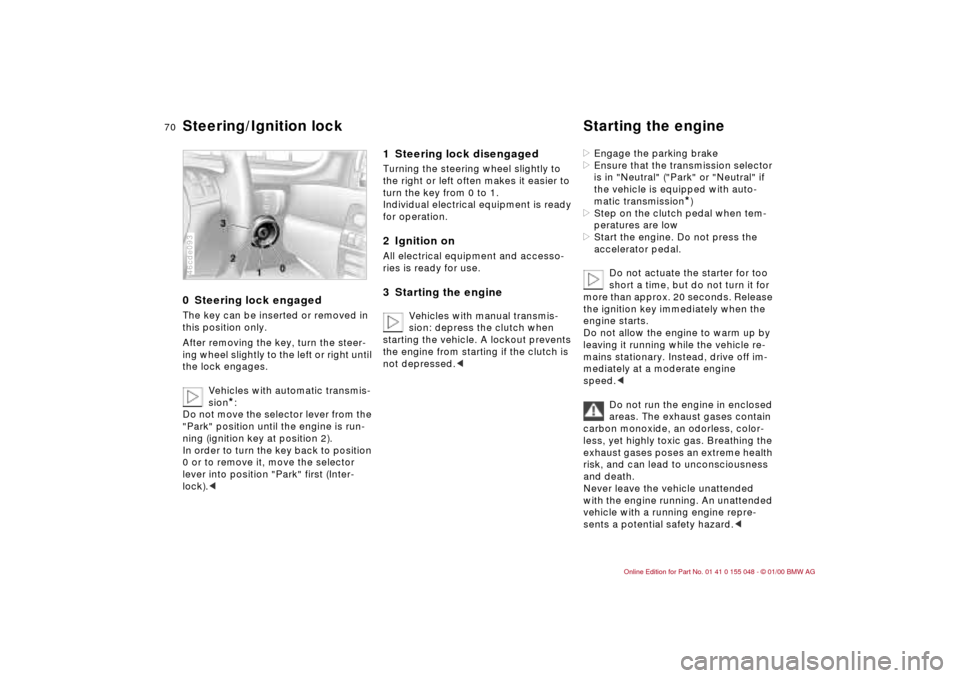
0 Steering lock engaged The key can be inserted or removed in
this position only.
After removing the key, turn the steer-
ing wheel slightly to the left or right until
the lock engages.
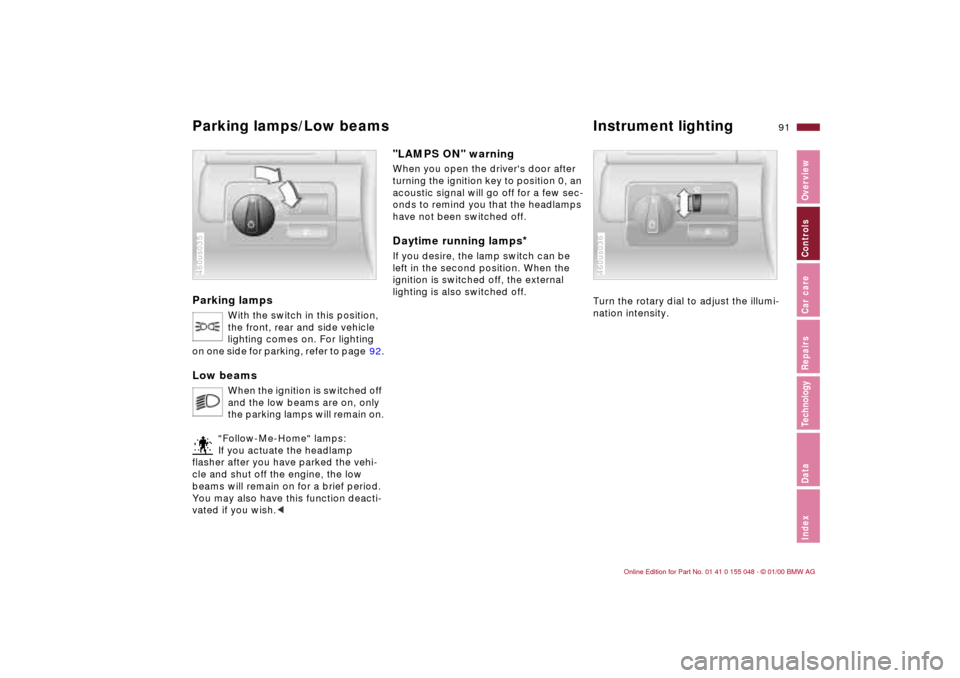
Vehicles with automatic transmis-
sion
*:
Do not move the selector lever from the
"Park" position until the engine is run-
ning (ignition key at position 2).
In order to turn the key back to position
0 or to remove it, move the selector
lever into position "Park" first (Inter-
lock).<
46cde093
1 Steering lock disengaged Turning the steering wheel slightly to
the right or left often makes it easier to
turn the key from 0 to 1.
Individual electrical equipment is ready
for operation.2 Ignition onAll electrical equipment and accesso-
ries is ready for use.3 Starting the engine
Vehicles with manual transmis-
sion: depress the clutch when
starting the vehicle. A lockout prevents
the engine from starting if the clutch is
not depressed.<
>Engage the parking brake
>Ensure that the transmission selector
is in "Neutral" ("Park" or "Neutral" if
the vehicle is equipped with auto-
matic transmission
*)
>Step on the clutch pedal when tem-
peratures are low
>Start the engine. Do not press the
accelerator pedal.
Do not actuate the starter for too
short a time, but do not turn it for
more than approx. 20 seconds. Release
the ignition key immediately when the
engine starts.
Do not allow the engine to warm up by
leaving it running while the vehicle re-
mains stationary. Instead, drive off im-
mediately at a moderate engine
speed.<
Do not run the engine in enclosed
areas. The exhaust gases contain
carbon monoxide, an odorless, color-
less, yet highly toxic gas. Breathing the
exhaust gases poses an extreme health
risk, and can lead to unconsciousness
and death.
Never leave the vehicle unattended
with the engine running. An unattended
vehicle with a running engine repre-
sents a potential safety hazard.<
Steering/Ignition lock Starting the engine
Page 72 of 199
72n
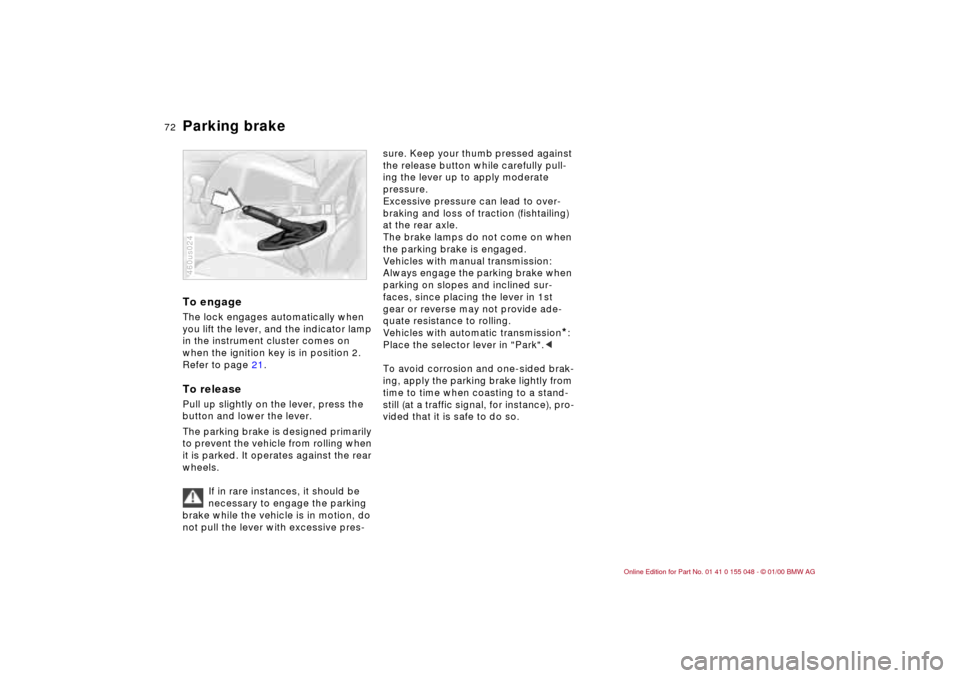
Parking brake To engageThe lock engages automatically when
you lift the lever, and the indicator lamp
in the instrument cluster comes on
when the ignition key is in position 2.
Refer to page 21.To releasePull up slightly on the lever, press the
button and lower the lever.
The parking brake is designed primarily
to prevent the vehicle from rolling when
it is parked. It operates against the rear
wheels.
If in rare instances, it should be
necessary to engage the parking
brake while the vehicle is in motion, do
not pull the lever with excessive pres-460us024
sure. Keep your thumb pressed against
the release button while carefully pull-
ing the lever up to apply moderate
pressure.
Excessive pressure can lead to over-
braking and loss of traction (fishtailing)
at the rear axle.
The brake lamps do not come on when
the parking brake is engaged.
Vehicles with manual transmission:
Always engage the parking brake when
parking on slopes and inclined sur-
faces, since placing the lever in 1st
gear or reverse may not provide ade-
quate resistance to rolling.
Vehicles with automatic transmission
*:
Place the selector lever in "Park".<
To avoid corrosion and one-sided brak-
ing, apply the parking brake lightly from
time to time when coasting to a stand-
still (at a traffic signal, for instance), pro-
vided that it is safe to do so.
Page 83 of 199
83n
IndexDataTechnologyRepairsCar careControlsOverview
Fuel gauge
Coolant temperature gauge
Service Interval Display
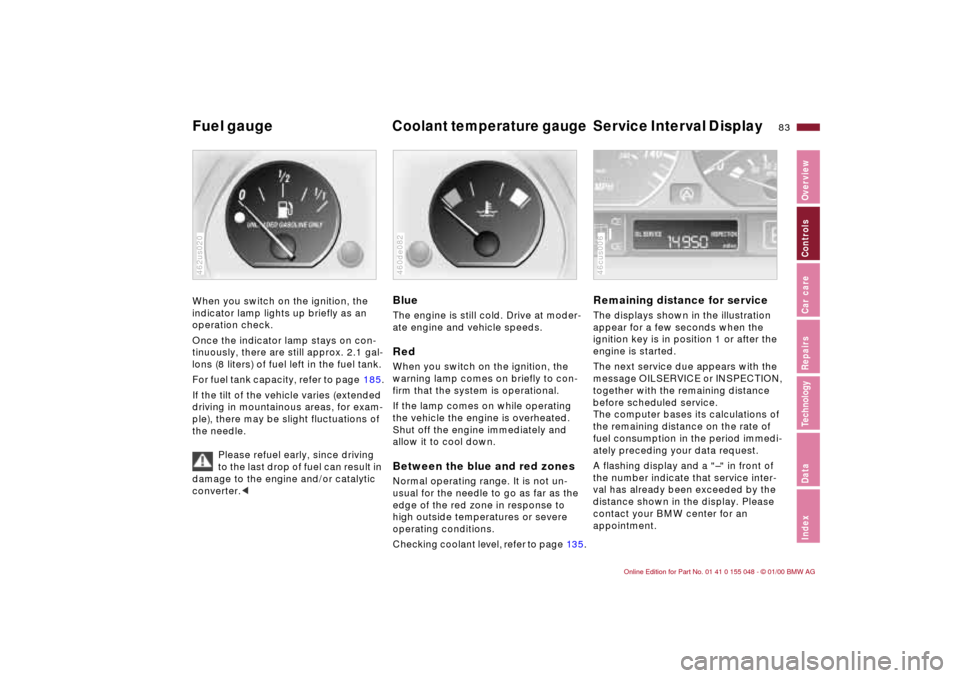
When you switch on the ignition, the
indicator lamp lights up briefly as an
operation check.
Once the indicator lamp stays on con-
tinuously, there are still approx. 2.1 gal-
lons (8 liters) of fuel left in the fuel tank.
For fuel tank capacity, refer to page 185.
If the tilt of the vehicle varies (extended
driving in mountainous areas, for exam-
ple), there may be slight fluctuations of
the needle.
Please refuel early, since driving
to the last drop of fuel can result in
damage to the engine and/or catalytic
converter.<462us020
BlueThe engine is still cold. Drive at moder-
ate engine and vehicle speeds.RedWhen you switch on the ignition, the
warning lamp comes on briefly to con-
firm that the system is operational.
If the lamp comes on while operating
the vehicle the engine is overheated.
Shut off the engine immediately and
allow it to cool down.Between the blue and red zonesNormal operating range. It is not un-
usual for the needle to go as far as the
edge of the red zone in response to
high outside temperatures or severe
operating conditions.Checking coolant level, refer to page 13 5.460de082
Remaining distance for serviceThe displays shown in the illustration
appear for a few seconds when the
ignition key is in position 1 or after the
engine is started.
The next service due appears with the
message OILSERVICE or INSPECTION,
together with the remaining distance
before scheduled service.
The computer bases its calculations of
the remaining distance on the rate of
fuel consumption in the period immedi-
ately preceding your data request.
A flashing display and a "–" in front of
the number indicate that service inter-
val has already been exceeded by the
distance shown in the display. Please
contact your BMW center for an
appointment.46cus006
Page 89 of 199
89n
IndexDataTechnologyRepairsCar careControlsOverview
Tire Pressure Control (RDC)
*
The conceptRDC monitors the tire pressure at all
four wheels – even while you are driv-
ing. The system provides an alert when-
ever the inflation pressure drops signifi-
cantly below the specified pressure in
one or more tires.
In order for the system to "learn" cor-
rect tire inflation pressure, check the
pressure in all the tires, compare your
pressures with those in the tire inflation
tables (page 28), and make corrections
as necessary. Then activate the system.
This indicator lamp in the
instrument cluster informs you
whenever the tire pressure is
not normal.
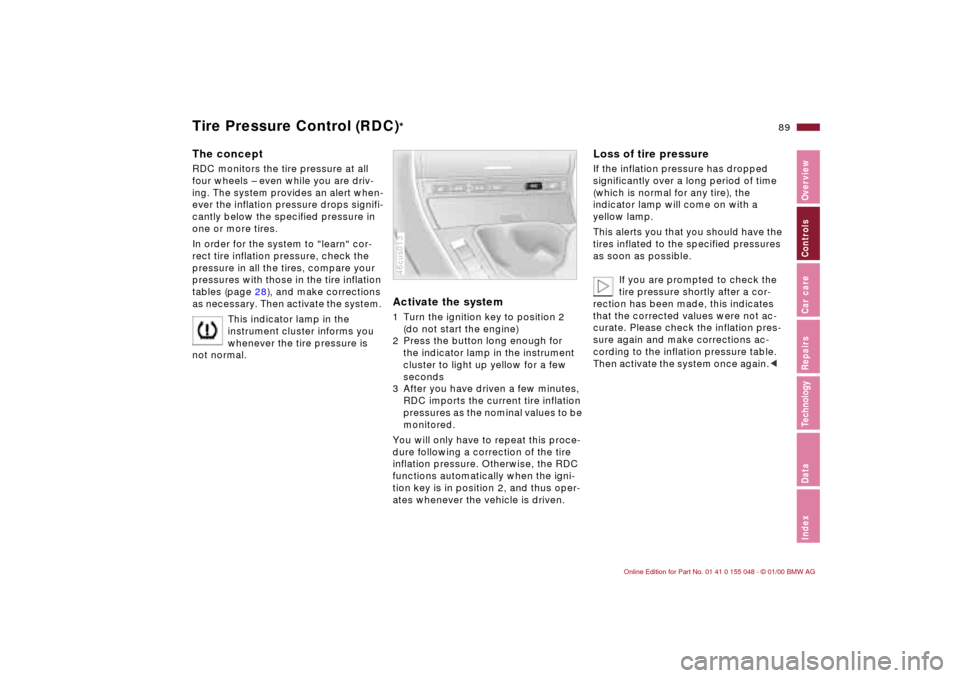
Activate the system 1 Turn the ignition key to position 2
(do not start the engine)
2 Press the button long enough for
the indicator lamp in the instrument
cluster to light up yellow for a few
seconds
3 After you have driven a few minutes,
RDC imports the current tire inflation
pressures as the nominal values to be
monitored.
You will only have to repeat this proce-
dure following a correction of the tire
inflation pressure. Otherwise, the RDC
functions automatically when the igni-
tion key is in position 2, and thus oper-
ates whenever the vehicle is driven.46cus013
Loss of tire pressureIf the inflation pressure has dropped
significantly over a long period of time
(which is normal for any tire), the
indicator lamp will come on with a
yellow lamp.
This alerts you that you should have the
tires inflated to the specified pressures
as soon as possible.
If you are prompted to check the
tire pressure shortly after a cor-
rection has been made, this indicates
that the corrected values were not ac-
curate. Please check the inflation pres-
sure again and make corrections ac-
cording to the inflation pressure table.
Then activate the system once again.<
Page 91 of 199
91n
IndexDataTechnologyRepairsCar careControlsOverview
Parking lamps
With the switch in this position,
the front, rear and side vehicle
lighting comes on. For lighting
on one side for parking, refer to page 92.
Low beams
When the ignition is switched off
and the low beams are on, only
the parking lamps will remain on.
"Follow-Me-Home" lamps:
If you actuate the headlamp
flasher after you have parked the vehi-
cle and shut off the engine, the low
beams will remain on for a brief period.
You may also have this function deacti-
vated if you wish.<
460us035
"LAMPS ON" warningWhen you open the driver's door after
turning the ignition key to position 0, an
acoustic signal will go off for a few sec-
onds to remind you that the headlamps
have not been switched off
.
Daytime running lamps
*
If you desire, the lamp switch can be
left in the second position. When the
ignition is switched off, the external
lighting is also switched off.
Turn the rotary dial to adjust the illumi-
nation intensity.
460us036
Parking lamps/Low beams Instrument lighting
Page 99 of 199
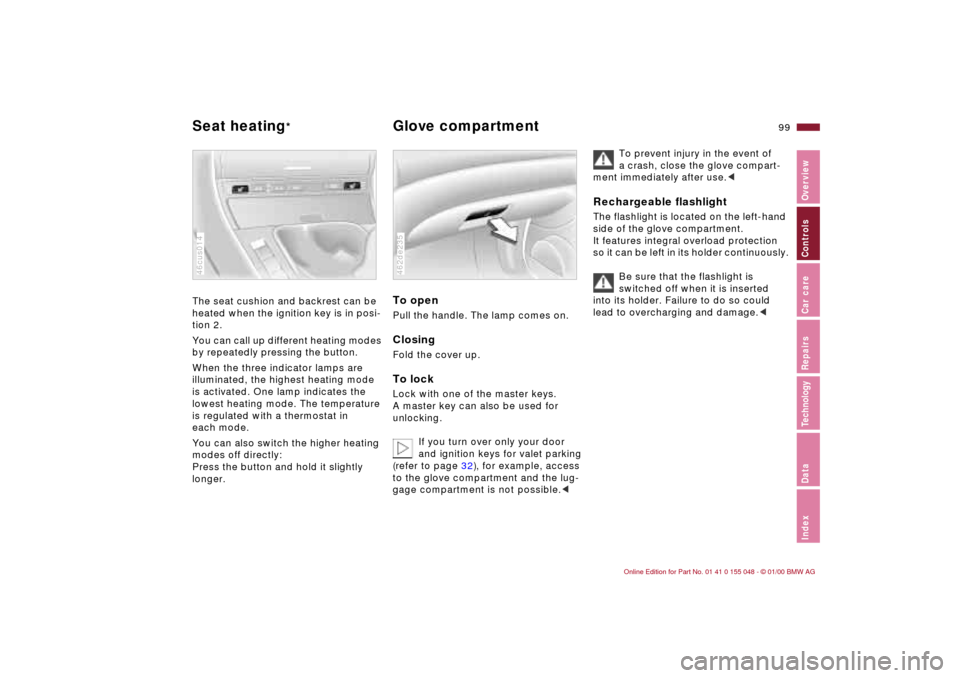
99n
IndexDataTechnologyRepairsCar careControlsOverview
The seat cushion and backrest can be
heated when the ignition key is in posi-
tion 2.
You can call up different heating modes
by repeatedly pressing the button.
When the three indicator lamps are
illuminated, the highest heating mode
is activated. One lamp indicates the
lowest heating mode. The temperature
is regulated with a thermostat in
each mode.
You can also switch the higher heating
modes off directly:
Press the button and hold it slightly
longer.46cus014
To open Pull the handle. The lamp comes on.ClosingFold the cover up.To lockLock with one of the master keys.
A master key can also be used for
unlocking.
If you turn over only your door
and ignition keys for valet parking
(refer to page 32), for example, access
to the glove compartment and the lug-
gage compartment is not possible.<462de235
To prevent injury in the event of
a crash, close the glove compart-
ment immediately after use.<
Rechargeable flashlight The flashlight is located on the left-hand
side of the glove compartment.
It features integral overload protection
so it can be left in its holder continuously.
Be sure that the flashlight is
switched off when it is inserted
into its holder. Failure to do so could
lead to overcharging and damage.<
Seat heating
*
Glove compartment
Page 100 of 199
100n
BMW Universal Transmitter
*
The concept The BMW Universal Transmitter re-
places up to three hand-held transmit-
ters for different devices such as ga-
rage-door openers, alarm systems, or
door-locking systems. The BMW Uni-
versal Transmitter recognizes and
"learns" the transmitted signal of each
of the original hand-held transmitters.
The signal of an original hand-held
transmitter can be programmed on one
of the three channel keys. Following
that, each of the devices can be actu-
ated with the appropriately pro-
grammed channel key. The indicator
lamp flashes to confirm transmission
of the signal.
If the vehicle is sold, the memory of the
channel keys should be cleared as de-
scribed on page 102.
During programming and before
every remote actuation of a pro-
grammed device by the BMW Universal
Transmitter, check to be sure that there
are no persons, animals or objects
within the actuation range of the device
in order to prevent possible injuries or
damage. Also, comply with the safety
precautions of the original hand-held
transmitter.<
To Canadian residents:
During programming, your hand-
held transmitter may automatically stop
transmitting after two seconds. This
may not be long enough to program the
BMW Universal Transmitter. If you are
programming from one of these hand-
held transmitters, the Universal Trans-
mitter's light may begin to flash in a
series of double-blinks. If this occurs,
continue to hold the button of the Uni-
versal Transmitter while you reactivate
your hand-held transmitter. You may
have to repeat this function several
times while programming.<
Before programming, read the
"User information" section on
page 102.<
Original hand-held transmitter
If this symbol is present on the
packaging or in the instructions
of the original hand-held trans-
mitter, it may be assumed that this
hand-held transmitter is compatible
with the BMW Universal Transmitter.
Checking for the conversion code To determine whether the original
hand-held transmitter has a conver-
sion-code system, you may either read
the instructions for the original hand-
held transmitter or program a channel
key as described on the next page (left-
hand column under "Programming").
Then press and hold the programmed
channel key of the BMW Universal
Transmitter. If the indicator lamp of
the BMW Universal Transmitter flashes
for two seconds and then stays on
steadily, the original hand-held trans-
mitter is equipped with a conversion-
code system. Using the conversion-
code system, program the channel keys
as described on the next page (right-
hand column under "Programming a
hand-held transmitter using conversion
code").
If you have additional questions,
please consult your BMW center
or call 1-800-355-3515.
You can also visit this website:
www.bmwusa.com.<
Page 104 of 199
104n
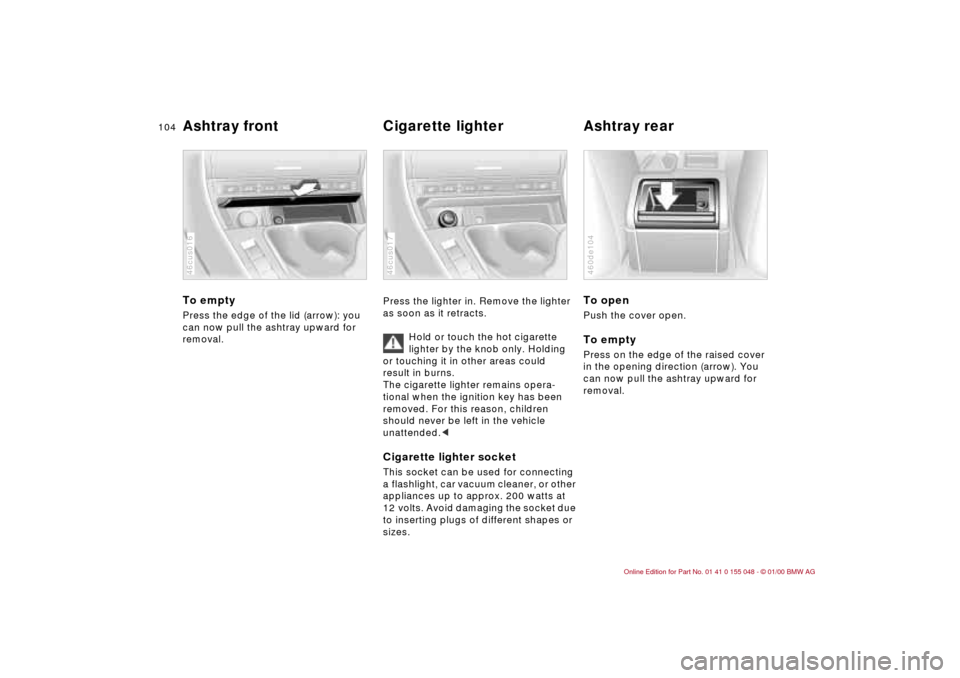
Ashtray front Cigarette lighter Ashtray rear To emptyPress the edge of the lid (arrow): you
can now pull the ashtray upward for
removal.46cus016
Press the lighter in. Remove the lighter
as soon as it retracts.
Hold or touch the hot cigarette
lighter by the knob only. Holding
or touching it in other areas could
result in burns.
The cigarette lighter remains opera-
tional when the ignition key has been
removed. For this reason, children
should never be left in the vehicle
unattended.
appliances up to approx. 200 watts at
12 volts. Avoid damaging the socket due
to inserting plugs of different shapes or
sizes.46cus017
To open Push the cover open.To emptyPress on the edge of the raised cover
in the opening direction (arrow). You
can now pull the ashtray upward for
removal.460de104
Page 107 of 199
107n
IndexDataTechnologyRepairsCar careControlsOverview
Cargo loadingSecuring the load >For small, light items, use the rubber-
lined non-skid side of the floor mat or
secure with a luggage compartment
net
* or elastic straps (refer to
page 40)
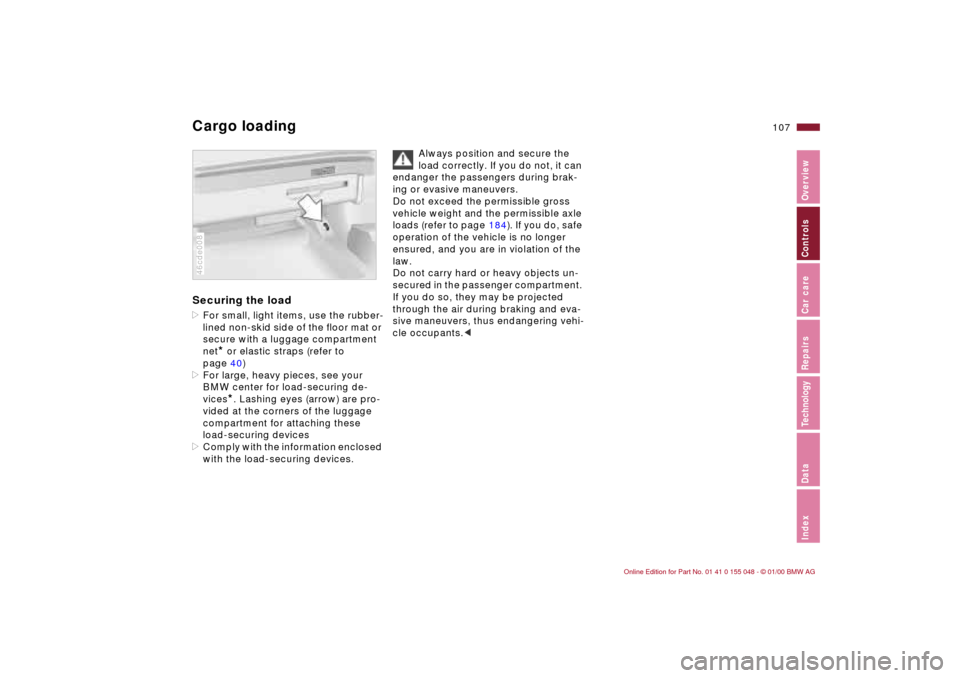
>For large, heavy pieces, see your
BMW center for load-securing de-
vices*. Lashing eyes (arrow) are pro-
vided at the corners of the luggage
compartment for attaching these
load-securing devices
>Comply with the information enclosed
with the load-securing devices.
46cde008
Always position and secure the
load correctly. If you do not, it can
endanger the passengers during brak-
ing or evasive maneuvers.
Do not exceed the permissible gross
vehicle weight and the permissible axle
loads (refer to page 184). If you do, safe
operation of the vehicle is no longer
ensured, and you are in violation of the
law.
Do not carry hard or heavy objects un-
secured in the passenger compartment.
If you do so, they may be projected
through the air during braking and eva-
sive maneuvers, thus endangering vehi-
cle occupants.<
Page 112 of 199

112n
To ensure that your vehicle provides
maximum economy throughout a long
service life, we request that you comply
with the following recommendations.
Engine and differentialUp to 1,200 miles (2,000 km):
Drive at varying engine and road
speeds, but do not exceed 4,500 rpm
or 100 mph (160 km/h) during this time.
Obey your local and state maximum
speed limits.
Refrain from using full throttle and avoid
pressing the accelerator beyond the
"kickdown" point.
After you have driven 1,200 miles
(2,000 km), you can gradually increase
the engine and road speed.
You should also comply with these
break-in procedures if the engine or
differential is replaced at a later point.
TiresDue to technical factors associated
with their manufacture, tires do not
achieve their full traction potential until
an initial break-in period has elapsed.
Thus, drive with extra care during the
initial 200 miles (300 km).
Obey your local and state maximum
speed limits.
When the vehicle is operated on
wet or slushy roads, a wedge of
water may form between the tire and
the road surface. This phenomenon is
referred to as aquaplaning, or hydro-
planing, and can lead to partial or com-
plete loss of traction, vehicle control
and braking effectiveness. Reduce your
speed on wet roads.
tact patterns until you have driven
approx. 300 miles (500 km).
To break in the separate parking brake
drums, apply the parking brake lightly
when coasting to a standstill (at a traffic
signal, for instance), provided that traf-
fic conditions allow you to do so.
To avoid corrosion, repeat this proce-
dure from time to time.
The brake lamps do not come on
when the parking brake is applied.
Vacuum for the brake system servo unit
on your BMW is available only when the
engine is running. When you move the
vehicle with the engine shut off – when
towing, for example – substantially
higher levels of pedal force will be
required to brake the vehicle.<
Break-in procedures