ECU BMW 328Ci COUPE 2000 E46 User Guide
[x] Cancel search | Manufacturer: BMW, Model Year: 2000, Model line: 328Ci COUPE, Model: BMW 328Ci COUPE 2000 E46Pages: 189, PDF Size: 1.68 MB
Page 44 of 189
42n
Alarm system
*
The conceptThe vehicle's alarm system responds:
>When a door, the hood or the lug-
gage compartment lid is opened
>To motion within the passenger com-
partment (interior motion sensor)
>To a change in the inclination of the
vehicle, e. g. during an attempted
wheel theft of unauthorized towing
>To interruption of battery voltage.
The alarm system signals unauthorized
access to the vehicle or an attempted
theft in different ways:
>Sounding an acoustical alarm for
30 seconds
>Activating the hazard warning flash-
ers for approx. five minutes
*.
To activate and deactivate the
alarm systemWhen the vehicle is locked or unlocked
by using a key or with the remote con-
trol, the alarm system is also simulta-
neously armed or disarmed.
The interior motion sensor is activated
approx. 30 seconds after you have fin-
ished locking the car.
If the alarm system has been armed
correctly, the hazard warning flashers
cycle once. An acoustic warning signal
sounds at the same time.
You can have various confirmation
messages set to inform you that
the alarm system has been armed or
disarmed.<
You can also open the luggage com-
partment lid when the system is armed
by pressing button 3 of the remote con-
trol (refer to page 37). When it is closed,
the lid is once again secured.
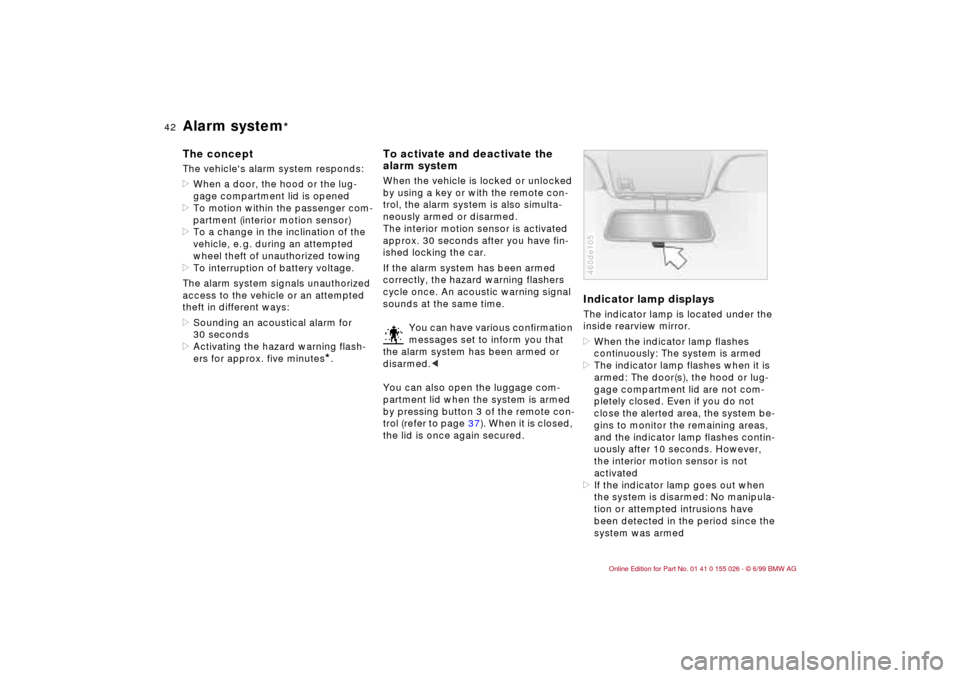
Indicator lamp displaysThe indicator lamp is located under the
inside rearview mirror.
>When the indicator lamp flashes
continuously: The system is armed
>The indicator lamp flashes when it is
armed: The door(s), the hood or lug-
gage compartment lid are not com-
pletely closed. Even if you do not
close the alerted area, the system be-
gins to monitor the remaining areas,
and the indicator lamp flashes contin-
uously after 10 seconds. However,
the interior motion sensor is not
activated
>If the indicator lamp goes out when
the system is disarmed: No manipula-
tion or attempted intrusions have
been detected in the period since the
system was armed460de105
Page 49 of 189
47n
RepairsIndexOverview Controls Car care Technology Data
For maximum safety when adjusting the
seat position, please observe the fol-
lowing:
Never try to adjust your seat while
operating the vehicle. The seat
could respond with an unexpected
movement, and the ensuing loss of ve-
hicle control could lead to an accident.
Be sure that the safety belt remains
firmly against your body at all times. In
the event of a frontal impact, a loose lap
belt could slide over the hips, leading to
abdominal injury. In addition, the safety
belt's restraint effectiveness is reduced
if the belt is worn loosely.
Never ride with the backrest reclined to
an extreme horizontal angle (especially
important for front passengers to re-
member). Keep the backrest relatively
upright to minimize the risk of "sliding
under" the safety belt and sustaining in-
jury in a crash.<
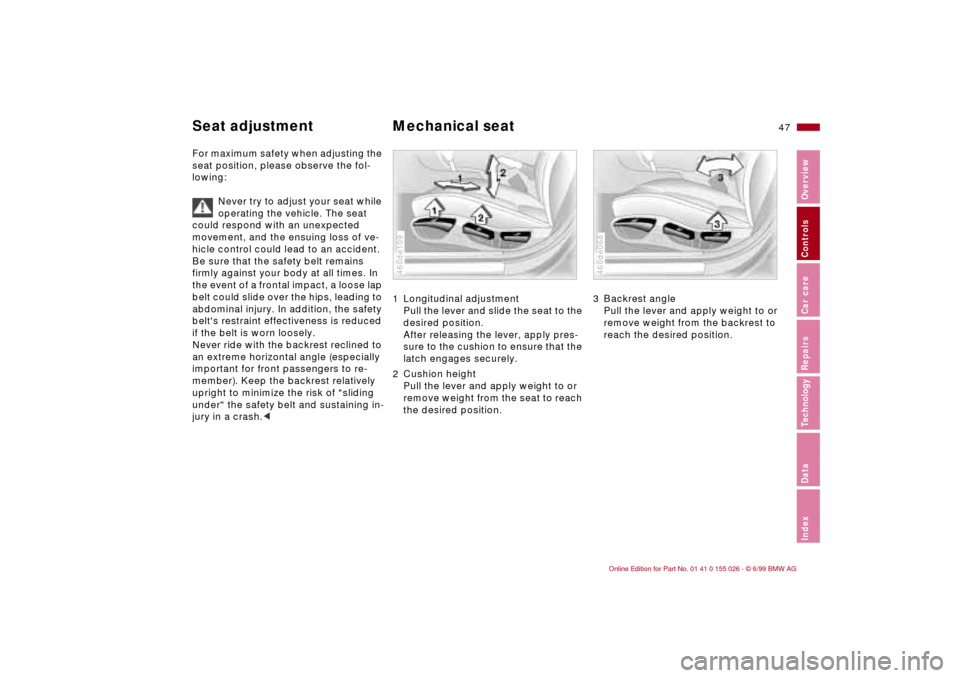
1 Longitudinal adjustment
Pull the lever and slide the seat to the
desired position.
After releasing the lever, apply pres-
sure to the cushion to ensure that the
latch engages securely.
2 Cushion height
Pull the lever and apply weight to or
remove weight from the seat to reach
the desired position.460de109
3 Backrest angle
Pull the lever and apply weight to or
remove weight from the backrest to
reach the desired position.460de068
Seat adjustment Mechanical seat
Page 62 of 189
60n
Child restraints
*
All occupants and especially children
should be restrained whenever riding
in a motor vehicle.
Infants or small children should never
be held on the lap of a passenger.
Children should always sit in the rear
and, depending on age, use either a
child restraint system or the existing
safety belts. Accident statistics have
shown that children are safer when
properly restrained in the rear seats
than in the front seating positions.
Infants or toddlers should be secured
with a child restraint system appropri-
ate for their size.
Commercially available child seats
complying with the legal standard are
designed to be secured with a lap belt
or with the lap belt portion of a combi-
nation lap/shoulder belt. 380us123
Improperly or inadequately installed re-
straint systems can increase the risk of
injury to children. Always read and fol-
low the instructions that come with the
system.
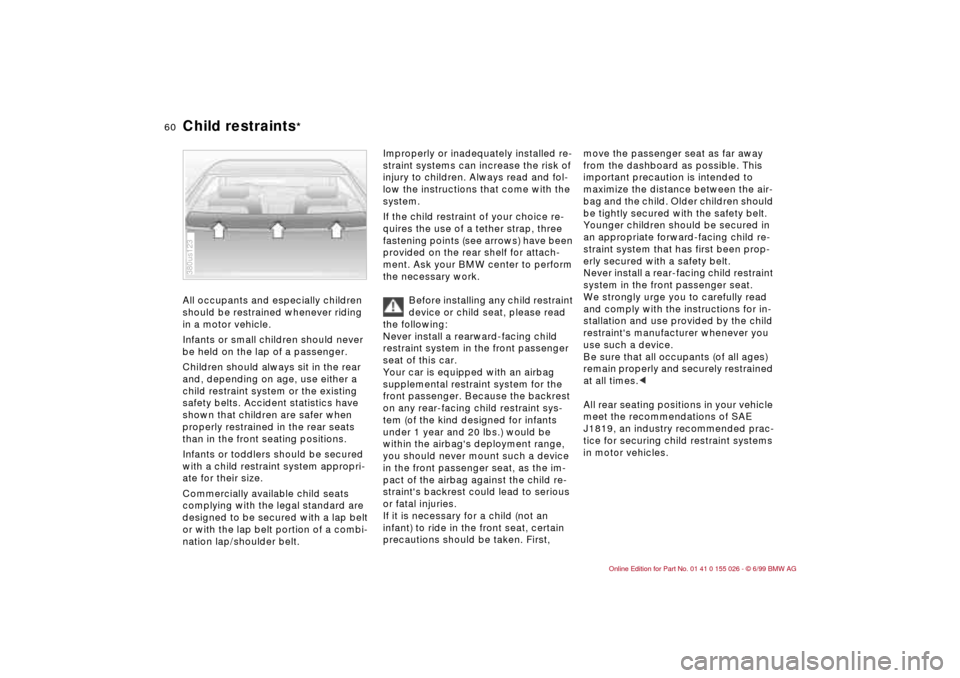
If the child restraint of your choice re-
quires the use of a tether strap, three
fastening points (see arrows) have been
provided on the rear shelf for attach-
ment. Ask your BMW center to perform
the necessary work.
Before installing any child restraint
device or child seat, please read
the following:
Never install a rearward-facing child
restraint system in the front passenger
seat of this car.
Your car is equipped with an airbag
supplemental restraint system for the
front passenger. Because the backrest
on any rear-facing child restraint sys-
tem (of the kind designed for infants
under 1 year and 20 lbs.) would be
within the airbag's deployment range,
you should never mount such a device
in the front passenger seat, as the im-
pact of the airbag against the child re-
straint's backrest could lead to serious
or fatal injuries.
If it is necessary for a child (not an
infant) to ride in the front seat, certain
precautions should be taken. First,
move the passenger seat as far away
from the dashboard as possible. This
important precaution is intended to
maximize the distance between the air-
bag and the child. Older children should
be tightly secured with the safety belt.
Younger children should be secured in
an appropriate forward-facing child re-
straint system that has first been prop-
erly secured with a safety belt.
Never install a rear-facing child restraint
system in the front passenger seat.
We strongly urge you to carefully read
and comply with the instructions for in-
stallation and use provided by the child
restraint's manufacturer whenever you
use such a device.
Be sure that all occupants (of all ages)
remain properly and securely restrained
at all times.c
All rear seating positions in your vehicle
meet the recommendations of SAE
J1819, an industry recommended prac-
tice for securing child restraint systems
in motor vehicles.
Page 63 of 189
61n
RepairsIndexOverview Controls Car care Technology Data
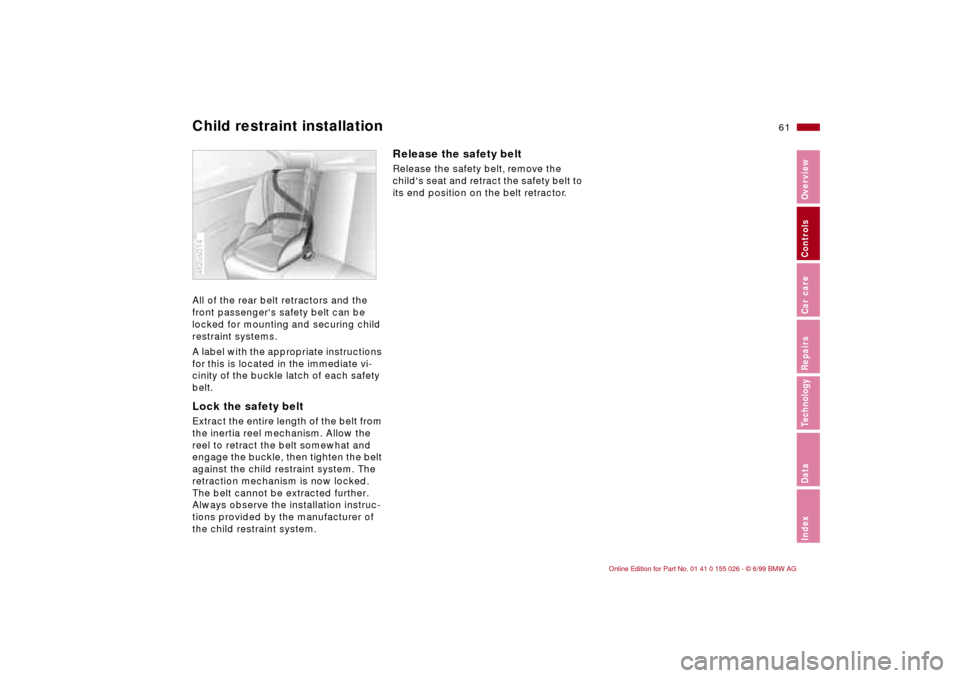
Child restraint installationAll of the rear belt retractors and the
front passenger's safety belt can be
locked for mounting and securing child
restraint systems.
A label with the appropriate instructions
for this is located in the immediate vi-
cinity of the buckle latch of each safety
belt.Lock the safety beltExtract the entire length of the belt from
the inertia reel mechanism. Allow the
reel to retract the belt somewhat and
engage the buckle, then tighten the belt
against the child restraint system. The
retraction mechanism is now locked.
The belt cannot be extracted further.
Always observe the installation instruc-
tions provided by the manufacturer of
the child restraint system.462us014
Release the safety beltRelease the safety belt, remove the
child's seat and retract the safety belt to
its end position on the belt retractor.
Page 100 of 189
98n
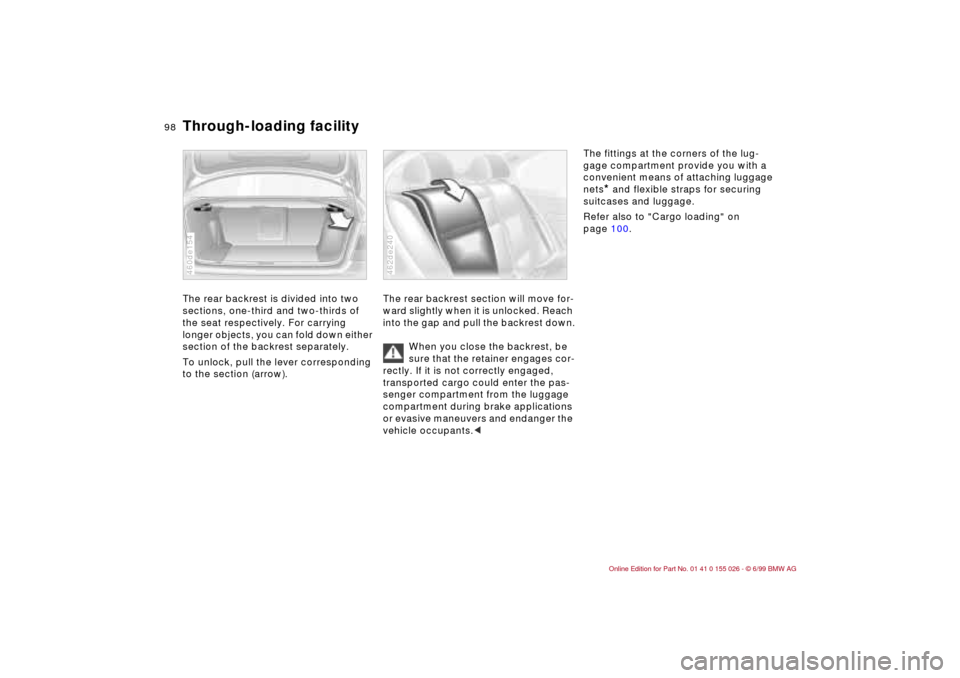
Through-loading facility The rear backrest is divided into two
sections, one-third and two-thirds of
the seat respectively. For carrying
longer objects, you can fold down either
section of the backrest separately.
To unlock, pull the lever corresponding
to the section (arrow).460de154
The rear backrest section will move for-
ward slightly when it is unlocked. Reach
into the gap and pull the backrest down.
When you close the backrest, be
sure that the retainer engages cor-
rectly. If it is not correctly engaged,
transported cargo could enter the pas-
senger compartment from the luggage
compartment during brake applications
or evasive maneuvers and endanger the
vehicle occupants.<462de240
The fittings at the corners of the lug-
gage compartment provide you with a
convenient means of attaching luggage
nets
* and flexible straps for securing
suitcases and luggage.
Refer also to "Cargo loading" on
page 100.
Page 101 of 189
99n
RepairsIndexOverview Controls Car care Technology Data
Ski bag
*
The ski bag allows the safe and clean
transport of four pairs of skis or two
snowboards.
The length of the ski bag and the addi-
tional space provided in the luggage
compartment make it possible to carry
skis with a length of up to 6.8 feet
(2.1 meters). The ski bag can only
accommodate two pairs of skis with a
length of 6.8 feet (2.1 meters), because
of the tapered shape of the bag.
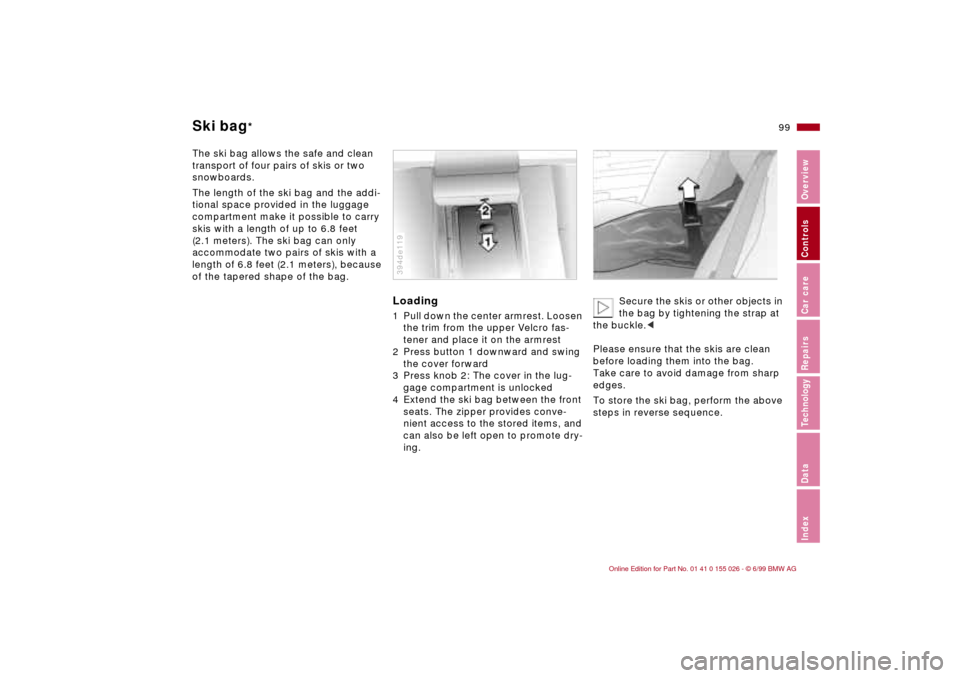
Loading1 Pull down the center armrest. Loosen
the trim from the upper Velcro fas-
tener and place it on the armrest
2 Press button 1 downward and swing
the cover forward
3 Press knob 2: The cover in the lug-
gage compartment is unlocked
4 Extend the ski bag between the front
seats. The zipper provides conve-
nient access to the stored items, and
can also be left open to promote dry-
ing.394de119
Secure the skis or other objects in
the bag by tightening the strap at
the buckle.<
Please ensure that the skis are clean
before loading them into the bag.
Take care to avoid damage from sharp
edges.
To store the ski bag, perform the above
steps in reverse sequence.
380de070
Page 102 of 189
100n
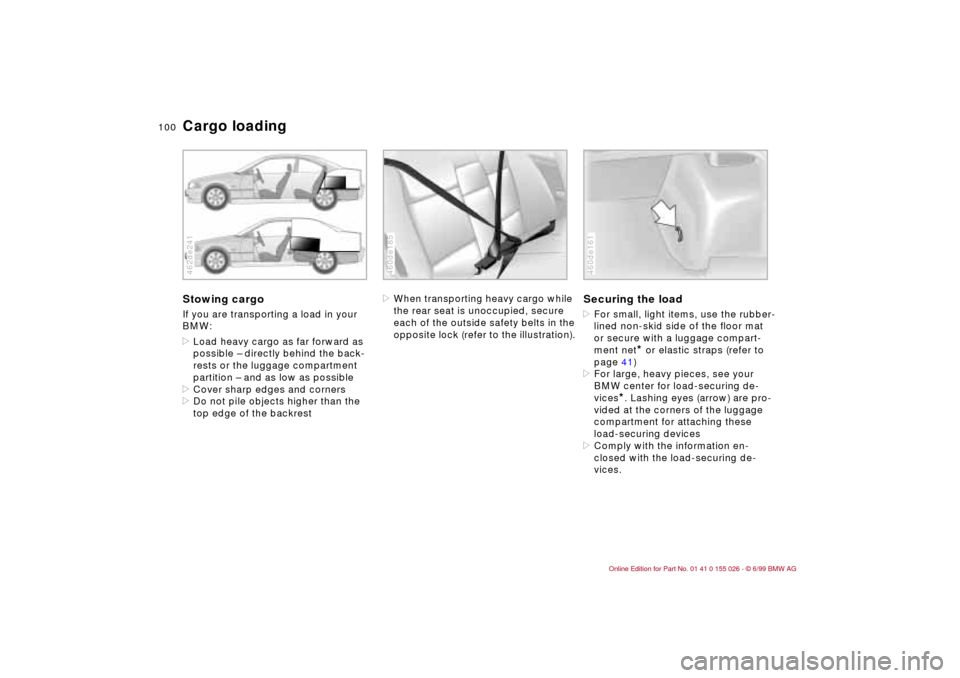
Cargo loadingStowing cargo If you are transporting a load in your
BMW:
>Load heavy cargo as far forward as
possible – directly behind the back-
rests or the luggage compartment
partition – and as low as possible
>Cover sharp edges and corners
>Do not pile objects higher than the
top edge of the backrest462de241
>When transporting heavy cargo while
the rear seat is unoccupied, secure
each of the outside safety belts in the
opposite lock (refer to the illustration).460de185
Securing the load >For small, light items, use the rubber-
lined non-skid side of the floor mat
or secure with a luggage compart-
ment net
* or elastic straps (refer to
page 41)
>For large, heavy pieces, see your
BMW center for load-securing de-
vices
*. Lashing eyes (arrow) are pro-
vided at the corners of the luggage
compartment for attaching these
load-securing devices
>Comply with the information en-
closed with the load-securing de-
vices.
460de161
Page 103 of 189
101n
RepairsIndexOverview Controls Car care Technology Data
Cargo loading Roof-mounted luggage rack
*
Always position and secure the
load correctly, otherwise it can en-
danger the passengers in the event of
braking or swerving.
Do not exceed the permissible gross
weight and axle load (refer to page 172),
otherwise the vehicle's operating safety
is no longer assured and you are in vio-
lation of the law.
Do not stow heavy or hard objects in the
passenger compartment without first
securing them. Otherwise they would
be thrown around during braking and
evasive maneuvers and endanger the
occupants.<
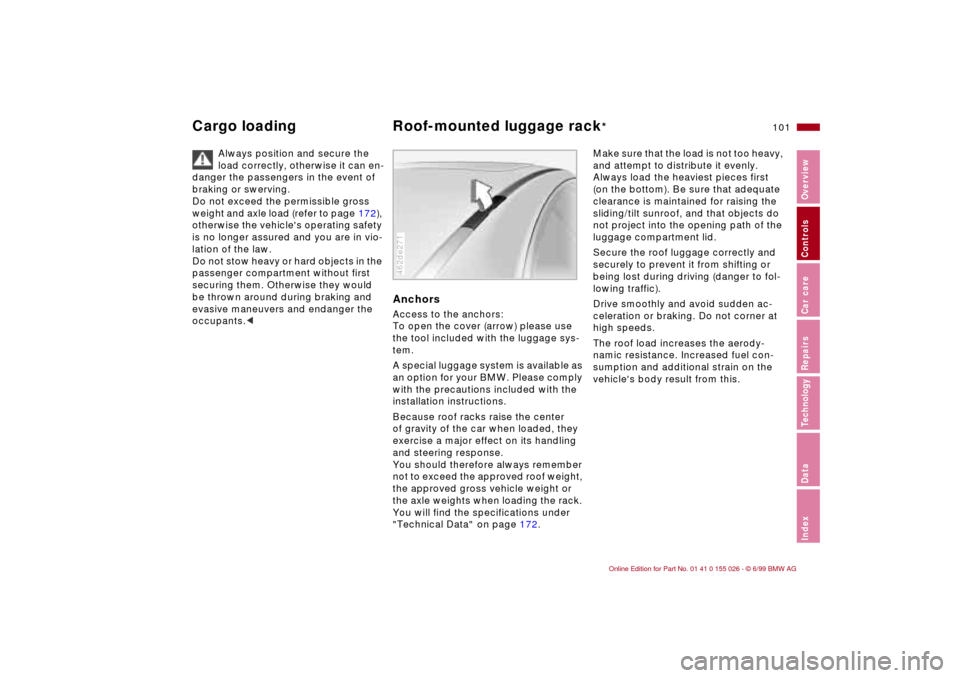
AnchorsAccess to the anchors:
To open the cover (arrow) please use
the tool included with the luggage sys-
tem.
A special luggage system is available as
an option for your BMW. Please comply
with the precautions included with the
installation instructions.
Because roof racks raise the center
of gravity of the car when loaded, they
exercise a major effect on its handling
and steering response.
You should therefore always remember
not to exceed the approved roof weight,
the approved gross vehicle weight or
the axle weights when loading the rack.
You will find the specifications under
"Technical Data" on page 172.462de271
Make sure that the load is not too heavy,
and attempt to distribute it evenly.
Always load the heaviest pieces first
(on the bottom). Be sure that adequate
clearance is maintained for raising the
sliding/tilt sunroof, and that objects do
not project into the opening path of the
luggage compartment lid.
Secure the roof luggage correctly and
securely to prevent it from shifting or
being lost during driving (danger to fol-
lowing traffic).
Drive smoothly and avoid sudden ac-
celeration or braking. Do not corner at
high speeds.
The roof load increases the aerody-
namic resistance. Increased fuel con-
sumption and additional strain on the
vehicle's body result from this.
Page 108 of 189

106n
Antilock Brake System (ABS)The concept ABS enhances active safety by helping
to prevent the wheels from locking dur-
ing brake applications. Locked wheels
are dangerous. When the front wheels
slide, the driver loses steering control
over the vehicle. Traction loss at the
rear wheels can cause the rear end to
break into an uncontrolled skid.
The system can achieve the shortest
braking distances possible under most
conditions (on straight-aways and in
curves, on asphalt, ice, wet road sur-
faces, etc.).
ABS is designed to meet two essential
requirements during every brake appli-
cation:
>To help provide vehicle stability
>To help maintain steering control and
maneuverability – on all types of road
surfaces (asphalt, concrete, mud,
wet, snow, ice).
Braking with ABSThe system becomes operative once
the vehicle exceeds a speed of approx.
6 mph (10 km/h). Below approx. 3 mph
(6 km/h), it is once again deactivated.
This means that the wheels can lock in
the final phase of a panic stop – a factor
of no significance in actual use.
If you are in a situation that requires full
braking, you will exploit the full benefits
of the ABS system if you apply maxi-
mum brake pressure ("panic stop").
Since the vehicle maintains steering re-
sponsiveness, you can avoid possible
obstacles with a minimum of steering
effort, despite the full brake application.
The ABS system closed-loop control
circuit cycles in fractions of a second.
A pulsation at the brake pedal indicates
to the driver that ABS is active, that is,
that the vehicle is within its maximum
braking range. In addition, a pulsation –
a result of the control function cycles –
indicates to the driver that vehicle
speed should be reduced to adapt to
road surface conditions when there is
reduced traction and grip between tires
and road surface (slippery road sur-
face).
In driving conditions where there is a
loose upper surface together with a
subsurface that provides good traction (on gravel or snow, for instance), or with
snow chains, the braking distance may
also be longer than when the wheels
are locked. However, ABS continues to
provide enhanced vehicle stability and
steering response under these condi-
tions.
Information for your safetyNot even ABS can suspend the laws
of physics. ABS cannot prevent the
consequences of brake applications
with inadequate clearances for safety
between vehicles, when exceeding the
speed limit in curves, or the risks in-
volved when aquaplaning occurs. Re-
sponsibility for these types of situations
remains in the hands (and at the feet) of
the driver.
You should never allow the added
safety of ABS to lull you into a false
sense of security, or mislead you into
taking increased risks that could affect
your own safety and that of others.
Do not make any modifications to
the ABS system.
Service procedures on ABS are to be
performed by authorized technicians
only.<
Page 121 of 189
119n
RepairsIndexOverview Controls Car care Technology Data
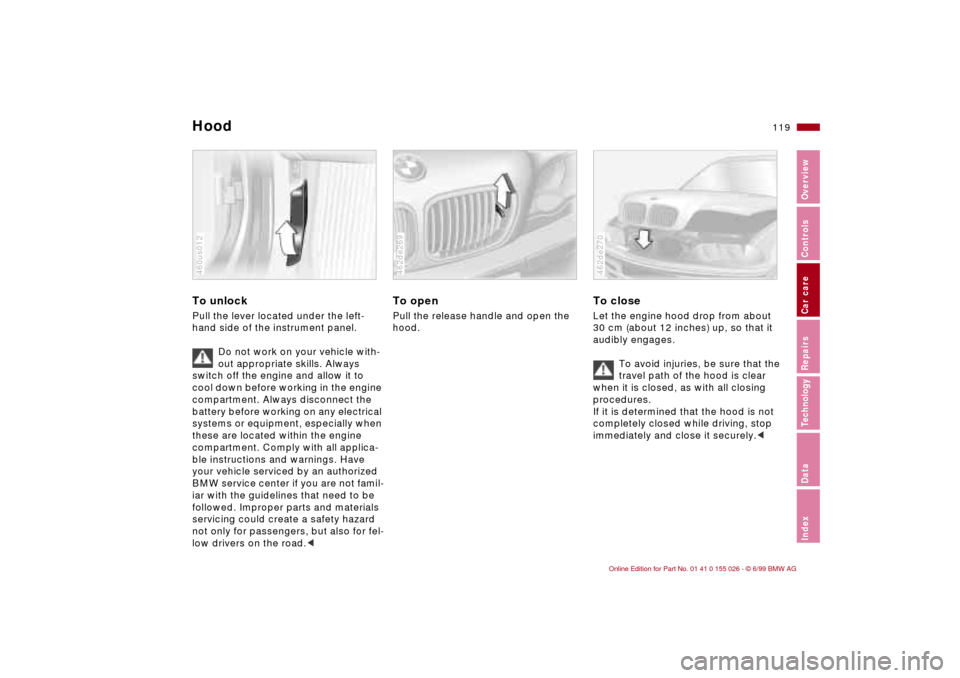
To unlock Pull the lever located under the left-
hand side of the instrument panel.
Do not work on your vehicle with-
out appropriate skills. Always
switch off the engine and allow it to
cool down before working in the engine
compartment. Always disconnect the
battery before working on any electrical
systems or equipment, especially when
these are located within the engine
compartment. Comply with all applica-
ble instructions and warnings. Have
your vehicle serviced by an authorized
BMW service center if you are not famil-
iar with the guidelines that need to be
followed. Improper parts and materials
servicing could create a safety hazard
not only for passengers, but also for fel-
low drivers on the road.<460us012
To openPull the release handle and open the
hood.462de269
To closeLet the engine hood drop from about
30 cm (about 12 inches) up, so that it
audibly engages.
To avoid injuries, be sure that the
travel path of the hood is clear
when it is closed, as with all closing
procedures.
If it is determined that the hood is not
completely closed while driving, stop
immediately and close it securely.<462de270
Hood