heating BMW 328Ci COUPE 2000 E46 Owner's Manual
[x] Cancel search | Manufacturer: BMW, Model Year: 2000, Model line: 328Ci COUPE, Model: BMW 328Ci COUPE 2000 E46Pages: 189, PDF Size: 1.68 MB
Page 22 of 189
20n
Indicator and warning lamps
Technology that monitors itself
Many of the systems of your BMW mon-
itor themselves automatically, both dur-
ing engine starts and while you are driv-
ing. Indicator and warning lamps that
are identified by "
l
" are tested for
proper functioning whenever the igni-
tion key is turned. They each light up
once for different periods of time.
If a fault should occur in one of these
systems, the corresponding lamp does
not go out after the engine is started or
it lights up while the vehicle is moving.
You will see how to react to this below.
Red: Stop immediately
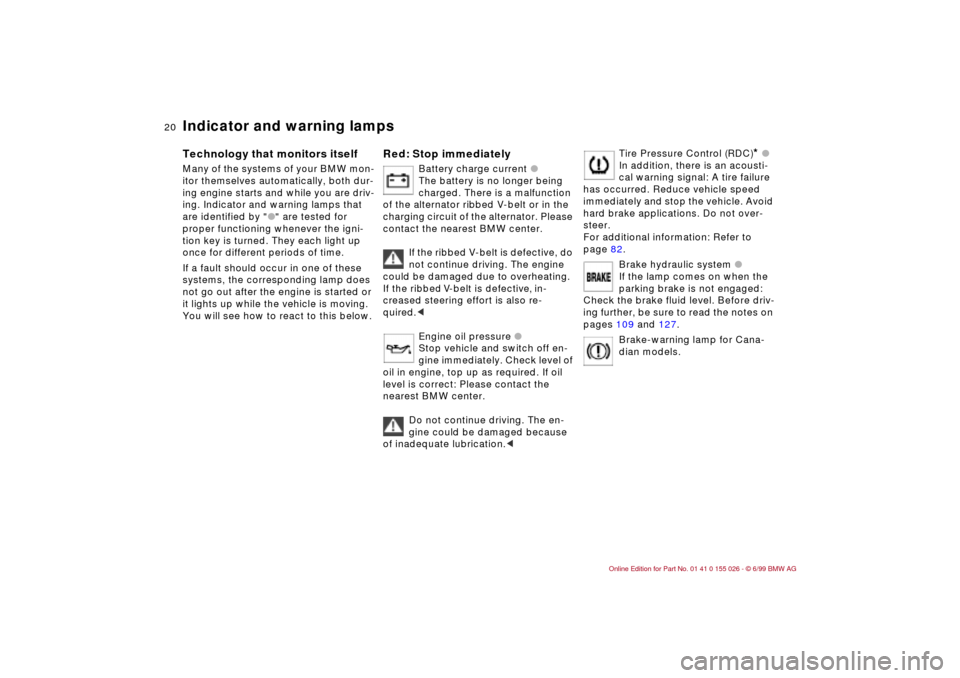
Battery charge current
l
The battery is no longer being
charged. There is a malfunction
of the alternator ribbed V-belt or in the
charging circuit of the alternator. Please
contact the nearest BMW center.
If the ribbed V-belt is defective, do
not continue driving. The engine
could be damaged due to overheating.
If the ribbed V-belt is defective, in-
creased steering effort is also re-
quired.
<
Engine oil pressure
l
Stop vehicle and switch off en-
gine immediately. Check level of
oil in engine, top up as required. If oil
level is correct: Please contact the
nearest BMW center.
Do not continue driving. The en-
gine could be damaged because
of inadequate lubrication.
<
Tire Pressure Control (RDC)
* l
In addition, there is an acousti-
cal warning signal: A tire failure
has occurred. Reduce vehicle speed
immediately and stop the vehicle. Avoid
hard brake applications. Do not over-
steer.
For additional information: Refer to
page 82.
Brake hydraulic system l
If the lamp comes on when the
parking brake is not engaged:
Check the brake fluid level. Before driv-
ing further, be sure to read the notes on
pages 109 and 127.
Brake-warning lamp for Cana-
dian models.
Page 93 of 189
91n
RepairsIndexOverview Controls Car care Technology Data
Automatic climate control Air supply
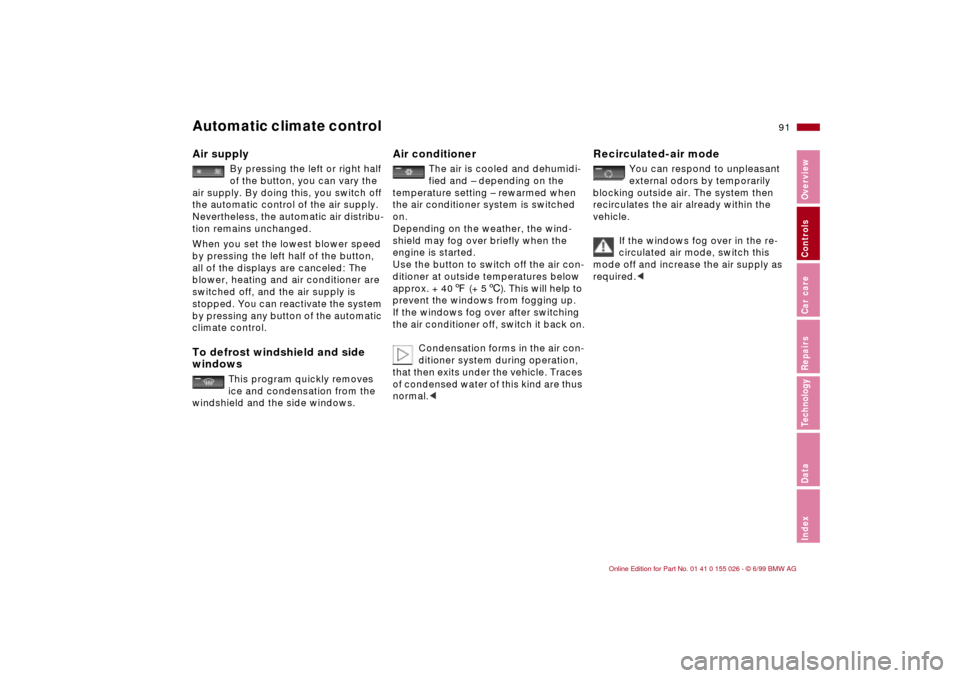
By pressing the left or right half
of the button, you can vary the
air supply. By doing this, you switch off
the automatic control of the air supply.
Nevertheless, the automatic air distribu-
tion remains unchanged.
When you set the lowest blower speed
by pressing the left half of the button,
all of the displays are canceled: The
blower, heating and air conditioner are
switched off, and the air supply is
stopped. You can reactivate the system
by pressing any button of the automatic
climate control.
To defrost windshield and side
windows
This program quickly removes
ice and condensation from the
windshield and the side windows.
Air conditioner
The air is cooled and dehumidi-
fied and – depending on the
temperature setting – rewarmed when
the air conditioner system is switched
on.
Depending on the weather, the wind-
shield may fog over briefly when the
engine is started.
Use the button to switch off the air con-
ditioner at outside temperatures below
approx. + 407 (+ 56). This will help to
prevent the windows from fogging up.
If the windows fog over after switching
the air conditioner off, switch it back on.
Condensation forms in the air con-
ditioner system during operation,
that then exits under the vehicle. Traces
of condensed water of this kind are thus
normal.<
Recirculated-air mode
You can respond to unpleasant
external odors by temporarily
blocking outside air. The system then
recirculates the air already within the
vehicle.
If the windows fog over in the re-
circulated air mode, switch this
mode off and increase the air supply as
required.<
Page 95 of 189
93n
RepairsIndexOverview Controls Car care Technology Data
Automatic climate control Heated seats
*
Roller sun blind
*
Microfilter, activated charcoal
filter
*
A microfilter traps dust and pollen from
the outside air. The activated-charcoal
filter provides additional protection by
filtering gaseous pollutants from the
outside air. Your BMW center replaces
this combined filter
* as a standard part
of your scheduled maintenance. A sub-
stantial reduction in air flow indicates
that the filter needs to be replaced
early.
For additional details on the filter
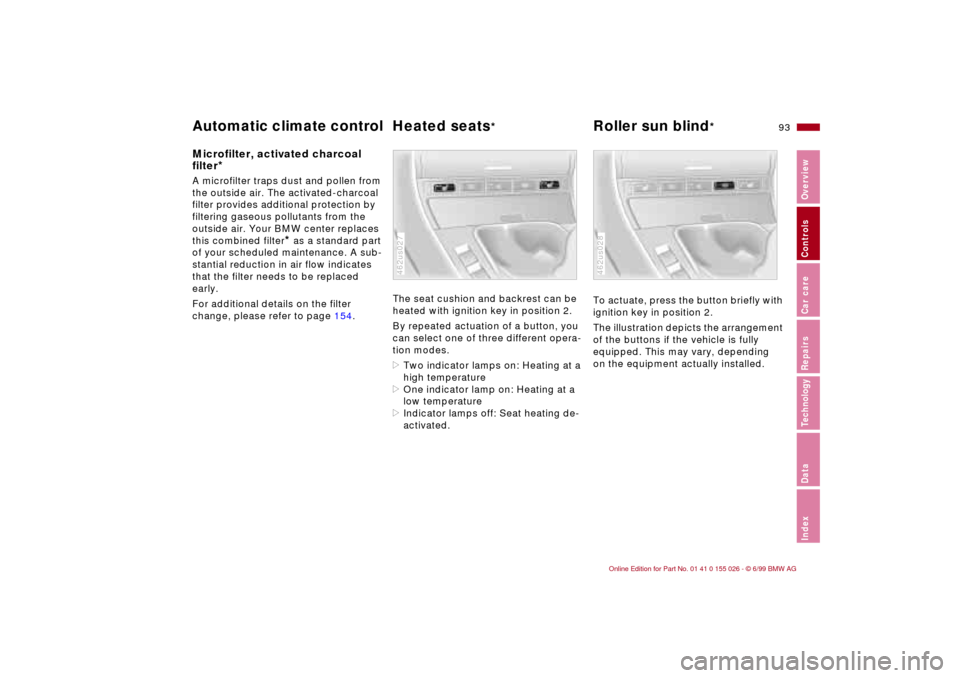
change, please refer to page 154.The seat cushion and backrest can be
heated with ignition key in position 2.
By repeated actuation of a button, you
can select one of three different opera-
tion modes.
>Two indicator lamps on: Heating at a
high temperature
>One indicator lamp on: Heating at a
low temperature
>Indicator lamps off: Seat heating de-
activated.
462us027
To actuate, press the button briefly with
ignition key in position 2.
The illustration depicts the arrangement
of the buttons if the vehicle is fully
equipped. This may vary, depending
on the equipment actually installed.462us028
Page 107 of 189

105n
RepairsIndexOverview Controls Car care Technology Data
Clothes hooks:
When suspending clothing from the
hooks, ensure that they will not obstruct
the driver's vision. In order to avoid per-
sonal injuries during braking maneu-
vers, do not hang heavy objects on the
hooks.
use with unleaded fuel only.
Even minute quantities of lead would be
enough to permanently damage both
the catalytic converter and the system
oxygen sensor.
To ensure efficient, trouble-free engine
operation and avoid potential damage:
>Be sure to comply with the scheduled
maintenance requirements
>Do not drive until the fuel tank is
empty
>Tow-start only when the engine is
cold, otherwise unburned, residual
fuel in the catalytic converter could
ignite and cause damage. It is better
to start the vehicle with an outside
starting aid
>Avoid other situations in which the
fuel is not burned, or burns incom-
pletely, such as engaging the starter
frequently or for extended periods, or
repeated start attempts in which the
engine does not start (stopping and
restarting an engine that is running
properly does not present a problem).
Never let the engine run with any of
the spark plug cables disconnected.Be sure to comply with the in-
structions above to prevent un-
burned fuel from reaching the catalytic
converter. Otherwise, the catalytic con-
verter could respond by overheating,
leading to serious damage.
Extreme temperatures occur at the cat-
alytic converter. Heat shields are in-
stalled adjacent to some sections of the
exhaust system. Never remove these
shields; do not apply undercoating to
their surfaces. When driving, standing
at idle, and parking the vehicle, take
care to avoid contact between the ex-
haust system and flammable materials
(grass, hay, leaves, etc.). Such contact
could lead to a fire, resulting in serious
injury and property damage.
Page 110 of 189

108n
Disc brakesDisc brakes furnish optimum decelera-
tion and braking control and greater
fade resistance under heavy use.
When the vehicle is driven only occa-
sionally, during extended periods when
the vehicle is not used at all, and in op-
erating conditions where brakes appli-
cations are less frequent, there is an in-
creased tendency for corrosion of the
rotors and accumulation of contamina-
tion on the brake pads. This occurs be-
cause the minimal pressure that must
be exerted by the pads to clean the
rotors by brake applications is not
reached.
If the brake rotors are corroded, they
will tend to respond to braking with a
pulsating effect that even extended
brake applications will fail to cure.
For your own safety: Only use
brake linings that BMW has re-
leased for your particular vehicle model.
BMW cannot vouch for driving safety or
the suitability of brake linings other than
those they have released.<
Driving notesWhile driving in wet conditions and in
heavy rain, it is effective to apply light
pressure to the brake pedal every few
miles (kilometers). Watch traffic condi-
tions to ensure that this maneuver does
not endanger other road users. The
heat that is generated by the brake ap-
plications helps to dry the brake pads
and rotors.
Maximum braking force is obtained
while the wheels continue to rotate,
peaking when the wheels remain on the
verge of locking without actually doing
so. ABS maintains this state automati-
cally. If the ABS fails, you should revert
to the staggered braking technique
described on page 110.
Long or steep mountain descents do
not necessarily lead to reduced braking
efficiency if you drive downhill with the
transmission in a gear that allows mini-
mal brake applications (or, with an auto-
matic transmission, in an appropriate
lower range).
You can further increase the engine's
braking effect by selecting a lower gear,
downshifting as far as first gear or plac-
ing the selector lever in position (1).Should engine braking prove inade-
quate, you should still avoid extended,
continuous braking. Instead of main-
taining low to moderate pressure over
an extended period of time, you should
decelerate the vehicle by applying more
substantial force on the pedal (watch
for following traffic!) and then pausing
before repeating the application. This
staggered braking technique allows the
brakes to cool in the intervals between
active braking phases, preventing over-
heating and ensuring that full braking
capacity remains available at all times.
Do not coast with the clutch de-
pressed or with the transmission
or selector lever in neutral. Do not drive
with the engine shut off. The engine
provides no braking effect when the
clutch pedal is depressed or the trans-
mission is in neutral, and there is no
power-assist for brakes and steering
when the engine is not running.
Never allow floor mats, carpets or any
other objects to protrude into the area
around the accelerator, clutch and
brake pedals and obstruct their move-
ment.<
Page 115 of 189
113n
RepairsIndexOverview Controls Car care Technology Data
Information for your safetyThe factory-approved radial tires are
matched to the car and have been se-
lected to provide optimum safety and
driving comfort on your car.
It is not merely the tire's service life, but
also driving comfort and – above all
else – driving safety that depend on the
condition of the tires and the mainte-
nance of the specified tire pressure.
Incorrect inflation pressure is a frequent
cause of tire damage. It also signifi-
cantly influences the roadholding ability
of your BMW.
Check tire inflation pressure regu-
larly — including the space-saver
and/or the spare tire — at least twice a
month and before beginning a longer
road trip. Incorrect tire pressure can
otherwise lead to tire damage and acci-
dents.<
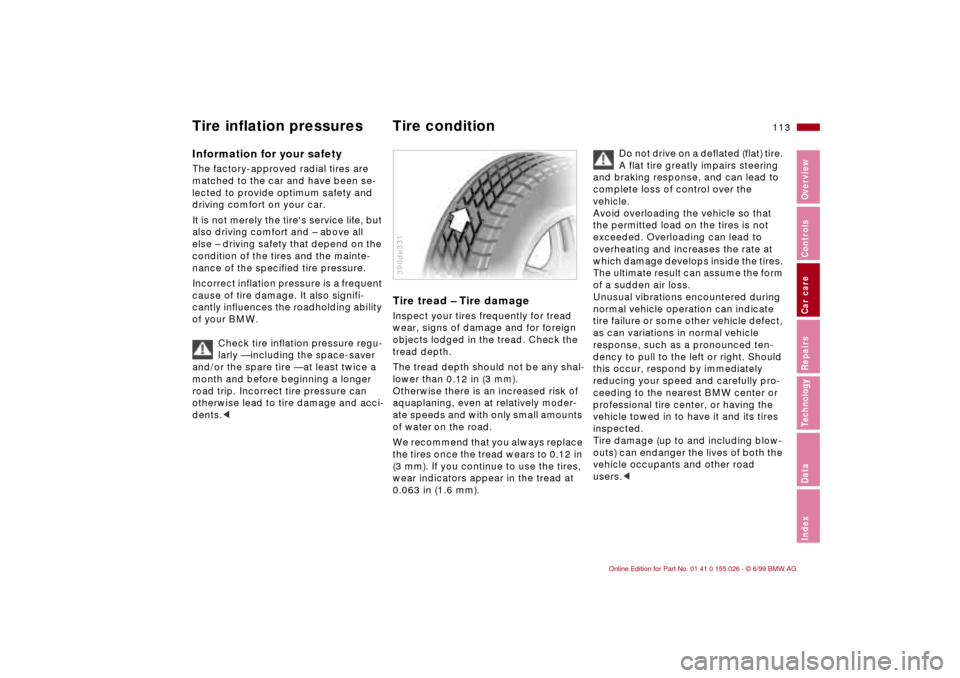
Tire tread – Tire damageInspect your tires frequently for tread
wear, signs of damage and for foreign
objects lodged in the tread. Check the
tread depth.
The tread depth should not be any shal-
lower than 0.12 in (3 mm).
Otherwise there is an increased risk of
aquaplaning, even at relatively moder-
ate speeds and with only small amounts
of water on the road.
We recommend that you always replace
the tires once the tread wears to 0.12 in
(3 mm). If you continue to use the tires,
wear indicators appear in the tread at
0.063 in (1.6 mm).390de331
Do not drive on a deflated (flat) tire.
A flat tire greatly impairs steering
and braking response, and can lead to
complete loss of control over the
vehicle.
Avoid overloading the vehicle so that
the permitted load on the tires is not
exceeded. Overloading can lead to
overheating and increases the rate at
which damage develops inside the tires.
The ultimate result can assume the form
of a sudden air loss.
Unusual vibrations encountered during
normal vehicle operation can indicate
tire failure or some other vehicle defect,
as can variations in normal vehicle
response, such as a pronounced ten-
dency to pull to the left or right. Should
this occur, respond by immediately
reducing your speed and carefully pro-
ceeding to the nearest BMW center or
professional tire center, or having the
vehicle towed in to have it and its tires
inspected.
Tire damage (up to and including blow-
outs) can endanger the lives of both the
vehicle occupants and other road
users.<
Tire inflation pressures Tire condition
Page 168 of 189
166n
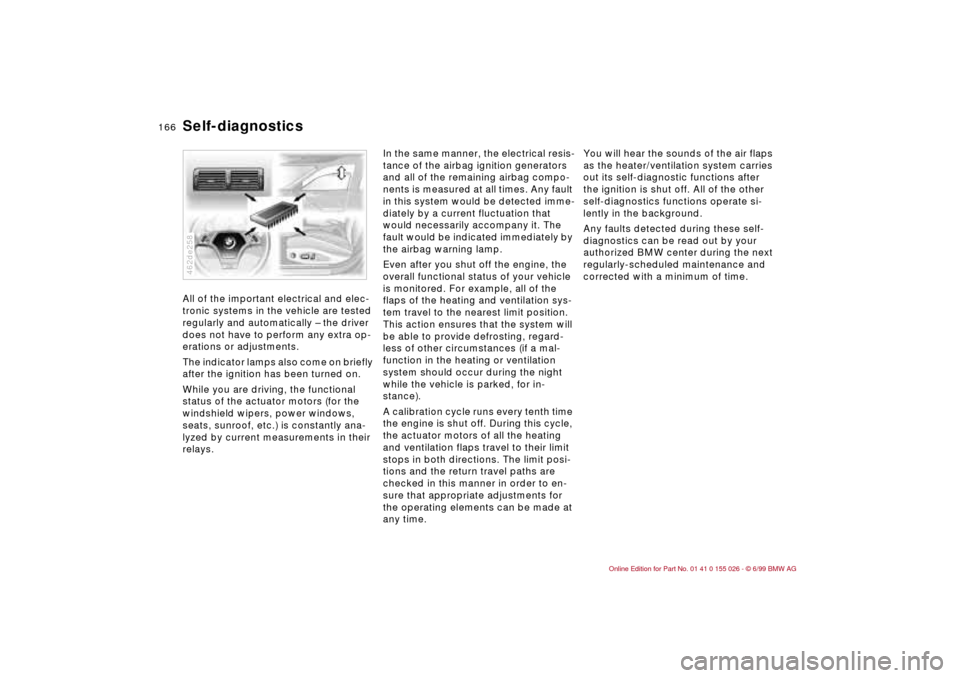
Self-diagnostics All of the important electrical and elec-
tronic systems in the vehicle are tested
regularly and automatically – the driver
does not have to perform any extra op-
erations or adjustments.
The indicator lamps also come on briefly
after the ignition has been turned on.
While you are driving, the functional
status of the actuator motors (for the
windshield wipers, power windows,
seats, sunroof, etc.) is constantly ana-
lyzed by current measurements in their
relays. 462de258
In the same manner, the electrical resis-
tance of the airbag ignition generators
and all of the remaining airbag compo-
nents is measured at all times. Any fault
in this system would be detected imme-
diately by a current fluctuation that
would necessarily accompany it. The
fault would be indicated immediately by
the airbag warning lamp.
Even after you shut off the engine, the
overall functional status of your vehicle
is monitored. For example, all of the
flaps of the heating and ventilation sys-
tem travel to the nearest limit position.
This action ensures that the system will
be able to provide defrosting, regard-
less of other circumstances (if a mal-
function in the heating or ventilation
system should occur during the night
while the vehicle is parked, for in-
stance).
A calibration cycle runs every tenth time
the engine is shut off. During this cycle,
the actuator motors of all the heating
and ventilation flaps travel to their limit
stops in both directions. The limit posi-
tions and the return travel paths are
checked in this manner in order to en-
sure that appropriate adjustments for
the operating elements can be made at
any time.You will hear the sounds of the air flaps
as the heater/ventilation system carries
out its self-diagnostic functions after
the ignition is shut off. All of the other
self-diagnostics functions operate si-
lently in the background.
Any faults detected during these self-
diagnostics can be read out by your
authorized BMW center during the next
regularly-scheduled maintenance and
corrected with a minimum of time.
Page 183 of 189

Everything from A to Z
181n
RepairsIndexOverview Controls Car care Technology Data
NNavigation system, refer to
the radio operating
instructions
Neckrest 48
New transmitter, radio
remote control 147
Non-smokers package 96
Nozzles 122OOBD connector 137
Obstruction protection 44
Odometer 74
Oil
filling capacity 173
quality 124
viscosity 124
Oil additives 123
Oil change intervals, see the
Service and Warranty
Information Booklet
Oil consumption 123
Oil dipstick 123
Oil filter change 173
Oil level
check 123
indicator lamp 21
Oil pressure, indicator
lamp 20
Oil specifications 124
OILSERVICE 76Onboard computer 77
Onboard computer, refer to
the radio operating
instructions
Onboard tool kit 140
Opening and closing
from inside 38
from outside 34
Outlets, ventilation 88
Outside temperature
display 78
PPaint blemishes 131
Paint, care 131
Paintwork
minor repairs 132
waxing 132
Park Distance Control
(PDC) 80
Parking brake 64
Parking help 80
Parking lamps 84, 85
bulb replacement 142
Parking, winter 111
PDC (Park Distance
Control) 80
Performance 170
Pocket lamp 94
Pollen 93
Power steering 112
Power windows 44Preheat 62
Pressure monitoring,
tires 82, 164
Pressure, tires 27, 113
RRadiator 173
Radio Data System
(RDS) 162
Radio reception 112, 162
Radio remote control, new
transmitter 147
Radio, refer also to the radio
operating instructions
Rain sensor 70, 165
RDC (Tire Pressure
Control) 82, 164
RDS (Radio Data
System) 162
Reading lamps 86
Rear backrest, folding 98
Rear lamps 143
Rear window
defroster 71, 92
Rear-view mirror 52
Reclining seat 47
Refueling 26
Remote control 35
Removal of the vehicle from
service 136
Remove condensation,
windows 91Replenish washer fluid 122
Reporting safety defects 7
Reserve control lamp 75
Restraint system 56, 60
Reverse 17, 65
Roller blind, sun
protection 93
Roof load 172
Roof luggage rack 101
Rubber parts 110
SSafety belt height
adjustment 55
Safety belt tensioner 162
Safety belts 55
safety belt height
adjustment 55
Safety buttons 38
Safety feature 44
Seat
electric power 50
mechanical 47
Seat adjustment 47
Seat heating 93
Seat memory 51
Securing cargo 100
Securing loads 100
Selector lever, automatic
transmission 66
Self-diagnostics 166