low BMW 328i 1997 E36 Workshop Manual
[x] Cancel search | Manufacturer: BMW, Model Year: 1997, Model line: 328i, Model: BMW 328i 1997 E36Pages: 759
Page 200 of 759
170-6
RADIATOR
AND
COOLING
SYSTEM
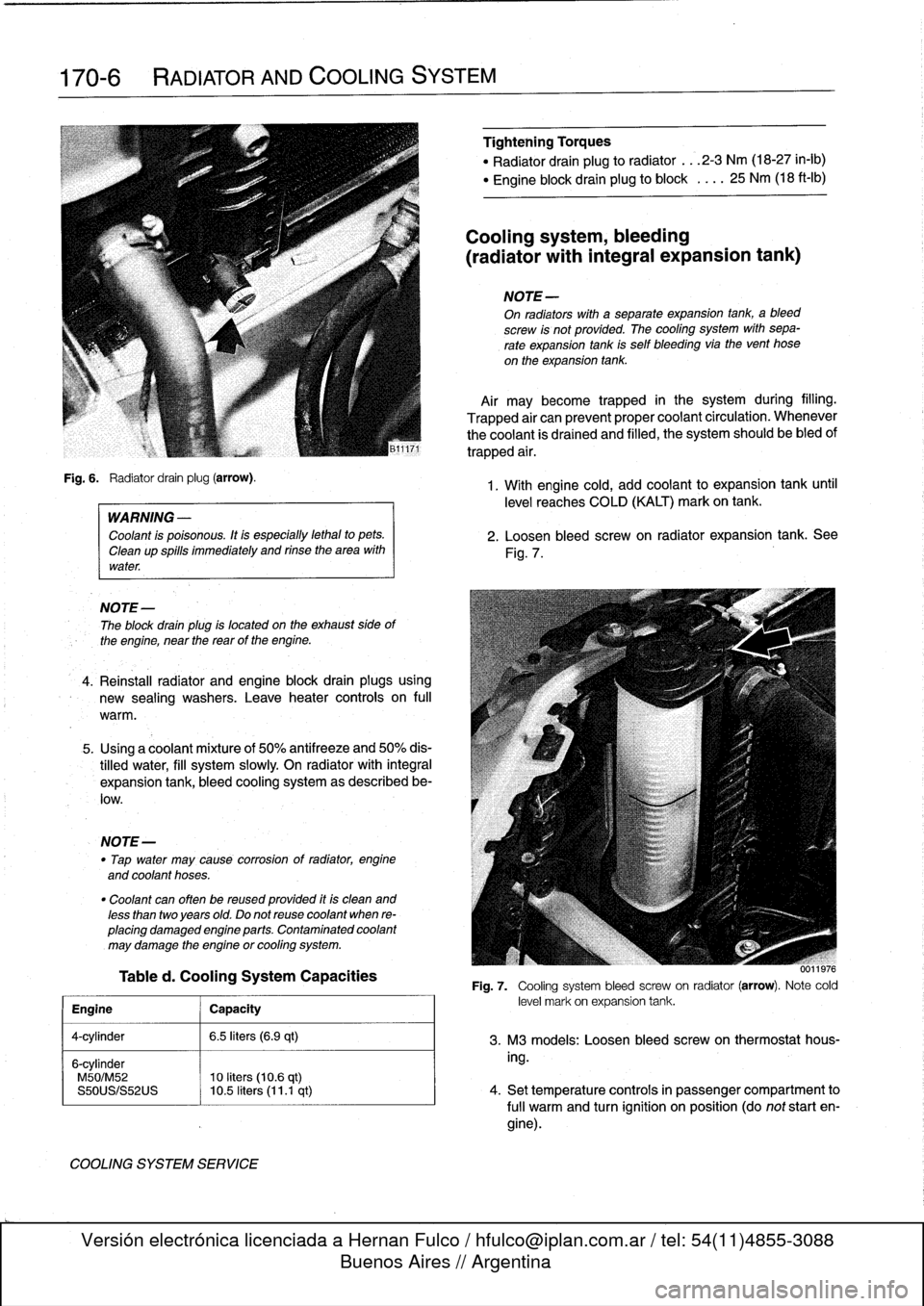
Fig
.
6
.
Radiator
drain
plug
(arrow)
.
WARNING
-
Coolant
is
poisonous
.
Itis
especially
lethal
to
pets
.
Cleanup
spills
immediately
and
rinse
the
area
with
water
.
NOTE
-
The
block
drain
plug
is
located
on
the
exhaust
side
of
the
engine,
near
the
reas
of
the
engine
.
4
.
Reinstall
radiator
and
engine
block
drain
plugsusing
new
sealing
washers
.
Leave
heater
controis
on
full
warm
.
5
.
Using
a
coolantmixture
of
50%
antifreeze
and
50%
dis-
tilled
water,
fill
system
slowly
On
radiator
with
integral
expansion
tank,
bleed
cooling
system
as
described
be-
low
.
NOTE-
"
Tap
water
may
cause
corrosion
of
radiator,
engine
and
coolant
hoses
.
"
Coolant
can
often
be
reused
provided
itis
clean
and
less
than
twoyears
old
.
Do
not
reuse
coolant
when
re-
placing
damaged
engine
parts
.
Contaminated
coolant
may
damage
the
engine
or
cooling
system
.
Tabled
.
Cooling
System
Capacities
Engine
j
Capacity
4-cylinder
1
6
.5
liters
(6.9
qt)
6-cylinder
M50/M52
10
liters
(10
.6
qt)
S50US/S52US
10
.5
liters
(11
.1
qt)
COOLING
SYSTEM
SERVICE
Tightehing
Torques
"
Radiator
drain
plug
to
radiator
...
2-3
Nm
(18-27
in-lb)
"
Engine
block
drain
plug
to
block
.
.
..
25
Nm
(18
ft-Ib)
Cooling
system,
bleeding
(radiator
with
integral
expansion
tank)
NOTE
-
On
radiators
with
a
separate
expansion
tank,
ableed
screw
is
not
provided
.
The
cooling
system
with
sepa-
rate
expansion
tank
is
self
bleeding
via
the
vent
hose
on
the
expansion
tank
.
Air
maybecome
trapped
in
the
system
during
filling
.
Trapped
air
can
prevent
proper
coolant
circulation
.
Whenever
the
coolant
is
drained
and
filled,
the
system
should
be
bled
of
trapped
air
.
1
.
With
engine
cold,
add
coolant
to
expansion
tank
until
level
reaches
COLD
(KALT)
mark
on
tank
.
2
.
Loosen
bleed
screw
on
radiator
expansion
tank
.
See
Fig
.
7
.
0011976
Fig
.
7
.
Cooling
system
bleed
screwon
radiator
(arrow)
.
Note
cold
level
mark
on
expansion
tank
.
3
.
M3
models
:
Loosen
bleed
screw
on
thermostathous-
ing
.
4
.
Set
temperature
controls
in
passenger
compartment
to
fui¡
warm
and
turn
ignition
on
position
(do
not
start
en-
gine)
.
Page 201 of 759
5
.
Slowly
add
coolant
until
it
spills
from
bleed
screws
.
When
coolant
spillíng
from
bleed
screws
is
free
of
air
bubbies,
tighten
screws
.
6
.
Run
engine
until
it
reaches
operatíng
temperature
.
Af-
ter
engine
has
cooled,
recheck
coolant
level
and
top
up
as
necessary
.
CAUTION-
Always
use
genuine
BMW
coolant
or
its
equiva-
lent
to
avoid
the
formation
of
harmful,
clogging
de-
posits
in
the
cooling
system
.
Use
of
other
antifreeze
solutions
may
be
harmful
to
the
cooling
system
.
Tightening
Torque
"
Radiator
bleed
screw
to
thermostat
housing
...
.
.
........
8
Nm
(71
in-lb)
Belt-driven
cooling
fan,
replacing
1
.
Usinga32
mm
wrench
on
fan
clutch
nut,
turn
wrench
quickly
in
a
clockwise
direction
(working
from
front
of
car)
to
loosen
.
Spin
fan
off
pump
.
See
Fig
.
8
.
NOTE-
"
The
radiator
cooling
fan
nut(32
mm
wrench)
has
left-
hand
threads
.
"
The
nut
may
be
difficult
to
loosen
.
Use
a
tool
to
hold
the
coolant
pump
pulleystationary
.
BMW
hasa
spe-
cial
tool
forthis
purpose
(BMW
special
tool
no
.
115
030)
.
2
.
Remove
expansion
rivets
holding
shroud
to
radiator
.
See
Fig
.
9
.
Remove
fan
and
shroud
together
.
NOTE-
Store
the
removed
fan
clutch
assembly
in
an
upright
(installed)
positionto
prevent
lossof
clutch
fluid
.
RADIATOR
AND
COOLING
SYSTEM
170-
7
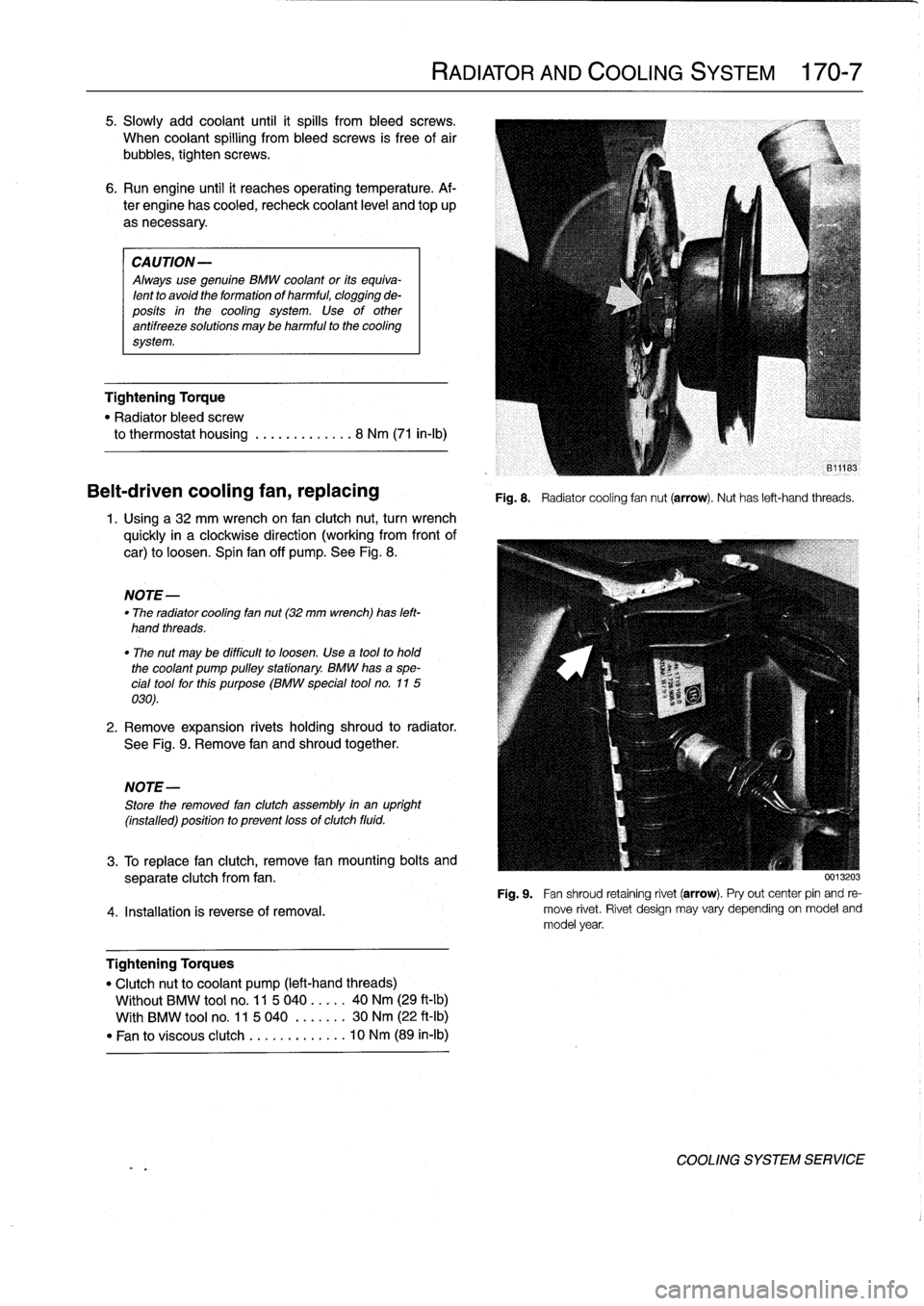
Fig
.
8
.
Radiatorcooling
fannut
(arrow)
.
Nuthas
left-hand
threads
.
3
.
To
replace
fan
clutch,
remove
fan
mounting
bolts
and
separate
clutch
from
fan
.
Fig
.
9
.
Fan
shroud
retaining
rivet
(arrow)
.
Pryout
center
pin
and
re
4
.
Installation
is
reverse
of
rernoval
.
move
rivet
.
Rivet
design
may
vary
depending
on
model
and
model
year
.
Tightening
Torques
"
Clutchnut
to
coolant
pump
(left-hand
threads)
Wíthout
BMW
tool
no
.
11
5
040
.....
40
Nm
(29
ft-lb)
With
BMW
tool
no
.
11
5
040
.
......
30
Nm
(22
ft-Ib)
"
Fan
to
viscous
clutch
...
.
..
.
......
10
Nm
(89
in-lb)
0013203
COOLING
SYSTEM
SERVICE
Page 202 of 759
170-8
RADIATOR
AND
COOLING
SYSTEM
Electric
cooling
fan,
replacing
On
late
4-cylinder
models
(M44
engine)
with
manual
trans-
mission,
the
primary
cooling
fan
is
electrically
operated
and
is
mounted
on
the
engine
side
of
the
radiator
.
1
.
If
necessary,
remove
cover
from
top
of
radiator
.
See
Fig
.
10
.
0012505
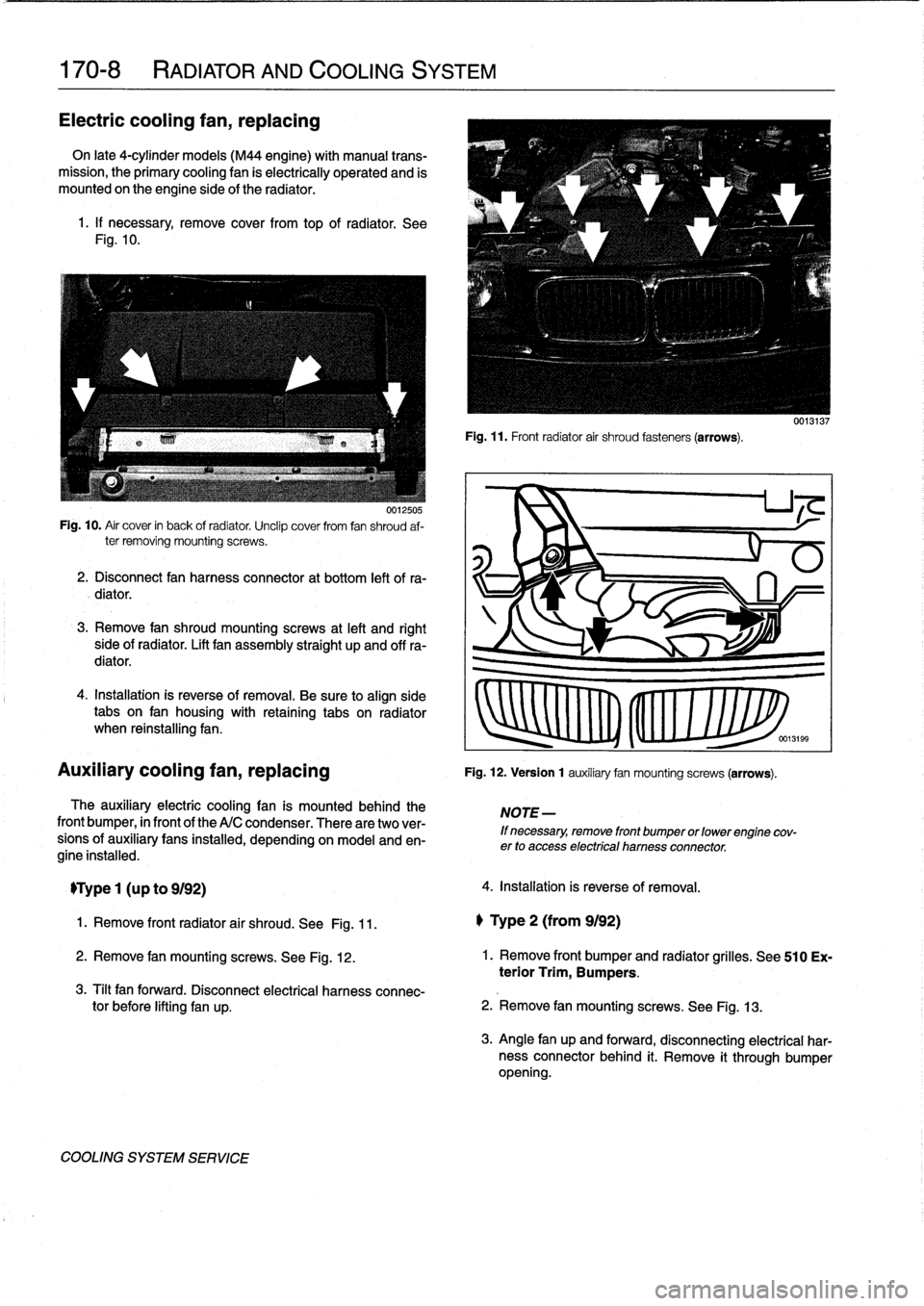
Fig
.
10
.
Air
cover
in
back
of
radiator
.
Unclip
cover
from
fan
shroud
af-
ter
removing
mounting
screws
.
2
.
Disconnect
fan
harness
connector
at
bottom
left
of
ra-
diator
.
3
.
Remove
fan
shroud
mountingscrews
at
left
and
right
side
of
radiator
.
Lift
fan
assembly
straight
up
and
offra-
diator
.
4
.
Installation
is
reverse
of
removal
.
Be
sure
to
align
side
tabs
on
fan
housíng
with
retaining
tabs
on
radiator
when
reinstalling
fan
.
Auxiliary
cooling
fan,
replacing
The
auxiliary
electric
cooling
fan
is
mounted
behind
the
front
bumper,
in
front
of
the
A/C
condenser
.
There
aretwo
ver-
sions
of
auxiliary
fans
installed,
depending
on
model
and
en-
gine
installed
.
TType
1
(u
p
to
9192)
1
.
Remove
front
radiator
air
shroud
.
See
Fig
.
11
.
2
.
Remove
fan
mountingscrews
.
See
Fig
.
12
.
3
.
Tilt
fan
forward
.
Disconnect
electrical
harness
connec-
tor
before
lifting
fan
up
.
COOLING
SYSTEM
SERVICE
Fig
.
11
.
Front
radiator
air
shroud
fasteners
(arrows)
.
Fig
.
12
.
Version
1
auxiliary
fan
mountingscrews
(arrows)
.
NOTE
-
If
necessary,
remove
front
bumper
or
lowerengine
cov-
erto
access
electrical
harnessconnector
.
4
.
Installation
is
reverse
of
removal
.
l)
Type
2
(from
9192)
2
.
Remove
fan
mounting
screws
.
See
Fig
.
13
.
0013137
1.
Remove
front
bumper
and
radiator
grilles
.
See
510
Ex-
terior
Trim,
Bumpers
.
3
.
Angle
fan
up
and
forward,
disconnecting
electrical
har-
nessconnectorbehind
it
.
Remove
it
through
bumper
opening
.
Page 203 of 759
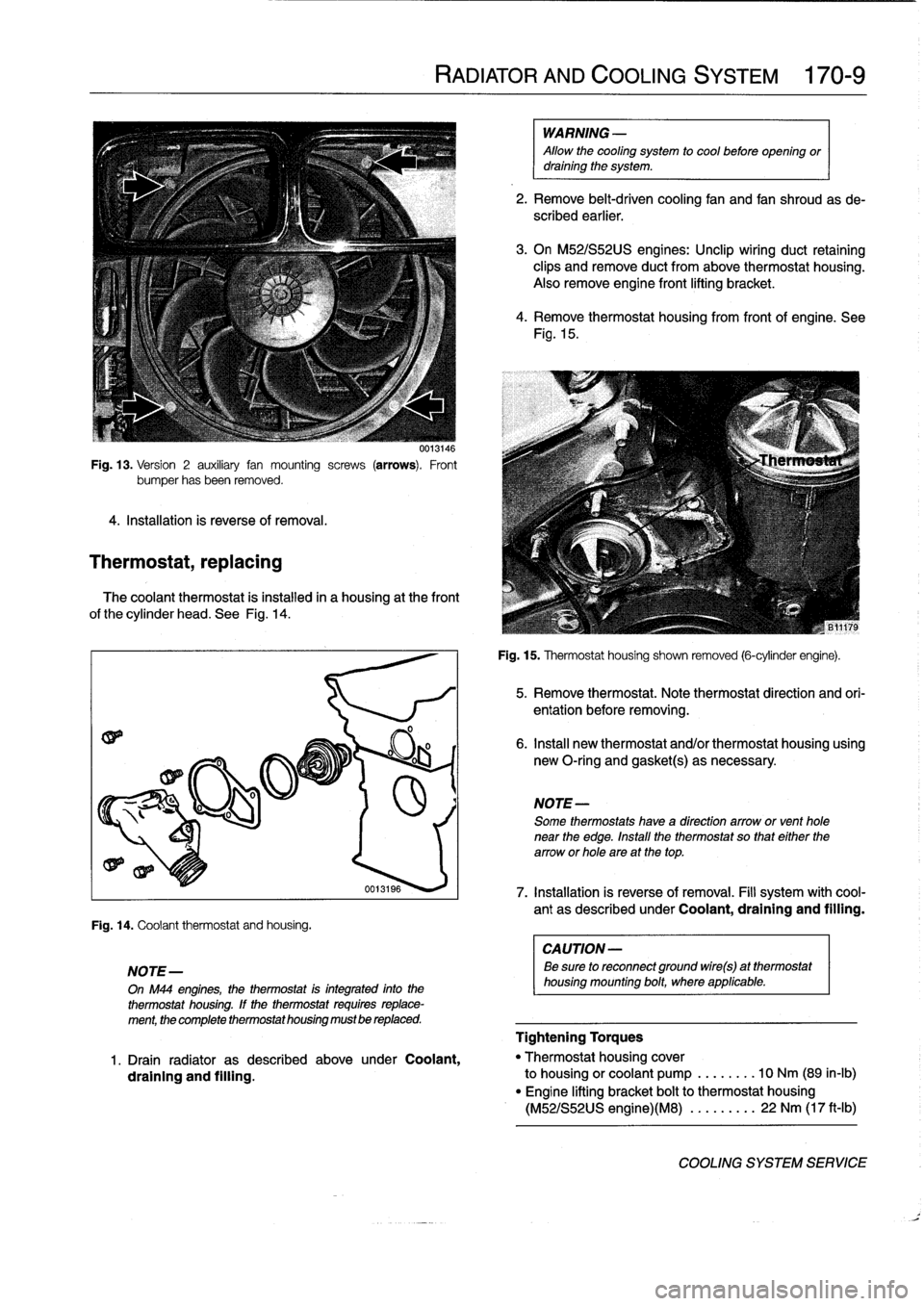
Fig
.
13
.
Version
2
auxiliary
fan
mounting
screws
(arrows)
.
Front
bumper
hasbeen
removed
.
4
.
Installation
is
reverse
of
removal
.
Thermostat,
replacing
0013146
The
coolant
thermostat
is
instalied
in
a
housing
at
the
front
of
the
cylinder
head
.
See
Fig
.
14
.
Fig
.
14
.
Coolantthermostat
and
housíng
.
NOTE-
On
M44
engines,
the
thermostat
is
integrated
into
the
thermostat
housíng
.
If
the
thermostat
requiresreplace-
ment,
the
complete
thermostathousing
mustbe
replaced
.
RADIATOR
AND
COOLING
SYSTEM
170-
9
WARNING
-
Allow
the
cooling
system
to
cool
before
opening
ordraining
the
system
.
2
.
Remove
belt-driven
cooling
fan
and
fan
shroudas
de-
scribed
earlier
.
3
.
On
M52/S52US
engines
:
Unclip
wiring
duct
retaining
clips
and
remove
duct
from
above
thermostat
housing
.
Also
remove
engine
front
lifting
bracket
.
4
.
Remove
thermostat
housing
from
front
of
engine
.
See
Fig
.
15
.
Fig
.
15
.
Thermostat
housíng
shown
removed
(6-cylinder
engine)
.
NOTE-
Some
thermostats
have
a
direction
arrowor
venthole
near
the
edge
.
Install
the
thermostat
so
that
either
the
arrow
or
hole
are
at
thetop
.
CAUTION
-
Be
sure
to
reconnect
ground
wire(s)
at
thermostat
housing
mounting
bolt,
where
applicable
.
5
.
Remove
thermostat
.
Note
thermostat
direction
and
ori-
entation
before
removing
.
6
.
Insta¡¡
new
thermostat
and/or
thermostat
housing
using
new
O-ring
and
gasket(s)
as
necessary
.
oo131ss
7
.
Installation
is
reverseof
removal
.
Fill
system
with
cool-
ant
as
described
under
Coolant,draining
and
filling
.
Tightening
Torques
1
.
Drain
radiator
as
described
above
under
Coolant,
"
Thermostat
housing
cover
draining
and
filling
.
to
housing
orcoolant
pump
..
..
....
10
Nm
(89
in-lb)
"
Engine
lifting
bracket
bolt
to
thermostat
housing
(M52/S52US
engine)(M8)
....
..
...
22
Nm
(17
ft-Ib)
COOLING
SYSTEM
SERVICE
Page 204 of 759
170-10
RADIATOR
AND
COOLING
SYSTEM
Coolant
pump,
replacing
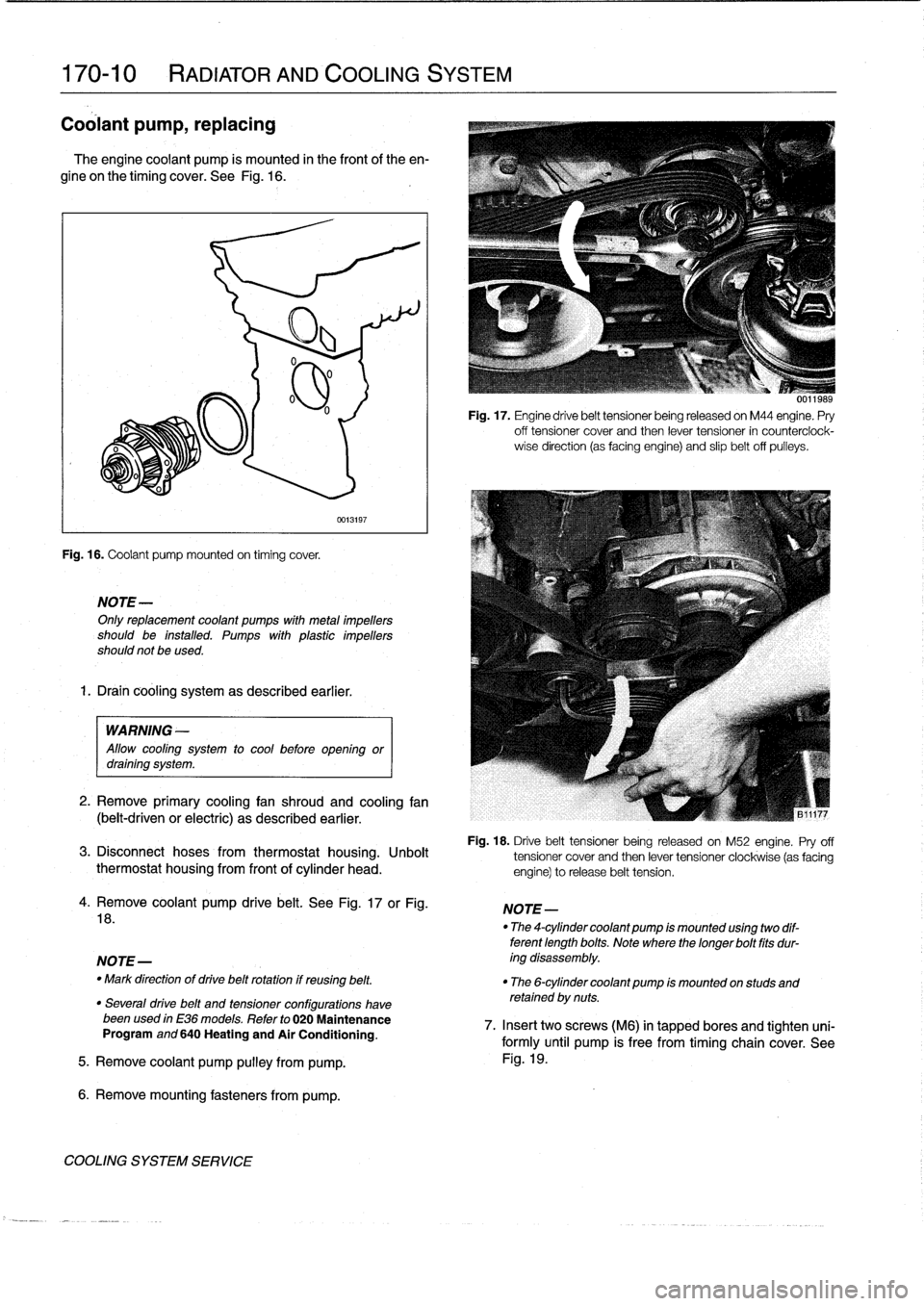
The
engine
coolant
pump
is
mounted
in
the
frontof
the
en-
gine
on
the
timing
cover
.
See
Fig
.
16
.
Fig
.
16
.
Coolant
pump
mounted
on
timing
cover
.
NOTE-
Onlyreplacement
coolant
pumps
with
metal
¡mpellers
should
be
installed
.
Pumps
with
plastic
impellers
should
not
be
used
.
1.
Drain
cooling
system
as
described
earlier
.
0013197
WARNING
-
Allow
cool¡ng
system
to
cool
before
open¡ngor
drain¡ng
system
.
2
.
Remove
primary
cooling
fan
shroud
and
cooling
fan
(belt-driven
or
electric)
as
described
earlier
.
Fig
.
17
.
Engine
drive
belt
tensioner
being
released
on
M44
engine
.
Pry
off
tensioner
cover
and
then
lever
tensioner
in
counterciock-
wise
direction
(as
facing
engine)
and
slip
belt
off
pulleys
.
Fig
.
18
.
Drive
belt
tensioner
being
released
on
M52
engine
.
Pry
off
3
.
Disconnect
hoses
from
thermostat
housing
.
Unbolt
tensioner
cover
and
then
lever
tensioner
clockwise
(as
facing
thermostat
housing
from
front
of
cylinder
head
.
engine)torelease
belt
tension
.
4
.
Remove
coolant
pump
drive
belt
.
See
Fig
.
17
or
Fig
.
18
.
NOTE-
-
Mark
direction
of
drive
belt
rotation
if
reusing
belt
.
"
The
6-cylinder
coolant
pump
¡s
mounted
on
studs
and
retained
by
nuts
.
"
Severa¡
drive
belt
and
tensioner
configurations
havebeenused
in
E36
models
.
Refer
to
020
Maintenance
Program
and
640
Heating
and
Air
Conditioning
.
5
.
Remove
coolant
pump
pulley
from
pump
.
6
.
Remove
mounting
fasteners
from
pump
.
COOLING
SYSTEM
SERVICE
NOTE-
"
The
4-cylinder
coolant
pump
¡s
mounted
us¡ng
two
dif-
terent
length
bolts
.
Note
where
thelonger
bolt
fits
dur-
ing
disassembly
.
0011989
7
.
Insert
twoscrews
(M6)
in
tapped
bores
and
tighten
uni-
formly
until
pump
is
free
from
timing
chain
cover
.
See
Fig
.
19
.
Page 205 of 759
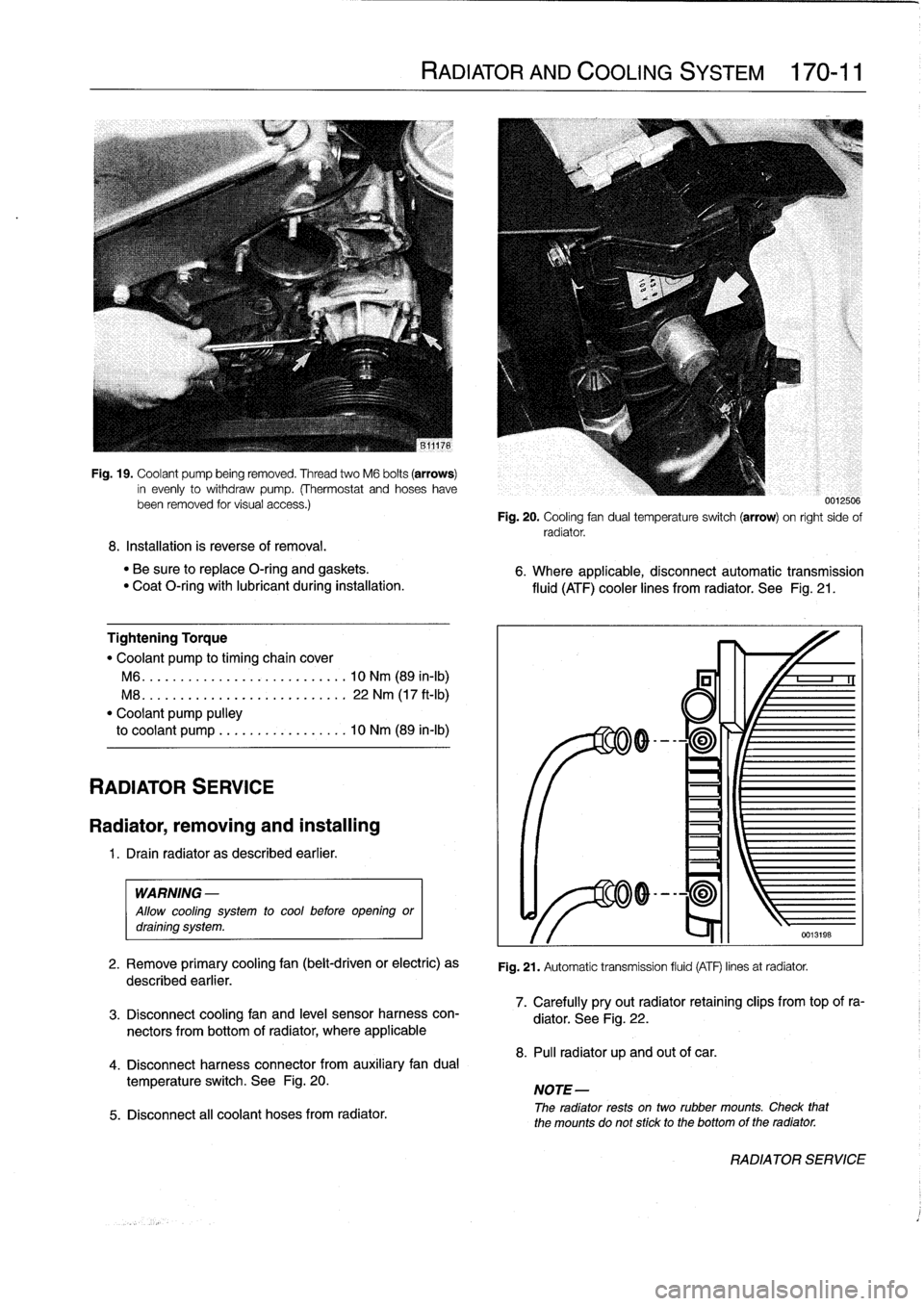
Fig
.
19
.
Coolant
pump
being
removed
.
Thread
two
M6
bolts
(arrows)
in
evenly
to
withdraw
pump
.
(Thermostat
and
hoseshavebeen
removed
tor
visual
access
.)
8
.
Installation
is
reverse
of
removal
.
"
Be
sure
to
replace
O-ring
and
gaskets
.
"
Coat
O-ring
with
lubricant
during
installation
.
Tightening
Torque
"
Coolant
pump
to
timing
chaincover
M6
...
.
...................
..
.
.
10
Nm
(89
in-lb)
M8
.
..
.
....................
.
.
.
22
Nm
(17
ft-Ib)
"
Coolant
pump
pulley
to
coolant
pump
.................
10
Nm
(89
in-lb)
RADIATOR
SERVICE
Radiator,
removing
and
installing
1
.
Drain
radiator
as
described
earlier
.
WARNING
-
Allow
cooling
system
to
cool
before
opening
ordraining
system
.
2
.
Remove
primary
cooling
fan
(belt-driven
or
electric)
as
described
earlier
.
3
.
Disconnect
coolingfan
and
leve¡
sensor
harness
con-
nectors
from
bottom
of
radiator,
where
applicable
4
.
Disconnect
harness
connector
from
auxiliary
fandual
temperature
switch
.
See
Fig
.
20
.
5
.
Disconnect
all
coolant
hoses
from
radiator
.
RADIATOR
AND
COOLING
SYSTEM
170-11
0012500
Fig
.
20
.
Cooling
fan
dual
temperatura
switch
(arrow)
on
right
sido
of
radiator
.
6
.
Where
applicable,
disconnectautomatic
transmission
fluid
(ATF)
cooler
lines
from
radiator
.
See
Fig
.
21
.
Fig
.
21
.
Automatic
transmission
fluid
(ATF)
linos
at
radiator
.
7
.
Carefully
pryout
radiator
retaining
clips
from
top
of
ra-
diator
.
See
Fig
.
22
.
8
.
Pul¡
radiator
up
and
out
of
car
.
NOTE-
The
radiator
rests
ontwo
rubber
mounts
.
Check
that
the
mounts
do
not
stick
to
the
bottomof
the
radiator
.
RADIATOR
SERVICE
Page 207 of 759
GENERAL
.
.
.......
.
......
.
...
.
.
.
.
.
...
180-1
Exhaust
system,
removing
and
installing
.
...
.180-3
EXHAUST
SYSTEM
REPLACEMENT
.
...
180-1
Exhaust
manifolds,
removing
and
installing
.
.
.180-5
GENERAL
The
exhaust
system
is
designed
to
be
maintenance
free,
al-
though
regular
inspection
is
warranted
due
to
the
harsh
oper-
atingconditions
.
Under
normal
conditions,
the
catalytic
converter
does
not
require
replacement
unless
it
is
damaged
.
On
1996
and
later
cars,
a
pre-
and
post-catalytic
converter
oxygen
sensor
is
used
at
each
catalytic
converter
.
Be
sure
to
take
care
when
removingthe
system
not
to
damage
the
sen-
EXHAUST
SYSTEMREPLACEMENT
sors
.
See
130
Fuel
Injection
for
information
on
testing
oxygen
sensors
.
NOTE-
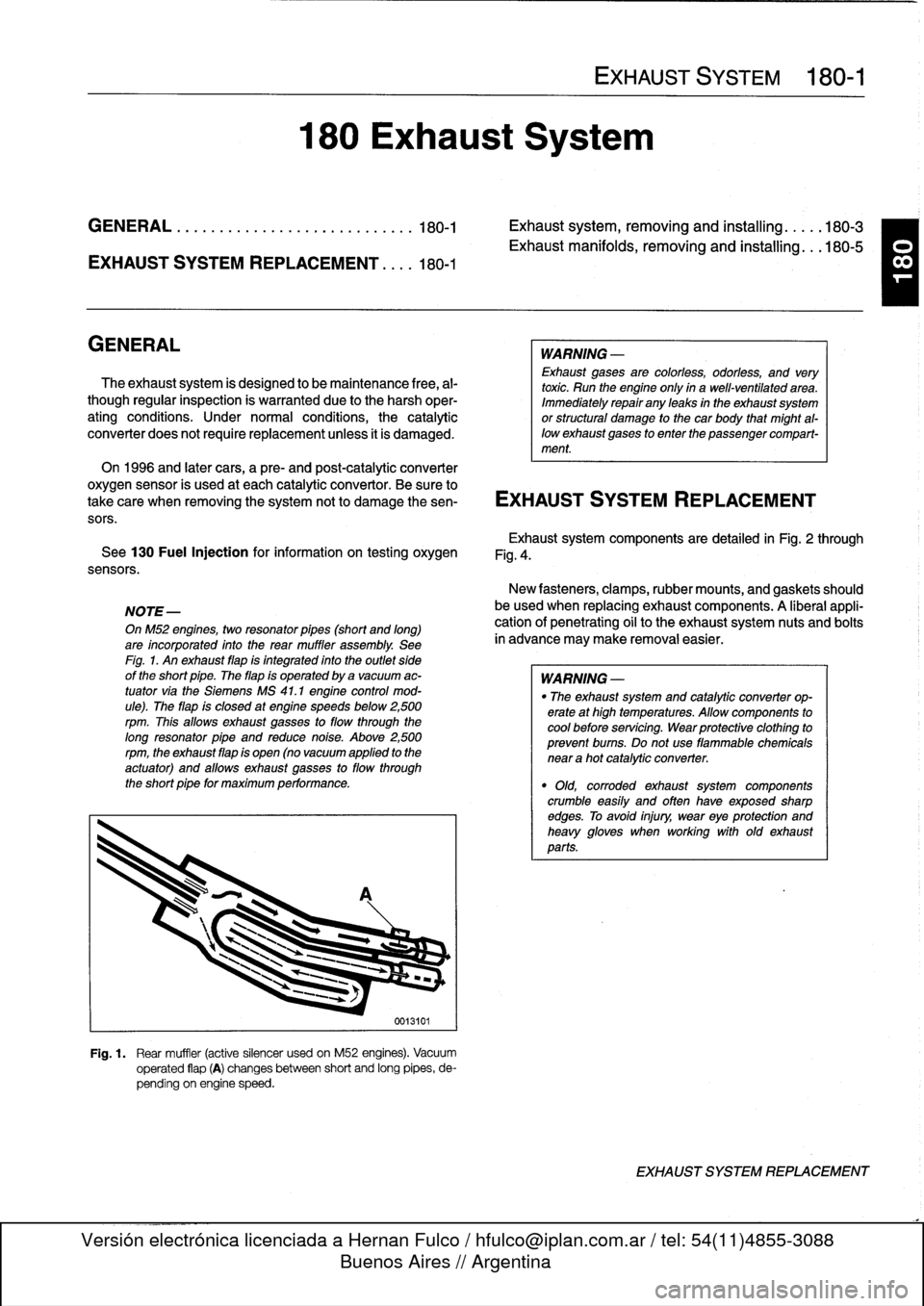
OnM52
engines,
two
resonator
pípes
(short
and
long)
are
incorporated
into
the
rear
muffler
assembly
.
See
Fíg
.
1
.
An
exhaust
flap
is
integrated
into
the
outlet
side
of
the
short
pipe
.
The
flap
is
operated
by
a
vacuum
ac-
tuator
via
the
Siemens
MS
41
.1
engine
control
mod-
ule)
.
The
flap
is
closed
at
engine
speeds
below
2,500
rpm
.
This
allows
exhaust
gasses
to
flow
through
the
long
resonator
pipe
and
reduce
noise
.
Above
2,500rpm,
the
exhaust
flap
is
open
(no
vacuum
applied
to
the
actuator)
and
allows
exhaust
gasses
to
flow
through
the
short
pipe
for
maximum
performance
.
180
Exhaust
System
0013101
Fig
.
1
.
Rear
muffler
(active
silencer
usedon
M52
engines)
.
Vacuum
operated
flap
(A)
changesbetween
short
and
long
pipes,
de-
pending
on
engine
speed
.
EXHAUST
SYSTEM
180-1
WARNING
-
Exhaust
gases
are
colorless,
odorless,
and
very
toxic
.
Run
the
engine
only
ín
a
well-ventilated
area
.
Immediately
repair
any
leaks
in
the
exhaust
system
or
structural
damage
to
the
car
body
that
might
al-
lowexhaust
gases
to
enter
the
passenger
compart-
ment
.
Exhaustsystem
components
are
detailed
in
Fig
.
2
through
Fig
.
4
.
New
fasteners,
clamps,rubber
mounts,
and
gaskets
should
be
used
when
replacing
exhaust
components
.
A
liberal
appli-
cationof
penetrating
oil
to
the
exhaustsystem
nuts
and
bolts
in
advance
may
make
removal
easier
.
WARNING
-
"
The
exhaust
system
and
catalytic
converter
op-
erate
at
high
temperatures
.
Allow
components
to
cool
before
servicing
.
Wear
protectíve
clothíng
to
prevent
bums
.
Do
not
use
flammable
chemicals
near
a
hot
catalytic
converter
.
"
Old,
corroded
exhaust
system
components
crumble
easíly
and
often
have
exposed
sharp
edges
.
To
avoid
injury,
wear
eye
protection
and
heavy
gloves
when
working
with
old
exhaust
parts
.
EXHAUST
SYSTEM
REPLACEMENT
T
Page 209 of 759
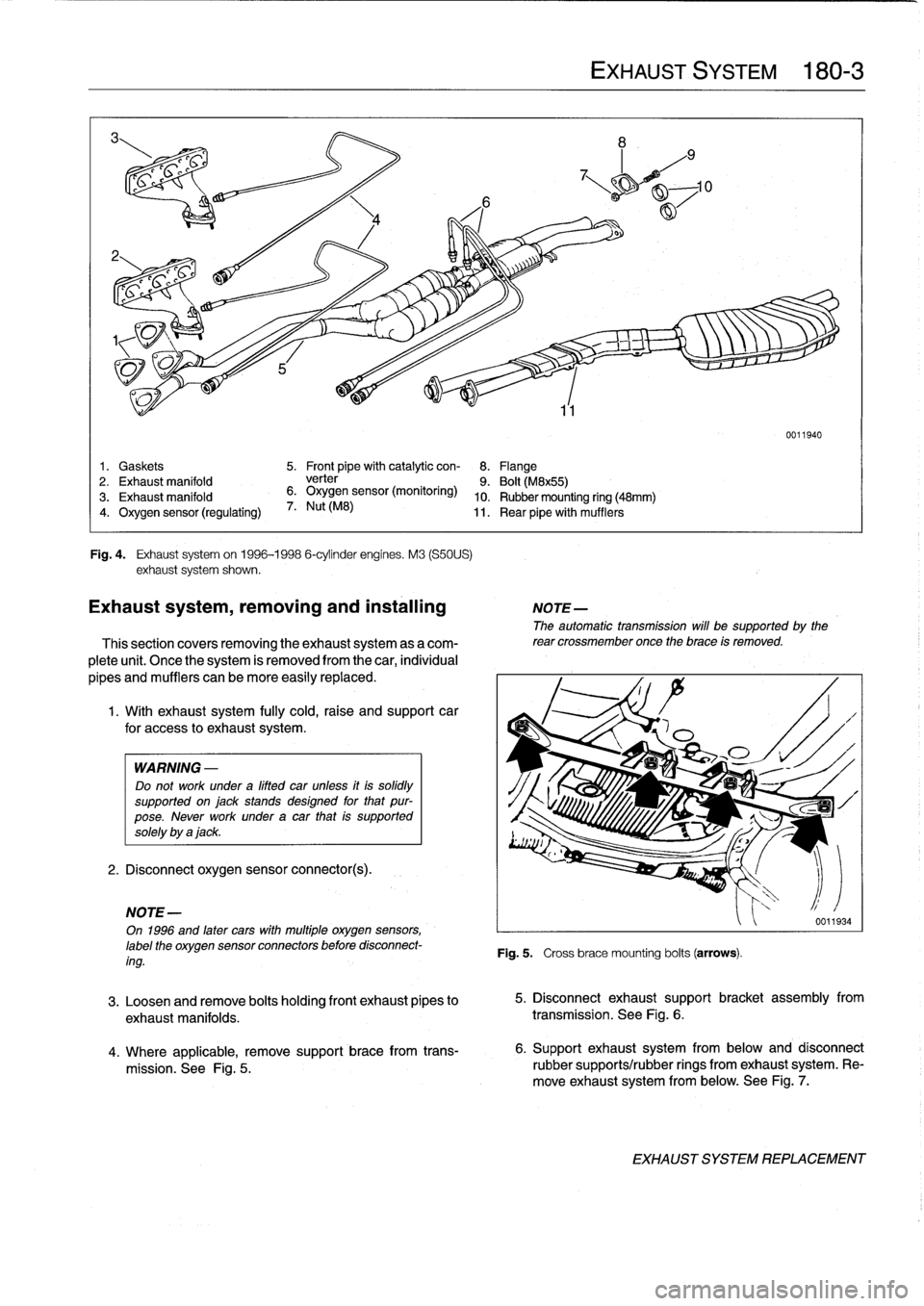
1
.
Gaskets
5
.
Front
pipe
with
catalytic
con-
8
.
Flange
2
.
Exhaust
manifold
verter
9
.
Bolt
(M8x55)
3
.
Exhaust
manifold
6
.
Oxygen
sensor
(monitoring)
10
.
Rubber
mounting
ring
(48mm)
4
.
Oxygen
sensor
(regulating)
7
.
Nut
(M8)
11
.
Rear
pipewith
mufflers
Fig
.
4
.
Exhaust
systemon
1996-1998
6-cylinder
engines
.
M3
(S50US)
exhaust
system
shown
.
Exhaust
system,
removing
and
installing
NOTE-
The
automatic
transmission
will
be
supported
by
the
This
section
covers
removing
the
exhaust
system
as
a
com-
rear
crossmember
once
the
brace
is
removed
.
plete
unit
.
Once
the
system
is
removed
from
the
car,
individual
pipes
and
mufflers
can
be
more
easily
replaced
.
1.
With
exhaust
system
fully
cold,raise
and
support
car
for
access
to
exhaustsystem
.
WARNING
-
Do
not
work
undera
lifted
car
unless
it
is
solidly
supported
on
jack
stands
designed
for
that
pur-
pose
.
Never
work
under
a
car
that
is
supported
solely
by
a
jack
.
2
.
Disconnect
oxygen
sensor
connector(s)
.
NOTE
-
On
1996
and
later
cars
with
multiple
oxygen
sensors,
label
the
oxygen
sensor
connectorsbefore
disconnect-
ing
.
4
.
Where
applicable,
remove
support
brace
from
trans-
mission
.
See
Fig
.
5
.
EXHAUSTSYSTEM
180-
3
3
.
Loosen
andremove
bolts
holding
front
exhaust
pipes
to
exhaust
manifolds
.
transmission
.
See
Fig
.
6
.
0011940
Fig
.
5
.
Crossbracemounting
bolts
(arrows)
.
5
.
Disconnect
exhaust
support
bracket
assembly
from
6
.
Supportexhaustsystem
from
below
and
dísconnect
rubbersupports/rubber
rings
from
exhaust
system
.
Re-
move
exhaust
system
from
below
.
See
Fig
.
7
.
EXHAUST
SYSTEM
REPLACEMENT
Page 214 of 759
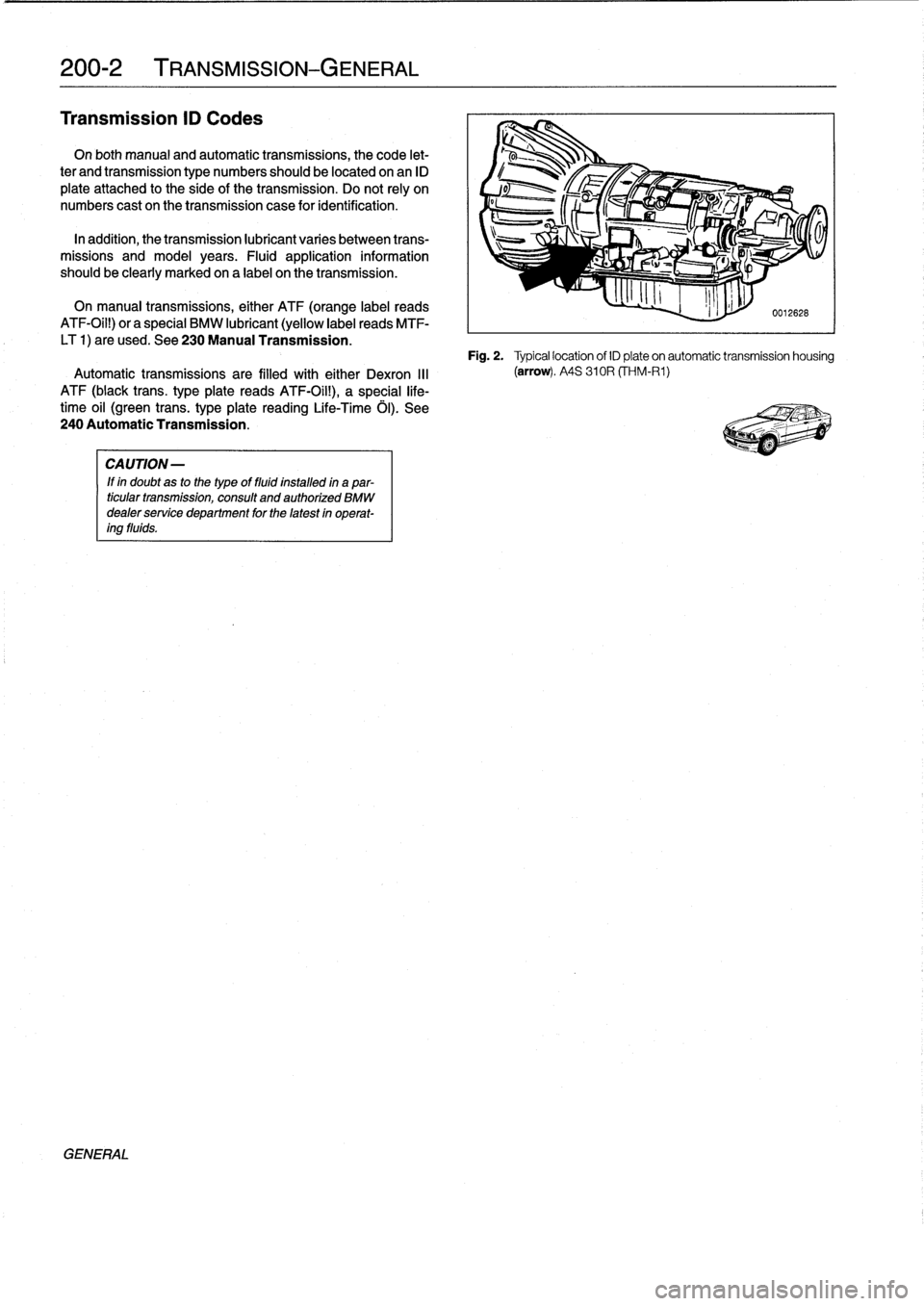
200-2
TRANSMISSION-GENERAL
Transmission
ID
Codes
On
both
manual
and
automatic
transmissions,
the
code
let-
ter
and
transmission
type
numbers
should
be
located
onan
ID
plate
attached
to
the
síde
of
thetransmission
.
Do
not
rely
on
numbers
cast
on
the
transmission
case
for
identification
.
In
addition,
thetransmission
lubricant
varies
between
trans-
missions
and
model
years
.
Fluid
application
information
should
be
clearly
marked
on
a
label
on
thetransmission
.
On
manual
transmissions,
either
ATF
(orange
label
reads
ATF-Oil!)
or
a
special
BMW
lubricant
(yellow
label
reads
MTF-
LT
1)
are
used
.
See
230Manual
Transmission
.
Automatic
transmissions
are
filled
with
either
Dexron
III
ATF
(black
trans
.
type
plate
reads
ATF-Oil!),
a
special
ffe-
time
oil
(green
trans
.
type
plate
reading
Life-Time
ó1)
.
See
240AutomaticTransmission
.
GENERAL
CAUTION-
lf
in
doubtas
to
the
typeof
fluid
installed
in
a
par-
ticular
transmission,
consult
and
authorized
BMW
dealer
service
department
for
the
latest
in
operat-
ing
fluids
.
Fig
.
2
.
Typical
location
of
IDpíate
on
automatic
transmission
housing
(arrow)
.
A4S
310R
(THM-R1)
Page 215 of 759
GENERAL
..
.
.
.
.
.
.
.
.
.
.
.
.
.
......
.
......
210-1
CLUTCH
MECHANICAL
.
.
.
.
.
...
.
.....
.
.
210-3
CLUTCH
HYDRAULICS
.
.
.
.............
210-1
Clutch,
removing
.
.
.
.
.
.
.
.
.
.
.
.
.
.
.
.
...
.
.
.
.
210-4
Clutch,inspecting
and
installing
.
.
.
.
.
.
.
.
.
.
.
.210-5Clutch
hydraulic
system,
Transmission
pilot
bearing,replacing
.
.
.
.
...
210-6
bleeding
and
flushing
.
.
.
.
.
.......
.
.....
210-2
Clutch
master
cylinder,
replacing
..
.
.
.
.
.
...
210-2
Table
Clutch
slave
cylinder,
replacing
...
.
.
.
.
.
.
.
.
210-3
a
.
Clutch
Disc
Diameter
.............
..
..
.
......
210-3
GENERAL
CLUTCH
HYDRAULICS
This
repair
group
covers
replacement
of
the
clutch
mechan-
The
Clutch
is
hydraulically
actuated
by
the
master
and
slave
¡cal
and
hydraulic
components
.
Special
tools
may
be
required
cylinders
.
Clutch
disc
wear
is
automatically
taken
upby
the
for
some
of
the
procedures
.
Read
the
procedure
through
be-
pushrod
travelof
the
slave
cylinder,
making
periodic
adjust-fore
beginning
a
job
.
ments
unnecessary
.
NOTE-
See200
Transmission-General
for
transmission
applicatíon
information
.
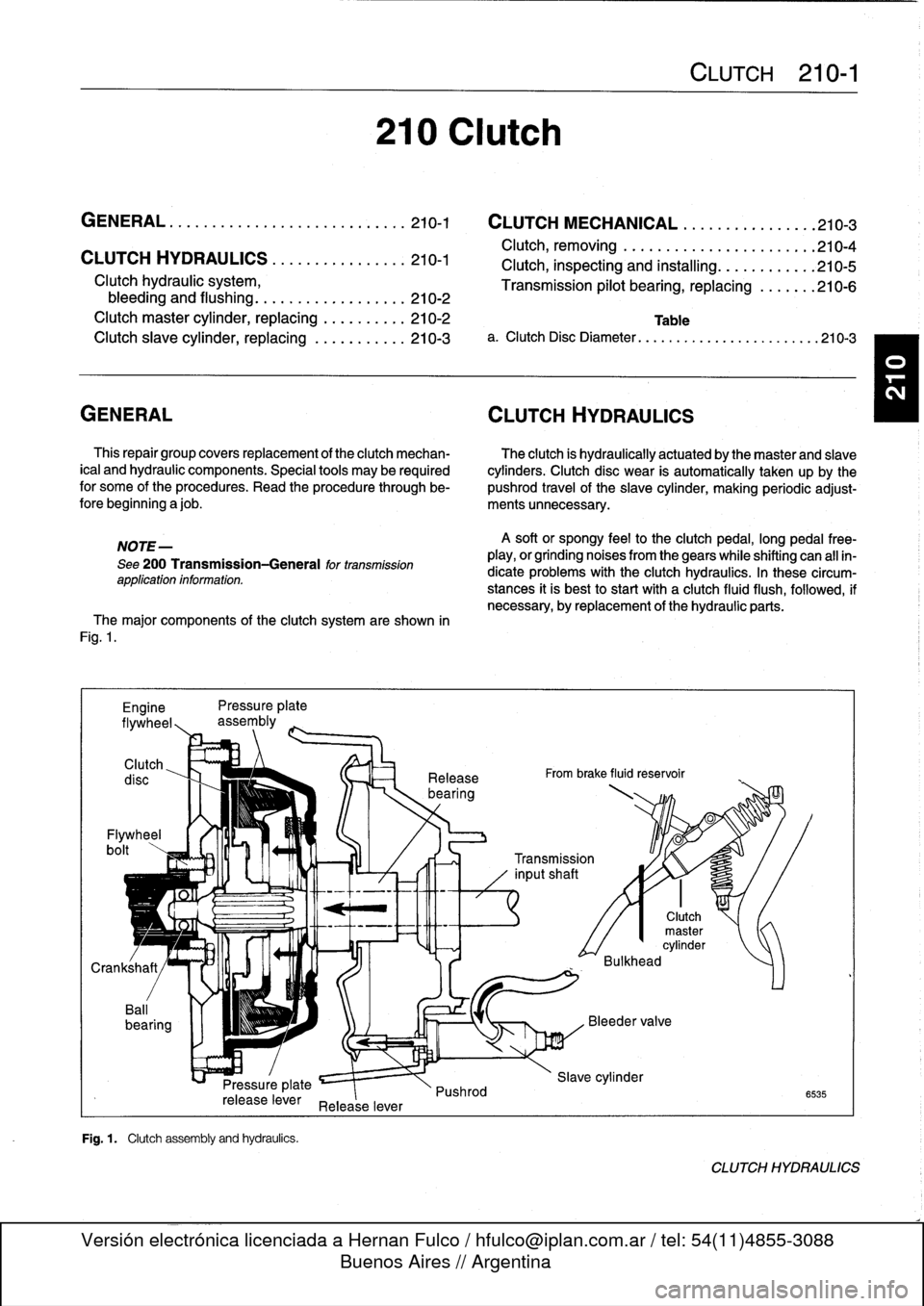
The
major
components
of
the
clutch
system
are
shown
in
Fig
.
1
.
Engine
Pressure
plate
flywheel,,
assembly
Clutch
Flywheel
bolt
Pressure
plate
release
lever
Release
lever
Fig
.
1
.
Clutch
assembly
and
hydraufcs
.
210
Clutch
Release
bearing
Pushrod
A
soft
or
spongy
feel
to
the
clutchpedal,
long
pedal
free-
play,
or
grinding
noises
from
thegears
while
shifting
can
all
in-
dicate
problems
with
the
Clutch
hydraulics
.
In
these
circum-
stances
it
is
best
to
start
with
a
clutch
fluid
flush,
followed,
if
necessary,
byreplacement
of
the
hydraulic
parts
.
From
brake
fluid
reservoir
CLUTCH
210-1
0
0
Transmission
inputshaft
Clutch
master
cylinder
Bulkhead
Slave
cylinder
6535
CLUTCH
HYDRAULICS