Check engine oil BMW 328i 1998 E36 Repair Manual
[x] Cancel search | Manufacturer: BMW, Model Year: 1998, Model line: 328i, Model: BMW 328i 1998 E36Pages: 759
Page 166 of 759
130-20
FUEL
INJECTION
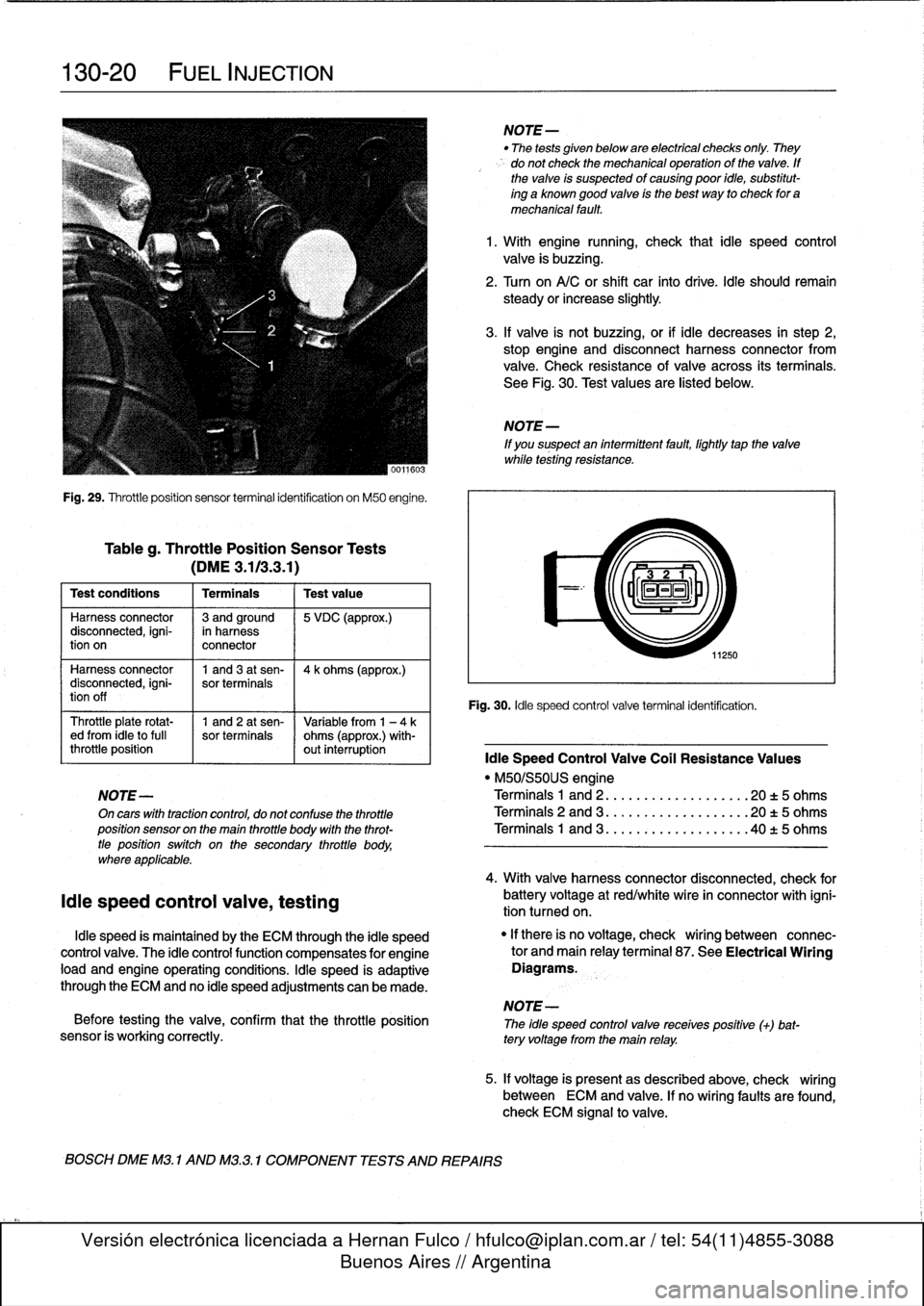
Fig
.
29
.
Throttleposition
sensor
terminal
identification
on
M50
engine
.
Tableg
.
Throttle
Position
Sensor
Tests
(DME3
.113
.3
.1)
Test
conditions
I
Terminals
I
Testvalue
Harness
connector
13
andground
15
VDC
(approx
.)
disconnected,
igni-
in
harness
tion
on
connector
Harness
connector
1
and3
at
sen-
14
k
ohms
(approx
.)
disconnected,
igni-
sor
terminals
tion
off
Throttle
plate
rotat-
1
and
2
at
sen-
Variable
from
1
-
4ked
from
¡dieto
full
sor
terminals
ohms
(approx
.)
with-
throttle
position
out
interruption
¡die
Speed
Control
Valve
Coil
Resistance
Values
"
M50/S50US
engine
NOTE-
Terminals
1
and
2
..
.
................
20
t
5
ohms
On
cars
with
tractioncontrol,
do
not
confuse
the
throttle
Terminals
2
and
3
...................
20
t5
ohms
position
sensor
on
the
main
throttle
body
with
the
throt-
Terminals
1
and
3
..
.
..
:
............
.40
t
5
ohms
tle
positionswitch
on
the
secondary
throttle
body,
where
applicable
.
¡die
speed
control
valve,
testing
¡die
speed
is
maintained
by
the
ECM
through
the
¡die
speed
control
valve
.
The
¡die
controlfunction
compensates
for
engine
load
and
engine
operating
conditions
.
¡die
speed
is
adaptive
through
the
ECM
and
no
¡die
speed
adjustments
can
be
made
.
NOTE-
Before
testing
the
valve,
confirm
that
the
throttle
position
The
idle
speed
controlvalve
receives
positive
(+)
bat-
sensor
is
working
correctly
.
tery
voltage
from
the
main
relay
.
BOSCH
DME
M3
.
1
AND
M3
.3
.1
COMPONENT
TESTS
AND
REPAIRS
NOTE-
"
The
tests
given
below
are
electrical
checks
only
.
They
do
not
check
the
mechanical
operation
of
the
valve
.
If
the
valve
is
suspected
of
causing
poor
idie,
substitut-
ing
a
known
good
valve
is
the
best
way
to
check
for
a
mechanical
fault
.
1
.
With
engine
running,
check
that
¡die
speed
control
valve
is
buzzing
.
2
.
Turn
on
A/C
or
shift
car
finto
drive
.
¡die
should
remain
steady
orincrease
slightly
.
3
.
If
valve
is
not
buzzing,or
if
¡die
decreases
in
step
2,
stop
engine
and
disconnect
harness
connector
from
valve
.
Check
resistance
of
valve
across
its
terminals
.
See
Fig
.
30
.
Test
values
are
listed
below
.
NOTE
-
If
you
suspect
an
intermittent
fault,
lightly
tapthe
valve
while
testing
resistance
.
11250
Fig
.
30
.
¡die
speed
control
valve
terminal
identification
.
4
.
With
valve
harnessconnector
disconnected,
check
for
battery
voltage
at
red/white
wire
in
connector
with
igni-
tion
tumed
on
.
"
If
there
is
no
voltage,
check
wiring
between
connec-
tor
and
main
relayterminal
87
.
See
Electrical
Wiring
Diagrams
.
5
.
If
voltage
is
presentas
described
above,
check
wiring
between
ECM
and
valve
.
If
no
wiring
faults
are
found,
check
ECM
signal
to
valve
.
Page 168 of 759
130-
2
2
FUEL
INJECTION
Mass
air
flow
sensor,
replacing
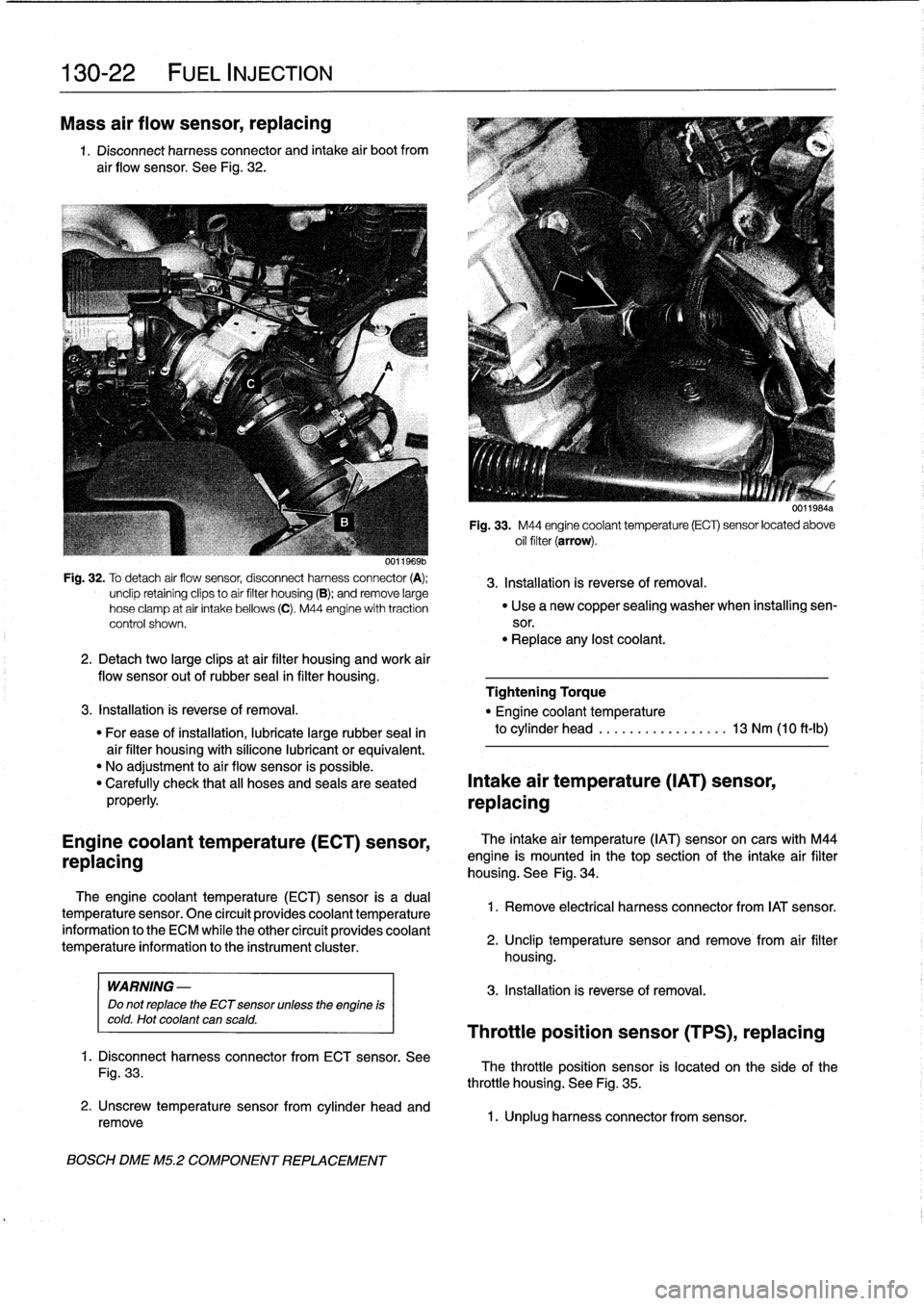
1
.
Disconnect
harness
connector
and
intake
air
bootfrom
air
flow
sensor
.
See
Fig
.
32
.
Fig
.
32
.
To
detach
air
flow
sensor,
disconnect
harness
connector
(A)
;
3
.
Installation
is
reverse
of
removal
.
unclip
retainíng
clips
to
aír
filter
housing
(B)
;
andremove
large
hose
clamp
at
air
intake
bellows
(C)
.
M44
engine
with
traction
"
Use
a
new
copper
sealing
washer
when
installing
sen-
control
shown
.
sor
.
"
Replace
any
lost
coolant
.
2
.
Detachtwo
large
clipsat
air
filter
housing
and
work
air
flow
sensor
out
of
rubber
seal
in
filter
housing
.
Tightening
Torque
3
.
Installation
is
reverse
of
removal
.
"
Engine
coolant
temperature
"
For
ease
of
installation,
lubricate
large
rubber
seal
in
to
cylinder
head
.............
.
..
.
13
Nm
(10
ft-Ib)
air
filter
housing
with
silicone
lubricant
or
equivalent
.
"
No
adjustment
to
air
flow
sensor
is
possible
.
"
Carefully
check
that
all
hoses
and
seals
are
seated
Intake
air
temperature
(IAT)
sensor,
properly
.
replacing
Engine
coolant
temperature
(ECT)
sensor,
replacing
The
engine
coolant
temperature
(ECT)sensor
is
a
dual
temperature
sensor
.
One
circuít
provides
coolant
temperature
information
to
the
ECM
while
the
other
circuít
provides
coolant
temperature
information
to
the
instrument
cluster
.
WARNING
-
Do
not
replace
the
ECT
sensor
unless
the
engine
is
cold
.
Hot
coolant
can
scald
.
1
.
Disconnect
harness
connector
from
ECT
sensor
.
See
Fig
.
33
.
2
.
Unscrew
temperature
sensorfrom
cylinder
head
and
remove
BOSCH
DME
M5
.2
COMPONENT
REPLACEMENT
U1111
bis4a
Fig
.
33
.
M44
engine
coolant
temperature
(ECT)
sensor
located
above
oil
filter
(arrow)
.
The
intake
air
temperature
(IAT)
sensoron
cars
with
M44
engine
is
mounted
in
thetop
section
of
the
intake
air
filter
housing
.
See
Fig
.
34
.
1
.
Remove
electrical
harness
connector
from
IAT
sensor
.
2
.
Unclip
temperature
sensor
and
remove
from
air
filter
housing
.
3
.
Installation
is
reverse
of
removal
.
Throttle
position
sensor
(TPS),
replacing
The
throttle
position
sensor
is
located
on
the
side
of
the
throttle
housing
.
See
Fig
.
35
.
1
.
Unplug
harness
connector
from
sensor
.
Page 174 of 759
130-
2
8
FUEL
INJECTION
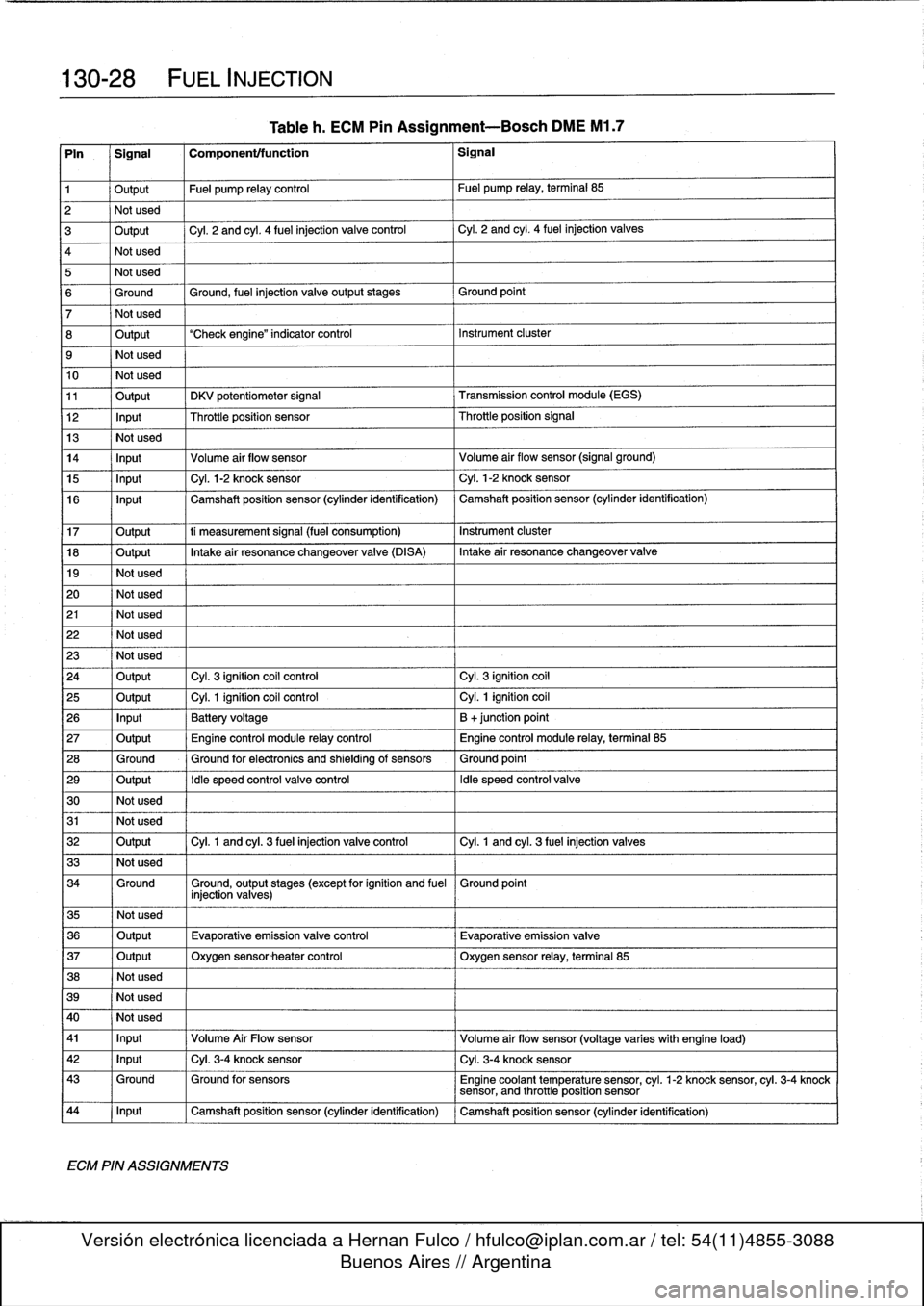
Tableh
.
ECM
Pin
Assignment-Bosch
DME
M1
.7
Pin
Signal
Componenttfunction
Signal
1
Output
Fuel
pump
relay
control
Fuel
pump
relay,
terminal
85
2
Not
used
3
Output
Cyl
.
2
and
cyl
.
4
fuel
injection
valve
control
Cyl
.
2
and
cyl
.
4
fuel
injection
valves
4
Not
used
5
Not
used
6
Ground
Ground,
fuel
injection
valveoutputstages
Ground
point
7
Not
used
8
Output
"Check
engine"
indicator
control
Instrument
cluster
9
Not
used
10
Not
used
11
Output
DKV
potentiometer
signal
Transmission
control
module
(EGS)
12
Input
Throttleposition
sensor
Throttleposition
Signal
13
Not
used
14
Input
Volume
air
flow
sensor
Volume
air
flow
sensor
(signal
ground)
15
Input
Cyl
.
1-2
knock
sensor
Cyl
.
1-2
knock
sensor
16
Input
Camshaft
position
sensor
(cylinder
identification)
Camshaft
position
sensor
(cylinder
identification)
17
Output
ti
measurement
signal
(fuel
consumption)
Instrument
cluster
18
Output
Intakeair
resonance
changeover
valve
(DISA)
Intake
air
resonance
changeover
valve
19
-
Not
used
20
Not
used
21
Not
used
22
Not
used
23
Not
used
24
Output
Cyl
.
3
ignition
coil
control
Cyl
.
3
ignition
coil
25
Output
Cyl
.
1
ignition
coil
control
Cyl
.
1
ignition
coil
26
Input
Battery
voltage
B
+junction
point
27
Output
Engine
control
module
relay
control
Engine
control
module
relay,
terminal
85
28
Ground
Ground
for
electronics
and
shielding
of
sensors
Ground
point
29
Output
Idle
speed
control
valve
control
Idle
speed
control
valve
30
Not
used
31
Not
used
32
Output
Cyl
.
1
and
cyl
.
3
fuel
injection
valve
control
Cyl
.
1
and
cyl
.
3
fuel
injection
valves
33
Not
used
34
Ground
Ground,
output
stages
(except
for
ignition
and
fuel
Ground
point
injection
valves)
35
Not
used
36
Output
Evaporative
emissionvalve
control
Evaporative
emission
valve
37
Output
Oxygen
sensor
heater
control
Oxygen
sensor
relay,
terminal
85
38
Not
used
39
Not
used
40
I
Not
used
41
I
Input
,
Volume
Air
Flow
sensor
Volume
air
flow
sensor
(voltage
varies
with
engine
load)
42
1
Input
1
Cyl
.
3-4
knock
sensor
1
Cyl
.
3-4
knock
sensor
43
Ground
Ground
for
sensors
Engine
coolant
temperature
sensor,
cyl
.
1-2
knock
sensor,
cyl
.
3-4
knock
sensor,
and
throttle
position
sensor
44
1
Input
1
Camshaft
position
sensor
(cylinder
identification)
1
Camshaft
position
sensor
(cylinder
identification)
ECM
PIN
ASSIGNMENTS
Page 176 of 759
130-
3
0
FUEL
INJECTION
Pin
Signal
Component/function
Signal
ECM
PIN
ASSIGNMENTS
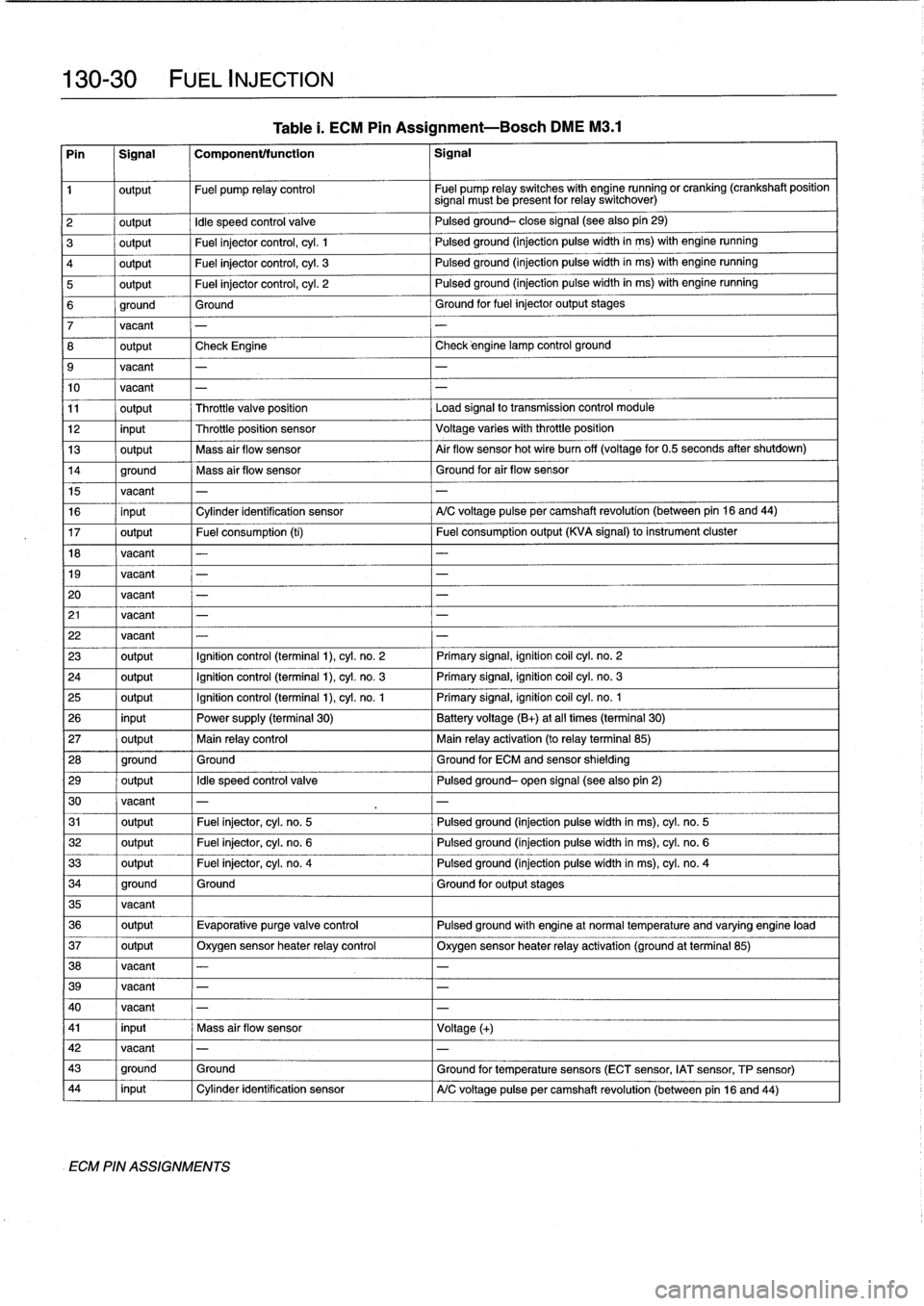
Table
1.
ECM
Pin
Assignment-Bosch
DME
M3
.1
1
output
Fuel
pump
relay
control
Fuel
pump
relay
switches
with
engine
runningor
cranking
(crankshaft
position
Signal
mustbe
present
for
relay
switchover)
2
1
output
1
Idle
speed
control
valve
1
Pulsad
ground-
close
signal
(seealsopin29)
3
output
Fuel
injectorcontrol,
cyl
.
1
Pulsedground
(injection
pulsewidth
in
ms)
with
engine
running
4
output
Fuel
injectorcontrol,
cyl
.
3
Pulsedground
(injection
pulsewidth
in
ms)
with
engine
running
5
output
Fuel
injector
control,
cyl
.
2
Pulsedground
(injection
pulse
width
in
ms)
with
enginerunning
6
ground
Ground
Ground
for
fuel
injector
output
stages
7
vacant
-
-
8
output
Check
Engine
Check
éngine
lamp
control
ground
9
vacant
-
-
10
vacant
-
-
11
output
Throttle
valve
position
Load
signal
to
transmission
control
module
12
input
Throttle
position
sensor
Voltage
varies
with
throttle
position
13
output
Mass
air
flow
sensor
Air
flow
sensor
hotwire
burn
off
(voltage
for
0
.5
seconds
after
shutdown)
14
ground
Mass
air
flow
sensor
Ground
for
air
flow
sensor
15
vacant
-
-
16
input
Cylinder
identification
sensor
A/C
voltage
pulse
per
camshaft
revolution
(between
pin
16
and
44)
17
output
Fuel
consumption
(ti)
Fuel
consumption
output
(KVA
Signal)
to
instrument
cluster
18
vacant
-
-
19
vacant
-
-
20
vacant
-
-
21vacant
-
-
22
vacant
-
-
23
output
Ignition
control
(terminal
1),
cyl
.
no
.
2
Primary
Signal,
ignition
coil
cyl
.
no
.
2
24
output
Ignition
control
(terminal
1),
cyl
.
n
o
.
3
Primary
signal,
ignition
coil
cyl
.
no
.
3
25
output
Ignition
control
(terminal
1),
cyl
.
n
o
.
1
Primary
signal,
ignitioh
coil
cyl
.
no
.
1
26
input
Power
supply
(terminal
30)
Battery
voltage
(B+)
at
al¡
times
(terminal
30)
27
output
Main
relay
control
Main
relay
activation
(to
relay
terminal
85)
28
ground
Ground
Ground
for
ECM
and
sensor
shielding
29
output
Idle
speed
control
valve
Pulsed
ground-
open
signal
(see
also
pin
2)
30
vacant
-
-
31
output
Fuel
injector,cyl
.
no
.
5
Pulsedground
(injection
pulsewidth
in
ms),
cyl
.
no
.
5
32
output
Fuel
injector,cyl
.
no
.
6
Pulsedground
(injection
pulse
width
in
ms),
cyl
.
no
.
6
33
output
Fuel
injector,cyl
.
no
.
4
Pulsedground
(injection
pulsewidth
in
ms),
cyl
.
no
.
4
34
ground
Ground
Ground
for
output
stages
35
vacant
36
output
Evaporative
purgevalve
control
Pulsed
ground
with
engine
at
normal
temperature
and
varying
engine
load
37
output
Oxygen
sensor
heater
relay
control
Oxygen
sensor
heater
relayactivation
(ground
at
terminal
85)
38
vacant
-
-
39
vacant
-
-
40
vacant
-
41
input
Mass
air
flow
sensor
Voltage
(+)
42
vacant
-
-
43
ground
Ground
Ground
for
temperatura
sensors
(ECT
sensor,
IAT
sensor,
TP
sensor)
44
input
Cylinder
identification
sensor
A/C
voltagepulseper
camshaft
revolution
(between
pin
16
and
44)
Page 178 of 759
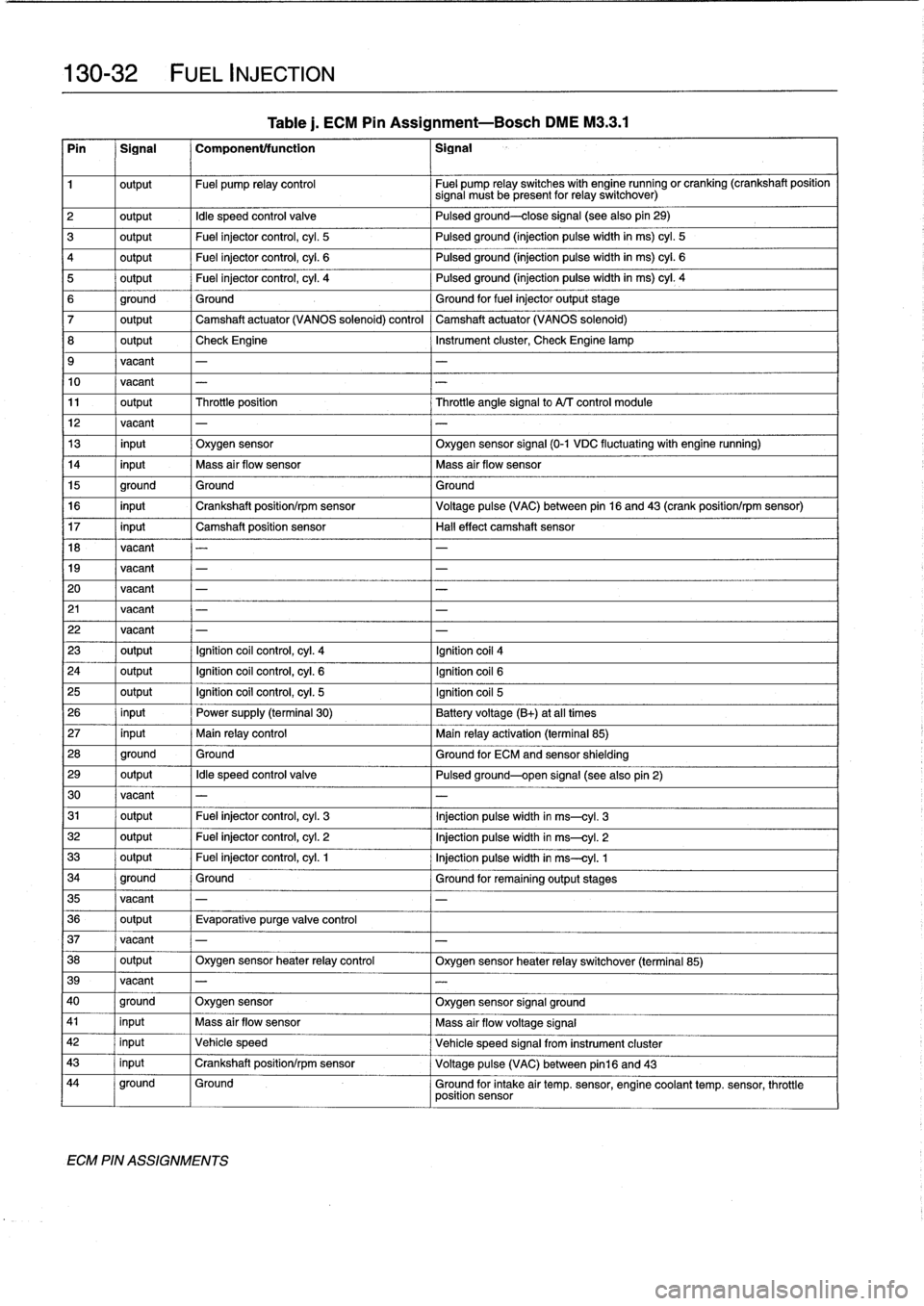
130-
3
2
FUEL
INJECTION
Pin
1
Signal
1
Component/function
1
Signal
1
output
Fuel
pump
relay
control
Fuel
pump
relay
switches
with
engine
running
or
cranking
(crankshaft
position
signal
must
be
present
for
relay
switchover)
2
output
Idle
speed
control
valve
Pulsed
ground-close
signal
(seealso
pin
29)
3
output
Fuel
ínjectorcontrol,
cyl
.
5
Pulsed
ground
(injection
pulsewidth
in
ms)
cyl
.
5
4
output
Fuel
injectorcontrol,
cyl
.
6
Pulsed
ground
(injection
pulsewidth
in
ms)
cyl
.
6
5
output
Fuel
injectorcontrol,
cyl
.
4
Pulsed
ground
(injection
pulsewidth
in
ms)
cyl
.
4
6
ground
Ground
Ground
for
fuel
injector
output
stage
7
output
Camshaft
actuator
(VANOS
solenoid)
control
Camshaft
actuator
(VANOS
solenoid)
8
output
Check
Engine
Instrument
cluster,
Check
Engine
lamp
9
vacant
-
-
10
vacant
-
-
11
output
Throttle
position
Throttle
angle
signal
to
A/T
control
module
12
vacant
-
-
13
input
Oxygen
sensor
Oxygen
sensor
signal
(0-1
VDC
fluctuating
with
engine
running)
14
input
Mass
air
flow
sensor
Mass
air
flow
sensor
15
ground
Ground
Ground
16
input
Crankshaft
position/rpm
sensor
Voltage
pulse
(VAC)
between
pin
16
and
43
(crank
position/rpm
sensor)
17
input
Camshaft
position
sensor
Halleffect
camshaft
sensor
18
vacant
-
-
19
vacant
-
-
20
vacant
-
-
21
vacant
-
-
22
vacant
-
-
23
output
Ignition
coil
control,
cyl
.
4
Ignition
coil
4
24
output
Ignition
coil
control,
cyl
.
6
Ignition
coil
6
25
output
Ignition
coil
control,
cyl
.
5
Ignition
coil
5
26
input
Power
supply
(terminal
30)
Battery
voltage(B+)
at
all
times
27
input
Main
relay
control
Main
relayactivation
(terminal
85)
28
ground
Ground
Ground
for
ECM
and
sensor
shielding
29
output
Idle
speed
control
valve
Pulsed
ground-open
signal
(seealsopin
2)
30
vacant
-
-
31
output
Fuel
injectorcontrol,
cyl
.
3
Injection
pulse
wicith
in
ms-cyl
.
3
32
output
Fuel
injectorcontrol,
cyl
.
2
Injection
pulse
wicith
in
ms-cyl
.
2
33
output
Fuel
injectorcontrol,
cyl
.
1
Injection
pulsewidth
in
ms-cyl
.
1
34
ground
Ground
Ground
for
remaining
output
stages
35
vacant
-
-
36
output
Evaporative
purge
valve
control
37
vacant
-
-
38
output
Oxygen
sensor
heater
relay
control
Oxygen
sensor
heater
relay
switchover
(terminal
85)
39
vacant
-
-
40
ground
Oxygen
sensor
Oxygen
sensor
signal
ground
41
input
Mass
air
flow
sensor
Mass
air
flow
voltage
signal
42
input
Vehicle
speed
Vehicle
speed
signal
from
instrument
cluster
43
input
Crankshaft
position/rpm
sensor
Voltage
pulse
(VAC)
between
pin16
and
43
44
ground
Ground
Ground
for
intake
air
temp
.
sensor,
engine
coolant
temp
.
sensor,
throttle
position
sensor
ECM
PIN
ASSIGNMENTS
Table
j
.
ECM
Pin
Assignment-Bosch
DME
M3
.3
.1
Page 180 of 759
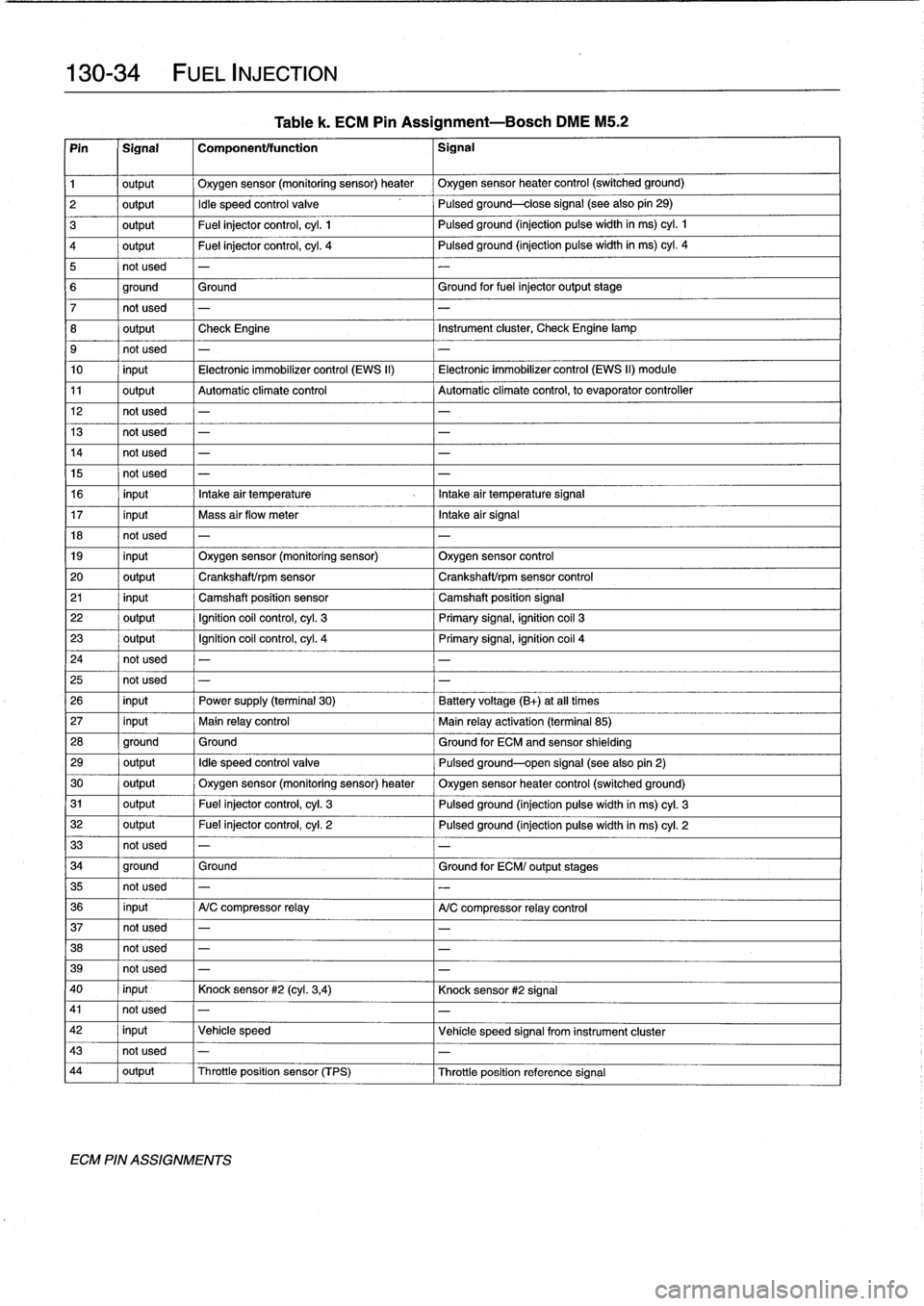
130-
34
FUEL
INJECTION
Pin
i
Signal
1
Component/function
1
Signal
1
output
Oxygen
sensor
(monitoring
sensor)heater
Oxygen
sensor
heater
control
(switched
ground)
2
output
Idle
speed
control
valve
Pulsed
ground-close
signal
(see
also
pin
29)
3
output
Fuel
injector
control,
cyl
.
1
Pulsed
ground
(injection
pulsewidth
in
ms)
cyl
.
1
4
output
Fuel
injector
control,
cyl
.
4
Pulsed
ground
(injection
pulse
width
in
ms)
cyl
.
4
5
not
used
-
-
6
ground
Ground
Ground
for
fuel
injector
output
stage
7
not
used
-
8
1
output
1
Check
Engine
1
Instrument
cluster,
Check
Engine
lamp
9
not
used
-
-
10
input
Electronic
immobilizer
control
(EWS
II)
Electronic
immobilizer
control
(EWS
II)
module
11
output
Automatic
climate
control
Automatic
climate
control,
to
evaporator
controlier
12
not
used
-
-
13
not
used
-
-
14
not
used
-
-
15
not
used
-
-
16
input
Intake
air
temperature
Intake
air
temperature
Signal
17
input
Mass
air
flow
meter
Intake
air
signal
18
not
used
-
-
19
input
Oxygen
sensor
(monitoring
sensor)
Oxygen
sensor
control
20
output
Crankshaft/rpm
sensor
Crankshaft/rpm
sensor
control
21
input
Camshaft
position
sensor
Camshaft
position
signal
22
output
Ignition
coil
control,
cyl
.
3
Primary
signal,
ignitioncoil
3
23
output
Ignition
coil
control,
cyl
.
4
Primary
signal,
ignitioncoil
4
24
not
used
-
-
25
not
used
-
-
26
input
Power
supply
(terminal
30)
Battery
voltage
(B+)
at
al¡
times
27
input
Main
relay
control
Main
relay
activation
(terminal
85)
28
ground
Ground
Ground
for
ECM
and
sensor
shielding
29
output
Idle
speed
control
valve
Pulsed
ground-open
signal
(seealsopin
2)
30
output
Oxygen
sensor
(monitoring
sensor)
heater
Oxygen
sensor
heater
control
(switched
ground)
31
output
Fuel
injectorcontrol,
cyl
.
3
Pulsed
ground
(injection
pulsewidth
in
ms)
cyl
.
3
32
output
Fuel
injector
control,
cyl
.
2
Pulsed
ground
(injection
pulsewidth
in
ms)
cyl
.
2
33
I
not
used
40
input
Knock
sensor
#2
(cyl
.
3,4)
Knock
sensor
#2
signal
41
not
used
-
-
42
input
Vehicle
speed
Vehicle
speed
signal
from
instrument
cluster
43
not
used
-
-
44
output
Throttleposition
sensor
(TPS)
Throttleposition
reference
signal
ECM
PIN
ASSIGNMENTS
Table
k
.
ECM
Pin
Assignment-Bosch
DME
M5
.2
34
ground
Ground
Ground
for
ECM/
output
stages
35
not
used
-
-
36
input
A/C
compressor
relay
A/C
compressor
relay
control
37
not
used
-
-
38
not
used
-
-
39
not
used
-
-
Page 196 of 759
170-2
RADIATOR
AND
COOLING
SYSTEM
Cooling
Fans
TROUBLESHOOTING
Belt-driven
coolingfan
.
The
primary
cooling
fan
is
belt-
driven
.
It
is
mounted
to
the
frontof
the
coolant
pump
through
a
fan
clutch
.
The
fan
clutch
is
a
viscous
fluid
coupling
that
con-
trols
the
speed
of
thefan
based
on
engine
compartment
tem-
perature
.
Electric
cooling
fan
.
Models
with
M44
engine
and
stan-
dard
transmission
substitute
an
electric
fan
for
the
belt-driven
viscous
fan
.
This
is
attached
to
the
rear
of
the
radiator
and
controlledvia
the
DME
5
.2
engine
management
system
.
NOTE-
The
electric
cooling
fan
in
these
models
is
activated
by
the
engine
control
module
(ECM)
.
Auxiliary
coolingfan
.
In
al¡
models
a
two-speed
electric
auxiliary
cooling
fan
is
mounted
behind
the
front
grill
and
in
front
of
the
radiator
.
This
fan
is
primarily
used
for
the
A/C
sys-
tem,
but
also
operates
when
the
coolant
temperature
ex-
ceeds
a
predetermined
leve¡
.
Warnings
and
Cautions
The
following
warnings
and
Cautions
should
beobserved
when
working
on
the
cooling
system
.
WARNING
-
"
Atnormal
operating
temperature
the
cooling
sys-
tem
is
pressurized
.
Allow
the
system
to
cool
as
long
as
possible
before
opening-a
minimum
of
an
hour-then
release
the
cap
slowly
to
allow
sale
release
of
pressure
.
"
Releasing
the
cooling
system
pressure
lowers
the
coolants
boiling
point
and
the
coolant
may
boíl
suddenly
.
Use
heavy
gloves
and
wear
eye
and
laceprotection
to
guard
against
scalding
.
"
Use
extreme
care
when
draining
and
disposing
of
engine
coolant
.
Coolant
is
poisonous
and
lethal
to
humans
and
pets
.
Pets
are
attracted
to
coolant
because
of
its
sweet
smell
and
taste
.
Consult
a
veterinarian
immediately
if
coolant
is
ingested
byan
animal
.
CAUTION-
"
Avoidadding
cold
water
to
the
coolant
while
the
engine
is
hot
or
overheated
.
If
it
is
necessary
to
add
coolant
to
ahot
system,
do
so
only
with
the
engine
running
and
coolant
pump
tuming
.
"
Prior
to
disconnecting
the
battery,
read
the
bat-
tery
disconnection
cautions
given
at
the
front
of
this
manual
on
page
viii
.
TROUBLESHOOTING
Most
cooling
system
faults
can
be
grouped
into
one
of
three
categories
:
"
Cooling
system
leaks
"
Poor
coolant
circulation
"
Radiator
cooling
fan
faults
When
investigating
the
cause
of
overheating
or
coolant
loss,
begin
with
a
visual
inspection
.
Be
sure
to
check
the
con-
dition
and
tension
of
the
coolant
pump
drive
belt
.
Check
hoses
for
cracks
or
softness
.
Check
clamps
for
looseness
.
Check
the
coolant
leve¡
and
check
for
evidence
of
coolantleaks
from
the
engine
.
Check
that
the
radiator
fins
are
not
blocked
with
dirt
or
de-
bris
.
Clean
the
radiator
using
low-pressure
water
or
com-
pressed
air
.
Blow
outward,
fromthe
engine
side
out
.
Inspect
the
coolant
pump
by
first
removing
the
drive
belt
from
the
pump
.
Firmly
grasp
opposite
sídes
of
the
pulley
and
check
for
play
in
all
directions
.
Spin
the
pulley
and
check
that
the
shaft
runs
smoothly
.
NOTE-
The
coolant
provides
lubrication
for
the
pump
shaft,
soan
occasional
drop
of
coolant
leaking
from
the
pump
is
acceptable
.
If
coolant
drips
steadily
from
the
vent
hole,
the
pump
should
be
replaced
.
The
cooling
system
becomes
pressurized
at
normal
operat-
ing
temperature,
which
raises
the
boiling
point
of
the
coolant
.
Leaks
may
prevent
the
system
from
becoming
pressurized,
allowing
the
coolant
to
boil
at
a
lower
temperature
.
If
visual
ev-
idence
is
inconclusive,
a
cooling
system
pressure
test
can
help
to
pinpointhard-to-find
leaks
.
If
the
cooling
system
is
full
of
coolant
and
holds
pressure,
the
next
most
probable
cause
of
overheating
are
:
"
Faulty
radiator
fan
"
Loose
or
worn
drive
belt
"
Failed
thermostat
or
coolant
pump
"
Clogged/plugged
radiator
or
coolant
passages
.
NOTE
-
"
Some
early
style
coolant
pumps
were
fitted
wíth
fi-
berlplastic
type
impellers
.
Over
time,
this
impeller
can
wear
away
and
result
in
overheating
.
The
plastic
im-
peller
can
also
slip
or
free-wheel
on
the
pump
shaft
.
If
the
engine
overheats
and
no
other
faults
canbe
found,
theold
style
impeller
may
be
the
cause
of
the
problem
.
"
Only
pumps
with
the
updated
metal
impeller
should
be
used
for
replacement
.
Page 198 of 759
170-
4
RADIATOR
AND
COOLING
SYSTEM
A
quick
testat
the
coolant
temperature
gauge
sender
can
The
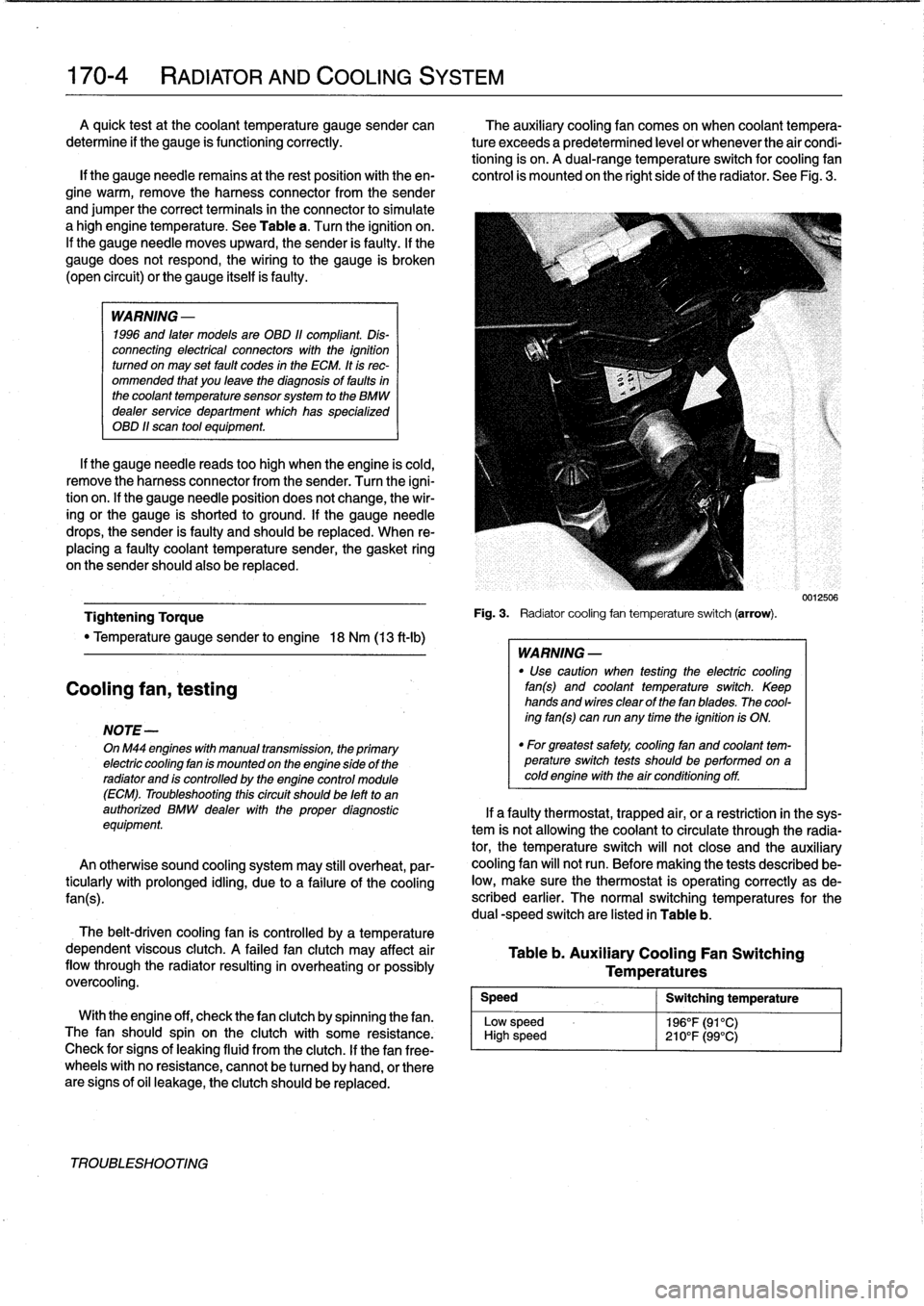
auxiliary
cooling
fan
comes
on
when
coolant
tempera
determine
if
the
gauge
is
functioning
correctly
.
ture
exceeds
a
predetermined
leve¡
or
whenever
the
air
condi-
tioning
is
on
.
A
dual-range
temperature
switch
for
cooling
fan
lf
the
gauge
needie
remains
at
the
rest
position
with
theen-
control
is
mounted
on
the
right
side
of
the
radiator
.
See
Fig
.
3
.
gine
warm,
remove
the
harness
connector
from
the
sender
and
jumper
the
correct
terminals
in
the
connector
to
simulate
a
high
engine
temperature
.
See
Table
a
.
Turn
the
ignition
on
.
If
the
gauge
needle
moves
upward,
the
sender
is
faulty
.
If
the
gauge
does
not
respond,
the
wiring
to
the
gauge
is
broken
(open
circuit)
or
the
gauge
itselfis
faulty
.
WARNING
-
1996
and
laten
models
are
OBD
11
compliant
.
Dis-
connecting
electrical
connectors
wíth
the
ignition
turned
on
may
set
fault
codes
in
the
ECM
.
It
is
rec-
ommended
that
you
leave
the
diagnosis
of
faults
in
the
coolant
temperature
sensorsystem
to
the
BMW
dealer
service
department
which
has
specialized
OBD
11
scan
tool
equipment
.
If
the
gauge
needle
reads
too
high
when
the
engine
is
cold,
remove
the
harness
connector
from
the
sender
.
Turn
the
igni-
tion
on
.
lf
the
gauge
needle
position
does
not
change,
the
wir-
ing
or
the
gauge
is
shorted
to
ground
.
If
the
gauge
needle
drops,
the
sender
is
faulty
and
should
be
replaced
.
When
re-
placing
a
faulty
coolant
temperature
sender,
the
gasket
ring
on
the
sender
should
also
be
replaced
.
Tightening
Torque
"
Temperature
gauge
sender
to
engine
18
Nm
(13
ft-Ib)
Cooling
fan,
testing
NOTE-
OnM44
engines
with
manual
transmission,
the
primary
electric
cooling
fan
is
mounted
on
the
engine
side
of
the
radiator
and
is
controlled
by
the
engine
control
module
(ECM)
.
Troubleshooting
thiscircuit
should
be
left
to
an
authorized
BMW
dealer
with
the
proper
diagnostic
equipment
An
otherwise
sound
cooling
system
may
still
overheat,
par-
ticularly
with
prolonged
idling,
due
to
a
failure
of
the
coolíng
fan(s)
.
The
belt-driven
cooling
fan
is
controlled
by
a
temperature
dependent
viscous
clutch
.
A
failed
fan
clutch
may
affect
air
flow
through
the
radiator
resulting
in
overheating
orpossibly
overcooling
.
Speed
Low
sp
High
s
With
the
engine
off,
check
thefan
clutch
by
spinning
thefan
.
eed
The
fan
should
spin
on
the
clutch
with
some
resistance
.
peed
Check
for
signs
of
leaking
fluid
from
the
clutch
.
If
thefan
free-
wheels
with
no
resistance,
cannot
be
tu
rned
by
hand,
or
there
are
signs
of
oil
leakage,
the
clutch
should
be
replaced
.
TROUBLESHOOTING
Fig
.
3
.
Radiatorcooling
fan
temperature
switch
(arrow)
.
WARNING
-
"
Use
caution
when
testing
the
electric
cooling
fan(s)
and
coolant
temperature
switch
.
Keep
hands
and
wires
clear
of
thefan
blades
.
The
cool-
ing
fan(s)
can
run
any
time
the
ignition
is
ON
.
"
For
greatest
safety,
coolíng
fan
and
coolant
tem-perature
switch
tests
shouldbe
performed
on
acoldengine
with
the
air
conditioning
off
.
Table
b
.
Auxiliary
Cooling
Fan
Switching
Temperatures
Switching
temperature
196°F(91°C)
210°F(99°C)
0012506
If
a
faulty
thermostat,
trapped
air,
or
a
restriction
in
the
sys-
tem
is
not
allowing
the
coolant
to
circulate
through
the
radia-
tor,
the
temperature
switch
will
not
close
and
the
auxiliary
cooling
fan
will
not
run
.
Before
making
the
tests
described
be-
low,
make
sure
the
thermostat
is
operating
correctly
as
de-
scribed
earlier
.
The
normal
switching
temperatures
for
the
dual
-speed
switch
are
listed
in
Table
b
.
Page 217 of 759
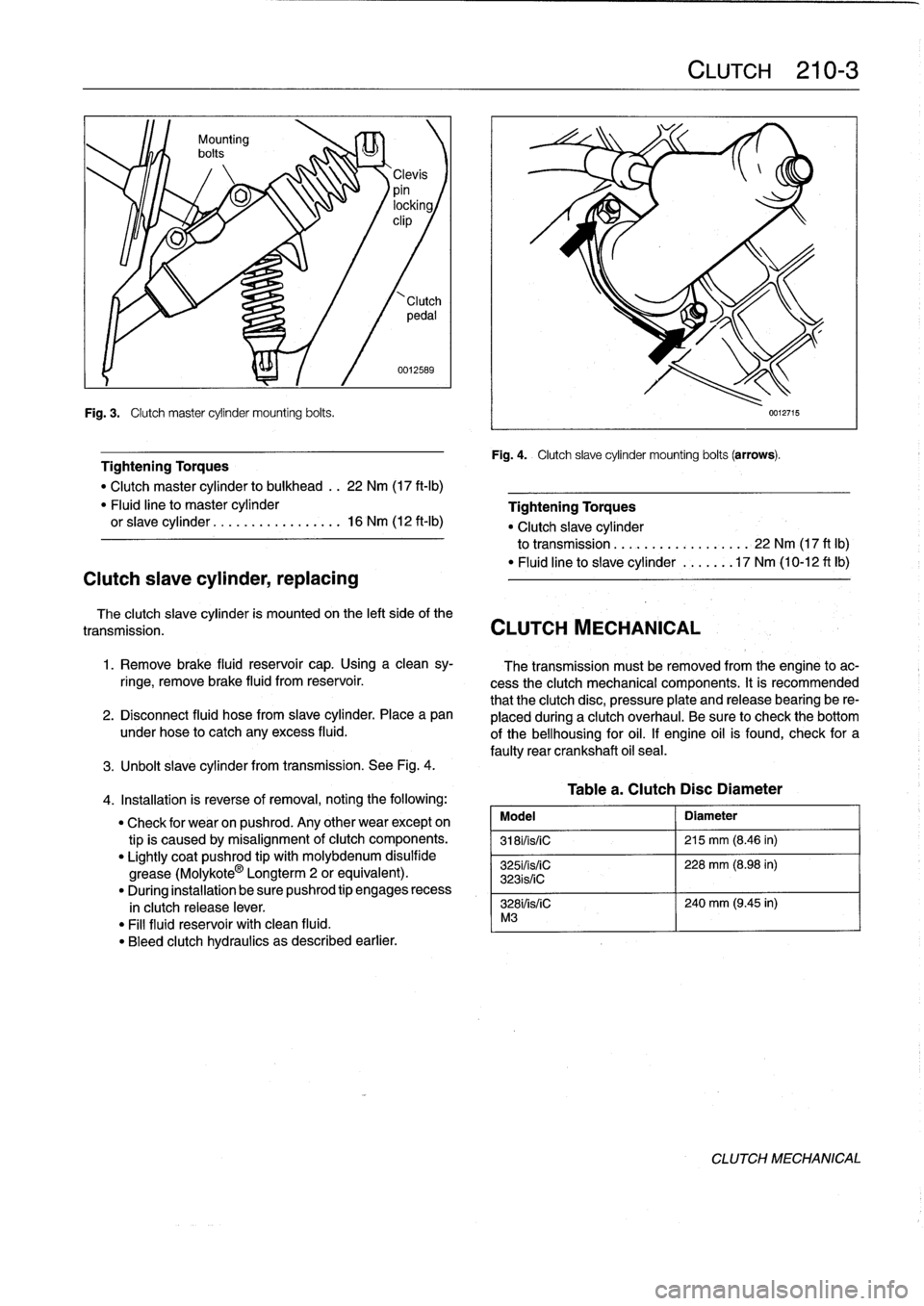
Fig
.
3
.
Clutch
master
cylinder
mounting
bolts
.
Clutch
slave
cylinder,
replacing
0012589
Tightening
Torques
"
Clutch
master
cylinder
to
bulkhead
..
22
Nm
(17
ft-Ib)
"
Fluid
line
to
master
cylinder
orslave
cylinder
.................
16
Nm
(12
ft-1b)
The
clutch
slave
cylinder
is
mounted
on
the
left
side
of
the
transmission
.
CLUTCH
MECHANICAL
1
.
Remove
brake
fluid
reservoir
cap
.
Using
a
clean
sy-
ringe,
remove
brake
fluid
from
reservoir
.
2
.
Disconnect
fluid
hose
from
slave
cylinder
.
Place
a
pan
under
hose
to
catch
any
excess
fluid
.
3
.
Unbolt
slave
cylinder
from
transmission
.
See
Fig
.
4
.
4
.
Installation
is
reverse
of
removal,
noting
the
following
:
"
Check
for
wear
on
pushrod
.
Any
other
wear
except
on
tipis
caused
by
misalignment
of
clutch
components
.
"
Lightly
coat
pushrod
tip
with
molybdenum
disulfide
grease
(Molykote
0
Longterm
2
or
equivalent)
.
"
During
installation
be
sure
pushrod
tip
engages
recess
in
clutch
release
lever
.
"
Fill
fluid
reservoir
with
clean
fluid
.
"
Bleed
clutch
hydraulics
as
described
earlier
.
CLUTCH
210-
3
Fig
.
4
.
Clutch
slave
cylinder
mounting
bolts
(arrows)
.
Tablea
.
ClutchDisc
Diameter
Model
Diameter
3181/is/iC
215
mm
(8
.46
in)
325i/is/iC
228
mm
(8
.98
in)
323is/iC
328i/is/iC
240
mm
(9
.45
in)
M3
0012715
Tightening
Torques
"
Clutch
slave
cylinder
to
transmission
.
.
................
22
Nm
(17
ft
lb)
"
Fluid
line
to
slave
cylinder
......
.17
Nm
(10-12
ft
lb)
The
transmission
must
be
removed
from
the
engine
to
ac-
cess
the
clutch
mechanical
components
.
It
is
recommended
that
the
clutch
disc,
pressure
plate
and
release
bearing
be
re-
placed
duringa
clutch
overhaul
.
Be
sure
to
check
the
bottom
of
the
bellhousing
for
oil
.
If
engine
oil
is
found,
check
for
a
faulty
rear
crankshaft
oil
seal
.
CLUTCH
MECHANICAL
Page 223 of 759
Selector
shaft
seal,
replacing
(transmission
instalied)
1
.
Raise
and
safely
support
vehicle
to
access
drain
plug
.
2
.
Support
transmission
with
transmission
jack
.
3
.
Remove
driveshaft
.
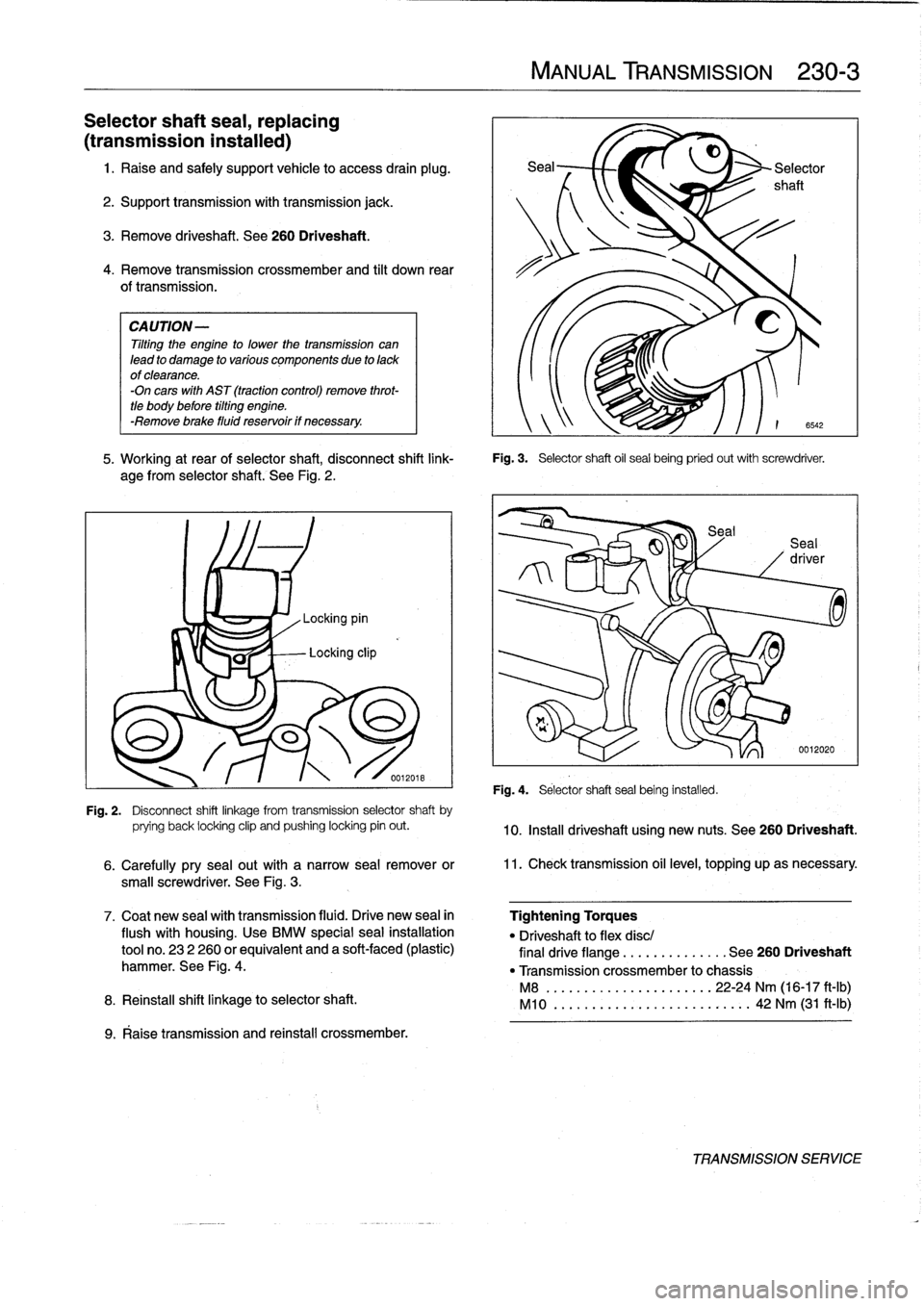
See
260
Driveshaft
.
4
.
Remove
transmission
crossmember
and
tilt
down
rear
of
transmission
.
CA
UTION--
Tilting
the
engine
to
lower
the
transmission
can
lead
to
damage
to
various
cgmponents
due
to
lack
of
clearance
.
-On
cars
with
AST
(traction
control)
remove
throt-
tle
body
before
tiltlng
engine
.
-Remove
brake
fluid
reservoir
lf
necessary
.
Locking
pin
á
Locking
clip
8
.
Reinstall
shift
linkage
to
selectorshaft
.
7
.
Coat
new
seal
with
transmission
fluid
.
Drive
new
seal
in
flush
with
housing
.
Use
BMW
special
seal
installation
tool
no
.
23
2
260
orequivalent
and
a
soft-faced
(plastic)
hammer
.
See
Fig
.
4
.
9
.
Fiaise
transmission
and
reinstall
crossmember
.
MANUAL
TRANSMISSION
230-
3
Seal
Selector
_
shaft
5
.
Working
at
rear
of
selector
shaft,
disconnect
shift
link-
Fig
.
3
.
Selector
shaft
oil
sea¡
being
pried
out
with
screwdriver
.
age
from
selectorshaft
.
See
Fig
.
2
.
Fig
.
4
.
Selector
shaftseal
being
installed
.
6542
0012020
Fig
.
2
.
Disconnect
shift
linkage
from
transmission
selector
shaft
by
prying
back
locking
clip
and
pushing
locking
pin
out
.
10
.
Install
driveshaft
using
new
nuts
.
See260
Driveshaft
.
6
.
Carefully
pry
sea¡
out
with
a
narrow
seal
remover
or
11
.
Check
transmission
oil
level,
topping
upas
necessary
.
small
screwdriver
.
See
Fig
.
3
.
Tightening
Torques
"
Driveshaftto
flex
disc/
final
drive
flange
..............
See
260
Driveshaft
"
Transmission
crossmember
to
chassis
M8
........
..
.
...
........
22-24
Nm
(16-17
ft-1b)
M10
........
.
.
...
...
.
.........
42
Nm
(31
ft-Ib)
TRANSMISSIONSERVICE