battery BMW 328I 2000 User Guide
[x] Cancel search | Manufacturer: BMW, Model Year: 2000, Model line: 328I, Model: BMW 328I 2000Pages: 189, PDF Size: 1.81 MB
Page 152 of 189
152n
Changing a wheel Battery Driving with the space-saver
spare tire
*
Drive cautiously and do not exceed a
speed of 45 mph (80 km/h).
Be aware that vehicle handling will be
altered. Slower brake response time,
longer braking distances and changed
steering characteristics may be antici-
pated when approaching limit condi-
tions.
The changes in handling characteristics
will be even more pronounced in con-
junction with winter tires.
Only one space-saver spare tire
may be mounted at one time.
Mount a wheel and tire with the same
size and specifications as the others at
the earliest possible opportunity. Main-
tain correct tire pressures. Refer to
page 28.<
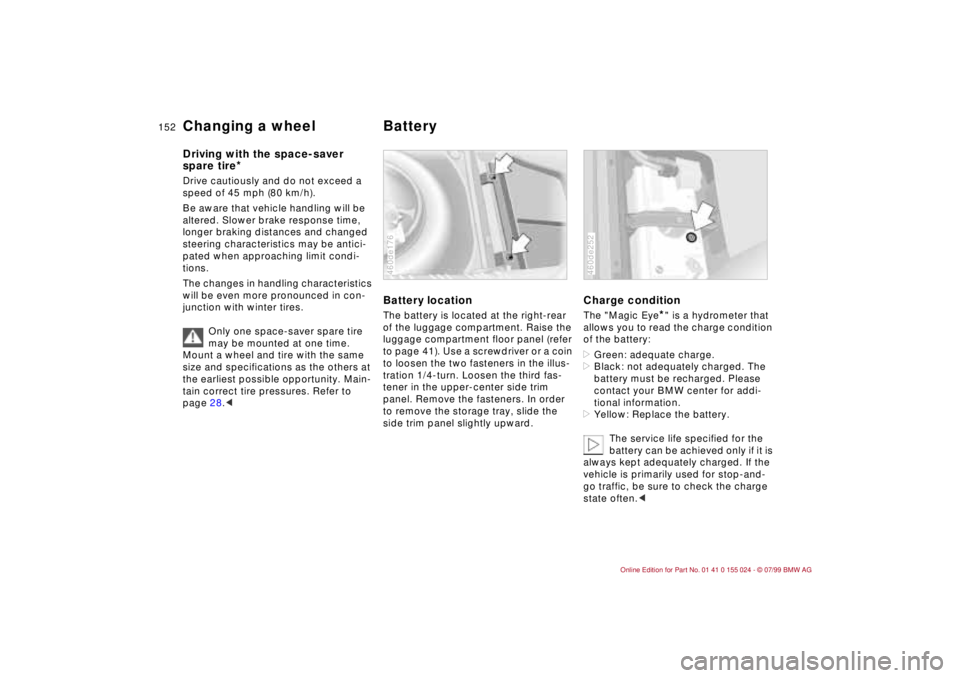
Battery locationThe battery is located at the right-rear
of the luggage compartment. Raise the
luggage compartment floor panel (refer
to page 41). Use a screwdriver or a coin
to loosen the two fasteners in the illus-
tration 1/4-turn. Loosen the third fas-
tener in the upper-center side trim
panel. Remove the fasteners. In order
to remove the storage tray, slide the
side trim panel slightly upward.460de176
Charge conditionThe "Magic Eye
*" is a hydrometer that
allows you to read the charge condition
of the battery:
>Green: adequate charge.
>Black: not adequately charged. The
battery must be recharged. Please
contact your BMW center for addi-
tional information.
>Yellow: Replace the battery.
The service life specified for the
battery can be achieved only if it is
always kept adequately charged. If the
vehicle is primarily used for stop-and-
go traffic, be sure to check the charge
state often.<
460de252
Page 153 of 189
153n
IndexDataTechnologyRepairsCar careControlsOverview
BatteryBattery careThe battery is absolutely maintenance-
free, that is, the original electrolyte will
normally last for the service life of the
battery under moderate climatic condi-
tions.
For all questions that regard the
battery, please consult your BMW
center. Since the battery is mainte-
nance-free, the following is for your
information only.
comply with the corresponding precau-
tions whenever you work with or near
the battery.
Before handling the battery,
please read the following infor-
mation.
Wear eye protection. Do not
allow particles containing bat-
tery acid or lead to come into
contact with your eyes, your skin, or
your clothing.
Battery acid is extremely corro-
sive. Wear eye protection and
protective gloves. Do not tip the
battery. Battery acid can leak from the
ventilation openings.
Do not allow children access to
batteries and battery acid.
Never allow sparks or open
flame in the vicinity of the bat-
tery. Avoid sparks from electri-
cal cables or electrical equipment. Turn
the key to position 0 in the steering lock
when disconnecting or connecting the
battery. Do not short-circuit the battery
terminals. This creates a risk of injury
from high-energy sparks.
A highly-explosive gas is gener-
ated when the battery is charged.
If battery acid is splashed into
your eyes, rinse them thor-
oughly with clear water for at
least 15 minutes. Consult a physician
immediately. If your skin or clothing are
splashed by acid, rinse immediately
with ample clear water. If electrolyte is
accidentally swallowed, consult a phy-
sician immediately.
In order to protect the battery
case from ultraviolet radiation,
do not place it in direct sunlight.
A discharged battery can freeze. Store
the battery in areas where temperature
remains above freezing.
Removal and installation
Do not disconnect the battery
when the engine is running. If you
do so, the ensuing voltage surge will
damage the vehicle's onboard electron-
ics.
Do not make any modifications in the
wires to the positive terminal. If you do
so, the protective function of the safety
battery terminal is no longer ensured.
Repair and disposal must be performed
by trained technicians only.<
When removing the battery, disconnect
the cable on the negative terminal first,
then the cable on the positive terminal.
Loosen the center adjusting screw on
the battery retaining strap (use the
screwdriver included with the onboard
tool kit) and disconnect the strap.
When installing a battery, connect the
positive terminal first, then connect the
negative terminal.
When installing a battery, be sure
that it is mounted properly and
that the retaining bracket is installed
with the center adjustment screw. If this
is not done, the battery will not be ade-
quately secured in case of an acci-
dent.<
Page 154 of 189
154n
Battery FusesCharging the battery Charge the battery in the vehicle only
when the engine is not running.
Before doing any work on the elec-
trical system, be sure to unclamp
the cable from the battery's negative
terminal. Failure to do so can result in
short-circuits, a fire or personal injury.<
If the vehicle is to be parked longer than
four weeks, disconnect the battery from
the vehicle's electrical system by dis-
connecting the negative terminal cable
and then recharge using a suitable
charging device.
If you intend to store your car for longer
than twelve weeks: Remove the battery,
charge it and store it in a cool (but frost-
and dust-free) room. Every three months
and before reinstalling the battery, have
it recharged. If it is not recharged, it will
not be serviceable. Every time the bat-
tery is discharged, especially over ex-
tended periods, its service life is re-
duced.
Return used batteries to a recy-
cling center or your BMW center.
Maintain the battery in an upright posi-
tion for transport and storage. Secure
the battery to prevent it from tilting dur-
ing transport.<
Storage periods during which the
battery is disconnected are not
taken into consideration by the Service
Interval Display for changing the brake
fluid.
For this reason, be sure that the brake
fluid is changed every two years, re-
gardless of the information displayed.
Read and comply with the information
on page 129 covering this subject.<
If an electrical accessory should fail,
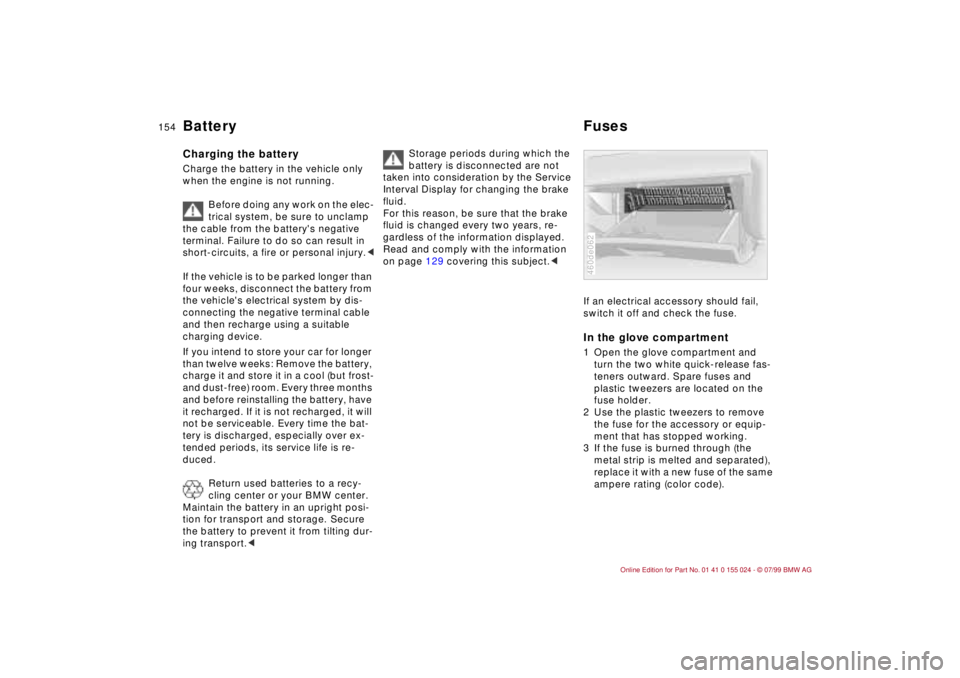
switch it off and check the fuse. In the glove compartment1 Open the glove compartment and
turn the two white quick-release fas-
teners outward. Spare fuses and
plastic tweezers are located on the
fuse holder.
2 Use the plastic tweezers to remove
the fuse for the accessory or equip-
ment that has stopped working.
3 If the fuse is burned through (the
metal strip is melted and separated),
replace it with a new fuse of the same
ampere rating (color code).460de062
Page 157 of 189
157n
IndexDataTechnologyRepairsCar careControlsOverview
Do not use spray starter fluids.
If the battery is discharged, the engine
can be started with the use of two
jumper cables and the battery of an-
other vehicle. Use only jumper cables
with fully insulated grips on the terminal
clamps.
Do not touch the parts conducting
electrical current while the engine
is running. Failure to comply with this
creates a risk of fatal injury.<
Carefully comply with the following in-
structions to avoid personal injury or
damage to one or both vehicles:
1 Be sure that the battery on the sup-
port vehicle is also rated at 12 volts,
and that the capacities of the two
batteries (Ah) are roughly comparable
(printed on casing).
2 Leave the discharged battery con-
nected to the vehicle's electrical sys-
tem.
3 Make sure that there is no contact
between the bodywork of the two ve-
hicles Ð this creates a risk of short cir-
cuits.
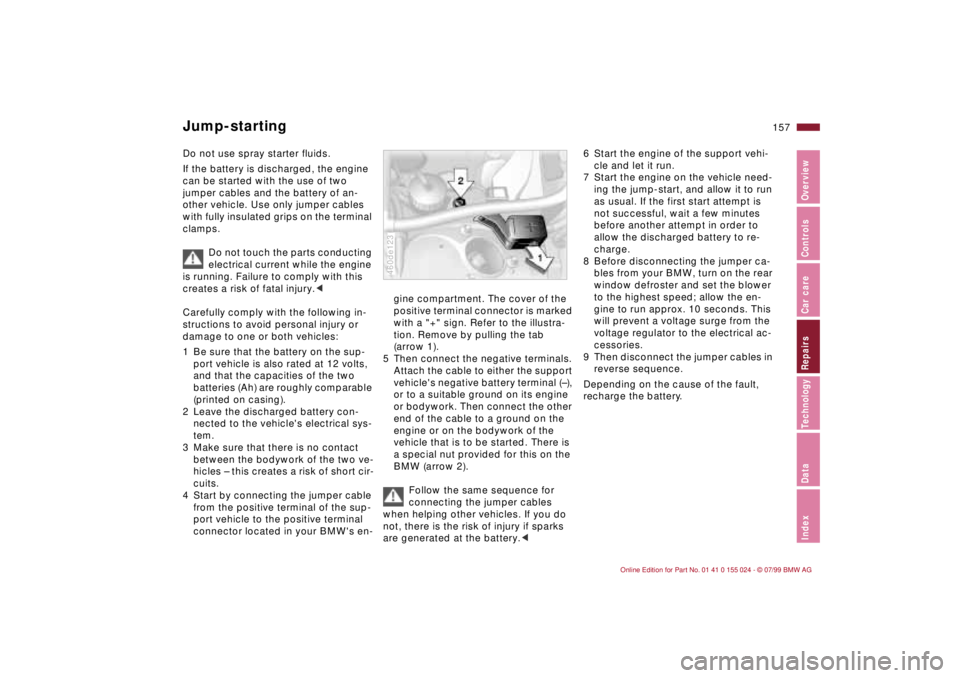
4 Start by connecting the jumper cable
from the positive terminal of the sup-
port vehicle to the positive terminal
connector located in your BMW's en-
gine compartment. The cover of the
positive terminal connector is marked
with a "+" sign. Refer to the illustra-
tion. Remove by pulling the tab
(arrow 1).
5 Then connect the negative terminals.
Attach the cable to either the support
vehicle's negative battery terminal (Ð),
or to a suitable ground on its engine
or bodywork. Then connect the other
end of the cable to a ground on the
engine or on the bodywork of the
vehicle that is to be started. There is
a special nut provided for this on the
BMW (arrow 2).
Follow the same sequence for
connecting the jumper cables
when helping other vehicles. If you do
not, there is the risk of injury if sparks
are generated at the battery.<460de123
6 Start the engine of the support vehi-
cle and let it run.
7 Start the engine on the vehicle need-
ing the jump-start, and allow it to run
as usual. If the first start attempt is
not successful, wait a few minutes
before another attempt in order to
allow the discharged battery to re-
charge.
8 Before disconnecting the jumper ca-
bles from your BMW, turn on the rear
window defroster and set the blower
to the highest speed; allow the en-
gine to run approx. 10 seconds. This
will prevent a voltage surge from the
voltage regulator to the electrical ac-
cessories.
9 Then disconnect the jumper cables in
reverse sequence.
Depending on the cause of the fault,
recharge the battery.
Jump-starting
Page 167 of 189
167n
IndexDataTechnologyRepairsCar careControlsOverview
Tire Pressure Control (RDC)
*
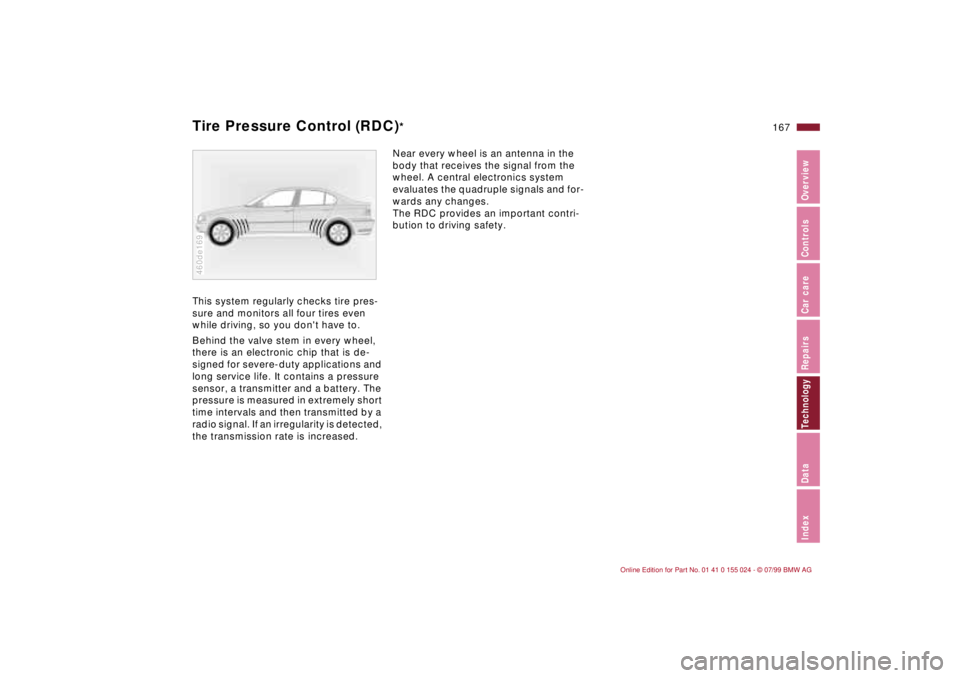
This system regularly checks tire pres-
sure and monitors all four tires even
while driving, so you don't have to.
Behind the valve stem in every wheel,
there is an electronic chip that is de-
signed for severe-duty applications and
long service life. It contains a pressure
sensor, a transmitter and a battery. The
pressure is measured in extremely short
time intervals and then transmitted by a
radio signal. If an irregularity is detected,
the transmission rate is increased. 460de169
Near every wheel is an antenna in the
body that receives the signal from the
wheel. A central electronics system
evaluates the quadruple signals and for-
wards any changes.
The RDC provides an important contri-
bution to driving safety.
Page 176 of 189
176n
Electrical system Ribbed V-beltBattery 12 V, 80 AhSpark plugs NGK BKR 6 EQUP
Bosch FGR 7 DQP (not released at this
time)Water pump Ð AC alternator Ð Power
steering
Ribbed V-belt 6 PK x 1538
A/C compressor
Ribbed V-belt 5 PK x 863You can obtain Original BMW
Parts and Accessories, as well as
professional advice from your BMW
center.<
Page 180 of 189
Everything from A to ZAABS (Antilock Brake
System)22, 106
Accessories6
Activated-charcoal
filter90, 155
Adaptive Transmission
Control (ATC)65, 162
Adding engine oil125
Adding washer
fluid124, 175
Adjusting the backrest47
Adjusting the steering
wheel51
Adjusting the thigh support
area49
Air distribution88
Air nozzles86
Air outlets86
ventilation86
Air pressure113
Air supply89
Airbags21, 56, 137, 163
Alarm system42
Antenna112
Antenna, Diversity164
Antifreeze128
radiator110
Antilock Brake System
(ABS)22, 106
Anti-theft alarm system42
Aquaplaning104, 113
Armrest93Ashtray95
front95
rear96
ATC (Adaptive Transmission
Control)65, 162
AUC (Automatic
recirculated-air
control)89
Automatic car washes132
Automatic climate
control86
removing condensation
from the windows89
Automatic cruise control71
Automatic dimming, interior
rearview mirror53
Automatic recirculated-air
control (AUC)89
Automatic transmission with
Steptronic22, 65
Automatic windshield
washer69
Average consumption77
Average speed77
Axle loads174
BBackup lamps64
bulb replacement145
Battery152, 176
capacity176
charge154discharged157
removal and
installation153
Battery charge current20
Battery Safety Terminal
(BST)153
Belts54
Blower89
BMW High Performance
Synthetic Oils126
BMW Sports Seat49
Bore172
Brake fluid129
Brake hydraulic system20
Brake lamps
bulb replacement145
Brake pads22
Brakes108
malfunctions109
Break-in procedure104
Breaking in the vehicle104
BST (Battery Safety
Terminal)153
Bulb replacement142
CCapacities175
Car Memory53
Car radio112
refer also to the separate
Owner's ManualCar radio
reception112, 164
Car vacuum cleaner,
connecting96
Car wash132
Care
exterior133
interior134
Care of upholstery135
Care of wool velour135
Cargo loading99
Caring for the vehicle
finish133
Catalytic converter105
CBC (Cornering Brake
Control)21, 107
Cellular phone95, 112
refer also to the separate
Owner's Manual
Center (high-mount) brake
lamp147
Center armrest93
Central locking system34
button38
Changing a tire149
Changing a wheel149
Charge indicator lamp20
Check Control75
Child restraint
systems55, 59
Child seat59
Child-safety locks56
Cigarette lighter96
Everything from A-Z
Page 184 of 189

Everything from A to ZSpeed display18
Speedometer18
Sports Seat49
Starting61
Starting assistance157
Starting problems105, 157
Starting the engine61
Steel wheels118
Steering111
Steering wheel lock61
Steptronic65
Stopping the vehicle62
Storage compartments93
Storing the vehicle137
Stroke172
Summer tires116
Sun visors52
Switching off the engine62
Symbols4, 153
Synthetic oils126TTachometer73
Tail lamp assembly
bulb replacement145
Tail lamps145
Tank capacity175
Technical data172
Technical
modifications6, 138Telephone
refer to the separate
Owner's Manual
Telephone hookup95
Temperature adjustment88
Temperature display
outside temperature76
Temperature gauge
engine coolant74
Temperature layering90
Third brake lamp147
Through-loading system97
Tilt alarm36, 43
remote control36
Tire codes116
Tire damage113
Tire inflation
pressure27, 113
Tire pressure
checking27
Tire Pressure Control
(RDC)80, 167
Tire pressure
monitoring80, 167
Tire replacement114, 115
Tire specifications118
Tire tread113
Tools142
Torque172
Tow fittings158
Tow starting158Towing158
Track173
Traction Control System
refer to DSC79
Transmission64
Tread depth, tires113
Trip odometer73
Trunk39
Trunk lid, refer to luggage
compartment lid39
Turn signal
indicator23, 68, 144
bulb replacement144
Turning radius173
Two-way radios112
UUsed batteries154VVacuum cleaner,
connecting96
Vanity mirror52
bulb replacement148
Vehicle battery152, 176
Vehicle care
exterior133
interior134
Vehicle identification130
Vehicle Identification
Number (VIN)130Vehicle immobilizer33
Vehicle painting133
Vehicle storage137
Vehicle weight174
Ventilation86
draft-free90
Vinyl care135
WWarning lamp "Please fasten
safety belts"21
Warning lamps20
Warning messages75
Warranty and Service Guide
Booklet131
Washer reservoir, filling124
Washing your car132
Water on roadways
deep water104
Waxing, paintwork134
Weights174
Wheel rims116
Wheelbase173
Wheels and tires116, 118
Width173
Windows, convenience
operation34
Windshield washer nozzle
adjustment124
Windshield washer reservoir,
filling124, 175
Page 186 of 189

Owner service proceduresAActivated-charcoal filter,
changing155
Adding brake fluid129
Adding engine coolant128
Adding engine oil125BBackup lamps
bulb replacement145
Battery
add distilled water153
charging154
Brake lamps
bulb replacement145
Brakes, brake faults109CChanging a tire149
Changing a wheel149
Check Control75
Checking air pressure27
Checking engine oil
level125
Checking oil level125DDefrosting the windows89
Difficult steering111
Doors, emergency
operation34
EElectrical accessories,
failure154
Electrical malfunction
fuel filler door156
sliding/tilt sunroof156
Emergency operation
doors34
fuel filler door156
sliding/tilt sunroof156
Engine oil
add125
quality126
specifications126
viscosity126FFailure messages75
Fault displays75
First aid25
First-aid kit25
Fittings, towing and
tow-starting158
Flat tire149
Footwell lamps
bulb replacement148
Front fog lamps
bulb replacement145
Fuses, replacing154GGlove compartment lamp
bulb replacement148
HHazard warning flashers25
Hazard warning triangle25
Headlamp cover, care143
High beams
bulb replacement143IIndicator lamps20
Inflated pressure27, 113
Interior lamps
bulb replacement147
Interior motion sensor,
switching off43JJack149LLicense plate lamp
bulb replacement147
Low beams
bulb replacement143
Lug wrench149
Luggage compartment
lamps
bulb replacement148
Luggage compartment lid,
emergency release39
MMaintenance131
Malfunction displays75
Microfilter, changing155OOil
quality126
specifications126
viscosity126
Onboard tool kit142PPressure, tires27RRear lamps145
Releasing the fuel filler door
following an electrical
malfunction156
Releasing the hood120
Removing condensation
from the windows89
Replacement key32
Replacing bulbs142
Replacing lamp bulbs142
Replacing windshield wiper
blades142
Replacing wiper blades142
Return used batteries154
Owner service procedures