belt BMW 328I 2000 User Guide
[x] Cancel search | Manufacturer: BMW, Model Year: 2000, Model line: 328I, Model: BMW 328I 2000Pages: 189, PDF Size: 1.81 MB
Page 56 of 189
56n
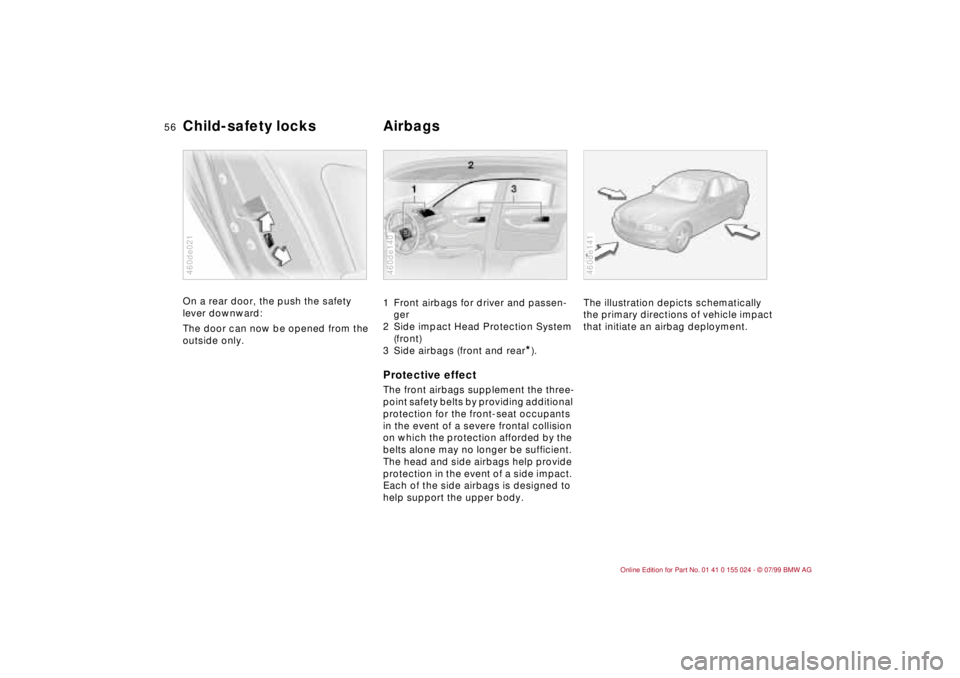
Child-safety locks Airbags On a rear door, the push the safety
lever downward:
The door can now be opened from the
outside only.460de021
1 Front airbags for driver and passen-
ger
2 Side impact Head Protection System
(front)
3 Side airbags (front and rear
*).
Protective effectThe front airbags supplement the three-
point safety belts by providing additional
protection for the front-seat occupants
in the event of a severe frontal collision
on which the protection afforded by the
belts alone may no longer be sufficient.
The head and side airbags help provide
protection in the event of a side impact.
Each of the side airbags is designed to
help support the upper body.460de140
The illustration depicts schematically
the primary directions of vehicle impact
that initiate an airbag deployment.460de141
Page 57 of 189
57n
IndexDataTechnologyRepairsCar careControlsOverview
AirbagsIndicator lamp
The indicator lamp displays the
operational status of the airbag
system when the ignition key is
in position 1 and higher.
System operational:
>The indicator lamp comes on briefly
then goes out.
System malfunction:
>The indicator lamp fails to come on.
>The indicator lamp comes on briefly
before going out, and then lights up
again.
If there is a system malfunction, there is
a risk that the airbags will not be trig-
gered within their normal response
range, even if the level of impact would
normally have triggered them.
Have your BMW center inspect and
repair the system immediately.
The airbag indicator lamp also
comes on if the safety belt ten-
sioners have been triggered.<
For your own safety, please com-
ply with the following precautions
concerning airbags. If you do not, their
protective function may be impaired
and your personal safety endangered.
The following information pertains to all
occupants:
The airbags are supplemental restraint
devices designed to provide extra pro-
tection; they are not a substitute for
safety belts. Wear your safety belt at all
times. The airbags will not be triggered
in the event of a minor accident, a vehi-
cle roll-over, or collisions from the rear.
In these instances, the safety belt offers
the best protection.
Airbags are located under the cover
panels in the steering wheel, in the in-
strument panel, in the side trim panels
in the front and rear
*, in the roof panels,
and in the sides of the inside roof lining.
Select a seat position that is comfort-
able and allows the greatest possible
distance from each of the applicable air-
bags. Hold the steering wheel at the rim
(hands at the "9 o'clock and 3 o'clock"
positions) in order to avoid injuries to
your hands or arms if the airbag is trig-
gered.
Never allow any objects to obstruct the
area between the airbag and an occu-
pant.
Do not use the cover panel above the
front passenger airbag as a storage
area.
Never tape the airbag cover panels,
cover them over or alter them in any
other way.
Never install a rear-facing child restraint
device on the front passenger seat. Chil-
dren under 13 years of age and children
who are smaller than 5 feet (150 cm),
should only travel in the rear seat.
If your vehicle is equipped with side air-
bags in the rear, be sure that child seats
are installed correctly and with the
greatest possible distance from the side
trim panels. Do not allow children to
lean out of the child's seat in the direc-
tion of the side trim panels. Otherwise,
serious injuries could occur if the airbag
is triggered.
At all times, occupants should sit up-
right and be properly restrained (infants
and small children in appropriate child
restraint systems; larger children and
adults using the safety belts). Never let
an occupant's head rest near or on a
side airbag because the inflating airbag
could cause a serious or fatal injury.
Please note that the word "Airbag" im-
printed on the door trim panel indicates
the airbag's location.
Page 58 of 189
58n
AirbagsAccident research shows that the safest
place for children in an automobile is in
the rear seat. However, a child sitting in
the rear seat and not properly restrained
may place his or her head on or near the
side airbag, if so equipped. For exam-
ple, a child Ð even though belted Ð may
fall asleep with his or her head against
the side airbag. It may be difficult for a
driver to ensure that children in the rear
seat will remain properly positioned at
all times and not place their heads on or
near the side airbag. Therefore, we rec-
ommend that the rear seat side airbags,
if provided, be deactivated if you plan to
transport children in the rear seat.
The rear seat side airbags may already
have been deactivated, either at the
time of manufacture or by a BMW cen-
ter. Labels in the rear door opening
should indicate the status of your rear
seat side airbags. If you are uncertain of
their status, or wish to have the airbags
activated or deactivated, please contact
your BMW center.
of injuries to the face, hands and arms
occurring from airbag deployment in
isolated instances. The ignition and in-
flation noise may induce a mild tempo-
rary hearing loss in sensitive individu-
als.
For additional information concerning
the airbag system: Refer to pages 137
and 163.
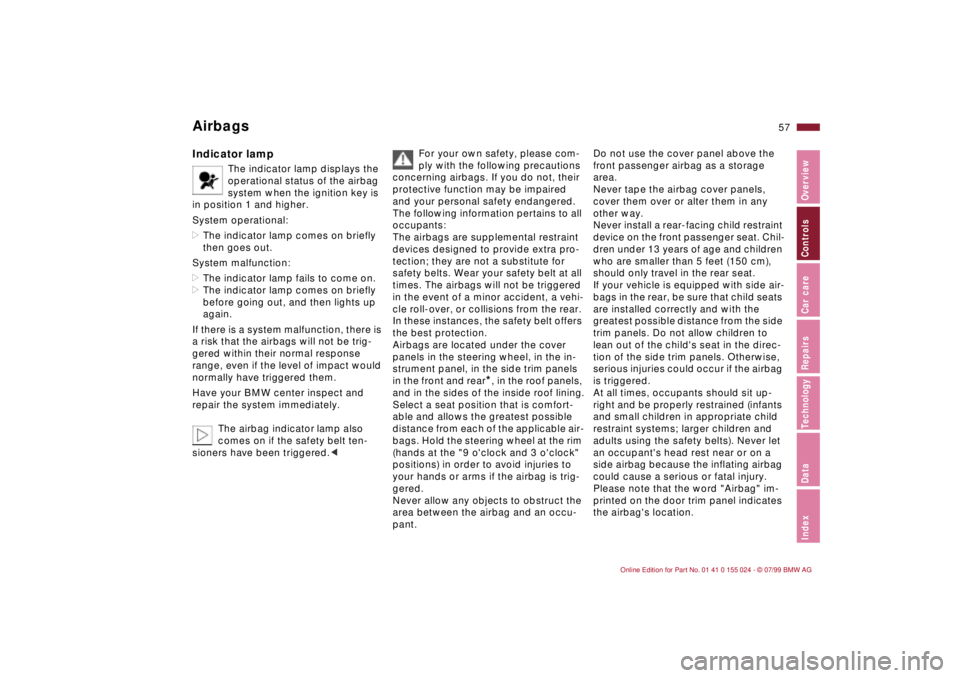
This is the right way for a child to sit in a
child restraint when rear side airbags
(arrow) are provided.
462us012
Page 59 of 189
59n
IndexDataTechnologyRepairsCar careControlsOverview
Airbags Child restraints
*
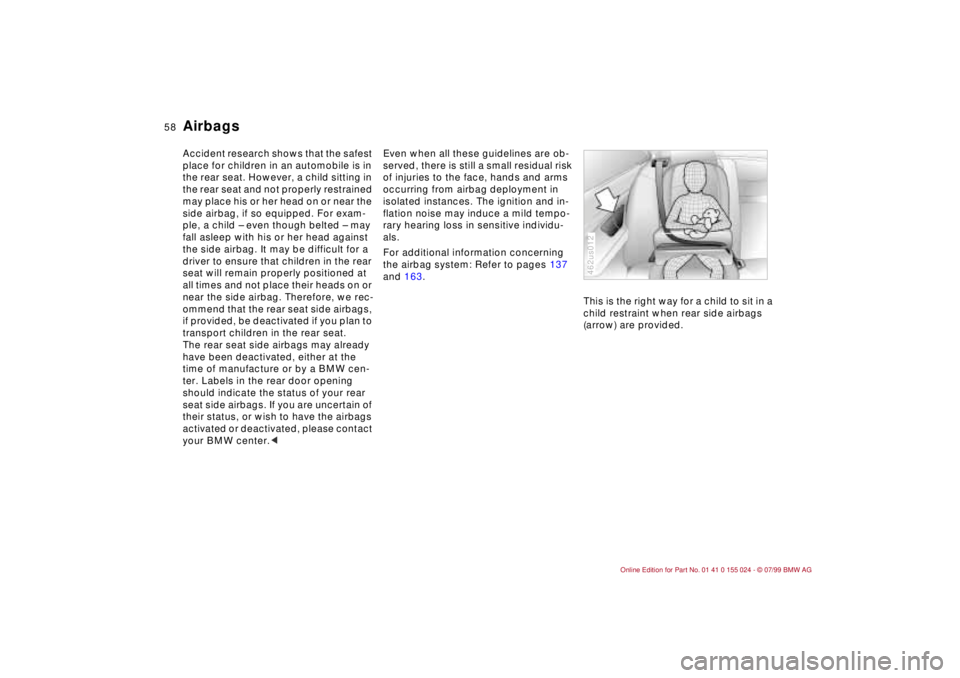
This is the right way for a larger child to
sit wearing the safety belt when rear
side airbags (arrow) are provided.462us013
Commercially available child seats
complying with the legal standard are
designed to be secured with a lap belt
or with the lap belt portion of a combi-
nation lap/shoulder belt. Improperly or
inadequately installed restraint sys-
tems can increase the risk of injury to
children. Always read and follow the in-
structions that come with the system.380us123
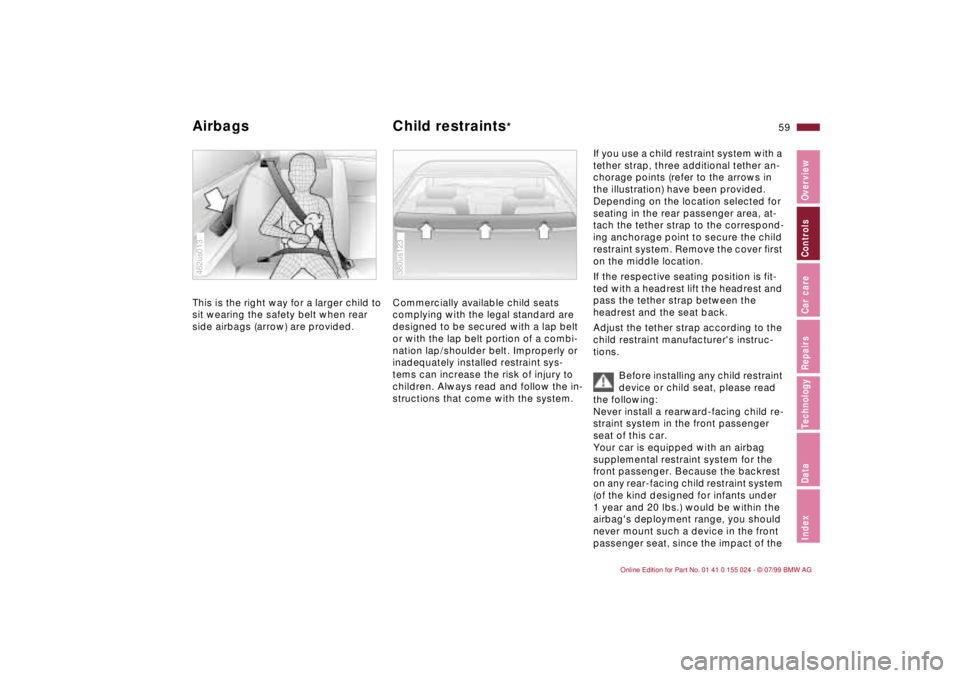
If you use a child restraint system with a
tether strap, three additional tether an-
chorage points (refer to the arrows in
the illustration) have been provided.
Depending on the location selected for
seating in the rear passenger area, at-
tach the tether strap to the correspond-
ing anchorage point to secure the child
restraint system. Remove the cover first
on the middle location.
If the respective seating position is fit-
ted with a headrest lift the headrest and
pass the tether strap between the
headrest and the seat back.
Adjust the tether strap according to the
child restraint manufacturer's instruc-
tions.
Before installing any child restraint
device or child seat, please read
the following:
Never install a rearward-facing child re-
straint system in the front passenger
seat of this car.
Your car is equipped with an airbag
supplemental restraint system for the
front passenger. Because the backrest
on any rear-facing child restraint system
(of the kind designed for infants under
1 year and 20 lbs.) would be within the
airbag's deployment range, you should
never mount such a device in the front
passenger seat, since the impact of the
Page 60 of 189
60n
Child restraints
*
Installing a child restraint system
airbag against the child restraint's back-
rest could lead to serious or fatal inju-
ries.
If it is necessary for a child (not an in-
fant) to ride in the front seat, certain pre-
cautions should be taken. First, move
the passenger seat as far away from the
dashboard as possible. This important
precaution is intended to maximize the
distance between the airbag and the
child. Older children should be tightly
secured with the safety belt. Younger
children should be secured in an appro-
priate forward-facing child restraint sys-
tem that has first been properly secured
with a safety belt.
Never install a rear-facing child restraint
system in the front passenger seat.
We strongly urge you to carefully read
and comply with the instructions for in-
stallation and use provided by the child
restraint's manufacturer whenever you
use such a device.
Be sure that all occupants (of all ages)
remain properly and securely restrained
at all times.c
All rear seating positions in your vehicle
meet the recommendations of SAE
J1819, an industry recommended prac-
tice for securing child restraint systems
in motor vehicles.All of the rear belt retractors and the
front passenger's safety belt can be
locked for mounting and securing child
restraint systems.
Information pertaining to this is located
in the immediate vicinity of the buckle
latch of each safety belt.
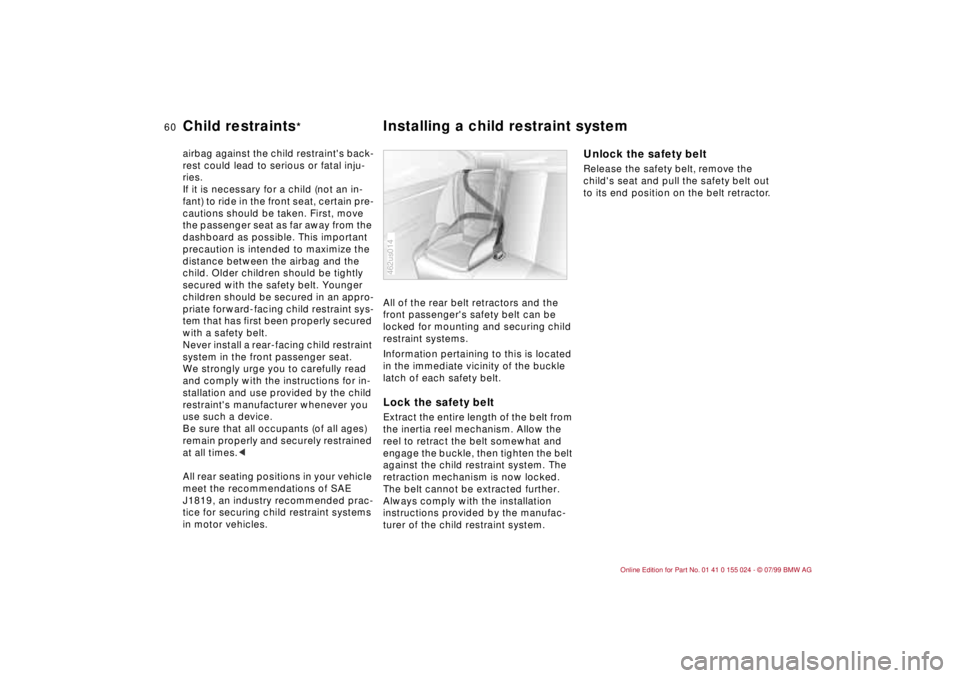
Lock the safety beltExtract the entire length of the belt from
the inertia reel mechanism. Allow the
reel to retract the belt somewhat and
engage the buckle, then tighten the belt
against the child restraint system. The
retraction mechanism is now locked.
The belt cannot be extracted further.
Always comply with the installation
instructions provided by the manufac-
turer of the child restraint system.462us014
Unlock the safety beltRelease the safety belt, remove the
child's seat and pull the safety belt out
to its end position on the belt retractor.
Page 99 of 189
99n
IndexDataTechnologyRepairsCar careControlsOverview
Cargo loadingStowing cargo If you are transporting a load in your
BMW
>Load heavy cargo as far forward as
possible Ð directly behind the back-
rests or the luggage compartment
partition Ð and as low as possible.
>Cover sharp edges and corners.
>Do not pile objects higher than the
top edge of the backrest.460de160
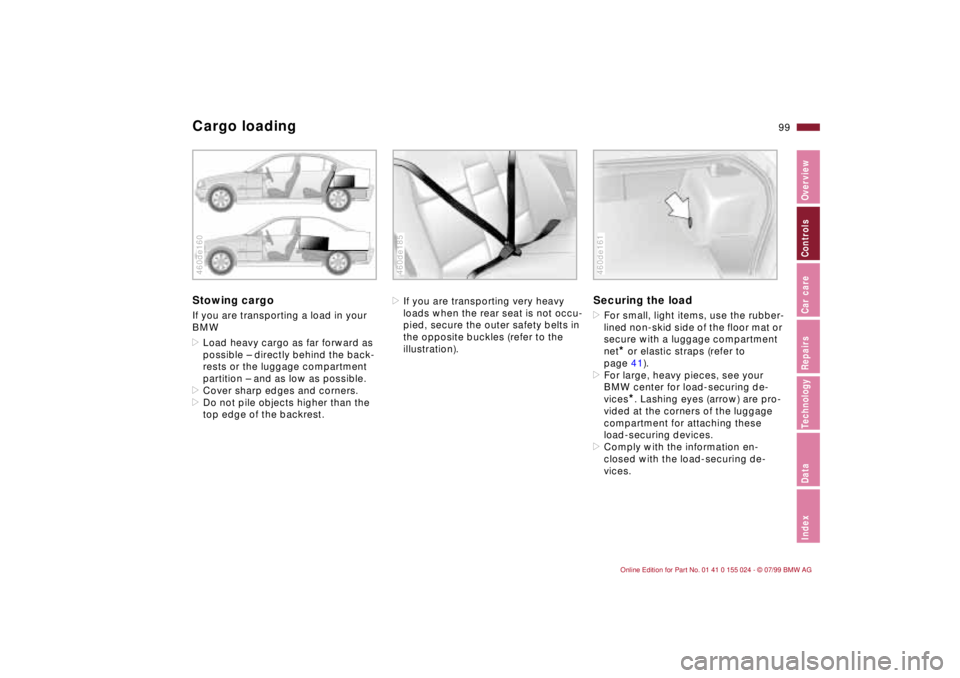
>If you are transporting very heavy
loads when the rear seat is not occu-
pied, secure the outer safety belts in
the opposite buckles (refer to the
illustration).460de185
Securing the load >For small, light items, use the rubber-
lined non-skid side of the floor mat or
secure with a luggage compartment
net
* or elastic straps (refer to
page 41).
>For large, heavy pieces, see your
BMW center for load-securing de-
vices*. Lashing eyes (arrow) are pro-
vided at the corners of the luggage
compartment for attaching these
load-securing devices.
>Comply with the information en-
closed with the load-securing de-
vices.
460de161
Page 135 of 189
135n
IndexDataTechnologyRepairsCar careControlsOverview
Caring for your carPlastic components, vinyl upholstery,
headliners, lamp lenses, the clear cover
of the instrument panel and compo-
nents with a sprayed dull black surface
can be cleaned with water (add plastic
shampoo as required). Do not allow
moisture to soak through the seats or
headliner. Never use solvents such as
lacquer thinner, heavy-duty grease re-
mover, fuels, or similar substances.
Rubber components should be cleaned
with water only; a rubber treatment or
silicone spray may also be applied.
Clean the wiper blades with soapy
water. The wiper blades should be re-
placed twice a year Ð before and after
the cold season. This is especially im-
portant for vehicles with a rain sensor
*.
Use only wiper blades approved
by BMW.<
Do not remove safety belts to clean
them. Clean them with mild soapy
water only. Do not use chemicals or dry
cleaners to clean safety belts, since this
could damage the belt fabric.
After cleaning, never allow the inertia
reel to retract the belts until they are
completely dry. Dirty safety belts pre-
vent the inertia reel mechanism from
retracting the strap properly, and thus
constitute a safety hazard.
Heavily soiled floor carpets and mats
*
can be cleaned with an interior cleaner.
The floor mats can be removed from
the vehicle for cleaning.
Use only a damp cloth to clean trim
panels made of real wood
* and other
parts constructed of real wood
*. Follow
up by drying with a soft cloth.
Use cleaning and car-care
products that you can obtain at
your BMW center.<
Care of upholstery materials Depressions in the upholstery that re-
sult from everyday use can be brushed
smooth by brushing against the nap
with a lightly dampened brush.
The tendency of the pile to lie in a par-
ticular direction on velour upholstery is
not a quality defect. Just as with home
textiles or clothing, this cannot be
avoided.
Lint on upholstery materials, rubbed-in
fabric or suede residues can be re-
moved with a lint brush or Velcro¨
brush. A cleaning glove is available for
especially "stubborn" lint. Stains and
fairly large areas of dirt should be
cleaned off without delay, using luke-
warm water and an interior cleaner,
stain remover or appropriate cleaning
fluid. Brush the fabric afterwards to re-
store its appearance.
If the vehicle will be stored for an ex-
tended period or if it is exposed to in-
tense sunlight, cover all the seats or the
windows to prevent fading.
Use cleaning and car-care
products that you can obtain at
your BMW center.<
Page 161 of 189
Overview
Controls and features
Operation, care
and maintenance
Owner service procedures
Technical data
Index Advanced technology
161n
IndexDataTechnologyRepairsCar careControlsOverview
Adaptive Transmission Control
(ATC)162
Airbags163
Dynamic Stability Control
(DSC)163
Radio reception164
Safety belt tensioner164
Interior rearview mirror
with automatic dimming
feature165
Rain sensor166
Tire Pressure Control (RDC)167
Self-diagnostics168
Xenon lamps169
Technol-
Page 163 of 189
163n
IndexDataTechnologyRepairsCar careControlsOverview
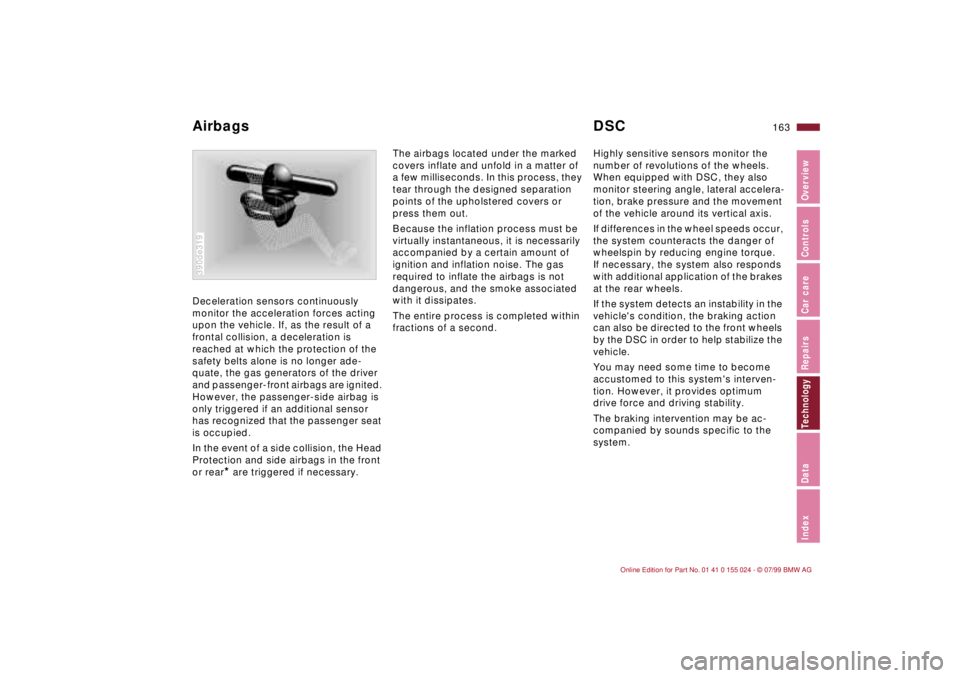
Deceleration sensors continuously
monitor the acceleration forces acting
upon the vehicle. If, as the result of a
frontal collision, a deceleration is
reached at which the protection of the
safety belts alone is no longer ade-
quate, the gas generators of the driver
and passenger-front airbags are ignited.
However, the passenger-side airbag is
only triggered if an additional sensor
has recognized that the passenger seat
is occupied.
In the event of a side collision, the Head
Protection and side airbags in the front
or rear
* are triggered if necessary.
390de319
The airbags located under the marked
covers inflate and unfold in a matter of
a few milliseconds. In this process, they
tear through the designed separation
points of the upholstered covers or
press them out.
Because the inflation process must be
virtually instantaneous, it is necessarily
accompanied by a certain amount of
ignition and inflation noise. The gas
required to inflate the airbags is not
dangerous, and the smoke associated
with it dissipates.
The entire process is completed within
fractions of a second.Highly sensitive sensors monitor the
number of revolutions of the wheels.
When equipped with DSC, they also
monitor steering angle, lateral accelera-
tion, brake pressure and the movement
of the vehicle around its vertical axis.
If differences in the wheel speeds occur,
the system counteracts the danger of
wheelspin by reducing engine torque.
If necessary, the system also responds
with additional application of the brakes
at the rear wheels.
If the system detects an instability in the
vehicle's condition, the braking action
can also be directed to the front wheels
by the DSC in order to help stabilize the
vehicle.
You may need some time to become
accustomed to this system's interven-
tion. However, it provides optimum
drive force and driving stability.
The braking intervention may be ac-
companied by sounds specific to the
system.
Airbags DSC
Page 164 of 189
164n
Radio reception Safety belt tensionerAM radio provides reception across a
considerable distance because the
broadcast signals not only travel along
the ground as surface waves, but they
are also reflected from the ionosphere
as atmospheric waves.
Frequency-modulation (FM) provides
substantially better sound quality than
AM. However, because FM transmis-
sions rely on line-of-sight broadcast
waves, their effective reception range is
limited. 360de084
The limitations inherent to radio recep-
tion in a moving vehicle have been min-
imized by a number of innovative sys-
tem designs:
The "Radio Data System" (RDS) makes
sure that, for broadcast stations send-
ing on several frequencies, the radio
automatically tunes to the frequency
with the best reception quality.
The Diversity Antenna system employs
several FM antennas integrated within
the rear window to provide three sepa-
rate sources for receiving broadcast
waves. An integral processor automati-
cally selects the antenna with the best
FM reception quality at any given time.
The selection of the antenna takes
place within milliseconds, and is there-
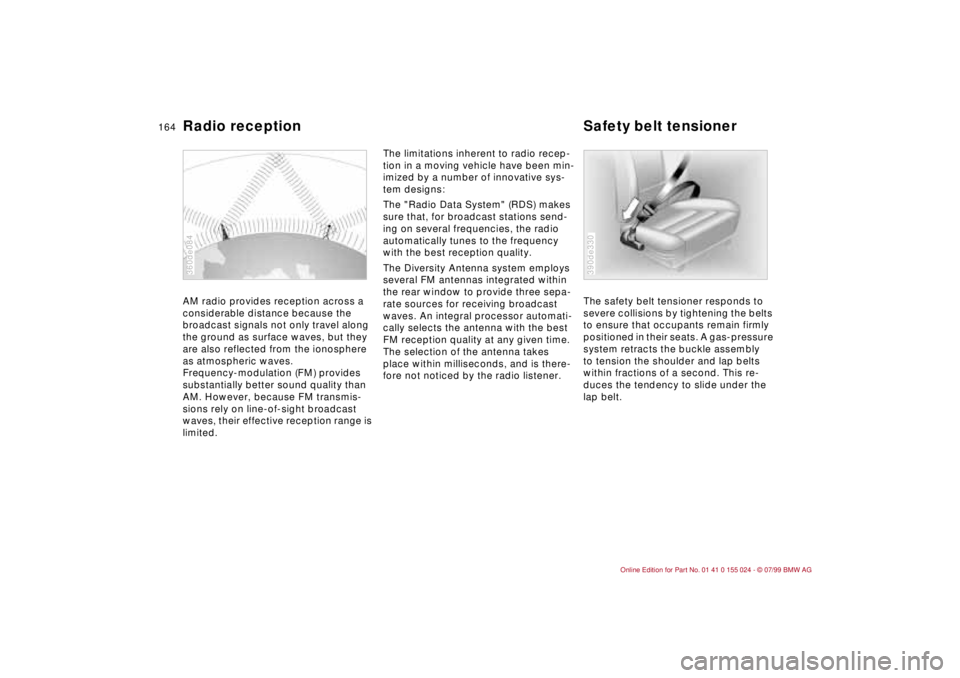
fore not noticed by the radio listener.The safety belt tensioner responds to
severe collisions by tightening the belts
to ensure that occupants remain firmly
positioned in their seats. A gas-pressure
system retracts the buckle assembly
to tension the shoulder and lap belts
within fractions of a second. This re-
duces the tendency to slide under the
lap belt.
390de330