flat tire BMW 328I 2000 User Guide
[x] Cancel search | Manufacturer: BMW, Model Year: 2000, Model line: 328I, Model: BMW 328I 2000Pages: 189, PDF Size: 1.81 MB
Page 115 of 189

115n
IndexDataTechnologyRepairsCar careControlsOverview
Tire replacement Tire rotation
Do not use retreaded tires. Driving
safety may be impaired by their
use. This is due to the possible varia-
tions in casing structures and, in some
cases, to their extreme age, factors that
can lead to a decrease in their durabil-
ity.<
Tire ageThe date on which the tire was manu-
factured is indicated by the code on the
sidewall:
DOT ... 329 indicates that the tire was
manufactured in Week 32 of 1999.
BMW recommends the replacement of
all tires when the tires are no more than
6 years old, even if a tire life of 10 years
is possible.
Spare tires over 6 years old should be
used only in case of emergency. A tire
in this condition should be replaced by
a new tire immediately, and should not
be mounted together with new tires.
Between the axlesThe tread wear patterns at the front end
differ from those at the rear Ð the actual
patterns will vary according to individ-
ual driving conditions. In the interests of
safety and maintaining optimal handling
characteristics, tire rotation is not rec-
ommended.
If a proposed interaxle rotation of tires
is based on economic considerations,
one should consider whether the costs
for the rotation are likely to be recap-
tured by any increase in the service life
of the tires that might be realized. In
principle, interaxle rotation should be
performed in short intervals, with a
maximum of 3,000 miles (5,000 km).
Consult your BMW center for more
information.
Should you decide to rotate the tires, it
is essential to comply with the following:
Rotate tires on the same side only, since
braking characteristics and road grip
could otherwise be adversely affected.
Following rotation, the tire inflation
pressure should always be corrected.If different tire sizes are mounted
on the front and rear axles (refer to
page 118), the wheels may not be ro-
tated from one axle to the other.<
Page 116 of 189

116n
Wheel and tire combinations The right choice Use only BMW-approved tires. Refer to
page 118.
Due to the high speeds this vehicle can
reach, the use of specific brands, spec-
ifications and sizes is mandatory. Con-
sult any BMW center for details. Com-
ply with local/national regulations.
The correct wheel-tire combina-
tion affects different systems such
as ABS, ATC and DSC. The function of
these systems is impaired if improper
wheel-tire combinations are used.
For this reason, use only tires of the
same brand and tread pattern. In the
event of a flat tire, for example, remount
the approved wheel-tire combination as
soon as possible.<
Codes on tires and wheels The tire codes will aid you in selecting
the correct tire.
The codes on radial tires:
The speed rating indicates the approved
maximum speed for the tire.
Summer tires:
S = up to 112 mph (180 km/h)
T = up to 118 mph (190 km/h)
H = up to 130 mph (210 km/h)
V = up to 150 mph (240 km/h)
W = up to 167 mph (270 km/h)
Y = above 167 mph (270 km/h)
ZR = above 150 mph (240 km/h) Example:
Nominal width
in mm
Aspect ratio in %
Radial tire ID code
Rim diameter in inches
Load rating
(not on ZR tires)
Speed rating
(before R on ZR tires)
205/60 R
1591W
Winter tires:
Q M+S = up to 100 mph (160 km/h)
T M+S = up to 118 mph (190 km/h)
H M+S = up to 130 mph (210 km/h)
Codes stamped on light-alloy wheels:
Protect tire valve from dirt by using
screw-on valve stem caps. Dirt in the
valves frequently leads to slow leaks. Example:
Rim width
in inches
Code letter for
flange type
Symbol for full-drop
center rim
Rim diameter in inches
Hump on the 2 rim shoulders
7 x 15 H 2
J
Page 117 of 189

117n
IndexDataTechnologyRepairsCar careControlsOverview
Winter tiresChoosing the right tireBMW recommends winter tires (M+S
radial tires) for driving in adverse winter
road conditions. Although all-season
M+S tires provide better winter traction
than standard summer tires with H, V,
W, Y and ZR speed ratings, they gener-
ally fail to provide the same levels of
performance as standard snow tires in
winter driving.
In the interest of safe tracking and
steering response, install winter tires
made by the same manufacturer having
the same tread configuration on all four
wheels.
Mount only winter tires approved by
BMW. Any BMW center will be glad to
provide you with information on the
best winter tires for your particular driv-
ing conditions.Never exceed the maximum speed
for which the tires are rated.
Unprofessional attempts by laymen to
service tires can lead to damage and
accidents.
Have this work performed by skilled
professionals only. Any BMW center
has the required technical knowledge
and the proper equipment and will be
happy to assist you.<
Tire condition, tire pressureWinter tires display a perceptible loss in
their ability to cope with winter driving
conditions once the tread wears to
below 0.16 inches (4 mm), and should
thus be replaced.
Comply with the specified tire inflation
pressures Ð and be sure to have the
wheel and tire assemblies balanced
every time you change the tires.
StorageAlways store tires in a cool, dry place.
Store them away from light whenever
possible. Protect the tires against con-
tact with oil, grease and fuel.Snow chains
*
The use of narrow-link BMW snow
chains on summer or winter tires is
approved only in pairs and only on the
rear wheels. Comply with all manufac-
turer's safety precautions when mount-
ing the chains.
Page 149 of 189
149n
IndexDataTechnologyRepairsCar careControlsOverview
Changing a wheel
Take these precautionary mea-
sures if you have either a flat tire
or are changing the tire.
Stop the vehicle as far as possible from
passing traffic. Park on a firm, flat sur-
face. Switch on the hazard flashers.
Turn the steering wheel to the straight-
ahead position, remove the key and en-
gage the steering lock. Shift into 1st or
reverse (selector lever in "Park" with
automatic) and engage the parking
brake.
Have all passengers leave the car and
remain well away from your immediate
working area (behind a guardrail, for in-
stance).
If a warning triangle or portable hazard
warning lamp is available, set it up on
the roadside at an appropriate distance
from the rear of the vehicle. Comply
with all applicable safety guidelines and
regulations.
Change the wheel only on a level, firm
surface that is not slippery. Avoid jack-
ing the car on a soft or slippery support
surface (snow, ice, loose gravel, etc.),
as it could slide sideways.
Position the jack on a firm support sur-
face.
Do not place wooden blocks or similar
objects under the jack. If you do so, the
jack might not be able to reach its full
support capacity because of the limited
height.
Do not lie under the vehicle or start the
engine when the vehicle is supported
by the jack. Failure to comply with this
creates a risk of fatal injury.<
Your BMW has either a spare wheel
* or
a space-saver spare tire
* for temporary
use and to ensure your mobility.
To remove the spare wheel
*,
lift the floor panel in the luggage
compartment completely out (refer to
page 41).<
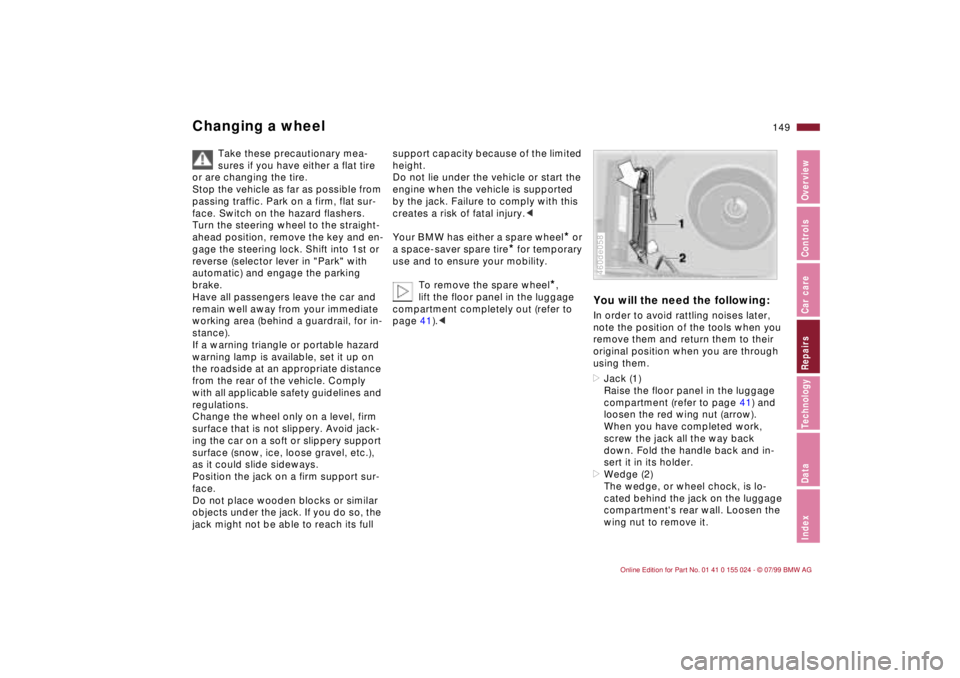
You will the need the following:In order to avoid rattling noises later,
note the position of the tools when you
remove them and return them to their
original position when you are through
using them.
>Jack (1)
Raise the floor panel in the luggage
compartment (refer to page 41) and
loosen the red wing nut (arrow).
When you have completed work,
screw the jack all the way back
down. Fold the handle back and in-
sert it in its holder.
>Wedge (2)
The wedge, or wheel chock, is lo-
cated behind the jack on the luggage
compartment's rear wall. Loosen the
wing nut to remove it.460de058
Page 150 of 189
150n
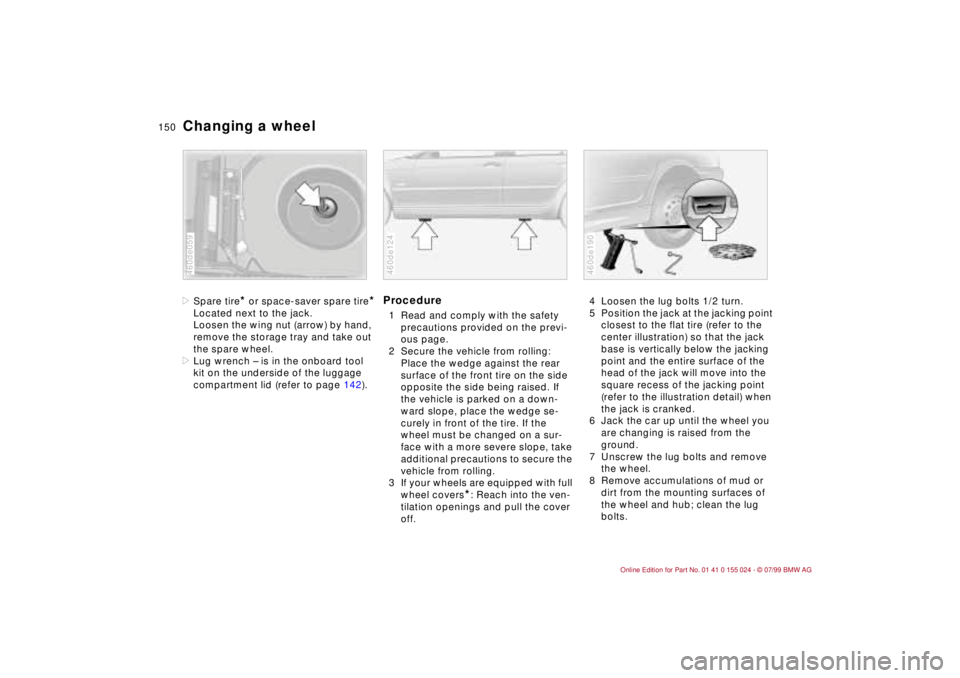
Changing a wheel>Spare tire
* or space-saver spare tire
*
Located next to the jack.
Loosen the wing nut (arrow) by hand,
remove the storage tray and take out
the spare wheel.
>Lug wrench Ð is in the onboard tool
kit on the underside of the luggage
compartment lid (refer to page 142).460de059
Procedure1 Read and comply with the safety
precautions provided on the previ-
ous page.
2 Secure the vehicle from rolling:
Place the wedge against the rear
surface of the front tire on the side
opposite the side being raised. If
the vehicle is parked on a down-
ward slope, place the wedge se-
curely in front of the tire. If the
wheel must be changed on a sur-
face with a more severe slope, take
additional precautions to secure the
vehicle from rolling.
3 If your wheels are equipped with full
wheel covers
*: Reach into the ven-
tilation openings and pull the cover
off.
460de124
4 Loosen the lug bolts 1/2 turn.
5 Position the jack at the jacking point
closest to the flat tire (refer to the
center illustration) so that the jack
base is vertically below the jacking
point and the entire surface of the
head of the jack will move into the
square recess of the jacking point
(refer to the illustration detail) when
the jack is cranked.
6 Jack the car up until the wheel you
are changing is raised from the
ground.
7 Unscrew the lug bolts and remove
the wheel.
8 Remove accumulations of mud or
dirt from the mounting surfaces of
the wheel and hub; clean the lug
bolts.460de190
Page 151 of 189
151n
IndexDataTechnologyRepairsCar careControlsOverview
Changing a wheel9 Position the new wheel or the
space-saver spare tire
* on the hub
and screw at least two lug bolts fin-
ger-tight into opposite bolt holes.
10 Screw in the remaining lug bolts.
Tighten all the bolts securely.
11 Lower the jack and remove it from
beneath the car.
12 Tighten the lug bolts in a diagonal
pattern.
462de267
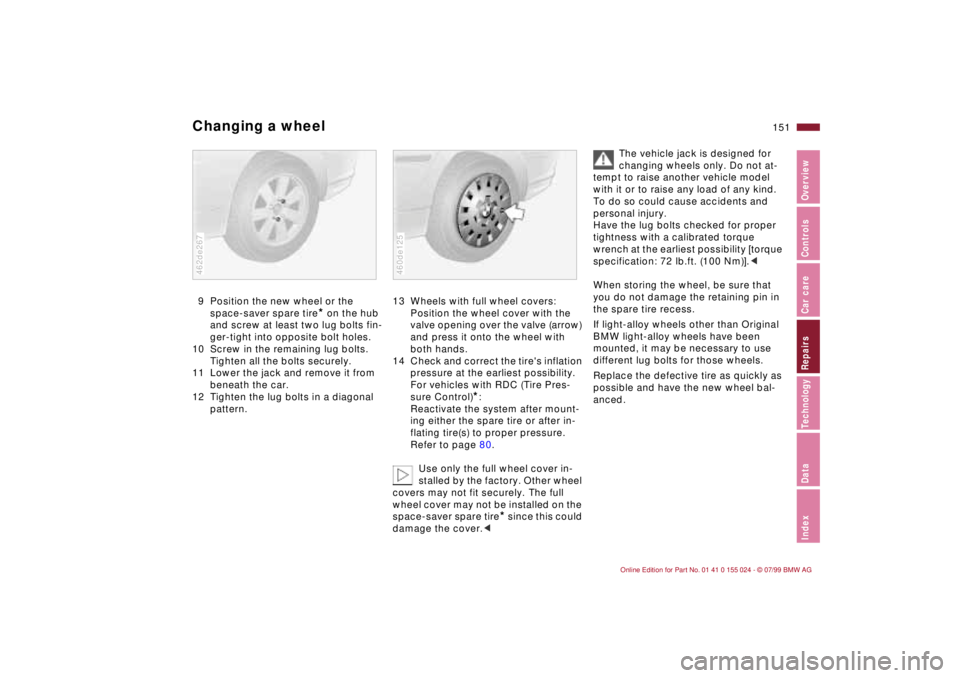
13 Wheels with full wheel covers:
Position the wheel cover with the
valve opening over the valve (arrow)
and press it onto the wheel with
both hands.
14 Check and correct the tire's inflation
pressure at the earliest possibility.
For vehicles with RDC (Tire Pres-
sure Control)
*:
Reactivate the system after mount-
ing either the spare tire or after in-
flating tire(s) to proper pressure.
Refer to page 80.
Use only the full wheel cover in-
stalled by the factory. Other wheel
covers may not fit securely. The full
wheel cover may not be installed on the
space-saver spare tire
* since this could
damage the cover.<
460de125
The vehicle jack is designed for
changing wheels only. Do not at-
tempt to raise another vehicle model
with it or to raise any load of any kind.
To do so could cause accidents and
personal injury.
Have the lug bolts checked for proper
tightness with a calibrated torque
wrench at the earliest possibility [torque
specification: 72 lb.ft. (100 Nm)].<
When storing the wheel, be sure that
you do not damage the retaining pin in
the spare tire recess.
If light-alloy wheels other than Original
BMW light-alloy wheels have been
mounted, it may be necessary to use
different lug bolts for those wheels.
Replace the defective tire as quickly as
possible and have the new wheel bal-
anced.
Page 163 of 189
163n
IndexDataTechnologyRepairsCar careControlsOverview
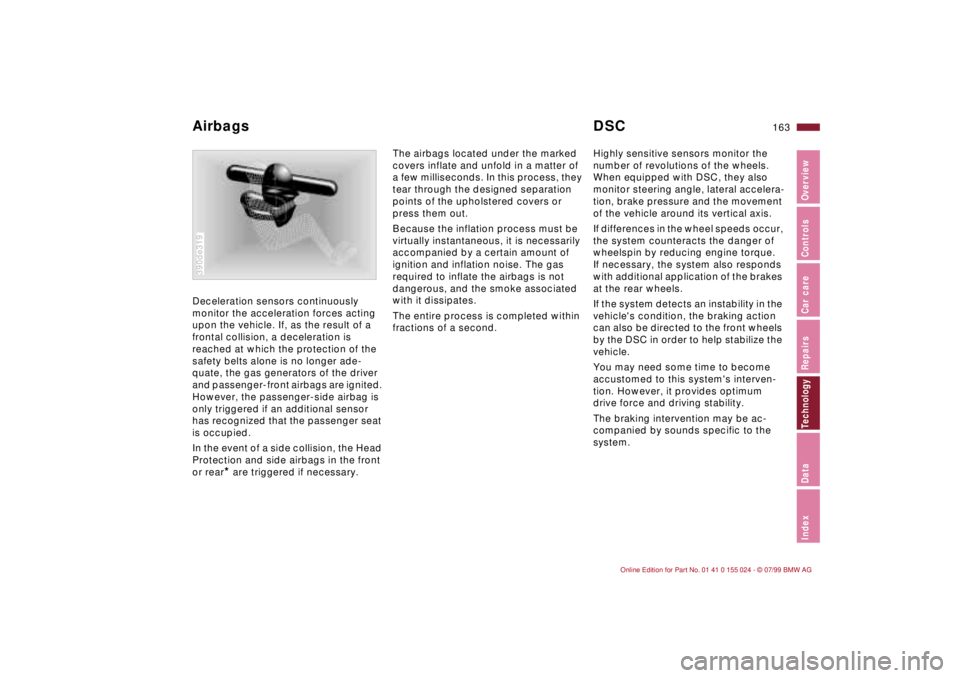
Deceleration sensors continuously
monitor the acceleration forces acting
upon the vehicle. If, as the result of a
frontal collision, a deceleration is
reached at which the protection of the
safety belts alone is no longer ade-
quate, the gas generators of the driver
and passenger-front airbags are ignited.
However, the passenger-side airbag is
only triggered if an additional sensor
has recognized that the passenger seat
is occupied.
In the event of a side collision, the Head
Protection and side airbags in the front
or rear
* are triggered if necessary.
390de319
The airbags located under the marked
covers inflate and unfold in a matter of
a few milliseconds. In this process, they
tear through the designed separation
points of the upholstered covers or
press them out.
Because the inflation process must be
virtually instantaneous, it is necessarily
accompanied by a certain amount of
ignition and inflation noise. The gas
required to inflate the airbags is not
dangerous, and the smoke associated
with it dissipates.
The entire process is completed within
fractions of a second.Highly sensitive sensors monitor the
number of revolutions of the wheels.
When equipped with DSC, they also
monitor steering angle, lateral accelera-
tion, brake pressure and the movement
of the vehicle around its vertical axis.
If differences in the wheel speeds occur,
the system counteracts the danger of
wheelspin by reducing engine torque.
If necessary, the system also responds
with additional application of the brakes
at the rear wheels.
If the system detects an instability in the
vehicle's condition, the braking action
can also be directed to the front wheels
by the DSC in order to help stabilize the
vehicle.
You may need some time to become
accustomed to this system's interven-
tion. However, it provides optimum
drive force and driving stability.
The braking intervention may be ac-
companied by sounds specific to the
system.
Airbags DSC
Page 181 of 189

Everything from A to Z
181n
IndexDataTechnologyRepairsCar careControlsOverview
Clock75
refer also to the Radio
or Onboard Computer
Owner's Manual
Cockpit16
Coin holder, cup holder93
Combination switch68
Compression172
Computer76
Configure settings53
Consumption77
Consumption display74
Coolant110, 128, 175
antifreeze110
Coolant temperature
gauge74
Cooling system175
Cornering Brake Control
(CBC)21, 107
Cruise control71
Cruising range77
Curb weight174DDash lighting82
Dashboard16
Data
dimensions173
engine172
weights174
Daytime-driving lamp
switch82
Defrost position89Defroster, rear window90
Defrosting the windows89
Digital clock75
Dimensions173
Dipstick125
Disc brakes108
Displacement172
Display lighting82
Displays18
Distance warning78
Diversity Antenna164
Divided rear backrest97
Door key32
Door locks, care110
Doors
child-safety locks56
emergency operation34
unlocking and locking34
Draft-free ventilation90
Driving hints104
Driving in winter110
Driving lamps82
Dynamic Stability Control
(DSC)22, 79, 163
EElectric power windows44
Electrical accessories,
failure154
Electrical system176
Electronic vehicle
immobilizer33
Elements of operation16Emergency operation,
doors34
Energy Control73
Engine
starting61
Engine compartment122
Engine coolant128, 175
Engine data172
Engine oil
capacity175
consumption125
pressure20
quality126
specifications126
viscosity126
Engine oil level21, 22
check125
Engine speed172
Exterior mirrors52
FFailure messages75
Fault
ABS107
Fault displays75
Filler cap cover26
Filling capacities175
Filling the washer
reservoir175
First aid25
First-aid kit25
Fittings, towing and
tow-starting158Flashlight92
Flat tire113, 149
Fog lamps83
Folding rear backrest97
Footbrake108
Footwell lamps83
bulb replacement148
Front fog lamps83
bulb replacement145
Front seat-adjustment47
Frost protection,
radiator128
Fuel26
fuel injection172
Fuel consumption77
Fuel consumption
display74
Fuel filler door
releasing following an
electrical malfunction156
Fuel gauge74
Fuel quality26
Fuel reserve indicator
lamp74
Fuel tank capacity175
Fuel tank gauge74
Functional status168
Fuses154
GGasoline26
Gasoline gauge74
Glove compartment92
Page 182 of 189

Everything from A to ZGlove compartment lamp
bulb replacement148
Gross vehicle weight174HHandbrake63
Handsfree system95
Hazard warning flashers25
Hazard warning triangle25
Head restraint48
Headlamp covers,
care132, 143
Headlamp flasher83
Headlamp washer
system124, 175
Headlamp washers70
Heated seats91
Heavy loads99
Height173
HiFi system Ð harman
kardon92
High beams23, 68, 83
bulb replacement143
Hood release120
Horn17
Hubcap150IIce warning76
Icy roads76
Identification, tires116Ignition key32
Ignition lock61
Indicator lamps20
Inflated pressure27, 113
Inflation pressure
monitoring80, 167
INSPECTION74
Installing a child restraint
system60
Instrument cluster18
Instrument lighting82
Instrument panel18
Interaxle tire rotation115
Interface socket96
for Onboard
Diagnostics139
Interference
cellular phones112
Interior lamps36, 83
bulb replacement147
remote control36
Interior motion sensor42
Interior rearview mirror52
automatic dimming
feature53, 165
Interlock61
Intermittent wipe68
JJack149
Jump-starting157
KKey Memory53
Keys32
with remote control32LLAMPS ON warning82
Lashing eyes99
Leather care136
Length173
License plate lamp
bulb replacement147
Light switch82
Light-alloy wheels118
Lighter96
Load-securing devices99
Louvers86
Low beam headlamps82
Low beams
bulb replacement143
Lug bolts150
Lug wrench149
Luggage compartment41
capacity174
floor mat41
floor panel41
remote control37
Luggage compartment
lamps
bulb replacement148Luggage compartment
lid39
emergency release39
securing separately39
Luggage compartment
lighting39
Luggage rack100
Lumbar support49
MM+S tires117
Maintenance74, 131
Malfunction displays75
Manual transmission64
Manually controlled
recirculated-air89
Memory50
MFL (Multifunction steering
wheel)24
Microfilter90, 155
Mirror memory50
Mirrors52
Mobile phones112
Modifications,
technical6, 138
Multifunction steering wheel
(MFL)24NNeckrest48
Page 184 of 189

Everything from A to ZSpeed display18
Speedometer18
Sports Seat49
Starting61
Starting assistance157
Starting problems105, 157
Starting the engine61
Steel wheels118
Steering111
Steering wheel lock61
Steptronic65
Stopping the vehicle62
Storage compartments93
Storing the vehicle137
Stroke172
Summer tires116
Sun visors52
Switching off the engine62
Symbols4, 153
Synthetic oils126TTachometer73
Tail lamp assembly
bulb replacement145
Tail lamps145
Tank capacity175
Technical data172
Technical
modifications6, 138Telephone
refer to the separate
Owner's Manual
Telephone hookup95
Temperature adjustment88
Temperature display
outside temperature76
Temperature gauge
engine coolant74
Temperature layering90
Third brake lamp147
Through-loading system97
Tilt alarm36, 43
remote control36
Tire codes116
Tire damage113
Tire inflation
pressure27, 113
Tire pressure
checking27
Tire Pressure Control
(RDC)80, 167
Tire pressure
monitoring80, 167
Tire replacement114, 115
Tire specifications118
Tire tread113
Tools142
Torque172
Tow fittings158
Tow starting158Towing158
Track173
Traction Control System
refer to DSC79
Transmission64
Tread depth, tires113
Trip odometer73
Trunk39
Trunk lid, refer to luggage
compartment lid39
Turn signal
indicator23, 68, 144
bulb replacement144
Turning radius173
Two-way radios112
UUsed batteries154VVacuum cleaner,
connecting96
Vanity mirror52
bulb replacement148
Vehicle battery152, 176
Vehicle care
exterior133
interior134
Vehicle identification130
Vehicle Identification
Number (VIN)130Vehicle immobilizer33
Vehicle painting133
Vehicle storage137
Vehicle weight174
Ventilation86
draft-free90
Vinyl care135
WWarning lamp "Please fasten
safety belts"21
Warning lamps20
Warning messages75
Warranty and Service Guide
Booklet131
Washer reservoir, filling124
Washing your car132
Water on roadways
deep water104
Waxing, paintwork134
Weights174
Wheel rims116
Wheelbase173
Wheels and tires116, 118
Width173
Windows, convenience
operation34
Windshield washer nozzle
adjustment124
Windshield washer reservoir,
filling124, 175