check engine BMW 328i SEDAN 2000 E46 User Guide
[x] Cancel search | Manufacturer: BMW, Model Year: 2000, Model line: 328i SEDAN, Model: BMW 328i SEDAN 2000 E46Pages: 189, PDF Size: 1.81 MB
Page 128 of 189
128n
Coolant
Do not add coolant to the cooling
system when the engine is hot. If
you attempt to do so, escaping coolant
can cause burns.
To avoid the possibility of damage later
on, never use anything other than fac-
tory-approved, nitrite and amino-free
extended-duty antifreeze with corrosion
inhibitor. Your BMW center is familiar
with the official specifications.
Antifreeze and anticorrosion agents are
hazardous to health. You should always
store them in their original container
and in a location that is inaccessible to
children. Extended-duty antifreeze with
corrosion inhibitor contains ethylene
glycol, a flammable substance. For this
reason, do not spill antifreeze with cor-
rosion inhibitor on hot engine parts. It
could ignite and cause serious burns.<
Comply with the applicable envi-
ronmental laws regulating the dis-
posal of extended-duty antifreeze with
corrosion inhibitor.<
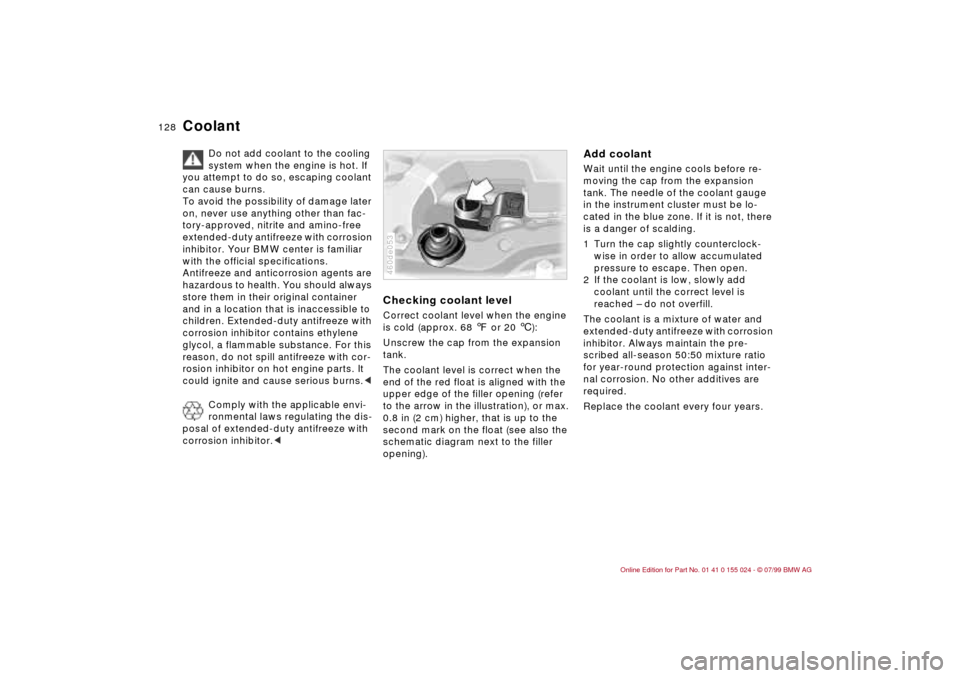
Checking coolant levelCorrect coolant level when the engine
is cold (approx. 68 7 or 20 6):
Unscrew the cap from the expansion
tank.
The coolant level is correct when the
end of the red float is aligned with the
upper edge of the filler opening (refer
to the arrow in the illustration), or max.
0.8 in (2 cm) higher, that is up to the
second mark on the float (see also the
schematic diagram next to the filler
opening).460de053
Add coolant Wait until the engine cools before re-
moving the cap from the expansion
tank. The needle of the coolant gauge
in the instrument cluster must be lo-
cated in the blue zone. If it is not, there
is a danger of scalding.
1 Turn the cap slightly counterclock-
wise in order to allow accumulated
pressure to escape. Then open.
2 If the coolant is low, slowly add
coolant until the correct level is
reached Ð do not overfill.
The coolant is a mixture of water and
extended-duty antifreeze with corrosion
inhibitor. Always maintain the pre-
scribed all-season 50:50 mixture ratio
for year-round protection against inter-
nal corrosion. No other additives are
required.
Replace the coolant every four years.
Page 129 of 189
129n
IndexDataTechnologyRepairsCar careControlsOverview
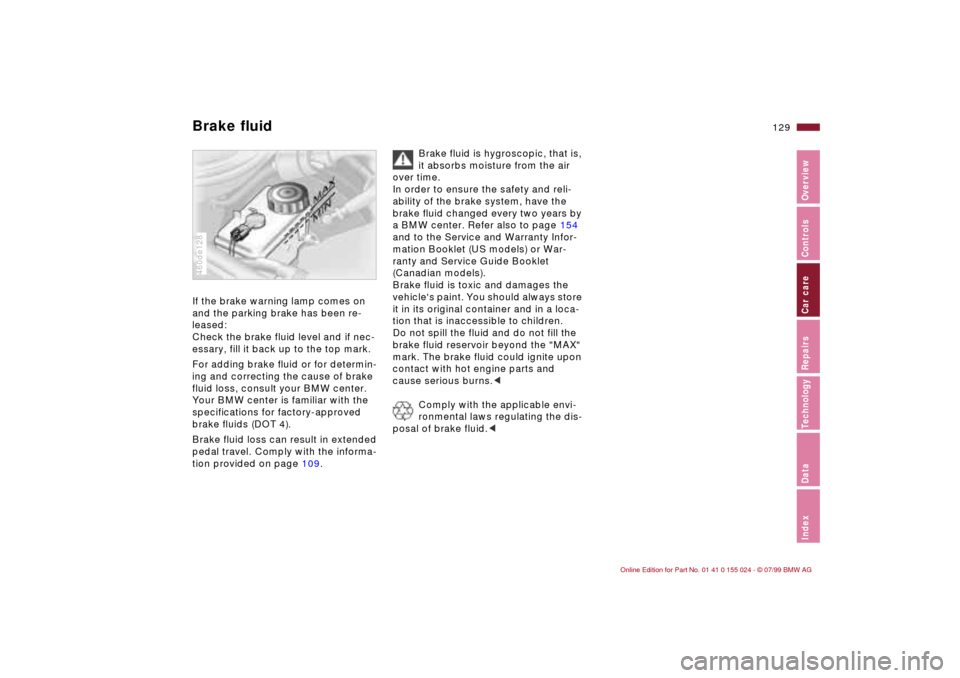
Brake fluidIf the brake warning lamp comes on
and the parking brake has been re-
leased:
Check the brake fluid level and if nec-
essary, fill it back up to the top mark.
For adding brake fluid or for determin-
ing and correcting the cause of brake
fluid loss, consult your BMW center.
Your BMW center is familiar with the
specifications for factory-approved
brake fluids (DOT 4).
Brake fluid loss can result in extended
pedal travel. Comply with the informa-
tion provided on page 109.460de128
Brake fluid is hygroscopic, that is,
it absorbs moisture from the air
over time.
In order to ensure the safety and reli-
ability of the brake system, have the
brake fluid changed every two years by
a BMW center. Refer also to page 154
and to the Service and Warranty Infor-
mation Booklet (US models) or War-
ranty and Service Guide Booklet
(Canadian models).
Brake fluid is toxic and damages the
vehicle's paint. You should always store
it in its original container and in a loca-
tion that is inaccessible to children.
Do not spill the fluid and do not fill the
brake fluid reservoir beyond the "MAX"
mark. The brake fluid could ignite upon
contact with hot engine parts and
cause serious burns.<
Comply with the applicable envi-
ronmental laws regulating the dis-
posal of brake fluid.<
Page 131 of 189
131n
IndexDataTechnologyRepairsCar careControlsOverview
The BMW Maintenance System has
been designed as a reliable means of
providing maximum driving and operat-
ing safety Ð and as cost-effectively as
possible for you. Technical innovations
have made it possible to reduce main-
tenance costs significantly compared to
earlier models.
Please keep in mind that regular main-
tenance is not only necessary for the
safety of your vehicle, but also plays a
significant role in maintaining the resale
value of the vehicle. 460us112
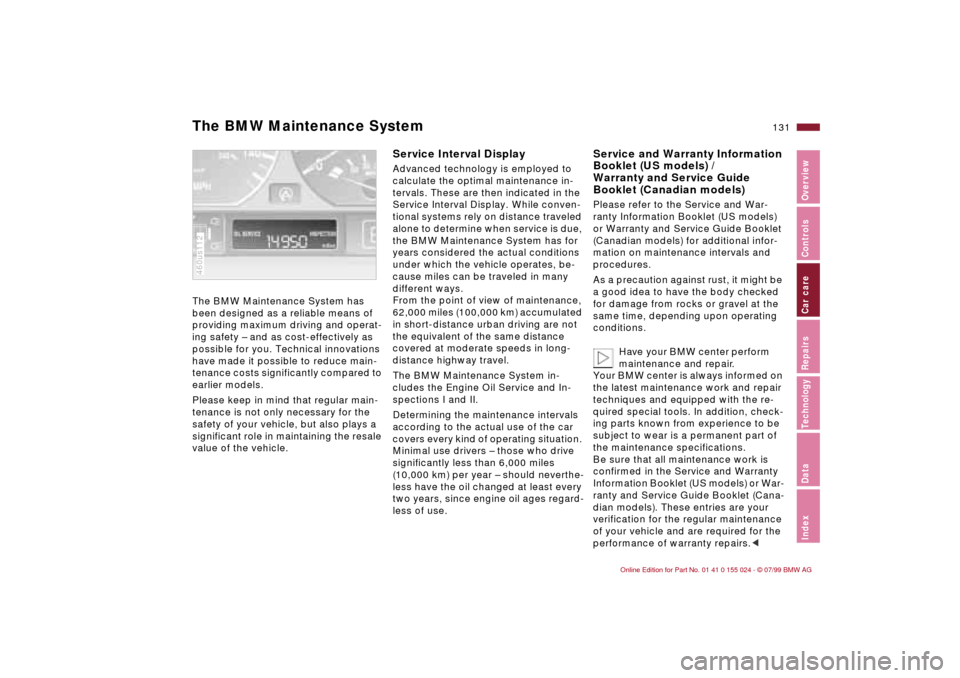
Service Interval DisplayAdvanced technology is employed to
calculate the optimal maintenance in-
tervals. These are then indicated in the
Service Interval Display. While conven-
tional systems rely on distance traveled
alone to determine when service is due,
the BMW Maintenance System has for
years considered the actual conditions
under which the vehicle operates, be-
cause miles can be traveled in many
different ways.
From the point of view of maintenance,
62,000 miles (100,000 km) accumulated
in short-distance urban driving are not
the equivalent of the same distance
covered at moderate speeds in long-
distance highway travel.
The BMW Maintenance System in-
cludes the Engine Oil Service and In-
spections I and II.
Determining the maintenance intervals
according to the actual use of the car
covers every kind of operating situation.
Minimal use drivers Ð those who drive
significantly less than 6,000 miles
(10,000 km) per year Ð should neverthe-
less have the oil changed at least every
two years, since engine oil ages regard-
less of use.
Service and Warranty Information
Booklet (US models) /
Warranty and Service Guide
Booklet (Canadian models) Please refer to the Service and War-
ranty Information Booklet (US models)
or Warranty and Service Guide Booklet
(Canadian models) for additional infor-
mation on maintenance intervals and
procedures.
As a precaution against rust, it might be
a good idea to have the body checked
for damage from rocks or gravel at the
same time, depending upon operating
conditions.
Have your BMW center perform
maintenance and repair.
Your BMW center is always informed on
the latest maintenance work and repair
techniques and equipped with the re-
quired special tools. In addition, check-
ing parts known from experience to be
subject to wear is a permanent part of
the maintenance specifications.
Be sure that all maintenance work is
confirmed in the Service and Warranty
Information Booklet (US models) or War-
ranty and Service Guide Booklet (Cana-
dian models). These entries are your
verification for the regular maintenance
of your vehicle and are required for the
performance of warranty repairs.<
The BMW Maintenance System
Page 139 of 189
139n
IndexDataTechnologyRepairsCar careControlsOverview
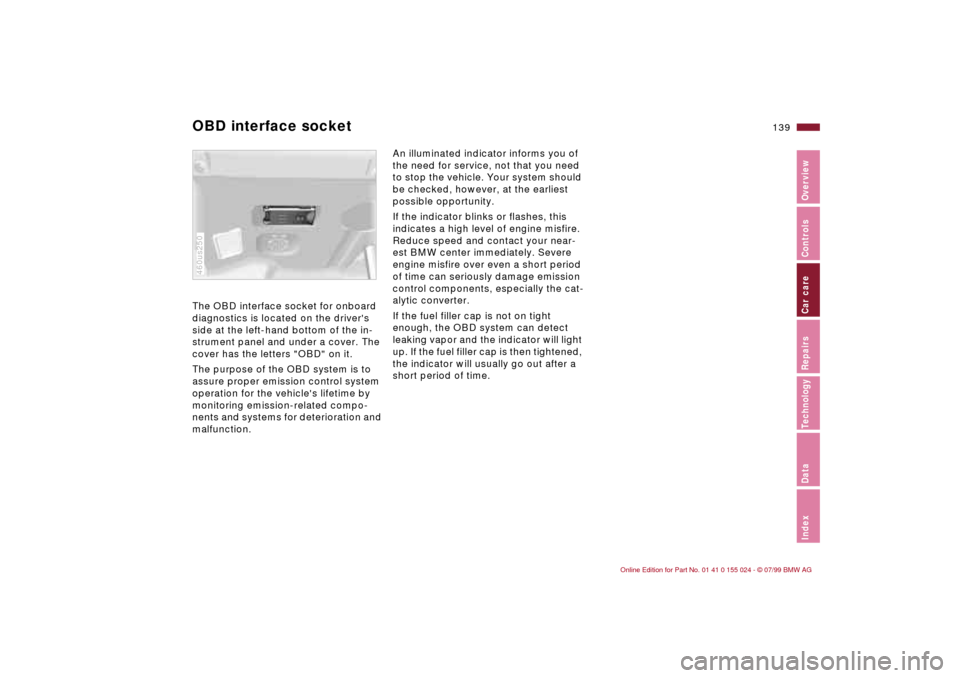
OBD interface socket The OBD interface socket for onboard
diagnostics is located on the driver's
side at the left-hand bottom of the in-
strument panel and under a cover. The
cover has the letters "OBD" on it.
The purpose of the OBD system is to
assure proper emission control system
operation for the vehicle's lifetime by
monitoring emission-related compo-
nents and systems for deterioration and
malfunction.460us250
An illuminated indicator informs you of
the need for service, not that you need
to stop the vehicle. Your system should
be checked, however, at the earliest
possible opportunity.
If the indicator blinks or flashes, this
indicates a high level of engine misfire.
Reduce speed and contact your near-
est BMW center immediately. Severe
engine misfire over even a short period
of time can seriously damage emission
control components, especially the cat-
alytic converter.
If the fuel filler cap is not on tight
enough, the OBD system can detect
leaking vapor and the indicator will light
up. If the fuel filler cap is then tightened,
the indicator will usually go out after a
short period of time.
Page 154 of 189
154n
Battery FusesCharging the battery Charge the battery in the vehicle only
when the engine is not running.
Before doing any work on the elec-
trical system, be sure to unclamp
the cable from the battery's negative
terminal. Failure to do so can result in
short-circuits, a fire or personal injury.<
If the vehicle is to be parked longer than
four weeks, disconnect the battery from
the vehicle's electrical system by dis-
connecting the negative terminal cable
and then recharge using a suitable
charging device.
If you intend to store your car for longer
than twelve weeks: Remove the battery,
charge it and store it in a cool (but frost-
and dust-free) room. Every three months
and before reinstalling the battery, have
it recharged. If it is not recharged, it will
not be serviceable. Every time the bat-
tery is discharged, especially over ex-
tended periods, its service life is re-
duced.
Return used batteries to a recy-
cling center or your BMW center.
Maintain the battery in an upright posi-
tion for transport and storage. Secure
the battery to prevent it from tilting dur-
ing transport.<
Storage periods during which the
battery is disconnected are not
taken into consideration by the Service
Interval Display for changing the brake
fluid.
For this reason, be sure that the brake
fluid is changed every two years, re-
gardless of the information displayed.
Read and comply with the information
on page 129 covering this subject.<
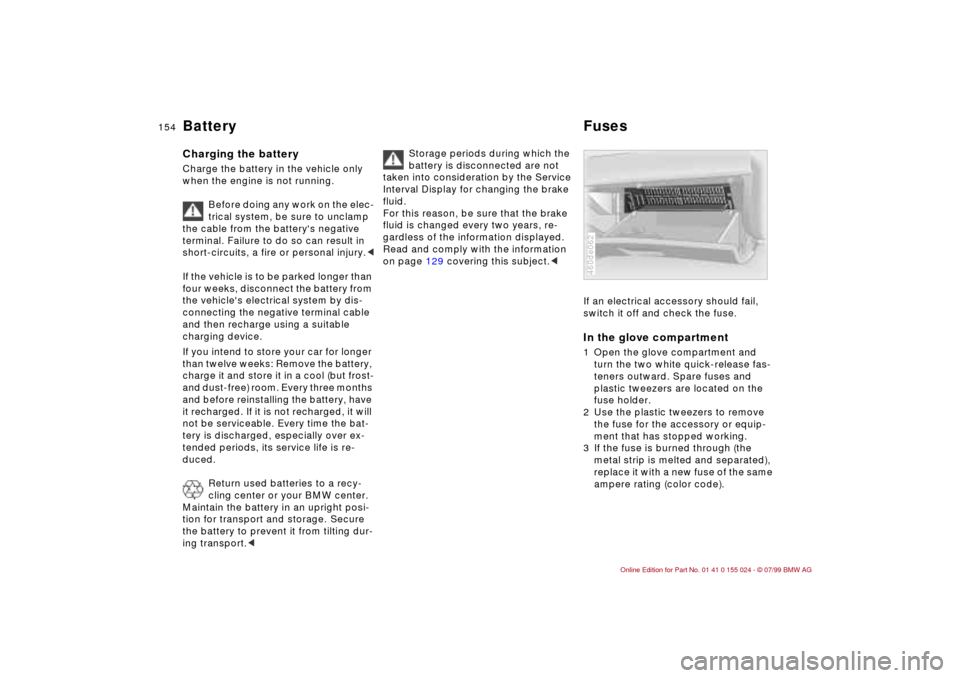
If an electrical accessory should fail,
switch it off and check the fuse. In the glove compartment1 Open the glove compartment and
turn the two white quick-release fas-
teners outward. Spare fuses and
plastic tweezers are located on the
fuse holder.
2 Use the plastic tweezers to remove
the fuse for the accessory or equip-
ment that has stopped working.
3 If the fuse is burned through (the
metal strip is melted and separated),
replace it with a new fuse of the same
ampere rating (color code).460de062
Page 168 of 189
168n
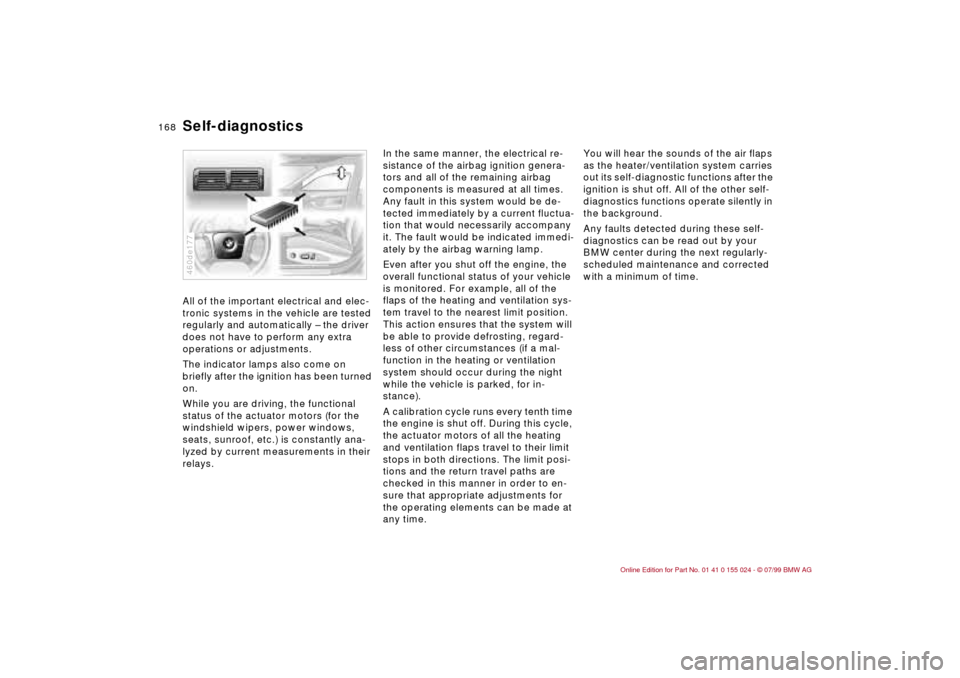
Self-diagnostics All of the important electrical and elec-
tronic systems in the vehicle are tested
regularly and automatically Ð the driver
does not have to perform any extra
operations or adjustments.
The indicator lamps also come on
briefly after the ignition has been turned
on.
While you are driving, the functional
status of the actuator motors (for the
windshield wipers, power windows,
seats, sunroof, etc.) is constantly ana-
lyzed by current measurements in their
relays.460de177
In the same manner, the electrical re-
sistance of the airbag ignition genera-
tors and all of the remaining airbag
components is measured at all times.
Any fault in this system would be de-
tected immediately by a current fluctua-
tion that would necessarily accompany
it. The fault would be indicated immedi-
ately by the airbag warning lamp.
Even after you shut off the engine, the
overall functional status of your vehicle
is monitored. For example, all of the
flaps of the heating and ventilation sys-
tem travel to the nearest limit position.
This action ensures that the system will
be able to provide defrosting, regard-
less of other circumstances (if a mal-
function in the heating or ventilation
system should occur during the night
while the vehicle is parked, for in-
stance).
A calibration cycle runs every tenth time
the engine is shut off. During this cycle,
the actuator motors of all the heating
and ventilation flaps travel to their limit
stops in both directions. The limit posi-
tions and the return travel paths are
checked in this manner in order to en-
sure that appropriate adjustments for
the operating elements can be made at
any time.You will hear the sounds of the air flaps
as the heater/ventilation system carries
out its self-diagnostic functions after the
ignition is shut off. All of the other self-
diagnostics functions operate silently in
the background.
Any faults detected during these self-
diagnostics can be read out by your
BMW center during the next regularly-
scheduled maintenance and corrected
with a minimum of time.
Page 180 of 189
Everything from A to ZAABS (Antilock Brake
System)22, 106
Accessories6
Activated-charcoal
filter90, 155
Adaptive Transmission
Control (ATC)65, 162
Adding engine oil125
Adding washer
fluid124, 175
Adjusting the backrest47
Adjusting the steering
wheel51
Adjusting the thigh support
area49
Air distribution88
Air nozzles86
Air outlets86
ventilation86
Air pressure113
Air supply89
Airbags21, 56, 137, 163
Alarm system42
Antenna112
Antenna, Diversity164
Antifreeze128
radiator110
Antilock Brake System
(ABS)22, 106
Anti-theft alarm system42
Aquaplaning104, 113
Armrest93Ashtray95
front95
rear96
ATC (Adaptive Transmission
Control)65, 162
AUC (Automatic
recirculated-air
control)89
Automatic car washes132
Automatic climate
control86
removing condensation
from the windows89
Automatic cruise control71
Automatic dimming, interior
rearview mirror53
Automatic recirculated-air
control (AUC)89
Automatic transmission with
Steptronic22, 65
Automatic windshield
washer69
Average consumption77
Average speed77
Axle loads174
BBackup lamps64
bulb replacement145
Battery152, 176
capacity176
charge154discharged157
removal and
installation153
Battery charge current20
Battery Safety Terminal
(BST)153
Belts54
Blower89
BMW High Performance
Synthetic Oils126
BMW Sports Seat49
Bore172
Brake fluid129
Brake hydraulic system20
Brake lamps
bulb replacement145
Brake pads22
Brakes108
malfunctions109
Break-in procedure104
Breaking in the vehicle104
BST (Battery Safety
Terminal)153
Bulb replacement142
CCapacities175
Car Memory53
Car radio112
refer also to the separate
Owner's ManualCar radio
reception112, 164
Car vacuum cleaner,
connecting96
Car wash132
Care
exterior133
interior134
Care of upholstery135
Care of wool velour135
Cargo loading99
Caring for the vehicle
finish133
Catalytic converter105
CBC (Cornering Brake
Control)21, 107
Cellular phone95, 112
refer also to the separate
Owner's Manual
Center (high-mount) brake
lamp147
Center armrest93
Central locking system34
button38
Changing a tire149
Changing a wheel149
Charge indicator lamp20
Check Control75
Child restraint
systems55, 59
Child seat59
Child-safety locks56
Cigarette lighter96
Everything from A-Z
Page 181 of 189

Everything from A to Z
181n
IndexDataTechnologyRepairsCar careControlsOverview
Clock75
refer also to the Radio
or Onboard Computer
Owner's Manual
Cockpit16
Coin holder, cup holder93
Combination switch68
Compression172
Computer76
Configure settings53
Consumption77
Consumption display74
Coolant110, 128, 175
antifreeze110
Coolant temperature
gauge74
Cooling system175
Cornering Brake Control
(CBC)21, 107
Cruise control71
Cruising range77
Curb weight174DDash lighting82
Dashboard16
Data
dimensions173
engine172
weights174
Daytime-driving lamp
switch82
Defrost position89Defroster, rear window90
Defrosting the windows89
Digital clock75
Dimensions173
Dipstick125
Disc brakes108
Displacement172
Display lighting82
Displays18
Distance warning78
Diversity Antenna164
Divided rear backrest97
Door key32
Door locks, care110
Doors
child-safety locks56
emergency operation34
unlocking and locking34
Draft-free ventilation90
Driving hints104
Driving in winter110
Driving lamps82
Dynamic Stability Control
(DSC)22, 79, 163
EElectric power windows44
Electrical accessories,
failure154
Electrical system176
Electronic vehicle
immobilizer33
Elements of operation16Emergency operation,
doors34
Energy Control73
Engine
starting61
Engine compartment122
Engine coolant128, 175
Engine data172
Engine oil
capacity175
consumption125
pressure20
quality126
specifications126
viscosity126
Engine oil level21, 22
check125
Engine speed172
Exterior mirrors52
FFailure messages75
Fault
ABS107
Fault displays75
Filler cap cover26
Filling capacities175
Filling the washer
reservoir175
First aid25
First-aid kit25
Fittings, towing and
tow-starting158Flashlight92
Flat tire113, 149
Fog lamps83
Folding rear backrest97
Footbrake108
Footwell lamps83
bulb replacement148
Front fog lamps83
bulb replacement145
Front seat-adjustment47
Frost protection,
radiator128
Fuel26
fuel injection172
Fuel consumption77
Fuel consumption
display74
Fuel filler door
releasing following an
electrical malfunction156
Fuel gauge74
Fuel quality26
Fuel reserve indicator
lamp74
Fuel tank capacity175
Fuel tank gauge74
Functional status168
Fuses154
GGasoline26
Gasoline gauge74
Glove compartment92
Page 184 of 189

Everything from A to ZSpeed display18
Speedometer18
Sports Seat49
Starting61
Starting assistance157
Starting problems105, 157
Starting the engine61
Steel wheels118
Steering111
Steering wheel lock61
Steptronic65
Stopping the vehicle62
Storage compartments93
Storing the vehicle137
Stroke172
Summer tires116
Sun visors52
Switching off the engine62
Symbols4, 153
Synthetic oils126TTachometer73
Tail lamp assembly
bulb replacement145
Tail lamps145
Tank capacity175
Technical data172
Technical
modifications6, 138Telephone
refer to the separate
Owner's Manual
Telephone hookup95
Temperature adjustment88
Temperature display
outside temperature76
Temperature gauge
engine coolant74
Temperature layering90
Third brake lamp147
Through-loading system97
Tilt alarm36, 43
remote control36
Tire codes116
Tire damage113
Tire inflation
pressure27, 113
Tire pressure
checking27
Tire Pressure Control
(RDC)80, 167
Tire pressure
monitoring80, 167
Tire replacement114, 115
Tire specifications118
Tire tread113
Tools142
Torque172
Tow fittings158
Tow starting158Towing158
Track173
Traction Control System
refer to DSC79
Transmission64
Tread depth, tires113
Trip odometer73
Trunk39
Trunk lid, refer to luggage
compartment lid39
Turn signal
indicator23, 68, 144
bulb replacement144
Turning radius173
Two-way radios112
UUsed batteries154VVacuum cleaner,
connecting96
Vanity mirror52
bulb replacement148
Vehicle battery152, 176
Vehicle care
exterior133
interior134
Vehicle identification130
Vehicle Identification
Number (VIN)130Vehicle immobilizer33
Vehicle painting133
Vehicle storage137
Vehicle weight174
Ventilation86
draft-free90
Vinyl care135
WWarning lamp "Please fasten
safety belts"21
Warning lamps20
Warning messages75
Warranty and Service Guide
Booklet131
Washer reservoir, filling124
Washing your car132
Water on roadways
deep water104
Waxing, paintwork134
Weights174
Wheel rims116
Wheelbase173
Wheels and tires116, 118
Width173
Windows, convenience
operation34
Windshield washer nozzle
adjustment124
Windshield washer reservoir,
filling124, 175
Page 186 of 189

Owner service proceduresAActivated-charcoal filter,
changing155
Adding brake fluid129
Adding engine coolant128
Adding engine oil125BBackup lamps
bulb replacement145
Battery
add distilled water153
charging154
Brake lamps
bulb replacement145
Brakes, brake faults109CChanging a tire149
Changing a wheel149
Check Control75
Checking air pressure27
Checking engine oil
level125
Checking oil level125DDefrosting the windows89
Difficult steering111
Doors, emergency
operation34
EElectrical accessories,
failure154
Electrical malfunction
fuel filler door156
sliding/tilt sunroof156
Emergency operation
doors34
fuel filler door156
sliding/tilt sunroof156
Engine oil
add125
quality126
specifications126
viscosity126FFailure messages75
Fault displays75
First aid25
First-aid kit25
Fittings, towing and
tow-starting158
Flat tire149
Footwell lamps
bulb replacement148
Front fog lamps
bulb replacement145
Fuses, replacing154GGlove compartment lamp
bulb replacement148
HHazard warning flashers25
Hazard warning triangle25
Headlamp cover, care143
High beams
bulb replacement143IIndicator lamps20
Inflated pressure27, 113
Interior lamps
bulb replacement147
Interior motion sensor,
switching off43JJack149LLicense plate lamp
bulb replacement147
Low beams
bulb replacement143
Lug wrench149
Luggage compartment
lamps
bulb replacement148
Luggage compartment lid,
emergency release39
MMaintenance131
Malfunction displays75
Microfilter, changing155OOil
quality126
specifications126
viscosity126
Onboard tool kit142PPressure, tires27RRear lamps145
Releasing the fuel filler door
following an electrical
malfunction156
Releasing the hood120
Removing condensation
from the windows89
Replacement key32
Replacing bulbs142
Replacing lamp bulbs142
Replacing windshield wiper
blades142
Replacing wiper blades142
Return used batteries154
Owner service procedures