belt BMW 330CI CONVERTABLE 2006 User Guide
[x] Cancel search | Manufacturer: BMW, Model Year: 2006, Model line: 330CI CONVERTABLE, Model: BMW 330CI CONVERTABLE 2006Pages: 190, PDF Size: 2.79 MB
Page 61 of 190
61
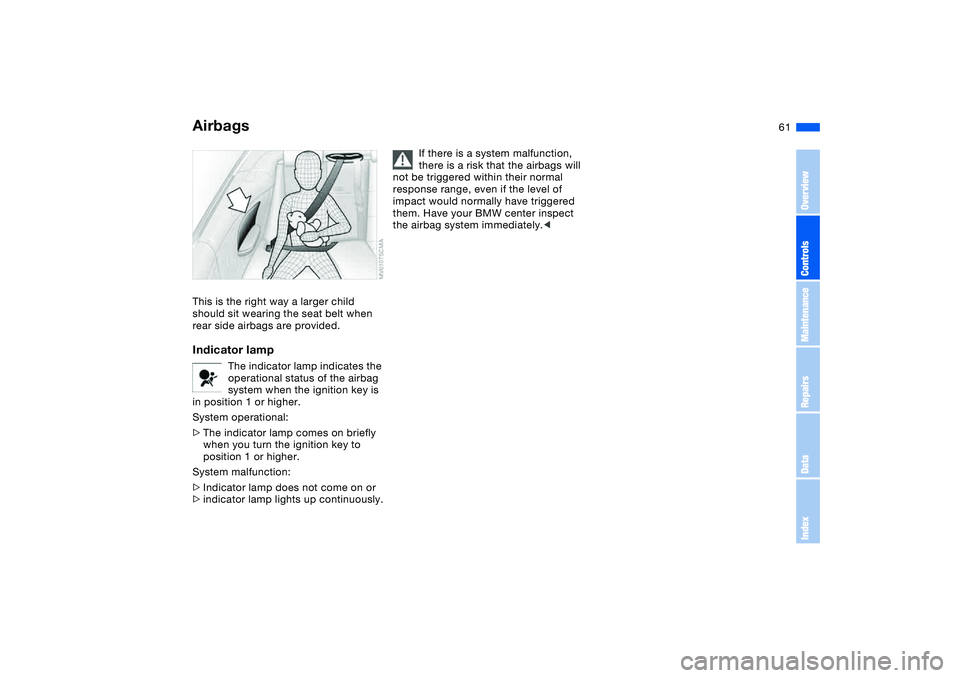
This is the right way a larger child
should sit wearing the seat belt when
rear side airbags are provided.Indicator lamp
The indicator lamp indicates the
operational status of the airbag
system when the ignition key is
in position 1 or higher.
System operational:
>The indicator lamp comes on briefly
when you turn the ignition key to
position 1 or higher.
System malfunction:
>Indicator lamp does not come on or
>indicator lamp lights up continuously.
If there is a system malfunction,
there is a risk that the airbags will
not be triggered within their normal
response range, even if the level of
impact would normally have triggered
them. Have your BMW center inspect
the airbag system immediately.<
Airbags
OverviewControlsMaintenanceRepairsDataIndex
Page 62 of 190
62
Transporting children safely
To avoid undesired movement at
high speeds, always store the rear
safety belts in their retainers when they
are not in use.<
Commercially available child-restraint
systems are designed to be secured
with a lap belt or with the lap belt por-
tion of a combination lap/shoulder belt.
Improperly or inadequately installed
restraint systems can increase the risk
of injury to children. Always read and
follow the instructions that come with
the system.
Correct location for installingIn your BMW, all seats equipped with a
three-point safety belt – except for the
driver's seat – are suitable for installing
universal child-restraint systems of all
age classes and which have been
approved for the age group in question.
Child-restraint system with
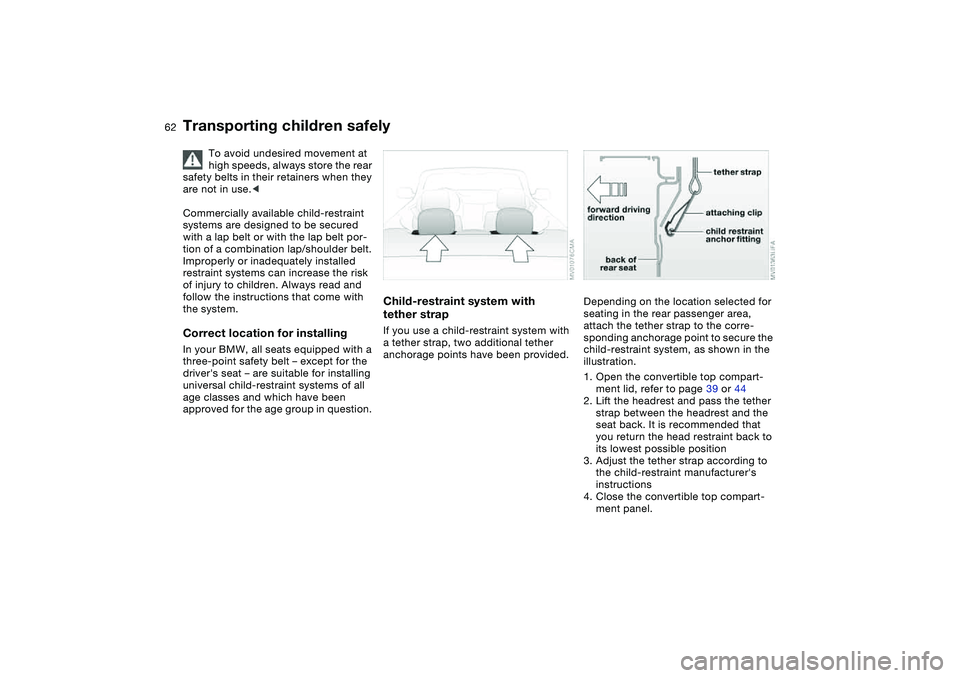
tether strapIf you use a child-restraint system with
a tether strap, two additional tether
anchorage points have been provided.
Depending on the location selected for
seating in the rear passenger area,
attach the tether strap to the corre-
sponding anchorage point to secure the
child-restraint system, as shown in the
illustration.
1. Open the convertible top compart-
ment lid, refer to page 39 or 44
2. Lift the headrest and pass the tether
strap between the headrest and the
seat back. It is recommended that
you return the head restraint back to
its lowest possible position
3. Adjust the tether strap according to
the child-restraint manufacturer's
instructions
4. Close the convertible top compart-
ment panel.
Page 63 of 190
63
It is recommended to cover the child-
restraint attaching clip with a soft mate-
rial to prevent damage to the stored
soft top.
Should a hard top be installed, the
fitting of child harness tether
strap/s – if child seat is required – is
necessary before installation of the
hard top.<
Before installing any child-
restraint device or child seat,
please read the following:
Never install a rearward-facing child-
restraint system in the front passenger
seat of this vehicle.
Your vehicle is equipped with an airbag
supplemental restraint system for the
front passenger. Because the backrest
on any rearward-facing child-restraint
system – of the kind designed for
infants under 1 year and 20 lbs/9 kg –
would be within the airbag's deploy-
ment range, you should never mount
such a device in the front passenger
seat, since the impact of the airbag
against the child restraint's backrest
could lead to serious or fatal injuries.
If it is necessary for a child – not an
infant – to ride in the front seat, certain
precautions should be taken. First,
move the passenger seat as far away
from the dashboard as possible. This
important precaution is intended to
maximize the distance between the air-
bag and the child. Older children
should be tightly secured with the
safety belt after they have outgrown a
booster seat that is appropriate for their
age, height, and weight. Younger chil-
dren should be secured in an appropri-
ate forward-facing child-restraint sys-
tem that has first been properly
installed with a safety belt.
Never install a rearward-facing child-
restraint system in the front passenger
seat.
We strongly urge you to carefully read
and comply with the instructions for
installation and use provided by the
child restraint's manufacturer when-
ever you use such a device.
Do not attempt to modify child-restraint
systems. If you do this, the protection
provided by these systems could be
impaired.
Be sure that all occupants – of all ages –
remain properly and securely restrained
at all times.<
All rear seating positions in your vehicle
meet the recommendations of
SAE J1819, an industry-recommended
practice for securing child-restraint sys-
tems in motor vehicles.
Transporting children safely
OverviewControlsMaintenanceRepairsDataIndex
Page 64 of 190
64
Securing child-restraint system
All of the rear belt retractors and the
front passenger's safety belt can be
locked for mounting and securing child-
restraint systems.
A label with the appropriate instructions
is located in the immediate vicinity of
the buckle of each safety belt.
To lock the safety belt
Extract the entire length of the belt from
the inertia reel mechanism. Allow the
reel to retract the belt somewhat and
engage the buckle, then tighten the belt
against the child-restraint system. The
retraction mechanism is now locked.
The belt cannot be extracted further.
Always observe the installation instruc-
tions provided by the manufacturer of
the child-restraint system.
To unlock the safety belt
Release the safety belt, remove the
child seat and retract the safety belt to
its end position on the belt retractor.
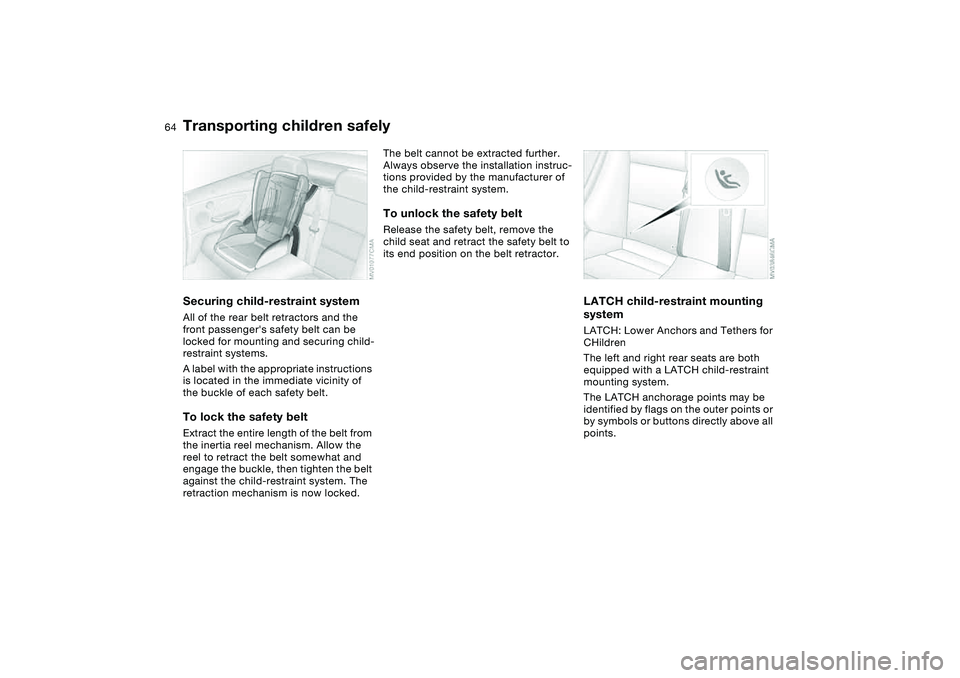
LATCH child-restraint mounting
system
LATCH: Lower Anchors and Tethers for
CHildren
The left and right rear seats are both
equipped with a LATCH child-restraint
mounting system.
The LATCH anchorage points may be
identified by flags on the outer points or
by symbols or buttons directly above all
points.
Transporting children safely
Page 65 of 190
65
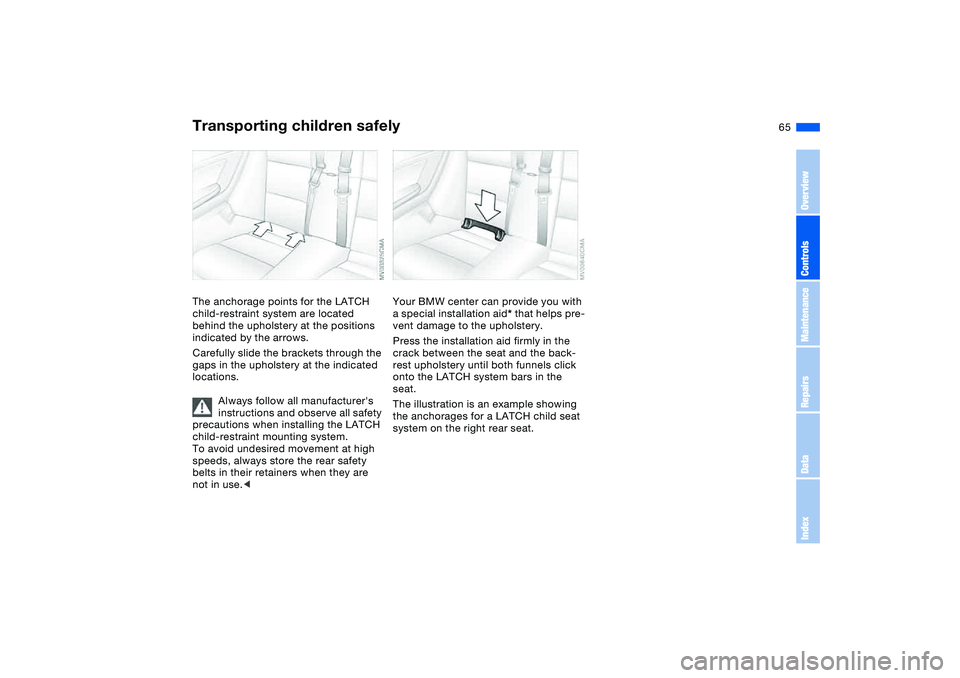
The anchorage points for the LATCH
child-restraint system are located
behind the upholstery at the positions
indicated by the arrows.
Carefully slide the brackets through the
gaps in the upholstery at the indicated
locations.Always follow all manufacturer's
instructions and observe all safety
precautions when installing the LATCH
child-restraint mounting system.
To avoid undesired movement at high
speeds, always store the rear safety
belts in their retainers when they are
not in use.
<
Your BMW center can provide you with
a special installation aid
*
that helps pre-
vent damage to the upholstery.
Press the installation aid firmly in the
crack between the seat and the back-
rest upholstery until both funnels click
onto the LATCH system bars in the
seat.
The illustration is an example showing
the anchorages for a LATCH child seat
system on the right rear seat.
Transporting children safely
OverviewControlsMaintenanceRepairsDataIndex
Page 66 of 190
66
Rollover protection systemIn the event of an accident or some
other critical driving situation – extreme
tilting in the longitudinal or transverse
axis, loss of contact with the ground –
the rollover protection system will be
automatically activated. The protective
bars located in the rear head restraints
extend within fractions of a second.
In addition to the integrated rollover bar
in the windshield frame, the rollover
protection system affords all the vehicle
occupants necessary headroom.
Always keep the travel path for the
rollover protection system free
and clear. Under no circumstances
should you cover the head restraints.
In the event of less serious accidents,
the safety belt will protect you and,
depending on the severity of the acci-
dent, so will the safety belt tensioner
and the multi-stage airbag restraint sys-
tem as well.<
If, after being automatically triggered,
its protective function is not needed,
then the rollover protection system can
be lowered back into place. No special
tool is needed for this.
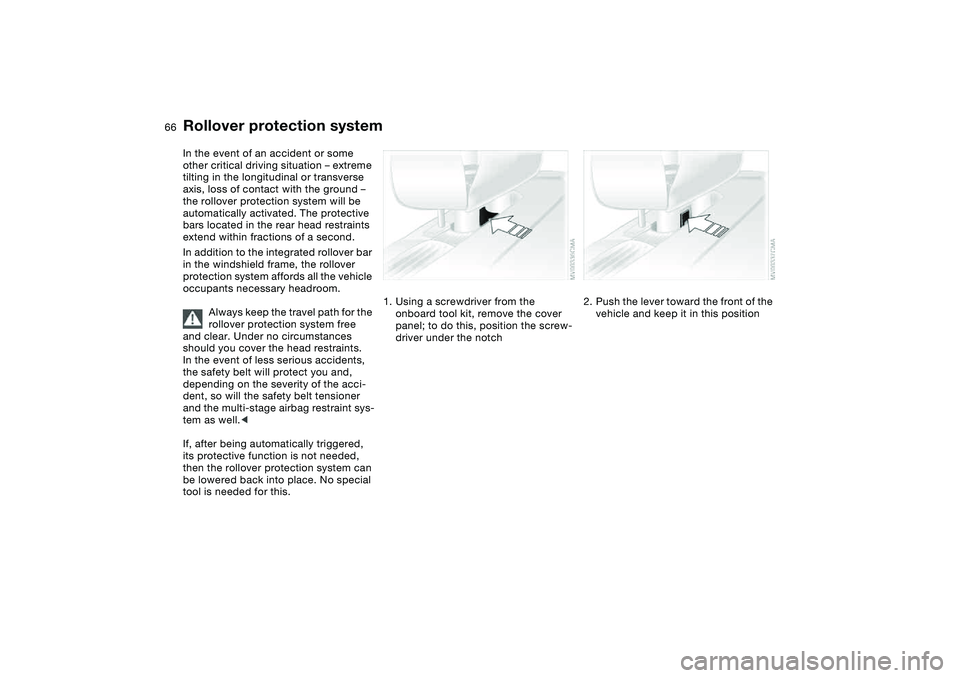
1. Using a screwdriver from the
onboard tool kit, remove the cover
panel; to do this, position the screw-
driver under the notch
2. Push the lever toward the front of the
vehicle and keep it in this position
Page 115 of 190
115 Loading and transporting
Ski bag*The ski bag allows the safe and clean
transport of up to 3 pairs of standard
skis or up to two snowboards.
The length of the ski bag and the addi-
tional space provided in the luggage
compartment make it possible to carry
skis up to 6 ft 10 in / 2.10 m long.
Because of the tapered shape of the
bag, only two pairs of skis longer than
6 ft 10 in / 2.10 m can be carried.
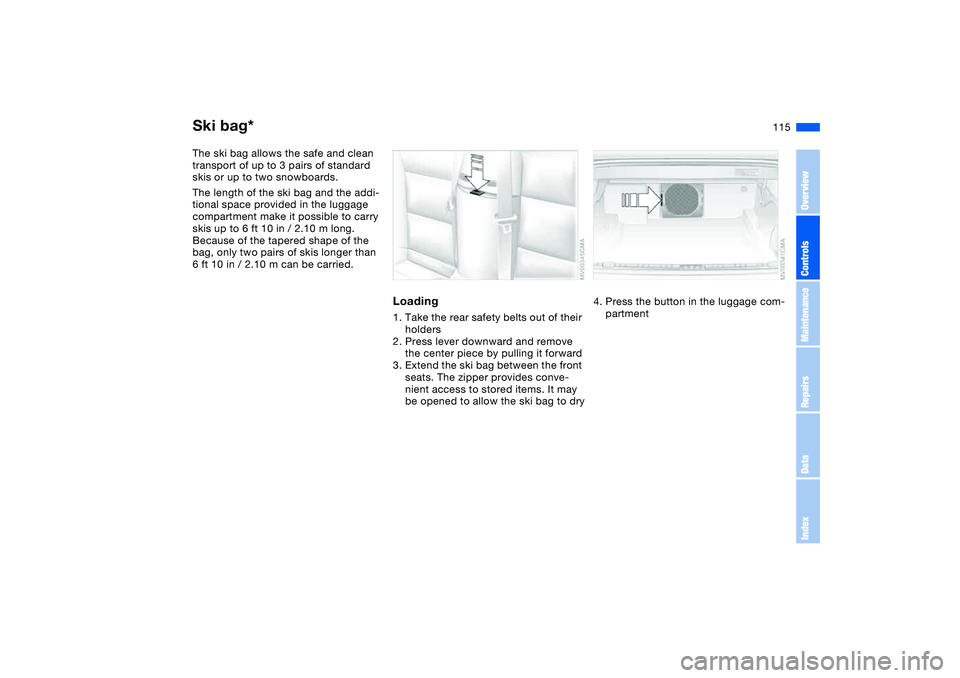
Loading1. Take the rear safety belts out of their
holders
2. Press lever downward and remove
the center piece by pulling it forward
3. Extend the ski bag between the front
seats. The zipper provides conve-
nient access to stored items. It may
be opened to allow the ski bag to dry
4. Press the button in the luggage com-
partment
OverviewControlsMaintenanceRepairsDataIndex
Page 116 of 190
116
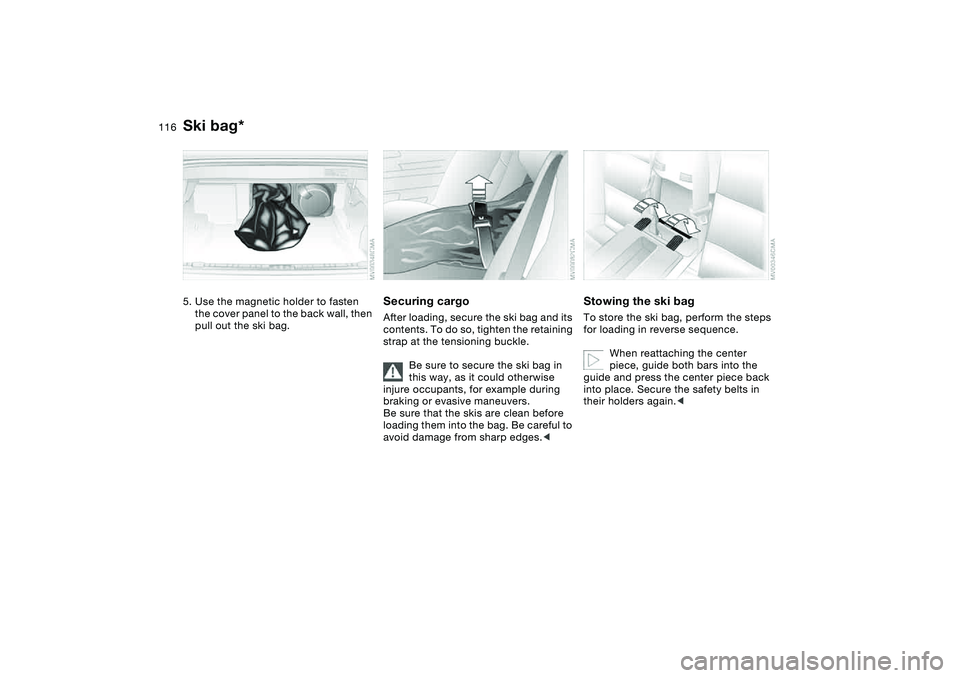
5. Use the magnetic holder to fasten
the cover panel to the back wall, then
pull out the ski bag.
Securing cargoAfter loading, secure the ski bag and its
contents. To do so, tighten the retaining
strap at the tensioning buckle.
Be sure to secure the ski bag in
this way, as it could otherwise
injure occupants, for example during
braking or evasive maneuvers.
Be sure that the skis are clean before
loading them into the bag. Be careful to
avoid damage from sharp edges.<
Stowing the ski bagTo store the ski bag, perform the steps
for loading in reverse sequence.
When reattaching the center
piece, guide both bars into the
guide and press the center piece back
into place. Secure the safety belts in
their holders again.<
Ski bag*
Page 133 of 190
133
Tire codeKnowing the tire code on the tire side-
wall makes it easier to correctly choose
and identify your tires.Tire sizeE.g. 205/60 R 15 91 W
205 = Nominal width in mm
60 = Cross-sectional ratio in %
R = Radial belt construction
15 = Rim diameter in inches
91 = Load index, not on ZR tires
W = Speed rating, in front of the R on
ZR tiresSpeed ratingQ = up to 100 mph (160 km/h)
T = up to 118 mph (190 km/h)
H = up to 130 mph (210 km/h)
V = up to 150 mph (240 km/h)
W = up to 167 mph (270 km/h)
Y = up to 186 mph (300 km/h)Tire Identification NumberTires with DOT codes comply with the
guidelines of the U.S. Department of
Transportation.DOT code:
E.g. DOT xxxx xxx 1004
xxxx = Manufacturer's code for tire
brand
xxx = Tire size and tire version
1004 = Tire age
Tire ageThe date on which the tire was manu-
factured is indicated by the code on the
sidewall:
DOT … 1004 indicates that the tire was
manufactured in week 10 of the year
2004.
BMW recommends the replacement of
all tires when they are no more than
6 years old, even if a tire life of 10 years
is possible.Uniform Tire Quality GradingQuality grades can be found where
applicable on the tire sidewall between
tread shoulder and maximum section
width. For example:
Trea dwear 200 Traction AA
Temperature ADOT quality gradesTread wearTraction AA A B C
Temperature A B C
All passenger car tires must con-
form to Federal Safety Require-
ments in addition to these grades.<
Tread wearThe tread wear grade is a comparative
rating based on the wear rate of the tire
when tested under controlled condi-
tions on a specified government test
course.
For example, a tire graded 150 would
wear one and one-half – 1
1/2 – times as
well on the government course as a tire
graded 100. The relative performance
of tires depends upon the actual condi-
tions of their use, however, and may
depart significantly from the norm due
to variations in driving habits, service
practices and differences in road char-
acteristics and climate.
TractionThe traction grades, from highest to
lowest, are AA, A, B, and C.
OverviewControlsMaintenanceRepairsDataIndex
Page 137 of 190
137
tire center, preferably your BMW cen-
ter. Observe any country-specific regu-
lations, e.g. on making a corresponding
entry in the vehicle documents.
The factory-approved radial belt tires
are matched to your vehicle and pro-
vide optimum safety and driving com-
fort when used properly.Run Flat tiresIf your vehicle is equipped with Run Flat
tires, refer to Run Flat tires, use only
these tires since no spare wheel is
available in the event of a flat.Special characteristics of winter
tiresBMW recommends the use of winter
tires for operation under winter road
conditions. While all-season tires with
M+S designation provide better winter
traction than summer tires, they gener-
ally do not achieve the full performance
of winter tires.
Run Flat tires:
If your vehicle is equipped with Run Flat
tires, refer to Run Flat tires, please note
the following: when mounting new tires
or replacing summer tires with winter tires, or vice versa, use only Run Flat
tires since no spare wheel is available
in the event of a flat. Your BMW center
wil be glad to advise you.
Observing speed ratings:
Never exceed the maximum
speed for which the winter tires
are rated. Unprofessional attempts by
laymen to service tires can lead to dam-
age and accidents. Have this work per-
formed by skilled professionals only.
The technicians at your BMW center
will be glad to assist you with the
required professional knowledge and
specialized equipment.<
StorageAlways store tires in a cool, dry place.
Store them away from light whenever
possible. Protect the tires against con-
tact with oil, grease and fuel. Do not
exceed the maximum tire inflation pres-
sures specified on the tire sidewall.
Snow chains*Only certain snow chains have been
tested by BMW and determined and
approved as roadworthy. Consult your
BMW center for details. BMW recom-
mends using only these approved fine-
link snow chains. Use them in pairs on
either summer or winter tires, but only
on both rear wheels.
Comply with all manufacturer's safety
precautions when mounting the chains.
Do not exceed a speed of 30 mph /
50 km/h when using snow chains.
You cannot mount snow chains with the
following tires:
>225/50 R 16
>225/45 R 17
>245/40 R 17
>225/40 R 18
>255/35 R 18.
Do not initialize the Flat Tire Moni-
tor after mounting snow chains to
the tires.
When driving with snow chains, it may
be useful to turn off the DSC for a short
time, refer to page 92.<
New wheels and tires
OverviewControlsMaintenanceRepairsDataIndex