transmission BMW 330CI CONVERTABLE 2006 User Guide
[x] Cancel search | Manufacturer: BMW, Model Year: 2006, Model line: 330CI CONVERTABLE, Model: BMW 330CI CONVERTABLE 2006Pages: 190, PDF Size: 2.79 MB
Page 79 of 190
79
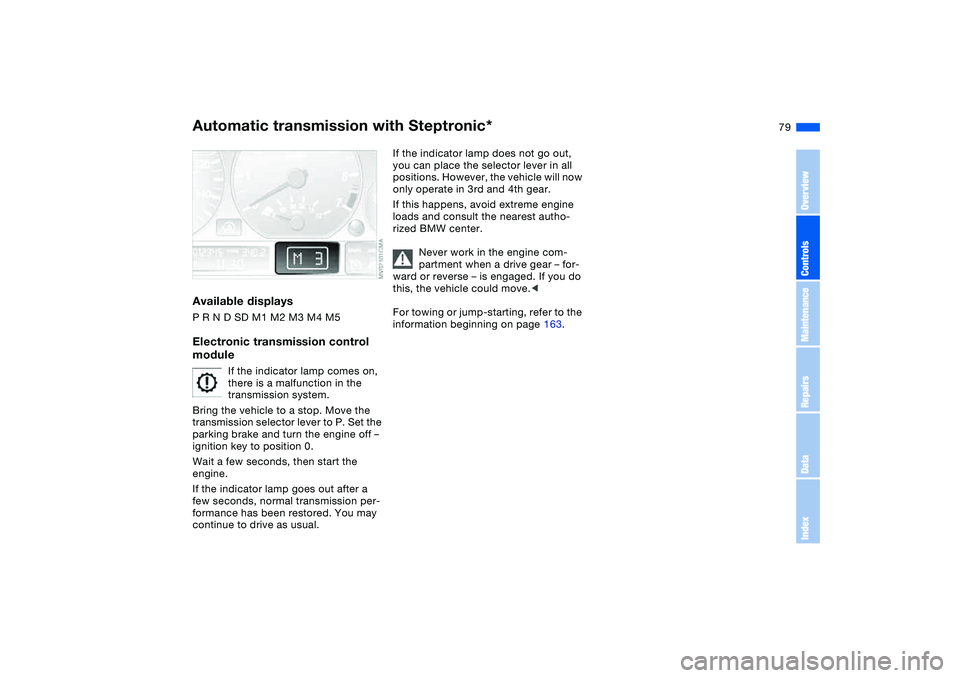
Available displaysP R N D SD M1 M2 M3 M4 M5Electronic transmission control
module
If the indicator lamp comes on,
there is a malfunction in the
transmission system.
Bring the vehicle to a stop. Move the
transmission selector lever to P. Set the
parking brake and turn the engine off –
ignition key to position 0.
Wait a few seconds, then start the
engine.
If the indicator lamp goes out after a
few seconds, normal transmission per-
formance has been restored. You may
continue to drive as usual.
If the indicator lamp does not go out,
you can place the selector lever in all
positions. However, the vehicle will now
only operate in 3rd and 4th gear.
If this happens, avoid extreme engine
loads and consult the nearest autho-
rized BMW center.
Never work in the engine com-
partment when a drive gear – for-
ward or reverse – is engaged. If you do
this, the vehicle could move.<
For towing or jump-starting, refer to the
information beginning on page 163.
Automatic transmission with Steptronic*
OverviewControlsMaintenanceRepairsDataIndex
Page 83 of 190
83
The speed stored in memory is deleted.To store and maintain speed or to
acceleratePress button + briefly:
The system maintains and stores the
current vehicle speed. Every time you
tap the button, the speed increases by
approx. 0.6 mph / 1 km/h.
Press and hold button +:
The vehicle accelerates without pres-
sure on the accelerator pedal. When
you release the button, the system
maintains and stores the current speed.
If on a downhill gradient the
engine braking effect is not suffi-
cient, the controlled speed can be
exceeded. Speed can drop on uphill
grades if the engine output is insuffi-
cient.<
To deceleratePress button – briefly:
If you are already driving with activated
cruise control, the speed is decreased
by approx. 0.6 mph / 1 km/h every time
you tap the button.
Press and hold button –:
With the cruise control active, the sys-
tem automatically reduces the throttle
opening to slow the vehicle. When you
release the button, the system main-
tains and stores the current speed.To interrupt the cruise controlWhen the system is activated, press the
button. The indicator lamp stays on.
You can use the cruise control again
whenever you want by calling up the
speed that was stored last.
In addition, cruise control is interrupted
automatically:
>When the brakes are applied
>When you apply pressure to the
clutch pedal, or when you move the
automatic transmission selector lever
from D to N
>If you exceed or fall below the pro-
grammed speed for an extended
period – by depressing the accelera-
tor, for example.To recall the stored settingPress the button:
The vehicle accelerates to and main-
tains the last speed stored.
Cruise control*
OverviewControlsMaintenanceRepairsDataIndex
Page 110 of 190
110
Integrated universal remote control*The conceptThe integrated universal remote control
takes the place of up to three different
handheld transmitters belonging to var-
ious radio remote control devices, such
as door openers and home alarm sys-
tems. The integrated universal remote
control recognizes and learns the signal
sent by each original control device.
The signal of an original control device
can be programmed into one of the
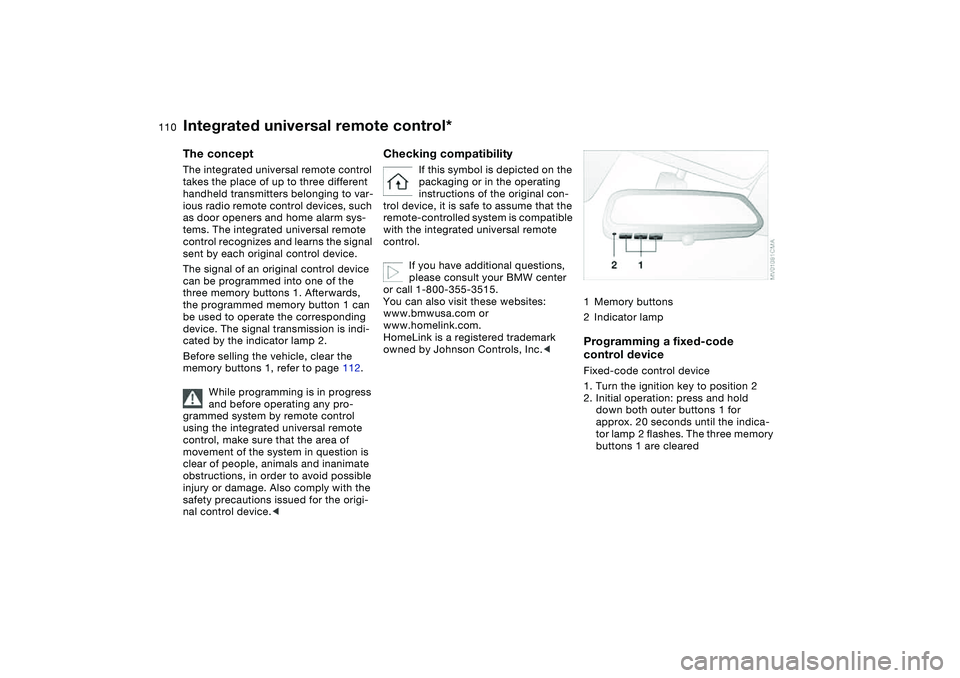
three memory buttons 1. Afterwards,
the programmed memory button 1 can
be used to operate the corresponding
device. The signal transmission is indi-
cated by the indicator lamp 2.
Before selling the vehicle, clear the
memory buttons 1, refer to page 112.
While programming is in progress
and before operating any pro-
grammed system by remote control
using the integrated universal remote
control, make sure that the area of
movement of the system in question is
clear of people, animals and inanimate
obstructions, in order to avoid possible
injury or damage. Also comply with the
safety precautions issued for the origi-
nal control device.<
Checking compatibility
If this symbol is depicted on the
packaging or in the operating
instructions of the original con-
trol device, it is safe to assume that the
remote-controlled system is compatible
with the integrated universal remote
control.
If you have additional questions,
please consult your BMW center
or call 1-800-355-3515.
You can also visit these websites:
www.bmwusa.com or
www.homelink.com.
HomeLink is a registered trademark
owned by Johnson Controls, Inc.<
1Memory buttons
2Indicator lampProgramming a fixed-code
control deviceFixed-code control device
1. Turn the ignition key to position 2
2. Initial operation: press and hold
down both outer buttons 1 for
approx. 20 seconds until the indica-
tor lamp 2 flashes. The three memory
buttons 1 are cleared
Page 125 of 190
125
General driving notesHot exhaust system
High temperatures occur with
every vehicle equipped with a cat-
alytic converter. Heat shields are
installed adjacent to some sections of
the exhaust system. Never remove
these shields; do not apply undercoat-
ing to their surfaces. When driving,
standing at idle and parking the vehicle,
take care to avoid contact between the
hot exhaust system and flammable
materials, e.g. hay, leaves, grass, etc.
Such contact could lead to a fire,
resulting in serious personal injury and
property damage.<
Parking the vehicleCondensation forms in the air condi-
tioner system during operation, which
then exits under the vehicle. It is thus
not unusual for a small puddle to form
under the car while the system is run-
ning.Before driving through a car washFold in the exterior mirrors manually
because they could otherwise be dam-
aged due to the width of the vehicle.
Hydroplaning
When driving on wet or slushy
roads, reduce vehicle speed. If
you do not, a wedge of water may form
between tire and road surface. This
phenomenon is referred to as hydro-
planing, and can lead to partial or com-
plete loss of traction, vehicle control
and braking effectiveness.<
The risk of hydroplaning increases as
the tread depth of the tires decreases,
refer also to Tire tread on page 135.
Driving through water
Do not drive through water on the
road if it is deeper than 1 ft/30 cm,
and then only at walking speed. Other-
wise, the vehicle's engine, the electrical
systems and the transmission may be
damaged.<
Braking safelyYour BMW is equipped with ABS as a
standard feature. If you are in a situa-
tion which requires full braking, it is
best to brake using maximum brake
pressure: panic stop. Since the vehicle
maintains steering responsiveness, you
can avoid possible obstacles with a
minimum of steering effort, despite the
full brake application.
Pulsation at the brake pedal combined
with sounds from the hydraulic circuits
indicates to the driver that ABS is in its
active mode.
Do not drive with your foot resting
on the brake pedal. Otherwise,
even light but consistent pedal pres-
sure can lead to high temperatures,
brake wear and possibly even brake
failure.<
Wet roads:
if the roads are wet or if there is heavy
rain, it is advisable to gently press the
brakes for a brief moment every few
miles/kilometers. Monitor traffic condi-
tions to ensure that this maneuver does
not endanger other road users. The
heat generated in this process helps
dry the pads and rotors. Immediate
braking force is then available if neces-
sary.
OverviewControlsMaintenanceRepairsDataIndex
Page 126 of 190
126
Inclines:
To prevent overheating and, as a
result, diminished braking effec-
tiveness, drive down long or steep
downhill grades in a gear which
requires the least braking. Otherwise,
even light but consistent pedal pres-
sure can lead to high temperatures,
brake wear and possibly even brake
failure.<
The braking power of the engine can be
further enhanced by downshifting the
automatic transmission in manual
mode, if necessary, into first gear. This
helps avoid placing excessive loads on
the brake system.
Do not coast with the clutch
depressed or with the transmis-
sion or selector lever in Neutral. Do not
coast with the engine switched off. Oth-
erwise, the engine provides no braking
effect while the transmission is in idling
position, and there is no power-assist
for braking or steering when the engine
is off.
Floor mats, floor carpets or other
objects must not be in the area near the
brake or accelerator pedal, as this
could impair the movement of the ped-
als.<
Corrosion on the brake rotorsLimited vehicle use, extended periods
with the vehicle parked or in storage,
and operating conditions in which brak-
ing is restricted to gentle, low-pressure
applications will all increase the ten-
dency for corrosion to form on the
rotors and contamination to accumulate
on the brake pads. This occurs because
the minimal pressure which must be
exerted by the pads to clean the rotors
by brake applications is not reached.
If the brake rotors are corroded, they
will tend to respond to braking with a
pulsating effect that even extended
brake applications will fail to cure.
Brake pads
For your own safety: use only
brake pads that BMW has
released for your particular vehicle
model. BMW cannot evaluate non-
approved brake pads to determine if
they are suitable for use, and therefore
cannot ensure the operating safety of
the vehicle if they are installed.<
Portable phone in the vehicle
BMW advises against using
mobile equipment, e.g. cellular
phones, inside the vehicle without con-
necting them directly to an outside
antenna. Otherwise, it cannot be ruled
out that vehicle electronics and the
mobile equipment interfere with one
another. In addition, it is not ensured
that the radio waves emitted during
transmission are directed outside of the
vehicle interior.<
General driving notes
Page 165 of 190
165
Towing and tow-starting the vehicle
Always comply with all applicable
towing laws and regulations.<
Using the towing eyeletThe screw-in towing eyelet is located in
the luggage compartment under the
floor panel; be sure that it remains with
the vehicle at all times. It can be
attached at the front or rear of your
BMW.
Observe the following instruc-
tions in order to avoid damaging
the towing eyelet or the vehicle: use
only the towing eyelet supplied with the
vehicle, and screw it in firmly until it
stops. Use the towing eyelet for towing
on paved roads only. Avoid subjecting
the towing eyelet to lateral loads, e.g.
do not lift the vehicle using the towing
eyelet.<
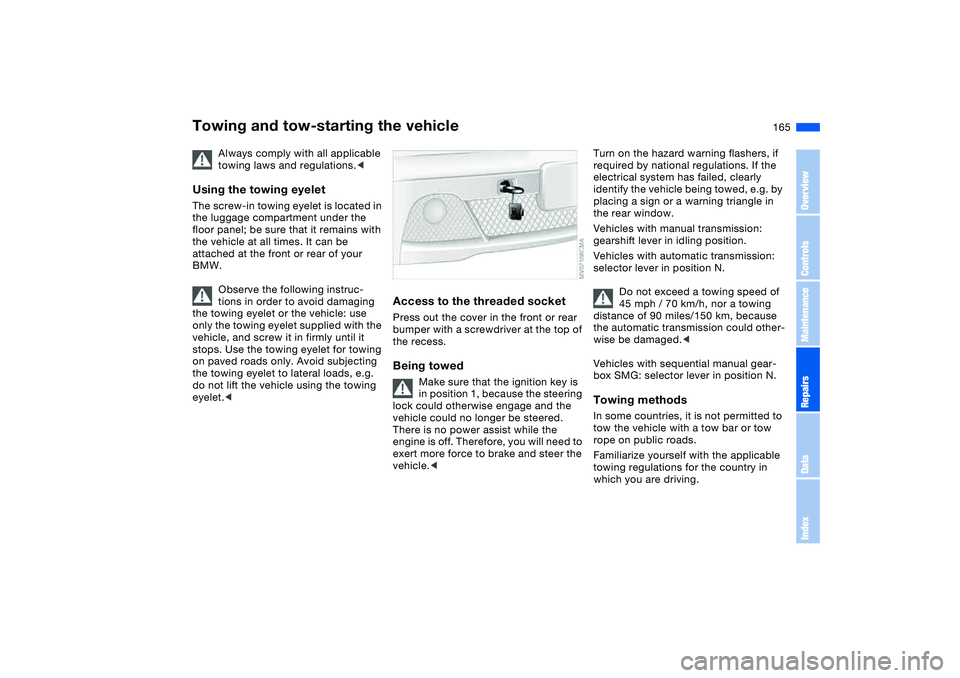
Access to the threaded socketPress out the cover in the front or rear
bumper with a screwdriver at the top of
the recess.Being towed
Make sure that the ignition key is
in position 1, because the steering
lock could otherwise engage and the
vehicle could no longer be steered.
There is no power assist while the
engine is off. Therefore, you will need to
exert more force to brake and steer the
vehicle.<
Turn on the hazard warning flashers, if
required by national regulations. If the
electrical system has failed, clearly
identify the vehicle being towed, e.g. by
placing a sign or a warning triangle in
the rear window.
Vehicles with manual transmission:
gearshift lever in idling position.
Vehicles with automatic transmission:
selector lever in position N.
Do not exceed a towing speed of
45 mph / 70 km/h, nor a towing
distance of 90 miles/150 km, because
the automatic transmission could other-
wise be damaged.<
Vehicles with sequential manual gear-
box SMG: selector lever in position N.Towing methodsIn some countries, it is not permitted to
tow the vehicle with a tow bar or tow
rope on public roads.
Familiarize yourself with the applicable
towing regulations for the country in
which you are driving.
OverviewControlsMaintenanceRepairsDataIndex
Page 166 of 190
166
With a tow bar
The towing vehicle must not be
lighter than the vehicle being
towed; otherwise, vehicle handling can
no longer be controlled.<
The towing eyelets of both vehicles
should be on the same side.
If the tow bar can only be used in a
diagonal position, please note the fol-
lowing:
>Clearance is restricted while you are
driving around corners
>The inclination of the tow bar pro-
duces lateral force.
Only attach the tow bar to the
towing eyelets. Other parts of the
vehicles could otherwise be dam-
aged.<
With a tow ropeWhen the towing vehicle is driving off,
make sure that the tow rope is taut.
Use nylon ropes or straps for tow-
ing because they prevent sudden
jerking movements. Attach the tow rope
only to the towing eyelets. Other parts
of the vehicles could otherwise be
damaged.<
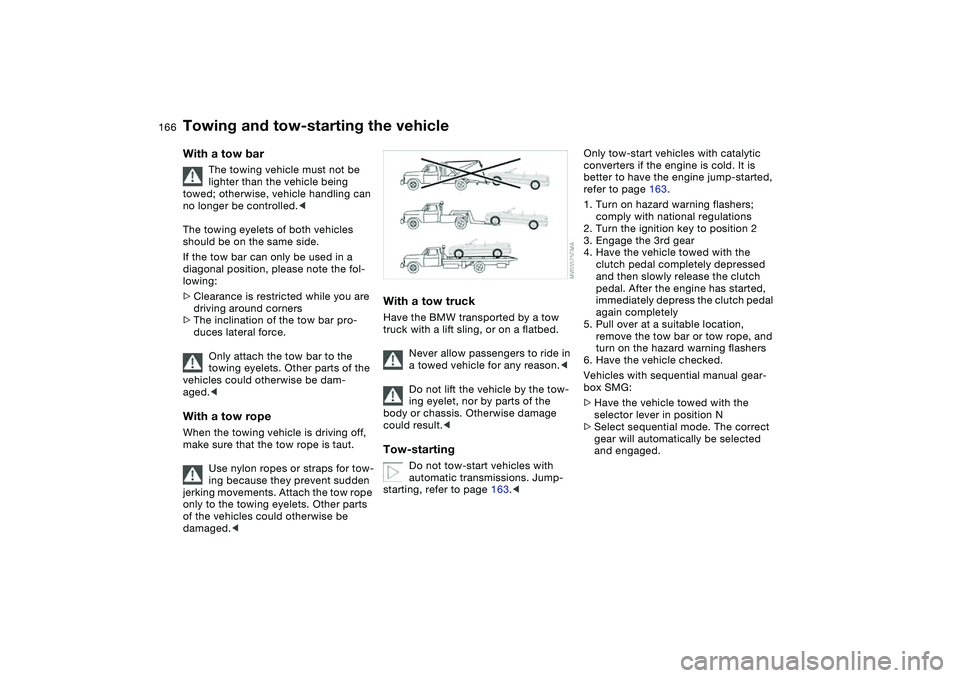
With a tow truckHave the BMW transported by a tow
truck with a lift sling, or on a flatbed.
Never allow passengers to ride in
a towed vehicle for any reason.<
Do not lift the vehicle by the tow-
ing eyelet, nor by parts of the
body or chassis. Otherwise damage
could result.
automatic transmissions. Jump-
starting, refer to page 163.<
Only tow-start vehicles with catalytic
converters if the engine is cold. It is
better to have the engine jump-started,
refer to page 163.
1. Turn on hazard warning flashers;
comply with national regulations
2. Turn the ignition key to position 2
3. Engage the 3rd gear
4. Have the vehicle towed with the
clutch pedal completely depressed
and then slowly release the clutch
pedal. After the engine has started,
immediately depress the clutch pedal
again completely
5. Pull over at a suitable location,
remove the tow bar or tow rope, and
turn on the hazard warning flashers
6. Have the vehicle checked.
Vehicles with sequential manual gear-
box SMG:
>Have the vehicle towed with the
selector lever in position N
>Select sequential mode. The correct
gear will automatically be selected
and engaged.
Towing and tow-starting the vehicle
Page 172 of 190
172
Weights
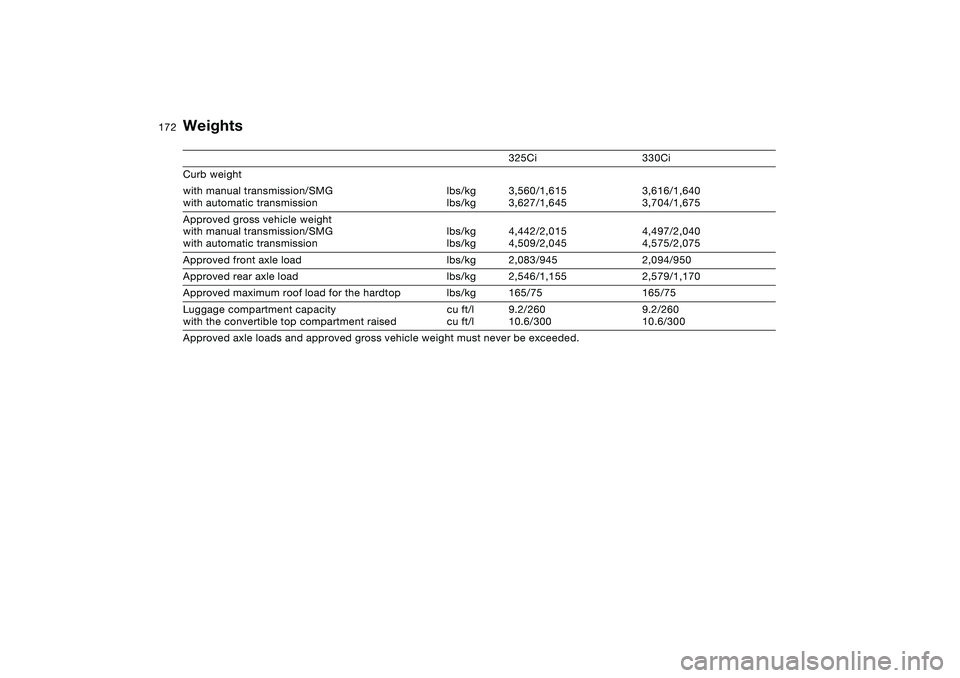
325Ci 330Ci
Curb weight
with manual transmission/SMG
with automatic transmissionlbs/kg
lbs/kg3,560/1,615
3,627/1,6453,616/1,640
3,704/1,675
Approved gross vehicle weight
with manual transmission/SMG
with automatic transmissionlbs/kg
lbs/kg4,442/2,015
4,509/2,0454,497/2,040
4,575/2,075
Approved front axle load lbs/kg 2,083/945 2,094/950
Approved rear axle load lbs/kg 2,546/1,155 2,579/1,170
Approved maximum roof load for the hardtop lbs/kg 165/75 165/75
Luggage compartment capacity
with the convertible top compartment raisedcu ft/l
cu ft/l9.2/260
10.6/3009.2/260
10.6/300
Approved axle loads and approved gross vehicle weight must never be exceeded.
Page 176 of 190
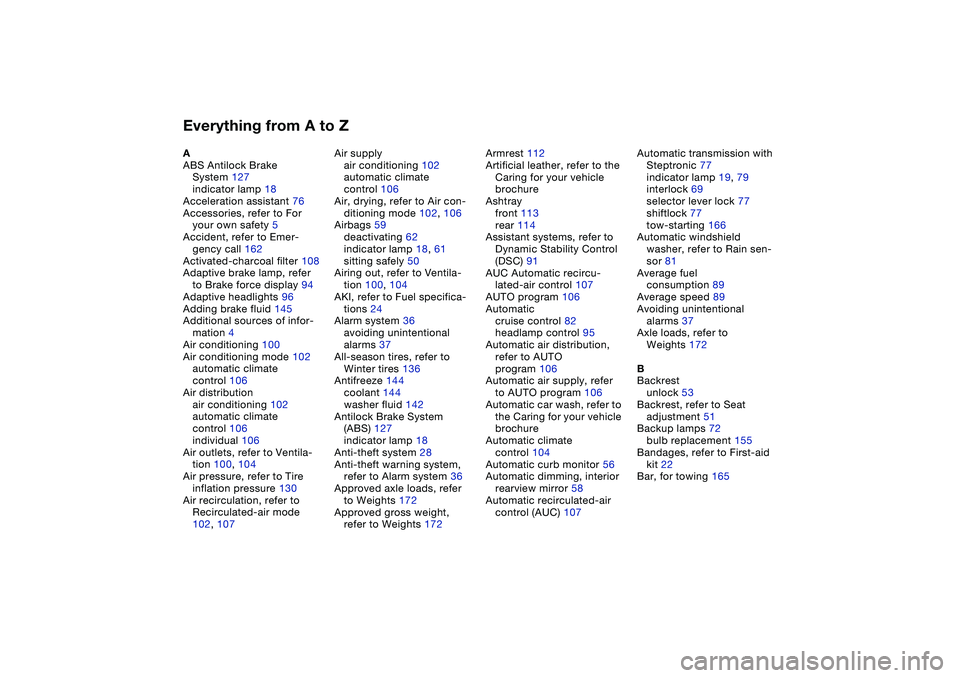
Everything from A to ZA
ABS Antilock Brake
System 127
indicator lamp 18
Acceleration assistant 76
Accessories, refer to For
your own safety 5
Accident, refer to Emer-
gency call 162
Activated-charcoal filter 108
Adaptive brake lamp, refer
to Brake force display 94
Adaptive headlights 96
Adding brake fluid 145
Additional sources of infor-
mation 4
Air conditioning 100
Air conditioning mode 102
automatic climate
control 106
Air distribution
air conditioning 102
automatic climate
control 106
individual 106
Air outlets, refer to Ventila-
tion 100, 104
Air pressure, refer to Tire
inflation pressure 130
Air recirculation, refer to
Recirculated-air mode
102, 107Air supply
air conditioning 102
automatic climate
control 106
Air, drying, refer to Air con-
ditioning mode 102, 106
Airbags 59
deactivating 62
indicator lamp 18, 61
sitting safely 50
Airing out, refer to Ventila-
tion 100, 104
AKI, refer to Fuel specifica-
tions 24
Alarm system 36
avoiding unintentional
alarms 37
All-season tires, refer to
Winter tires 136
Antifreeze 144
coolant 144
washer fluid 142
Antilock Brake System
(ABS) 127
indicator lamp 18
Anti-theft system 28
Anti-theft warning system,
refer to Alarm system 36
Approved axle loads, refer
to Weights 172
Approved gross weight,
refer to Weights 172Armrest 112
Artificial leather, refer to the
Caring for your vehicle
brochure
Ashtray
front 113
rear 114
Assistant systems, refer to
Dynamic Stability Control
(DSC) 91
AUC Automatic recircu-
lated-air control 107
AUTO program 106
Automatic
cruise control 82
headlamp control 95
Automatic air distribution,
refer to AUTO
program 106
Automatic air supply, refer
to AUTO program 106
Automatic car wash, refer to
the Caring for your vehicle
brochure
Automatic climate
control 104
Automatic curb monitor 56
Automatic dimming, interior
rearview mirror 58
Automatic recirculated-air
control (AUC) 107Automatic transmission with
Steptronic 77
indicator lamp 19, 79
interlock 69
selector lever lock 77
shiftlock 77
tow-starting 166
Automatic windshield
washer, refer to Rain sen-
sor 81
Average fuel
consumption 89
Average speed 89
Avoiding unintentional
alarms 37
Axle loads, refer to
Weights 172
B
Backrest
unlock 53
Backrest, refer to Seat
adjustment 51
Backup lamps 72
bulb replacement 155
Bandages, refer to First-aid
kit 22
Bar, for towing 165
Page 179 of 190
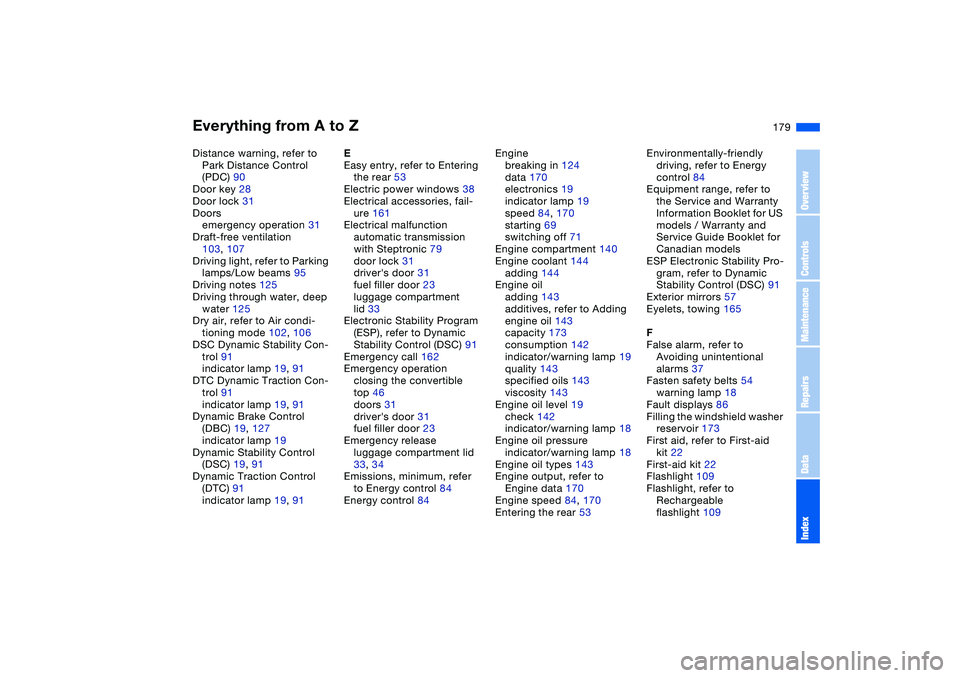
Everything from A to Z
179
Distance warning, refer to
Park Distance Control
(PDC) 90
Door key 28
Door lock 31
Doors
emergency operation 31
Draft-free ventilation
103, 107
Driving light, refer to Parking
lamps/Low beams 95
Driving notes 125
Driving through water, deep
water 125
Dry air, refer to Air condi-
tioning mode 102, 106
DSC Dynamic Stability Con-
trol 91
indicator lamp 19, 91
DTC Dynamic Traction Con-
trol 91
indicator lamp 19, 91
Dynamic Brake Control
(DBC) 19, 127
indicator lamp 19
Dynamic Stability Control
(DSC) 19, 91
Dynamic Traction Control
(DTC) 91
indicator lamp 19, 91E
Easy entry, refer to Entering
the rear 53
Electric power windows 38
Electrical accessories, fail-
ure 161
Electrical malfunction
automatic transmission
with Steptronic 79
door lock 31
driver's door 31
fuel filler door 23
luggage compartment
lid 33
Electronic Stability Program
(ESP), refer to Dynamic
Stability Control (DSC) 91
Emergency call 162
Emergency operation
closing the convertible
top 46
doors 31
driver's door 31
fuel filler door 23
Emergency release
luggage compartment lid
33, 34
Emissions, minimum, refer
to Energy control 84
Energy control 84Engine
breaking in 124
data 170
electronics 19
indicator lamp 19
speed 84, 170
starting 69
switching off 71
Engine compartment 140
Engine coolant 144
adding 144
Engine oil
adding 143
additives, refer to Adding
engine oil 143
capacity 173
consumption 142
indicator/warning lamp 19
quality 143
specified oils 143
viscosity 143
Engine oil level 19
check 142
indicator/warning lamp 18
Engine oil pressure
indicator/warning lamp 18
Engine oil types 143
Engine output, refer to
Engine data 170
Engine speed 84, 170
Entering the rear 53Environmentally-friendly
driving, refer to Energy
control 84
Equipment range, refer to
the Service and Warranty
Information Booklet for US
models / Warranty and
Service Guide Booklet for
Canadian models
ESP Electronic Stability Pro-
gram, refer to Dynamic
Stability Control (DSC) 91
Exterior mirrors 57
Eyelets, towing 165
F
False alarm, refer to
Avoiding unintentional
alarms 37
Fasten safety belts 54
warning lamp 18
Fault displays 86
Filling the windshield washer
reservoir 173
First aid, refer to First-aid
kit 22
First-aid kit 22
Flashlight 109
Flashlight, refer to
Rechargeable
flashlight 109
OverviewControlsMaintenanceRepairsDataIndex