change wheel BMW 330Ci CONVERTIBLE 2001 E46 Owner's Manual
[x] Cancel search | Manufacturer: BMW, Model Year: 2001, Model line: 330Ci CONVERTIBLE, Model: BMW 330Ci CONVERTIBLE 2001 E46Pages: 215, PDF Size: 2.1 MB
Page 42 of 215
42n
Alarm system
*
The conceptThe vehicle alarm system responds:
>When a door, the hood or the
luggage compartment lid is opened.
>To movement inside the vehicle
(interior motion sensor).
>To a change of the vehicle's tilt Ð if
someone attempts to steal the
wheels or tow the vehicle without
authorization, for example.
>If there is an interruption in battery
voltage.
The system responds to unauthorized
vehicle entry and attempted theft by
simultaneously activating the following:
>Sounding an alarm for 30 seconds.
>The hazard warning flashers are acti-
vated for approx. five minutes.
>The high beams flash on and off in the
same rhythm.
To activate and deactivate the
alarm systemWhen the vehicle is locked or unlocked
by using a key or with the remote
control, the alarm system is also simul-
taneously armed or disarmed.
The interior motion sensor and the tilt
alarm sensor are activated approx.
30 seconds after you have finished
locking the vehicle.
If the alarm system has been armed
correctly, the hazard warning flashers
flash once.
You can have a signal set as
acknowledgment for both arming
and disarming the alarm system.<
You can also open the luggage
compartment lid when the system is
armed by pressing button 3 of the
remote control (refer to page 36). When
it is closed, the lid is once again
secured.
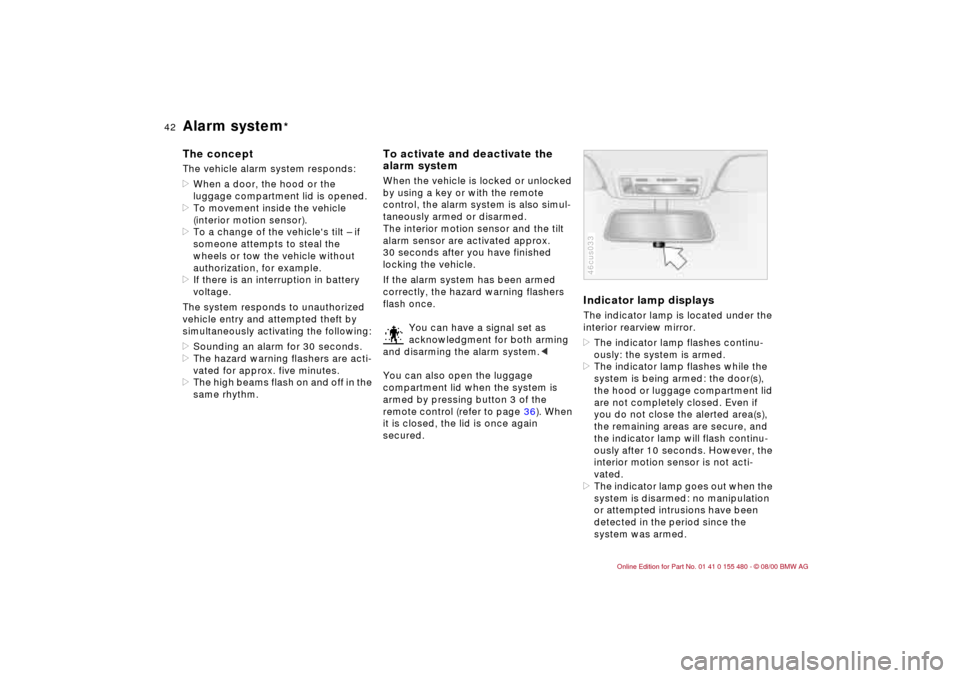
Indicator lamp displaysThe indicator lamp is located under the
interior rearview mirror.
>The indicator lamp flashes continu-
ously: the system is armed.
>The indicator lamp flashes while the
system is being armed: the door(s),
the hood or luggage compartment lid
are not completely closed. Even if
you do not close the alerted area(s),
the remaining areas are secure, and
the indicator lamp will flash continu-
ously after 10 seconds. However, the
interior motion sensor is not acti-
vated.
>The indicator lamp goes out when the
system is disarmed: no manipulation
or attempted intrusions have been
detected in the period since the
system was armed.46cus033
Page 92 of 215

92n
Tire Pressure Control (RDC)
*
In the event of a flat tireIf there is a tire failure with loss of pres-
sure, the indicator lamp comes on with
a red lamp. In addition, an acoustic
signal is sounded.
If this occurs, reduce vehicle speed
immediately to stop the vehicle in a safe
location. Avoid hard brake applications.
Do not oversteer. Replace the wheel
and flat tire.
The space-saver spare tire is
provided for temporary use only in
the event of a flat tire. It does not have
RDC electronics and is not monitored.<
RDC cannot alert you to severe
and sudden tire damage caused
by external factors.<
Have the tires changed by your
BMW center.
Your BMW center has been trained to
work with the RDC system and is
equipped with the necessary special
tools.<
System interferenceLocal devices using the same radio
frequency can interfere with the RDC.
The yellow indicator lamp will come on
during the malfunction.
The indicator lamp also comes on
>in the event of a system fault.
>if a wheel is mounted without RDC
electronics.
>if additional wheels with RDC elec-
tronics are on board.
Please contact your BMW center for
additional information.
Page 127 of 215

127n
IndexDataTechnologyRepairsCar careControlsOverview
Winter operationThe onset of winter is often accompa-
nied by rapid changes in weather.
Adaptations in driving style should be
accompanied by preparations on the
vehicle itself to ensure that your
progress through the winter remains
safe and trouble-free.CoolantBe sure that the coolant mixture
contains the year-round ratio of 50:50
water and extended-duty antifreeze/
corrosion protection. This mixture
provides protection against freezing
down to approx. Ð34 7 (Ð37 6).
Replace the coolant every four years.LocksBMW door lock deicer can be used to
free them if frozen. This deicer also
contains lubricant.
After using the deicer, we recommend
you treat the door lock with BMW lock
cylinder lubricant.
Rubber seals and components To prevent the weather-stripping from
freezing, apply a spray-on rubber treat-
ment or silicone spray to the door, hood
and luggage compartment lid seals.
A full range of car care products is
available from your BMW center.
BMW snow chains can be mounted on
both summer and winter tires. Mount
them in pairs on the rear wheels only
and comply with the manufacturer's
safety precautions. Do not exceed a
maximum speed of 30 mph (50 km/h).
In this rare situation, it may be effective
to deactivate the ASC+T/DSC for a
brief period of time. Refer to page 88.
Starting offWhen starting up from a full stop in
deep snow or when "rocking" the
vehicle to free it, it may be effective to
deactivate the ASC+T/DSC system for
a brief period of time. Refer to page 88.Driving on low-traction road
surfacesUse smooth, gentle pressure to control
the accelerator pedal. Avoid excessive
engine speeds and shift to the next
higher gear at an early point. On down-
hill grades or slopes, shift down to the
next lower gear at an early point. Main-
tain an adequate distance between
yourself and the vehicle ahead.
Page 136 of 215

136n
Winter tiresChoosing the right tireBMW recommends winter tires (M+S
radial tires) for driving in adverse winter
road conditions. So-called all-season
tires with the M+S identification mark
do indeed possess better winter trac-
tion than summer tires that have the H,
V, W, Y and ZR speed ratings, but they
generally fail to provide the same levels
of performance as winter tires.
In the interest of safe tracking and
steering response, install winter tires
made by the same manufacturer having
the same tread configuration on all four
wheels.
Mount only winter tires which have
been approved by BMW. Any BMW
center will be glad to provide you with
information on the best winter tires for
every particular driving condition.
Do not exceed specified
maximum speeds
Never exceed the maximum speed
for which the tires are rated.
Unprofessional attempts by laymen to
service tires can lead to damage and
accidents.
Have this work performed by skilled
professionals only. Any BMW center
has the required technical knowledge
and the proper equipment and will be
happy to assist you.<
Tire condition, tire pressureWinter tires display a perceptible loss in
their ability to cope with winter driving
conditions once the tread wears to
below 0.16 in (4 mm), and therefore in
the interest of safety, should be
replaced.
Comply with the specified tire inflation
pressures Ð and be sure to have the
wheel and tire assemblies balanced
every time you change the tires.
StorageAlways store tires in a cool, dry place.
Store them away from light whenever
possible. Protect the tires against
contact with oil, grease and fuel.Snow chains
*
Use narrow-link BMW snow chains
on
winter tires only in pairs and only on the
rear wheels. Comply with all manufac-
turer's safety precautions when
mounting the chains.
Page 160 of 215

160n
Vehicle storage
If you plan on parking the vehicle
for more than three months, have
the maintenance operations described
on this page performed.<
Preparations for storageHave your BMW center perform the
following procedures:
1 Clean and apply a rustproofing agent
or other treatment to the engine,
engine compartment, undercarriage,
axles and major components in
accordance with approved repair
procedures. First wash the vehicle
surface, then clean the interior,
following up with paint and chrome
care, after which you clean the
rubber seals for the hood and doors.
2 Change the engine oil and oil filter at
operating temperature. As an addi-
tional corrosion protection measure,
an anticorrosive agent can be added
to the engine in accordance with the
manufacturer's instructions.
3 Check the coolant level and concen-
tration and top up if necessary.
4 Check the fluid level of the wind-
shield washer fluid reservoir and top
up if necessary.
5 Fill the fuel tank completely to pre-
vent the formation of condensation.
6 Increase the tire inflation pressure to
51 psi (350 kilopascal).
Before parking the vehicle1 To prevent the brake discs and
drums from corroding, dry the park-
ing and footbrake by applying the
brakes.
2 Park the vehicle in a covered, dry and
well-ventilated space. Place the
transmission in 1st gear or set the
selector lever to the "P" position.
Chock the wheels to prevent the
vehicle from rolling if necessary. Do
not set the parking brake.
3 Remove the battery, charge it
completely and store it in a cool (but
frost-free) room.
4 Remove the hardtop and store
separately. Refer to page 130.
5 Close the convertible top.During storageRecharge the battery every six months.
If it is not recharged, it will not be
serviceable. Every time the battery is
drained, especially over extended
periods, its service life is reduced.
Removing the vehicle from
storageRecharge the battery if the "Magic
Eye"
* turns black. Refer to page 176.
Then have Inspection I performed by
your BMW center, including a brake
fluid replacement if necessary. Refer
to the Service Manual.
Page 173 of 215
173n
IndexDataTechnologyRepairsCar careControlsOverview
Changing a wheel
Take these precautionary
measures if you have either a flat
tire or are changing the tire:
Stop the vehicle as far as possible from
passing traffic. Park on a firm, flat
surface. Switch on the hazard warning
flashers. Turn the steering wheel to the
straight-ahead position, remove the key
and engage the steering lock. Shift into
1st or reverse gear (selector lever in
"Park" with automatic transmission) and
engage the parking brake.
All passengers should be outside the
vehicle and well away from your imme-
diate working area (behind a guardrail,
for instance).
Set up a warning triangle
* or portable
hazard warning on the roadside at an
appropriate distance from the rear of
the vehicle. Comply with all safety
guidelines and regulations.
Change the wheel only on a level, firm
surface which is not slippery. Avoid
jacking the vehicle on a soft or slippery
support surface (snow, ice, loose
gravel, etc.), as it could slide sideways.
Position the jack on a firm support
surface.
Do not place wooden blocks or similar
objects under the jack. If this is done,
the jack might not be able to reach its
full support capacity because of the
limited height.
Do not lie under the vehicle or start the
engine when the vehicle is supported
by the jack. Failure to comply with this
creates a risk of fatal injury.<
Your BMW has a space-saver spare tire
for temporary use to ensure your
mobility.
To remove the space-saver spare
tire, take out the floor panel in the
luggage compartment completely (refer
to page 41).<
You will need the following:In order to avoid rattling noises later,
note the position of the tools when you
remove them and return them to their
original position when you are through
using them.
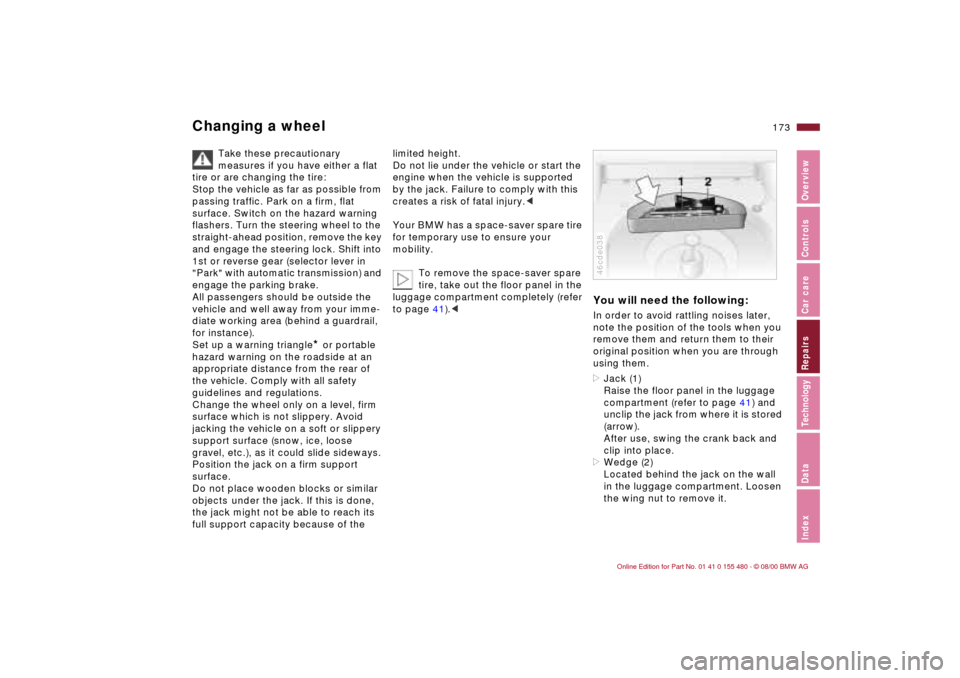
>Jack (1)
Raise the floor panel in the luggage
compartment (refer to page 41) and
unclip the jack from where it is stored
(arrow).
After use, swing the crank back and
clip into place.
>Wedge (2)
Located behind the jack on the wall
in the luggage compartment. Loosen
the wing nut to remove it.46cde038
Page 174 of 215
174n
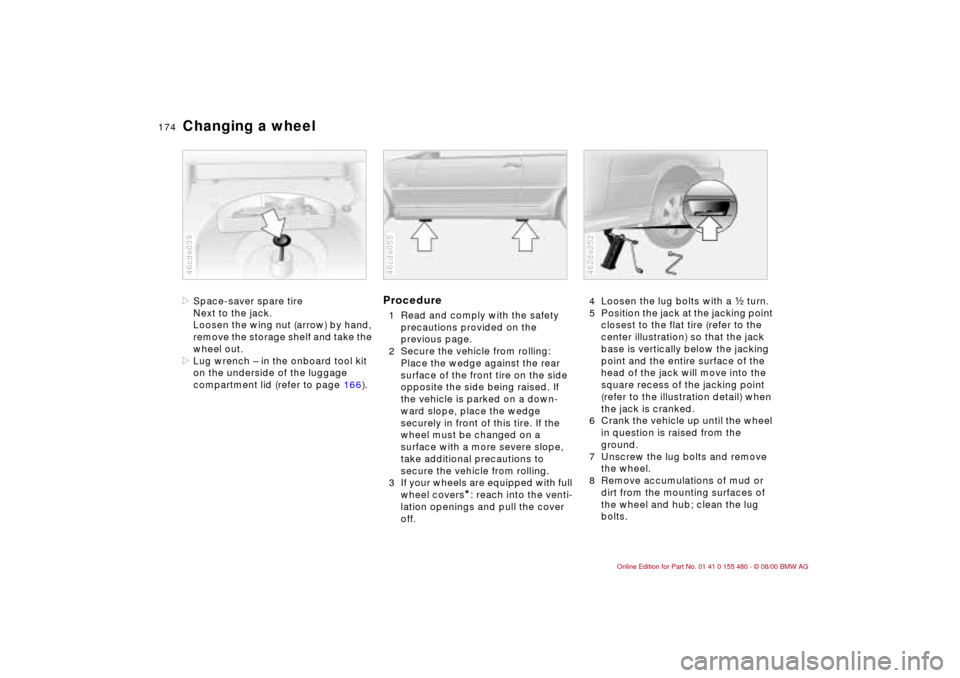
Changing a wheel>Space-saver spare tire
Next to the jack.
Loosen the wing nut (arrow) by hand,
remove the storage shelf and take the
wheel out.
>Lug wrench Ð in the onboard tool kit
on the underside of the luggage
compartment lid (refer to page 166).46cde039
Procedure1 Read and comply with the safety
precautions provided on the
previous page.
2 Secure the vehicle from rolling:
Place the wedge against the rear
surface of the front tire on the side
opposite the side being raised. If
the vehicle is parked on a down-
ward slope, place the wedge
securely in front of this tire. If the
wheel must be changed on a
surface with a more severe slope,
take additional precautions to
secure the vehicle from rolling.
3 If your wheels are equipped with full
wheel covers
*: reach into the venti-
lation openings and pull the cover
off.
46cde055
4 Loosen the lug bolts with a g turn.
5 Position the jack at the jacking point
closest to the flat tire (refer to the
center illustration) so that the jack
base is vertically below the jacking
point and the entire surface of the
head of the jack will move into the
square recess of the jacking point
(refer to the illustration detail) when
the jack is cranked.
6 Crank the vehicle up until the wheel
in question is raised from the
ground.
7 Unscrew the lug bolts and remove
the wheel.
8 Remove accumulations of mud or
dirt from the mounting surfaces of
the wheel and hub; clean the lug
bolts.462de252
Page 176 of 215
176n
Changing a wheel Battery Driving with the space-saver
spare tireDrive cautiously and do not exceed a
speed of 50 mph (80 km/h).
Be aware that vehicle handling will be
altered. Slower brake response time,
longer braking distances and changed
steering characteristics may be
anticipated when approaching limit
conditions.
The changes in handling characteristics
will be even more pronounced in
conjunction with winter tires.
Only one space-saver spare tire
*
may be mounted at a time. Mount
a wheel and tire with the same size
and specifications as the others at the
earliest possible opportunity. Maintain
correct tire pressures. Refer to
page 28.<
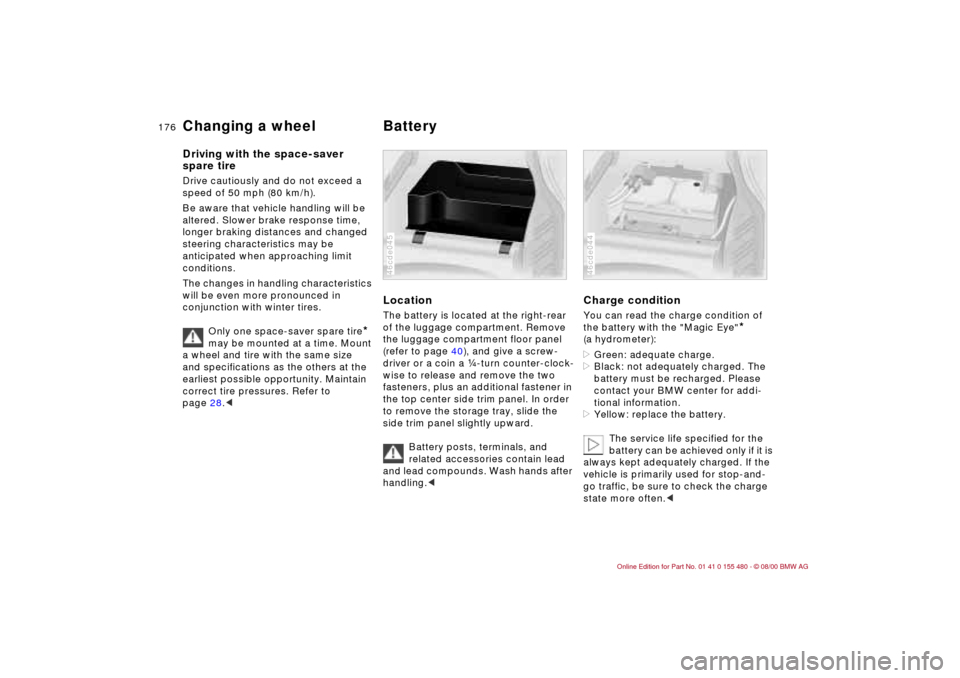
LocationThe battery is located at the right-rear
of the luggage compartment. Remove
the luggage compartment floor panel
(refer to page 40), and give a screw-
driver or a coin a f-turn counter-clock-
wise to release and remove the two
fasteners, plus an additional fastener in
the top center side trim panel. In order
to remove the storage tray, slide the
side trim panel slightly upward.
Battery posts, terminals, and
related accessories contain lead
and lead compounds. Wash hands after
handling.<46cde045
Charge conditionYou can read the charge condition of
the battery with the "Magic Eye"
*
(a hydrometer):
>Green: adequate charge.
>Black: not adequately charged. The
battery must be recharged. Please
contact your BMW center for addi-
tional information.
>Yellow: replace the battery.
The service life specified for the
battery can be achieved only if it is
always kept adequately charged. If the
vehicle is primarily used for stop-and-
go traffic, be sure to check the charge
state more often.<
46cde044
Page 192 of 215
192n
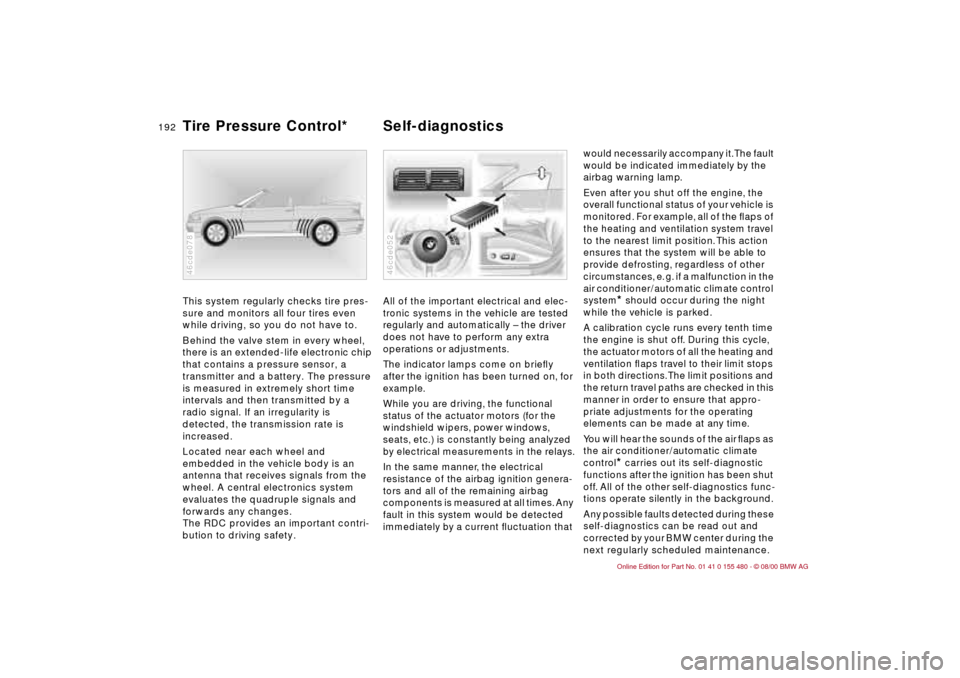
Tire Pressure Control* Self-diagnostics This system regularly checks tire pres-
sure and monitors all four tires even
while driving, so you do not have to.
Behind the valve stem in every wheel,
there is an extended-life electronic chip
that contains a pressure sensor, a
transmitter and a battery. The pressure
is measured in extremely short time
intervals and then transmitted by a
radio signal. If an irregularity is
detected, the transmission rate is
increased.
Located near each wheel and
embedded in the vehicle body is an
antenna that receives signals from the
wheel. A central electronics system
evaluates the quadruple signals and
forwards any changes.
The RDC provides an important contri-
bution to driving safety.46cde078
All
of the important electrical and elec-
tronic systems in the vehicle are tested
regularly and automatically Ð the driver
does not have to perform any extra
operations or adjustments.
The indicator lamps come on brießy
after the ignition has been turned on, for
example.
While you are driving, the functional
status of the actuator motors (for the
windshield wipers, power windows,
seats, etc.) is constantly being analyzed
by electrical measurements in the relays.
In the same manner, the electrical
resistance of the airbag ignition genera-
tors and all of the remaining airbag
components is measured at all times. Any
fault in this system would be detected
immediately by a current ßuctuation that 46cde052
would necessarily accompany it.
The fault
would be indicated immediately by the
airbag warning lamp.
Even after you shut off the engine, the
overall functional status of your vehicle is
monitored. For example, all of the ßaps of
the heating and ventilation system travel
to the nearest limit position. This action
ensures that the system will be able to
provide defrosting, regardless of other
circumstances, e. g. if a malfunction in the
air conditioner/automatic climate control
system
* should occur during the night
while the vehicle is parked.
A calibration cycle runs every tenth time
the engine is shut off. During this cycle,
the actuator motors of all the heating and
ventilation ßaps travel to their limit stops
in both directions. The limit positions and
the return travel paths are checked in this
manner in order to ensure that appro-
priate adjustments for the operating
elements can be made at any time.
You will hear the sounds of the air ßaps as
the air conditioner/automatic climate
control* carries out its self-diagnostic
functions after the ignition has been shut
off. All of the other self-diagnostics func-
tions operate silently in the background.
Any possible faults detected during these
self-diagnostics can be read out and
corrected by your BMW center
during the
next regularly scheduled maintenance.
Page 207 of 215

Everything from A to Z
207n
IndexDataTechnologyRepairsCar careControlsOverview
Interlock69
Intermittent mode, wiper
system76 J
Jack173
Jump-starting183 K
Key Memory59
Keys32
with remote control32 L
Lamps and bulbs166
LAMPS ON warning93
Lashing eyes115
LATCH attachment of the
child seat64
Leather care155
Length197
License plate lamp, bulb
replacement171
Light-alloy wheels137
Lighter112
Loads, securing114
Load-securing devices115
Low beam headlamps93
bulb replacement167
Lug bolts174 Luggage
compartment40,41
capacity198
emergency release39
floor panel40
lid39
lighting39
lock separately39
remote control36
Luggage compartment
lamps, bulb
replacement172
Luggage rack116
Lumbar support55
M
M+S tires136
Maintenance82,150
Malfunction displays83
Manual convertible top,
operating45
Manual transmission72
Manually controlled
recirculated-air105
Memory57
MFL (Multi-function steering
wheel)24
Microfilter99,180
Mirror memory57
Mirrors57
Mobile phones129 Modifications,
technical6,161
Motion sensor, interior43
Mounting child safety
seat64
Mounting the roof
carrier130
Multi-function steering
wheel (MFL)24
N
Navigation system, refer to
the radio Owner's Manual O
OBD interface socket162
Odometer81
Oil
additives145
capacity199
consumption145
dipstick145
quality146
specifications146
viscosity146
Oil change intervals, see the
Service and Warranty
Information Booklet (US
models)/Warranty and
Service Guide Booklet
(Canadian models) Oil filter change199
Oil level
check145
indicator lamp20
Oil pressure, indicator
lamp20
OILSERVICE82
Onboard tool kit166
Opening and closing
from the inside38
from the outside34
Operating the convertible
top manually in the event
of an electrical
malfunction181
Outside temperature
display84
P
Paint blemishes152
Paint, care152
Paintwork
minor repairs153
waxing153
Park Distance Control
(PDC)87
Parking brake71
Parking help87
Parking lamps94
Parking, winter128