fuel BMW 330Ci COUPE 2001 E46 User Guide
[x] Cancel search | Manufacturer: BMW, Model Year: 2001, Model line: 330Ci COUPE, Model: BMW 330Ci COUPE 2001 E46Pages: 203, PDF Size: 2.03 MB
Page 38 of 203
38n
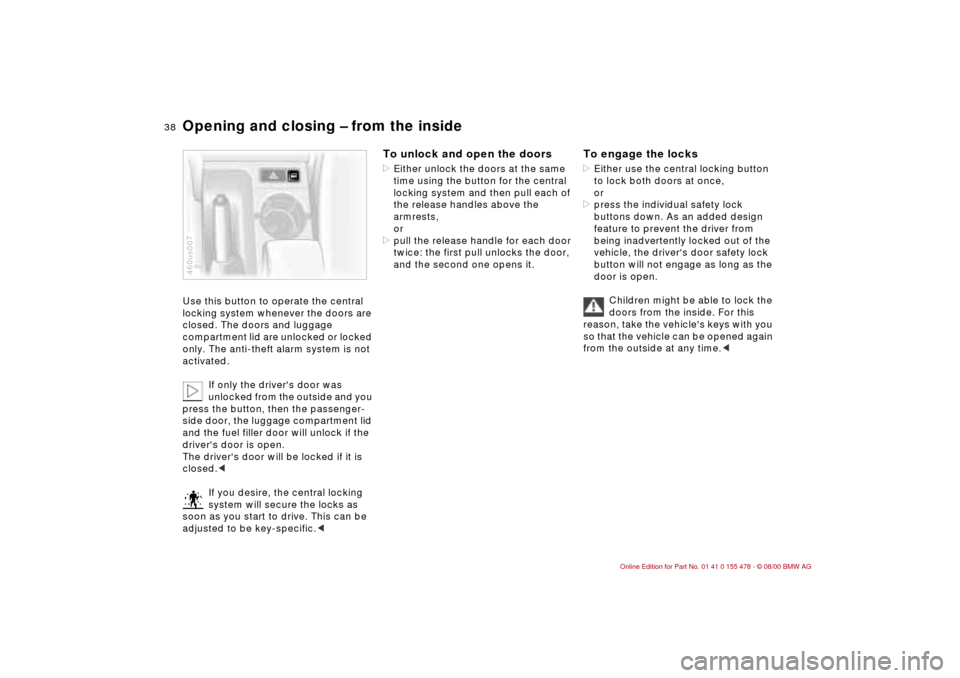
Opening and closing Ð from the inside Use this button to operate the central
locking system whenever the doors are
closed. The doors and luggage
compartment lid are unlocked or locked
only. The anti-theft alarm system is not
activated.
If only the driver's door was
unlocked from the outside and you
press the button, then the passenger-
side door, the luggage compartment lid
and the fuel filler door will unlock if the
driver's door is open.
The driver's door will be locked if it is
closed.<
If you desire, the central locking
system will secure the locks as
soon as you start to drive. This can be
adjusted to be key-specific.<460us007
To unlock and open the doors>Either unlock the doors at the same
time using the button for the central
locking system and then pull each of
the release handles above the
armrests,
or
>pull the release handle for each door
twice: the first pull unlocks the door,
and the second one opens it.
To engage the locks>Either use the central locking button
to lock both doors at once,
or
>press the individual safety lock
buttons down. As an added design
feature to prevent the driver from
being inadvertently locked out of the
vehicle, the driver's door safety lock
button will not engage as long as the
door is open.
Children might be able to lock the
doors from the inside. For this
reason, take the vehicle's keys with you
so that the vehicle can be opened again
from the outside at any time.<
Page 75 of 203
75n
IndexDataTechnologyRepairsCar careControlsOverview
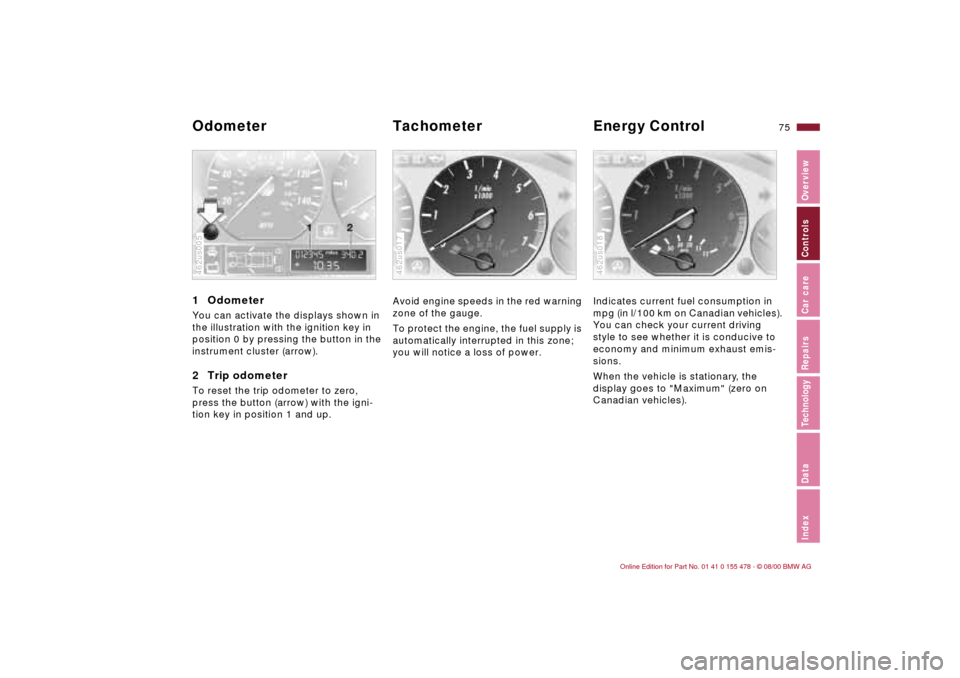
1 Odometer You can activate the displays shown in
the illustration with the ignition key in
position 0 by pressing the button in the
instrument cluster (arrow).2 Trip odometerTo reset the trip odometer to zero,
press the button (arrow) with the igni-
tion key in position 1 and up.462us005
Avoid engine speeds in the red warning
zone of the gauge.
To protect the engine, the fuel supply is
automatically interrupted in this zone;
you will notice a loss of power.462us017
Indicates current fuel consumption in
mpg (in l/100 km on Canadian vehicles).
You can check your current driving
style to see whether it is conducive to
economy and minimum exhaust emis-
sions.
When the vehicle is stationary, the
display goes to "Maximum" (zero on
Canadian vehicles).462us018
Odometer Tachometer Energy Control
Page 76 of 203
76n
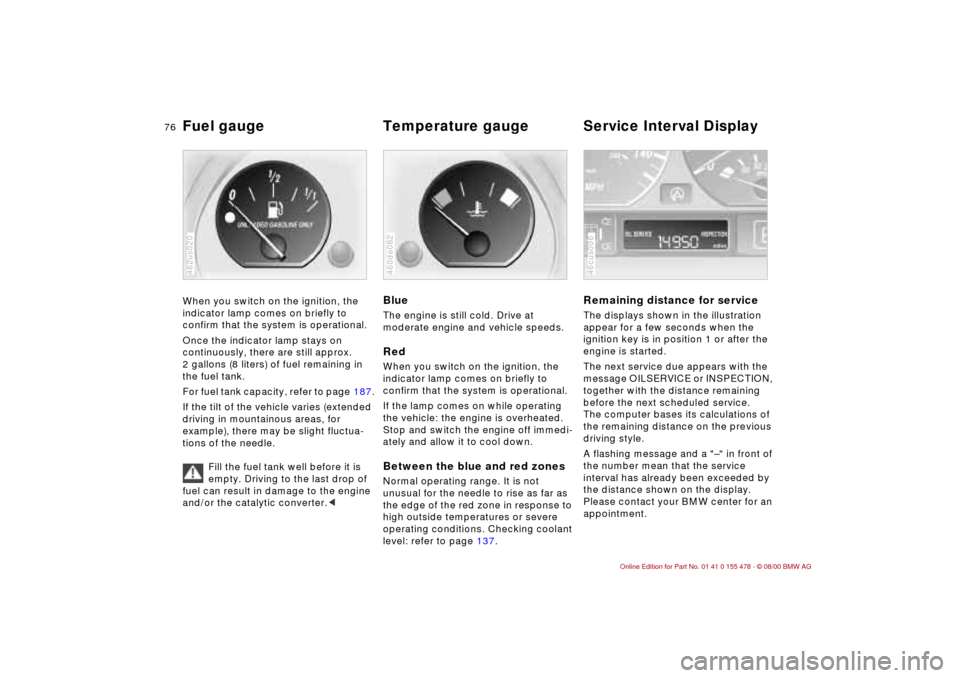
Fuel gauge Temperature gauge Service Interval Display When you switch on the ignition, the
indicator lamp comes on briefly to
confirm that the system is operational.
Once the indicator lamp stays on
continuously, there are still approx.
2 gallons (8 liters) of fuel remaining in
the fuel tank.
For fuel tank capacity, refer to page 187.
If the tilt of the vehicle varies (extended
driving in mountainous areas, for
example), there may be slight fluctua-
tions of the needle.
Fill the fuel tank well before it is
empty. Driving to the last drop of
fuel can result in damage to the engine
and/or the catalytic converter.<462us020
BlueThe engine is still cold. Drive at
moderate engine and vehicle speeds.RedWhen you switch on the ignition, the
indicator lamp comes on briefly to
confirm that the system is operational.
If the lamp comes on while operating
the vehicle: the engine is overheated.
Stop and switch the engine off immedi-
ately and allow it to cool down.Between the blue and red zonesNormal operating range. It is not
unusual for the needle to rise as far as
the edge of the red zone in response to
high outside temperatures or severe
operating conditions. Checking coolant
level: refer to page 137.460de082
Remaining distance for serviceThe displays shown in the illustration
appear for a few seconds when the
ignition key is in position 1 or after the
engine is started.
The next service due appears with the
message OILSERVICE or INSPECTION,
together with the distance remaining
before the next scheduled service.
The computer bases its calculations of
the remaining distance on the previous
driving style.
A flashing message and a "Ð" in front of
the number mean that the service
interval has already been exceeded by
the distance shown on the display.
Please contact your BMW center for an
appointment.46cus006
Page 77 of 203
77n
IndexDataTechnologyRepairsCar careControlsOverview
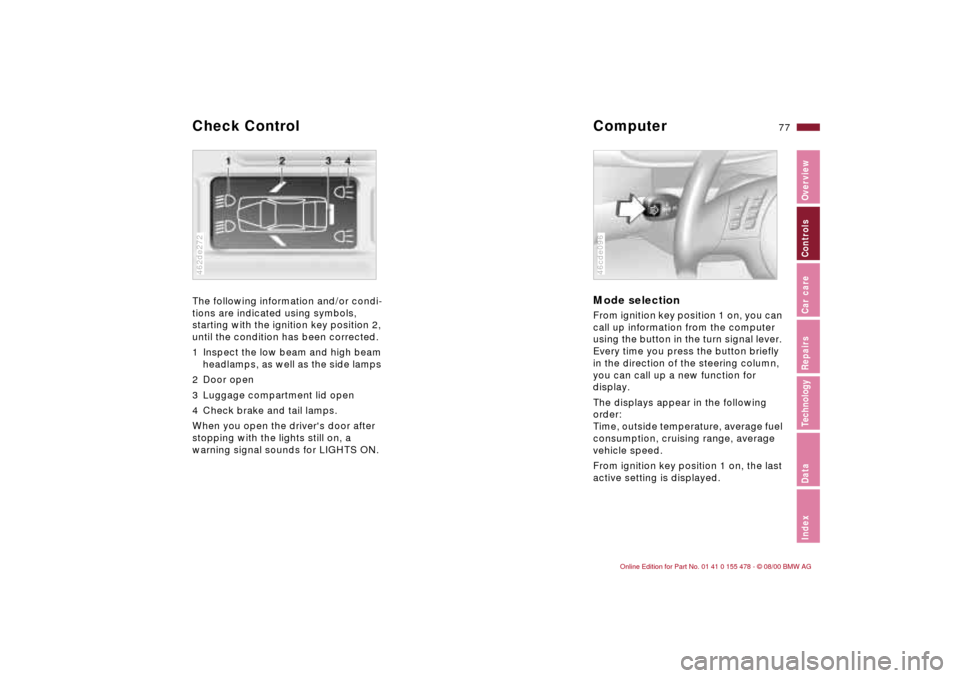
The following information and/or condi-
tions are indicated using symbols,
starting with the ignition key position 2,
until the condition has been corrected.
1 Inspect the low beam and high beam
headlamps, as well as the side lamps
2 Door open
3 Luggage compartment lid open
4 Check brake and tail lamps.
When you open the driver's door after
stopping with the lights still on, a
warning signal sounds for LIGHTS ON.462de272
Mode selectionFrom ignition key position 1 on, you can
call up information from the computer
using the button in the turn signal lever.
Every time you press the button briefly
in the direction of the steering column,
you can call up a new function for
display.
The displays appear in the following
order:
Time, outside temperature, average fuel
consumption, cruising range, average
vehicle speed.
From ignition key position 1 on, the last
active setting is displayed.46cde096
Check Control Computer
Page 79 of 203
79n
StichworteDatenTechnikSelbsthilfeWartungBedienung†berblick
Computer
Ice warning
If the outside temperature drops to
about 37.5
7
(+3
6
), then the
computer will automatically switch to
show the outside temperature. In addi-
tion, a signal sounds as a warning and
the display flashes for a brief period.
This warning will repeat itself whenever
the temperature has reached at least
43
7
(+6
6
) since the last warning,
and has then dropped further to
37.5
7
(+3
6
).
Ice warnings do not exclude the
possibility that surface ice can still
occur at temperatures above 37.5
7
(+3
6
), e. g. on bridges and shady
roads. <
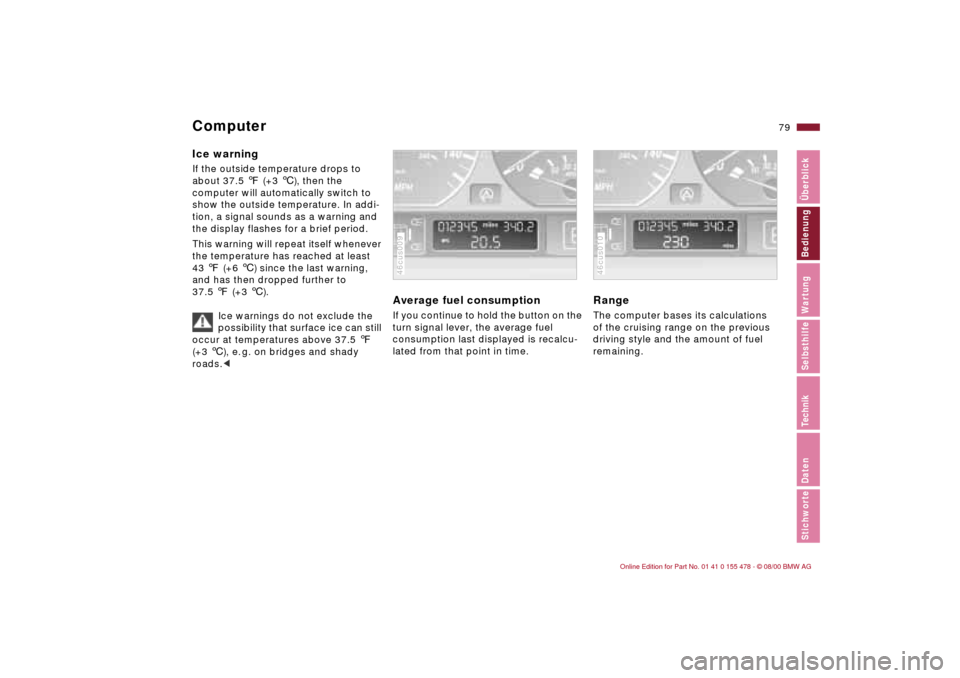
Average fuel consumption
If you continue to hold the button on the
turn signal lever, the average fuel
consumption last displayed is recalcu-
lated from that point in time.46cus009
Range
The computer bases its calculations
of the cruising range on the previous
driving style and the amount of fuel
remaining.46cus010
Page 80 of 203
80n
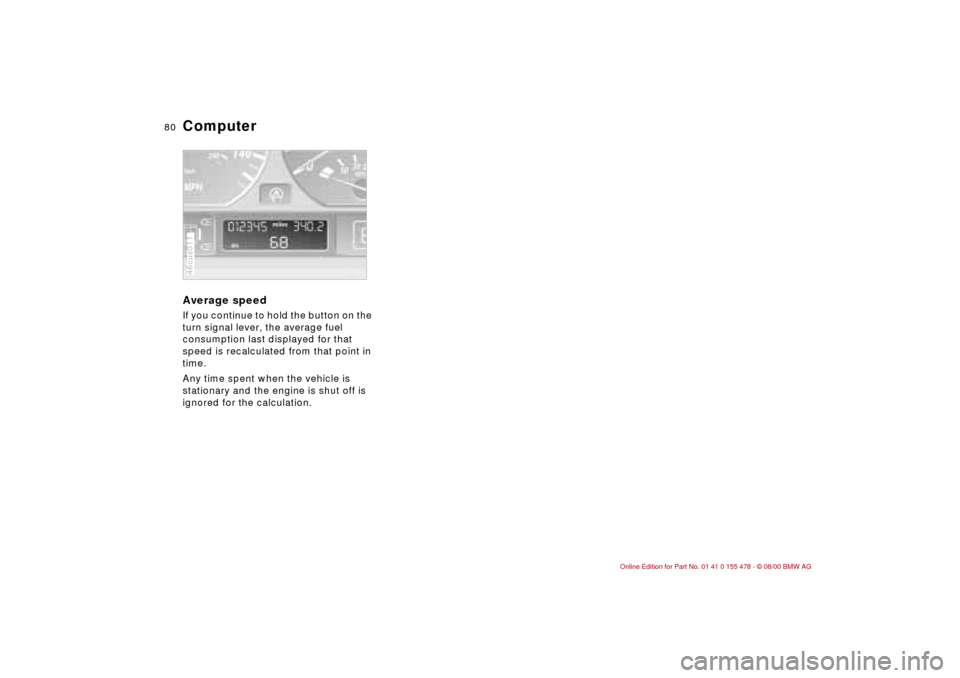
ComputerAverage speed If you continue to hold the button on the
turn signal lever, the average fuel
consumption last displayed for that
speed is recalculated from that point in
time.
Any time spent when the vehicle is
stationary and the engine is shut off is
ignored for the calculation.46cus011
Page 109 of 203
109n
IndexDataTechnologyRepairsCar careControlsOverview
Cargo loading Roof-mounted luggage rack
*
Always position and secure the
load correctly. If you do not, it can
endanger the passengers during
braking or evasive maneuvers.
Do not exceed the permissible gross
weight and axle loads (refer to
page 186), otherwise the vehicle's oper-
ating safety is no longer assured and
you are in violation of the law.
Do not stow heavy or hard objects in
the passenger compartment without
securing them. Otherwise they would
be thrown around during braking and
evasive maneuvers and endanger the
occupants.<
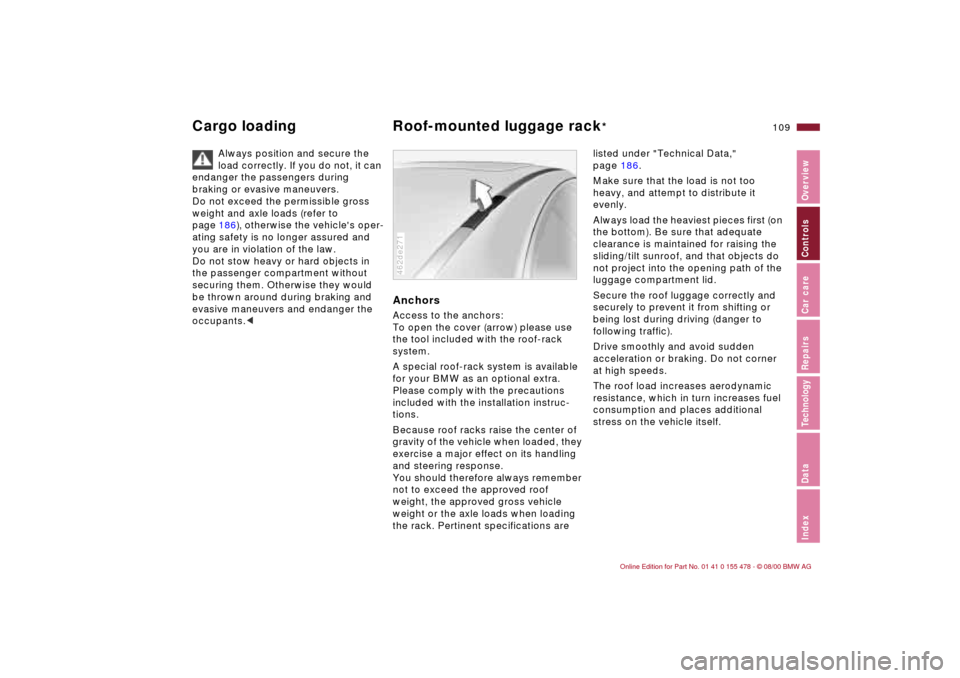
AnchorsAccess to the anchors:
To open the cover (arrow) please use
the tool included with the roof-rack
system.
A special roof-rack system is available
for your BMW as an optional extra.
Please comply with the precautions
included with the installation instruc-
tions.
Because roof racks raise the center of
gravity of the vehicle when loaded, they
exercise a major effect on its handling
and steering response.
You should therefore always remember
not to exceed the approved roof
weight, the approved gross vehicle
weight or the axle loads when loading
the rack. Pertinent specifications are 462de271
listed under "Technical Data,"
page 186.
Make sure that the load is not too
heavy, and attempt to distribute it
evenly.
Always load the heaviest pieces first (on
the bottom). Be sure that adequate
clearance is maintained for raising the
sliding/tilt sunroof, and that objects do
not project into the opening path of the
luggage compartment lid.
Secure the roof luggage correctly and
securely to prevent it from shifting or
being lost during driving (danger to
following traffic).
Drive smoothly and avoid sudden
acceleration or braking. Do not corner
at high speeds.
The roof load increases aerodynamic
resistance, which in turn increases fuel
consumption and places additional
stress on the vehicle itself.
Page 113 of 203

113n
IndexDataTechnologyRepairsCar careControlsOverview
Brakes:
Do not drive with your foot resting
on the brake pedal. Even light but
consistent pedal pressure can lead to
high temperatures, brake wear, and
possibly to brake failure.
Aquaplaning:
When driving on wet or slushy roads,
reduce vehicle speed. If you do not, a
wedge of water may form between the
tires and the road surface. This
phenomenon is referred to as aqua-
planing or hydroplaning. It is character-
ized by a partial or complete loss of
contact between the tires and the road
surface. The ultimate results are loss of
steering and braking control.
Driving through water:
Do not drive through water on the road
if it is deeper than 1 foot (30 cm), and
then only at walking speed. Otherwise,
the vehicle's engine, the electrical
systems and the transmission may be
damaged.
Rear window shelf:
Never use it to store heavy or hard
objects, otherwise, occupants could
be injured if the vehicle is braked hard.
Clothes hooks:
When suspending clothing from the
hooks, be sure that they will not
obstruct the driver's vision. Do not hang
heavy objects on the hooks. If you do
so, they could cause personal injury
during braking or evasive maneuvers.
It is designed for use with unleaded fuel
only. Even minute quantities of lead
would be enough to permanently
damage both the catalytic converter
and the system oxygen sensor.
To ensure efficient, trouble-free engine
operation and to avoid potential
damage:
>Be sure to comply with the scheduled
maintenance requirements.
>Fill the fuel tank well before it is
empty.
>Tow-start only when the engine is
cold. If you attempt to tow-start with
a warm engine, unburned residual
fuel in the catalytic converter could
ignite and cause damage. It is better
to jump-start the vehicle with outside
assistance.
>Avoid other situations in which the
fuel is not burned, or burns incom-
pletely, such as engaging the starter
frequently or for extended periods, or
repeated start attempts in which the
engine does not start (stopping and
restarting an engine which is running
properly does not present a problem).
Never allow the engine to run with
any of the spark plug cables discon-
nected.
Driving notes Catalytic converter
Page 114 of 203

114n
Catalytic converter
Be sure to comply with the
preceding instructions to prevent
unburned fuel from reaching the cata-
lytic converter. If you do not, the cata-
lytic converter could respond by
overheating, leading to serious
damage.
Very high temperatures occur in any
vehicle equipped with a catalytic
converter. Heat shields are installed
adjacent to some sections of the
exhaust system. Never remove these
shields; do not apply undercoating to
their surfaces. When driving, standing
at idle, and parking the vehicle, take
extra care to avoid contact between the
exhaust system and flammable mate-
rials (grass, hay, leaves, etc.). Such
contact could lead to a fire, resulting in
serious personal injury and property
damage.<
Page 126 of 203

126n
Winter tires
Choosing the right tire
BMW recommends winter tires (M+S
radial tires) for driving in adverse winter
road conditions. So-called all-season
tires with the M+S identification mark
do indeed possess better winter trac-
tion than summer tires that have the H,
V, W, Y and ZR speed ratings, they
generally fail to provide the same levels
of performance as winter tires.
In the interest of safe tracking and
steering response, install winter tires
made by the same manufacturer having
the same tread configuration on all four
wheels.
Mount only winter tires which have
been approved by BMW. Any BMW
center will be glad to provide you with
information on the best winter tires for
your particular driving conditions.
Do not exceed specified
maximum speeds
Never exceed the maximum speed
for which the tires are rated.
Unprofessional attempts by laymen to
service tires can lead to damage and
accidents.
Have this work performed by skilled
professionals only. Any BMW center
has the required technical knowledge
and the proper equipment and will be
happy to assist you.
<
Tire condition, tire pressure
Winter tires display a perceptible loss in
their ability to cope with winter driving
conditions once the tread wears to
below 0.16 in (4 mm), and therefore in
the interest of safety, should be
replaced.
Comply with the specified tire inflation
pressures Ð and be sure to have the
wheel and tire assemblies balanced
every time you change the tires.
Storage
Always store tires in a cool, dry place.
Store them away from light whenever
possible. Protect the tires against con-
tact with oil, grease and fuel.
Snow chains
*
Use narrow-link BMW snow chains
on
winter tires only in pairs and only on the
rear wheels. Comply with all manufac-
turer's safety precautions when mount-
ing the chains.