warning BMW 330Ci COUPE 2001 E46 Owner's Guide
[x] Cancel search | Manufacturer: BMW, Model Year: 2001, Model line: 330Ci COUPE, Model: BMW 330Ci COUPE 2001 E46Pages: 203, PDF Size: 2.03 MB
Page 111 of 203
Overview
Controls and features
Operation, care
and maintenance
Owner service procedures
Technical data
Index Advanced technology
111n
IndexDataTechnologyRepairsCar careControlsOverview
Special operating instructions:
Break-in procedures112
Driving notes113
Catalytic converter113
Antilock Brake System
(ABS)115
Disc brakes117
Brake system118
Winter operation119
Power steering121
Cellular phones121
Radio reception121
Wheels and tires:
Tire inflation pressure122
Tire condition122
Tire replacement123
Tire rotation124
Wheel and tire
combinations125
Winter tires126
Snow chains126
Approved wheel and tire
specifications127Under the hood:
Hood130
Engine compartment132
Washer fluids134
Washer nozzles134
Engine oil135
Coolant137
Brake fluid138
Vehicle Identification
Number139
Care and maintenance:
The BMW Maintenance
System140
Caring for your vehicle141
Airbags146
Vehicle storage147
Laws and regulations:
Technical modifications148
California Proposition
65 Warning148
OBD interface socket149
Car care
Page 116 of 203
116n
Antilock Brake System (ABS)Antilock Brake System (ABS)/
Cornering Brake Control (CBC) CBC is an advanced engineering
design of the ABS. When braking while
cornering at high speed or braking
during high lateral acceleration, or
when braking during a lane change,
vehicle stability is improved and
steering response is enhanced.In the event of a malfunction
If the ABS warning lamp in the
instrument cluster lights up,
refer to page 22. The brake
system then reverts to conventional
operation as on vehicles without ABS.
However, have the brake system
checked by your BMW center as soon
as possible. To prevent undetected
defects and cumulative faults from
adversely affecting the brake system,
refer any problems to your BMW center
at the earliest opportunity.
ABS warning lamp for Canadian
models.
If the brake warning lamp, and
the ABS and ASC+T/DSC
indi-
cator lamps come on, refer to
page 21, then the entire ABS,
CBC, ASC+T/DSC control
system has failed. Continue
driving cautiously and defen-
sively. Avoid full brake applica-
tions. This could cause the vehicle to
lose stability and you might no longer
be able to control it.
Have the system checked by your BMW
center as soon as possible.
Indicator and warning lamps for
CBC, ABS and ASC+T/DSC and
ADB for Canadian models.
Dynamic Brake Control (DBC)*DBC is included in the DSC, refer to
information beginning on page 83.
If you step on the brake rapidly, this
system automatically produces
maximum braking force boost and thus
helps to achieve the shortest possible
braking distance during "panic stops."
All of the benefits of the ABS system
are exploited under these circum-
stances.
Do not reduce the pressure on the
brake pedal for the duration of the
brake application. When the brake
pedal is released, the DBC is deacti-
vated.
In the event of a malfunction,
the yellow brake warning lamp
comes on. Normal braking effi-
ciency and ABS are still fully available.
Have the system checked and repaired
at your BMW center as soon as
possible.
Please observe the section "Infor-
mation for your safety" concerning
the ABS system, which also applies to
the DSC system.<
Page 118 of 203

118n
Brake systemBrake fluid level
If the brake warning lamp
comes on with the parking
brake released:
The brake fluid level is too low in the
reservoir (refer to page 138).
If the brake fluid level is too low and
brake pedal travel has become notice-
ably longer, there may be a defect in
one of the hydraulic circuits of the
brake system.
Brake warning lamp for Cana-
dian models.
Proceed to the nearest BMW
center. Higher brake application
pressure may be necessary under these
conditions, and brake pedal travel may
be significantly longer. Please
remember to adapt your driving style
accordingly.<
Brake pads
If the warning lamp for the brake
pads lights up:
Only the minimum pad thick-
ness still remains on the brake pads.
Proceed to the nearest BMW center
as soon as possible to have the pads
replaced.
For your own safety: use only
brake pads that BMW has
approved for your particular vehicle
model. BMW cannot evaluate non-
approved brake pads to determine if
they are suited for use, and therefore
cannot ensure the operating safety of
the vehicle if they are installed.<
Page 130 of 203
130n
Do not work on your vehicle with-
out appropriate skills. Always
switch off the engine and allow it to
cool down before working in the engine
compartment. Always disconnect the
battery before working on any electrical
systems or equipment. Comply with all
applicable instructions and warnings.
Failure to work in an informed, profes-
sional manner when servicing compo-
nents and materials constitutes a safety
hazard for vehicle occupants and other
road users. If you are not familiar with
the guidelines, please have the opera-
tions performed by your BMW center.<
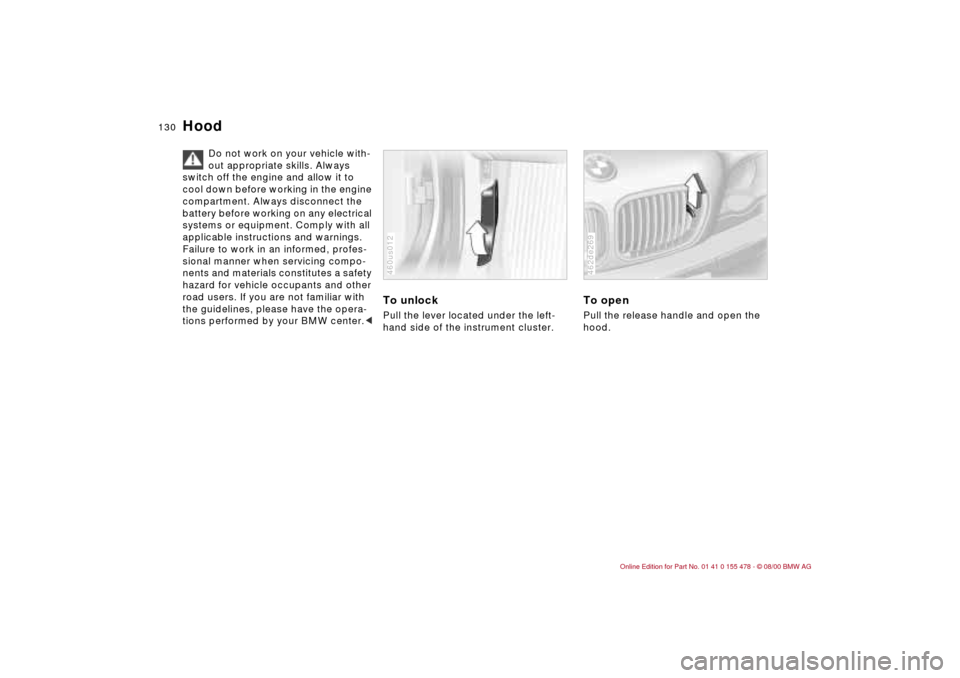
To unlock Pull the lever located under the left-
hand side of the instrument cluster. 460us012
To openPull the release handle and open the
hood.462de269
Hood
Page 137 of 203
137n
IndexDataTechnologyRepairsCar careControlsOverview
Engine oil Coolant
Always observe all environmental
protection laws when disposing of
used oil.<
Recommendation: have the oil changed
by your BMW center only.
Continuous exposure to used oil
has caused cancer in laboratory
testing.
For this reason, thoroughly wash any
areas of skin that come into contact
with oil using soap and water.
Always store oils, grease and similar
materials so that they are inaccessible
to children. Comply with warning labels
and information on containers.<
Do not add coolant to the cooling
system when the engine is hot. If
you attempt to do so, escaping coolant
can cause burns.
To avoid the possibility of damage later
on, never use anything other than fac-
tory-approved, nitrite and amino-free
extended-duty antifreeze with corrosion
inhibitor. Your BMW center is familiar
with the official specifications.
Antifreeze and anticorrosion agents are
hazardous to health. You should always
store it in its original container and in a
location that is inaccessible to children.
Extended-duty antifreeze with corro-
sion inhibitor contains ethylene glycol, a
flammable substance. For this reason,
do not spill antifreeze with corrosion
inhibitor on hot engine parts. It could
ignite and cause burns.<
Comply with the applicable envi-
ronmental laws regulating the dis-
posal of extended-duty antifreeze with
corrosion inhibitor.<
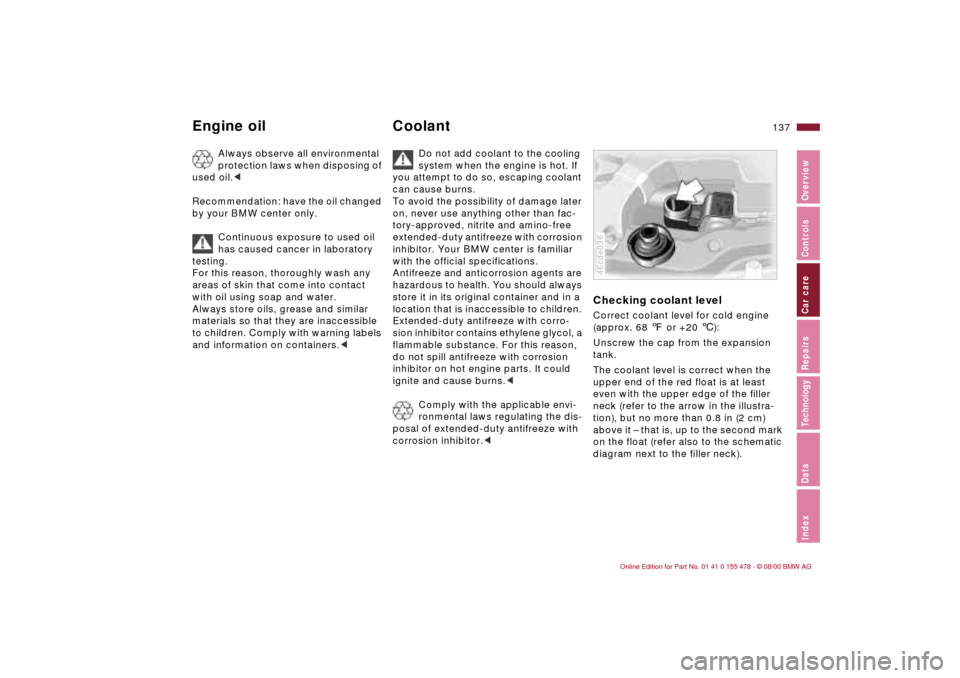
Checking coolant levelCorrect coolant level for cold engine
(approx. 68 7 or +20 6):
Unscrew the cap from the expansion
tank.
The coolant level is correct when the
upper end of the red float is at least
even with the upper edge of the filler
neck (refer to the arrow in the illustra-
tion), but no more than 0.8 in (2 cm)
above it Ð that is, up to the second mark
on the float (refer also to the schematic
diagram next to the filler neck).46cde036
Page 138 of 203
138n
Coolant Brake fluidAdding coolant Wait until the engine cools before
removing the cap from the expansion
tank. The needle of the coolant
temperature gauge in the instrument
cluster must be located in the blue
zone. If it is not, there is a danger of
scalding.
1 Turn the cap slightly counterclock-
wise in order to allow accumulated
pressure to escape. Then open.
2 If the coolant is low, slowly add
coolant until the correct level is
reached Ð do not overfill.
The coolant is a mixture of water and
extended-duty antifreeze with corrosion
inhibitor. Always maintain the pre-
scribed all-season 50:50 mixture ratio
for year-round protection against inter-
nal corrosion. No other additives are
required.
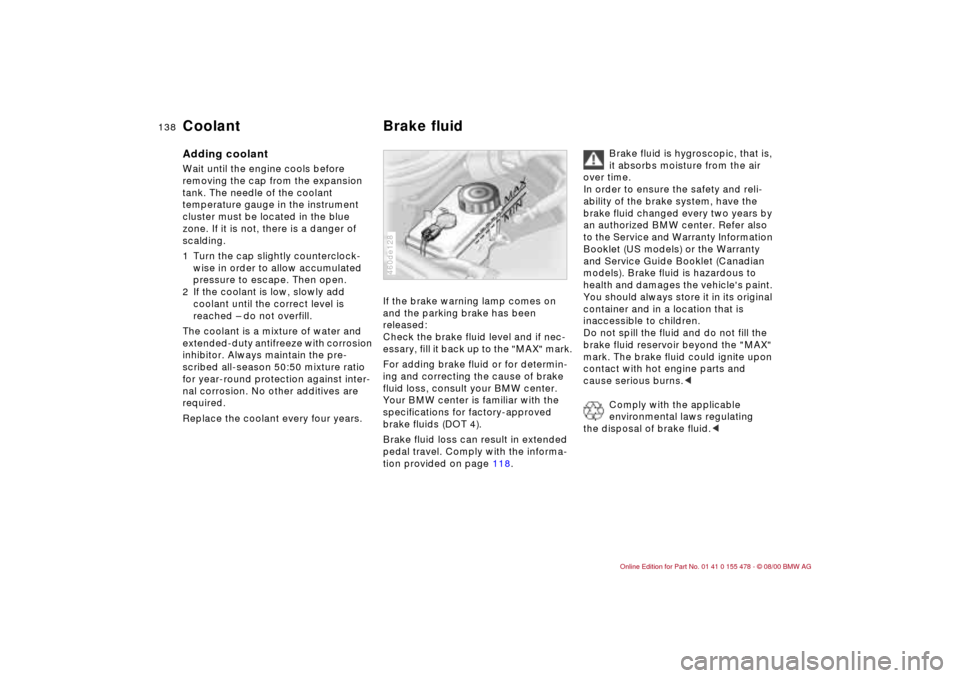
Replace the coolant every four years.If the brake warning lamp comes on
and the parking brake has been
released:
Check the brake fluid level and if nec-
essary, fill it back up to the "MAX" mark.
For adding brake fluid or for determin-
ing and correcting the cause of brake
fluid loss, consult your BMW center.
Your BMW center is familiar with the
specifications for factory-approved
brake fluids (DOT 4).
Brake fluid loss can result in extended
pedal travel. Comply with the informa-
tion provided on page 118.
460de128
Brake fluid is hygroscopic, that is,
it absorbs moisture from the air
over time.
In order to ensure the safety and reli-
ability of the brake system, have the
brake fluid changed every two years by
an authorized BMW center. Refer also
to the Service and Warranty Information
Booklet (US models) or the Warranty
and Service Guide Booklet (Canadian
models). Brake fluid is hazardous to
health and damages the vehicle's paint.
You should always store it in its original
container and in a location that is
inaccessible to children.
Do not spill the fluid and do not fill the
brake fluid reservoir beyond the "MAX"
mark. The brake fluid could ignite upon
contact with hot engine parts and
cause serious burns.<
Comply with the applicable
environmental laws regulating
the disposal of brake fluid.<
Page 146 of 203
146n
Caring for your vehicle Airbags We recommend that you perform this
procedure twice a year on leather
exposed to normal use.
Spills should be wiped up immediately.
Remove grease and oil stains by
dabbing with spot remover. Avoid
rubbing.
If the upholstery is to be exposed to
intense sunlight or if the vehicle is to be
stored for an extended period, cover all
leather surfaces (or, better yet, the
windows) to prevent fading.
Use the cleaning and car-care
products available at your BMW
center.<
Cleaning agents can contain
substances that are dangerous or
that pose health risks. For this reason,
always comply with the warnings and
danger notices on the packaging.
Open the doors or windows on your
vehicle whenever cleaning the interior.
Never clean your vehicle with solvents
or other materials not specifically
intended for this purpose.<
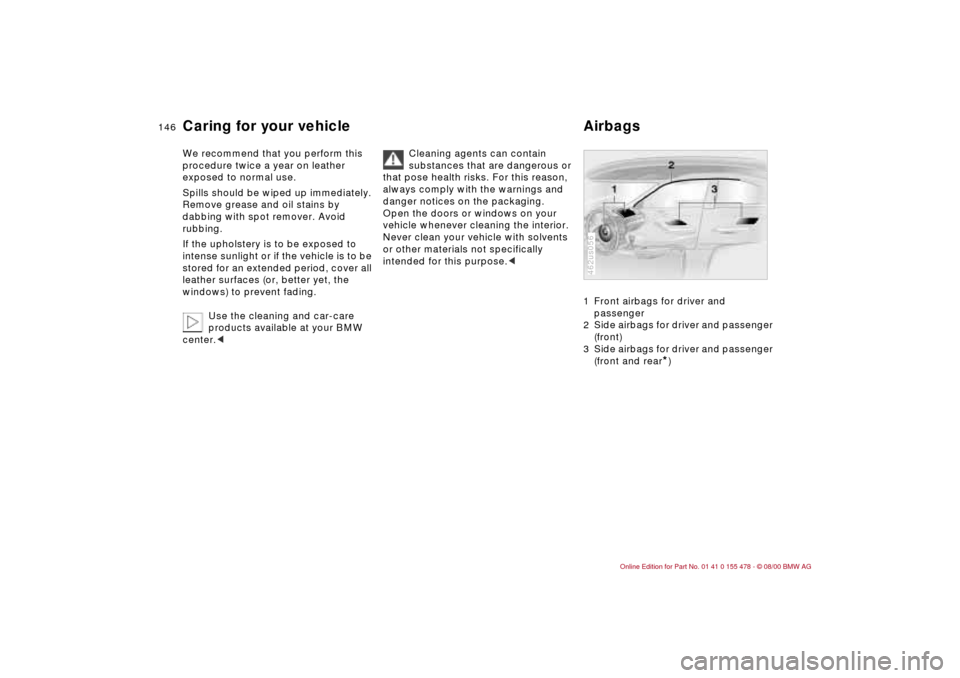
1 Front airbags for driver and
passenger
2 Side airbags for driver and passenger
(front)
3 Side airbags for driver and passenger
(front and rear
*)
462us056
Page 148 of 203

148n
Any BMW center will be glad to inform
you of the advisability, legal require-
ments and factory recommendations
regarding technical modifications on
your vehicle. For this purpose, the
BMW center will require the Vehicle
Identification Number and, in some
cases, also the engine number.
Light-Emitting Diodes (LEDs)Light-emitting diodes installed behind
translucent lenses serve as the light
source for many of the controls and
displays in your vehicle. The concept
behind their operation is related to that
employed for lasers.
Do not remove the protective lens
and avoid staring directly at the
unfiltered beam for extended periods
(several hours), as inflammation of the
iris could result.<
California laws require us to state the
following warning:
Engine exhaust, some of its
constituents, and certain vehicle
components contain or emit chemicals
known to the State of California to
cause cancer and birth defects or other
reproductive harm.<
Technical modifications California Proposition 65 Warning
Page 149 of 203
149n
IndexDataTechnologyRepairsCar careControlsOverview
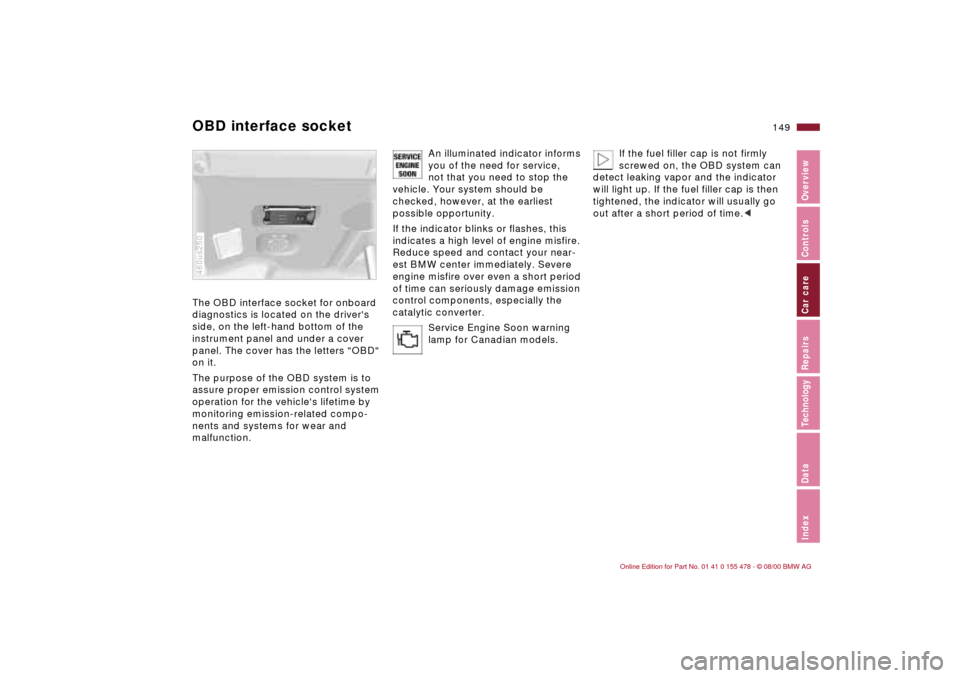
OBD interface socketThe OBD interface socket for onboard
diagnostics is located on the driver's
side, on the left-hand bottom of the
instrument panel and under a cover
panel. The cover has the letters "OBD"
on it.
The purpose of the OBD system is to
assure proper emission control system
operation for the vehicle's lifetime by
monitoring emission-related compo-
nents and systems for wear and
malfunction.460us250
An illuminated indicator informs
you of the need for service,
not that you need to stop the
vehicle. Your system should be
checked, however, at the earliest
possible opportunity.
If the indicator blinks or flashes, this
indicates a high level of engine misfire.
Reduce speed and contact your near-
est BMW center immediately. Severe
engine misfire over even a short period
of time can seriously damage emission
control components, especially the
catalytic converter.
Service Engine Soon warning
lamp for Canadian models.
If the fuel filler cap is not firmly
screwed on, the OBD system can
detect leaking vapor and the indicator
will light up. If the fuel filler cap is then
tightened, the indicator will usually go
out after a short period of time.<
Page 159 of 203

159n
IndexDataTechnologyRepairsCar careControlsOverview
Changing a wheel
Take these precautionary
measures if you have either a flat
tire or are changing the tire:
Stop the vehicle as far as possible from
passing traffic. Park on a firm, flat
surface. Switch on the hazard warning
flashers. Turn the steering wheel to the
straight-ahead position, remove the key
and engage the steering lock. Shift into
1st gear or reverse (selector lever in
"Park" with automatic transmission) and
engage the parking brake.
All passengers should be outside the
vehicle and well away from your imme-
diate working area (behind a guardrail,
for instance).
If a warning triangle
or portable hazard
warning lamp is available, set it up on
the roadside at an appropriate distance
from the rear of the vehicle. Comply
with all safety guidelines and
regulations.
Change the wheel only on a level, firm
surface which is not slippery. Avoid
jacking the vehicle on a soft or slippery
support surface (snow, ice, loose
gravel, etc.), as it could slide sideways.
Position the jack on a firm support
surface. Do not place wooden blocks or
similar objects under the jack. If this is
done, the jack might not be able to
reach its full support capacity because
of the limited height.
Do not lie under the vehicle or start the
engine when the vehicle is supported
by the jack. Failure to comply with this
creates a risk of fatal injury.< Your BMW has a spare tire
or a space-
saver spare tire for temporary use to
ensure your mobility.
To remove the spare tire, lift out
the floor panel in the luggage
compartment completely (refer to
page 41).<