ABS BMW 330Ci COUPE 2001 E46 Owner's Manual
[x] Cancel search | Manufacturer: BMW, Model Year: 2001, Model line: 330Ci COUPE, Model: BMW 330Ci COUPE 2001 E46Pages: 203, PDF Size: 2.03 MB
Page 11 of 203

11n
Controls and features
Operation, care and maintenance
Lamps:
Side lamps/Low beams87
Instrument panel lighting87
High beams/Parking lamps88
Fog lamps88
Interior lamps88
Controlling the climate
for pleasant driving:
Air conditioner90
Automatic climate control96
Seat heating101
Roller sun blind101
Interior convenience:
HiFi system101
Glove compartment102
Storage facilities102
Cellular phone104
Ashtray, front104
Cigarette lighter105
Ashtray, rear105
Clothes hooks105
Loading and transporting:
Through-loading system106
Ski bag107
Cargo loading108
Roof-mounted luggage rack109
Special operating instructions:
Break-in procedures112
Driving notes113
Catalytic converter113
Antilock Brake System
(ABS)115
Disc brakes117
Brake system118
Winter operation119
Power steering121
Cellular phones121
Radio reception121
Wheels and tires:
Tire inflation pressure122
Tire condition122
Tire replacement123
Tire rotation124
Wheel and tire
combinations125
Winter tires126
Snow chains126
Approved wheel and tire
specifications127
Under the hood:
Hood130
Engine compartment132
Washer fluids134
Washer nozzles134
Engine oil135
Coolant137
Brake fluid138
Vehicle Identification
Number139
Care and maintenance:
The BMW Maintenance
System140
Caring for your vehicle141
Airbags146
Vehicle storage147
Laws and regulations:
Technical modifications148
California Proposition
65 Warning148
ODB interface socket149
Page 19 of 203

19n
IndexDataTechnologyRepairsCar careControlsOverview
Instrument cluster
1 Fuel gauge with indicator lamp
for fuel reserve76
2 Indicator lamp for turn signal
indicator23
3 Speedometer
4 Indicator lamp for:
>
Battery charge current20
>
High beams23
>
Engine oil pressure/Engine oil
level20, 22
5 Tachometer and Energy control75
6 Engine coolant temperature gauge
with "Coolant temperature too high"
indicator76
7 Indicator and warning lamps
(clockwise) for:
>
Parking brake/Brake hydraulic
system/Cornering Brake Control
(CBC/DBC)20
>
Antilock Brake System (ABS)22 > Brake pads22
>
Tire Pressure Control
(RDC)
*
20, 22
>
Airbags21
>
Please fasten safety belts21
>
Cruise control23
8 Set button for the clock789 Program display for automatic
transmission
*
69
Indicator lamp for automatic
transmission
*
21, 69
10 Indicator lamp for Automatic
Stability Control plus Traction
(ASC+T)/Dynamic Stability Control
(DSC)
*
and ADB22
11 Indicator for:
>
Odometer75
>
Trip odometer75
>
Clock78
>
Service Interval76
Indicator for computer, operation
using the turn signal lever, refer to
page 77:
>
Clock
>
Outside temperature
>
Average fuel consumption
> Range >
Average speed
12 Indicator for Check Control77
13 Trip odometer, reset to zero7514 Indicator and warning lamps
(clockwise) for:
>
Front fog lamps23
>
Add washer fluid22
>
Coolant level23
>
Electronic Throttle Control
(EML)
*
23
>
Service Engine Soon22
You can display the outside
temperature and distance driven
in different units of measurement.
<
Page 21 of 203
21n
IndexDataTechnologyRepairsCar careControlsOverview
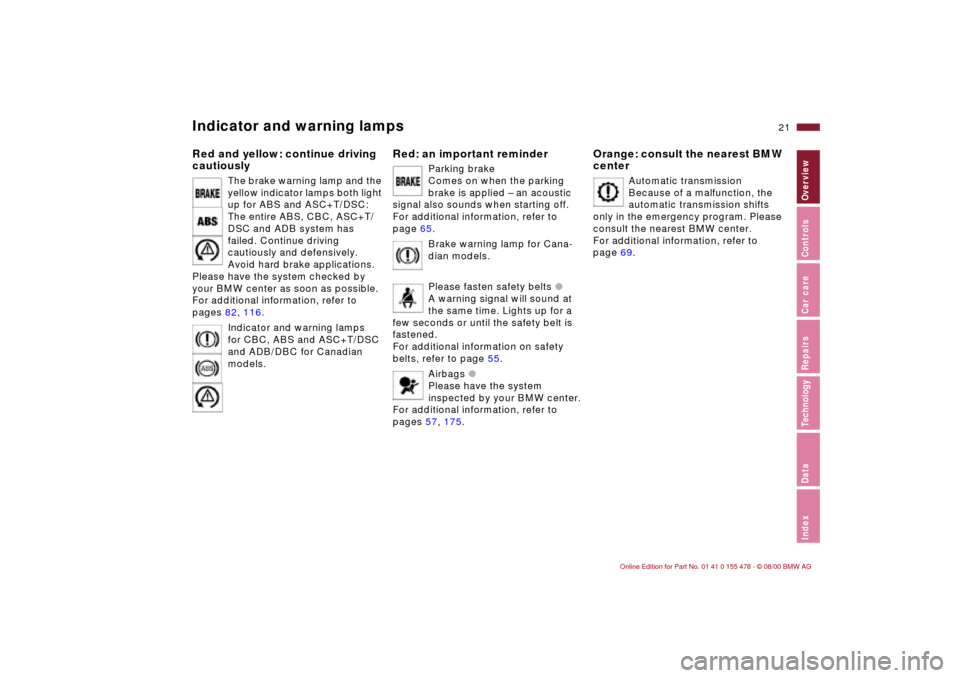
Indicator and warning lampsRed and yellow: continue driving
cautiously
The brake warning lamp and the
yellow indicator lamps both light
up for ABS and ASC+T/DSC:
The entire ABS, CBC, ASC+T/
DSC and ADB system has
failed. Continue driving
cautiously and defensively.
Avoid hard brake applications.
Please have the system checked by
your BMW center as soon as possible.
For additional information, refer to
pages 82, 116.
Indicator and warning lamps
for CBC, ABS and ASC+T/DSC
and ADB/DBC for Canadian
models.
Red: an important reminder
Parking brake
Comes on when the parking
brake is applied Ð an acoustic
signal also sounds when starting off.
For additional information, refer to
page 65. Brake warning lamp for Cana-
dian models.
Please fasten safety belts l
A warning signal will sound at
the same time. Lights up for a
few seconds or until the safety belt is
fastened.
For additional information on safety
belts, refer to page 55.
Airbags l
Please have the system
inspected by your BMW center.
For additional information, refer to
pages 57, 175.
Orange: consult the nearest BMW
center
Automatic transmission
Because of a malfunction, the
automatic transmission shifts
only in the emergency program. Please
consult the nearest BMW center.
For additional information, refer to
page 69.
Page 22 of 203
22n
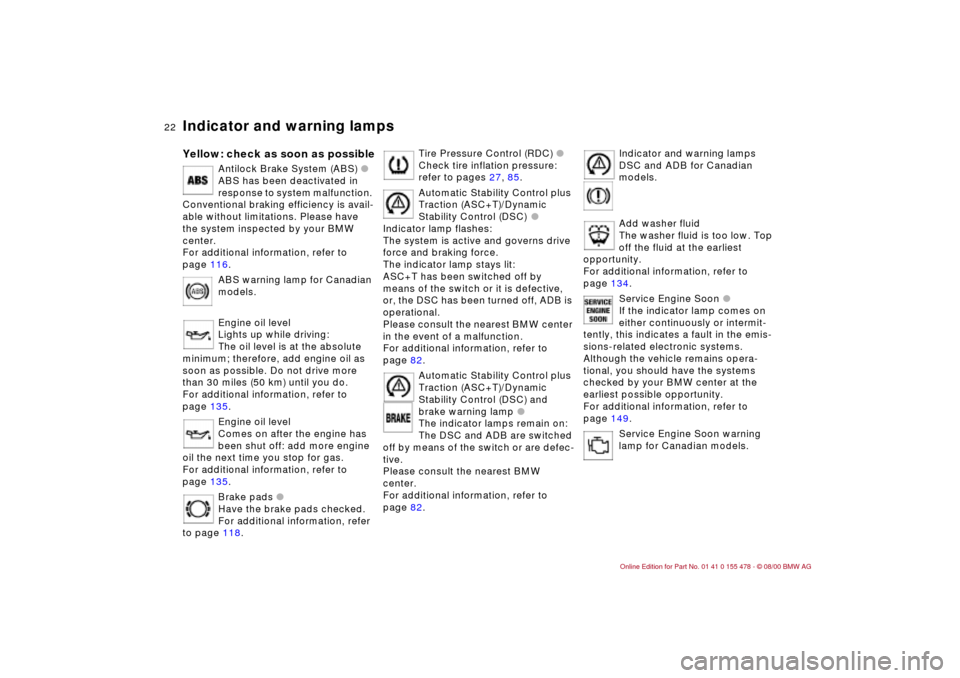
Indicator and warning lampsYellow: check as soon as possible
Antilock Brake System (ABS) l
ABS has been deactivated in
response to system malfunction.
Conventional braking efficiency is avail-
able without limitations. Please have
the system inspected by your BMW
center.
For additional information, refer to
page 116.
ABS warning lamp for Canadian
models.
Engine oil level
Lights up while driving:
The oil level is at the absolute
minimum; therefore, add engine oil as
soon as possible. Do not drive more
than 30 miles (50 km) until you do.
For additional information, refer to
page 135.
Engine oil level
Comes on after the engine has
been shut off: add more engine
oil the next time you stop for gas.
For additional information, refer to
page 135.
Brake pads l
Have the brake pads checked.
For additional information, refer
to page 118.
Tire Pressure Control (RDC) l
Check tire inflation pressure:
refer to pages 27, 85.
Automatic Stability Control plus
Traction (ASC+T)/Dynamic
Stability Control (DSC)
l
Indicator lamp flashes:
The system is active and governs drive
force and braking force.
The indicator lamp stays lit:
ASC+T has been switched off by
means of the switch or it is defective,
or, the DSC has been turned off, ADB is
operational.
Please consult the nearest BMW center
in the event of a malfunction.
For additional information, refer to
page 82.
Automatic Stability Control plus
Traction (ASC+T)/Dynamic
Stability Control (DSC) and
brake warning lamp l
The indicator lamps remain on:
The DSC and ADB are switched
off by means of the switch or are defec-
tive.
Please consult the nearest BMW
center.
For additional information, refer to
page 82.
Indicator and warning lamps
DSC and ADB for Canadian
models.
Add washer fluid
The washer fluid is too low. Top
off the fluid at the earliest
opportunity.
For additional information, refer to
page 134.
Service Engine Soon l
If the indicator lamp comes on
either continuously or intermit-
tently, this indicates a fault in the emis-
sions-related electronic systems.
Although the vehicle remains opera-
tional, you should have the systems
checked by your BMW center at the
earliest possible opportunity.
For additional information, refer to
page 149.
Service Engine Soon warning
lamp for Canadian models.
Page 40 of 203
40n
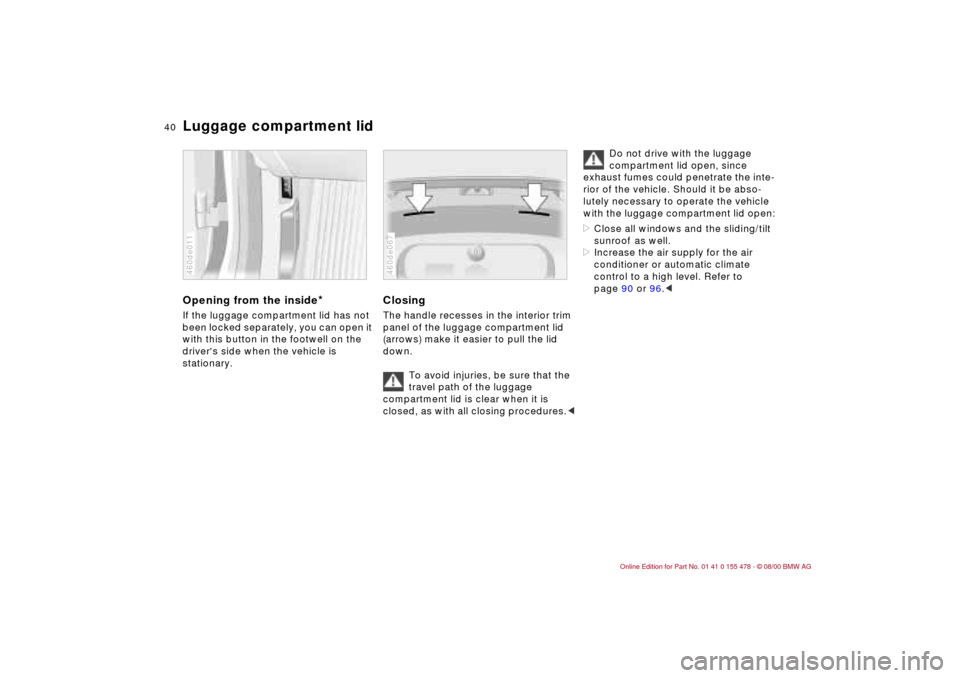
Luggage compartment lidOpening from the inside
*
If the luggage compartment lid has not
been locked separately, you can open it
with this button in the footwell on the
driver's side when the vehicle is
stationary.460de011
ClosingThe handle recesses in the interior trim
panel of the luggage compartment lid
(arrows) make it easier to pull the lid
down.
To avoid injuries, be sure that the
travel path of the luggage
compartment lid is clear when it is
closed, as with all closing procedures.<460de067
Do not drive with the luggage
compartment lid open, since
exhaust fumes could penetrate the inte-
rior of the vehicle. Should it be abso-
lutely necessary to operate the vehicle
with the luggage compartment lid open:
>Close all windows and the sliding/tilt
sunroof
as well.
>Increase the air supply for the air
conditioner or automatic climate
control to a high level. Refer to
page 90 or 96.<
Page 111 of 203
Overview
Controls and features
Operation, care
and maintenance
Owner service procedures
Technical data
Index Advanced technology
111n
IndexDataTechnologyRepairsCar careControlsOverview
Special operating instructions:
Break-in procedures112
Driving notes113
Catalytic converter113
Antilock Brake System
(ABS)115
Disc brakes117
Brake system118
Winter operation119
Power steering121
Cellular phones121
Radio reception121
Wheels and tires:
Tire inflation pressure122
Tire condition122
Tire replacement123
Tire rotation124
Wheel and tire
combinations125
Winter tires126
Snow chains126
Approved wheel and tire
specifications127Under the hood:
Hood130
Engine compartment132
Washer fluids134
Washer nozzles134
Engine oil135
Coolant137
Brake fluid138
Vehicle Identification
Number139
Care and maintenance:
The BMW Maintenance
System140
Caring for your vehicle141
Airbags146
Vehicle storage147
Laws and regulations:
Technical modifications148
California Proposition
65 Warning148
OBD interface socket149
Car care
Page 115 of 203

115n
IndexDataTechnologyRepairsCar careControlsOverview
Antilock Brake System (ABS)The concept ABS enhances active safety by helping
to prevent the wheels from locking
under braking. This is because locked
wheels are dangerous. When the front
wheels slide, the driver loses steering
control over the vehicle. Traction loss at
the rear wheels can cause the rear end
to break into an uncontrolled skid.
The system can achieve the shortest
braking distances possible under most
conditions (on straight-aways and in
curves, on asphalt, ice, wet road
surfaces, etc.).
ABS is designed to meet two essential
requirements during every brake appli-
cation:
>To help provide vehicle stability.
>To help maintain steering control and
maneuverability Ð on all types of road
surfaces (asphalt, concrete, mud, on
wet road surfaces, snow, ice).
Braking with ABSAt approx. 6 mph (10 km/h), the system
becomes operative. Whenever the
vehicle's speed drops below approx.
4 mph (6 km/h), the ABS is deactivated.
This means that the wheels can lock in
the final phase of a panic stop Ð a factor
of no significance in actual use.
If you are in a situation that requires full
braking, you will exploit the full benefits
of the ABS system if you apply
maximum brake pressure ("panic
stop"). Since the vehicle maintains
steering responsiveness, you can
nevertheless avoid possible obstacles
with a minimum of steering effort.
The ABS system closed-loop control
circuit cycles in fractions of a second.
A pulsation at the brake pedal, together
with the sounds associated with the
hydraulic controls, tells you that the
brake system is within its maximum
limit range and reminds you that you
should adapt road speed to the road
conditions.On road surfaces that have a loose
surface layer on a firm base with good
traction (on gravel or snow, for
example), or when snow chains are
mounted, braking distances may be
longer than with locked wheels.
However, ABS continues to provide
enhanced vehicle stability and steering
response under these conditions.
Information for your safetyNot even ABS can suspend the laws of
physics. ABS cannot prevent the
consequences of brake applications
with inadequate clearances for safety
between vehicles, when exceeding the
speed limit, or the risks involved when
aquaplaning occurs. Responsibility for
these types of situations remains in the
hands (and at the feet) of the driver. You
should never allow the added safety of
ABS to lull you into a false sense of
security, or mislead you into taking
increased risks.
Do not make any modifications to
the ABS system.
Service procedures on ABS are to be
performed by authorized technicians
only.<
Page 116 of 203
116n
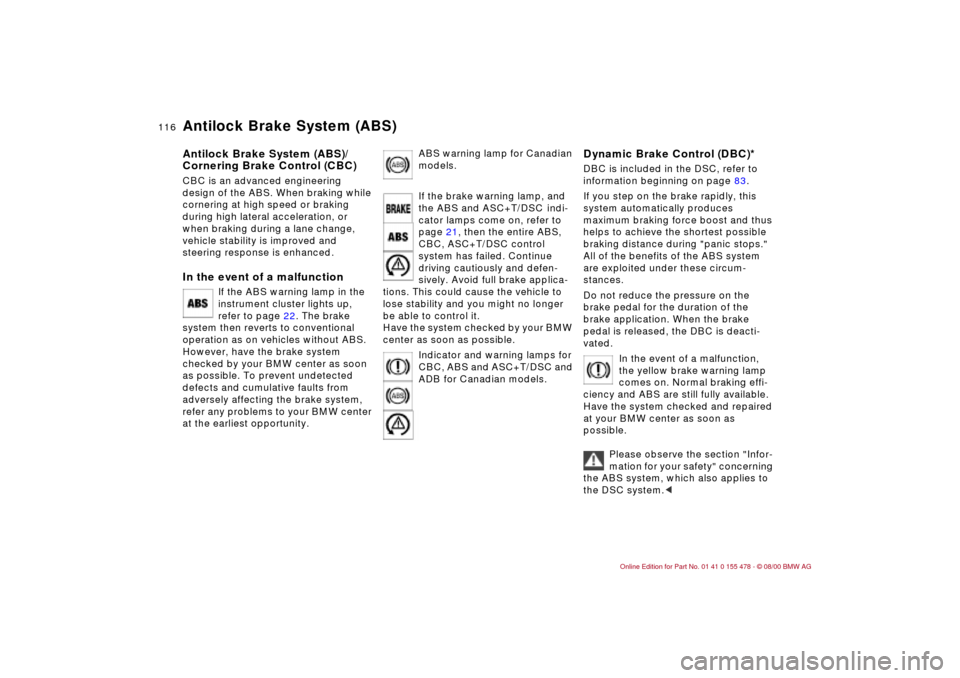
Antilock Brake System (ABS)Antilock Brake System (ABS)/
Cornering Brake Control (CBC) CBC is an advanced engineering
design of the ABS. When braking while
cornering at high speed or braking
during high lateral acceleration, or
when braking during a lane change,
vehicle stability is improved and
steering response is enhanced.In the event of a malfunction
If the ABS warning lamp in the
instrument cluster lights up,
refer to page 22. The brake
system then reverts to conventional
operation as on vehicles without ABS.
However, have the brake system
checked by your BMW center as soon
as possible. To prevent undetected
defects and cumulative faults from
adversely affecting the brake system,
refer any problems to your BMW center
at the earliest opportunity.
ABS warning lamp for Canadian
models.
If the brake warning lamp, and
the ABS and ASC+T/DSC
indi-
cator lamps come on, refer to
page 21, then the entire ABS,
CBC, ASC+T/DSC control
system has failed. Continue
driving cautiously and defen-
sively. Avoid full brake applica-
tions. This could cause the vehicle to
lose stability and you might no longer
be able to control it.
Have the system checked by your BMW
center as soon as possible.
Indicator and warning lamps for
CBC, ABS and ASC+T/DSC and
ADB for Canadian models.
Dynamic Brake Control (DBC)*DBC is included in the DSC, refer to
information beginning on page 83.
If you step on the brake rapidly, this
system automatically produces
maximum braking force boost and thus
helps to achieve the shortest possible
braking distance during "panic stops."
All of the benefits of the ABS system
are exploited under these circum-
stances.
Do not reduce the pressure on the
brake pedal for the duration of the
brake application. When the brake
pedal is released, the DBC is deacti-
vated.
In the event of a malfunction,
the yellow brake warning lamp
comes on. Normal braking effi-
ciency and ABS are still fully available.
Have the system checked and repaired
at your BMW center as soon as
possible.
Please observe the section "Infor-
mation for your safety" concerning
the ABS system, which also applies to
the DSC system.<
Page 117 of 203

117n
IndexDataTechnologyRepairsCar careControlsOverview
Disc brakesDisc brakes furnish optimum decelera-
tion and braking control and greater
fade resistance under heavy use.
When the vehicle is driven only occa-
sionally, during extended periods when
the vehicle is not used at all, and in
operating conditions where brake appli-
cations are less frequent, there is an
increased tendency for corrosion of the
discs and accumulation of contamina-
tion on the brake pads. This occurs
because the minimal pressure that must
be exerted by the pads to clean the
discs by brake applications is not
reached.
If the brake discs are corroded, they will
tend to respond to braking with a
pulsating effect that even extended
brake applications will fail to cure.
For your own safety: use only
brake pads that BMW has
approved for your particular vehicle
model. BMW cannot evaluate non-
approved brake pads to determine if
they are suited for use, and therefore
cannot ensure the operating safety of
the vehicle if they are installed.<
Driving notesWhen driving in wet conditions and in
heavy rain, it is effective to apply light
pressure to the brakes every few miles
or kilometers. Be aware of traffic condi-
tions to ensure that this maneuver does
not endanger other road users. The
heat which is generated by the brake
applications helps to dry the brake
pads and discs.
Maximum braking force is obtained
while the wheels are not locked, but
rather when they are still barely turning
immediately prior to locking. ABS main-
tains this state automatically. If the
antilock brake system ever fails, you
should revert to pumping the brakes
(refer to page 120).
Extended or steep mountain descents
should be driven in the gear in which
only minimal periodic brake applica-
tions is required. This avoids excessive
strain on the brakes and possible
impairment of the braking effect.
You can further increase the engine's
braking effect by selecting a lower gear,
downshifting as far as first gear.
When driving a vehicle with automatic
transmission, you can still downshift
into first gear. Refer to page 67.If engine braking should prove to be
inadequate, you should still avoid
extended, continuous braking. Instead
of maintaining low to moderate pres-
sure over an extended period of time,
you should decelerate by applying
more substantial pressure to the brake
pedal (watch for following traffic),
releasing the pedal, and then repeating
the application (staggered braking). The
cooling phases between active braking
intervals prevent the brakes from over-
heating, thus ensuring that full braking
capacity remains available at all times.
Do not coast with the clutch
depressed or with the shift lever
or selector lever in Neutral. Do not drive
with the engine shut off. The engine
provides no braking effect when the
clutch is depressed or the transmission
is in Neutral, and there is no power-
assist for braking or steering when the
engine is not running. Never allow floor
mats, carpets or any other objects to
protrude into the area around the brake,
clutch or accelerator pedals, which can
obstruct pedal travel.<
Page 120 of 203

120n
Winter operationBrakesWinter road conditions substantially
reduce the amount of traction available
between the tires and the road surface;
the resulting increase in braking
distance is considerable and should
always be kept in mind.
ABS is intended to prevent the wheels
from locking during brake applications,
thus helping to maintain vehicle stability
and steering response.
If the ABS does not respond in a critical
braking situation and the wheels lock:
reduce the pressure on the brake pedal
until the wheels just start to roll again
while still maintaining enough force to
continue braking.
Then increase the pedal pressure,
reduce the pressure when the wheels
lock, reapply pressure etc.
This staggered braking procedure will
reduce stopping distances while
helping you maintain steering control.
You can then attempt to steer around
hazards after you have reduced pres-
sure on the brake pedal.Do not shift down on slick road
surfaces. Doing so could cause
the rear wheels to lose traction and
skid, that could result in the loss of
vehicle control.<
Depress the clutch during hard
braking on road surfaces that
provide only poor or uneven traction.<
Skid control Depress the clutch and let up on the
accelerator pedal, or place the selector
lever for the automatic transmission in
the "Neutral" position. Countersteer
carefully and attempt to regain control
of the vehicle.
ParkingEngage 1st or reverse gear. If your
vehicle is equipped with an automatic
transmission, place the selector lever in
Park. On vehicles with manual trans-
mission, also apply the parking brake
when parking on inclined surfaces. In
order to prevent the parking brake pads
from locking due to frost or corrosion,
dry them by gently applying the parking
brake as the vehicle is coming to a
stop. Make sure that following traffic is
not endangered.
The brake lamps do not come
on when the parking brake is
applied.<