brake light BMW 330Ci COUPE 2001 E46 Owner's Manual
[x] Cancel search | Manufacturer: BMW, Model Year: 2001, Model line: 330Ci COUPE, Model: BMW 330Ci COUPE 2001 E46Pages: 203, PDF Size: 2.03 MB
Page 11 of 203

11n
Controls and features
Operation, care and maintenance
Lamps:
Side lamps/Low beams87
Instrument panel lighting87
High beams/Parking lamps88
Fog lamps88
Interior lamps88
Controlling the climate
for pleasant driving:
Air conditioner90
Automatic climate control96
Seat heating101
Roller sun blind101
Interior convenience:
HiFi system101
Glove compartment102
Storage facilities102
Cellular phone104
Ashtray, front104
Cigarette lighter105
Ashtray, rear105
Clothes hooks105
Loading and transporting:
Through-loading system106
Ski bag107
Cargo loading108
Roof-mounted luggage rack109
Special operating instructions:
Break-in procedures112
Driving notes113
Catalytic converter113
Antilock Brake System
(ABS)115
Disc brakes117
Brake system118
Winter operation119
Power steering121
Cellular phones121
Radio reception121
Wheels and tires:
Tire inflation pressure122
Tire condition122
Tire replacement123
Tire rotation124
Wheel and tire
combinations125
Winter tires126
Snow chains126
Approved wheel and tire
specifications127
Under the hood:
Hood130
Engine compartment132
Washer fluids134
Washer nozzles134
Engine oil135
Coolant137
Brake fluid138
Vehicle Identification
Number139
Care and maintenance:
The BMW Maintenance
System140
Caring for your vehicle141
Airbags146
Vehicle storage147
Laws and regulations:
Technical modifications148
California Proposition
65 Warning148
ODB interface socket149
Page 20 of 203
20n
Indicator and warning lamps
Technology that monitors itself
Many of the systems of your BMW
monitor themselves automatically, both
during engine starts and while you are
driving. Indicator and warning lamps
that are identified by "
l
" are tested for
proper functioning whenever the igni-
tion key is turned. They each light up
once for different periods of time.
If a fault should occur in one of these
systems, the corresponding lamp does
not go out after the engine is started, or
it lights up while the vehicle is moving.
You will see how to react to this below.
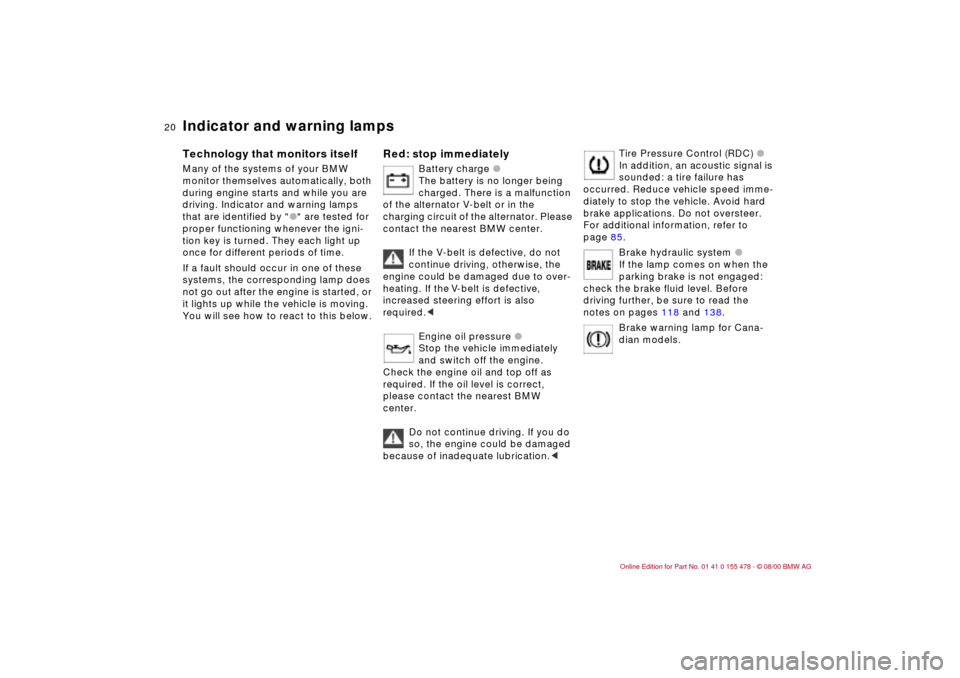
Red: stop immediately
Battery charge
l
The battery is no longer being
charged. There is a malfunction
of the alternator V-belt or in the
charging circuit of the alternator. Please
contact the nearest BMW center.
If the V-belt is defective, do not
continue driving, otherwise, the
engine could be damaged due to over-
heating. If the V-belt is defective,
increased steering effort is also
required.
<
Engine oil pressure
l
Stop the vehicle immediately
and switch off the engine.
Check the engine oil and top off as
required. If the oil level is correct,
please contact the nearest BMW
center.
Do not continue driving. If you do
so, the engine could be damaged
because of inadequate lubrication.
<
Tire Pressure Control (RDC) l
In addition, an acoustic signal is
sounded: a tire failure has
occurred. Reduce vehicle speed imme-
diately to stop the vehicle. Avoid hard
brake applications. Do not oversteer.
For additional information, refer to
page 85.
Brake hydraulic system l
If the lamp comes on when the
parking brake is not engaged:
check the brake fluid level. Before
driving further, be sure to read the
notes on pages 118 and 138.
Brake warning lamp for Cana-
dian models.
Page 21 of 203
21n
IndexDataTechnologyRepairsCar careControlsOverview
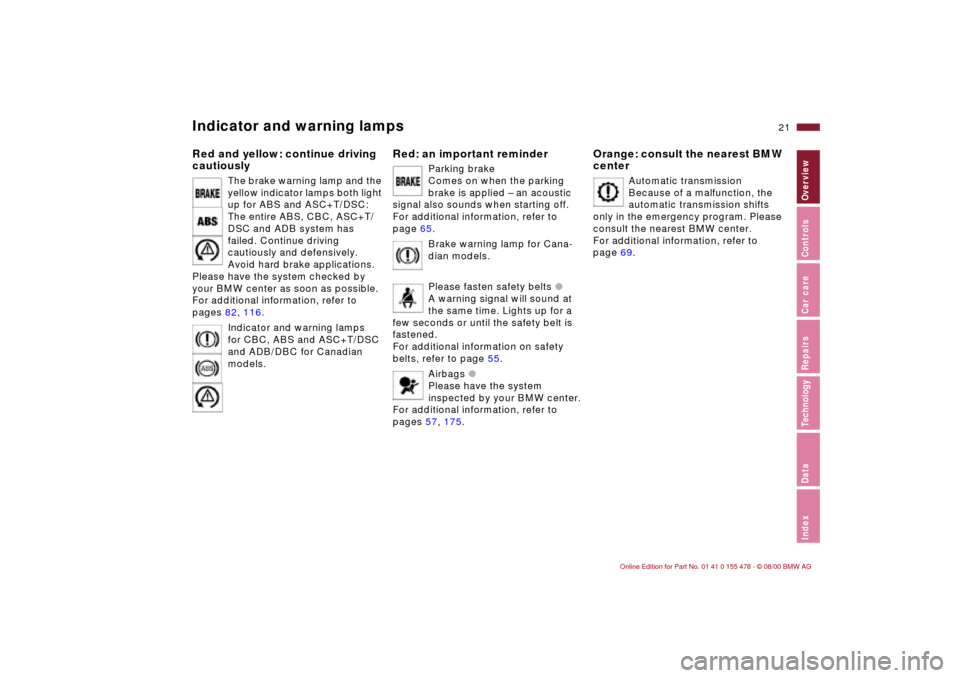
Indicator and warning lampsRed and yellow: continue driving
cautiously
The brake warning lamp and the
yellow indicator lamps both light
up for ABS and ASC+T/DSC:
The entire ABS, CBC, ASC+T/
DSC and ADB system has
failed. Continue driving
cautiously and defensively.
Avoid hard brake applications.
Please have the system checked by
your BMW center as soon as possible.
For additional information, refer to
pages 82, 116.
Indicator and warning lamps
for CBC, ABS and ASC+T/DSC
and ADB/DBC for Canadian
models.
Red: an important reminder
Parking brake
Comes on when the parking
brake is applied Ð an acoustic
signal also sounds when starting off.
For additional information, refer to
page 65. Brake warning lamp for Cana-
dian models.
Please fasten safety belts l
A warning signal will sound at
the same time. Lights up for a
few seconds or until the safety belt is
fastened.
For additional information on safety
belts, refer to page 55.
Airbags l
Please have the system
inspected by your BMW center.
For additional information, refer to
pages 57, 175.
Orange: consult the nearest BMW
center
Automatic transmission
Because of a malfunction, the
automatic transmission shifts
only in the emergency program. Please
consult the nearest BMW center.
For additional information, refer to
page 69.
Page 22 of 203
22n
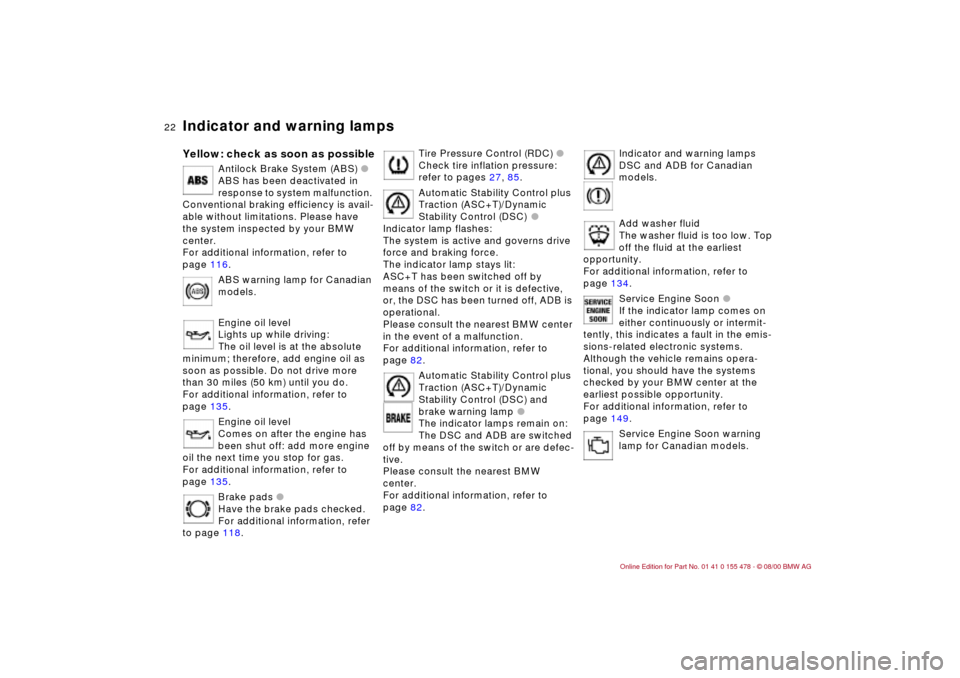
Indicator and warning lampsYellow: check as soon as possible
Antilock Brake System (ABS) l
ABS has been deactivated in
response to system malfunction.
Conventional braking efficiency is avail-
able without limitations. Please have
the system inspected by your BMW
center.
For additional information, refer to
page 116.
ABS warning lamp for Canadian
models.
Engine oil level
Lights up while driving:
The oil level is at the absolute
minimum; therefore, add engine oil as
soon as possible. Do not drive more
than 30 miles (50 km) until you do.
For additional information, refer to
page 135.
Engine oil level
Comes on after the engine has
been shut off: add more engine
oil the next time you stop for gas.
For additional information, refer to
page 135.
Brake pads l
Have the brake pads checked.
For additional information, refer
to page 118.
Tire Pressure Control (RDC) l
Check tire inflation pressure:
refer to pages 27, 85.
Automatic Stability Control plus
Traction (ASC+T)/Dynamic
Stability Control (DSC)
l
Indicator lamp flashes:
The system is active and governs drive
force and braking force.
The indicator lamp stays lit:
ASC+T has been switched off by
means of the switch or it is defective,
or, the DSC has been turned off, ADB is
operational.
Please consult the nearest BMW center
in the event of a malfunction.
For additional information, refer to
page 82.
Automatic Stability Control plus
Traction (ASC+T)/Dynamic
Stability Control (DSC) and
brake warning lamp l
The indicator lamps remain on:
The DSC and ADB are switched
off by means of the switch or are defec-
tive.
Please consult the nearest BMW
center.
For additional information, refer to
page 82.
Indicator and warning lamps
DSC and ADB for Canadian
models.
Add washer fluid
The washer fluid is too low. Top
off the fluid at the earliest
opportunity.
For additional information, refer to
page 134.
Service Engine Soon l
If the indicator lamp comes on
either continuously or intermit-
tently, this indicates a fault in the emis-
sions-related electronic systems.
Although the vehicle remains opera-
tional, you should have the systems
checked by your BMW center at the
earliest possible opportunity.
For additional information, refer to
page 149.
Service Engine Soon warning
lamp for Canadian models.
Page 31 of 203
Overview
Controls and features
Operation, care
and maintenance
Owner service procedures
Technical data
Index Advanced technology
31n
IndexDataTechnologyRepairsCar careControlsOverview
Driving:
Steering/Ignition lock63
Starting the engine63
Switching off the engine64
Parking brake65
Manual transmission66
Automatic transmission with
Steptronic67
Turn signal indicator/Headlamp
flasher70
Washer/Wiper system70
Rear window defroster72
Cruise control73
Everything under control:
Odometer75
Tachometer75
Energy Control75
Fuel gauge76
Temperature gauge76
Service Interval Display76
Check Control77
Computer77
Technology for driving comfort
and safety:
Park Distance Control (PDC)81
Automatic Stability Control plus
Traction (ASC+T)82
Dynamic Stability Control (DSC)
with Automatic Differential
Brake (ADB) and Dynamic
Brake Control (DBC)83
Tire Pressure Control (RDC)85Lamps:
Side lamps/Low beams87
Instrument panel lighting87
High beams/Parking lamps88
Fog lamps88
Interior lamps88
Controlling the climate
for pleasant driving:
Air conditioner90
Automatic climate control96
Seat heating101
Roller sun blind101
Interior convenience:
HiFi System101
Glove compartment102
Storage facilities102
Cellular phone104
Ashtray, front104
Cigarette lighter105
Ashtray, rear105
Clothes hooks105
Loading and transporting:
Through-loading system106
Ski bag107
Cargo loading108
Roof-mounted luggage rack109
Page 63 of 203
63n
IndexDataTechnologyRepairsCar careControlsOverview
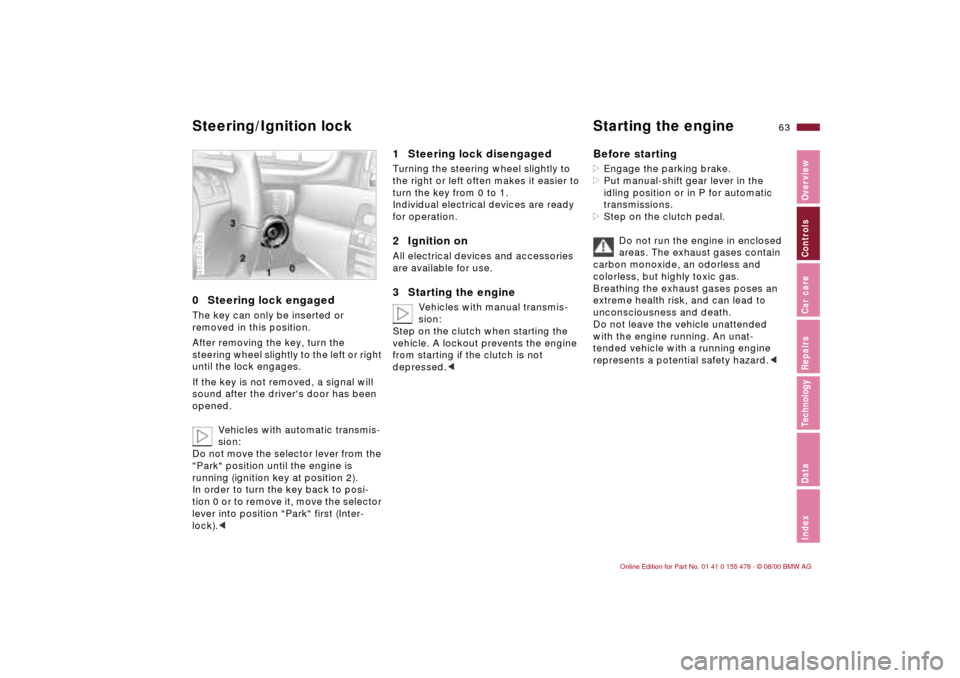
0 Steering lock engaged The key can only be inserted or
removed in this position.
After removing the key, turn the
steering wheel slightly to the left or right
until the lock engages.
If the key is not removed, a signal will
sound after the driver's door has been
opened.
Vehicles with automatic transmis-
sion:
Do not move the selector lever from the
"Park" position until the engine is
running (ignition key at position 2).
In order to turn the key back to posi-
tion 0 or to remove it, move the selector
lever into position "Park" first (Inter-
lock).<46cde093
1 Steering lock disengaged Turning the steering wheel slightly to
the right or left often makes it easier to
turn the key from 0 to 1.
Individual electrical devices are ready
for operation.2 Ignition onAll electrical devices and accessories
are available for use.3 Starting the engine
Vehicles with manual transmis-
sion:
Step on the clutch when starting the
vehicle. A lockout prevents the engine
from starting if the clutch is not
depressed.<
Before starting>Engage the parking brake.
>Put manual-shift gear lever in the
idling position or in P for automatic
transmissions.
>Step on the clutch pedal.
Do not run the engine in enclosed
areas. The exhaust gases contain
carbon monoxide, an odorless and
colorless, but highly toxic gas.
Breathing the exhaust gases poses an
extreme health risk, and can lead to
unconsciousness and death.
Do not leave the vehicle unattended
with the engine running. An unat-
tended vehicle with a running engine
represents a potential safety hazard.<
Steering/Ignition lock Starting the engine
Page 65 of 203
65n
IndexDataTechnologyRepairsCar careControlsOverview
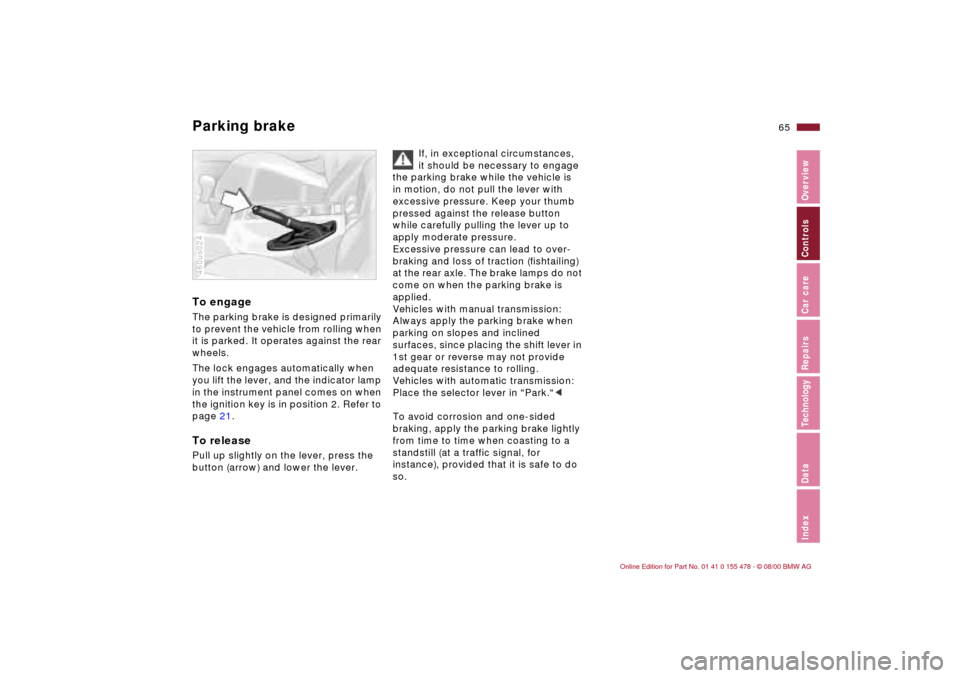
Parking brake To engageThe parking brake is designed primarily
to prevent the vehicle from rolling when
it is parked. It operates against the rear
wheels.
The lock engages automatically when
you lift the lever, and the indicator lamp
in the instrument panel comes on when
the ignition key is in position 2. Refer to
page 21.To releasePull up slightly on the lever, press the
button (arrow) and lower the lever.460us024
If, in exceptional circumstances,
it should be necessary to engage
the parking brake while the vehicle is
in motion, do not pull the lever with
excessive pressure. Keep your thumb
pressed against the release button
while carefully pulling the lever up to
apply moderate pressure.
Excessive pressure can lead to over-
braking and loss of traction (fishtailing)
at the rear axle. The brake lamps do not
come on when the parking brake is
applied.
Vehicles with manual transmission:
Always apply the parking brake when
parking on slopes and inclined
surfaces, since placing the shift lever in
1st gear or reverse may not provide
adequate resistance to rolling.
Vehicles with automatic transmission:
Place the selector lever in "Park."<
To avoid corrosion and one-sided
braking, apply the parking brake lightly
from time to time when coasting to a
standstill (at a traffic signal, for
instance), provided that it is safe to do
so.
Page 66 of 203
66n
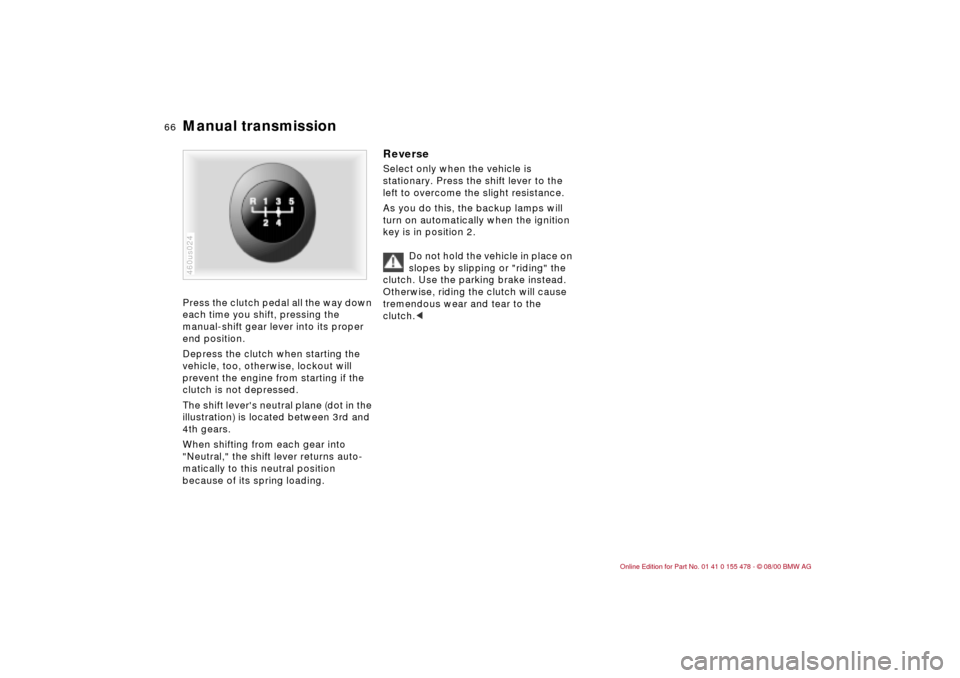
Manual transmission Press the clutch pedal all the way down
each time you shift, pressing the
manual-shift gear lever into its proper
end position.
Depress the clutch when starting the
vehicle, too, otherwise, lockout will
prevent the engine from starting if the
clutch is not depressed.
The shift lever's neutral plane (dot in the
illustration) is located between 3rd and
4th gears.
When shifting from each gear into
"Neutral," the shift lever returns auto-
matically to this neutral position
because of its spring loading.460us024
Reverse Select only when the vehicle is
stationary. Press the shift lever to the
left to overcome the slight resistance.
As you do this, the backup lamps will
turn on automatically when the ignition
key is in position 2.
Do not hold the vehicle in place on
slopes by slipping or "riding" the
clutch. Use the parking brake instead.
Otherwise, riding the clutch will cause
tremendous wear and tear to the
clutch.<
Page 77 of 203
77n
IndexDataTechnologyRepairsCar careControlsOverview
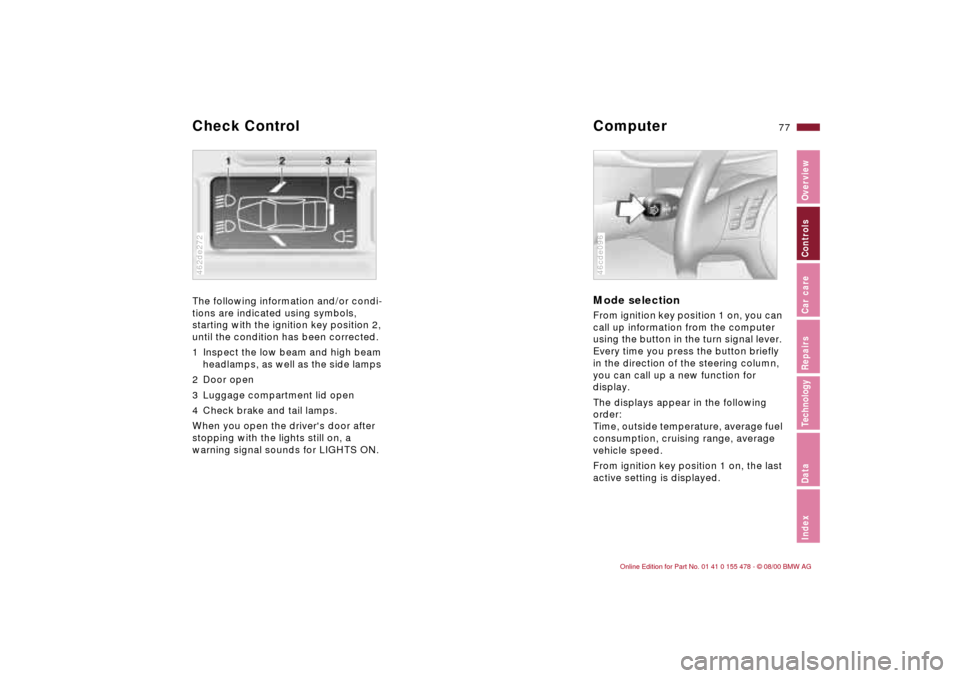
The following information and/or condi-
tions are indicated using symbols,
starting with the ignition key position 2,
until the condition has been corrected.
1 Inspect the low beam and high beam
headlamps, as well as the side lamps
2 Door open
3 Luggage compartment lid open
4 Check brake and tail lamps.
When you open the driver's door after
stopping with the lights still on, a
warning signal sounds for LIGHTS ON.462de272
Mode selectionFrom ignition key position 1 on, you can
call up information from the computer
using the button in the turn signal lever.
Every time you press the button briefly
in the direction of the steering column,
you can call up a new function for
display.
The displays appear in the following
order:
Time, outside temperature, average fuel
consumption, cruising range, average
vehicle speed.
From ignition key position 1 on, the last
active setting is displayed.46cde096
Check Control Computer
Page 83 of 203
83n
IndexDataTechnologyRepairsCar careControlsOverview
ASC+T DSC
*
Reactivating the ASC+TPress the button again; the indicator
lamp goes out.
The laws of physics cannot be
repealed, even with ASC+T. It will
always be the driver's responsibility to
drive in a manner that matches road
conditions. We therefore urge you to
avoid using the additional safety margin
of the system as an excuse for taking
risks.<
For additional details concerning
ASC+T, please refer to the chapter
"Advanced Technology" on page 175.
The ConceptDSC maintains vehicle stability, even in
critical driving situations.
The system optimizes vehicle stability
during acceleration and when starting
from a full stop, as well as optimizing
traction. In addition, it recognizes
unstable vehicle conditions, such as
understeering or oversteering, and, as
far as is possible within the laws of
physics, helps keep the car on a steady
course by reducing the engine spped
and brake applications to the individual
wheels.
The DSC is operational every time you
start the engine. DSC contains the
functions of ADB and CBC, refer to
page 116.
The ADB (automatic differential braking)
copies the function of conventional
differential and transverse lock through
brake intervention, and increases trac-
tion whenever conditions merit, e. g.
when driving on snow-covered roads.
If the DSC is switched off the ADB will
still be in ready mode.
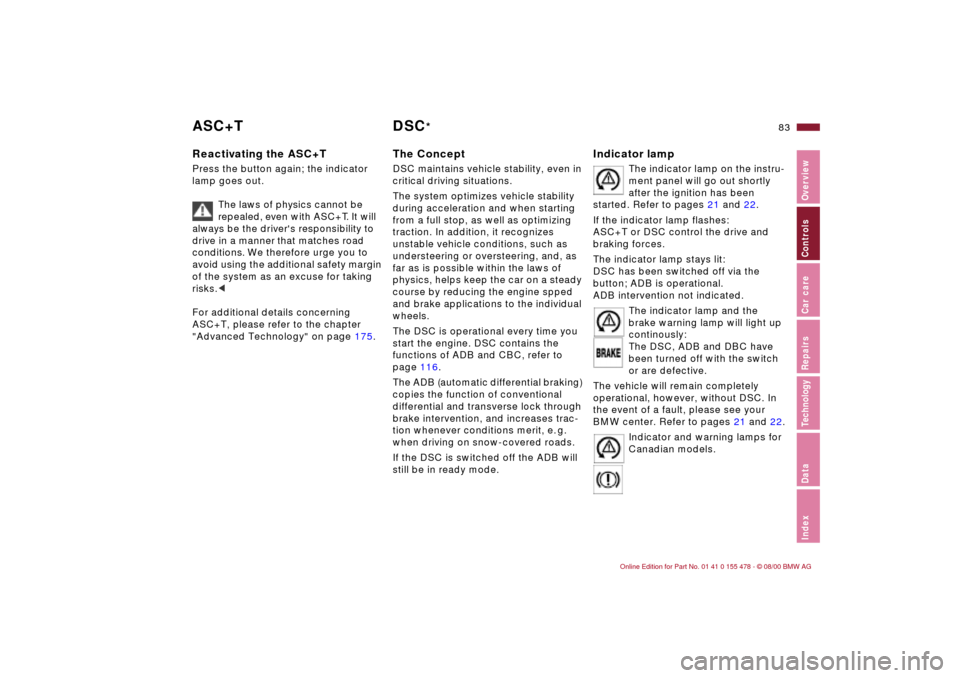
Indicator lamp
The indicator lamp on the instru-
ment panel will go out shortly
after the ignition has been
started. Refer to pages 21 and 22.
If the indicator lamp flashes:
ASC+T or DSC control the drive and
braking forces.
The indicator lamp stays lit:
DSC has been switched off via the
button; ADB is operational.
ADB intervention not indicated.
The indicator lamp and the
brake warning lamp will light up
continously:
The DSC, ADB and DBC have
been turned off with the switch
or are defective.
The vehicle will remain completely
operational, however, without DSC. In
the event of a fault, please see your
BMW center. Refer to pages 21 and 22.
Indicator and warning lamps for
Canadian models.