air condition BMW 330Ci COUPE 2002 E46 User Guide
[x] Cancel search | Manufacturer: BMW, Model Year: 2002, Model line: 330Ci COUPE, Model: BMW 330Ci COUPE 2002 E46Pages: 147, PDF Size: 2.2 MB
Page 84 of 147

84n
Automatic climate control
*
Tips for pleasant drivingUse the automatic system Ð switch on
with AUTO button 7. Select an interior
temperature that is comfortable for you.
Detailed setting options are described
for you in the following section.Automatic air distribution
The AUTO program adjusts the
air distribution and the air
supply for you and in addition adapts
the temperature to external influences
(summer, winter) to meet preferences
you can specify.
Individual air distribution
You can cancel the AUTO
program by selecting specific
distribution patterns to suit your
own individual requirements.
While the AUTO program is then deacti-
vated, the automatic airflow control
remains in operation. The system
directs air to the windows , the upper
body and into the footwells . You
can reactivate the automatic air distri-
bution mode by selecting the AUTO
button.
Temperature
The interior temperature that
appears in the display panel is a
general figure intended for reference
purposes. We recommend 72 7
(+22 6) as a comfortable setting, even
if the air conditioning is on. When you
start the vehicle, the system ensures
that the selected temperature is
achieved as quickly as possible regard-
less of the season. It then maintains this
temperature.
Air supply
By pressing the left or right half
of the button, you can vary the
air supply. This deactivates the auto-
matic control of the air supply, AUTO
disappears from the display panel.
Nevertheless, the automatic air distri-
bution remains unchanged. You can
reactivate the automatic air distribution
mode by selecting the AUTO button.
When the lowest blower speed is set
and you press the left half of the button,
all of the displays are canceled: the
blower, heating and air conditioner are
switched off. The outside air supply is
blocked. You can reactivate the system
by pressing any button for the auto-
matic climate control.
To defrost windows and remove
condensation
This program quickly removes
ice and condensation from the
windshield and the side windows.
Air conditioning
The air is cooled and dehumidi-
fied and Ð depending on the
temperature setting Ð rewarmed.
Depending on the weather, the wind-
shield may fog over briefly when the
engine is started. Switching on the air
conditioning will reduce condensation
forming on the windows.
Condensation forms during opera-
tion of the air conditioning system,
which then exits under the vehicle.
Traces of condensed water of this kind
are thus normal.<
Page 86 of 147
86n
Automatic climate control
*
Roller sun blind
*
Premium sound system
*
Microfilter/activated-charcoal
filterThe built-in microfilter removes dust
and pollen from the incoming air. The
activated-charcoal filter provides addi-
tional protection by filtering gaseous
pollutants from the outside air. Your
BMW center replaces this combined
filter as a standard part of your sched-
uled maintenance. A substantial reduc-
tion in airflow indicates that the filter
needs to be replaced before scheduled
maintenance.
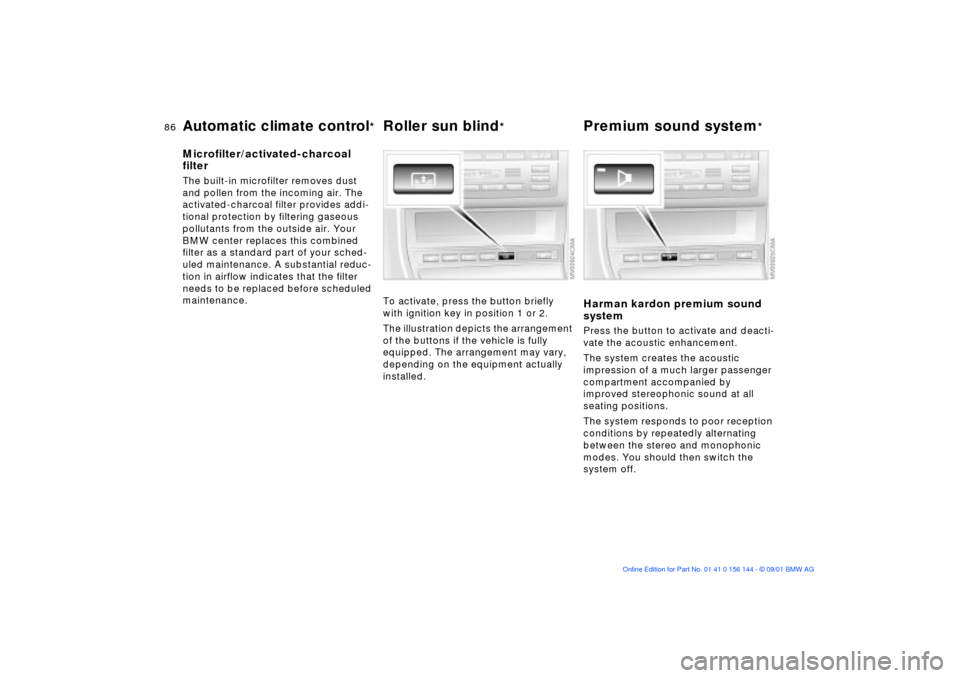
To activate, press the button briefly
with ignition key in position 1 or 2.
The illustration depicts the arrangement
of the buttons if the vehicle is fully
equipped. The arrangement may vary,
depending on the equipment actually
installed.
Harman kardon premium sound
systemPress the button to activate and deacti-
vate the acoustic enhancement.
The system creates the acoustic
impression of a much larger passenger
compartment accompanied by
improved stereophonic sound at all
seating positions.
The system responds to poor reception
conditions by repeatedly alternating
between the stereo and monophonic
modes. You should then switch the
system off.
Page 101 of 147
101n
OverviewControlsMaintenanceRepairsDataIndex
Information for your safetyThe factory-approved radial tires are
matched to the vehicle and have been
selected to provide optimum safety and
driving comfort.
It is not merely the tire's service life, but
also driving comfort and Ð above all else
Ð driving safety that depend on the
condition of the tires and the mainte-
nance of the specified tire inflation
pressure.
Incorrect tire inflation pressure is
a frequent cause of tire damage. It
also significantly influences the road-
holding ability of your BMW.
Be sure to check the tire inflation pres-
sure, including the space-saver spare
tire or the spare tire, on a regular basis,
at least twice a month and before every
extended journey, refer to page 24. If
this is not done, incorrect tire pressures
can cause driving instability and tire
damage, ultimately resulting in acci-
dents.<
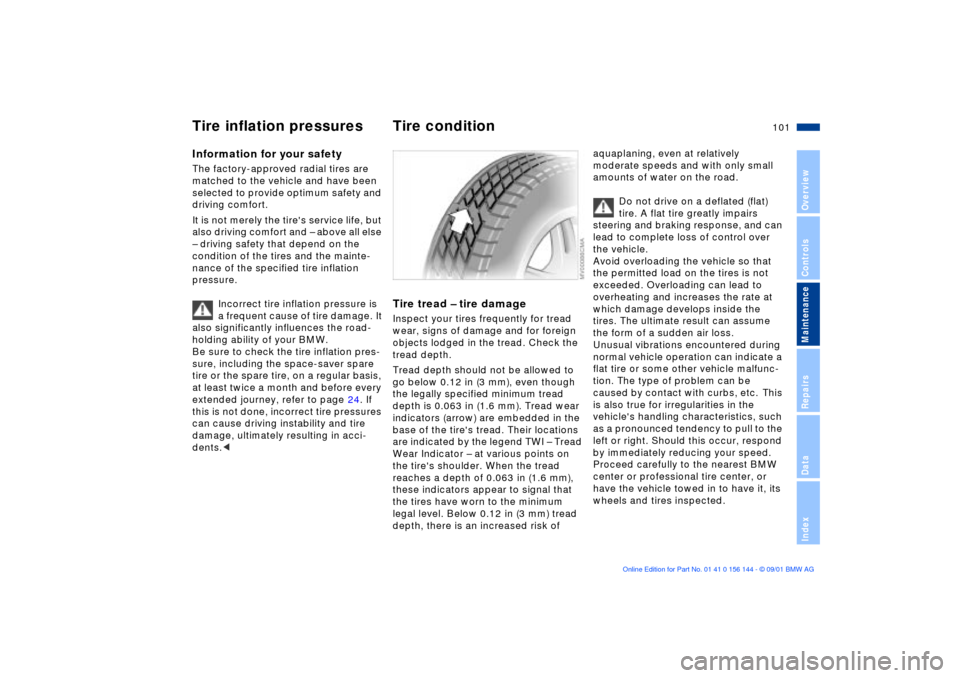
Tire tread Ð tire damageInspect your tires frequently for tread
wear, signs of damage and for foreign
objects lodged in the tread. Check the
tread depth.
Tread depth should not be allowed to
go below 0.12 in (3 mm), even though
the legally specified minimum tread
depth is 0.063 in (1.6 mm). Tread wear
indicators (arrow) are embedded in the
base of the tire's tread. Their locations
are indicated by the legend TWI Ð Tread
Wear Indicator Ð at various points on
the tire's shoulder. When the tread
reaches a depth of 0.063 in (1.6 mm),
these indicators appear to signal that
the tires have worn to the minimum
legal level. Below 0.12 in (3 mm) tread
depth, there is an increased risk of
aquaplaning, even at relatively
moderate speeds and with only small
amounts of water on the road.
Do not drive on a deflated (flat)
tire. A flat tire greatly impairs
steering and braking response, and can
lead to complete loss of control over
the vehicle.
Avoid overloading the vehicle so that
the permitted load on the tires is not
exceeded. Overloading can lead to
overheating and increases the rate at
which damage develops inside the
tires. The ultimate result can assume
the form of a sudden air loss.
Unusual vibrations encountered during
normal vehicle operation can indicate a
flat tire or some other vehicle malfunc-
tion. The type of problem can be
caused by contact with curbs, etc. This
is also true for irregularities in the
vehicle's handling characteristics, such
as a pronounced tendency to pull to the
left or right. Should this occur, respond
by immediately reducing your speed.
Proceed carefully to the nearest BMW
center or professional tire center, or
have the vehicle towed in to have it, its
wheels and tires inspected.
Tire inflation pressures
Tire condition
Page 102 of 147

102n
Tire condition Tire replacementTire damage (up to and including
sudden and complete air loss) can
endanger the lives of both the vehicle
occupants and other road users.
tread configuration from a single manu-
facturer.
DOT Quality GradesTread wear
Traction AA A B C
Temperature A B C
All passenger vehicle tires must
conform to Federal Safety
Requirements in addition to these
grades.< Tread wearThe tread wear grade is a comparative
rating based on the wear rate of the tire
when tested under controlled condi-
tions on a specified government test
course.
For example, a tire graded 150 would
wear one and one-half (1 g) times as
well on the government course as a tire
graded 100. The relative performance
of tires depends upon the actual condi-
tions of their use, however, and may
depart significantly from the norm due
to variations in driving habits, service
practices and differences in road char-
acteristics and climate.
TractionThe traction grades, from highest to
lowest, are AA, A, B, and C.
Those grades represent the tire's ability
to stop on wet pavement as measured
under controlled conditions on speci-
fied government test surfaces of
asphalt and concrete. A tire marked C
may have poor traction performance.
The traction grade assigned to
this tire is based on straight-
ahead braking traction tests, and does
not include acceleration, cornering,
hydroplaning, or peak traction charac-
teristics.< TemperatureThe temperature grades are A (the
highest), B, and C, representing the
tire's resistance to the generation of
heat and its ability to dissipate heat
when tested under controlled condi-
tions on a specified indoor laboratory
test wheel.
Sustained high temperature can cause
the material of the tire to degenerate
and reduce tire life, and excessive
temperature can lead to sudden tire
failure. The grade C corresponds to a
level of performance which all
passenger vehicle tires must meet
Page 105 of 147

105n
OverviewControlsMaintenanceRepairsDataIndex
Winter tiresChoosing the right tireBMW recommends winter tires (M+S
radial tires) for operation under
inclement winter driving conditions.
While all-season tires (M+S designa-
tion) provide better winter traction than
summer tires with the load ratings H, V,
W, Y and ZR, they generally do not
achieve the performance of winter tires.
In the interest of safe tracking and
steering response, install winter tires
made by the same manufacturer having
the same tread configuration on all four
wheels.Never exceed the maximum
speed for which the winter tires
are rated.
Unprofessional attempts by laymen to
service tires can lead to damage and
accidents.
Have this work performed by trained
professionals only. Any BMW center
has the required technical knowledge
and the proper equipment and will be
happy to assist you.<
Tire condition, tire pressureOnce the tire wears to below 0.16 in
(4 mm), winter tires display a percep-
tible decrease in their ability to cope
with winter driving conditions, and
should be replaced in the interest of
safety.
Comply with the specified tire inflation
pressures Ð and be sure to have the
wheel and tire assemblies balanced
every time you change the tires.
StorageAlways store tires in a cool, dry place.
Store them away from light whenever
possible. Protect the tires against
contact with oil, grease and fuel.Snow chains
*
BMW narrow-link snow chains are
intended for mounting on summer or
winter tires in pairs at the rear wheels
only. Comply with all manufacturer's
safety precautions when mounting the
chains.
You cannot mount snow chains on the
following tires:
225/50 R 16 92
225/45 R 17 91
245/40 ZR 17
Page 109 of 147
109n
OverviewControlsMaintenanceRepairsDataIndex
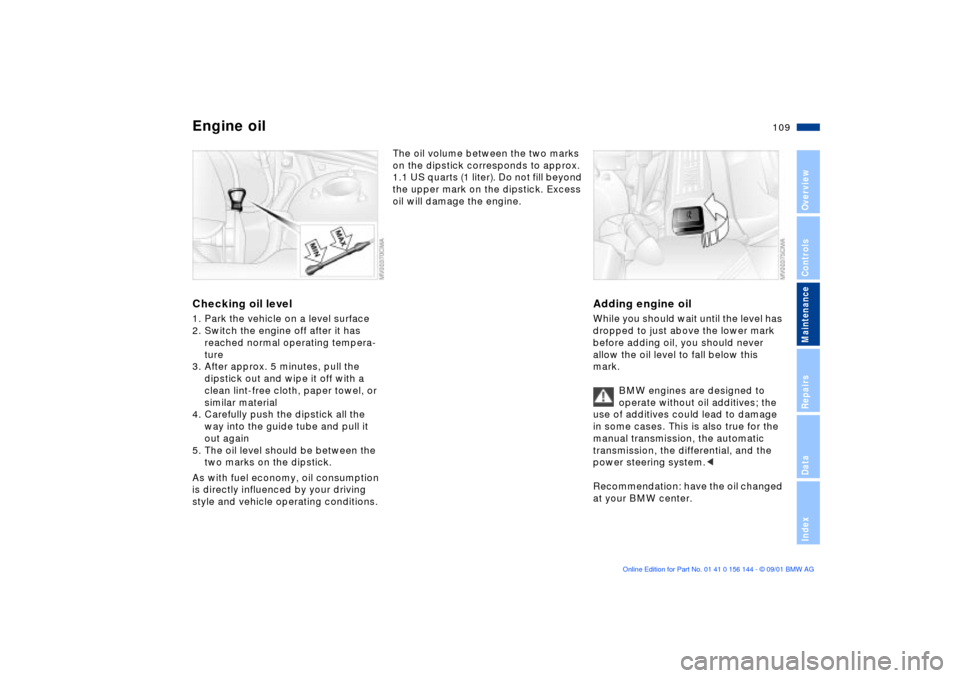
Engine oilChecking oil level1. Park the vehicle on a level surface
2. Switch the engine off after it has
reached normal operating tempera-
ture
3. After approx. 5 minutes, pull the
dipstick out and wipe it off with a
clean lint-free cloth, paper towel, or
similar material
4. Carefully push the dipstick all the
way into the guide tube and pull it
out again
5. The oil level should be between the
two marks on the dipstick.
As with fuel economy, oil consumption
is directly influenced by your driving
style and vehicle operating conditions.
The oil volume between the two marks
on the dipstick corresponds to approx.
1.1 US quarts (1 liter). Do not fill beyond
the upper mark on the dipstick. Excess
oil will damage the engine.
Adding engine oilWhile you should wait until the level has
dropped to just above the lower mark
before adding oil, you should never
allow the oil level to fall below this
mark.
BMW engines are designed to
operate without oil additives; the
use of additives could lead to damage
in some cases. This is also true for the
manual transmission, the automatic
transmission, the differential, and the
power steering system.<
Recommendation: have the oil changed
at your BMW center.
Page 113 of 147
113n
OverviewControlsMaintenanceRepairsDataIndex
The BMW Maintenance System has
been designed as a reliable means of
providing maximum driving and oper-
ating safety Ð and as cost-effectively as
possible for you.
Please keep in mind that regular main-
tenance is not only necessary for the
safety of your vehicle, but also plays a
significant role in maintaining the resale
value of the vehicle.
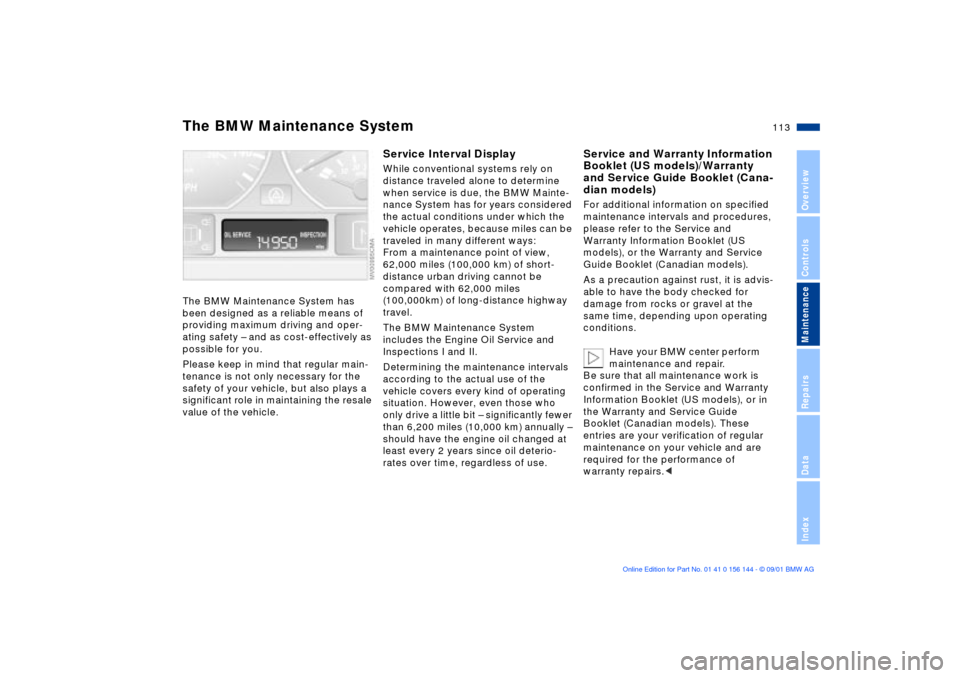
Service Interval DisplayWhile conventional systems rely on
distance traveled alone to determine
when service is due, the BMW Mainte-
nance System has for years considered
the actual conditions under which the
vehicle operates, because miles can be
traveled in many different ways:
From a maintenance point of view,
62,000 miles (100,000 km) of short-
distance urban driving cannot be
compared with 62,000 miles
(100,000km) of long-distance highway
travel.
The BMW Maintenance System
includes the Engine Oil Service and
Inspections I and II.
Determining the maintenance intervals
according to the actual use of the
vehicle covers every kind of operating
situation. However, even those who
only drive a little bit Ð significantly fewer
than 6,200 miles (10,000 km) annually Ð
should have the engine oil changed at
least every 2 years since oil deterio-
rates over time, regardless of use.
Service and Warranty Information
Booklet (US models)/Warranty
and Service Guide Booklet (Cana-
dian models)For additional information on specified
maintenance intervals and procedures,
please refer to the Service and
Warranty Information Booklet (US
models), or the Warranty and Service
Guide Booklet (Canadian models).
As a precaution against rust, it is advis-
able to have the body checked for
damage from rocks or gravel at the
same time, depending upon operating
conditions.
Have your BMW center perform
maintenance and repair.
Be sure that all maintenance work is
confirmed in the Service and Warranty
Information Booklet (US models), or in
the Warranty and Service Guide
Booklet (Canadian models). These
entries are your verification of regular
maintenance on your vehicle and are
required for the performance of
warranty repairs.<
The BMW Maintenance System
Page 138 of 147

Everything from A to ZA
ABS (Antilock Brake
System)19, 99
Acceleration traction control,
refer to DSC71
Accessories10
Activated-charcoal filter86
Adaptive Transmission
Control (ATC)58
ADB (Automatic Differential
Brake)71
Adding
brake fluid112
coolant111
engine oil109
washer fluid108
Adjusting
head restraints43
lumbar support42
manual seat41
power seat42
steering wheel46
thigh support41
Air conditioning80
temperature settings81
Air distribution81, 84 Air nozzles80, 83
Air outlets80, 83
ventilation80
Air supply81, 84
Airbags18, 48
sitting correctly40
Alarm system36
Antifreeze111
radiator111
Antilock Brake System
(ABS)19, 99
Anti-theft system36
Aquaplaning99
Armrest87
ASC+T (Automatic Stability
Control plus Traction)70
Ashtray
front89
rear90
ATC (Adaptive Transmission
Control)58
Attach vehicle vacuum
cleaner89
AUC (Automatic
recirculated-air
control)85
Automatic climate
control83
temperature settings84 Automatic cruise control62
Automatic Differential Brake
(ADB)71
Automatic headlight
control77
Automatic recirculated-air
control (AUC)85
Automatic Stability Control
plus Traction (ASC+T)70
Automatic transmission57
Automatic transmission with
Steptronic18, 57
Automatic-dimming inside
rearview mirror48
Average consumption68
Average speed68
Axle loads134
B
Backrest
adjusting41
releasing43
Backup lamps56
bulb replacement121
Battery127
charge current indicator
lamp17
charging127 Beverage holder88
Blower81, 84
BMW High Performance
Synthetic Oil110
BMW Maintenance
System113
BMW sports seat
manual adjustment41
power adjustment42
Bore132
Bottle holder, refer to
beverage holder88
Brake fluid112
Brake hydraulic system17
Brake lamps
bulb replacement121
Brake system100
brake fluid level100
brake pads100
brake pads, indicator19
disc brakes100
Brake system, brake
malfunction100
Break-in procedure98
Bulbs and lamps,
replacement118
A-Z
Page 143 of 147

Everything from A to Z
143n
OverviewControlsMaintenancRepairsDataIndex
Selector lever, automatic
transmission57
Service and Warranty
Information Booklet (US
models)113
Service Interval
Display65, 113
Setting temperature81
Shiftlock57
Side airbags48
Side Impact Head Protection
System48
Ski bag92
Sliding/tilt sunroof38
electrical malfunction39
manual operation39
Snow chains105
Socket89
Sound system86
Space-saver spare
tire25, 123
Spare key28
Spare tire123
Speedometer15
Sport steering wheel21
Sports seat
manual adjustment41
power adjustment42 Standing lamps78
Starting the engine54
Steering wheel46
Steering wheel lock54
Stopping the vehicle55
Storage compartments87
Stowing cargo93
Stroke132
Sun blind cover86
Switching off the engine55
Switching off the interior
motion sensor37
Switching off the tilt alarm
sensor37
Symbols8
Synthetic oils110
T
Tachometer64
Tail lamps
bulb replacement121
Tank capacity135
Technical data132
Technical
modifications10, 114
Telephone preparation89
Temperature display
outside temperature67 Temperature gauge
engine coolant65
Temperature
layering82, 85
Thigh support
adjustment41
Third brake light122
Through-loading system91
Tilt alarm sensor30, 37
remote control30
switching off37
Tire change123
Tire condition101
Tire damage101
Tire inflation
pressures24, 101
monitoring73
table25
Tire Pressure Monitor
(RDC)73, 103, 126
Tire pressure warning73
Tire Quality Grading103
Tire replacement102
Tire tread101
Tires and wheels101
Tool kit118
Torque132
Towing fittings129 Towing the vehicle129
Track133
Transmission56
Transmitter keys28
Transporting children
safely51
Tread depth, tires101
Tread Wear Indicator101
Trip odometer64
Trunk lid, refer to luggage
compartment lid33
Trunk, refer to luggage
compartment35
Turn signal
indicator20, 59, 120
bulb replacement120
Turning radius133
U
Uniform Tire Quality
Grading103