engine BMW 330Ci COUPE 2003 E46 Service Manual
[x] Cancel search | Manufacturer: BMW, Model Year: 2003, Model line: 330Ci COUPE, Model: BMW 330Ci COUPE 2003 E46Pages: 162, PDF Size: 4.23 MB
Page 130 of 162
130Replacement procedures
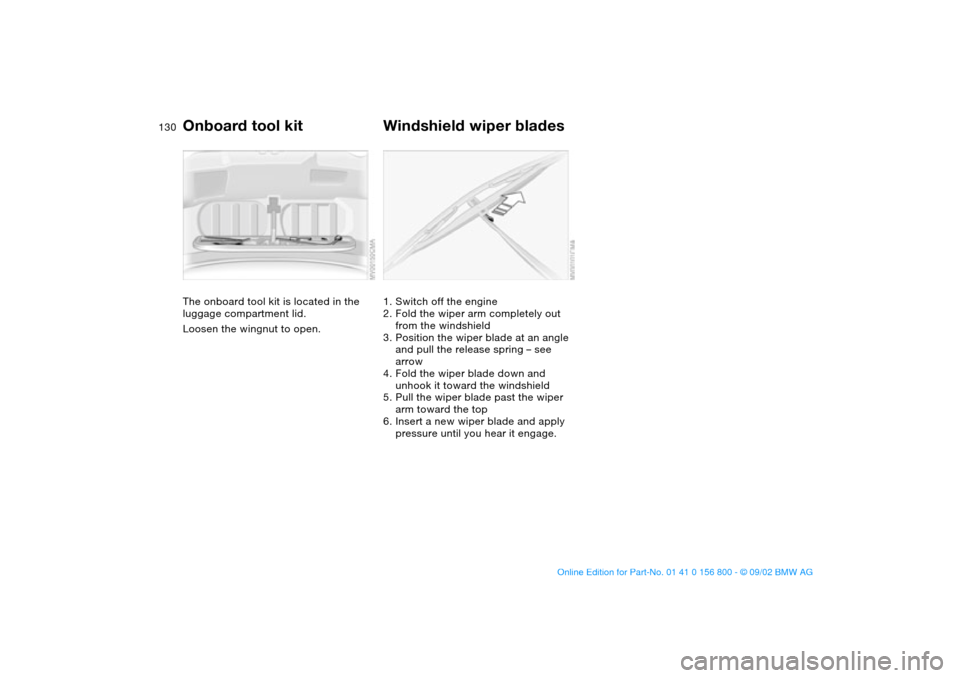
Onboard tool kitThe onboard tool kit is located in the
luggage compartment lid.
Loosen the wingnut to open.
Windshield wiper blades1. Switch off the engine
2. Fold the wiper arm completely out
from the windshield
3. Position the wiper blade at an angle
and pull the release spring – see
arrow
4. Fold the wiper blade down and
unhook it toward the windshield
5. Pull the wiper blade past the wiper
arm toward the top
6. Insert a new wiper blade and apply
pressure until you hear it engage.
handbook.book Page 130 Tuesday, July 30, 2002 12:16 PM
Page 131 of 162
131
Lamps and bulbsThe lamps and bulbs make essential
contributions to the safety of your vehi-
cle. Therefore, comply fully with the fol-
lowing instructions during bulb replace-
ment. If you are not familiar with any of
the procedures, consult your BMW
center.
Do not touch the glass portion of
a new bulb with your bare hands
since even small amounts of impurities
burn in to the surface and reduce the
service life of the bulb. Use a clean
cloth, paper napkin, or a similar mate-
rial, or hold the bulb by its metallic
base.<
A replacement bulb set is available from
your BMW center.
Before working on the electrical
system, switch off the electrical
accessory you are working on or dis-
connect the cable from the negative
terminal of the battery. Failure to
observe this precaution could result in
short circuits.
To prevent injuries and damage, com-
ply with any instructions provided by
the bulb manufacturer.<
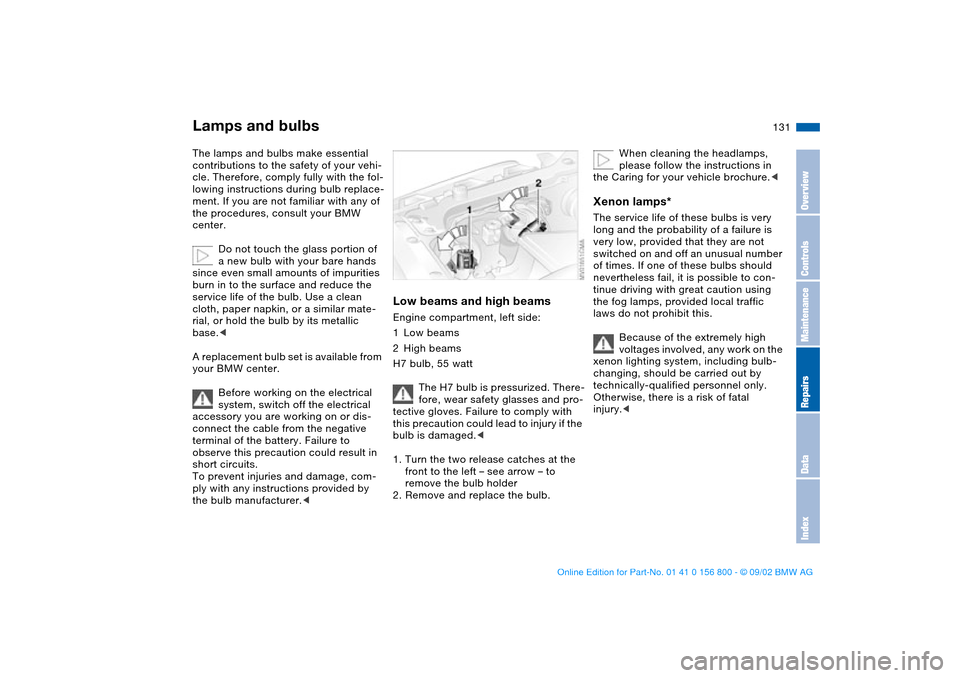
Low beams and high beamsEngine compartment, left side:
1Low beams
2High beams
H7 bulb, 55 watt
The H7 bulb is pressurized. There-
fore, wear safety glasses and pro-
tective gloves. Failure to comply with
this precaution could lead to injury if the
bulb is damaged.<
1. Turn the two release catches at the
front to the left – see arrow – to
remove the bulb holder
2. Remove and replace the bulb.
When cleaning the headlamps,
please follow the instructions in
the Caring for your vehicle brochure.<
Xenon lamps*The service life of these bulbs is very
long and the probability of a failure is
very low, provided that they are not
switched on and off an unusual number
of times. If one of these bulbs should
nevertheless fail, it is possible to con-
tinue driving with great caution using
the fog lamps, provided local traffic
laws do not prohibit this.
Because of the extremely high
voltages involved, any work on the
xenon lighting system, including bulb-
changing, should be carried out by
technically-qualified personnel only.
Otherwise, there is a risk of fatal
injury.<
OverviewControlsMaintenanceRepairsDataIndex
handbook.book Page 131 Tuesday, July 30, 2002 12:16 PM
Page 132 of 162
132
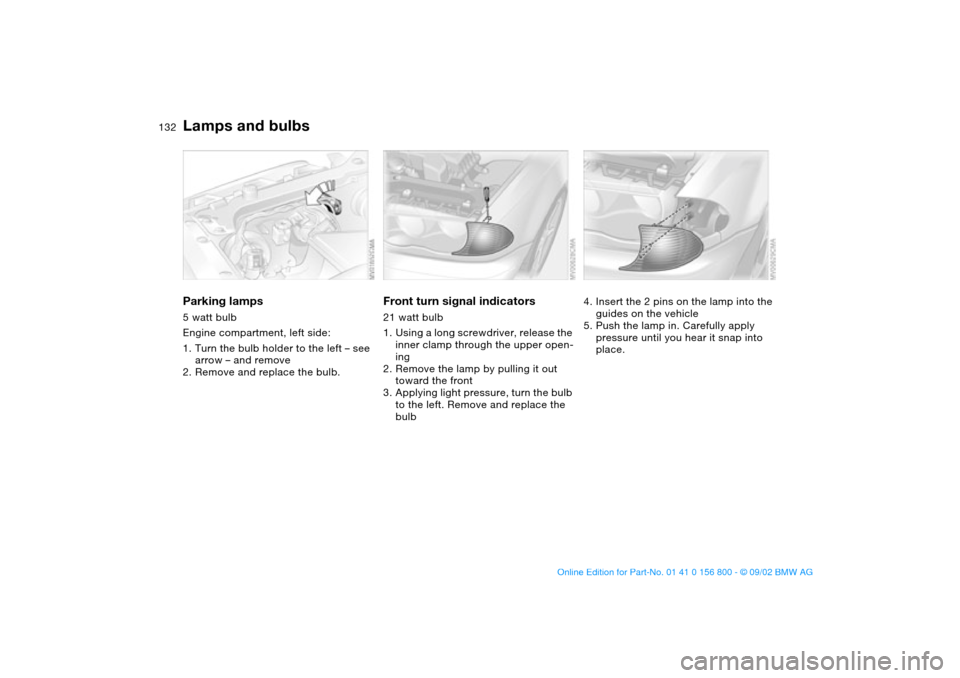
Parking lamps5 watt bulb
Engine compartment, left side:
1. Turn the bulb holder to the left – see
arrow – and remove
2. Remove and replace the bulb.
Front turn signal indicators21 watt bulb
1. Using a long screwdriver, release the
inner clamp through the upper open-
ing
2. Remove the lamp by pulling it out
toward the front
3. Applying light pressure, turn the bulb
to the left. Remove and replace the
bulb
4. Insert the 2 pins on the lamp into the
guides on the vehicle
5. Push the lamp in. Carefully apply
pressure until you hear it snap into
place.
Lamps and bulbs
handbook.book Page 132 Tuesday, July 30, 2002 12:16 PM
Page 135 of 162
135
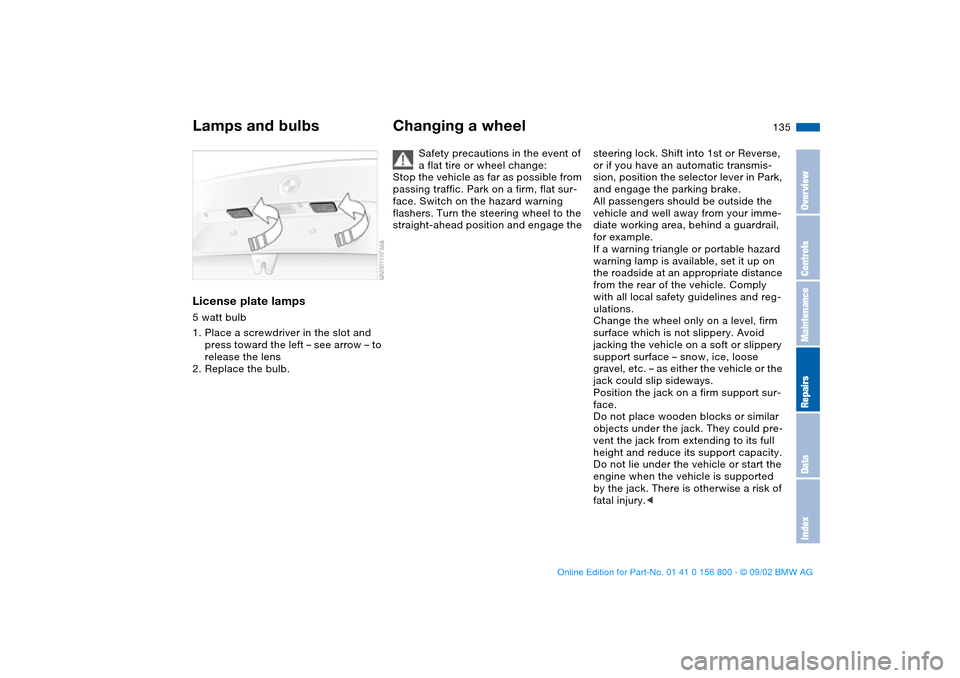
License plate lamps5 watt bulb
1. Place a screwdriver in the slot and
press toward the left – see arrow – to
release the lens
2. Replace the bulb.
Changing a wheel
Safety precautions in the event of
a flat tire or wheel change:
Stop the vehicle as far as possible from
passing traffic. Park on a firm, flat sur-
face. Switch on the hazard warning
flashers. Turn the steering wheel to the
straight-ahead position and engage the
steering lock. Shift into 1st or Reverse,
or if you have an automatic transmis-
sion, position the selector lever in Park,
and engage the parking brake.
All passengers should be outside the
vehicle and well away from your imme-
diate working area, behind a guardrail,
for example.
If a warning triangle or portable hazard
warning lamp is available, set it up on
the roadside at an appropriate distance
from the rear of the vehicle. Comply
with all local safety guidelines and reg-
ulations.
Change the wheel only on a level, firm
surface which is not slippery. Avoid
jacking the vehicle on a soft or slippery
support surface – snow, ice, loose
gravel, etc. – as either the vehicle or the
jack could slip sideways.
Position the jack on a firm support sur-
face.
Do not place wooden blocks or similar
objects under the jack. They could pre-
vent the jack from extending to its full
height and reduce its support capacity.
Do not lie under the vehicle or start the
engine when the vehicle is supported
by the jack. There is otherwise a risk of
fatal injury.<
Lamps and bulbs
OverviewControlsMaintenanceRepairsDataIndex
handbook.book Page 135 Tuesday, July 30, 2002 12:16 PM
Page 140 of 162
140
BatteryMaintenanceThe battery is absolutely maintenance-
free, that is, the original electrolyte will
normally last for the service life of the
battery under moderate climatic condi-
tions.
Please consult your BMW center
whenever you have any questions
concerning the battery. Since the bat-
tery is absolutely maintenance-free, the
following is for your information only.<
Never disconnect the battery
when the engine is running; the
ensuing voltage surge would seriously
damage the vehicle's onboard elec-
tronic systems.
Connect the charge cables to the termi-
nals in the engine compartment. For
terminal locations, refer to Jump-start-
ing on page 141.
Return used batteries to a recy-
cling point or your BMW center.
Maintain the battery in an upright posi-
tion for transport and storage. Secure
the battery against falling over in tran-
sit.<
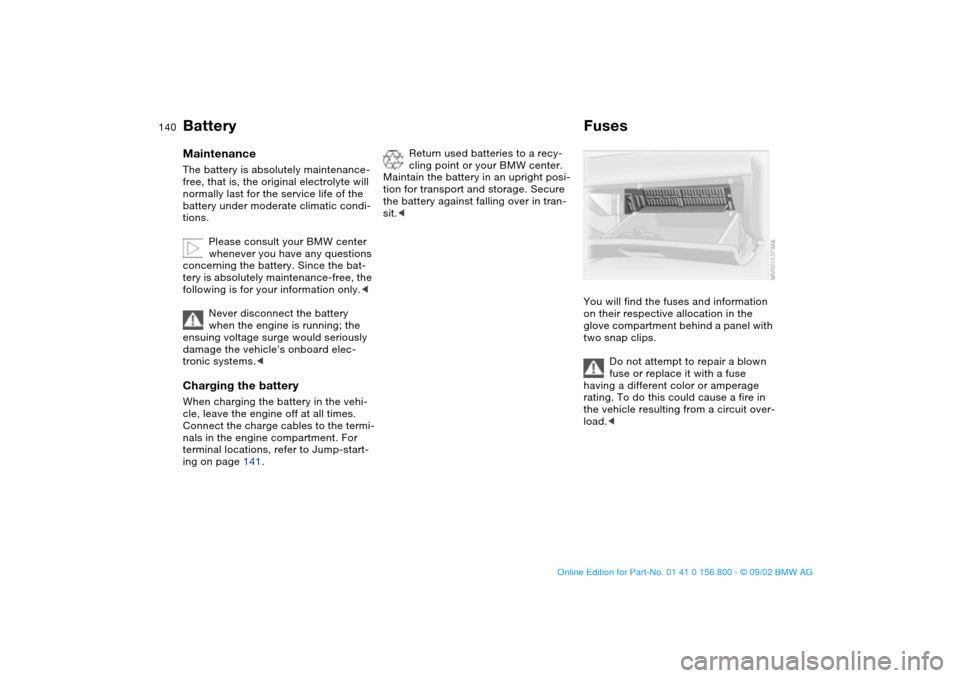
FusesYou will find the fuses and information
on their respective allocation in the
glove compartment behind a panel with
two snap clips.
Do not attempt to repair a blown
fuse or replace it with a fuse
having a different color or amperage
rating. To do this could cause a fire in
the vehicle resulting from a circuit over-
load.<
handbook.book Page 140 Tuesday, July 30, 2002 12:16 PM
Page 141 of 162
141 Giving and receiving assistance
Jump-startingWhen your battery is discharged, you
can use two jumper cables to start your
vehicle with power from the battery in a
second vehicle. You can also use the
same method to help start another
vehicle. Only use jumper cables with
fully insulated handles on the terminal
clamps.
Do not touch high-voltage wiring
and cables on a running engine.
Contact with components carrying high
voltage can be harmful or fatal. Care-
fully observe the following instructions
to avoid personal injury and/or damage
to one or both vehicles.<
1. The battery in the support vehicle
must also be rated at 12 volts. This
information is provided on the battery
label
2. Stop the engine of the support vehi-
cle and switch off all electrical com-
ponents in both vehicles – except for
the hazard warning flashers of the
support vehicle
3. Make absolutely certain that there is
no contact between the bodywork of
the two vehicles – short circuit haz-
ard
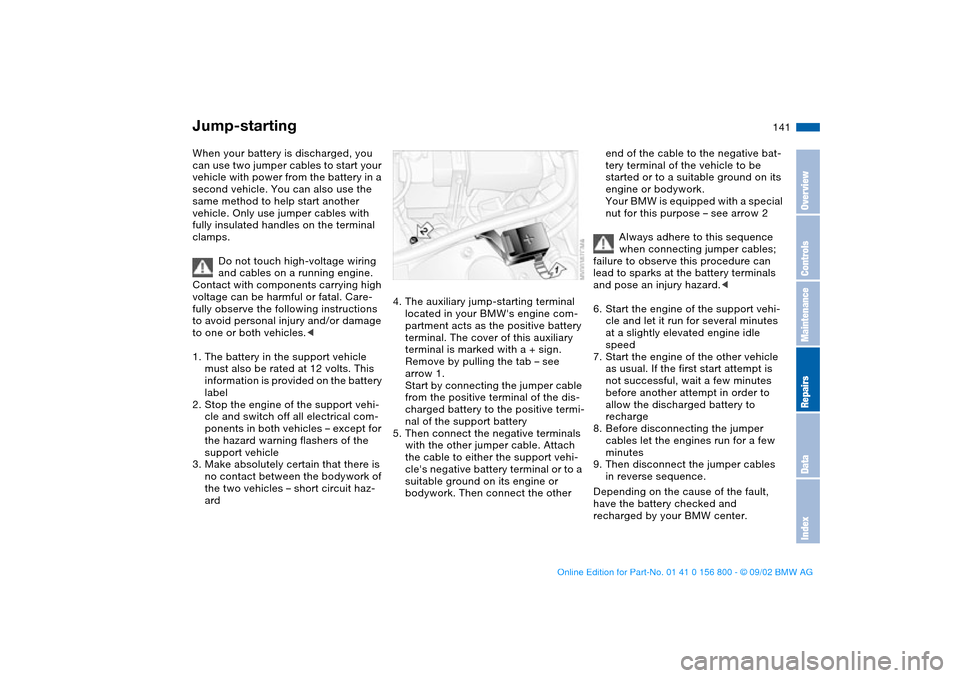
4. The auxiliary jump-starting terminal
located in your BMW's engine com-
partment acts as the positive battery
terminal. The cover of this auxiliary
terminal is marked with a + sign.
Remove by pulling the tab – see
arrow 1.
Start by connecting the jumper cable
from the positive terminal of the dis-
charged battery to the positive termi-
nal of the support battery
5. Then connect the negative terminals
with the other jumper cable. Attach
the cable to either the support vehi-
cle's negative battery terminal or to a
suitable ground on its engine or
bodywork. Then connect the other
end of the cable to the negative bat-
tery terminal of the vehicle to be
started or to a suitable ground on its
engine or bodywork.
Your BMW is equipped with a special
nut for this purpose – see arrow 2
Always adhere to this sequence
when connecting jumper cables;
failure to observe this procedure can
lead to sparks at the battery terminals
and pose an injury hazard.<
6. Start the engine of the support vehi-
cle and let it run for several minutes
at a slightly elevated engine idle
speed
7. Start the engine of the other vehicle
as usual. If the first start attempt is
not successful, wait a few minutes
before another attempt in order to
allow the discharged battery to
recharge
8. Before disconnecting the jumper
cables let the engines run for a few
minutes
9. Then disconnect the jumper cables
in reverse sequence.
Depending on the cause of the fault,
have the battery checked and
recharged by your BMW center.
OverviewControlsMaintenanceRepairsDataIndex
handbook.book Page 141 Tuesday, July 30, 2002 12:16 PM
Page 142 of 162
142
Do not use spray starter fluids to
start the engine.<
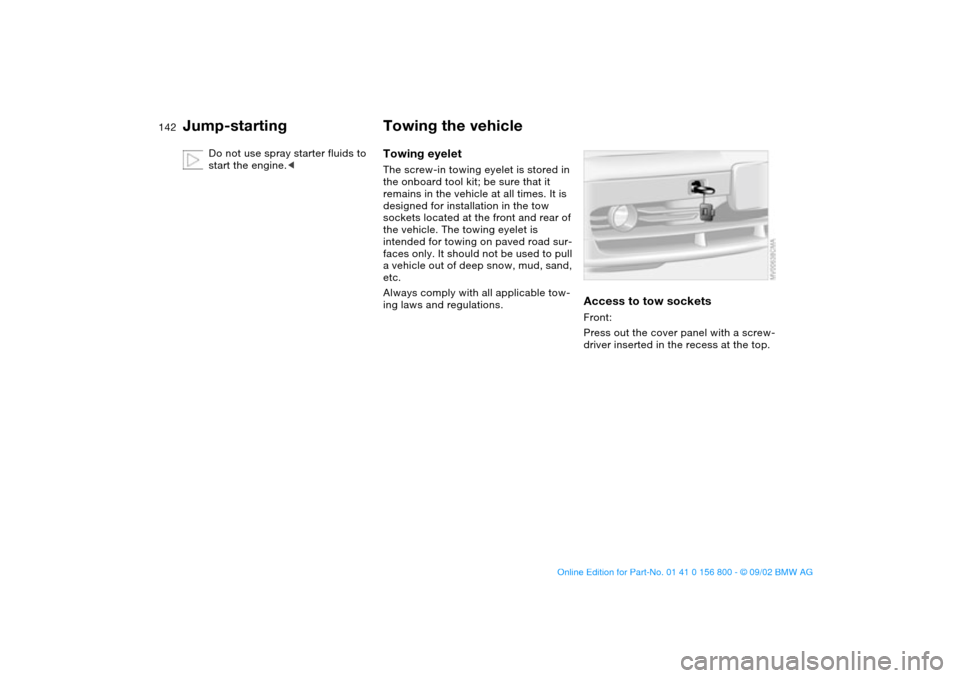
Towing the vehicleTowing eyeletThe screw-in towing eyelet is stored in
the onboard tool kit; be sure that it
remains in the vehicle at all times. It is
designed for installation in the tow
sockets located at the front and rear of
the vehicle. The towing eyelet is
intended for towing on paved road sur-
faces only. It should not be used to pull
a vehicle out of deep snow, mud, sand,
etc.
Always comply with all applicable tow-
ing laws and regulations.
Access to tow socketsFront:
Press out the cover panel with a screw-
driver inserted in the recess at the top.
Jump-starting
handbook.book Page 142 Tuesday, July 30, 2002 12:16 PM
Page 146 of 162
146
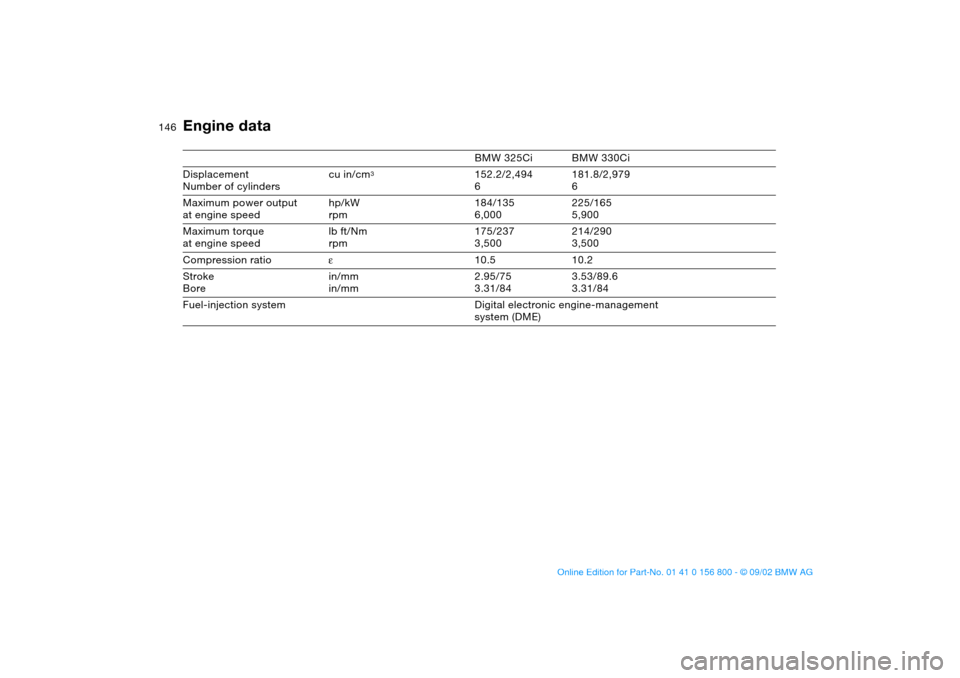
Engine data
BMW 325Ci BMW 330Ci
Displacement
Number of cylinderscu in/cm
3
152.2/2,494
6181.8/2,979
6
Maximum power output
at engine speedhp/kW
rpm184/135
6,000225/165
5,900
Maximum torque
at engine speedlb ft/Nm
rpm175/237
3,500214/290
3,500
Compression ratioε10.5 10.2
Stroke
Borein/mm
in/mm2.95/75
3.31/843.53/89.6
3.31/84
Fuel-injection system Digital electronic engine-management
system (DME)
handbook.book Page 146 Tuesday, July 30, 2002 12:16 PM
Page 149 of 162
149
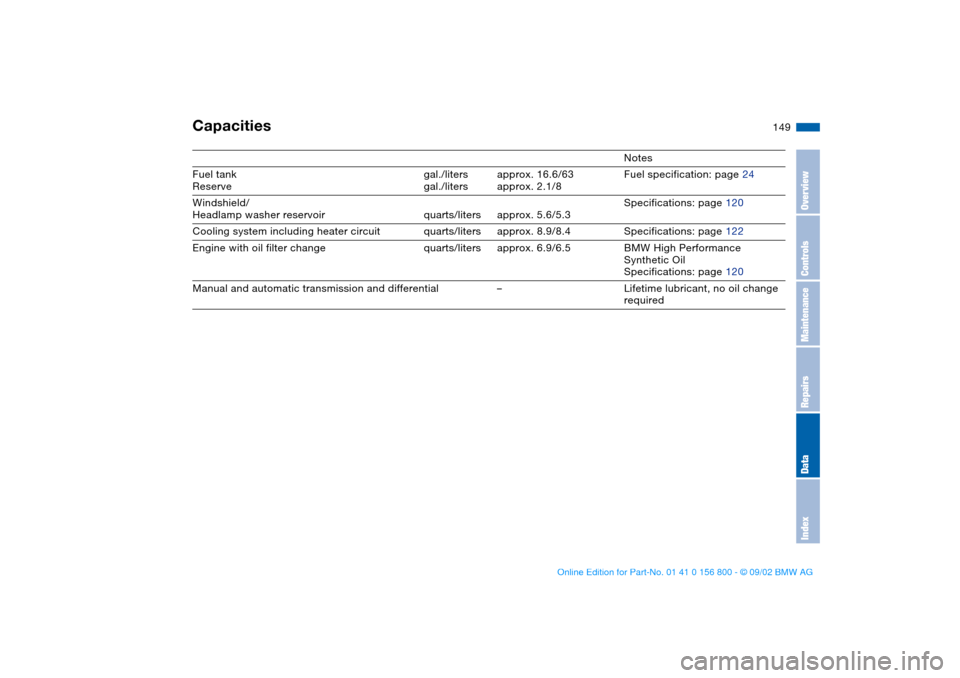
Capacities
Notes
Fuel tank
Reservegal./liters
gal./litersapprox. 16.6/63
approx. 2.1/8Fuel specification: page 24
Windshield/
Headlamp washer reservoir quarts/liters approx. 5.6/5.3Specifications: page 120
Cooling system including heater circuit quarts/liters approx. 8.9/8.4 Specifications: page 122
Engine with oil filter change quarts/liters approx. 6.9/6.5 BMW High Performance
Synthetic Oil
Specifications: page 120
Manual and automatic transmission and differential – Lifetime lubricant, no oil change
required
OverviewControlsMaintenanceRepairsDataIndex
handbook.book Page 149 Tuesday, July 30, 2002 12:16 PM
Page 153 of 162
Everything from A to Z
153
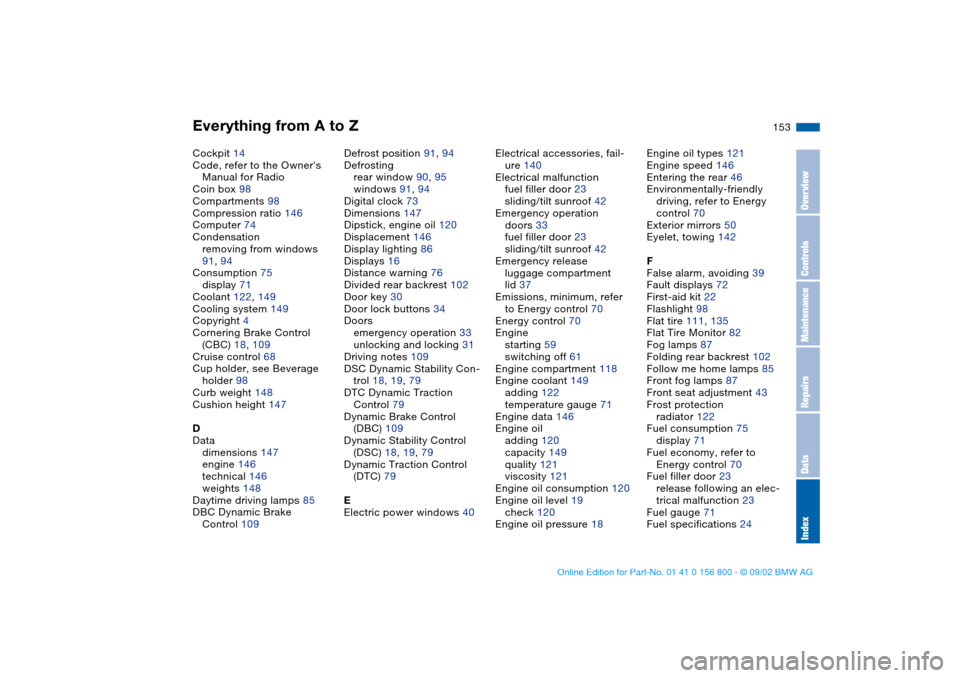
Cockpit 14
Code, refer to the Owner's
Manual for Radio
Coin box 98
Compartments 98
Compression ratio 146
Computer 74
Condensation
removing from windows
91, 94
Consumption 75
display 71
Coolant 122, 149
Cooling system 149
Copyright 4
Cornering Brake Control
(CBC) 18, 109
Cruise control 68
Cup holder, see Beverage
holder 98
Curb weight 148
Cushion height 147
D
Data
dimensions 147
engine 146
technical 146
weights 148
Daytime driving lamps 85
DBC Dynamic Brake
Control 109Defrost position 91, 94
Defrosting
rear window 90, 95
windows 91, 94
Digital clock 73
Dimensions 147
Dipstick, engine oil 120
Displacement 146
Display lighting 86
Displays 16
Distance warning 76
Divided rear backrest 102
Door key 30
Door lock buttons 34
Doors
emergency operation 33
unlocking and locking 31
Driving notes 109
DSC Dynamic Stability Con-
trol 18, 19, 79
DTC Dynamic Traction
Control 79
Dynamic Brake Control
(DBC) 109
Dynamic Stability Control
(DSC) 18, 19, 79
Dynamic Traction Control
(DTC) 79
E
Electric power windows 40Electrical accessories, fail-
ure 140
Electrical malfunction
fuel filler door 23
sliding/tilt sunroof 42
Emergency operation
doors 33
fuel filler door 23
sliding/tilt sunroof 42
Emergency release
luggage compartment
lid 37
Emissions, minimum, refer
to Energy control 70
Energy control 70
Engine
starting 59
switching off 61
Engine compartment 118
Engine coolant 149
adding 122
temperature gauge 71
Engine data 146
Engine oil
adding 120
capacity 149
quality 121
viscosity 121
Engine oil consumption 120
Engine oil level 19
check 120
Engine oil pressure 18Engine oil types 121
Engine speed 146
Entering the rear 46
Environmentally-friendly
driving, refer to Energy
control 70
Exterior mirrors 50
Eyelet, towing 142
F
False alarm, avoiding 39
Fault displays 72
First-aid kit 22
Flashlight 98
Flat tire 111, 135
Flat Tire Monitor 82
Fog lamps 87
Folding rear backrest 102
Follow me home lamps 85
Front fog lamps 87
Front seat adjustment 43
Frost protection
radiator 122
Fuel consumption 75
display 71
Fuel economy, refer to
Energy control 70
Fuel filler door 23
release following an elec-
trical malfunction 23
Fuel gauge 71
Fuel specifications 24
OverviewControlsMaintenanceRepairsDataIndex
handbook.book Page 153 Tuesday, July 30, 2002 12:16 PM