seat adjustment BMW 330Ci COUPE 2003 E46 Owner's Manual
[x] Cancel search | Manufacturer: BMW, Model Year: 2003, Model line: 330Ci COUPE, Model: BMW 330Ci COUPE 2003 E46Pages: 162, PDF Size: 4.23 MB
Page 8 of 162
Contents
Notes
About this Owner's Manual4
Symbols used4
Your individual vehicle4
Status at time of printing5
For your own safety5
Symbol on vehicle parts6
Service and warranty6
Reporting safety defects6
Overview
Cockpit14
Instrument cluster16
Indicator and warning lamps18
Steering wheel with multifunction
buttons*21
Hazard warning triangle*22
First-aid kit*22
Refueling23
Fuel specifications24
Tire inflation pressure24
Controls and features
Opening and closing:
Keys30
Central locking system30
Opening and closing – via the
remote control31
Opening and closing – via the
door lock33
Opening and closing – from the
inside34
Luggage compartment lid35
Luggage compartment37
Alarm system*38
Electric power windows40
Sliding/tilt sunroof*41
Adjustments:
Safe seating position43
Seats43
Manual seat adjustment44
Power seat adjustment*45
Lumbar support*45
Head restraints46
Entering the rear46
Safety belts47
Seat and mirror memory*48
Seat heating*49
Steering wheel50
Mirrors50
handbook.book Page 8 Tuesday, July 30, 2002 12:16 PM
Page 43 of 162
43 Adjustments
Safe seating positionFor relaxed and fatigue-free driving you
should select a sitting position that
reflects your personal requirements. In
combination with the safety belts and
airbags, the correct seating position
plays an important role in enhancing
occupant safety in the event of an acci-
dent. To ensure that the vehicle's safety
systems provide you with optimal pro-
tection, we request that you direct your
careful attention to the following sec-
tion.
For supplementary information on
transporting children, refer to page 54.Sitting safely with airbags
Always maintain an adequate dis-
tance between yourself and the
airbags. Always hold the steering wheel
by the rim to keep any chance of injury
to hands or arms to an absolute mini-
mum should the airbag be deployed.
Never allow any objects, individuals or
animals to obstruct the areas between
passengers and airbags. Never use the
front airbag's cover as a storage tray or
support for objects of any kind. Never
allow front passengers to rest their feet
or legs on the airbag cover.<
For airbag locations and additional
information on airbags, refer to
page 52.Sitting safely with safety belts
Never allow more than one person
to wear a single safety belt. Never
allow infants or small children to ride in
a passenger's lap. Avoid twisting the
belt while routing it firmly across the
pelvis and shoulder, wear it as snugly
against your body as possible. Do not
allow the belt to rest against hard or
fragile objects. Do not route the belt
across your neck, or run it across sharp
edges. Be sure that the belt does not
become caught or jammed. Avoid
wearing bulky clothing and pull on the
lap belt periodically to retension it over
your shoulders. In the event of a frontal
impact, a loose lap belt could slide over
the hips, leading to abdominal injury. In
addition, the safety belt's restraint
effectiveness is reduced if it is worn
loosely. Expectant mothers should
always wear their safety belts, taking
care to position the lap belt against the
lower hips, where it will not exert pres-
sure against the abdominal area.<
For information on using the safety
belts, refer to page 47.
SeatsWhen adjusting your seat, always
observe the following precautions
Never try to adjust your seat while
operating the vehicle. The seat
could respond with an unexpected
movement, and the ensuing loss of
vehicle control could lead to an acci-
dent. Never ride with the backrest
reclined to an extreme angle. This is
especially important for the front pas-
senger to remember. If you do so, there
is a risk that you will slide under the
safety belt in an accident, thus reducing
the protection provided by the safety
belt.<
Seat adjustment>Manual seat adjustment, refer to
page 44
>Power seat adjustment, refer to
page 45
>Head restraint, refer to page 46
>Entering the rear, refer to page 46.
OverviewControlsMaintenanceRepairsDataIndex
handbook.book Page 43 Tuesday, July 30, 2002 12:16 PM
Page 44 of 162
44
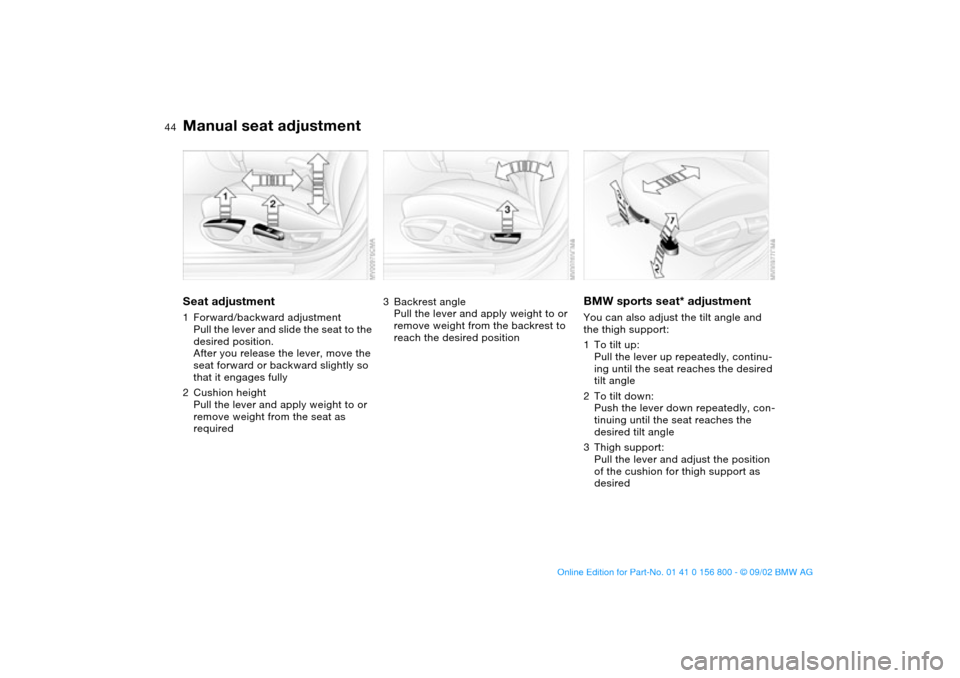
Manual seat adjustmentSeat adjustment1Forward/backward adjustment
Pull the lever and slide the seat to the
desired position.
After you release the lever, move the
seat forward or backward slightly so
that it engages fully
2Cushion height
Pull the lever and apply weight to or
remove weight from the seat as
required
3Backrest angle
Pull the lever and apply weight to or
remove weight from the backrest to
reach the desired position
BMW sports seat* adjustmentYou can also adjust the tilt angle and
the thigh support:
1To tilt up:
Pull the lever up repeatedly, continu-
ing until the seat reaches the desired
tilt angle
2To tilt down:
Push the lever down repeatedly, con-
tinuing until the seat reaches the
desired tilt angle
3Thigh support:
Pull the lever and adjust the position
of the cushion for thigh support as
desired
handbook.book Page 44 Tuesday, July 30, 2002 12:16 PM
Page 45 of 162
45
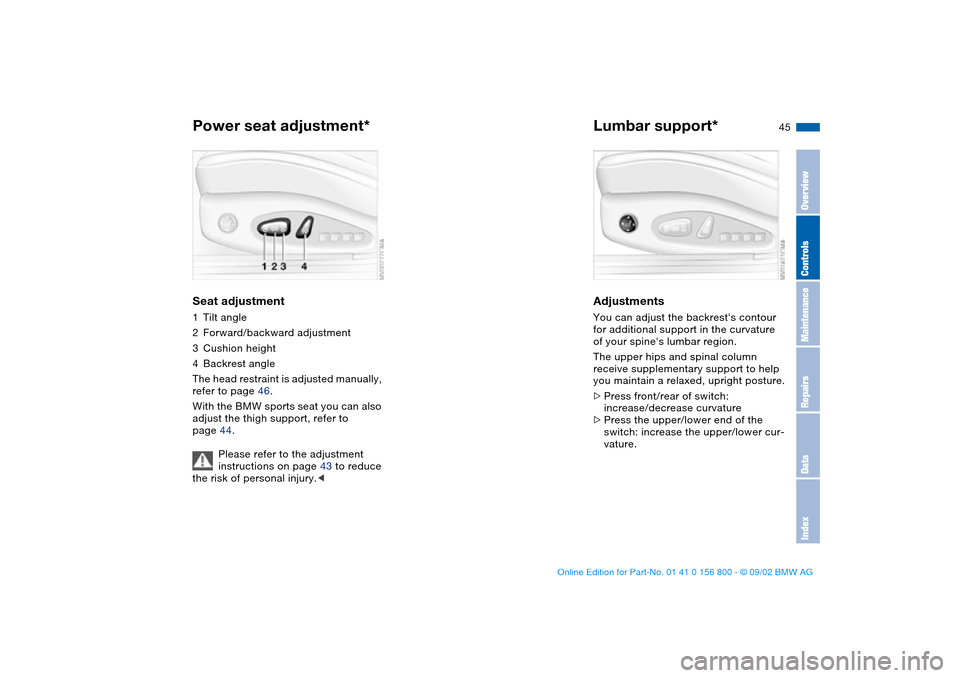
Power seat adjustment*Seat adjustment1Tilt angle
2Forward/backward adjustment
3Cushion height
4Backrest angle
The head restraint is adjusted manually,
refer to page 46.
With the BMW sports seat you can also
adjust the thigh support, refer to
page 44.
Please refer to the adjustment
instructions on page 43 to reduce
the risk of personal injury.<
Lumbar support*AdjustmentsYou can adjust the backrest's contour
for additional support in the curvature
of your spine's lumbar region.
The upper hips and spinal column
receive supplementary support to help
you maintain a relaxed, upright posture.
>Press front/rear of switch:
increase/decrease curvature
>Press the upper/lower end of the
switch: increase the upper/lower cur-
vature.
OverviewControlsMaintenanceRepairsDataIndex
handbook.book Page 45 Tuesday, July 30, 2002 12:16 PM
Page 47 of 162
47
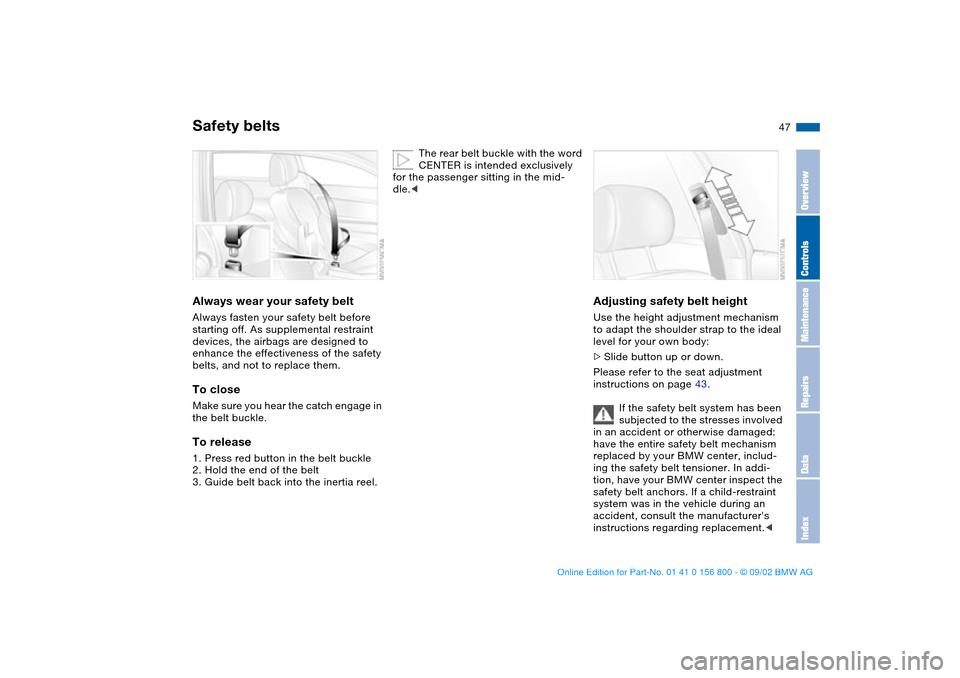
Safety beltsAlways wear your safety beltAlways fasten your safety belt before
starting off. As supplemental restraint
devices, the airbags are designed to
enhance the effectiveness of the safety
belts, and not to replace them.To closeMake sure you hear the catch engage in
the belt buckle.To release1. Press red button in the belt buckle
2. Hold the end of the belt
3. Guide belt back into the inertia reel.
The rear belt buckle with the word
CENTER is intended exclusively
for the passenger sitting in the mid-
dle.<
Adjusting safety belt heightUse the height adjustment mechanism
to adapt the shoulder strap to the ideal
level for your own body:
>Slide button up or down.
Please refer to the seat adjustment
instructions on page 43.
If the safety belt system has been
subjected to the stresses involved
in an accident or otherwise damaged:
have the entire safety belt mechanism
replaced by your BMW center, includ-
ing the safety belt tensioner. In addi-
tion, have your BMW center inspect the
safety belt anchors. If a child-restraint
system was in the vehicle during an
accident, consult the manufacturer's
instructions regarding replacement.<
OverviewControlsMaintenanceRepairsDataIndex
handbook.book Page 47 Tuesday, July 30, 2002 12:16 PM
Page 48 of 162
48
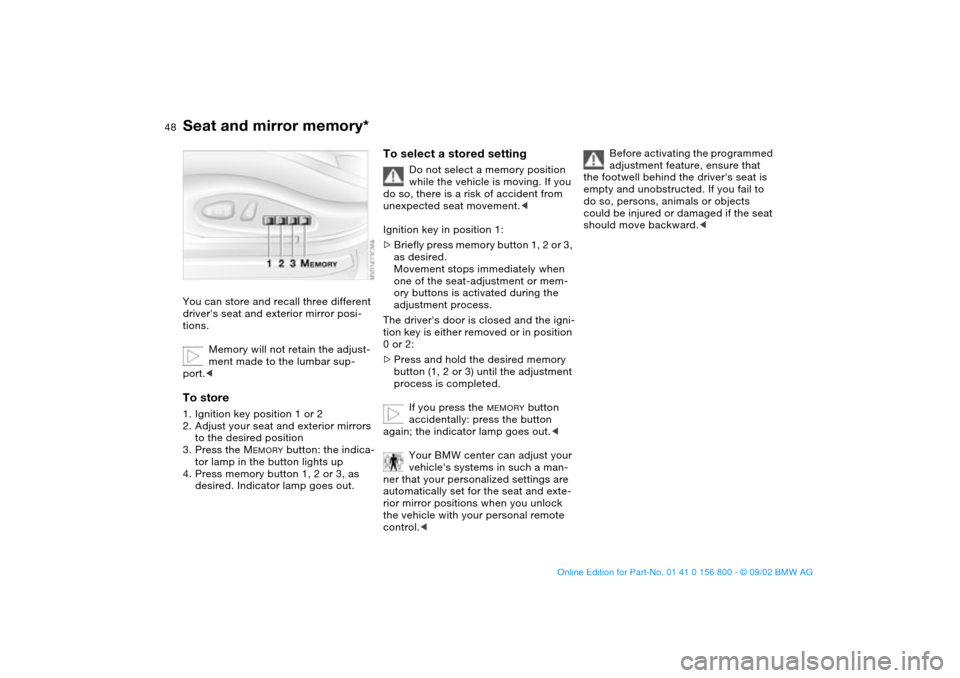
Seat and mirror memory*You can store and recall three different
driver's seat and exterior mirror posi-
tions.
Memory will not retain the adjust-
ment made to the lumbar sup-
port.
to the desired position
3. Press the M
EMORY
button: the indica-
tor lamp in the button lights up
4. Press memory button 1, 2 or 3, as
desired. Indicator lamp goes out.
To select a stored setting
Do not select a memory position
while the vehicle is moving. If you
do so, there is a risk of accident from
unexpected seat movement.<
Ignition key in position 1:
>Briefly press memory button 1, 2 or 3,
as desired.
Movement stops immediately when
one of the seat-adjustment or mem-
ory buttons is activated during the
adjustment process.
The driver's door is closed and the igni-
tion key is either removed or in position
0 or 2:
>Press and hold the desired memory
button (1, 2 or 3) until the adjustment
process is completed.
If you press the
MEMORY
button
accidentally: press the button
again; the indicator lamp goes out.<
Your BMW center can adjust your
vehicle's systems in such a man-
ner that your personalized settings are
automatically set for the seat and exte-
rior mirror positions when you unlock
the vehicle with your personal remote
control.<
Before activating the programmed
adjustment feature, ensure that
the footwell behind the driver's seat is
empty and unobstructed. If you fail to
do so, persons, animals or objects
could be injured or damaged if the seat
should move backward.<
handbook.book Page 48 Tuesday, July 30, 2002 12:16 PM
Page 50 of 162
50
Steering wheelAdjustments
Do not adjust the steering wheel
while the vehicle is moving, other-
wise you run the risk of an accident due
to unexpected movement.<
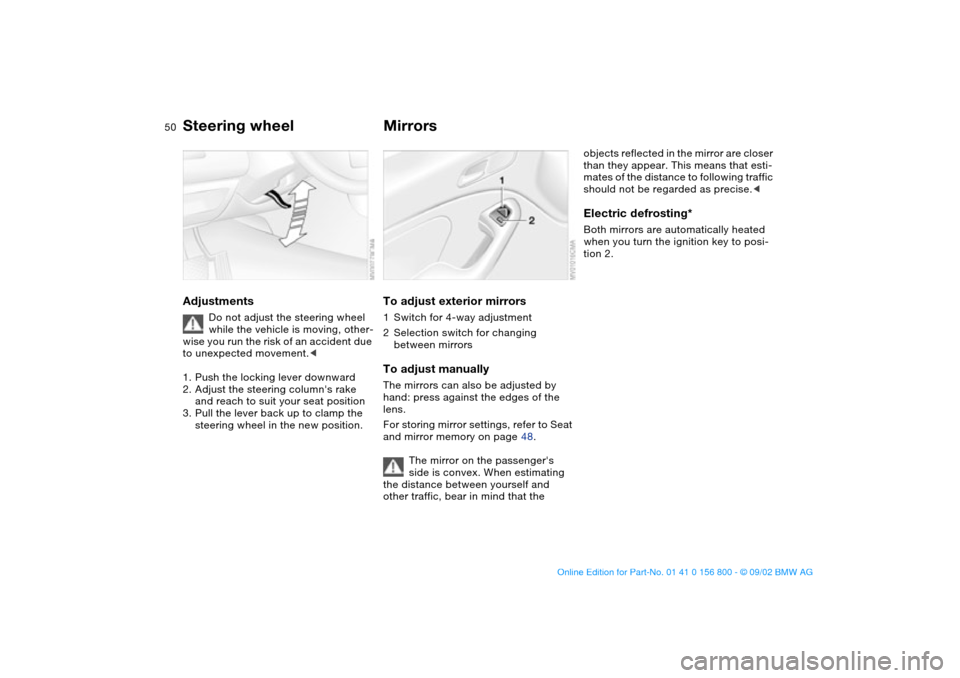
1. Push the locking lever downward
2. Adjust the steering column's rake
and reach to suit your seat position
3. Pull the lever back up to clamp the
steering wheel in the new position.
MirrorsTo adjust exterior mirrors1Switch for 4-way adjustment
2Selection switch for changing
between mirrorsTo adjust manuallyThe mirrors can also be adjusted by
hand: press against the edges of the
lens.
For storing mirror settings, refer to Seat
and mirror memory on page 48.
The mirror on the passenger's
side is convex. When estimating
the distance between yourself and
other traffic, bear in mind that the
objects reflected in the mirror are closer
than they appear. This means that esti-
mates of the distance to following traffic
should not be regarded as precise.
tion 2.
handbook.book Page 50 Tuesday, July 30, 2002 12:16 PM
Page 58 of 162
58
Vehicle Memory, Key MemoryHow the system functionsNo doubt you have reflected at one
time or another on how great it would
be if you could permanently configure
your vehicle's various features and
adjustments to mirror your own individ-
ual preferences. In engineering your
vehicle, BMW has provided for a num-
ber of options for personal adjustment
that can be programmed into your vehi-
cle at your BMW center.
The available configuration data fall into
two categories, according to whether
their primary orientation is the vehicle –
Vehicle Memory – or the individual –
Key Memory. Provided that each per-
son has a separate remote-control key,
you can have your BMW center enter
adjustment data for as many as four dif-
ferent individuals into the system.
The system then relies on a bilateral
data exchange to identify the individual
user and executes the selected settings
whenever the remote control unit is
used to disengage the door locks.
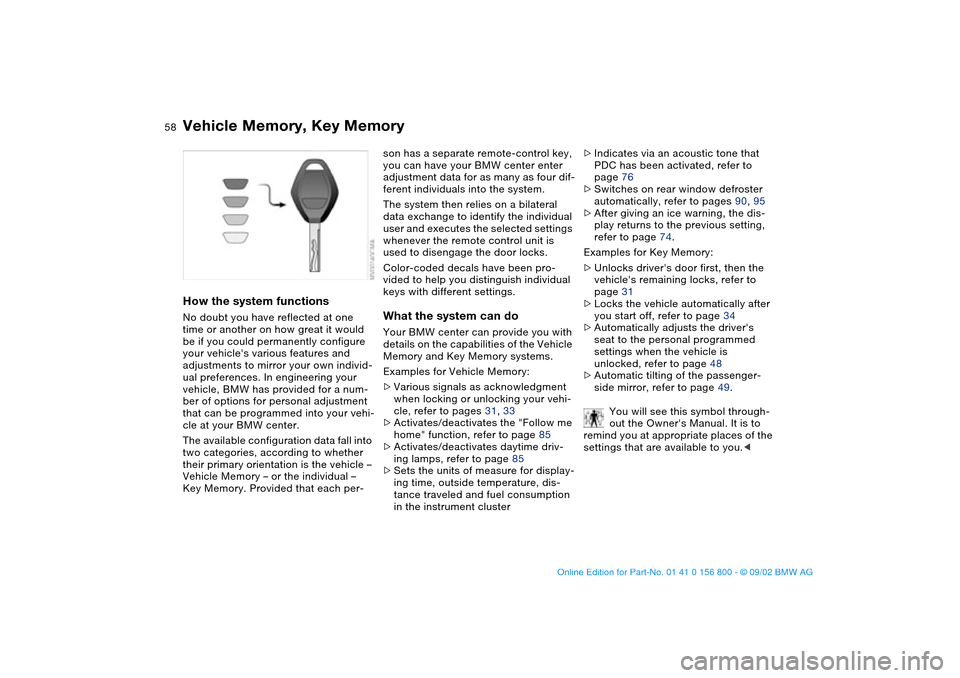
Color-coded decals have been pro-
vided to help you distinguish individual
keys with different settings.What the system can doYour BMW center can provide you with
details on the capabilities of the Vehicle
Memory and Key Memory systems.
Examples for Vehicle Memory:
>Various signals as acknowledgment
when locking or unlocking your vehi-
cle, refer to pages 31, 33
>Activates/deactivates the "Follow me
home" function, refer to page 85
>Activates/deactivates daytime driv-
ing lamps, refer to page 85
>Sets the units of measure for display-
ing time, outside temperature, dis-
tance traveled and fuel consumption
in the instrument cluster>Indicates via an acoustic tone that
PDC has been activated, refer to
page 76
>Switches on rear window defroster
automatically, refer to pages 90, 95
>After giving an ice warning, the dis-
play returns to the previous setting,
refer to page 74.
Examples for Key Memory:
>Unlocks driver's door first, then the
vehicle's remaining locks, refer to
page 31
>Locks the vehicle automatically after
you start off, refer to page 34
>Automatically adjusts the driver's
seat to the personal programmed
settings when the vehicle is
unlocked, refer to page 48
>Automatic tilting of the passenger-
side mirror, refer to page 49.
You will see this symbol through-
out the Owner's Manual. It is to
remind you at appropriate places of the
settings that are available to you.<
handbook.book Page 58 Tuesday, July 30, 2002 12:16 PM
Page 153 of 162
Everything from A to Z
153
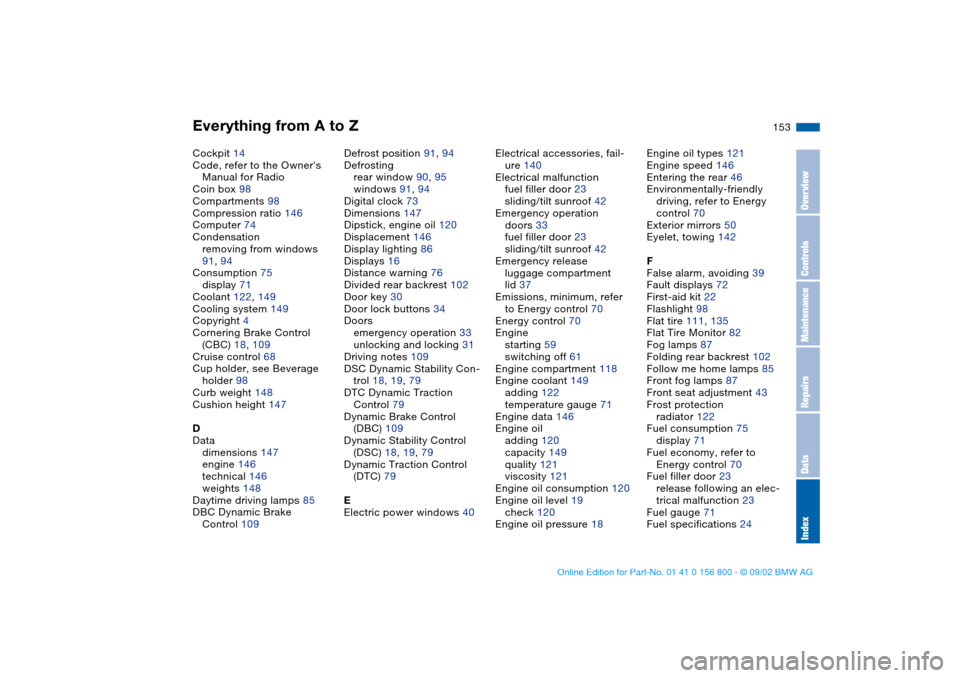
Cockpit 14
Code, refer to the Owner's
Manual for Radio
Coin box 98
Compartments 98
Compression ratio 146
Computer 74
Condensation
removing from windows
91, 94
Consumption 75
display 71
Coolant 122, 149
Cooling system 149
Copyright 4
Cornering Brake Control
(CBC) 18, 109
Cruise control 68
Cup holder, see Beverage
holder 98
Curb weight 148
Cushion height 147
D
Data
dimensions 147
engine 146
technical 146
weights 148
Daytime driving lamps 85
DBC Dynamic Brake
Control 109Defrost position 91, 94
Defrosting
rear window 90, 95
windows 91, 94
Digital clock 73
Dimensions 147
Dipstick, engine oil 120
Displacement 146
Display lighting 86
Displays 16
Distance warning 76
Divided rear backrest 102
Door key 30
Door lock buttons 34
Doors
emergency operation 33
unlocking and locking 31
Driving notes 109
DSC Dynamic Stability Con-
trol 18, 19, 79
DTC Dynamic Traction
Control 79
Dynamic Brake Control
(DBC) 109
Dynamic Stability Control
(DSC) 18, 19, 79
Dynamic Traction Control
(DTC) 79
E
Electric power windows 40Electrical accessories, fail-
ure 140
Electrical malfunction
fuel filler door 23
sliding/tilt sunroof 42
Emergency operation
doors 33
fuel filler door 23
sliding/tilt sunroof 42
Emergency release
luggage compartment
lid 37
Emissions, minimum, refer
to Energy control 70
Energy control 70
Engine
starting 59
switching off 61
Engine compartment 118
Engine coolant 149
adding 122
temperature gauge 71
Engine data 146
Engine oil
adding 120
capacity 149
quality 121
viscosity 121
Engine oil consumption 120
Engine oil level 19
check 120
Engine oil pressure 18Engine oil types 121
Engine speed 146
Entering the rear 46
Environmentally-friendly
driving, refer to Energy
control 70
Exterior mirrors 50
Eyelet, towing 142
F
False alarm, avoiding 39
Fault displays 72
First-aid kit 22
Flashlight 98
Flat tire 111, 135
Flat Tire Monitor 82
Fog lamps 87
Folding rear backrest 102
Follow me home lamps 85
Front fog lamps 87
Front seat adjustment 43
Frost protection
radiator 122
Fuel consumption 75
display 71
Fuel economy, refer to
Energy control 70
Fuel filler door 23
release following an elec-
trical malfunction 23
Fuel gauge 71
Fuel specifications 24
OverviewControlsMaintenanceRepairsDataIndex
handbook.book Page 153 Tuesday, July 30, 2002 12:16 PM
Page 155 of 162
Everything from A to Z
155
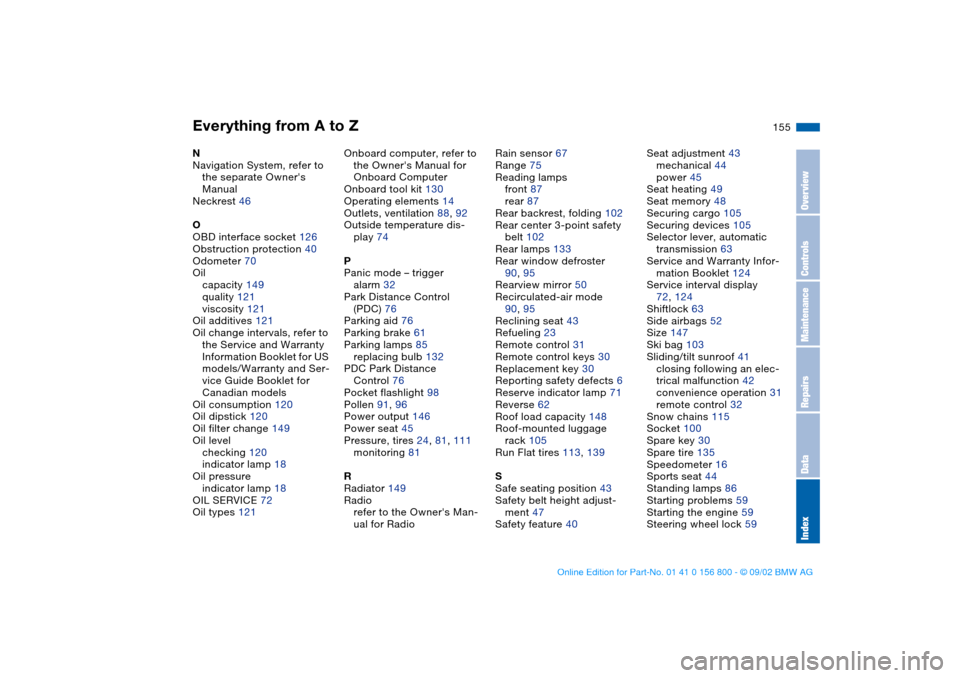
N
Navigation System, refer to
the separate Owner's
Manual
Neckrest 46
O
OBD interface socket 126
Obstruction protection 40
Odometer 70
Oil
capacity 149
quality 121
viscosity 121
Oil additives 121
Oil change intervals, refer to
the Service and Warranty
Information Booklet for US
models/Warranty and Ser-
vice Guide Booklet for
Canadian models
Oil consumption 120
Oil dipstick 120
Oil filter change 149
Oil level
checking 120
indicator lamp 18
Oil pressure
indicator lamp 18
OIL SERVICE 72
Oil types 121Onboard computer, refer to
the Owner's Manual for
Onboard Computer
Onboard tool kit 130
Operating elements 14
Outlets, ventilation 88, 92
Outside temperature dis-
play 74
P
Panic mode – trigger
alarm 32
Park Distance Control
(PDC) 76
Parking aid 76
Parking brake 61
Parking lamps 85
replacing bulb 132
PDC Park Distance
Control 76
Pocket flashlight 98
Pollen 91, 96
Power output 146
Power seat 45
Pressure, tires 24, 81, 111
monitoring 81
R
Radiator 149
Radio
refer to the Owner's Man-
ual for RadioRain sensor 67
Range 75
Reading lamps
front 87
rear 87
Rear backrest, folding 102
Rear center 3-point safety
belt 102
Rear lamps 133
Rear window defroster
90, 95
Rearview mirror 50
Recirculated-air mode
90, 95
Reclining seat 43
Refueling 23
Remote control 31
Remote control keys 30
Replacement key 30
Reporting safety defects 6
Reserve indicator lamp 71
Reverse 62
Roof load capacity 148
Roof-mounted luggage
rack 105
Run Flat tires 113, 139
S
Safe seating position 43
Safety belt height adjust-
ment 47
Safety feature 40Seat adjustment 43
mechanical 44
power 45
Seat heating 49
Seat memory 48
Securing cargo 105
Securing devices 105
Selector lever, automatic
transmission 63
Service and Warranty Infor-
mation Booklet 124
Service interval display
72, 124
Shiftlock 63
Side airbags 52
Size 147
Ski bag 103
Sliding/tilt sunroof 41
closing following an elec-
trical malfunction 42
convenience operation 31
remote control 32
Snow chains 115
Socket 100
Spare key 30
Spare tire 135
Speedometer 16
Sports seat 44
Standing lamps 86
Starting problems 59
Starting the engine 59
Steering wheel lock 59
OverviewControlsMaintenanceRepairsDataIndex
handbook.book Page 155 Tuesday, July 30, 2002 12:16 PM