tow BMW 330I 2004 Owner's Manual
[x] Cancel search | Manufacturer: BMW, Model Year: 2004, Model line: 330I, Model: BMW 330I 2004Pages: 182, PDF Size: 2.76 MB
Page 154 of 182
154
2. Start the engine of the other vehicle
as usual.
If the first start attempt is not suc-
cessful, wait a few minutes before
another attempt in order to allow the
discharged battery to recharge
3. Allow the engines to run for several
minutes
4. Disconnect the jumper cables in
reverse sequence.
Depending on the cause of the fault,
have the battery checked and
recharged by your BMW center.
Do not use spray starter fluids to
start the engine.<
Towing the vehicle
Always observe all applicable
towing laws and regulations.<
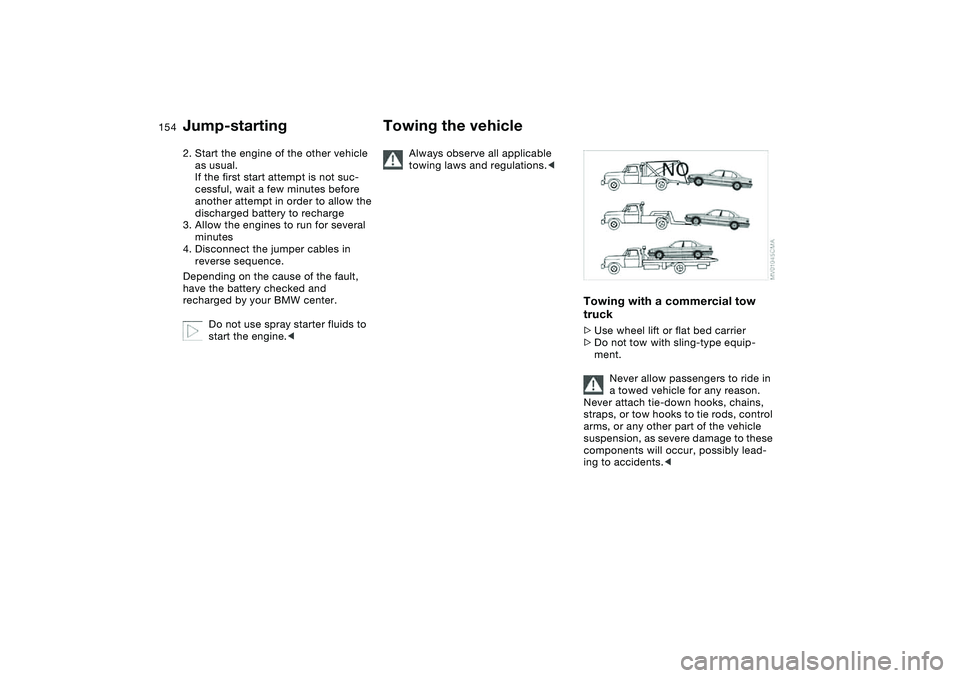
Towing with a commercial tow
truck>Use wheel lift or flat bed carrier
>Do not tow with sling-type equip-
ment.
Never allow passengers to ride in
a towed vehicle for any reason.
Never attach tie-down hooks, chains,
straps, or tow hooks to tie rods, control
arms, or any other part of the vehicle
suspension, as severe damage to these
components will occur, possibly lead-
ing to accidents.<
Jump-starting
Page 155 of 182
155
Towing the vehicle with the front
axle raisedVehicles with automatic transmission:
1. Maximum towing speed: maximum
45 mph / 70 km/h
2. Maximum towing distance: maximum
90 miles/150 km.
Vehicles with sequential manual gear-
box SMG:
While the ignition is on move the selec-
tor lever to position N, then turn off the
ignition.325xi, 330xi: towing the vehicle
with the front or rear axle raised1. Place the transmission in Neutral
2. Switch off the engine
3. Maximum towing speed:
30 mph / 50 km/h
4. Maximum towing distance:
90 miles/150 km.
Remove the rear driveshaft for
longer towing distances with the
front axle lifted; remove the front drive-
shaft for towing over longer distances
with the rear axle lifted. Failure to com-
ply with this will result in damage to the
transfer box.<
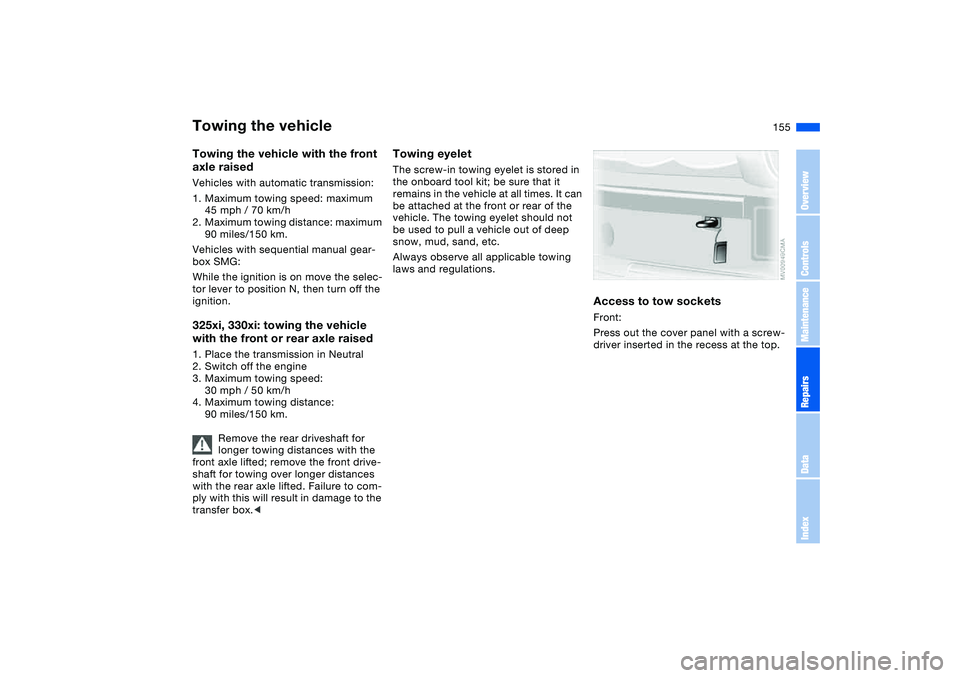
Towing eyeletThe screw-in towing eyelet is stored in
the onboard tool kit; be sure that it
remains in the vehicle at all times. It can
be attached at the front or rear of the
vehicle. The towing eyelet should not
be used to pull a vehicle out of deep
snow, mud, sand, etc.
Always observe all applicable towing
laws and regulations.
Access to tow socketsFront:
Press out the cover panel with a screw-
driver inserted in the recess at the top.
Towing the vehicle
OverviewControlsMaintenanceRepairsDataIndex
Page 156 of 182
156
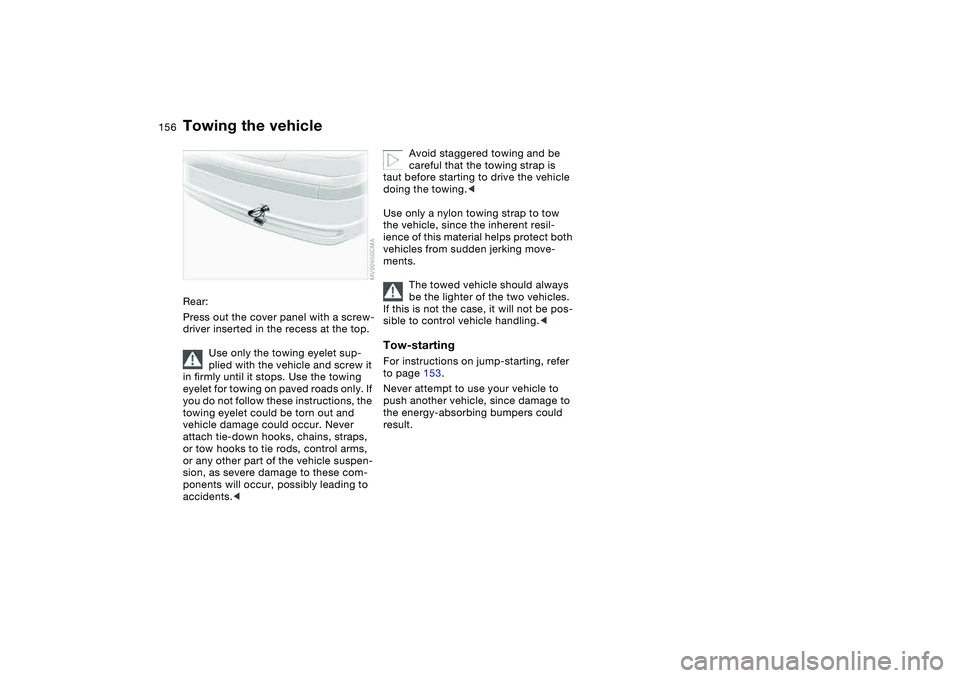
Rear:
Press out the cover panel with a screw-
driver inserted in the recess at the top.
Use only the towing eyelet sup-
plied with the vehicle and screw it
in firmly until it stops. Use the towing
eyelet for towing on paved roads only. If
you do not follow these instructions, the
towing eyelet could be torn out and
vehicle damage could occur. Never
attach tie-down hooks, chains, straps,
or tow hooks to tie rods, control arms,
or any other part of the vehicle suspen-
sion, as severe damage to these com-
ponents will occur, possibly leading to
accidents.<
Avoid staggered towing and be
careful that the towing strap is
taut before starting to drive the vehicle
doing the towing.<
Use only a nylon towing strap to tow
the vehicle, since the inherent resil-
ience of this material helps protect both
vehicles from sudden jerking move-
ments.
The towed vehicle should always
be the lighter of the two vehicles.
If this is not the case, it will not be pos-
sible to control vehicle handling.<
Tow-startingFor instructions on jump-starting, refer
to page 153.
Never attempt to use your vehicle to
push another vehicle, since damage to
the energy-absorbing bumpers could
result.
Towing the vehicle
Page 169 of 182
Everything from A to Z
169
DSC Dynamic Stability Con-
trol 87
indicator lamp 19, 87
DTC Dynamic Traction Con-
trol 87
indicator lamp 19, 87
Dynamic Brake Control
(DBC) 19, 121
Dynamic Brake Control DBC
indicator lamp 19
Dynamic Stability Control
(DSC) 19, 87
Dynamic Traction Control
(DTC) 87
indicator lamp 19, 87
E
Electric glass sunroof 44
Electric power windows 43
Electrical accessories, fail-
ure 151
Electrical malfunction
automatic transmission
with Steptronic 75
door lock 36
driver's door 36
fuel filler door 24
glass sunroof 46
luggage compartment
lid 38Electronic Stability Program
ESP, refer to Dynamic Sta-
bility Control DSC 87
Emergency call 152
Emergency operation
doors 36
driver's door 36
fuel filler door 24
glass sunroof 46
Emergency release
luggage compartment lid
38, 40
Emissions, minimum, refer
to Energy control 80
Energy control 80
Engine
breaking in 120
data 160
electronics 19
indicator lamp 19
speed 80, 160
starting 65
switching off 67
Engine compartment 130
Engine coolant 134
adding 134Engine oil
adding 133
additives, refer to Adding
engine oil 133
capacity 163
consumption 132
indicator/warning lamp 19
quality 133
types 133
viscosity 133
Engine oil level 19
check 132
indicator/warning lamp 18
Engine oil pressure
indicator/warning lamp 18
Engine output, refer to
Engine data 160
Engine speed 80, 160
Environmentally-friendly
driving, refer to Energy
control 80
ESP Electronic Stability Pro-
gram, refer to Dynamic
Stability Control (DSC) 87
Exterior mirrors 55
Eyeglasses
compartment 109
Eyelet, towing 155F
False alarm, refer to
Avoiding unintentional
alarms 42
Fastening the safety belts 51
Fault displays 82
First aid, refer to First-aid
kit 23
First-aid kit 23
Flashlight 108
Flashlight, refer to
Rechargeable
flashlight 108
Flat tire 147
Flat Tire Monitor 92
space-saver spare tire 147
Flat Tire Monitor 92
indicator lamp 18, 19, 93
Flat tire, refer to Tire condi-
tion 124
Fluid reservoir for washer
systems 132
Fog lamps 96
indicator lamp 20
Folding rear backrest 112
Follow me home lamps 94
Footbrake, refer to General
driving notes 121
Front airbags 57
Front center armrest 108
Front fog lamps 96
indicator lamp 20
OverviewControlsMaintenanceRepairsDataIndex
Page 175 of 182
Everything from A to Z
175
Storing seat positions,
refer to Seat and mirror
memory 53
Storing tires 127
Stroke, refer to Engine
data 160
Sun blind, refer to Roller sun
blind 106
Surface ice, refer to Ice
warning 84
Switches, refer to
Cockpit 14
Switching off
engine 67
vehicle 67
Symbols 4
Synthetic oils 133
T
Tachometer 80
Tail lamps
bulb replacement 145
Tail lamps, refer to Rear
lamps 145
Tank capacity, refer to Fuel
tank capacity 163
Tank indicator, refer to Fuel
gauge 81
Technical data 160
Technical modifications 5Technical modifications,
refer to For your own
safety 5
Telephone hookup 110
Telephone, refer to the sep-
arate Owner's Manual
Television, refer to the
Owner's Manual for
Onboard Computer
Temperature
air conditioning 100
automatic climate
control 104
Temperature adjustment
100, 104
Temperature display
engine coolant 81
ice warning 84
outside temperature 84
setting units 84
Temperature layering
101, 105
Tempomat, refer to Cruise
control 78
Thigh support area, adjust-
ing 49
Third brake lamp, refer to
Center high-mount brake
lamp 146
Three-point safety belt 51
Through-loading system 112Tilt alarm
deactivate 42
Tilt alarm sensor 34
remote control 34
Tilting passenger-side exte-
rior mirror 54
Time 83
Tire pressure monitoring,
refer to Flat Tire
Monitor 92
Tire replacement 125, 147
Tires
age 126
breaking in 120
changing 147
condition 128
damage 124
flat 147
inflation pressure 25, 124
replacing 125
size, refer to Wheel and
tire combinations 127
storing 127
tread 124
treadwear indicator,
refer to Tire tread – tire
damage 124
winter tires 127
Tools, refer to Onboard tool
kit 142Torque
engine 160
lug bolts 148
Tow sockets for towing eye-
let 155
Towing eyelet 155
Towing the vehicle 154
Track width, refer to Dimen-
sions 161
Transmission
automatic transmission
with Steptronic 73
sequential manual gear-
box SMG 69
Transmission lock, refer to P
Park 73
Transmission malfunction
automatic transmission
with Steptronic 75
sequential manual gear-
box SMG 71
Transport securing devices,
refer to Securing cargo
116
Transporting children
safely 60
Trap protection
electric power windows 43
Tread depth, refer to Tire
tread 124
OverviewControlsMaintenanceRepairsDataIndex