temperature BMW 330I SEDAN 2006 E90 Owner's Guide
[x] Cancel search | Manufacturer: BMW, Model Year: 2006, Model line: 330I SEDAN, Model: BMW 330I SEDAN 2006 E90Pages: 245, PDF Size: 8.24 MB
Page 193 of 245
Mobility
191Reference
At a glance
Controls
Driving tips
Communications
Navigation
Entertainment
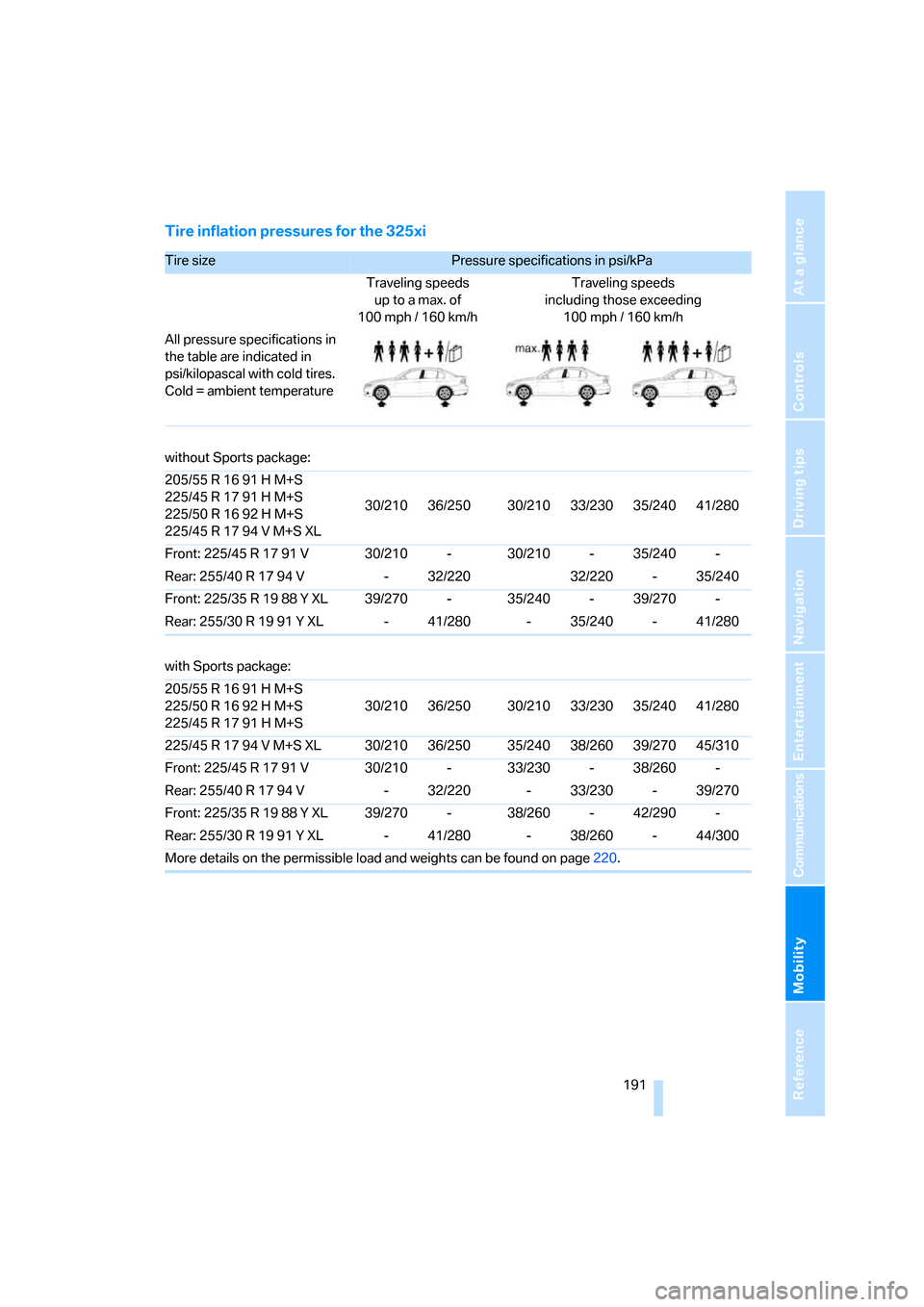
Tire inflation pressures for the 325xi
Tire size Pressure specifications in psi/kPa
Traveling speeds
up to a max. of
100 mph / 160 km/hTraveling speeds
including those exceeding
100 mph / 160 km/h
All pressure specifications in
the table are indicated in
psi/kilopascal with cold tires.
Cold = ambient temperature
without Sports package:
205/55 R 16 91 H M+S
225/45 R 17 91 H M+S
225/50 R 16 92 H M+S
225/45 R 17 94 V M+S XL30/210 36/250 30/210 33/230 35/240 41/280
Front: 225/45 R 17 91 V 30/210 - 30/210 - 35/240 -
Rear: 255/40 R 17 94 V - 32/220 32/220 - 35/240
Front: 225/35 R 19 88 Y XL 39/270 - 35/240 - 39/270 -
Rear: 255/30 R 19 91 Y XL - 41/280 - 35/240 - 41/280
with Sports package:
205/55 R 16 91 H M+S
225/50 R 16 92 H M+S
225/45 R 17 91 H M+S30/210 36/250 30/210 33/230 35/240 41/280
225/45 R 17 94 V M+S XL 30/210 36/250 35/240 38/260 39/270 45/310
Front: 225/45 R 17 91 V 30/210 - 33/230 - 38/260 -
Rear: 255/40 R 17 94 V - 32/220 - 33/230 - 39/270
Front: 225/35 R 19 88 Y XL 39/270 - 38/260 - 42/290 -
Rear: 255/30 R 19 91 Y XL - 41/280 - 38/260 - 44/300
More details on the permissible load and weights can be found on page220.
Page 194 of 245
Wheels and tires
192
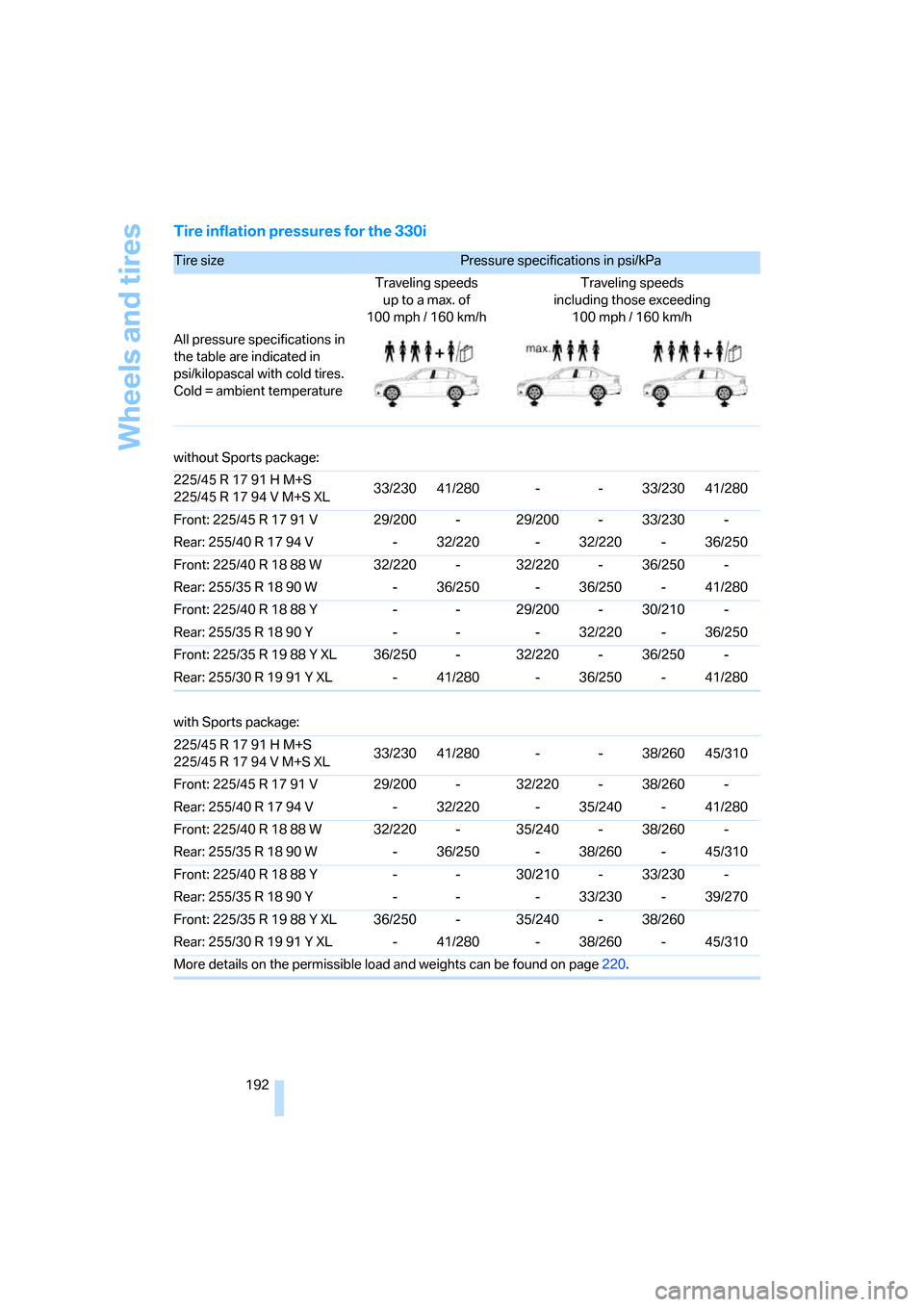
Tire inflation pressures for the 330i
Tire size Pressure specifications in psi/kPa
Traveling speeds
up to a max. of
100mph / 160km/hTraveling speeds
including those exceeding
100 mph / 160 km/h
All pressure specifications in
the table are indicated in
psi/kilopascal with cold tires.
Cold = ambient temperature
without Sports package:
225/45 R 17 91 H M+S
225/45 R 17 94 V M+S XL33/230 41/280 - - 33/230 41/280
Front: 225/45 R 17 91 V 29/200 - 29/200 - 33/230 -
Rear: 255/40 R 17 94 V - 32/220 - 32/220 - 36/250
Front: 225/40 R 18 88 W 32/220 - 32/220 - 36/250 -
Rear: 255/35 R 18 90 W - 36/250 - 36/250 - 41/280
Front: 225/40 R 18 88 Y - - 29/200 - 30/210 -
Rear: 255/35 R 18 90 Y - - - 32/220 - 36/250
Front: 225/35 R 19 88 Y XL 36/250 - 32/220 - 36/250 -
Rear: 255/30 R 19 91 Y XL - 41/280 - 36/250 - 41/280
with Sports package:
225/45 R 17 91 H M+S
225/45 R 17 94 V M+S XL33/230 41/280 - - 38/260 45/310
Front: 225/45 R 17 91 V 29/200 - 32/220 - 38/260 -
Rear: 255/40 R 17 94 V - 32/220 - 35/240 - 41/280
Front: 225/40 R 18 88 W 32/220 - 35/240 - 38/260 -
Rear: 255/35 R 18 90 W - 36/250 - 38/260 - 45/310
Front: 225/40 R 18 88 Y - - 30/210 - 33/230 -
Rear: 255/35 R 18 90 Y - - - 33/230 - 39/270
Front: 225/35 R 19 88 Y XL 36/250 - 35/240 - 38/260
Rear: 255/30 R 19 91 Y XL - 41/280 - 38/260 - 45/310
More details on the permissible load and weights can be found on page220.
Page 195 of 245
Mobility
193Reference
At a glance
Controls
Driving tips
Communications
Navigation
Entertainment
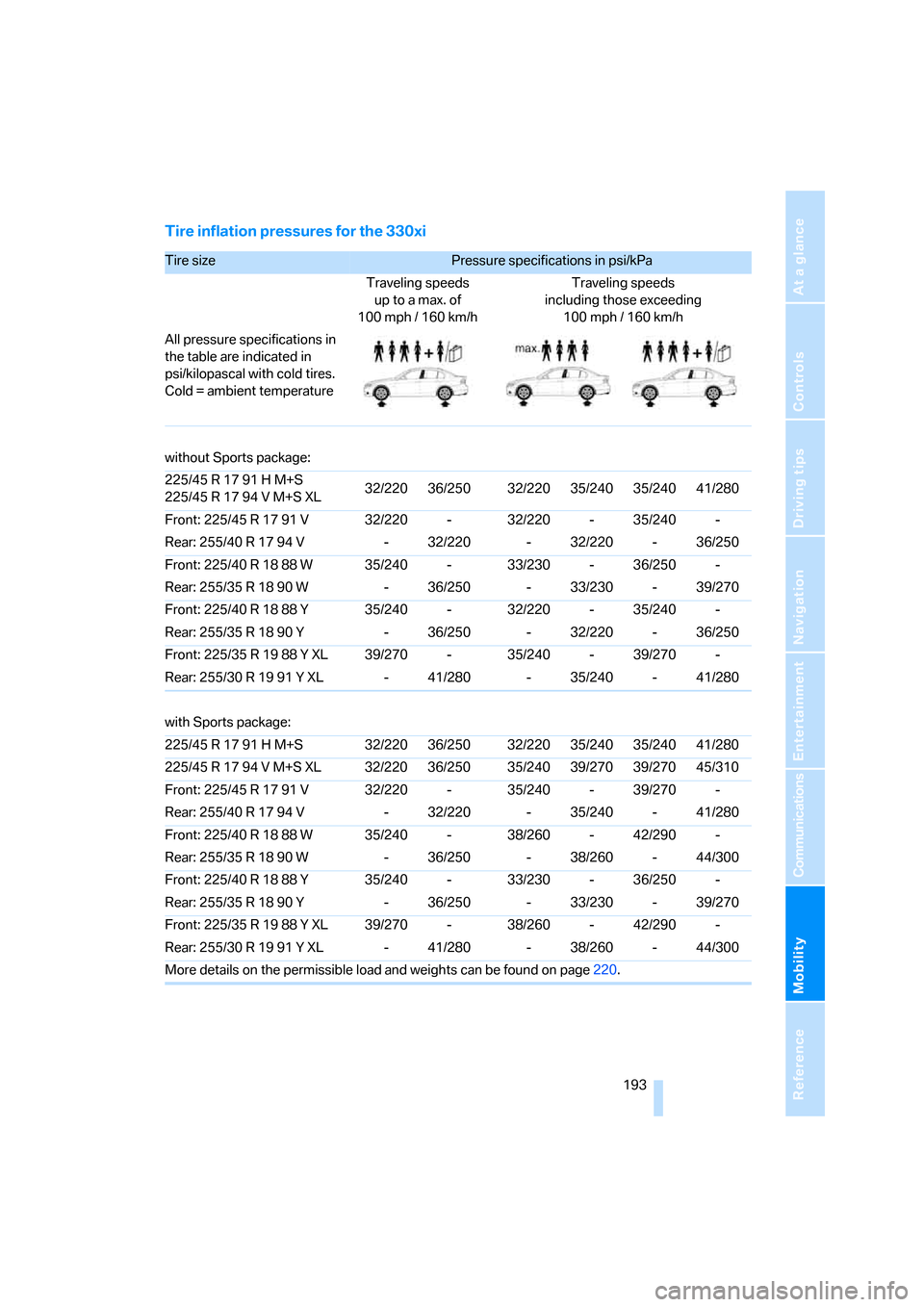
Tire inflation pressures for the 330xi
Tire size Pressure specifications in psi/kPa
Traveling speeds
up to a max. of
100 mph / 160 km/hTraveling speeds
including those exceeding
100 mph / 160 km/h
All pressure specifications in
the table are indicated in
psi/kilopascal with cold tires.
Cold = ambient temperature
without Sports package:
225/45 R 17 91 H M+S
225/45 R 17 94 V M+S XL32/220 36/250 32/220 35/240 35/240 41/280
Front: 225/45 R 17 91 V 32/220 - 32/220 - 35/240 -
Rear: 255/40 R 17 94 V - 32/220 - 32/220 - 36/250
Front: 225/40 R 18 88 W 35/240 - 33/230 - 36/250 -
Rear: 255/35 R 18 90 W - 36/250 - 33/230 - 39/270
Front: 225/40 R 18 88 Y 35/240 - 32/220 - 35/240 -
Rear: 255/35 R 18 90 Y - 36/250 - 32/220 - 36/250
Front: 225/35 R 19 88 Y XL 39/270 - 35/240 - 39/270 -
Rear: 255/30 R 19 91 Y XL - 41/280 - 35/240 - 41/280
with Sports package:
225/45 R 17 91 H M+S 32/220 36/250 32/220 35/240 35/240 41/280
225/45 R 17 94 V M+S XL 32/220 36/250 35/240 39/270 39/270 45/310
Front: 225/45 R 17 91 V 32/220 - 35/240 - 39/270 -
Rear: 255/40 R 17 94 V - 32/220 - 35/240 - 41/280
Front: 225/40 R 18 88 W 35/240 - 38/260 - 42/290 -
Rear: 255/35 R 18 90 W - 36/250 - 38/260 - 44/300
Front: 225/40 R 18 88 Y 35/240 - 33/230 - 36/250 -
Rear: 255/35 R 18 90 Y - 36/250 - 33/230 - 39/270
Front: 225/35 R 19 88 Y XL 39/270 - 38/260 - 42/290 -
Rear: 255/30 R 19 91 Y XL - 41/280 - 38/260 - 44/300
More details on the permissible load and weights can be found on page220.
Page 196 of 245
Wheels and tires
194
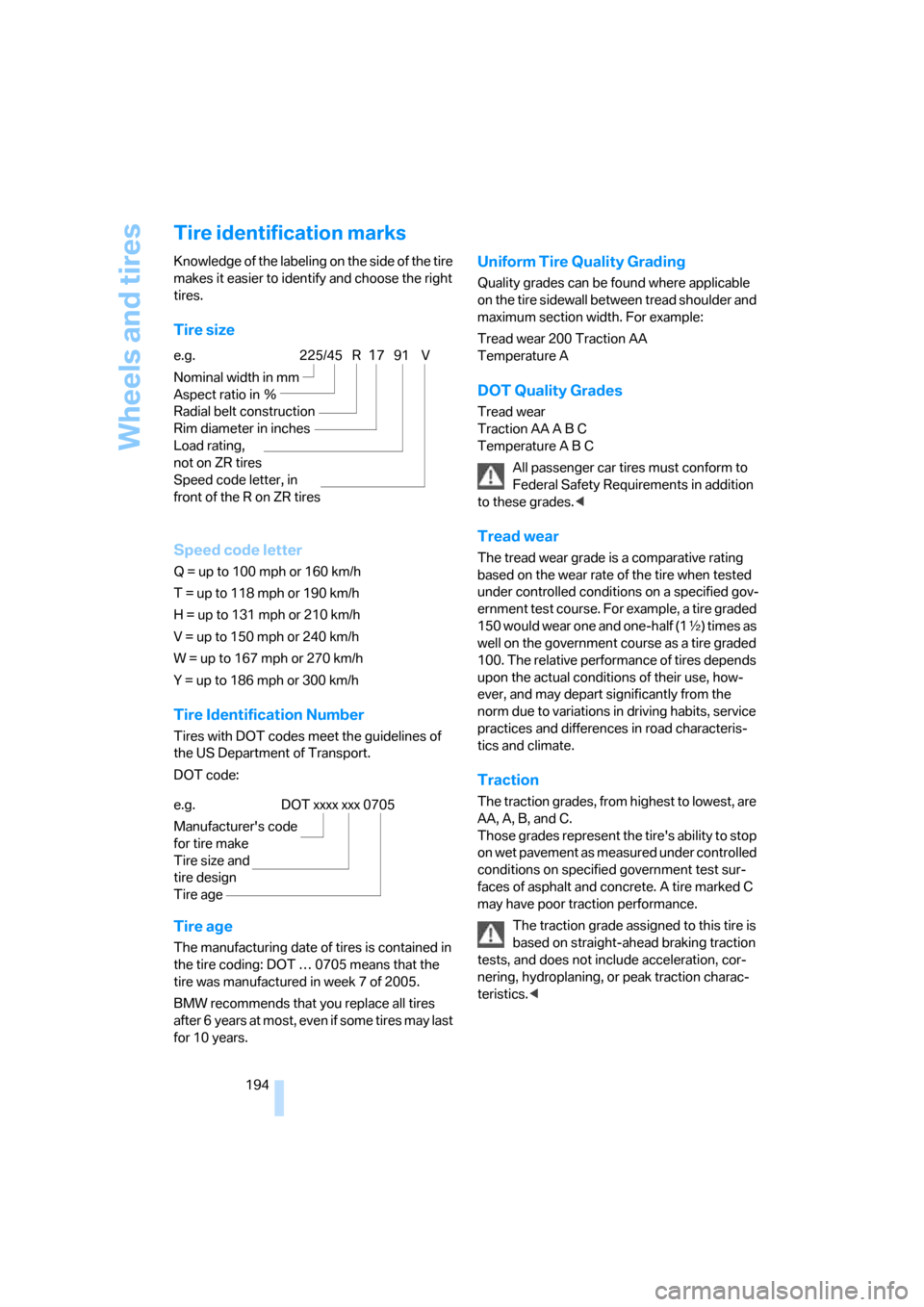
Tire identification marks
Knowledge of the labeling on the side of the tire
makes it easier to identify and choose the right
tires.
Tire size
Speed code letter
Q = up to 100 mph or 160 km/h
T = up to 118 mph or 190 km/h
H = up to 131 mph or 210 km/h
V = up to 150 mph or 240 km/h
W = up to 167 mph or 270 km/h
Y = up to 186 mph or 300 km/h
Tire Identification Number
Tires with DOT codes meet the guidelines of
the US Department of Transport.
DOT code:
Tire age
The manufacturing date of tires is contained in
the tire coding: DOT … 0705 means that the
tire was manufactured in week 7 of 2005.
BMW recommends that you replace all tires
after 6 years at most, even if some tires may last
for 10 years.
Uniform Tire Quality Grading
Quality grades can be found where applicable
on the tire sidewall between tread shoulder and
maximum section width. For example:
Tread wear 200 Traction AA
Temperature A
DOT Quality Grades
Tread wear
Traction AA A B C
Temperature A B C
All passenger car tires must conform to
Federal Safety Requirements in addition
to these grades.<
Tread wear
The tread wear grade is a comparative rating
based on the wear rate of the tire when tested
under controlled conditions on a specified gov-
ernment test course. For example, a tire graded
150 would wear one and one-half (1γ) times as
well on the government course as a tire graded
100. The relative performance of tires depends
upon the actual conditions of their use, how-
ever, and may depart significantly from the
norm due to variations in driving habits, service
practices and differences in road characteris-
tics and climate.
Traction
The traction grades, from highest to lowest, are
AA, A, B, and C.
Those grades represent the tire's ability to stop
on wet pavement as measured under controlled
conditions on specified government test sur-
faces of asphalt and concrete. A tire marked C
may have poor traction performance.
The traction grade assigned to this tire is
based on straight-ahead braking traction
tests, and does not include acceleration, cor-
nering, hydroplaning, or peak traction charac-
teristics.< e.g.
Nominal width in mm
Aspect ratio in Ξ
Radial belt construction
Rim diameter in inches
Load rating,
not on ZR tires
Speed code letter, in
front of the R on ZR tires
225/45 R1791 V
e.g.
Manufacturer's code
for tire make
Tire size and
tire design
Tire ageDOT xxxx xxx 0705
Page 197 of 245
Mobility
195Reference
At a glance
Controls
Driving tips
Communications
Navigation
Entertainment
Temperature
The temperature grades are A, the highest, B,
and C, representing the tire's resistance to the
generation of heat and its ability to dissipate
heat when tested under controlled conditions
on a specified indoor laboratory test wheel.
Sustained high temperature can cause the
material of the tire to degenerate and reduce
tire life, and excessive temperature can lead to
sudden tire failure. The grade C corresponds to
a level of performance which all passenger car
tires must meet under the Federal Motor Vehi-
cle Safety Standard No. 109. Grades B and A
represent higher levels of performance on the
laboratory test wheel than the minimum
required by law.
The temperature grade for this tire is
established for a tire that is properly
inflated and not overloaded. Excessive speed,
underinflation, or excessive loading, either sep-
arately or in combination, can cause heat
buildup and possible tire failure.<
RSC – Run-Flat Tires
You will recognize Run-Flat Tires by a circular
symbol containing the letters RSC on the side
of the tire, refer to page196.
M+S
Winter and all-season tires.
These have better winter properties than sum-
mer tires.
XL
Designation for specially reinforced tires.
Tire condition
Inspect your tires frequently for tread wear,
signs of damage and for foreign objects lodged
in the tread. Check the tread depth.
Minimum tread depth
The tread depth should not drop below 1/8 in/
3 mm, although, for example, European legisla-
tion only specifies a minimum tread depth of 1/16 in/1.6 mm. At tread depths below 1/8 in/
3 mm there is an increased risk of high-speed
hydroplaning, even when only small amounts of
water are present on the road surface.
When winter tires wear down past a tread depth
of 1/6 in/4 mm, they become perceptibly less
suitable for winter conditions. In the interest of
safety, new tires should be installed.
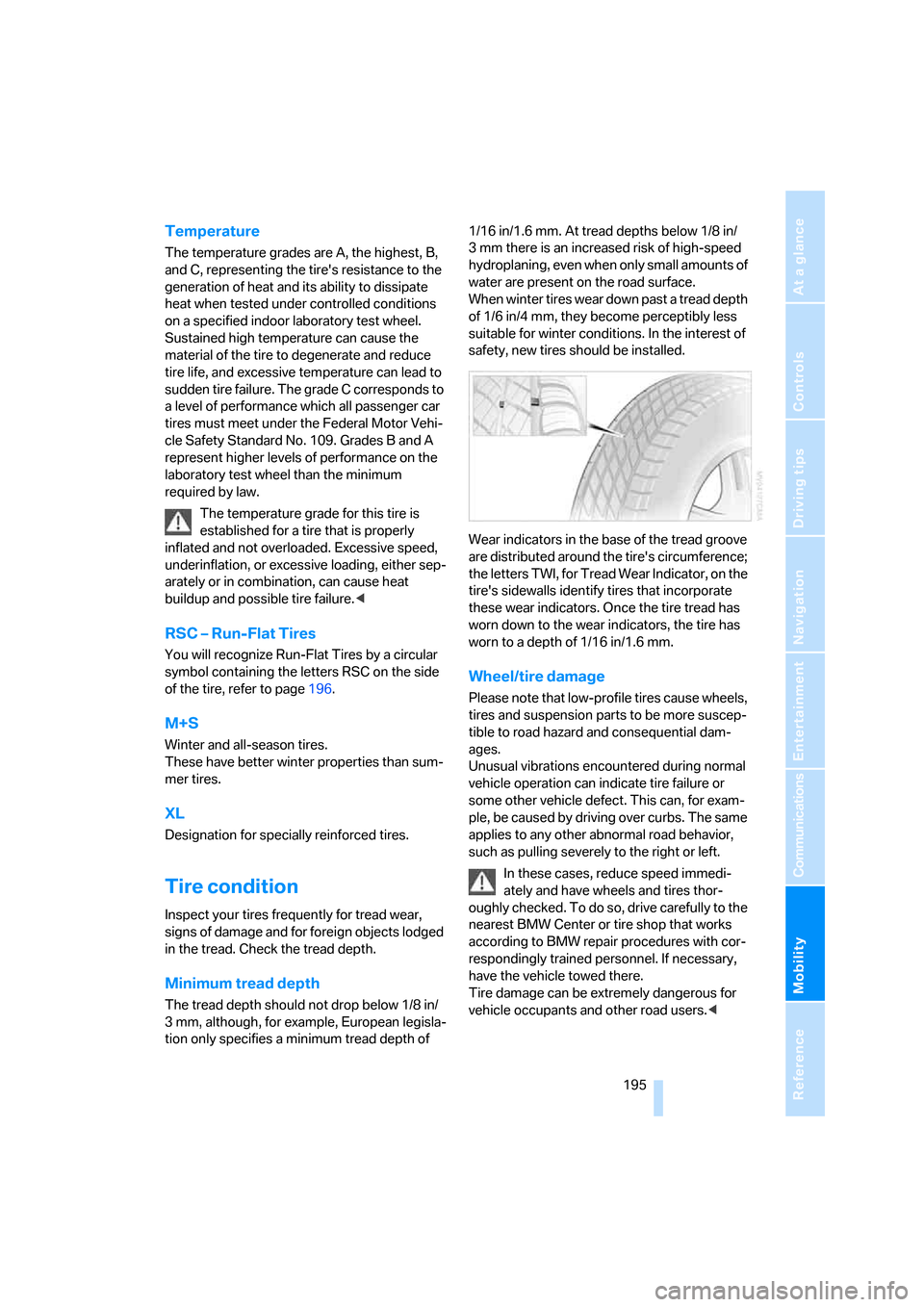
Wear indicators in the base of the tread groove
are distributed around the tire's circumference;
the letters TWI, for Tread Wear Indicator, on the
tire's sidewalls identify tires that incorporate
these wear indicators. Once the tire tread has
worn down to the wear indicators, the tire has
worn to a depth of 1/16 in/1.6 mm.
Wheel/tire damage
Please note that low-profile tires cause wheels,
tires and suspension parts to be more suscep-
tible to road hazard and consequential dam-
ages.
Unusual vibrations encountered during normal
vehicle operation can indicate tire failure or
some other vehicle defect. This can, for exam-
ple, be caused by driving over curbs. The same
applies to any other abnormal road behavior,
such as pulling severely to the right or left.
In these cases, reduce speed immedi-
ately and have wheels and tires thor-
oughly checked. To do so, drive carefully to the
nearest BMW Center or tire shop that works
according to BMW repair procedures with cor-
respondingly trained personnel. If necessary,
have the vehicle towed there.
Tire damage can be extremely dangerous for
vehicle occupants and other road users.<
Page 201 of 245
Mobility
199Reference
At a glance
Controls
Driving tips
Communications
Navigation
Entertainment
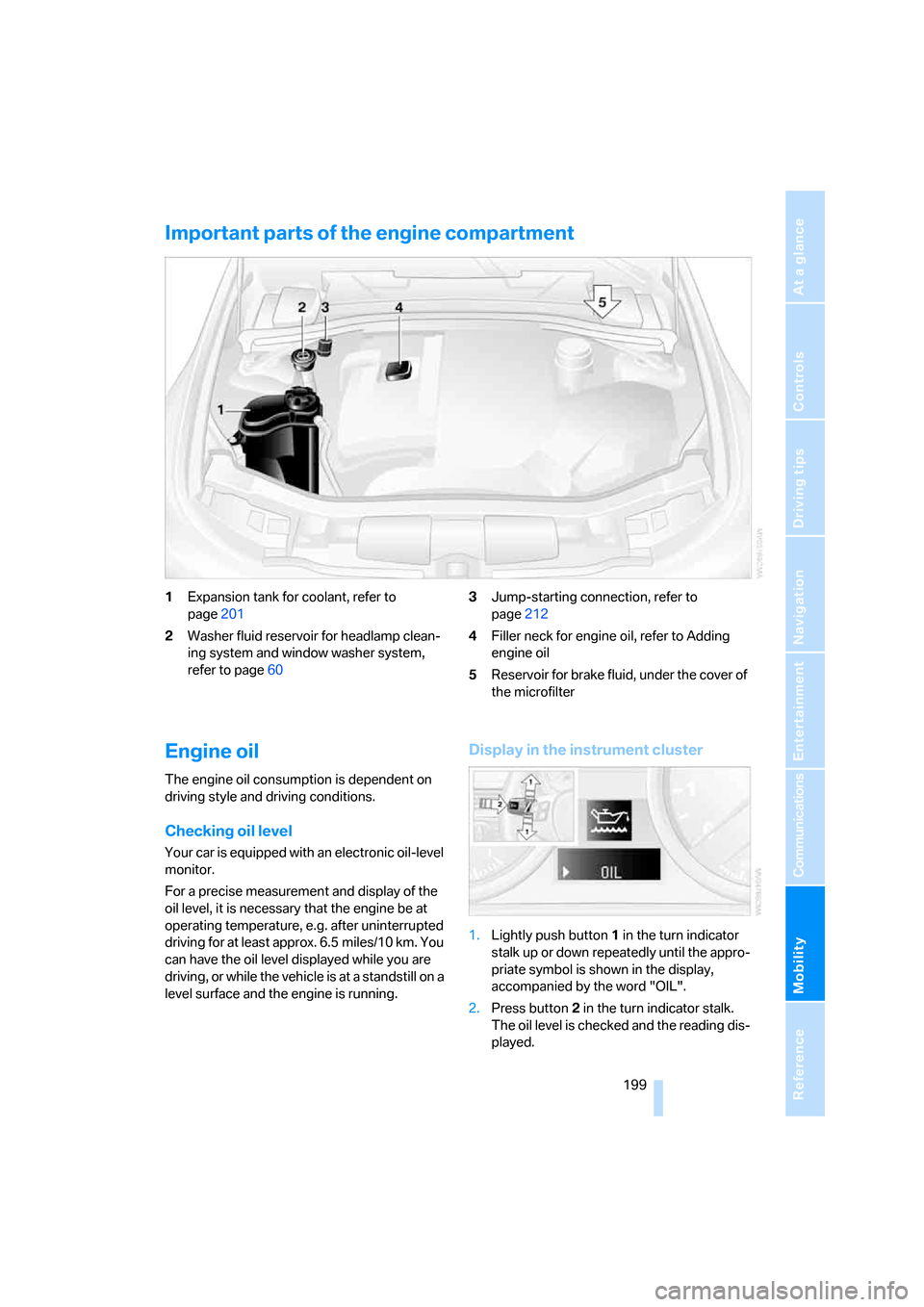
Important parts of the engine compartment
1Expansion tank for coolant, refer to
page201
2Washer fluid reservoir for headlamp clean-
ing system and window washer system,
refer to page603Jump-starting connection, refer to
page212
4Filler neck for engine oil, refer to Adding
engine oil
5Reservoir for brake fluid, under the cover of
the microfilter
Engine oil
The engine oil consumption is dependent on
driving style and driving conditions.
Checking oil level
Your car is equipped with an electronic oil-level
monitor.
For a precise measurement and display of the
oil level, it is necessary that the engine be at
operating temperature, e.g. after uninterrupted
driving for at least approx. 6.5 miles/10 km. You
can have the oil level displayed while you are
driving, or while the vehicle is at a standstill on a
level surface and the engine is running.
Display in the instrument cluster
1.Lightly push button 1 in the turn indicator
stalk up or down repeatedly until the appro-
priate symbol is shown in the display,
accompanied by the word "OIL".
2.Press button 2 in the turn indicator stalk.
The oil level is checked and the reading dis-
played.
Page 203 of 245
Mobility
201Reference
At a glance
Controls
Driving tips
Communications
Navigation
Entertainment
Too much oil will harm the engine.
Have the vehicle checked without
delay.<
>"Please observe recalculated service inter-
val for engine oil"
Do not add engine oil. You can continue
your journey. Note the newly calculated dis-
tance remaining to the next oil service, refer
to page74. Have the system checked as
soon as possible.
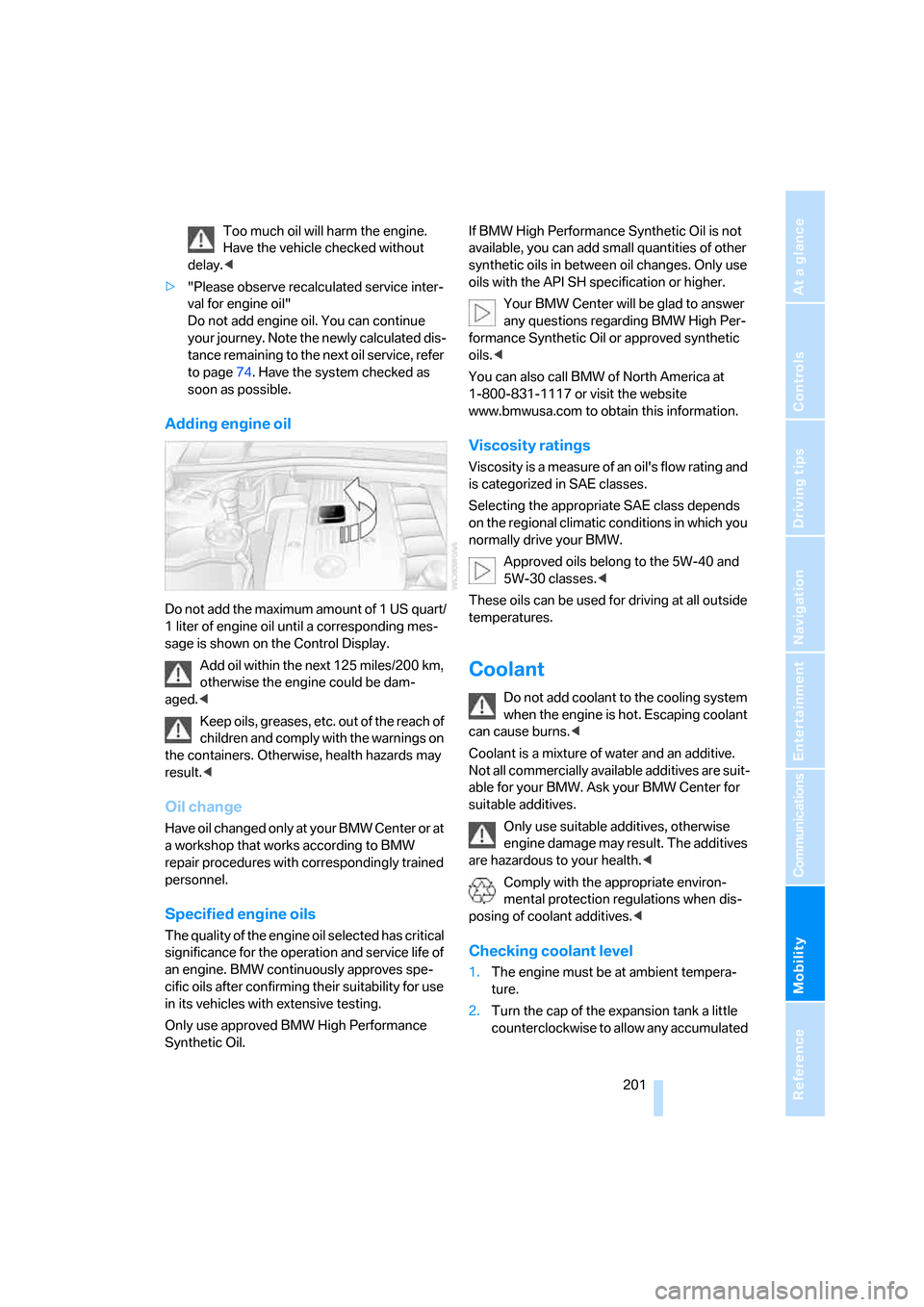
Adding engine oil
Do not add the maximum amount of 1 US quart/
1 liter of engine oil until a corresponding mes-
sage is shown on the Control Display.
Add oil within the next 125 miles/200 km,
otherwise the engine could be dam-
aged.<
Keep oils, greases, etc. out of the reach of
children and comply with the warnings on
the containers. Otherwise, health hazards may
result.<
Oil change
Have oil changed only at your BMW Center or at
a workshop that works according to BMW
repair procedures with correspondingly trained
personnel.
Specified engine oils
The quality of the engine oil selected has critical
significance for the operation and service life of
an engine. BMW continuously approves spe-
cific oils after confirming their suitability for use
in its vehicles with extensive testing.
Only use approved BMW High Performance
Synthetic Oil.If BMW High Performance Synthetic Oil is not
available, you can add small quantities of other
synthetic oils in between oil changes. Only use
oils with the API SH specification or higher.
Your BMW Center will be glad to answer
any questions regarding BMW High Per-
formance Synthetic Oil or approved synthetic
oils.<
You can also call BMW of North America at
1-800-831-1117 or visit the website
www.bmwusa.com to obtain this information.
Viscosity ratings
Viscosity is a measure of an oil's flow rating and
is categorized in SAE classes.
Selecting the appropriate SAE class depends
on the regional climatic conditions in which you
normally drive your BMW.
Approved oils belong to the 5W-40 and
5W-30 classes.<
These oils can be used for driving at all outside
temperatures.
Coolant
Do not add coolant to the cooling system
when the engine is hot. Escaping coolant
can cause burns.<
Coolant is a mixture of water and an additive.
Not all commercially available additives are suit-
able for your BMW. Ask your BMW Center for
suitable additives.
Only use suitable additives, otherwise
engine damage may result. The additives
are hazardous to your health.<
Comply with the appropriate environ-
mental protection regulations when dis-
posing of coolant additives.<
Checking coolant level
1.The engine must be at ambient tempera-
ture.
2.Turn the cap of the expansion tank a little
counterclockwise to allow any accumulated
Page 228 of 245
Everything from A - Z
226
Everything from A - Z
Index
"..." Identifies Control Display
texts used to select
individual functions and
refers you to the page where
these texts can be found.
A
ABS Antilock Brake
System84
ACC, refer to Active cruise
control62
Acceleration assistant with
the sequential manual
gearbox SMG57
Accessories, refer to The
individual vehicle5
Activated-charcoal filter for
automatic climate
control101
"Activation time"101
Active cruise control62
– indicator lamps65
– malfunction66
– selecting distance64
– sensor66
Active steering89
– warning lamp89
Adapter for spare key28
Adaptive Head Light95
"Add digits" for mobile
phone172
Additives
– coolant201
"Address book" in
navigation132
Address for navigation
– deleting133
– entering125,128,132
– selecting133
– storing132
– storing current position132"Add to destination
list"128,129
Adjusting temperature inside
the car, refer to Automatic
climate control98
Adjusting the tone during
audio operation, refer to
Tone control145
Adjustment in audio mode
– front-to-rear145
– right/left balance145
Airbags90
– sitting safely40
– warning lamp92
Air conditioning mode
– automatic climate control98
– ventilation100
Air distribution
– automatic98
– individual98
Air flow rate99
Airing, refer to Ventilation100
Air pressure, tires188
Air recirculation, refer to
Recirculated-air mode99
"Air recirculation on / off"47
Air supply
– automatic climate control98
– ventilation100
Air vents97
AKI, refer to Fuel
specifications186
Alarm system34
– avoiding unintentional
alarms35
– interior motion sensor35
– switching off an alarm34
– tilt alarm sensor35
"All channels"154
All-season tires, refer to
Winter tires197
"All stations", calling up on
radio148"AM", waveband144,148
Ambient air, refer to
Recirculated-air mode99
Antenna for mobile phone166
Antifreeze
– coolant201
– washer fluid60
Anti-theft alarm system, refer
to Alarm system34
Anti-theft system30
Anti-trapping mechanism
– glass sunroof, electric39
– windows37
Approved axle loads, refer to
Weights220
Approved gross vehicle
weight, refer to Weights220
Armrest, refer to Center
armrest106
Arrival time
– computer71
– destination guidance136
"Arrow display" in
navigation137
Ashtray
– front107
– rear108
Assist, refer to BMW
Assist178
Assistance systems, refer to
Dynamic Stability Control
DSC84
Assistance window20
– refer to iDrive20
AUC Automatic recirculated-
air control99
Audio144
– controls144
– switching on/off144
– tone control145
– volume145
"Audio Aux"
144,162
Page 229 of 245
Reference 227
At a glance
Controls
Driving tips
Communications
Navigation
Entertainment
Mobility
Audio device,
external107,162
"Audio" tone settings145
"Auto. headlamps"94
Automatic
– air distribution98
– air flow rate98
– cruise control60,62
– headlamp control93
– service notification179
– storing of stations149
Automatic climate control97
– automatic air distribution98
– settings via iDrive98
Automatic curb monitor46
"Automatic programs" with
automatic climate control99
Automatic recirculated-air
control AUC99
Automatic station search149
Automatic transmission with
Steptronic57
– interlock57
– overriding selector lever
lock58
– shiftlock57
– sport program58
"Automatic ventilation"101
AUTO program for automatic
climate control98
"Autostore"
– on the radio150
AUX-IN162
– port107
Average fuel consumption71
– setting the units73
Average speed70
"Avoid ferries" in
navigation135
"Avoid highways" in
navigation135
Avoid highways in
navigation135
Avoiding unintentional
alarms35
"Avoid tollroads" in
navigation135
Axle loads, refer to
Weights220"A - Z"172
B
Backrests, refer to Seats40
Backrest width adjustment42
Back seats
– refer to Rear seats
Backup lamps
– replacing bulbs208
Backup lamps, refer to Tail
lamps207
Balance, tone control145
Band-aids, refer to First-aid
pouch212
Bar, refer to Tow-starting,
towing away214
Bass, tone control145
Bass sounds, refer to Tone
control145
Bass sounds, refer to Treble
and bass145
Battery209
– charging209
– disposal37,209
– jump starting212
– temporary power failure209
Battery renewal
– remote control37
Being towed213
Belts, refer to Safety belts45
Belt tensioner, refer to Safety
belts45
Beverage holders, refer to
Cup holders107
Black ice, refer to Outside
temperature warning69
Blower, refer to Air flow
rate99
BMW Assist178
– enabling178
– services offered179
"BMW Contact"182
"BMW Contact
Numbers"182
BMW Homepage4
BMW Maintenance
System203
"BMW Service"180"BMW Service settings"179
BMW webpage4
Bottle holders, refer to Cup
holders107
Brake assist, refer to Dynamic
Brake Control84
Brake fluid202
– level too low202
– warning lamp202
Brake fluid, refer to Service
requirements74
Brake Force Display90
Brake hydraulics, refer to
Brakes202
Brake lamps
– Brake Force Display90
– replacing bulbs208
Brake pads, breaking in116
Brake rotors118
– brakes116
– breaking in116
Brakes
– ABS84
– BMW Maintenance
System203
– brake fluid202
– brake pads202
– breaking in116
– handbrake54
– service requirements74
Brakes, refer to Braking
safely117
Brake system116
– BMW Maintenance
System203
– brake fluid202
– brake pads202
– breaking in116
– disc brakes118
Breakdown services, refer to
Roadside Assistance211
Breaking in
– sequential manual gearbox
SMG116
Breaking in the clutch116
Breaking in the
differential116
Break-in period116
Page 231 of 245
Reference 229
At a glance
Controls
Driving tips
Communications
Navigation
Entertainment
Mobility
Cleaning, refer to Caring for
your vehicle brochure
Cleaning headlamps60
– washer fluid60
"Climate"98
Clock69
– 12h/24h mode78
– setting time77
Closing
– from inside32
– from outside30
Clothes hooks107
Cockpit10
Cold start, refer to Starting the
engine53
Combined instrument, refer to
Instrument cluster12
Comfort Access, refer to
Convenient access35
Comfort area, refer to Around
the center console14
"Communication"170
"Communication
settings"179
Compact disc, refer to
– CD changer156
– CD player156
Compartment for remote
control, refer to Ignition
lock52
Compass104
Computer70
– displays on Control
Display71
– hour signal78
Computer, refer to iDrive16
"Concert hall" tone
settings146
Condensation, refer to When
the vehicle is parked118
Configuring settings, refer to
Personal Profile29
Confirmation signals for
locking/unlocking of the
vehicle31
Connecting vacuum cleaner,
refer to Connecting
electrical appliances108Consumption display
– average consumption71
Consumption indicator
– Energy Control70
"Continue guidance to
destination?"137
Control Center, refer to
iDrive16
Control Display
– settings73
– switching on/off21
Control Display, refer to
iDrive16
Controller, refer to iDrive16
Controls and displays10
Control unit, refer to iDrive16
Convenience operation
– windows30
Convenience start, refer to
Starting the engine53
Convenient access35
– replacing the battery37
– what to observe before
entering a car wash36
Convenient operation
– windows with convenient
access36
– with convenient access36
Coolant201
– adding201
– checking level201
Coolant temperature69
Cooling, maximum98
Cooling fluid, refer to
Coolant201
Cornering lamps, refer to
Adaptive Head Light95
Country of destination for
navigation126
Courtesy lamps96
Cross-hairs in navigation129
Cruise control60
– active62
– malfunction62
Cruising range70
Cup holders107
Curb weight, refer to
Weights220Current consumption, refer to
Energy Control70
"Current position"140
Current position
– displaying140
– entering132
– storing132
"Customer
Relations"180,182
D
Dashboard, refer to
Cockpit10
Dashboard, refer to
Instrument cluster12
Dashboard lighting, refer to
Instrument lighting96
Data218
– capacities221
– dimensions219
– engine218
– weights220
"Date"79
Date
– setting78
– setting format79
"Date format"79
Daytime driving lamps94
"Daytime running light"95
DBC Dynamic Brake
Control84
DCC, refer to Cruise
control60
"Deactivated"44
Deactivating front passenger
airbags91
Deadlocking, refer to
Locking30
Decommissioning the vehicle
– refer to Caring for your
vehicle brochure
Defect
– door lock32
– fuel filler door186
– glass sunroof39
Defogging windows100
Defrosting windows100