ESP BMW 330i TOURING 2001 E46 Owner's Guide
[x] Cancel search | Manufacturer: BMW, Model Year: 2001, Model line: 330i TOURING, Model: BMW 330i TOURING 2001 E46Pages: 203, PDF Size: 2.07 MB
Page 123 of 203

123n
IndexDataTechnologyRepairsCar careControlsOverview
Power steering Cellular phone
*
Radio reception
Changes in steering response, e. g. high
steering effort:
Consult a BMW center to have the
system checked.
If the power steering fails,
increased effort will be required to
steer the vehicle.<
Only mobile communications systems
(cellular phone, radio, etc.) with an
output up to 10 watts are permitted.
Mobile communications devices not
specifically designed for use in your
vehicle may trigger malfunctions while
operating your vehicle. BMW can
neither test nor assume responsibility
for every individual product being
offered on the market. We recommend
that you consult your BMW center
before purchasing any device of this
kind.
To ensure that your BMW continues to
provide reliable and trouble-free opera-
tion, do not use a cellular phone or
other radio device with an antenna
located inside the passenger compart-
ment. The antenna should always be
mounted on the outside of the vehicle.
Before loading the vehicle on a
car-carrier train or driving it
through a car-wash, remove the
antenna.<
The reception and sound quality
obtained from mobile radios vary
according to a variety of factors,
including the broadcast range of the
transmitter and the directional orienta-
tion of the antenna. Interference factors
such as high-tension power lines,
structural or natural obstructions can all
lead to unavoidable reception interfer-
ence, regardless of how well the vehicle
sound system is operating.
Climatic factors such as intense solar
radiation, fog, rain and snow can also
interfere with reception.
Cellular or portable phones not recom-
mended by BMW can also generate
interference in the radio when making
telephone calls. This phenomenon
assumes the form of a low-pitched hum
emanating from the speaker system.
Please refer to the Owner's Manual
provided with your sound system for
detailed information on its use.
Page 124 of 203
124n
Information for your safetyThe factory-approved radial tires are
matched to the vehicle and have been
selected to provide optimum safety and
driving comfort on your vehicle.
It is not merely the tire's service life, but
also driving comfort and Ð above all
else Ð driving safety that depend on the
condition of the tires and the mainte-
nance of the specified tire pressure.
Incorrect inflation pressure is a frequent
cause of tire damage. It also signifi-
cantly influences the roadholding ability
of your BMW.
Check the tire inflation pressure Ð
for the space-saver spare tire or
spare tire Ð on a regular basis (refer to
page 28), at least twice a month, and
before starting out on any extended
trip. If this is not done, incorrect tire
pressures can cause driving instability
and tire damage, ultimately resulting in
an accident.<
Tire tread Ð tire damageInspect your tires frequently for tread
wear, signs of damage and for foreign
objects lodged in the tread. Check the
tread depth.
Tread depth should not be allowed to
go below 0.12 in (3 mm), even though
the legally specified minimum tread
depth is only 0.063 in (1.6 mm). At a
tread depth of 0.063 in (1.6 mm), tread
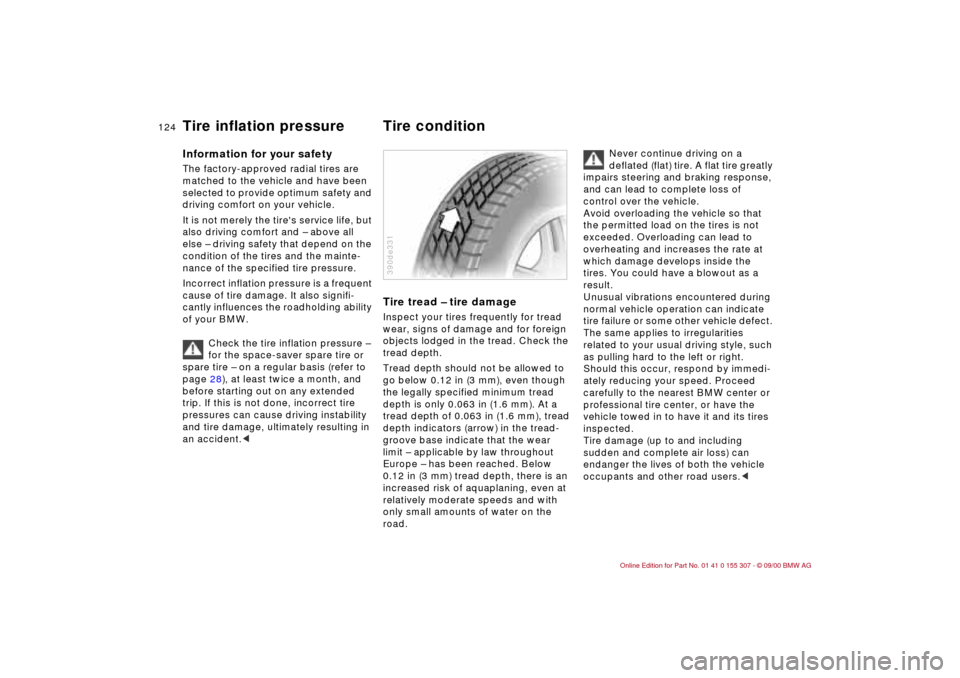
depth indicators (arrow) in the tread-
groove base indicate that the wear
limit Ð applicable by law throughout
Europe Ð has been reached. Below
0.12 in (3 mm) tread depth, there is an
increased risk of aquaplaning, even at
relatively moderate speeds and with
only small amounts of water on the
road.390de331
Never continue driving on a
deflated (flat) tire. A flat tire greatly
impairs steering and braking response,
and can lead to complete loss of
control over the vehicle.
Avoid overloading the vehicle so that
the permitted load on the tires is not
exceeded. Overloading can lead to
overheating and increases the rate at
which damage develops inside the
tires. You could have a blowout as a
result.
Unusual vibrations encountered during
normal vehicle operation can indicate
tire failure or some other vehicle defect.
The same applies to irregularities
related to your usual driving style, such
as pulling hard to the left or right.
Should this occur, respond by immedi-
ately reducing your speed. Proceed
carefully to the nearest BMW center or
professional tire center, or have the
vehicle towed in to have it and its tires
inspected.
Tire damage (up to and including
sudden and complete air loss) can
endanger the lives of both the vehicle
occupants and other road users.<
Tire inflation pressure Tire condition
Page 125 of 203

125n
IndexDataTechnologyRepairsCar careControlsOverview
To maintain good handling and vehicle
response, use only tires of a single
tread configuration from a single manu-
facturer. BMW tests and approves
wheel/tire combinations. Refer to
page 129.DOT Quality GradesTreadwear
Traction AA A B C
Temperature A B C
All passenger car tires must
conform to Federal Safety
Requirements in addition to these
grades.< Tread wearThe tread wear grade is a comparative
rating based on the wear rate of the tire
when tested under controlled condi-
tions on a specified government test
course.
For example, a tire graded 150 would
wear one and one-half (1g) times as
well on the government course as a tire
graded 100. The relative performance
of tires depends upon the actual condi-
tions of their use, however, and may
depart significantly from the norm due
to variations in driving habits, service
practices and differences in road char-
acteristics and climate.
TractionThe traction grades, from highest to
lowest, are AA, A, B, and C.
Those grades represent the tire's ability
to stop on wet pavement as measured
under controlled conditions on speci-
fied government test surfaces of asphalt
and concrete. A tire marked C may have
poor traction performance.
The traction grade assigned to
this tire is based on straight-
ahead braking traction tests, and does
not include acceleration, cornering,
hydroplaning, or peak traction charac-
teristics.< TemperatureThe temperature grades are A (the
highest), B, and C, representing the
tire's resistance to the generation of
heat and its ability to dissipate heat
when tested under controlled condi-
tions on a specified indoor laboratory
test wheel.
Sustained high temperature can cause
the material of the tire to degenerate
and reduce tire life, and excessive
temperature can lead to sudden tire
failure. The grade C corresponds to a
level of performance which all
passenger car tires must meet under
the Federal Motor Vehicle Safety Stan-
dard No. 109. Grades B and A repre-
sent higher levels of performance on
the laboratory test wheel than the
minimum required by law.
The temperature grade for this tire
is established for a tire that is
properly inflated and not overloaded.
Excessive speed, under-inflation, or
excessive loading, either separately or
in combination, can cause heat buildup
and possible tire failure.< Uniform Tire Quality Grading Quality grades can be found where
applicable on the tire sidewall between
tread shoulder and maximum section
width. For example:
Tread wear 200 Traction AA
Temperature A
Do not use retreaded tires. Driving
safety may be impaired by their
use. This is due to the possible varia-
tions in casing structures and, in some
cases, to their extreme age, which can
lead to a decrease in their durability.<
Tire replacement
Page 128 of 203

128n
Winter tiresChoosing the right tireBMW recommends winter tires (M+S
radial tires) for driving in adverse winter
road conditions. So-called all-season
tires with the M+S-identification mark
do indeed possess better winter trac-
tion than summer tires with the load
rating H, V, W, Y und ZR, but usually do
not achieve the same level of perfor-
mance as winter tires.
In the interests of safe tracking and
steering response, install radial tires
made by the same manufacturer and
with the same tread configuration on all
four wheels if you elect to mount winter
tires.
Mount only winter tires which have
been approved by BMW. Any BMW
center will be glad to provide you with
information on the best winter tires for
your particular driving conditions.
Do not exceed specified
maximum speeds
Never exceed the maximum speed
for which the tires are rated.
Unprofessional attempts by laymen to
service tires can lead to damage and
accidents.
Have this work performed by skilled
professionals only. Any BMW center
has the required technical knowledge
and the proper equipment and will be
happy to assist you.<
Tire condition, tire pressureOnce the tire wears to below 0.16 in
(4 mm), winter tires display a percep-
tible decrease in their ability to cope
with winter driving conditions, and
should be replaced in the interest of
safety.
Comply with the specified tire inflation
pressures Ð and be sure to have the
wheel and tire assemblies balanced
every time you change the tires.
StorageAlways store tires in a cool, dry place.
Store them away from light whenever
possible. Protect the tires against
contact with oil, grease and fuel.Snow chains
*
The use of narrow-link BMW snow
chains on summer or winter tires is
approved only in pairs and only on the
rear wheels. Comply with all manufac-
turer's safety precautions when
mounting the chains.
BMW 325xi: in a worst-case scenario,
i.e. if your vehicle is stuck on one side
or you cannot access one tire, then only
one chain may be attached to a rear
wheel for a short period of time.
Comply with all manufacturer's safety
precautions when mounting the chains.
Page 130 of 203
130n
Do not work on your vehicle with-
out appropriate skills. Always
switch off the engine and allow it to
cool down before working in the engine
compartment. Always disconnect the
battery before working on any electrical
systems or equipment, especially when
these are located within the engine
compartment. Comply with all applica-
ble instructions and warnings. Failure to
work in an informed, professional man-
ner when servicing components and
materials constitutes a safety hazard for
vehicle occupants and other road
users. If you are not familiar with the
guidelines, please have the operations
performed by your BMW center.
<
To unlock
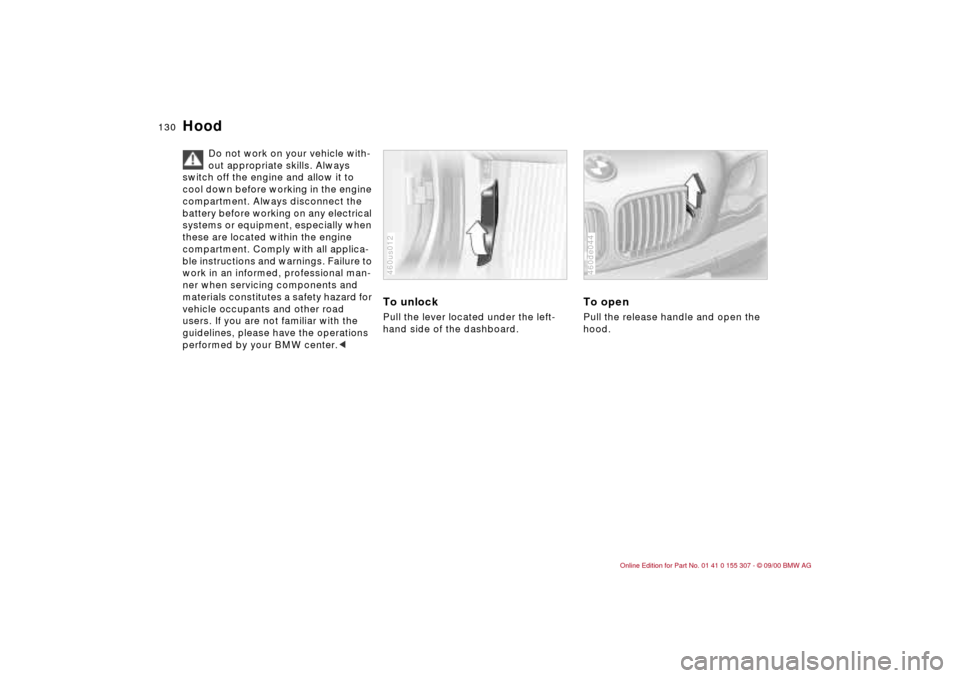
Pull the lever located under the left-
hand side of the dashboard. 460us012
To open
Pull the release handle and open the
hood.460de044
Hood
Page 135 of 203
135n
IndexDataTechnologyRepairsCar careControlsOverview
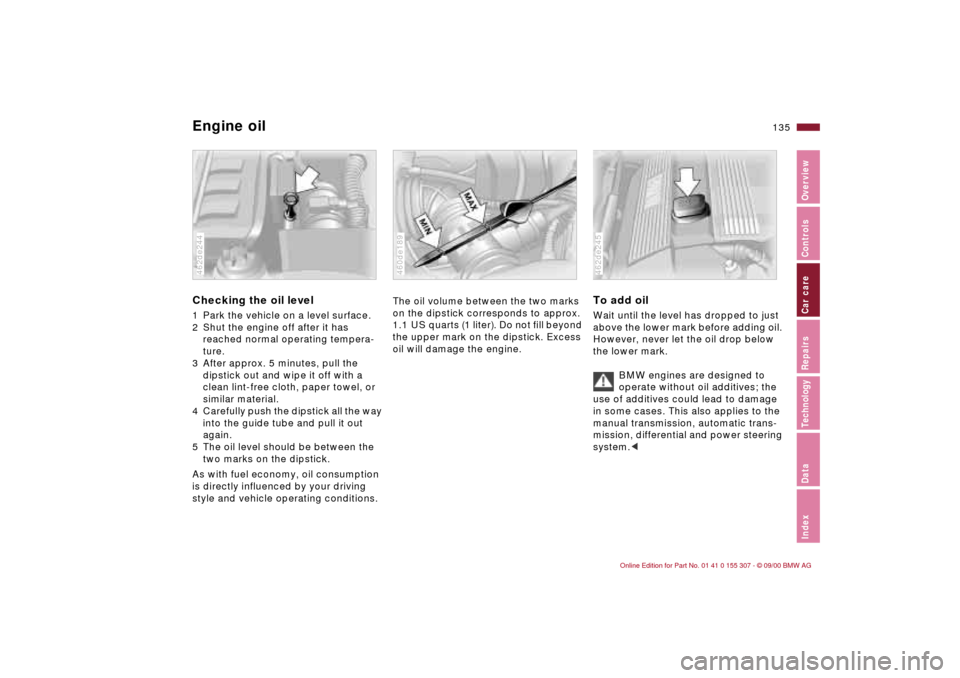
Engine oilChecking the oil level 1 Park the vehicle on a level surface.
2 Shut the engine off after it has
reached normal operating tempera-
ture.
3 After approx. 5 minutes, pull the
dipstick out and wipe it off with a
clean lint-free cloth, paper towel, or
similar material.
4 Carefully push the dipstick all the way
into the guide tube and pull it out
again.
5 The oil level should be between the
two marks on the dipstick.
As with fuel economy, oil consumption
is directly influenced by your driving
style and vehicle operating conditions.462de244
The oil volume between the two marks
on the dipstick corresponds to approx.
1.1 US quarts (1 liter). Do not fill beyond
the upper mark on the dipstick. Excess
oil will damage the engine.460de189
To add oil Wait until the level has dropped to just
above the lower mark before adding oil.
However, never let the oil drop below
the lower mark.
BMW engines are designed to
operate without oil additives; the
use of additives could lead to damage
in some cases. This also applies to the
manual transmission, automatic trans-
mission, differential and power steering
system.<462de245
Page 141 of 203

141n
IndexDataTechnologyRepairsCar careControlsOverview
Washing your vehicle You can wash your BMW at an auto-
matic car wash, even when it is new.
Brushless systems are preferable.
Wipe away tough dirt and loosen and
remove dead insects before washing
the vehicle.
In order to avoid spots, do not wash
the vehicle when the hood is warm, or
during or immediately after exposure to
strong sunlight.
When using an automatic car wash, be
sure that:
>The car wash system is suited for the
dimensions of your vehicle.
>No damage will occur to vehicles
with attached body accessories (such
as spoilers or antennas). Consult the
car wash operator if necessary.
>The wheels and tires of your vehicle
cannot be damaged by the convey-
ance devices of the car wash system.
>The vehicle is cleaned with minimum
brush pressure, and that ample water
is available for washing and rinsing.
Vehicles with rain sensor:
Clean the windshield regularly. Wax
from automatic car washes or insects
can cause malfunctions in the function
of the rain sensor.Turn the rain sensor off (refer to
page 69) when passing through an
automatic car wash. Failure to do so
could result in damage caused by unin-
tended wiper activation.<
Parts of the vehicle which are
inaccessible to the automatic washer Ð
such as door sills, door and hood
edges, etc. Ð should be cleaned by
hand.
In the winter months, it is especially
important to ensure that the vehicle is
washed on a regular basis. Large quan-
tities of dirt and road salt are difficult to
remove, and they also damage the
vehicle.
If spray wands or high-pressure
washers are used, be sure to
maintain an adequate distance between
the spray source and the vehicle's
surface. Inadequate distance and
excessive pressure can damage or
weaken the finish, making it more
susceptible to subsequent attack. In
addition, moisture could penetrate to
vehicle components, leading to long-
term damage.<
When cleaning the headlamps,
please observe the following:
do not clean by wiping with a dry cloth
(scratches). Never use abrasives or
strong solvents to clean the covers.
Remove dirt and contamination (such
as insects) by soaking with BMW Car
Shampoo and then rinsing with plenty
of water. Always use a deicer spray to
remove accumulated ice and snow Ð
never use a scraper.<
After washing the vehicle, apply
the brakes briefly to dry them.
Braking efficiency might otherwise be
reduced by the moisture and the brake
rotors could be corrode.<
Caring for your vehicle
Page 142 of 203

142n
Caring for your vehicleExterior finish To provide effective corrosion protec-
tion, multilayer paintwork is applied at
the factory. Cataphoretic immersion
priming techniques are supplemented
with special body-cavity protectants,
by applying specially-developed and
extensively tested materials.
A layer of flexible PVC is first applied
to the undercarriage. Following this,
a comprehensive undercoating treat-
ment with a wax-based protectant is
applied. Regular maintenance makes
an important contribution to maintaining
the safety and value of your vehicle.
Increasing awareness of the effects of
harmful environmental factors on vehi-
cle finishes have led paint and vehicle
manufacturers to initiate programs
designed to further improve the durabil-
ity of their finishes. Despite this, envi-
ronmental factors that occur locally or
regionally can have negative effects on
the finish of your vehicle. Use the
factors to determine the frequency and
extent of your efforts to maintain the
vehicle finish.Depending upon material and type of
impact (perforation of paint layer),
physical stresses from sand, road salt,
gravel, etc., can cause corrosion to start
extending beneath the finish, starting at
the point of impact.
Road dirt, tar spots, dead insects,
animal droppings (strong alkali effect)
and tree excretions (resins and pollen)
all contain substances capable of
causing damage when allowed to
remain on the finish of your vehicle for
any extended period of time (spots,
etching, flaking, separation in the top
coat).
In industrial areas, flue dust deposits,
lime, oily soot, precipitation containing
sulfur-dioxide (acid rain) and other envi-
ronmental pollutants will damage the
vehicle's finish unless adequate care is
provided Ð even though this is generally
limited to the outside horizontal sur-
faces.In coastal regions, high levels of
atmospheric salt and humidity promote
corrosion.
In tropical zones, temperatures of over
+105 7 (+40 6) in the shade prevail,
in addition to heavy ultraviolet radiation
and high humidity. Under those condi-
tions, light paints can reach tempera-
tures up to +175 7 (+80 6) and dark
paints up to +250 7 (+120 6).
Page 143 of 203

143n
IndexDataTechnologyRepairsCar careControlsOverview
Caring for your vehicleCaring for the vehicle finish Regular washing is a preventive
measure against long-term effects from
substances that are harmful to the
vehicle's finish, especially if you drive
your vehicle in areas with high levels of
air pollution or aggressive natural
substances (tree resins, pollen).
Nevertheless, you should immediately
remove especially aggressive
substances. Failure to do so can lead to
changes in the paint's chemical
structure or to discoloration. Gasoline
spilled during refueling, oil, grease and
brake fluid should always be cleaned
away immediately, as should bird
droppings.
Any contamination remaining on the
surface of the vehicle will be especially
conspicuous after washing. Use
cleaning fluid or alcohol with a clean
cloth or cotton pad to remove. Remove
tar spots with tar remover. After clean-
ing, the affected areas should be waxed
to ensure continued protection.
Use the cleaning and car-care
products available at your BMW
center.<
Waxing your vehicle Protect the finish using only carnauba
or synthetic-based waxes.
The best way to determine when the
finish needs to be waxed is by noting
when water stops beading on the
surface.
You can use a glass cleaner to remove
any wax or silicone that may have been
left on the windows during waxing.
Use the cleaning and car-care
products available at your BMW
center.<
Paint damageYou can touch up small areas of paint
damage with a BMW spray paint or a
BMW touchup stick.
The paint color code for your car is
provided on a sticker located on the
righthand side under the hood and on
the first page of your Service and
Warranty Information Booklet
(US models) or Warranty and Service
Guide (Canadian models).
Damage caused by flying stones,
scratches, etc., must be touched up
without delay to prevent rust from
forming.
If corrosion has started to form in an
area with paint damage, remove all rust
and clean the area. Then prime the
area with a BMW Primer Stick. Finally,
apply the finish coat. Wait a few days,
then polish the repaired area. Finish by
applying a wax preservative.
More extensive paint damage should
be repaired professionally in accor-
dance with the manufacturer's instruc-
tions. Your BMW center uses original
BMW finish materials in accordance
with approved repair procedures.
Page 144 of 203

144n
Caring for your vehicleCaring for the windowsYou can use window and glass cleaner
to clean inside window surfaces and
mirrors without smearing and streaking.
Never use polishing pastes or abrasive
(quartz) cleansers on mirror lenses.
Clean the wiper blades with soapy
water. The wiper blades should be
replaced twice a year Ð before and after
winter. This is especially important for
vehicles with a rain sensor.
Use only wiper blades approved
by BMW.<
Caring for other vehicle
components and materials Light-alloy wheels should be treated
with alloy wheel cleaner, especially
during the winter months. However, do
not use aggressive products contain-
ing acids, strong alkalis or abrasives.
Do not use steam cleaners operating at
temperatures above +140 7 (+60 6).
Follow the manufacturer's instructions.
If your vehicle has chrome parts
*, such
as the window frames and door
handles, be especially careful about
cleaning them with plenty of water and
possibly a shampoo supplement as well
after the roads have been salted.
Use a chrome polish for an additional
treatment.
Plastic components, vinyl upholstery,
headliners, lamp lenses, the clear cover
of the instrument cluster and compo-
nents with a sprayed dull black surface
can be cleaned with water and a
synthetic cleaner (if necessary). Do not
allow moisture to soak through the
seats or headliner. Never use solvents
such as lacquer thinner, heavy-duty
grease remover, fuels, or similar
substances. Rubber components should be cleaned
with water only; a rubber treatment or
silicone spray may also be applied.
Safety belts should be cleaned with a
mild soap and water solution without
being removed from the car. Never
attempt chemical or dry cleaning, as
damage to the belt fabric could result.
After cleaning, never allow the inertia
reel to retract the belts until they are
completely dry. Dirty safety belts pre-
vent the inertia reel mechanism from
retracting the strap properly, and thus
constitute a safety hazard.
Heavily soiled floor carpets and mats
*
can be cleaned with an interior cleaner.
The floor mats can be removed from
the vehicle for cleaning.
Use only a damp cloth to clean trim
panels made of real wood
* and other
parts constructed of real wood
*. Follow
up by drying with a soft cloth.
Use the cleaning and car-care
products available at your BMW
center.<