rear view mirror BMW 330XI SEDAN 2001 Owners Manual
[x] Cancel search | Manufacturer: BMW, Model Year: 2001, Model line: 330XI SEDAN, Model: BMW 330XI SEDAN 2001Pages: 211, PDF Size: 2.1 MB
Page 10 of 211

Contents
Overview
Controls and features
Cockpit16
Instrument cluster18
Indicator and warning lamps20
Multifunction steering wheel
(MFL)24
Sports steering wheel with
multifunction buttons25
Hazard warning flashers26
Warning triangle26
First-aid kit26
Refueling27
Fuel specifications28
Tire inflation pressure28
Locks and security systems:
Keys32
Electronic vehicle
immobilizer33
Central locking system34
Opening and closing Ð from the
outside34
Opening and closing Ð from the
inside38
Luggage compartment lid39
Luggage compartment41
Alarm system42
Electric power windows44
Sliding/tilt sunroof45
Adjustments:
Seats47
Seat and mirror memory50
Steering wheel51
Mirrors52
Car Memory, Key Memory53
Passenger safety systems:
Safety belts54
Airbags55
Transporting children safely59
Driving:
Steering/Ignition lock62
Starting the engine62
Switching off the engine63
Parking brake64
Manual transmission65
Automatic transmission with
Steptronic66
Turn signal indicator/Headlamp
flasher69
Wiper/Washer system69
Rear window defroster71
Cruise control72
Everything under control:
Odometer74
Tachometer74
Energy Control74
Fuel gauge75
Temperature gauge75
Service Interval Display75
Check Control76
Clock76
Computer77
Technology for safety and
convenience:
Park Distance Control (PDC)79
Automatic Stability Control plus
Traction (ASC+T)80
Dynamic Stability Control
(DSC)82
Tire Pressure Control (RDC)86
Contents
Page 12 of 211
Contents
Owner service procedures
Advanced technology
Technical data
Replacement procedures:
Onboard tool kit158
Windshield wiper blades158
Lamps and bulbs158
Changing a wheel165
Battery168
Fuses170
Microfilter/Activated-charcoal
filter171
In case of electrical
malfunction:
Fuel filler door172
Sliding/Tilt sunroof172
Assistance, giving and
receiving:
Jump-starting173
Towing the vehicle174Adaptive Transmission Control
(ATC)178
Airbags179
Automatic Stability Control plus
traction (ASC+T)/Dynamic
Stability Control (DSC)180
Radio reception181
Four-wheel drive182
Safety belt tensioner183
Interior rearview mirror with
automatic dimming
feature184
Rain sensor185
Tire Pressure Control (RDC)186
Self-diagnostics187
Xenon lamps188Engine data192
Dimensions193
Weights194
Capacities195
Electrical system196
V-belts196
Page 42 of 211
42n
Alarm system
*
The conceptThe vehicle's alarm system responds:
>When a door, the hood or the
luggage compartment lid is opened.
>To movement inside the vehicle
(interior motion sensor).
>To a change of the vehicle's tilt Ð if
someone attempts to steal the wheels
or tow the vehicle without authoriza-
tion, for example.
>If there is an interruption of battery
voltage.
The system responds to unauthorized
vehicle entry and attempted theft by
simultaneously activating the following:
>Sounding an acoustical alarm for
30 seconds.
>The hazard warning flashers are acti-
vated for approx. five minutes.
>The high beams flash on and off in
the same rhythm.
To activate and deactivate the
alarm systemWhen the vehicle is locked or unlocked
by using a key or with the remote
control, the alarm system is also simul-
taneously armed or disarmed.
The interior motion sensor and the tilt
alarm sensor are activated approx.
30 seconds after you have finished
locking the vehicle.
If the alarm system has been armed
correctly, the hazard warning flashers
flash once.
You can have a signal set as
acknowledgment for both acti-
vating and deactivating the alarm.<
You can also open the luggage
compartment lid when the system is
armed by pressing button 3 of the
remote control (refer to page 37). When
it is closed, the lid is once again
secured.
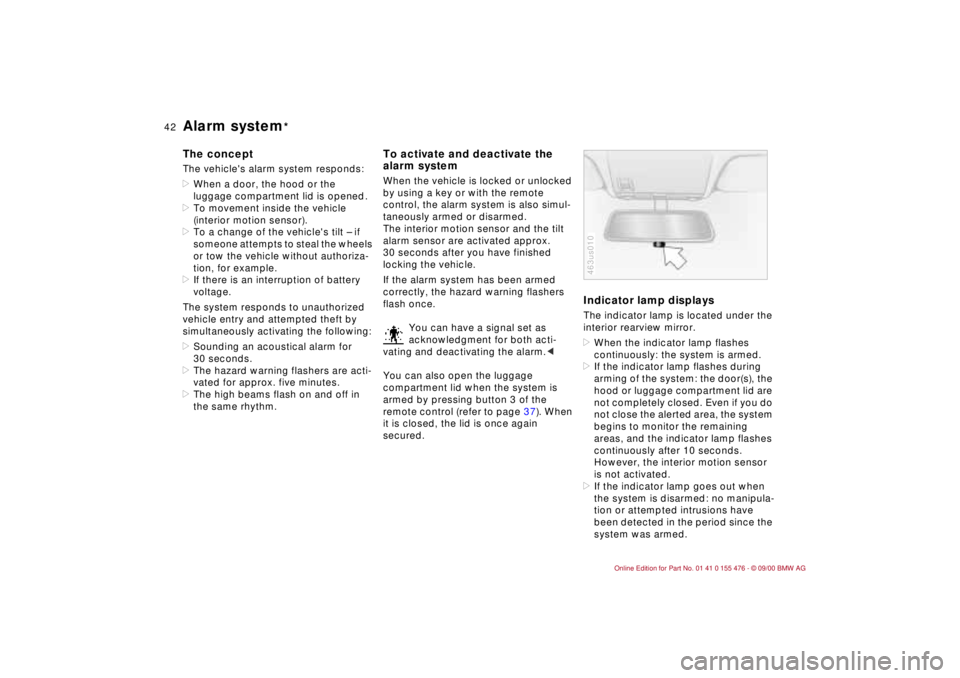
Indicator lamp displaysThe indicator lamp is located under the
interior rearview mirror.
>When the indicator lamp flashes
continuously: the system is armed.
>If the indicator lamp flashes during
arming of the system: the door(s), the
hood or luggage compartment lid are
not completely closed. Even if you do
not close the alerted area, the system
begins to monitor the remaining
areas, and the indicator lamp flashes
continuously after 10 seconds.
However, the interior motion sensor
is not activated.
>If the indicator lamp goes out when
the system is disarmed: no manipula-
tion or attempted intrusions have
been detected in the period since the
system was armed.463us010
Page 52 of 211
52n
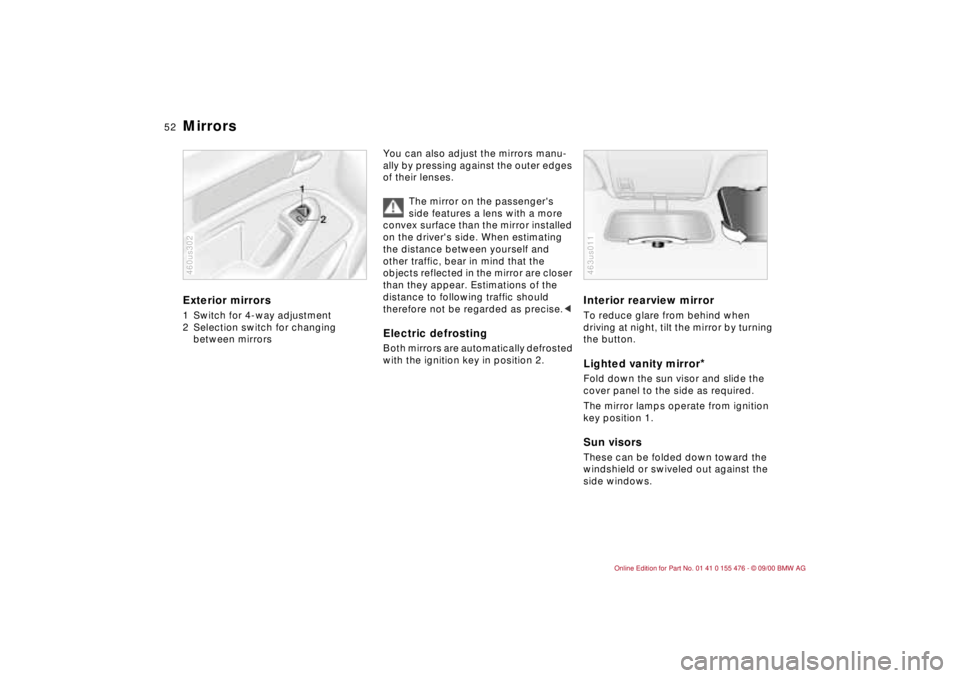
Mirrors Exterior mirrors1 Switch for 4-way adjustment
2 Selection switch for changing
between mirrors460us302
You can also adjust the mirrors manu-
ally by pressing against the outer edges
of their lenses.
The mirror on the passenger's
side features a lens with a more
convex surface than the mirror installed
on the driver's side. When estimating
the distance between yourself and
other traffic, bear in mind that the
objects reflected in the mirror are closer
than they appear. Estimations of the
distance to following traffic should
therefore not be regarded as precise.
Interior rearview mirror To reduce glare from behind when
driving at night, tilt the mirror by turning
the button.Lighted vanity mirror
*
Fold down the sun visor and slide the
cover panel to the side as required.
The mirror lamps operate from ignition
key position 1.Sun visorsThese can be folded down toward the
windshield or swiveled out against the
side windows.463us011
Page 53 of 211
53n
IndexDataTechnologyRepairsCar careControlsOverview
Mirrors Car Memory, Key Memory Interior rearview mirror with
automatic dimming feature
*
By responding to the effects of ambient
light and the glare from following traffic,
this mirror automatically dims through
an infinitely variable range.
The mirror switches to its clear,
undimmed mode whenever the trans-
mission is placed in reverse gear
(selector lever in "Reverse").
To ensure that the mirror continues to
operate properly, keep the two photo-
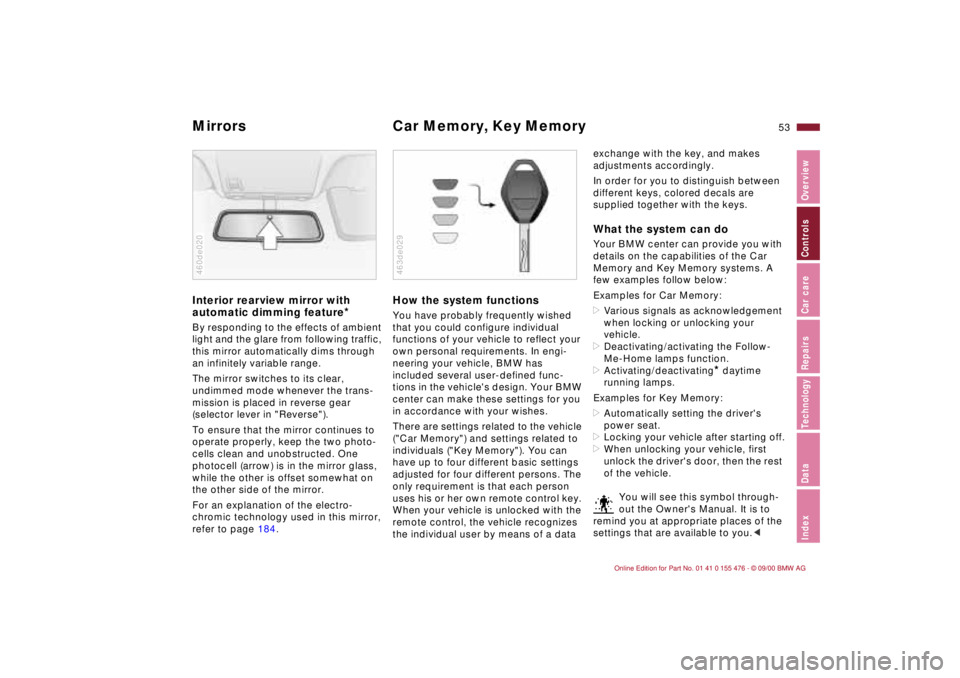
cells clean and unobstructed. One
photocell (arrow) is in the mirror glass,
while the other is offset somewhat on
the other side of the mirror.
For an explanation of the electro-
chromic technology used in this mirror,
refer to page 184.460de020
How the system functionsYou have probably frequently wished
that you could configure individual
functions of your vehicle to reflect your
own personal requirements. In engi-
neering your vehicle, BMW has
included several user-defined func-
tions in the vehicle's design. Your BMW
center can make these settings for you
in accordance with your wishes.
There are settings related to the vehicle
("Car Memory") and settings related to
individuals ("Key Memory"). You can
have up to four different basic settings
adjusted for four different persons. The
only requirement is that each person
uses his or her own remote control key.
When your vehicle is unlocked with the
remote control, the vehicle recognizes
the individual user by means of a data 463de029
exchange with the key, and makes
adjustments accordingly.
In order for you to distinguish between
different keys, colored decals are
supplied together with the keys.What the system can doYour BMW center can provide you with
details on the capabilities of the Car
Memory and Key Memory systems. A
few examples follow below:
Examples for Car Memory:
>Various signals as acknowledgement
when locking or unlocking your
vehicle.
>Deactivating/activating the Follow-
Me-Home lamps function.
>Activating/deactivating
* daytime
running lamps.
Examples for Key Memory:
>Automatically setting the driver's
power seat.
>Locking your vehicle after starting off.
>When unlocking your vehicle, first
unlock the driver's door, then the rest
of the vehicle.
You will see this symbol through-
out the Owner's Manual. It is to
remind you at appropriate places of the
settings that are available to you.<
Page 70 of 211
70n
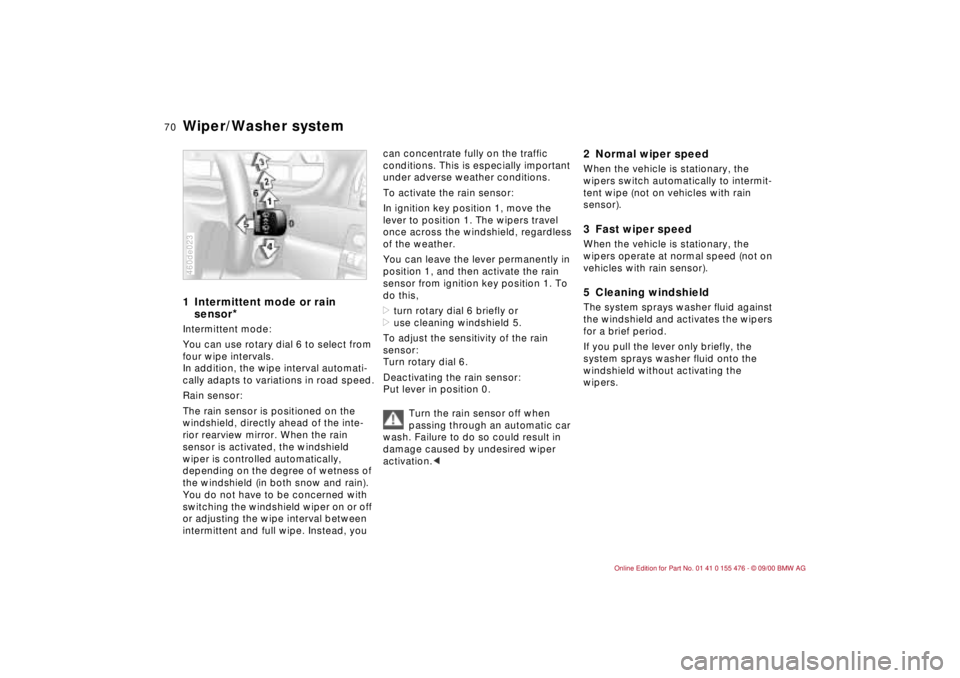
Wiper/Washer system1 Intermittent mode or rain
sensor
*
Intermittent mode:
You can use rotary dial 6 to select from
four wipe intervals.
In addition, the wipe interval automati-
cally adapts to variations in road speed.
Rain sensor:
The rain sensor is positioned on the
windshield, directly ahead of the inte-
rior rearview mirror. When the rain
sensor is activated, the windshield
wiper is controlled automatically,
depending on the degree of wetness of
the windshield (in both snow and rain).
You do not have to be concerned with
switching the windshield wiper on or off
or adjusting the wipe interval between
intermittent and full wipe. Instead, you 460de023
can concentrate fully on the traffic
conditions. This is especially important
under adverse weather conditions.
To activate the rain sensor:
In ignition key position 1, move the
lever to position 1. The wipers travel
once across the windshield, regardless
of the weather.
You can leave the lever permanently in
position 1, and then activate the rain
sensor from ignition key position 1. To
do this,
>turn rotary dial 6 briefly or
>use cleaning windshield 5.
To adjust the sensitivity of the rain
sensor:
Turn rotary dial 6.
Deactivating the rain sensor:
Put lever in position 0.
Turn the rain sensor off when
passing through an automatic car
wash. Failure to do so could result in
damage caused by undesired wiper
activation.<
2 Normal wiper speedWhen the vehicle is stationary, the
wipers switch automatically to intermit-
tent wipe (not on vehicles with rain
sensor).3 Fast wiper speedWhen the vehicle is stationary, the
wipers operate at normal speed (not on
vehicles with rain sensor).5 Cleaning windshieldThe system sprays washer fluid against
the windshield and activates the wipers
for a brief period.
If you pull the lever only briefly, the
system sprays washer fluid onto the
windshield without activating the
wipers.
Page 177 of 211
Overview
Controls and features
Operation, care
and maintenance
Owner service procedures
Technical data
Index Advanced technology
177n
IndexDataTechnologyRepairsCar careControlsOverview
Adaptive Transmission Control
(ATC)178
Airbags179
Automatic Stability Control plus
Traction (ASC+T)/Dynamic
Stability Control (DSC)180
Radio reception181
Four-wheel drive182
Safety belt tensioner183
Interior rearview mirror
with automatic dimming
feature184
Rain sensor185
Tire Pressure Control (RDC)186
Self-diagnostics187
Xenon lamps188
Technol-
Page 184 of 211
184n
Interior rearview mirror with automatic dimming feature
*
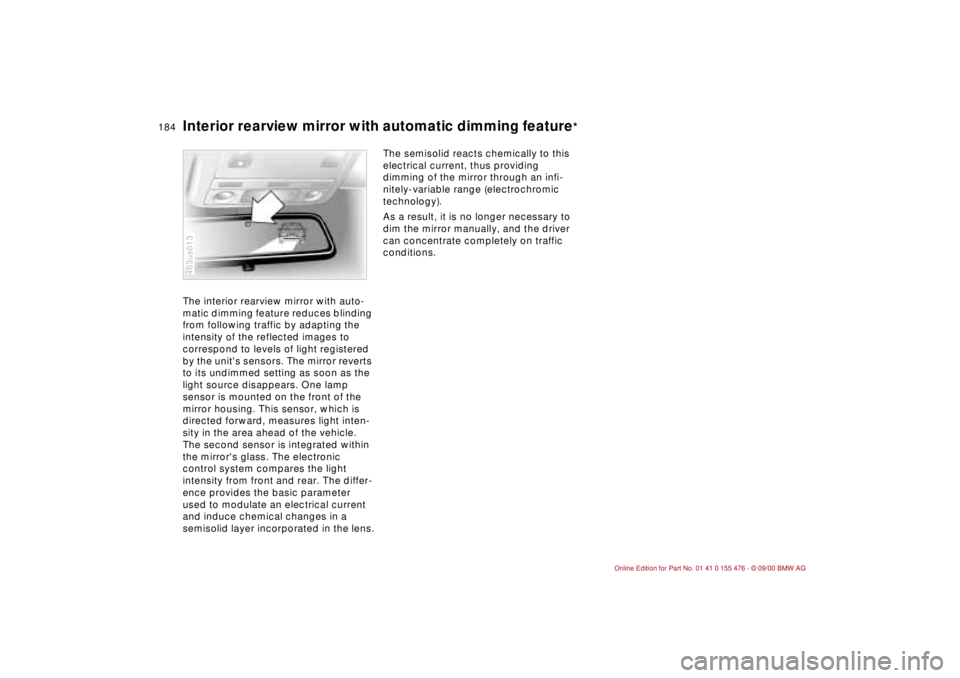
The interior rearview mirror with auto-
matic dimming feature reduces blinding
from following traffic by adapting the
intensity of the reflected images to
correspond to levels of light registered
by the unit's sensors. The mirror reverts
to its undimmed setting as soon as the
light source disappears. One lamp
sensor is mounted on the front of the
mirror housing. This sensor, which is
directed forward, measures light inten-
sity in the area ahead of the vehicle.
The second sensor is integrated within
the mirror's glass. The electronic
control system compares the light
intensity from front and rear. The differ-
ence provides the basic parameter
used to modulate an electrical current
and induce chemical changes in a
semisolid layer incorporated in the lens.463us013
The semisolid reacts chemically to this
electrical current, thus providing
dimming of the mirror through an infi-
nitely-variable range (electrochromic
technology).
As a result, it is no longer necessary to
dim the mirror manually, and the driver
can concentrate completely on traffic
conditions.
Page 200 of 211
Everything from A to ZA
ABS (Antilock Brake
System)22,118
Accessories6
Activated-charcoal
filter102,171
Adaptive Transmission
Control (ATC)66,178
Adding engine oil139
Adding washer
fluid138,195
Adjusting the backrest48
Adjusting the steering
wheel51
Adjusting the
temperature94
Adjusting the thigh support
area49
Air conditioner92
Air distribution94,100
Air nozzles92,98
Air outlets92,98
ventilation92,98
Air pressure125
Air supply94,101
Airbags21,55,151,179
Alarm system42
Antenna124
Antenna, Diversity181
Antifreeze142
radiator122 Antilock Brake System
(ABS)22,118
Anti-theft alarm system42
Aquaplaning117,125
Armrest105
ASC+T (Automatic Stability
Control plus Traction)22
Ashtray107
front107
rear108
ATC (Adaptive Transmission
Control)66,178
Attach car vacuum
cleaner108
AUC (Automatic
recirculated-air
control)101
Automatic car washes146
Automatic climate
control98
removing condensation
from the windows101
Automatic cruise control72
Automatic dimming, interior
rearview mirror53
Automatic recirculated-air
control (AUC)101
Automatic Stability Control
plus Traction (ASC+T)22
Automatic transmission with
Steptronic21,66 Automatic windshield
washer70
Average consumption78
Average speed78
Axle loads194
B
Backrest, adjusting48
Backup lamps65
bulb replacement161
Battery168,196
capacity196
charge170
discharged173
removal and
installation169
Battery charge current20
Battery safety terminal169
Belts54
Beverage holder105
Blower94,101
BMW High Performance
Synthetic Oils140
BMW sports seat49
Bore192
Brake fluid143
Brake hydraulic system20
Brake lamps, bulb
replacement161
Brake pads22
Brake system121 Brakes120
malfunctions121
Break-in procedures116
Bulb replacement158
C
California Proposition
65 Warning153
Capacities195
Car Memory53
Car radio124
refer also to the separate
Owner's Manual
Car radio
reception124,181
Car vacuum cleaner,
connecting108
Car wash146
Care
exterior147
interior150
Care of upholstery150
Care of wool velour150
Cargo loading112
Caring for the vehicle
finish148
Catalytic converter117
CBC (Cornering Brake
Control)21,119
Cellular phone107,124
refer also to the separate
Owner's Manual
A-Z
Page 201 of 211
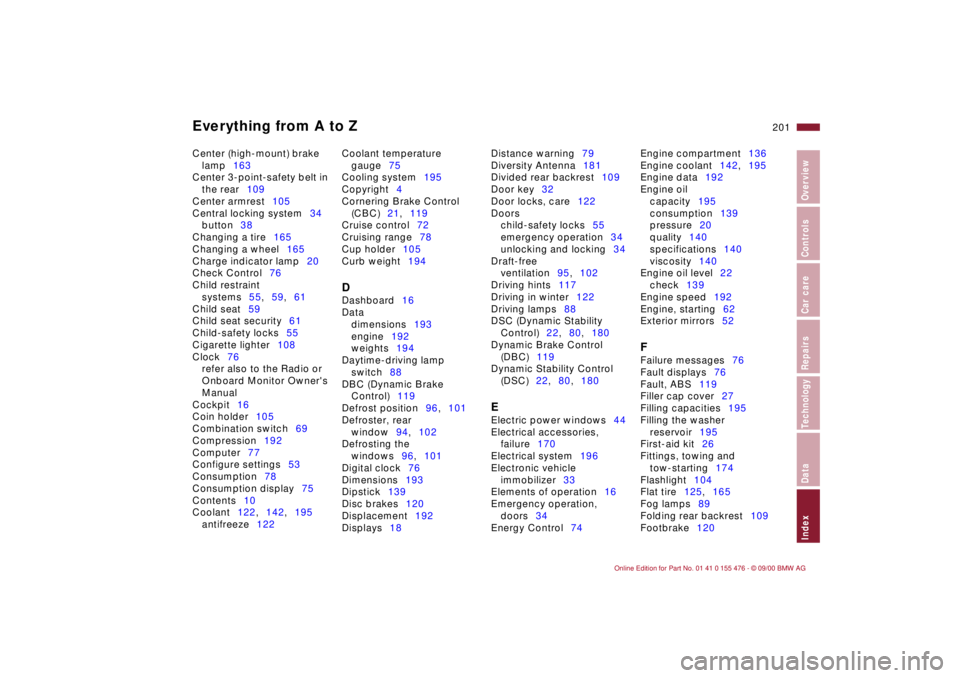
Everything from A to Z
201n
IndexDataTechnologyRepairsCar careControlsOverview
Center (high-mount) brake
lamp163
Center 3-point-safety belt in
the rear109
Center armrest105
Central locking system34
button38
Changing a tire165
Changing a wheel165
Charge indicator lamp20
Check Control76
Child restraint
systems55,59,61
Child seat59
Child seat security61
Child-safety locks55
Cigarette lighter108
Clock76
refer also to the Radio or
Onboard Monitor Owner's
Manual
Cockpit16
Coin holder105
Combination switch69
Compression192
Computer77
Configure settings53
Consumption78
Consumption display75
Contents10
Coolant122,142,195
antifreeze122 Coolant temperature
gauge75
Cooling system195
Copyright4
Cornering Brake Control
(CBC)21,119
Cruise control72
Cruising range78
Cup holder105
Curb weight194
D
Dashboard16
Data
dimensions193
engine192
weights194
Daytime-driving lamp
switch88
DBC (Dynamic Brake
Control)119
Defrost position96,101
Defroster, rear
window94,102
Defrosting the
windows96,101
Digital clock76
Dimensions193
Dipstick139
Disc brakes120
Displacement192
Displays18 Distance warning79
Diversity Antenna181
Divided rear backrest109
Door key32
Door locks, care122
Doors
child-safety locks55
emergency operation34
unlocking and locking34
Draft-free
ventilation95,102
Driving hints117
Driving in winter122
Driving lamps88
DSC (Dynamic Stability
Control)22,80,180
Dynamic Brake Control
(DBC)119
Dynamic Stability Control
(DSC)22,80,180
E
Electric power windows44
Electrical accessories,
failure170
Electrical system196
Electronic vehicle
immobilizer33
Elements of operation16
Emergency operation,
doors34
Energy Control74 Engine compartment136
Engine coolant142,195
Engine data192
Engine oil
capacity195
consumption139
pressure20
quality140
specifications140
viscosity140
Engine oil level22
check139
Engine speed192
Engine, starting62
Exterior mirrors52
F
Failure messages76
Fault displays76
Fault, ABS119
Filler cap cover27
Filling capacities195
Filling the washer
reservoir195
First-aid kit26
Fittings, towing and
tow-starting174
Flashlight104
Flat tire125,165
Fog lamps89
Folding rear backrest109
Footbrake120